Construction Method and Application
 Diaphragm Wall:
Diaphragm wall is an underground wall constructed from
the ground level to support excavation sides from lateral
earth pressure and water pressure and to provide water
tightness to the underground structure.
Features:
1. As a cut-off provision to support deep excavation.
2. As a retaining wall.
3. It is also used as a permanent basement walls for
facilitating Top-down construction method.
4. Typical wall thickness varies between 0.6 to 1.5m
5. Panel width varies from 2.5m to about 6.5m or even more
depending on various conditions.
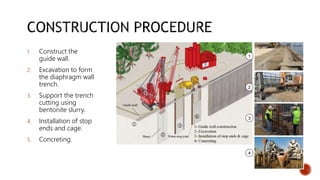
1. Construct the
guide wall.
2. Excavation to form
the diaphragm wall
trench.
3. Support the trench
cutting using
bentonite slurry.
4. Installation of stop
ends and cage.
5. Concreting.
Trench Cutter Mechanical Hydraulic Grab Reverse Mud Circulation Rig
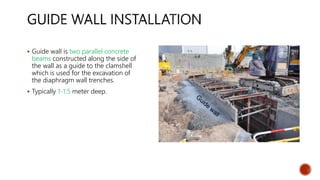
 Guide wall is two parallel concrete
beams constructed along the side of
the wall as a guide to the clamshell
which is used for the excavation of
the diaphragm wall trenches.
 Typically 1-1.5 meter deep.
 Trench excavation
 In normal soil condition excavation is done
using a clamshell or grab suspended by
cables to a crane
 Excavation support
 The sides inside the trench cut can collapse
easily.
 Bentonite slurry is used to protect the sides
of soil.
 Bentonite is a specially selected fine clay,
when added to water, forms an impervious
cakelike slurry with very large viscosity.
 The slurry will produce a great lateral
pressure sufficient enough to retain the
vertical soil.
 Reinforcement Cage
 Reinforcement is inserted in the form of a
steel cage, but may be required to lap a few
sections in order to reach the required length.
 Concreting
 Placing of concrete is done using tremie
pipes to avoid the segregation of concrete.
 As Concrete being poured down, bentonite
will be displaced due to its lower density than
concrete.
 Bentonite is then collected and reused.
Concreting
 The process of constructing the wall is relatively quiet &
has small vibration.
 Can be constructed to a great depth.
 The wall provides temporary supports during
excavation hence expensive steelwork is eliminated.
 Good water cutoff. No dewatering is necessary.
 Serves both as external work for the basement and
foundation for superstructure.
 Suitable for deep basement. It can be up to 50m depth.
 Commonly used in congested areas.
 Installed in close proximity to existing structure.
 Suitable for unstable soil profiles below water table.
 Limited construction time.
 Designable to carry vertical loads.
 Minimize the settlement of adjacent building.
 The cost is higher than conventional
methods.
 Special Equipment is necessary.
 Larger space is required at site for the
special equipment.
 Diaphragm Wall
 Diaphragm Wall

Diaphragm Wall

  • 1.
  • 2.
     Diaphragm Wall: Diaphragmwall is an underground wall constructed from the ground level to support excavation sides from lateral earth pressure and water pressure and to provide water tightness to the underground structure. Features: 1. As a cut-off provision to support deep excavation. 2. As a retaining wall. 3. It is also used as a permanent basement walls for facilitating Top-down construction method. 4. Typical wall thickness varies between 0.6 to 1.5m 5. Panel width varies from 2.5m to about 6.5m or even more depending on various conditions.
  • 3.
    1. Construct the guidewall. 2. Excavation to form the diaphragm wall trench. 3. Support the trench cutting using bentonite slurry. 4. Installation of stop ends and cage. 5. Concreting.
  • 4.
    Trench Cutter MechanicalHydraulic Grab Reverse Mud Circulation Rig
  • 5.
     Guide wallis two parallel concrete beams constructed along the side of the wall as a guide to the clamshell which is used for the excavation of the diaphragm wall trenches.  Typically 1-1.5 meter deep.
  • 6.
     Trench excavation In normal soil condition excavation is done using a clamshell or grab suspended by cables to a crane  Excavation support  The sides inside the trench cut can collapse easily.  Bentonite slurry is used to protect the sides of soil.  Bentonite is a specially selected fine clay, when added to water, forms an impervious cakelike slurry with very large viscosity.  The slurry will produce a great lateral pressure sufficient enough to retain the vertical soil.
  • 7.
     Reinforcement Cage Reinforcement is inserted in the form of a steel cage, but may be required to lap a few sections in order to reach the required length.  Concreting  Placing of concrete is done using tremie pipes to avoid the segregation of concrete.  As Concrete being poured down, bentonite will be displaced due to its lower density than concrete.  Bentonite is then collected and reused.
  • 8.
  • 10.
     The processof constructing the wall is relatively quiet & has small vibration.  Can be constructed to a great depth.  The wall provides temporary supports during excavation hence expensive steelwork is eliminated.  Good water cutoff. No dewatering is necessary.  Serves both as external work for the basement and foundation for superstructure.  Suitable for deep basement. It can be up to 50m depth.  Commonly used in congested areas.  Installed in close proximity to existing structure.  Suitable for unstable soil profiles below water table.  Limited construction time.  Designable to carry vertical loads.  Minimize the settlement of adjacent building.
  • 11.
     The costis higher than conventional methods.  Special Equipment is necessary.  Larger space is required at site for the special equipment.