Stability of slopes
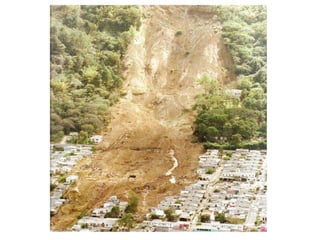
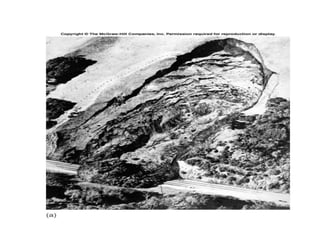
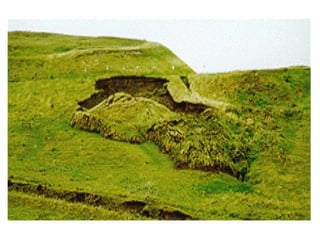
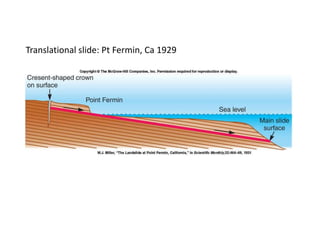
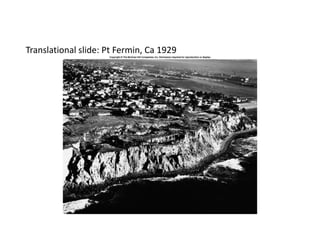
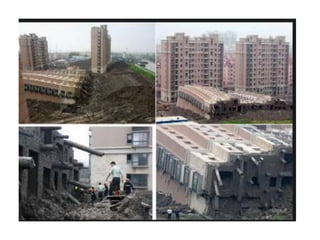
Translational slide: Pt Fermin, Ca 1929
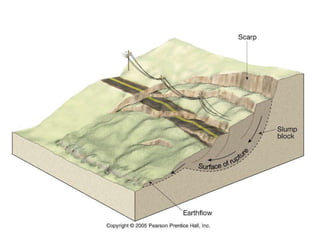
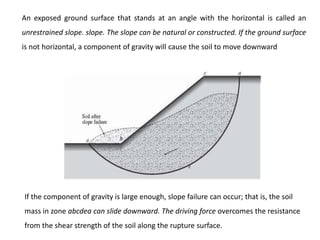
An exposed ground surface that stands at an angle with the horizontal is called an
unrestrained slope. slope. The slope can be natural or constructed. If the ground surface
is not horizontal, a component of gravity will cause the soil to move downward
If the component of gravity is large enough, slope failure can occur; that is, the soil
mass in zone abcdea can slide downward. The driving force overcomes the resistance
from the shear strength of the soil along the rupture surface.
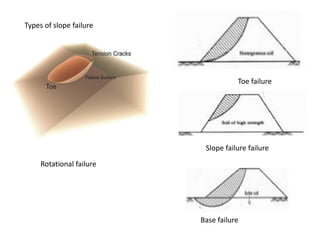
Types of slope failure
Rotational failure
Toe failure
Slope failure failure
Base failure
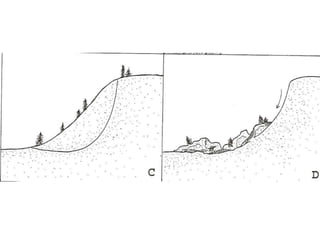
This type of failure occurs by rotation along a slip surface by downward and
outward movement of the soil mass. The slip surface is generally circular and soil
is generally homogeneous.
1) Toe failure:- the slope failure occurs when the failure surface intersect
the slope at toe.
2) Base failure:- the base failure occur when the failure surface passes
through the base of the slope
3) Slope failure:- when failure surface passes through the slope surface.
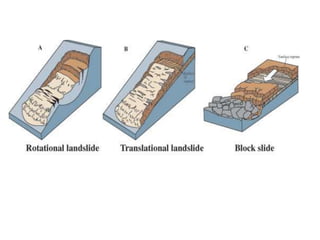
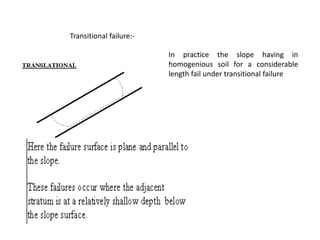
Transitional failure:-
In practice the slope having in
homogenious soil for a considerable
length fail under transitional failure
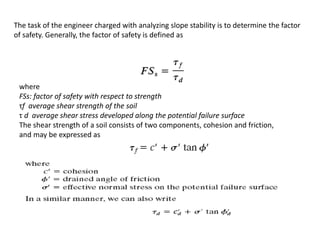
The task of the engineer charged with analyzing slope stability is to determine the factor
of safety. Generally, the factor of safety is defined as
where
FSs: factor of safety with respect to strength
τf average shear strength of the soil
τ d average shear stress developed along the potential failure surface
The shear strength of a soil consists of two components, cohesion and friction,
and may be expressed as
Where ϕd and cd are the shear parameters along the developed potential failure
surface. By all above equations,
Fc and Fϕ together results in to the Fs
Now we can introduce some other aspects of the factor of safety—that is, the factor of
safety with respect to cohesion, FSc, and the factor of safety with respect to
friction, FS. They are defined as follows:
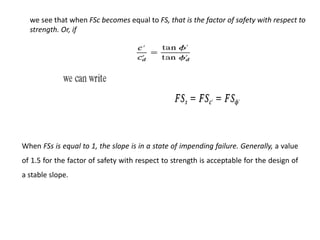
we see that when FSc becomes equal to FS, that is the factor of safety with respect to
strength. Or, if
When FSs is equal to 1, the slope is in a state of impending failure. Generally, a value
of 1.5 for the factor of safety with respect to strength is acceptable for the design of
a stable slope.
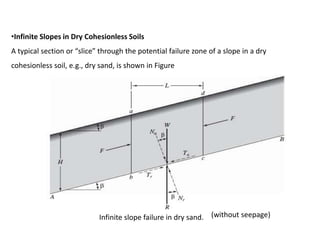
•Infinite Slopes in Dry Cohesionless Soils
A typical section or “slice” through the potential failure zone of a slope in a dry
cohesionless soil, e.g., dry sand, is shown in Figure
Infinite slope failure in dry sand. (without seepage)
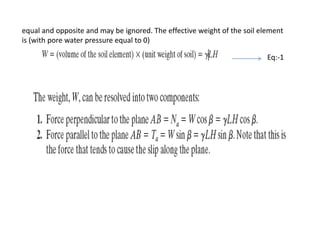
equal and opposite and may be ignored. The effective weight of the soil element
is (with pore water pressure equal to 0)
Eq:-1
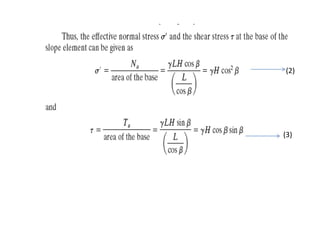
(2) (2)
(3)
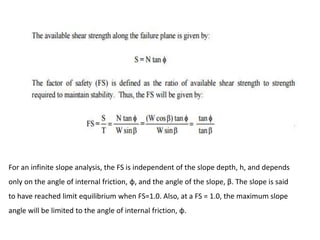
For an infinite slope analysis, the FS is independent of the slope depth, h, and depends
only on the angle of internal friction, φ, and the angle of the slope, β. The slope is said
to have reached limit equilibrium when FS=1.0. Also, at a FS = 1.0, the maximum slope
angle will be limited to the angle of internal friction, φ.
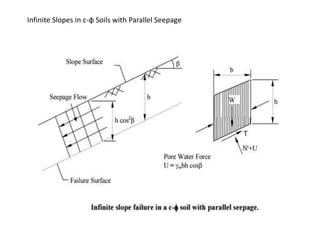
Infinite Slopes in c-φ Soils with Parallel Seepage
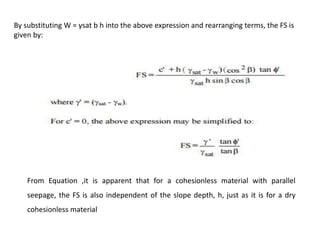
By substituting W = γsat b h into the above expression and rearranging terms, the FS is
given by:
From Equation ,it is apparent that for a cohesionless material with parallel
seepage, the FS is also independent of the slope depth, h, just as it is for a dry
cohesionless material
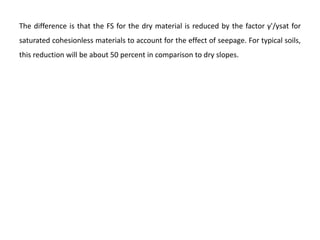
The difference is that the FS for the dry material is reduced by the factor γ'/γsat for
saturated cohesionless materials to account for the effect of seepage. For typical soils,
this reduction will be about 50 percent in comparison to dry slopes.
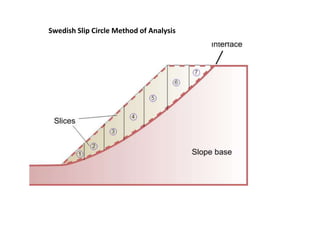
Swedish Slip Circle Method of Analysis
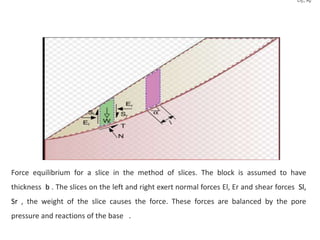
Force equilibrium for a slice in the method of slices. The block is assumed to have
thickness b . The slices on the left and right exert normal forces El, Er and shear forces Sl,
Sr , the weight of the slice causes the force. These forces are balanced by the pore
pressure and reactions of the base .
•In the method of slices,, the sliding mass above the failure surface is divided into a
number of slices. The forces acting on each slice are obtained by considering the
mechanical (force and moment) equilibrium for the slices.
•Each slice is considered on its own and interactions between slices are neglected
because the resultant forces are parallel to the base of each slice.
•However, Newton's third law is not satisfied by this method because, in general, the
resultants on the left and right of a slice do not have the same magnitude and are not
collinear
For a c-φ soils the undrained strength envelope shows both c and φ values. The total
stress analysis can be adopted. The procedure is follows
1. Draw the slope to scale
2. 2. A trail slip circle such as AB with radius ‘r’ is drawn from the center of rotation
O.
3. Divide the soil mass above the slip surface into convenient number of slices (more
than 5 is preferred)
4. Determine the area of each slice A1, A2, -------, An A = width of the slice X mid
height = b X Z
5. Determine the total weight W including external load if any as W = γ b Z = γ A
Where, γ = unit weight b = width of slice Z = height of slice.
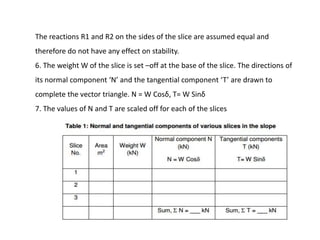
The reactions R1 and R2 on the sides of the slice are assumed equal and
therefore do not have any effect on stability.
6. The weight W of the slice is set –off at the base of the slice. The directions of
its normal component ‘N’ and the tangential component ‘T’ are drawn to
complete the vector triangle. N = W Cosδ, T= W Sinδ
7. The values of N and T are scaled off for each of the slices
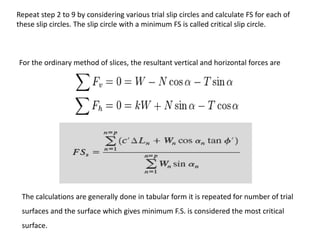
For the ordinary method of slices, the resultant vertical and horizontal forces are
The calculations are generally done in tabular form it is repeated for number of trial
surfaces and the surface which gives minimum F.S. is considered the most critical
surface.
Repeat step 2 to 9 by considering various trial slip circles and calculate FS for each of
these slip circles. The slip circle with a minimum FS is called critical slip circle.
•Improvement of stability of slopes:-
•The slopes that are prone to failure and collapse by sliding can be enhanced and made
serviceable, safe and secure. For this numerous efficient and reliant methods are used
to stabilize the slopes. The methods usually engage one or more of the following
measures, which either reduce the mass that are vulnerable to cause the sliding and
collapse or successfully helps improving the shear strength of the soil in the failure
zone.
1) Slope flattening reduces the weight of the mass tending to slide/collapse. It can be
employed wherever possible.
2) Proving a berm beneath the toe of the slope enhances the resistance to movement.
It is especially useful when there is a possibility of a base line.
4) Densification by the using explosives, vibroflotation or terra probe aids in increasing
the shear strength of cohesionless soils and hence increases stability.
5) Consolidation by surcharging, electro-osmosis or various other reliable effective
methods help in enhancing the stability of slopes in cohesive soils.
6) Grouting and injection of cement concrete mixture along with other compounds into
specific zones help in increasing the stability of slopes.
3) Drainage helps in reducing the seepage forces and thus enhances the stability of
slopes. The zone of subsurface water is lowered and infiltration of the surface water
is prevented.
7)Sheet piles and retaining wall structures can be installed to provide lateral support
and to increase the stability.
8)Stabilization of the soil helps in enhancing the stability of slopes.
9) Other relative inexpensive methods like for slope flattening and drainage control
may be usually applied
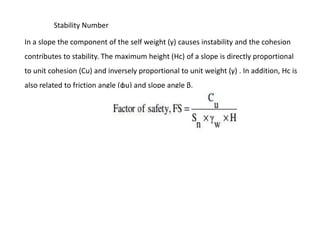
In a slope the component of the self weight (γ) causes instability and the cohesion
contributes to stability. The maximum height (Hc) of a slope is directly proportional
to unit cohesion (Cu) and inversely proportional to unit weight (γ) . In addition, Hc is
also related to friction angle (φu) and slope angle β.
Stability Number
Stability of upstream slope during sudden drawdown : For the upstream
slope of an earth dam the most critical condition occurs when the reservoir is
suddenly emptied without allowing appreciable drainage from the saturated soil
mass. This condition is known as sudden drawdown.
When sudden drawdown take place, the weight of water which is still present in the
soil tends to cause sliding of the wedge, as the water pressure which was acting on
the u/s slope to balance this weight has been suddenly removed.
According to another interpretation, the shearing resistance of the soil is
considerably reduced due to pore pressure existing in the soil, whereas the
disturbing force due to saturated unit weight of the soil remains the same.
To take into account this fact in stability analysis the pore water pressures determined
along the portion of the slip surface which lies below the water surface obtaining the
net effective resisting forces and the actuating (disturbing) forces are calculated by
taking the saturated weight of soil mass which lies below water surface, this case also
the pore water pressure may be determine by drawing the flownet .

stability of slopes final.pptx

  • 1.
  • 11.
    Translational slide: PtFermin, Ca 1929
  • 12.
    Translational slide: PtFermin, Ca 1929
  • 14.
    An exposed groundsurface that stands at an angle with the horizontal is called an unrestrained slope. slope. The slope can be natural or constructed. If the ground surface is not horizontal, a component of gravity will cause the soil to move downward If the component of gravity is large enough, slope failure can occur; that is, the soil mass in zone abcdea can slide downward. The driving force overcomes the resistance from the shear strength of the soil along the rupture surface.
  • 15.
    Types of slopefailure Rotational failure Toe failure Slope failure failure Base failure
  • 17.
    This type offailure occurs by rotation along a slip surface by downward and outward movement of the soil mass. The slip surface is generally circular and soil is generally homogeneous. 1) Toe failure:- the slope failure occurs when the failure surface intersect the slope at toe. 2) Base failure:- the base failure occur when the failure surface passes through the base of the slope 3) Slope failure:- when failure surface passes through the slope surface.
  • 18.
    Transitional failure:- In practicethe slope having in homogenious soil for a considerable length fail under transitional failure
  • 19.
    The task ofthe engineer charged with analyzing slope stability is to determine the factor of safety. Generally, the factor of safety is defined as where FSs: factor of safety with respect to strength τf average shear strength of the soil τ d average shear stress developed along the potential failure surface The shear strength of a soil consists of two components, cohesion and friction, and may be expressed as
  • 20.
    Where ϕd andcd are the shear parameters along the developed potential failure surface. By all above equations, Fc and Fϕ together results in to the Fs Now we can introduce some other aspects of the factor of safety—that is, the factor of safety with respect to cohesion, FSc, and the factor of safety with respect to friction, FS. They are defined as follows:
  • 21.
    we see thatwhen FSc becomes equal to FS, that is the factor of safety with respect to strength. Or, if When FSs is equal to 1, the slope is in a state of impending failure. Generally, a value of 1.5 for the factor of safety with respect to strength is acceptable for the design of a stable slope.
  • 22.
    •Infinite Slopes inDry Cohesionless Soils A typical section or “slice” through the potential failure zone of a slope in a dry cohesionless soil, e.g., dry sand, is shown in Figure Infinite slope failure in dry sand. (without seepage)
  • 23.
    equal and oppositeand may be ignored. The effective weight of the soil element is (with pore water pressure equal to 0) Eq:-1
  • 24.
  • 25.
    For an infiniteslope analysis, the FS is independent of the slope depth, h, and depends only on the angle of internal friction, φ, and the angle of the slope, β. The slope is said to have reached limit equilibrium when FS=1.0. Also, at a FS = 1.0, the maximum slope angle will be limited to the angle of internal friction, φ.
  • 26.
    Infinite Slopes inc-φ Soils with Parallel Seepage
  • 28.
    By substituting W= γsat b h into the above expression and rearranging terms, the FS is given by: From Equation ,it is apparent that for a cohesionless material with parallel seepage, the FS is also independent of the slope depth, h, just as it is for a dry cohesionless material
  • 29.
    The difference isthat the FS for the dry material is reduced by the factor γ'/γsat for saturated cohesionless materials to account for the effect of seepage. For typical soils, this reduction will be about 50 percent in comparison to dry slopes.
  • 30.
    Swedish Slip CircleMethod of Analysis
  • 31.
    Force equilibrium fora slice in the method of slices. The block is assumed to have thickness b . The slices on the left and right exert normal forces El, Er and shear forces Sl, Sr , the weight of the slice causes the force. These forces are balanced by the pore pressure and reactions of the base .
  • 32.
    •In the methodof slices,, the sliding mass above the failure surface is divided into a number of slices. The forces acting on each slice are obtained by considering the mechanical (force and moment) equilibrium for the slices. •Each slice is considered on its own and interactions between slices are neglected because the resultant forces are parallel to the base of each slice. •However, Newton's third law is not satisfied by this method because, in general, the resultants on the left and right of a slice do not have the same magnitude and are not collinear
  • 33.
    For a c-φsoils the undrained strength envelope shows both c and φ values. The total stress analysis can be adopted. The procedure is follows 1. Draw the slope to scale 2. 2. A trail slip circle such as AB with radius ‘r’ is drawn from the center of rotation O. 3. Divide the soil mass above the slip surface into convenient number of slices (more than 5 is preferred) 4. Determine the area of each slice A1, A2, -------, An A = width of the slice X mid height = b X Z 5. Determine the total weight W including external load if any as W = γ b Z = γ A Where, γ = unit weight b = width of slice Z = height of slice.
  • 34.
    The reactions R1and R2 on the sides of the slice are assumed equal and therefore do not have any effect on stability. 6. The weight W of the slice is set –off at the base of the slice. The directions of its normal component ‘N’ and the tangential component ‘T’ are drawn to complete the vector triangle. N = W Cosδ, T= W Sinδ 7. The values of N and T are scaled off for each of the slices
  • 35.
    For the ordinarymethod of slices, the resultant vertical and horizontal forces are The calculations are generally done in tabular form it is repeated for number of trial surfaces and the surface which gives minimum F.S. is considered the most critical surface. Repeat step 2 to 9 by considering various trial slip circles and calculate FS for each of these slip circles. The slip circle with a minimum FS is called critical slip circle.
  • 36.
    •Improvement of stabilityof slopes:- •The slopes that are prone to failure and collapse by sliding can be enhanced and made serviceable, safe and secure. For this numerous efficient and reliant methods are used to stabilize the slopes. The methods usually engage one or more of the following measures, which either reduce the mass that are vulnerable to cause the sliding and collapse or successfully helps improving the shear strength of the soil in the failure zone. 1) Slope flattening reduces the weight of the mass tending to slide/collapse. It can be employed wherever possible. 2) Proving a berm beneath the toe of the slope enhances the resistance to movement. It is especially useful when there is a possibility of a base line.
  • 37.
    4) Densification bythe using explosives, vibroflotation or terra probe aids in increasing the shear strength of cohesionless soils and hence increases stability. 5) Consolidation by surcharging, electro-osmosis or various other reliable effective methods help in enhancing the stability of slopes in cohesive soils. 6) Grouting and injection of cement concrete mixture along with other compounds into specific zones help in increasing the stability of slopes. 3) Drainage helps in reducing the seepage forces and thus enhances the stability of slopes. The zone of subsurface water is lowered and infiltration of the surface water is prevented.
  • 38.
    7)Sheet piles andretaining wall structures can be installed to provide lateral support and to increase the stability. 8)Stabilization of the soil helps in enhancing the stability of slopes. 9) Other relative inexpensive methods like for slope flattening and drainage control may be usually applied
  • 39.
    In a slopethe component of the self weight (γ) causes instability and the cohesion contributes to stability. The maximum height (Hc) of a slope is directly proportional to unit cohesion (Cu) and inversely proportional to unit weight (γ) . In addition, Hc is also related to friction angle (φu) and slope angle β. Stability Number
  • 40.
    Stability of upstreamslope during sudden drawdown : For the upstream slope of an earth dam the most critical condition occurs when the reservoir is suddenly emptied without allowing appreciable drainage from the saturated soil mass. This condition is known as sudden drawdown. When sudden drawdown take place, the weight of water which is still present in the soil tends to cause sliding of the wedge, as the water pressure which was acting on the u/s slope to balance this weight has been suddenly removed. According to another interpretation, the shearing resistance of the soil is considerably reduced due to pore pressure existing in the soil, whereas the disturbing force due to saturated unit weight of the soil remains the same.
  • 41.
    To take intoaccount this fact in stability analysis the pore water pressures determined along the portion of the slip surface which lies below the water surface obtaining the net effective resisting forces and the actuating (disturbing) forces are calculated by taking the saturated weight of soil mass which lies below water surface, this case also the pore water pressure may be determine by drawing the flownet .