Basic Roof and
Ceiling Fr aming
 
EAVES FINISHES
EAVES FINISHES
EAVES FINISHES
  There are a number of ways to frame and
   finish eaves.
  Types include simple boxed level eaves, lined
   on-the-rake eaves, eaves lined on top of rafters
   or combinations of these.
  The level framing members, running between
   the wall and fascia, are referred to as soffit
   bearers or eaves sprockets.
  They are spaced at 450 to 600 mm centres to
   provide fixing for the eaves soffit lining, which
   may be timber boarding or more commonly 4.5
   mm thick fibre cement sheeting joined with a
   PVC
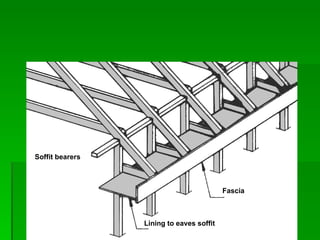
Soffit bearers


                                          Fascia


                 Lining to eaves soffit
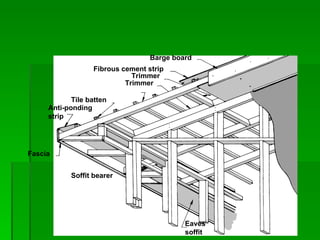
Barge board
                  Fibrous cement strip
                             Trimmer
                           Trimmer

            Tile batten
     Anti-ponding
     strip


Fascia


            Soffit bearer


                                           Eaves
                                           soffit
Eaves soffit clearance


  Where timber eaves framing passes over face
   brick walls, as in brick veneer construction, an
   allowance for frame shrinkage must be
   provided.
  If no clearance is allowed, the top course/s of
   brickwork may be cracked or even dislodged
   when the timber shrinks causing the eaves
   framing to drop, which will allow the roof load
   to bear directly onto the brickwork.
Eaves soffit clearance

  When unseasoned, or partly seasoned, timber is used
   it will continue to dry out causing a reduction in its
   section size.
  Timber shrinks in width, thickness and to a much lesser
   extent, its length. Unseasoned timber with a width of
   more than 175 mm will shrink excessively, i.e. up to 10
   mm for every additional 25 mm of width in some cases.
  This shrinkage usually occurs in the width of bearers,
   joists, lintels and in the thickness of the top and bottom
   plates. (Stud length is relatively unaffected)
  Therefore, a clearance of 12 mm minimum is to be
   allowed between the underside of the eaves soffit
   bearer and the top of the brickwork.
Eaves soffit clearance

  Note: No clearance is required for cavity-
   brick construction or where timber frame
   construction is used on its own or when
   the timber framing is fully
Eaves soffit clearance


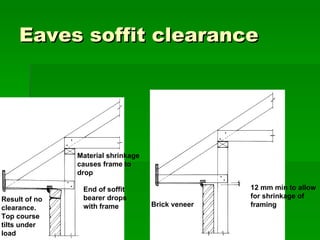
               Material shrinkage
               causes frame to
               drop

                End of soffit                      12 mm min to allow
Result of no    bearer drops                       for shrinkage of
clearance.      with frame          Brick veneer   framing
Top course
tilts under
load
QUESTIONS

Eave finishes

  • 1.
    Basic Roof and CeilingFr aming   EAVES FINISHES
  • 2.
  • 3.
    EAVES FINISHES There are a number of ways to frame and finish eaves.  Types include simple boxed level eaves, lined on-the-rake eaves, eaves lined on top of rafters or combinations of these.  The level framing members, running between the wall and fascia, are referred to as soffit bearers or eaves sprockets.  They are spaced at 450 to 600 mm centres to provide fixing for the eaves soffit lining, which may be timber boarding or more commonly 4.5 mm thick fibre cement sheeting joined with a PVC
  • 4.
    Soffit bearers Fascia Lining to eaves soffit
  • 5.
    Barge board Fibrous cement strip Trimmer Trimmer Tile batten Anti-ponding strip Fascia Soffit bearer Eaves soffit
  • 7.
    Eaves soffit clearance  Where timber eaves framing passes over face brick walls, as in brick veneer construction, an allowance for frame shrinkage must be provided.  If no clearance is allowed, the top course/s of brickwork may be cracked or even dislodged when the timber shrinks causing the eaves framing to drop, which will allow the roof load to bear directly onto the brickwork.
  • 8.
    Eaves soffit clearance  When unseasoned, or partly seasoned, timber is used it will continue to dry out causing a reduction in its section size.  Timber shrinks in width, thickness and to a much lesser extent, its length. Unseasoned timber with a width of more than 175 mm will shrink excessively, i.e. up to 10 mm for every additional 25 mm of width in some cases.  This shrinkage usually occurs in the width of bearers, joists, lintels and in the thickness of the top and bottom plates. (Stud length is relatively unaffected)  Therefore, a clearance of 12 mm minimum is to be allowed between the underside of the eaves soffit bearer and the top of the brickwork.
  • 9.
    Eaves soffit clearance  Note: No clearance is required for cavity- brick construction or where timber frame construction is used on its own or when the timber framing is fully
  • 10.
    Eaves soffit clearance Material shrinkage causes frame to drop End of soffit 12 mm min to allow Result of no bearer drops for shrinkage of clearance. with frame Brick veneer framing Top course tilts under load
  • 11.