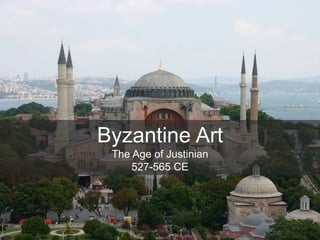

Byzantine Art
The Age of Justinian
527-565 CE
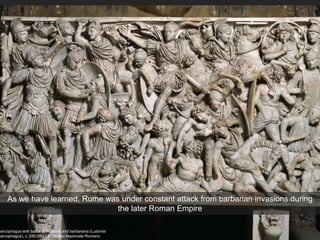
Sarcophagus with battle of Romans and barbarians, c. 250-260 CE, Museio
As we have learned, Rome was under constant attack from barbarian invasions during
the later Roman Empire
Sarcophagus with battle of Romans and barbarians (Ludovisi
Sarcophagus), c. 250-260 CE, Museo Nazionale Romano
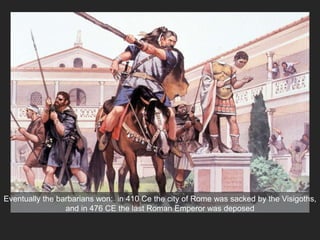
Eventually the barbarians won: in 410 Ce the city of Rome was sacked by the Visigoths,
and in 476 CE the last Roman Emperor was deposed
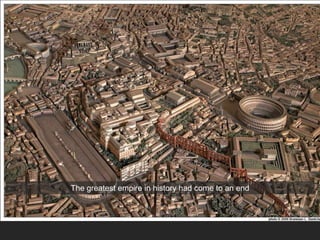
The greatest empire in history had come to an end
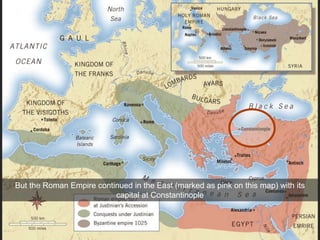
But the Roman Empire continued in the East (marked as pink on this map) with its
capital at Constantinople
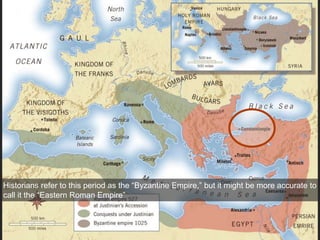
Historians refer to this period as the “Byzantine Empire,” but it might be more accurate to
call it the “Eastern Roman Empire”
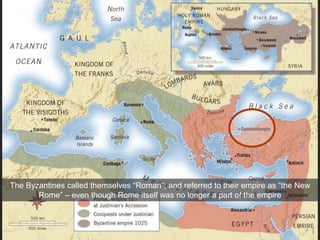
The Byzantines called themselves “Roman”, and referred to their empire as “the New
Rome” – even though Rome itself was no longer a part of the empire
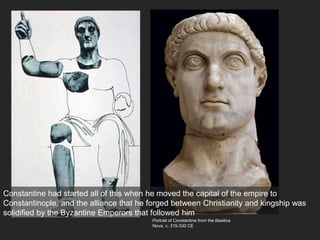
Portrait of Constantine from the Basilica
Nova, c. 315-330 CE
Constantine had started all of this when he moved the capital of the empire to
Constantinople, and the alliance that he forged between Christianity and kingship was
solidified by the Byzantine Emperors that followed him
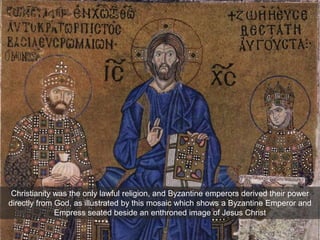
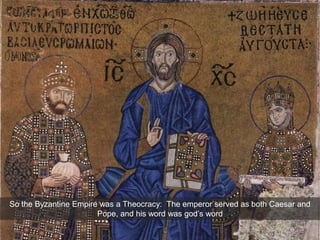
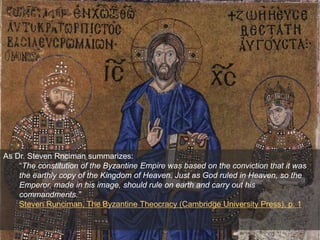
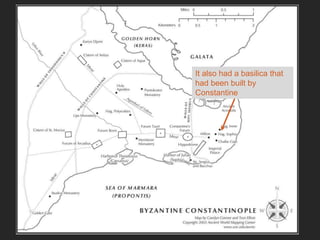
Christianity was the only lawful religion, and Byzantine emperors derived their power
directly from God, as illustrated by this mosaic which shows a Byzantine Emperor and
Empress seated beside an enthroned image of Jesus Christ
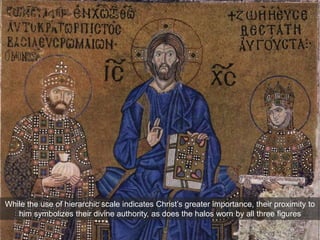
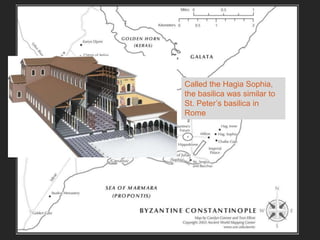
While the use of hierarchic scale indicates Christ’s greater importance, their proximity to
him symbolizes their divine authority, as does the halos worn by all three figures
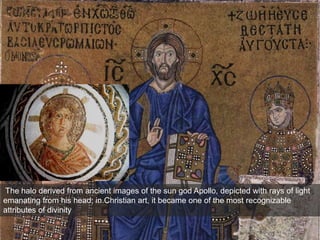
The halo derived from ancient images of the sun god Apollo, depicted with rays of light
emanating from his head; in Christian art, it became one of the most recognizable
attributes of divinity
So the Byzantine Empire was a Theocracy: The emperor served as both Caesar and
Pope, and his word was god’s word
As Dr. Steven Rnciman summarizes:
“The constitution of the Byzantine Empire was based on the conviction that it was
the earthly copy of the Kingdom of Heaven. Just as God ruled in Heaven, so the
Emperor, made in his image, should rule on earth and carry out his
commandments.”
Steven Runciman, The Byzantine Theocracy (Cambridge University Press), p. 1
Barberini Ivory, early 6thc
Louvre
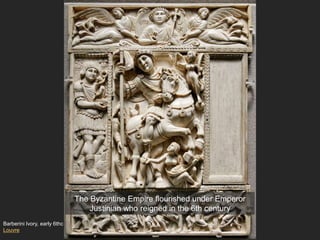
The Byzantine Empire flourished under Emperor
Justinian who reigned in the 6th century
Barberini Ivory, early 6thc
Louvre
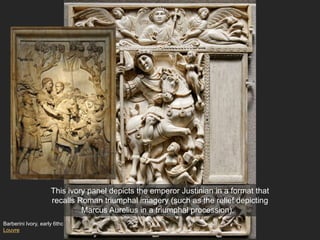
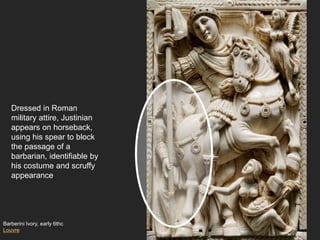
This ivory panel depicts the emperor Justinian in a format that
recalls Roman triumphal imagery (such as the relief depicting
Marcus Aurelius in a triumphal procession).
Barberini Ivory, early 6thc
Louvre
Dressed in Roman
military attire, Justinian
appears on horseback,
using his spear to block
the passage of a
barbarian, identifiable by
his costume and scruffy
appearance
Barberini Ivory, early 6thc
Louvre
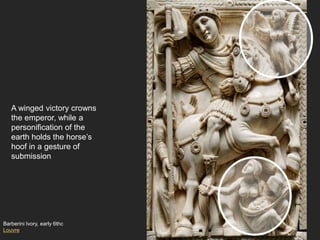
A winged victory crowns
the emperor, while a
personification of the
earth holds the horse’s
hoof in a gesture of
submission
Barberini Ivory, early 6thc
Louvre
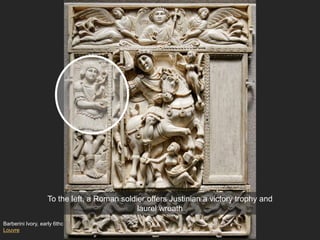
To the left, a Roman soldier offers Justinian a victory trophy and
laurel wreath
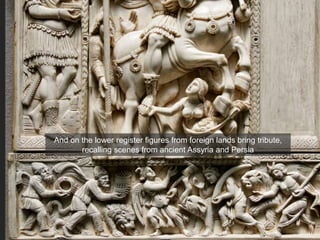
And on the lower register figures from foreign lands bring tribute,
recalling scenes from ancient Assyria and Persia
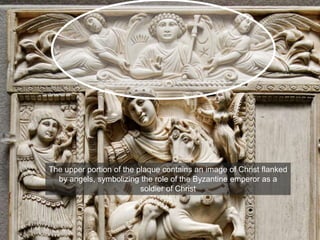
The upper portion of the plaque contains an image of Christ flanked
by angels, symbolizing the role of the Byzantine emperor as a
soldier of Christ
Barberini Ivory, early 6thc
Louvre
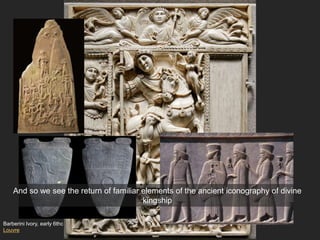
And so we see the return of familiar elements of the ancient iconography of divine
kingship
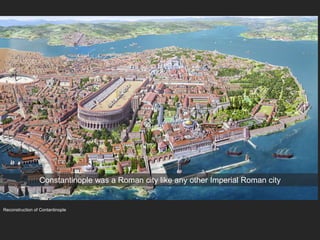
Reconstruction of Contantinople
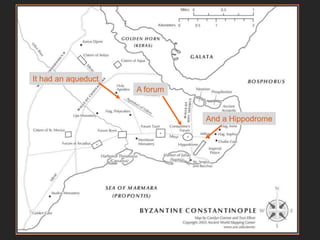
Constantinople was a Roman city like any other Imperial Roman city
It had an aqueduct
A forum
And a Hippodrome
It also had a basilica that
had been built by
Constantine
Called the Hagia Sophia,
the basilica was similar to
St. Peter’s basilica in
Rome
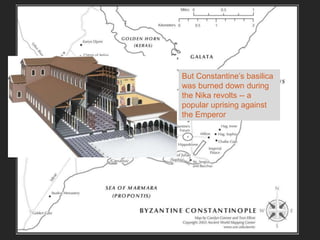
But Constantine’s basilica
was burned down during
the Nika revolts -- a
popular uprising against
the Emperor
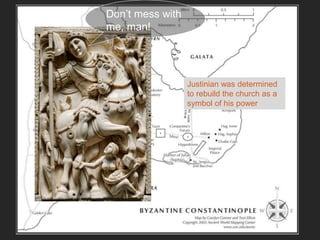
Justinian was determined
to rebuild the church as a
symbol of his power
Don’t mess with
me, man!
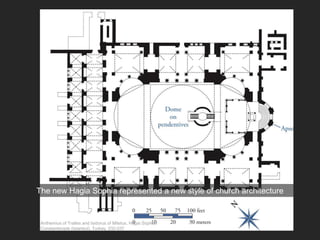
The new Hagia Sophia represented a new style of church architecture
Anthemius of Tralles and Isidorus of Miletus, Hagia Sophia,
Constantinople (Istanbul), Turkey, 532-537
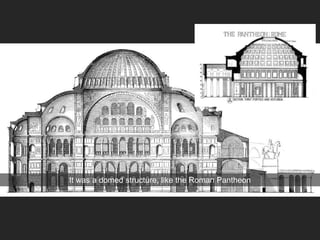
It was a domed structure, like the Roman Pantheon
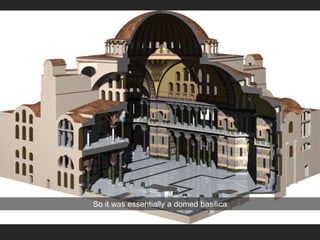
So it was essentially a domed basilica
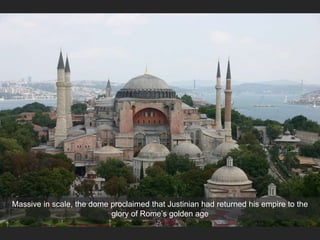
Massive in scale, the dome proclaimed that Justinian had returned his empire to the
glory of Rome’s golden age
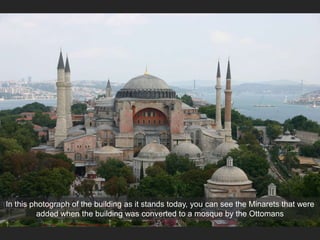
In this photograph of the building as it stands today, you can see the Minarets that were
added when the building was converted to a mosque by the Ottomans
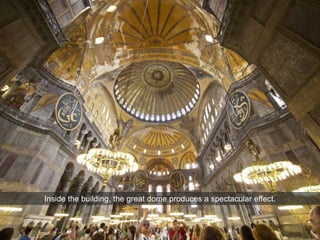
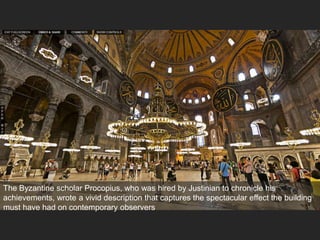
Inside the building, the great dome produces a spectacular effect.
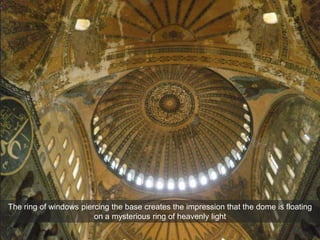
The ring of windows piercing the base creates the impression that the dome is floating
on a mysterious ring of heavenly light
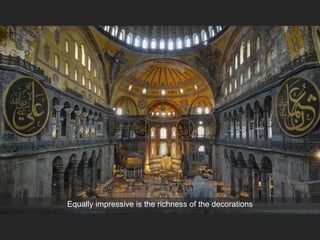
Equally impressive is the richness of the decorations
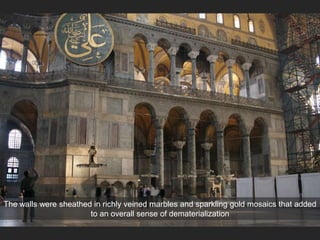
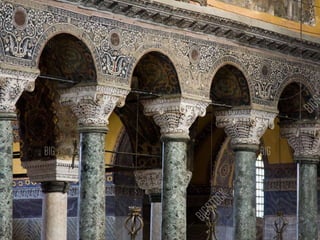
The walls were sheathed in richly veined marbles and sparkling gold mosaics that added
to an overall sense of dematerialization
The Byzantine scholar Procopius, who was hired by Justinian to chronicle his
achievements, wrote a vivid description that captures the spectacular effect the building
must have had on contemporary observers
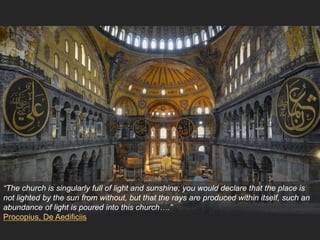
“The church is singularly full of light and sunshine; you would declare that the place is
not lighted by the sun from without, but that the rays are produced within itself, such an
abundance of light is poured into this church….”
Procopius, De Aedificiis
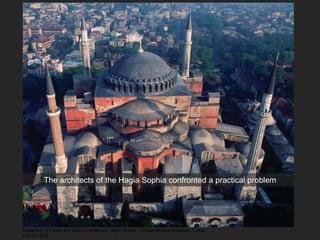
Anthemius of Tralles and Isidorus of Miletus, Hagia Sophia, Constantitinope (Istanbul), Turkey
532-537 BCE
The architects of the Hagia Sophia confronted a practical problem
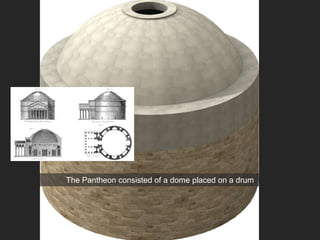
The Pantheon consisted of a dome placed on a drum
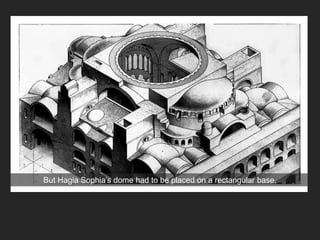
But Hagia Sophia’s dome had to be placed on a rectangular base.
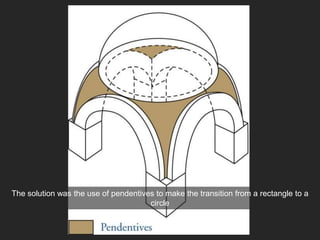
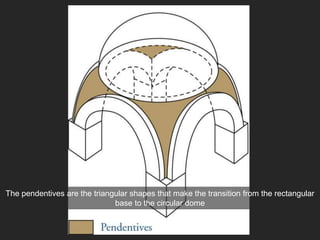
The solution was the use of pendentives to make the transition from a rectangle to a
circle
The pendentives are the triangular shapes that make the transition from the rectangular
base to the circular dome
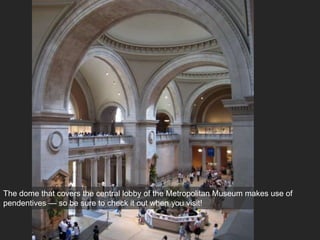
The dome that covers the central lobby of the Metropolitan Museum makes use of
pendentives — so be sure to check it out when you visit!
Thanks for listening!
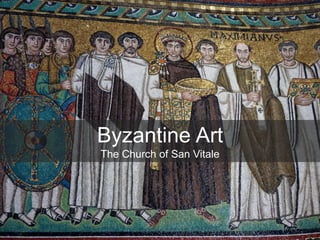
Byzantine Art
The Church of San Vitale
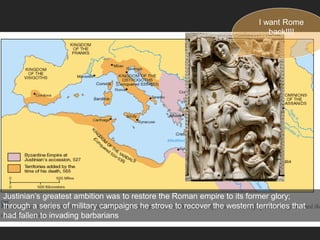
Justinian’s greatest ambition was to restore the Roman empire to its former glory;
through a series of military campaigns he strove to recover the western territories that
had fallen to invading barbarians
I want Rome
back!!!!
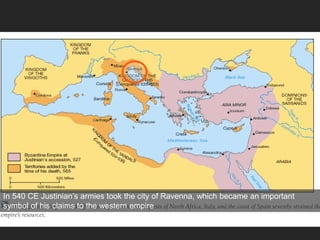
In 540 CE Justinian’s armies took the city of Ravenna, which became an important
symbol of his claims to the western empire
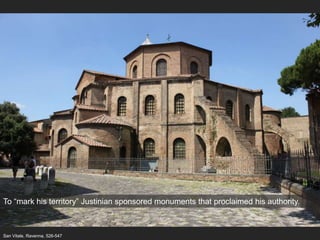
To “mark his territory” Justinian sponsored monuments that proclaimed his authority.
San Vitale, Ravenna, 526-547
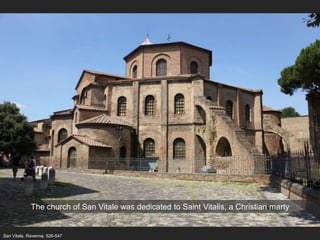
The church of San Vitale was dedicated to Saint Vitalis, a Christian marty
San Vitale, Ravenna, 526-547
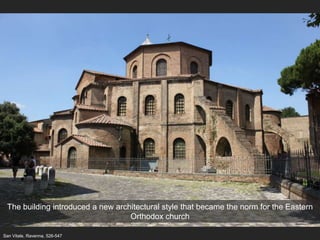
The building introduced a new architectural style that became the norm for the Eastern
Orthodox church
San Vitale, Ravenna, 526-547
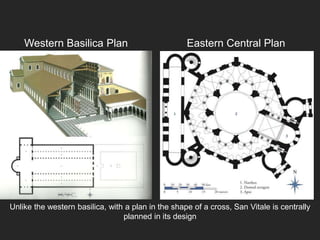
Unlike the western basilica, with a plan in the shape of a cross, San Vitale is centrally
planned in its design
Western Basilica Plan Eastern Central Plan
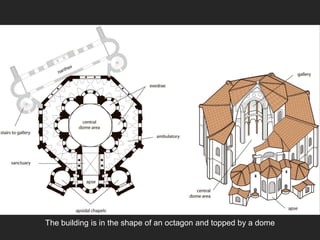
The building is in the shape of an octagon and topped by a dome
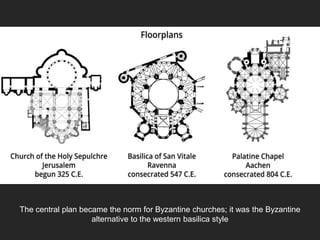
The central plan became the norm for Byzantine churches; it was the Byzantine
alternative to the western basilica style
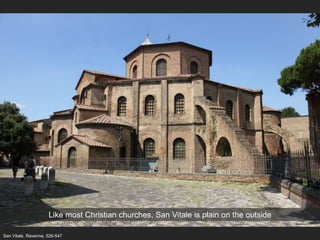
Like most Christian churches, San Vitale is plain on the outside
San Vitale, Ravenna, 526-547
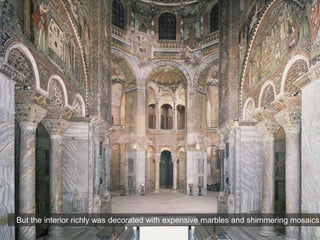
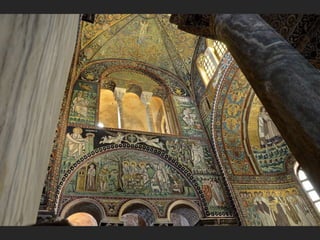
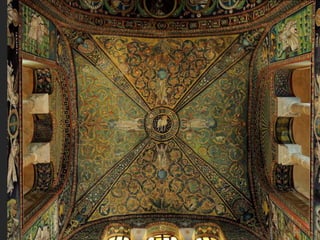
But the interior richly was decorated with expensive marbles and shimmering mosaics
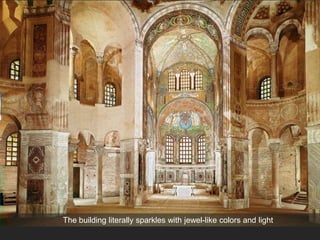
The building literally sparkles with jewel-like colors and light
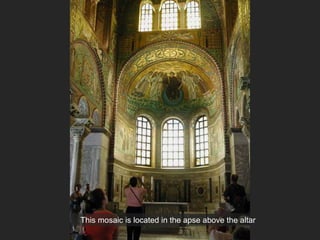
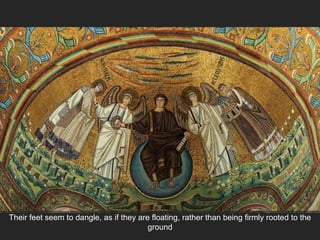
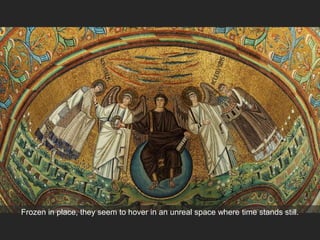
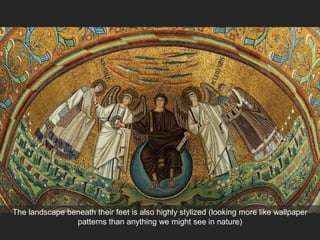
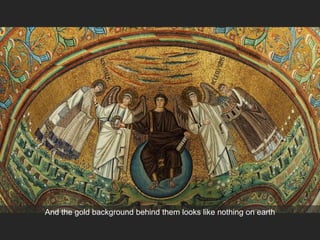
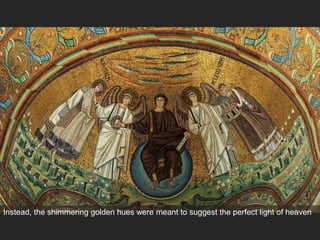
This mosaic is located in the apse above the altar
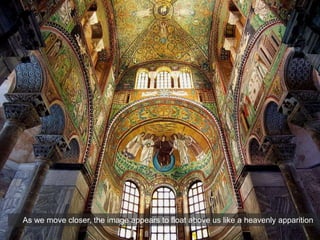
As we move closer, the image appears to float above us like a heavenly apparition
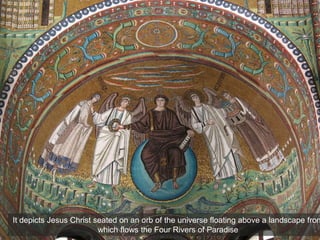
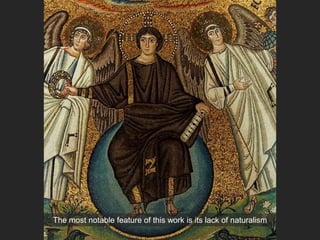
It depicts Jesus Christ seated on an orb of the universe floating above a landscape from
which flows the Four Rivers of Paradise
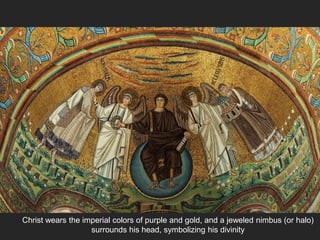
Christ wears the imperial colors of purple and gold, and a jeweled nimbus (or halo)
surrounds his head, symbolizing his divinity
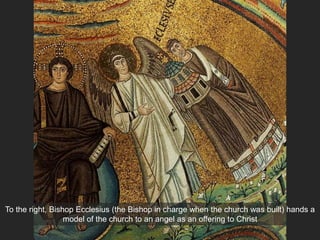
To the right, Bishop Ecclesius (the Bishop in charge when the church was built) hands a
model of the church to an angel as an offering to Christ
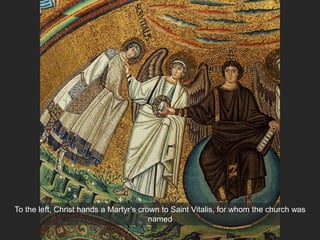
To the left, Christ hands a Martyr’s crown to Saint Vitalis, for whom the church was
named
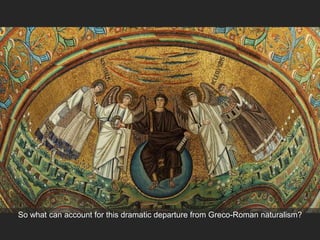
The most notable feature of this work is its lack of naturalism
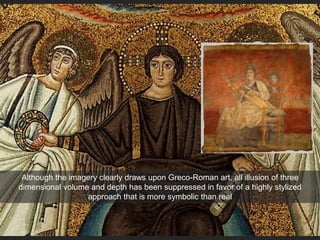
Although the imagery clearly draws upon Greco-Roman art, all illusion of three
dimensional volume and depth has been suppressed in favor of a highly stylized
approach that is more symbolic than real
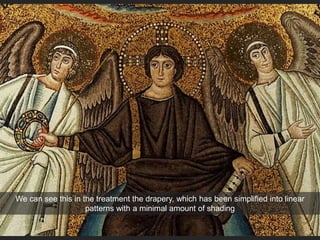
We can see this in the treatment the drapery, which has been simplified into linear
patterns with a minimal amount of shading
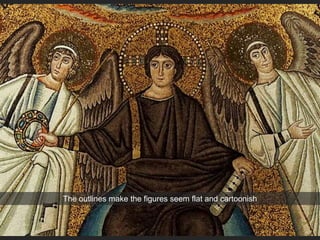
The outlines make the figures seem flat and cartoonish
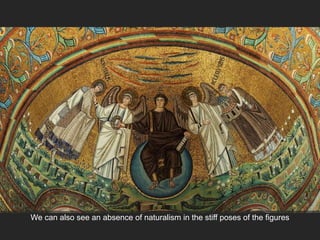
We can also see an absence of naturalism in the stiff poses of the figures
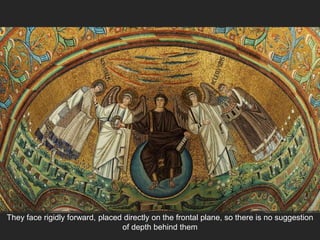
They face rigidly forward, placed directly on the frontal plane, so there is no suggestion
of depth behind them
Their feet seem to dangle, as if they are floating, rather than being firmly rooted to the
ground
Frozen in place, they seem to hover in an unreal space where time stands still.
The landscape beneath their feet is also highly stylized (looking more like wallpaper
patterns than anything we might see in nature)
And the gold background behind them looks like nothing on earth
Instead, the shimmering golden hues were meant to suggest the perfect light of heaven
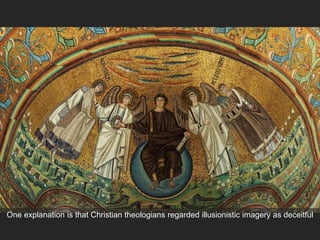
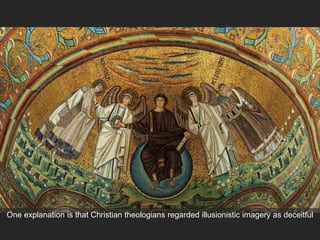
So what can account for this dramatic departure from Greco-Roman naturalism?
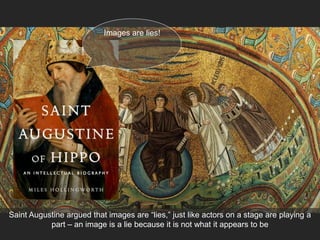
One explanation is that Christian theologians regarded illusionistic imagery as deceitful
Saint Augustine argued that images are “lies,” just like actors on a stage are playing a
part – an image is a lie because it is not what it appears to be
Images are lies!
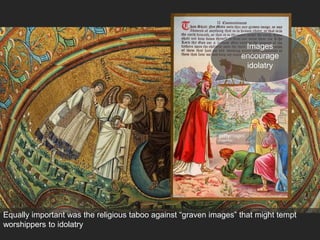
Equally important was the religious taboo against “graven images” that might tempt
worshippers to idolatry
Images
encourage
idolatry
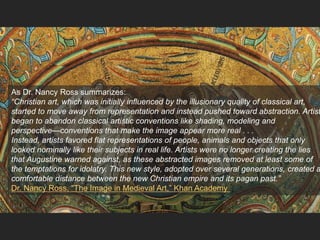
As Dr. Nancy Ross summarizes:
“Christian art, which was initially influenced by the illusionary quality of classical art,
started to move away from representation and instead pushed toward abstraction. Artist
began to abandon classical artistic conventions like shading, modeling and
perspective—conventions that make the image appear more real . . .
Instead, artists favored flat representations of people, animals and objects that only
looked nominally like their subjects in real life. Artists were no longer creating the lies
that Augustine warned against, as these abstracted images removed at least some of
the temptations for idolatry. This new style, adopted over several generations, created a
comfortable distance between the new Christian empire and its pagan past.”
Dr. Nancy Ross, “The Image in Medieval Art,” Khan Academy
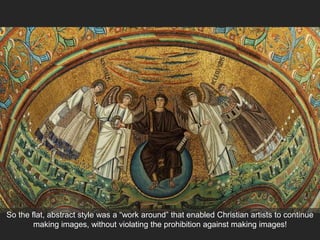
So the flat, abstract style was a “work around” that enabled Christian artists to continue
making images, without violating the prohibition against making images!
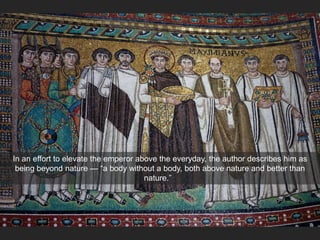
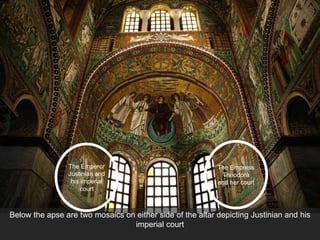
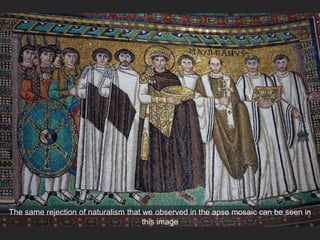
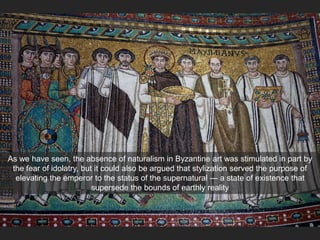
Below the apse are two mosaics on either side of the altar depicting Justinian and his
imperial court
The Emperor
Justinian and
his imperial
court
The Empress
Theodora
and her court
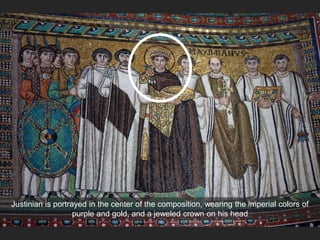
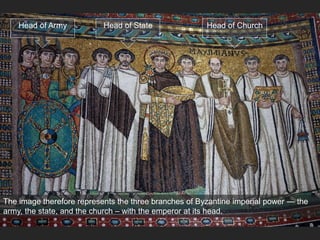
Justinian is portrayed in the center of the composition, wearing the imperial colors of
purple and gold, and a jeweled crown on his head
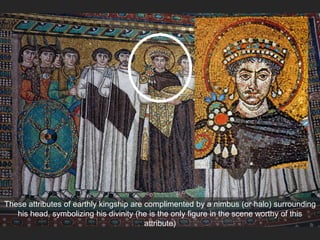
These attributes of earthly kingship are complimented by a nimbus (or halo) surrounding
his head, symbolizing his divinity (he is the only figure in the scene worthy of this
attribute)
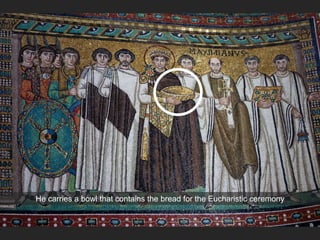
He carries a bowl that contains the bread for the Eucharistic ceremony
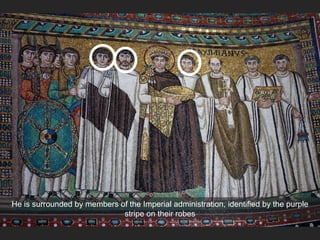
He is surrounded by members of the Imperial administration, identified by the purple
stripe on their robes
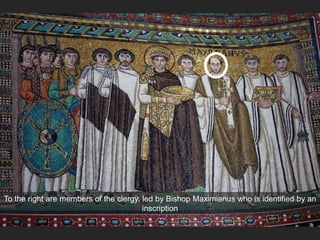
To the right are members of the clergy, led by Bishop Maximianus who is identified by an
inscription
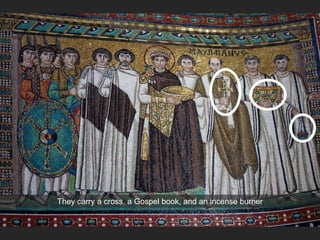
They carry a cross, a Gospel book, and an incense burner
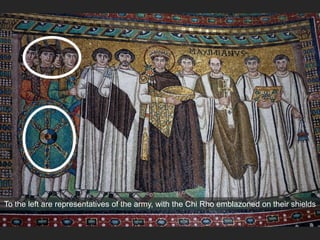
To the left are representatives of the army, with the Chi Rho emblazoned on their shields
The image therefore represents the three branches of Byzantine imperial power — the
army, the state, and the church – with the emperor at its head.
Head of ChurchHead of StateHead of Army
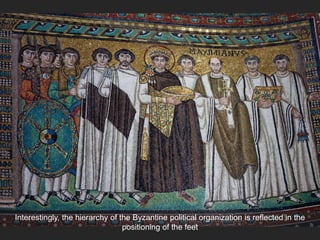
Interestingly, the hierarchy of the Byzantine political organization is reflected in the
positioning of the feet
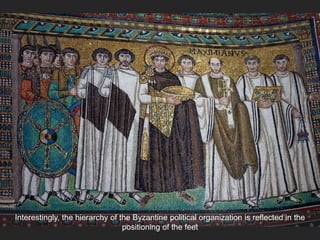
Interestingly, the hierarchy of the Byzantine political organization is reflected in the
positioning of the feet
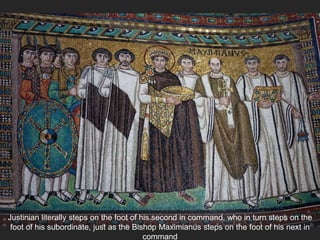
Justinian literally steps on the foot of his second in command, who in turn steps on the
foot of his subordinate, just as the Bishop Maximianus steps on the foot of his next in
command
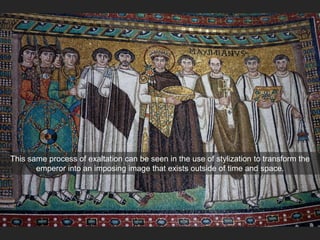
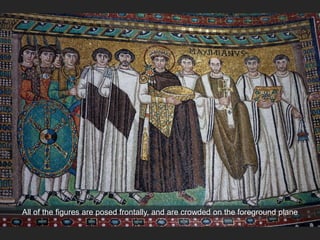
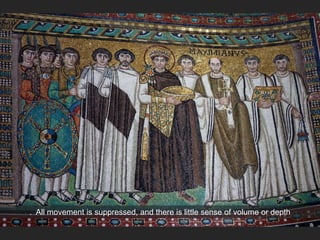
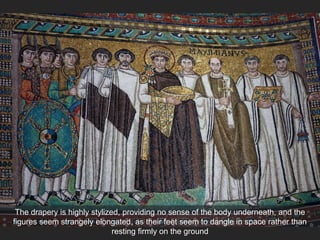
The same rejection of naturalism that we observed in the apse mosaic can be seen in
this image
All of the figures are posed frontally, and are crowded on the foreground plane
. All movement is suppressed, and there is little sense of volume or depth
The drapery is highly stylized, providing no sense of the body underneath, and the
figures seem strangely elongated, as their feet seem to dangle in space rather than
resting firmly on the ground
As we have seen, the absence of naturalism in Byzantine art was stimulated in part by
the fear of idolatry, but it could also be argued that stylization served the purpose of
elevating the emperor to the status of the supernatural — a state of existence that
supersede the bounds of earthly reality
Consider, for example, this panegyric speech written in praise the emperor Constantine
IX:
“Shall I, then, compare you to someone? But whoever could make you a subject of
comparison, you who are so great and above compare?… For you have outdone
nature, and have become closest to the ranks of the spiritual beings . . . How
therefore shall we complete your portrait…? For you are to some extent a being
with a body and without a body, both above nature and better than nature. We
compare you, therefore, to the finest of bodies and to the more immeasurable of
those without bodies.”[1]
In an effort to elevate the emperor above the everyday, the author describes him as
being beyond nature — “a body without a body, both above nature and better than
nature.”
This same process of exaltation can be seen in the use of stylization to transform the
emperor into an imposing image that exists outside of time and space.
Thanks for listening!
Byzantine Art
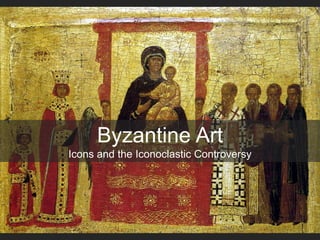
Icons and the Iconoclastic Controversy
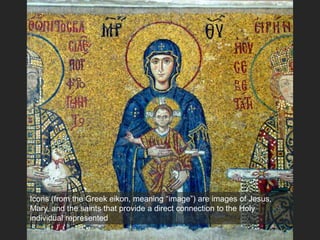
Icons (from the Greek eikon, meaning “image”) are images of Jesus,
Mary, and the saints that provide a direct connection to the Holy
individual represented
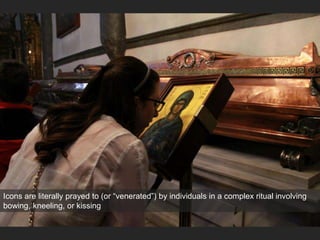
Icons are literally prayed to (or “venerated”) by individuals in a complex ritual involving
bowing, kneeling, or kissing
Wonderworking Icon of St. Nicholas is venerated
http://iconreader.wordpress.com/2011/02/17/miraculous-icon-of-tsar-
nicholas-in-st-petersburg/
The eighth-century theologian John of Damascus urged the faithful to ”embrace
[icons] with the eyes, the lips, the heart, bow before them, love them . . .” (NGA)
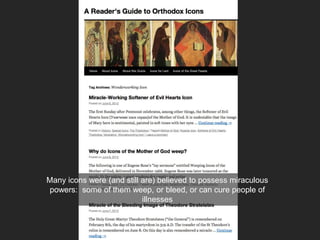
Many icons were (and still are) believed to possess miraculous
powers: some of them weep, or bleed, or can cure people of
illnesses
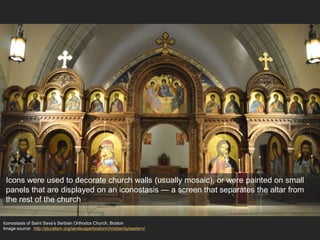
Iconostasis of Saint Sava’s Serbian Orthodox Church, Boston
Image source: http://pluralism.org/landscape/boston/christianity/eastern/
Icons were used to decorate church walls (usually mosaic), or were painted on small
panels that are displayed on an iconostasis — a screen that separates the altar from
the rest of the church
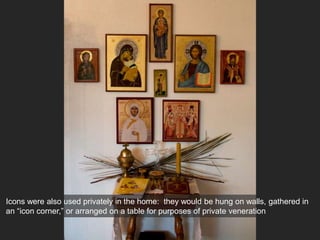
Icons were also used privately in the home: they would be hung on walls, gathered in
an “icon corner,” or arranged on a table for purposes of private veneration
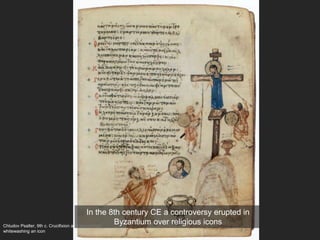
Chludov Psalter, 9th c. Crucifixion and Iconoclasts
whitewashing an icon
In the 8th century CE a controversy erupted in
Byzantium over religious icons
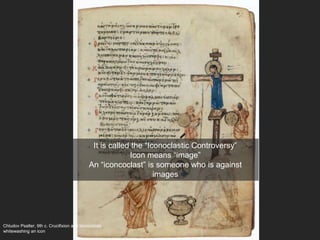
Chludov Psalter, 9th c. Crucifixion and Iconoclasts
whitewashing an icon
It is called the “Iconoclastic Controversy”
Icon means “image”
An “iconcoclast” is someone who is against
images
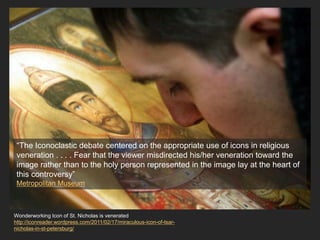
Wonderworking Icon of St. Nicholas is venerated
http://iconreader.wordpress.com/2011/02/17/miraculous-icon-of-tsar-
nicholas-in-st-petersburg/
“The Iconoclastic debate centered on the appropriate use of icons in religious
veneration . . . . Fear that the viewer misdirected his/her veneration toward the
image rather than to the holy person represented in the image lay at the heart of
this controversy”
Metropolitan Museum
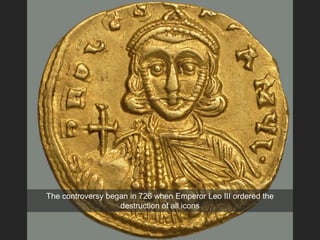
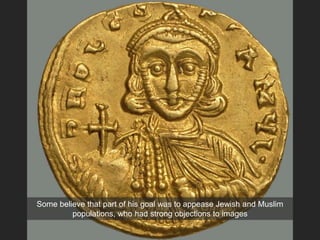
The controversy began in 726 when Emperor Leo III ordered the
destruction of all icons
Some believe that part of his goal was to appease Jewish and Muslim
populations, who had strong objections to images
Icon of the Triumph of
Orthodoxy, c. 1400 CE.
British Museum
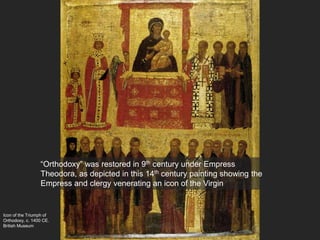
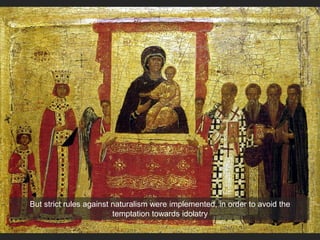
“Orthodoxy” was restored in 9th century under Empress
Theodora, as depicted in this 14th century painting showing the
Empress and clergy venerating an icon of the Virgin
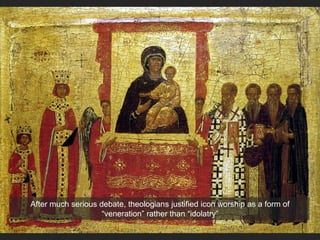
After much serious debate, theologians justified icon worship as a form of
“veneration” rather than “idolatry”
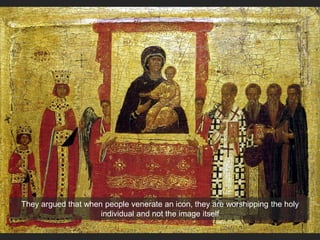
They argued that when people venerate an icon, they are worshipping the holy
individual and not the image itself
But strict rules against naturalism were implemented, in order to avoid the
temptation towards idolatry
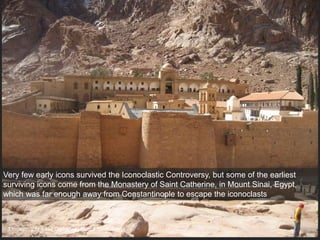
Monastery of Saint Catherine, Mount Sinai, Egypt
Very few early icons survived the Iconoclastic Controversy, but some of the earliest
surviving icons come from the Monastery of Saint Catherine, in Mount Sinai, Egypt,
which was far enough away from Constantinople to escape the iconoclasts
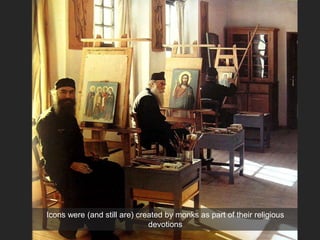
Icons were (and still are) created by monks as part of their religious
devotions
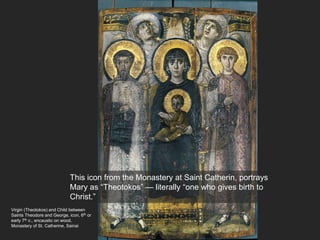
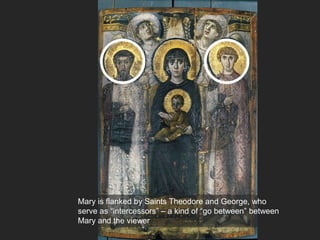
Virgin (Theotokos) and Child between
Saints Theodore and George, icon, 6th or
early 7th c., encaustic on wood,
Monastery of St. Catherine, Sainai
This icon from the Monastery at Saint Catherin, portrays
Mary as “Theotokos” — literally “one who gives birth to
Christ.”
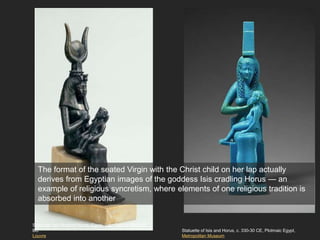
Statuette of Isis and Horus, c. 330-30 CE, Ptolmaic Egypt,
Metropolitan Museum
Statuette: Isis Nursing Horus, Egypt, Late Period, 664-332
BC
Louvre
The format of the seated Virgin with the Christ child on her lap actually
derives from Egyptian images of the goddess Isis cradling Horus — an
example of religious syncretism, where elements of one religious tradition is
absorbed into another
Mary is flanked by Saints Theodore and George, who
serve as “intercessors” – a kind of “go between” between
Mary and the viewer
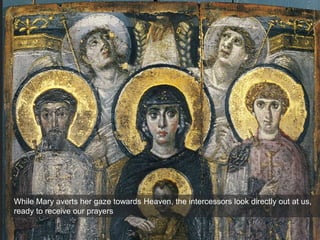
While Mary averts her gaze towards Heaven, the intercessors look directly out at us,
ready to receive our prayers
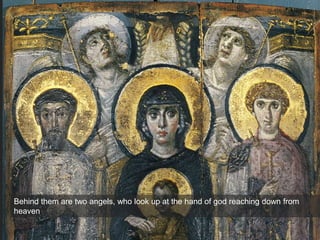
Behind them are two angels, who look up at the hand of god reaching down from
heaven
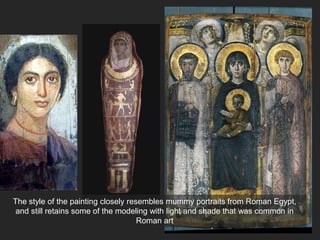
The style of the painting closely resembles mummy portraits from Roman Egypt,
and still retains some of the modeling with light and shade that was common in
Roman art
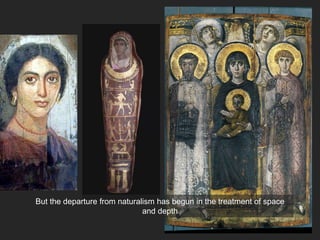
But the departure from naturalism has begun in the treatment of space
and depth
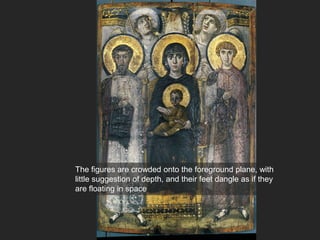
The figures are crowded onto the foreground plane, with
little suggestion of depth, and their feet dangle as if they
are floating in space
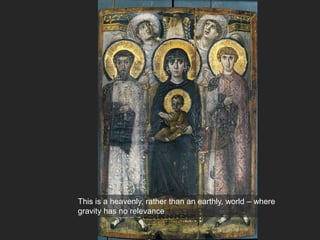
This is a heavenly, rather than an earthly, world – where
gravity has no relevance
Icon of Christ Pantocrator, encaustic on
wood, 6th c.
Monastery of St. Catherine, Mount Sinai,
Egypt
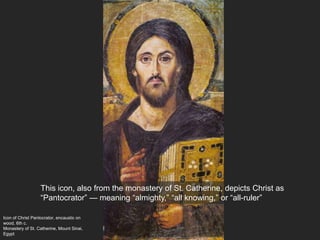
This icon, also from the monastery of St. Catherine, depicts Christ as
“Pantocrator” — meaning “almighty,” “all knowing,” or “all-ruler”
Icon of Christ Pantocrator, encaustic on
wood, 6th c.
Monastery of St. Catherine, Mount Sinai,
Egypt
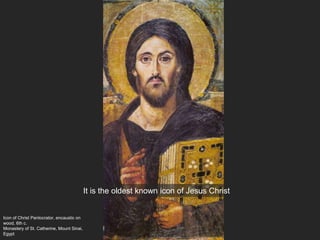
It is the oldest known icon of Jesus Christ
Icon of Christ Pantocrator, encaustic on
wood, 6th c.
Monastery of St. Catherine, Mount Sinai,
Egypt
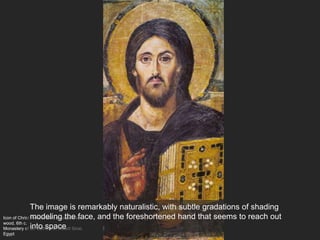
The image is remarkably naturalistic, with subtle gradations of shading
modeling the face, and the foreshortened hand that seems to reach out
into space
Icon of Christ Pantocrator, encaustic on
wood, 6th c.
Monastery of St. Catherine, Mount Sinai,
Egypt
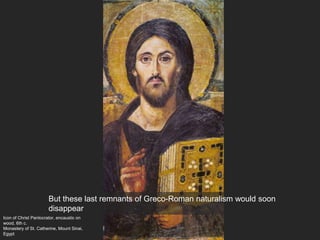
But these last remnants of Greco-Roman naturalism would soon
disappear
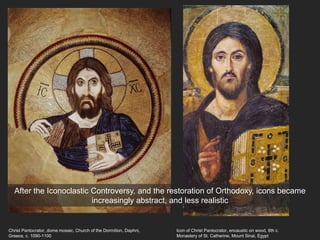
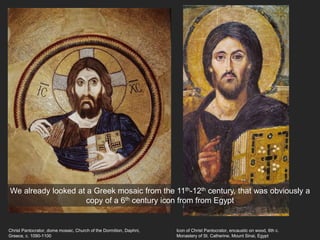
Christ Pantocrator, dome mosaic, Church of the Dormition, Daphni,
Greece, c. 1090-1100
Icon of Christ Pantocrator, encaustic on wood, 6th c.
Monastery of St. Catherine, Mount Sinai, Egypt
After the Iconoclastic Controversy, and the restoration of Orthodoxy, icons became
increasingly abstract, and less realistic
Christ Pantocrator, dome mosaic, Church of the Dormition, Daphni,
Greece, c. 1090-1100
Icon of Christ Pantocrator, encaustic on wood, 6th c.
Monastery of St. Catherine, Mount Sinai, Egypt
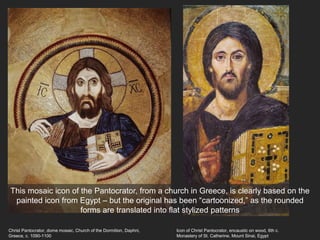
This mosaic icon of the Pantocrator, from a church in Greece, is clearly based on the
painted icon from Egypt – but the original has been “cartoonized,” as the rounded
forms are translated into flat stylized patterns
Christ Pantocrator, dome mosaic, Church of the Dormition, Daphni,
Greece, c. 1090-1100
Icon of Christ Pantocrator, encaustic on wood, 6th c.
Monastery of St. Catherine, Mount Sinai, Egypt
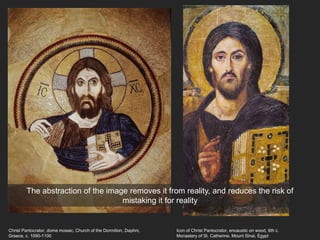
The abstraction of the image removes it from reality, and reduces the risk of
mistaking it for reality
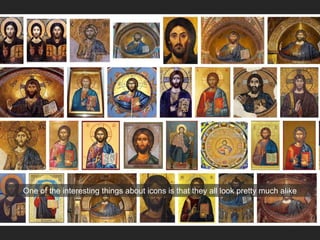
One of the interesting things about icons is that they all look pretty much alike
Christ Pantocrator, dome mosaic, Church of the Dormition, Daphni,
Greece, c. 1090-1100
Icon of Christ Pantocrator, encaustic on wood, 6th c.
Monastery of St. Catherine, Mount Sinai, Egypt
We already looked at a Greek mosaic from the 11th-12th century, that was obviously a
copy of a 6th century icon from from Egypt
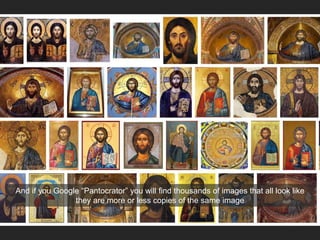
And if you Google “Pantocrator” you will find thousands of images that all look like
they are more or less copies of the same image
Icon of Christ Pantocrator, encaustic on
wood, 6th c.
Monastery of St. Catherine, Mount Sinai,
Egypt
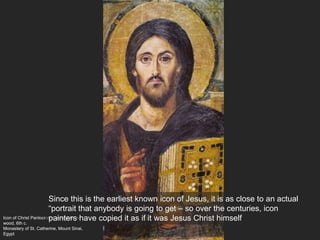
Since this is the earliest known icon of Jesus, it is as close to an actual
“portrait that anybody is going to get – so over the centuries, icon
painters have copied it as if it was Jesus Christ himself
Icon of Christ Pantocrator, encaustic on
wood, 6th c.
Monastery of St. Catherine, Mount Sinai,
Egypt
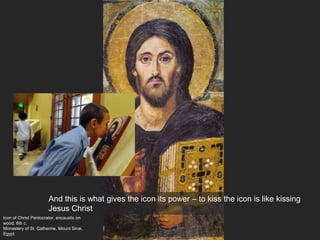
And this is what gives the icon its power – to kiss the icon is like kissing
Jesus Christ
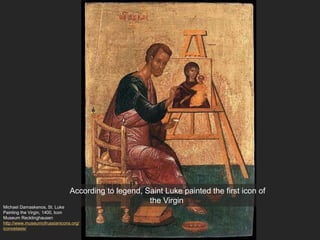
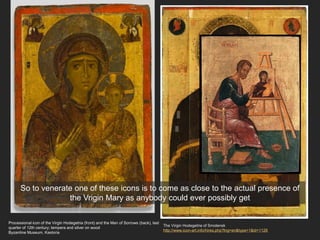
Michael Damaskenos, St. Luke
Painting the Virgin, 1400, Icon
Museum Recklinghausen
http://www.museumofrussianicons.org/
iconostasis/
According to legend, Saint Luke painted the first icon of
the Virgin
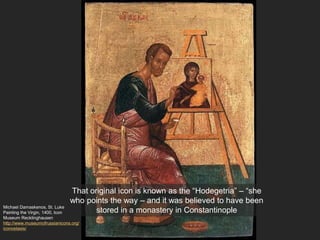
Michael Damaskenos, St. Luke
Painting the Virgin, 1400, Icon
Museum Recklinghausen
http://www.museumofrussianicons.org/
iconostasis/
That original icon is known as the “Hodegetria” – “she
who points the way – and it was believed to have been
stored in a monastery in Constantinople
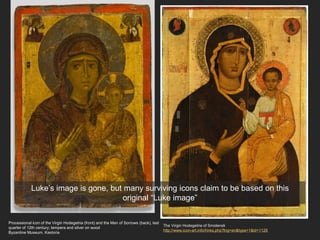
Processional icon of the Virgin Hodegetria (front) and the Man of Sorrows (back), last
quarter of 12th century; tempera and silver on wood
Byzantine Museum, Kastoria
The Virgin Hodegetria of Smolensk
http://www.icon-art.info/hires.php?lng=en&type=1&id=1126
Luke’s image is gone, but many surviving icons claim to be based on this
original “Luke image”
Processional icon of the Virgin Hodegetria (front) and the Man of Sorrows (back), last
quarter of 12th century; tempera and silver on wood
Byzantine Museum, Kastoria
The Virgin Hodegetria of Smolensk
http://www.icon-art.info/hires.php?lng=en&type=1&id=1126
So to venerate one of these icons is to come as close to the actual presence of
the Vrigin Mary as anybody could ever possibly get
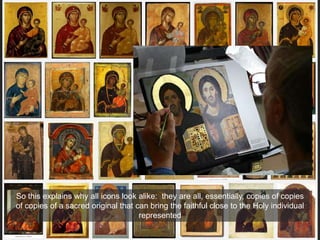
So this explains why all icons look alike: they are all, essentially, copies of copies
of copies of a sacred original that can bring the faithful close to the Holy individual
represented
Thanks for listening!
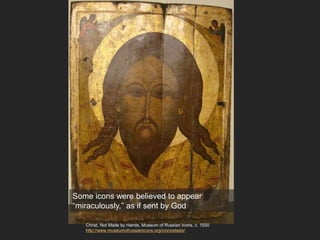
Christ, Not Made by Hands, Museum of Russian Icons, c. 1550
http://www.museumofrussianicons.org/iconostasis/
Some icons were believed to appear
“miraculously,” as if sent by God
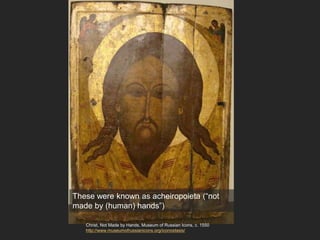
Christ, Not Made by Hands, Museum of Russian Icons, c. 1550
http://www.museumofrussianicons.org/iconostasis/
These were known as acheiropoieta (“not
made by (human) hands”)
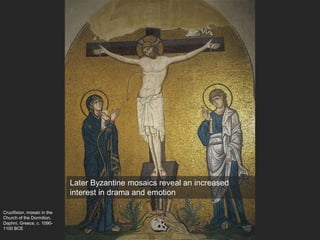
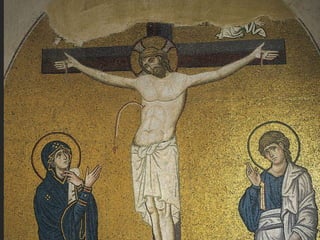
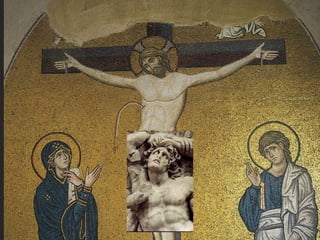
Crucifixion, mosaic in the
Church of the Dormition,
Daphni, Greece, c. 1090-
1100 BCE
Later Byzantine mosaics reveal an increased
interest in drama and emotion
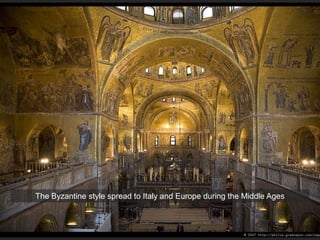
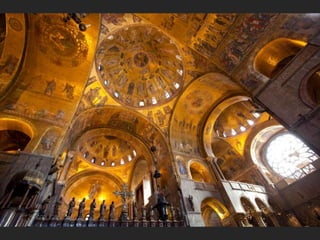
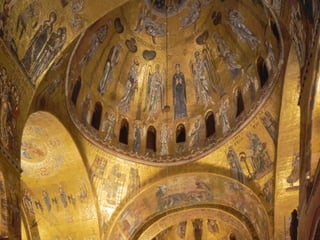
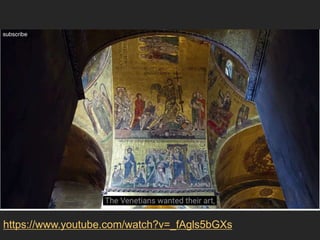
The Byzantine style spread to Italy and Europe during the Middle Ages
San Marco, Venice, begun 1063
https://www.youtube.com/watch?v=_fAgls5bGXs
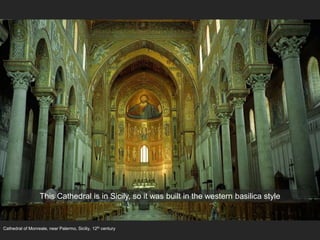
Cathedral of Monreale, near Palermo, Siciliy, 12th century
This Cathedral is in Sicily, so it was built in the western basilica style
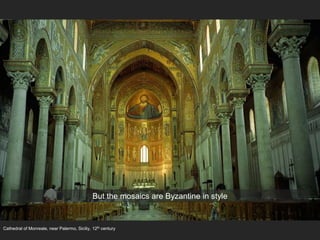
Cathedral of Monreale, near Palermo, Siciliy, 12th century
But the mosaics are Byzantine in style
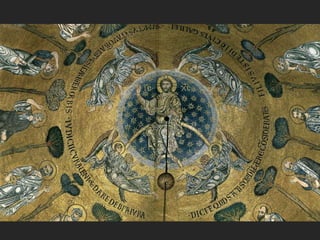
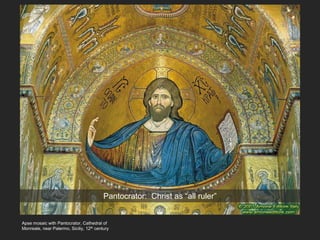
Apse mosaic with Pantocrator, Cathedral of
Monreale, near Palermo, Siciliy, 12th century
Pantocrator: Christ as “all ruler”
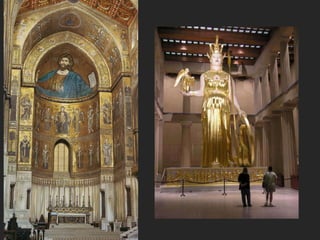
He stands the full height of the
church like Phidias’ Athena
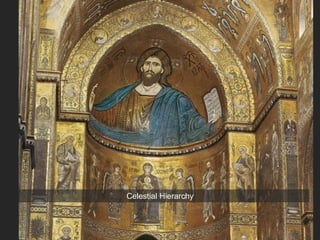
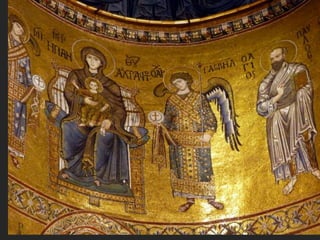
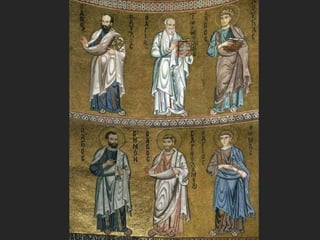
Celestial Hierarchy
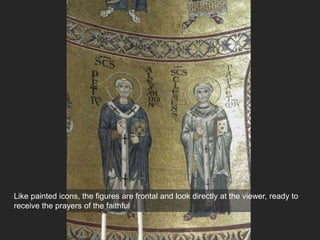
Like painted icons, the figures are frontal and look directly at the viewer, ready to
receive the prayers of the faithful
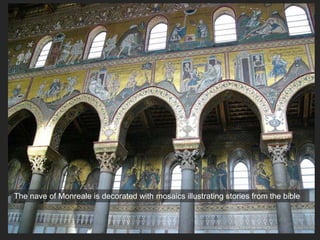
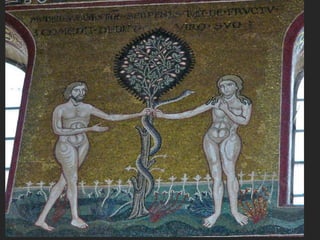
The nave of Monreale is decorated with mosaics illustrating stories from the bible
Byzantine Art
Byzantine Art

Byzantine Art

  • 1.
    Byzantine Art The Ageof Justinian 527-565 CE
  • 2.
    Sarcophagus with battleof Romans and barbarians, c. 250-260 CE, Museio As we have learned, Rome was under constant attack from barbarian invasions during the later Roman Empire Sarcophagus with battle of Romans and barbarians (Ludovisi Sarcophagus), c. 250-260 CE, Museo Nazionale Romano
  • 3.
    Eventually the barbarianswon: in 410 Ce the city of Rome was sacked by the Visigoths, and in 476 CE the last Roman Emperor was deposed
  • 4.
    The greatest empirein history had come to an end
  • 5.
    But the RomanEmpire continued in the East (marked as pink on this map) with its capital at Constantinople
  • 6.
    Historians refer tothis period as the “Byzantine Empire,” but it might be more accurate to call it the “Eastern Roman Empire”
  • 7.
    The Byzantines calledthemselves “Roman”, and referred to their empire as “the New Rome” – even though Rome itself was no longer a part of the empire
  • 8.
    Portrait of Constantinefrom the Basilica Nova, c. 315-330 CE Constantine had started all of this when he moved the capital of the empire to Constantinople, and the alliance that he forged between Christianity and kingship was solidified by the Byzantine Emperors that followed him
  • 9.
    Christianity was theonly lawful religion, and Byzantine emperors derived their power directly from God, as illustrated by this mosaic which shows a Byzantine Emperor and Empress seated beside an enthroned image of Jesus Christ
  • 10.
    While the useof hierarchic scale indicates Christ’s greater importance, their proximity to him symbolizes their divine authority, as does the halos worn by all three figures
  • 11.
    The halo derivedfrom ancient images of the sun god Apollo, depicted with rays of light emanating from his head; in Christian art, it became one of the most recognizable attributes of divinity
  • 12.
    So the ByzantineEmpire was a Theocracy: The emperor served as both Caesar and Pope, and his word was god’s word
  • 13.
    As Dr. StevenRnciman summarizes: “The constitution of the Byzantine Empire was based on the conviction that it was the earthly copy of the Kingdom of Heaven. Just as God ruled in Heaven, so the Emperor, made in his image, should rule on earth and carry out his commandments.” Steven Runciman, The Byzantine Theocracy (Cambridge University Press), p. 1
  • 14.
    Barberini Ivory, early6thc Louvre The Byzantine Empire flourished under Emperor Justinian who reigned in the 6th century
  • 15.
    Barberini Ivory, early6thc Louvre This ivory panel depicts the emperor Justinian in a format that recalls Roman triumphal imagery (such as the relief depicting Marcus Aurelius in a triumphal procession).
  • 16.
    Barberini Ivory, early6thc Louvre Dressed in Roman military attire, Justinian appears on horseback, using his spear to block the passage of a barbarian, identifiable by his costume and scruffy appearance
  • 17.
    Barberini Ivory, early6thc Louvre A winged victory crowns the emperor, while a personification of the earth holds the horse’s hoof in a gesture of submission
  • 18.
    Barberini Ivory, early6thc Louvre To the left, a Roman soldier offers Justinian a victory trophy and laurel wreath
  • 19.
    And on thelower register figures from foreign lands bring tribute, recalling scenes from ancient Assyria and Persia
  • 20.
    The upper portionof the plaque contains an image of Christ flanked by angels, symbolizing the role of the Byzantine emperor as a soldier of Christ
  • 21.
    Barberini Ivory, early6thc Louvre And so we see the return of familiar elements of the ancient iconography of divine kingship
  • 22.
    Reconstruction of Contantinople Constantinoplewas a Roman city like any other Imperial Roman city
  • 23.
    It had anaqueduct A forum And a Hippodrome
  • 24.
    It also hada basilica that had been built by Constantine
  • 25.
    Called the HagiaSophia, the basilica was similar to St. Peter’s basilica in Rome
  • 26.
    But Constantine’s basilica wasburned down during the Nika revolts -- a popular uprising against the Emperor
  • 27.
    Justinian was determined torebuild the church as a symbol of his power Don’t mess with me, man!
  • 28.
    The new HagiaSophia represented a new style of church architecture Anthemius of Tralles and Isidorus of Miletus, Hagia Sophia, Constantinople (Istanbul), Turkey, 532-537
  • 29.
    It was adomed structure, like the Roman Pantheon
  • 30.
    So it wasessentially a domed basilica
  • 31.
    Massive in scale,the dome proclaimed that Justinian had returned his empire to the glory of Rome’s golden age
  • 32.
    In this photographof the building as it stands today, you can see the Minarets that were added when the building was converted to a mosque by the Ottomans
  • 33.
    Inside the building,the great dome produces a spectacular effect.
  • 34.
    The ring ofwindows piercing the base creates the impression that the dome is floating on a mysterious ring of heavenly light
  • 35.
    Equally impressive isthe richness of the decorations
  • 36.
    The walls weresheathed in richly veined marbles and sparkling gold mosaics that added to an overall sense of dematerialization
  • 38.
    The Byzantine scholarProcopius, who was hired by Justinian to chronicle his achievements, wrote a vivid description that captures the spectacular effect the building must have had on contemporary observers
  • 39.
    “The church issingularly full of light and sunshine; you would declare that the place is not lighted by the sun from without, but that the rays are produced within itself, such an abundance of light is poured into this church….” Procopius, De Aedificiis
  • 40.
    Anthemius of Trallesand Isidorus of Miletus, Hagia Sophia, Constantitinope (Istanbul), Turkey 532-537 BCE The architects of the Hagia Sophia confronted a practical problem
  • 41.
    The Pantheon consistedof a dome placed on a drum
  • 42.
    But Hagia Sophia’sdome had to be placed on a rectangular base.
  • 43.
    The solution wasthe use of pendentives to make the transition from a rectangle to a circle
  • 44.
    The pendentives arethe triangular shapes that make the transition from the rectangular base to the circular dome
  • 45.
    The dome thatcovers the central lobby of the Metropolitan Museum makes use of pendentives — so be sure to check it out when you visit!
  • 46.
  • 47.
  • 48.
    Justinian’s greatest ambitionwas to restore the Roman empire to its former glory; through a series of military campaigns he strove to recover the western territories that had fallen to invading barbarians I want Rome back!!!!
  • 49.
    In 540 CEJustinian’s armies took the city of Ravenna, which became an important symbol of his claims to the western empire
  • 50.
    To “mark histerritory” Justinian sponsored monuments that proclaimed his authority. San Vitale, Ravenna, 526-547
  • 51.
    The church ofSan Vitale was dedicated to Saint Vitalis, a Christian marty San Vitale, Ravenna, 526-547
  • 52.
    The building introduceda new architectural style that became the norm for the Eastern Orthodox church San Vitale, Ravenna, 526-547
  • 53.
    Unlike the westernbasilica, with a plan in the shape of a cross, San Vitale is centrally planned in its design Western Basilica Plan Eastern Central Plan
  • 54.
    The building isin the shape of an octagon and topped by a dome
  • 55.
    The central planbecame the norm for Byzantine churches; it was the Byzantine alternative to the western basilica style
  • 56.
    Like most Christianchurches, San Vitale is plain on the outside San Vitale, Ravenna, 526-547
  • 57.
    But the interiorrichly was decorated with expensive marbles and shimmering mosaics
  • 58.
    The building literallysparkles with jewel-like colors and light
  • 61.
    This mosaic islocated in the apse above the altar
  • 62.
    As we movecloser, the image appears to float above us like a heavenly apparition
  • 63.
    It depicts JesusChrist seated on an orb of the universe floating above a landscape from which flows the Four Rivers of Paradise
  • 64.
    Christ wears theimperial colors of purple and gold, and a jeweled nimbus (or halo) surrounds his head, symbolizing his divinity
  • 65.
    To the right,Bishop Ecclesius (the Bishop in charge when the church was built) hands a model of the church to an angel as an offering to Christ
  • 66.
    To the left,Christ hands a Martyr’s crown to Saint Vitalis, for whom the church was named
  • 67.
    The most notablefeature of this work is its lack of naturalism
  • 68.
    Although the imageryclearly draws upon Greco-Roman art, all illusion of three dimensional volume and depth has been suppressed in favor of a highly stylized approach that is more symbolic than real
  • 69.
    We can seethis in the treatment the drapery, which has been simplified into linear patterns with a minimal amount of shading
  • 70.
    The outlines makethe figures seem flat and cartoonish
  • 71.
    We can alsosee an absence of naturalism in the stiff poses of the figures
  • 72.
    They face rigidlyforward, placed directly on the frontal plane, so there is no suggestion of depth behind them
  • 73.
    Their feet seemto dangle, as if they are floating, rather than being firmly rooted to the ground
  • 74.
    Frozen in place,they seem to hover in an unreal space where time stands still.
  • 75.
    The landscape beneaththeir feet is also highly stylized (looking more like wallpaper patterns than anything we might see in nature)
  • 76.
    And the goldbackground behind them looks like nothing on earth
  • 77.
    Instead, the shimmeringgolden hues were meant to suggest the perfect light of heaven
  • 78.
    So what canaccount for this dramatic departure from Greco-Roman naturalism?
  • 79.
    One explanation isthat Christian theologians regarded illusionistic imagery as deceitful
  • 80.
    One explanation isthat Christian theologians regarded illusionistic imagery as deceitful
  • 81.
    Saint Augustine arguedthat images are “lies,” just like actors on a stage are playing a part – an image is a lie because it is not what it appears to be Images are lies!
  • 82.
    Equally important wasthe religious taboo against “graven images” that might tempt worshippers to idolatry Images encourage idolatry
  • 83.
    As Dr. NancyRoss summarizes: “Christian art, which was initially influenced by the illusionary quality of classical art, started to move away from representation and instead pushed toward abstraction. Artist began to abandon classical artistic conventions like shading, modeling and perspective—conventions that make the image appear more real . . . Instead, artists favored flat representations of people, animals and objects that only looked nominally like their subjects in real life. Artists were no longer creating the lies that Augustine warned against, as these abstracted images removed at least some of the temptations for idolatry. This new style, adopted over several generations, created a comfortable distance between the new Christian empire and its pagan past.” Dr. Nancy Ross, “The Image in Medieval Art,” Khan Academy
  • 84.
    So the flat,abstract style was a “work around” that enabled Christian artists to continue making images, without violating the prohibition against making images!
  • 85.
    Below the apseare two mosaics on either side of the altar depicting Justinian and his imperial court The Emperor Justinian and his imperial court The Empress Theodora and her court
  • 86.
    Justinian is portrayedin the center of the composition, wearing the imperial colors of purple and gold, and a jeweled crown on his head
  • 87.
    These attributes ofearthly kingship are complimented by a nimbus (or halo) surrounding his head, symbolizing his divinity (he is the only figure in the scene worthy of this attribute)
  • 88.
    He carries abowl that contains the bread for the Eucharistic ceremony
  • 89.
    He is surroundedby members of the Imperial administration, identified by the purple stripe on their robes
  • 90.
    To the rightare members of the clergy, led by Bishop Maximianus who is identified by an inscription
  • 91.
    They carry across, a Gospel book, and an incense burner
  • 92.
    To the leftare representatives of the army, with the Chi Rho emblazoned on their shields
  • 93.
    The image thereforerepresents the three branches of Byzantine imperial power — the army, the state, and the church – with the emperor at its head. Head of ChurchHead of StateHead of Army
  • 94.
    Interestingly, the hierarchyof the Byzantine political organization is reflected in the positioning of the feet
  • 95.
    Interestingly, the hierarchyof the Byzantine political organization is reflected in the positioning of the feet
  • 96.
    Justinian literally stepson the foot of his second in command, who in turn steps on the foot of his subordinate, just as the Bishop Maximianus steps on the foot of his next in command
  • 97.
    The same rejectionof naturalism that we observed in the apse mosaic can be seen in this image
  • 98.
    All of thefigures are posed frontally, and are crowded on the foreground plane
  • 99.
    . All movementis suppressed, and there is little sense of volume or depth
  • 100.
    The drapery ishighly stylized, providing no sense of the body underneath, and the figures seem strangely elongated, as their feet seem to dangle in space rather than resting firmly on the ground
  • 101.
    As we haveseen, the absence of naturalism in Byzantine art was stimulated in part by the fear of idolatry, but it could also be argued that stylization served the purpose of elevating the emperor to the status of the supernatural — a state of existence that supersede the bounds of earthly reality
  • 102.
    Consider, for example,this panegyric speech written in praise the emperor Constantine IX: “Shall I, then, compare you to someone? But whoever could make you a subject of comparison, you who are so great and above compare?… For you have outdone nature, and have become closest to the ranks of the spiritual beings . . . How therefore shall we complete your portrait…? For you are to some extent a being with a body and without a body, both above nature and better than nature. We compare you, therefore, to the finest of bodies and to the more immeasurable of those without bodies.”[1]
  • 103.
    In an effortto elevate the emperor above the everyday, the author describes him as being beyond nature — “a body without a body, both above nature and better than nature.”
  • 104.
    This same processof exaltation can be seen in the use of stylization to transform the emperor into an imposing image that exists outside of time and space.
  • 105.
  • 106.
    Byzantine Art Icons andthe Iconoclastic Controversy
  • 107.
    Icons (from theGreek eikon, meaning “image”) are images of Jesus, Mary, and the saints that provide a direct connection to the Holy individual represented
  • 108.
    Icons are literallyprayed to (or “venerated”) by individuals in a complex ritual involving bowing, kneeling, or kissing
  • 109.
    Wonderworking Icon ofSt. Nicholas is venerated http://iconreader.wordpress.com/2011/02/17/miraculous-icon-of-tsar- nicholas-in-st-petersburg/ The eighth-century theologian John of Damascus urged the faithful to ”embrace [icons] with the eyes, the lips, the heart, bow before them, love them . . .” (NGA)
  • 110.
    Many icons were(and still are) believed to possess miraculous powers: some of them weep, or bleed, or can cure people of illnesses
  • 111.
    Iconostasis of SaintSava’s Serbian Orthodox Church, Boston Image source: http://pluralism.org/landscape/boston/christianity/eastern/ Icons were used to decorate church walls (usually mosaic), or were painted on small panels that are displayed on an iconostasis — a screen that separates the altar from the rest of the church
  • 112.
    Icons were alsoused privately in the home: they would be hung on walls, gathered in an “icon corner,” or arranged on a table for purposes of private veneration
  • 113.
    Chludov Psalter, 9thc. Crucifixion and Iconoclasts whitewashing an icon In the 8th century CE a controversy erupted in Byzantium over religious icons
  • 114.
    Chludov Psalter, 9thc. Crucifixion and Iconoclasts whitewashing an icon It is called the “Iconoclastic Controversy” Icon means “image” An “iconcoclast” is someone who is against images
  • 115.
    Wonderworking Icon ofSt. Nicholas is venerated http://iconreader.wordpress.com/2011/02/17/miraculous-icon-of-tsar- nicholas-in-st-petersburg/ “The Iconoclastic debate centered on the appropriate use of icons in religious veneration . . . . Fear that the viewer misdirected his/her veneration toward the image rather than to the holy person represented in the image lay at the heart of this controversy” Metropolitan Museum
  • 116.
    The controversy beganin 726 when Emperor Leo III ordered the destruction of all icons
  • 117.
    Some believe thatpart of his goal was to appease Jewish and Muslim populations, who had strong objections to images
  • 118.
    Icon of theTriumph of Orthodoxy, c. 1400 CE. British Museum “Orthodoxy” was restored in 9th century under Empress Theodora, as depicted in this 14th century painting showing the Empress and clergy venerating an icon of the Virgin
  • 119.
    After much seriousdebate, theologians justified icon worship as a form of “veneration” rather than “idolatry”
  • 120.
    They argued thatwhen people venerate an icon, they are worshipping the holy individual and not the image itself
  • 121.
    But strict rulesagainst naturalism were implemented, in order to avoid the temptation towards idolatry
  • 122.
    Monastery of SaintCatherine, Mount Sinai, Egypt Very few early icons survived the Iconoclastic Controversy, but some of the earliest surviving icons come from the Monastery of Saint Catherine, in Mount Sinai, Egypt, which was far enough away from Constantinople to escape the iconoclasts
  • 123.
    Icons were (andstill are) created by monks as part of their religious devotions
  • 124.
    Virgin (Theotokos) andChild between Saints Theodore and George, icon, 6th or early 7th c., encaustic on wood, Monastery of St. Catherine, Sainai This icon from the Monastery at Saint Catherin, portrays Mary as “Theotokos” — literally “one who gives birth to Christ.”
  • 125.
    Statuette of Isisand Horus, c. 330-30 CE, Ptolmaic Egypt, Metropolitan Museum Statuette: Isis Nursing Horus, Egypt, Late Period, 664-332 BC Louvre The format of the seated Virgin with the Christ child on her lap actually derives from Egyptian images of the goddess Isis cradling Horus — an example of religious syncretism, where elements of one religious tradition is absorbed into another
  • 126.
    Mary is flankedby Saints Theodore and George, who serve as “intercessors” – a kind of “go between” between Mary and the viewer
  • 127.
    While Mary avertsher gaze towards Heaven, the intercessors look directly out at us, ready to receive our prayers
  • 128.
    Behind them aretwo angels, who look up at the hand of god reaching down from heaven
  • 129.
    The style ofthe painting closely resembles mummy portraits from Roman Egypt, and still retains some of the modeling with light and shade that was common in Roman art
  • 130.
    But the departurefrom naturalism has begun in the treatment of space and depth
  • 131.
    The figures arecrowded onto the foreground plane, with little suggestion of depth, and their feet dangle as if they are floating in space
  • 132.
    This is aheavenly, rather than an earthly, world – where gravity has no relevance
  • 133.
    Icon of ChristPantocrator, encaustic on wood, 6th c. Monastery of St. Catherine, Mount Sinai, Egypt This icon, also from the monastery of St. Catherine, depicts Christ as “Pantocrator” — meaning “almighty,” “all knowing,” or “all-ruler”
  • 134.
    Icon of ChristPantocrator, encaustic on wood, 6th c. Monastery of St. Catherine, Mount Sinai, Egypt It is the oldest known icon of Jesus Christ
  • 135.
    Icon of ChristPantocrator, encaustic on wood, 6th c. Monastery of St. Catherine, Mount Sinai, Egypt The image is remarkably naturalistic, with subtle gradations of shading modeling the face, and the foreshortened hand that seems to reach out into space
  • 136.
    Icon of ChristPantocrator, encaustic on wood, 6th c. Monastery of St. Catherine, Mount Sinai, Egypt But these last remnants of Greco-Roman naturalism would soon disappear
  • 137.
    Christ Pantocrator, domemosaic, Church of the Dormition, Daphni, Greece, c. 1090-1100 Icon of Christ Pantocrator, encaustic on wood, 6th c. Monastery of St. Catherine, Mount Sinai, Egypt After the Iconoclastic Controversy, and the restoration of Orthodoxy, icons became increasingly abstract, and less realistic
  • 138.
    Christ Pantocrator, domemosaic, Church of the Dormition, Daphni, Greece, c. 1090-1100 Icon of Christ Pantocrator, encaustic on wood, 6th c. Monastery of St. Catherine, Mount Sinai, Egypt This mosaic icon of the Pantocrator, from a church in Greece, is clearly based on the painted icon from Egypt – but the original has been “cartoonized,” as the rounded forms are translated into flat stylized patterns
  • 139.
    Christ Pantocrator, domemosaic, Church of the Dormition, Daphni, Greece, c. 1090-1100 Icon of Christ Pantocrator, encaustic on wood, 6th c. Monastery of St. Catherine, Mount Sinai, Egypt The abstraction of the image removes it from reality, and reduces the risk of mistaking it for reality
  • 140.
    One of theinteresting things about icons is that they all look pretty much alike
  • 141.
    Christ Pantocrator, domemosaic, Church of the Dormition, Daphni, Greece, c. 1090-1100 Icon of Christ Pantocrator, encaustic on wood, 6th c. Monastery of St. Catherine, Mount Sinai, Egypt We already looked at a Greek mosaic from the 11th-12th century, that was obviously a copy of a 6th century icon from from Egypt
  • 142.
    And if youGoogle “Pantocrator” you will find thousands of images that all look like they are more or less copies of the same image
  • 143.
    Icon of ChristPantocrator, encaustic on wood, 6th c. Monastery of St. Catherine, Mount Sinai, Egypt Since this is the earliest known icon of Jesus, it is as close to an actual “portrait that anybody is going to get – so over the centuries, icon painters have copied it as if it was Jesus Christ himself
  • 144.
    Icon of ChristPantocrator, encaustic on wood, 6th c. Monastery of St. Catherine, Mount Sinai, Egypt And this is what gives the icon its power – to kiss the icon is like kissing Jesus Christ
  • 145.
    Michael Damaskenos, St.Luke Painting the Virgin, 1400, Icon Museum Recklinghausen http://www.museumofrussianicons.org/ iconostasis/ According to legend, Saint Luke painted the first icon of the Virgin
  • 146.
    Michael Damaskenos, St.Luke Painting the Virgin, 1400, Icon Museum Recklinghausen http://www.museumofrussianicons.org/ iconostasis/ That original icon is known as the “Hodegetria” – “she who points the way – and it was believed to have been stored in a monastery in Constantinople
  • 147.
    Processional icon ofthe Virgin Hodegetria (front) and the Man of Sorrows (back), last quarter of 12th century; tempera and silver on wood Byzantine Museum, Kastoria The Virgin Hodegetria of Smolensk http://www.icon-art.info/hires.php?lng=en&type=1&id=1126 Luke’s image is gone, but many surviving icons claim to be based on this original “Luke image”
  • 148.
    Processional icon ofthe Virgin Hodegetria (front) and the Man of Sorrows (back), last quarter of 12th century; tempera and silver on wood Byzantine Museum, Kastoria The Virgin Hodegetria of Smolensk http://www.icon-art.info/hires.php?lng=en&type=1&id=1126 So to venerate one of these icons is to come as close to the actual presence of the Vrigin Mary as anybody could ever possibly get
  • 149.
    So this explainswhy all icons look alike: they are all, essentially, copies of copies of copies of a sacred original that can bring the faithful close to the Holy individual represented
  • 150.
  • 151.
    Christ, Not Madeby Hands, Museum of Russian Icons, c. 1550 http://www.museumofrussianicons.org/iconostasis/ Some icons were believed to appear “miraculously,” as if sent by God
  • 152.
    Christ, Not Madeby Hands, Museum of Russian Icons, c. 1550 http://www.museumofrussianicons.org/iconostasis/ These were known as acheiropoieta (“not made by (human) hands”)
  • 153.
    Crucifixion, mosaic inthe Church of the Dormition, Daphni, Greece, c. 1090- 1100 BCE Later Byzantine mosaics reveal an increased interest in drama and emotion
  • 156.
    The Byzantine stylespread to Italy and Europe during the Middle Ages
  • 159.
  • 160.
  • 161.
    Cathedral of Monreale,near Palermo, Siciliy, 12th century This Cathedral is in Sicily, so it was built in the western basilica style
  • 162.
    Cathedral of Monreale,near Palermo, Siciliy, 12th century But the mosaics are Byzantine in style
  • 163.
    Apse mosaic withPantocrator, Cathedral of Monreale, near Palermo, Siciliy, 12th century Pantocrator: Christ as “all ruler”
  • 164.
    He stands thefull height of the church like Phidias’ Athena
  • 165.
  • 167.
    Like painted icons,the figures are frontal and look directly at the viewer, ready to receive the prayers of the faithful
  • 169.
    The nave ofMonreale is decorated with mosaics illustrating stories from the bible