Late Antique and    Early Christian Art William V. Ganis, PhD
Judaism  is the " religion ,  philosophy , and way of life" of the  Jewish people . [1]  Judaism, originating in the Hebrew Bible (also known as the Tanakh ) and explored in later texts such as the  Talmud , is considered by Jews to be the expression of the covenantal relationship  God  developed with the  Children of Israel .  -Wikipedia
Jewish Art
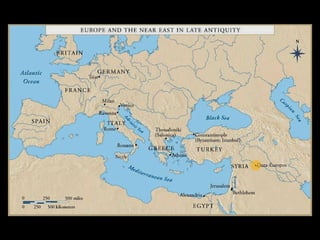
Let's go back to where it all began… Ancient Jewish art goes over centuries ago. In those times the prevalent opinion was that creating art by drawing and sculpting was a violation of the  second commandment  " graven images".  Despite this approach, Jewish people had a need to express their longing for beauty and art. Their solution was found by focusing on adornment of their ceremonial objects and producing less by using graphic arts. It can be traced back to the sources You can find several historical reports documenting the creation of Jewish art throughout history. Take the Bible for example; it records the building of  altars  and later of a  tabernacle  that the Israelites carried through their desert wandering when led out of Egypt. These creations all accumulate to one historical figure, do you know who I'm talking about? The first creator ancient Jewish art The first Jewish artist on record was named  Bezalel . He was an  architect, sculptor and designer of holy garments . Mostly he was known for making the Tabernacle that contained the  Ark of the Covenant . Now let's move to a matter that may be puzzling you right about now… With centuries of creating why do so few objects remain? Unfortunately, because the Jews were exiled and persecuted over the years, many ancient  Jewish art objects created prior to the sixteenth century did not survive . Among the items that have remained are the beautiful mosaics of  Beth Alpha in Israel  and segments of an ancient synagogue in  Duro-Europos, Syria.  But this is not all!
Another reason for the rareness of these objects After the  Babylonian Captivity , Jewish cultural advancement slowed down, Jews became  scattered  throughout the globe, wandering and persecuted. Those living in Europe were not permitted to take part in the creation of art. This was because  art was considered to be under the influence of the church.  So how did this all change? The turning point… This approach began fading towards the end of the eighteen century with the growing popularity of the  spirit of emancipation and the emphasis on education . This change eventually opened the doors of art academies to Jews. Parallel to this development there grew an interest in and demand for  Judaica. The most significant development Around this time, the  Zionist movement  began to grow and the link to the land of Israel as the home of the Jewish nation became stronger. The  Bezalel School of the Arts  was founded in Jerusalem  in 1906 . And headed by its founder,  Boris Schatz , it led the first modern movement to create a  contemporary Jewish style of art. When contemporary and ancient come together Jewish ceremonial art created today is influenced by the spirit of the Bezalel School but also takes the liberty to combine a  variety of antique styles with modern materials such as glass, plastic and porcelain.  These items are purchased all over the world, some bought by collectors, some to be used when worshiping God and others as valued gifts. But always, using Jewish art strengthens your belief in the continuity of Jewish history and cultural development
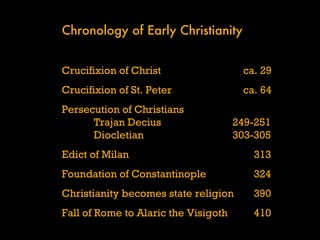
Chronology of Early Christianity Crucifixion of Christ   ca. 29 Crucifixion of St. Peter   ca. 64 Persecution of Christians Trajan Decius   249-251 Diocletian   303-305 Edict of Milan 313 Foundation of Constantinople 324 Christianity becomes state religion 390 Fall of Rome to Alaric the Visigoth 410
 
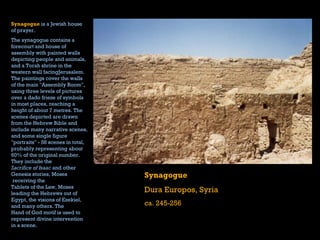
Synagogue Dura Europos, Syria ca. 245-256 Synagogue   is a  Jewish  house of prayer.   The synagogue contains a forecourt and house of assembly with painted walls depicting people and animals, and a  Torah  shrine in the western wall facing Jerusalem . The paintings cover the walls of the main "Assembly Room", using three levels of pictures over a  dado   frieze  of symbols in most places, reaching a height of about 7 metres. The scenes depicted are drawn from the  Hebrew Bible  and include many narrative scenes, and some single figure "portraits" - 58 scenes in total, probably representing about 60% of the original number. They include the  Sacrifice of Isaac  and other  Genesis  stories,  Moses  receiving the  Tablets of the Law , Moses leading the  Hebrews  out of  Egypt , the visions of  Ezekiel , and many others. The  Hand of God   motif  is used to represent divine intervention in a scene. 
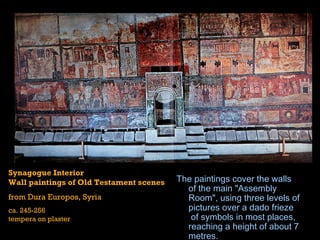
The paintings cover the walls of the main "Assembly Room", using three levels of pictures over a  dado   frieze  of symbols in most places, reaching a height of about 7 metres. Synagogue Interior Wall paintings of Old Testament scenes from Dura Europos, Syria ca. 245-256 tempera on plaster
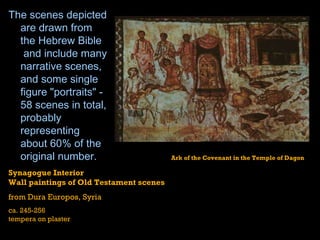
The scenes depicted are drawn from the  Hebrew Bible  and include many narrative scenes, and some single figure "portraits" - 58 scenes in total, probably representing about 60% of the original number. Synagogue Interior Wall paintings of Old Testament scenes from Dura Europos, Syria ca. 245-256 tempera on plaster Ark of the Covenant in the Temple of Dagon
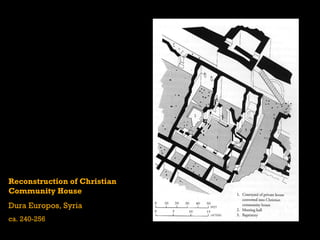
Reconstruction of Christian  Community House Dura Europos, Syria ca. 240-256
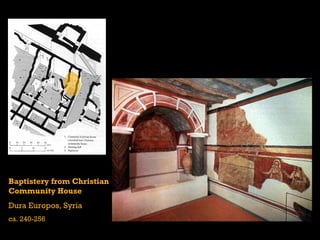
Baptistery from Christian  Community House Dura Europos, Syria ca. 240-256
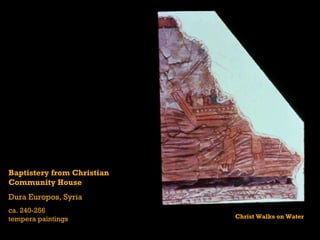
Baptistery from Christian  Community House Dura Europos, Syria ca. 240-256 tempera paintings Christ Walks on Water
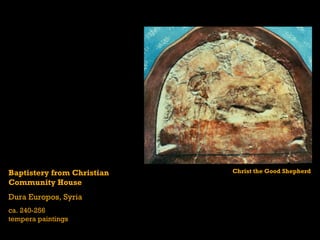
Baptistery from Christian  Community House Dura Europos, Syria ca. 240-256 tempera paintings Christ the Good Shepherd
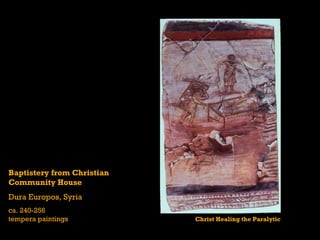
Baptistery from Christian  Community House Dura Europos, Syria ca. 240-256 tempera paintings Christ Healing the Paralytic
 
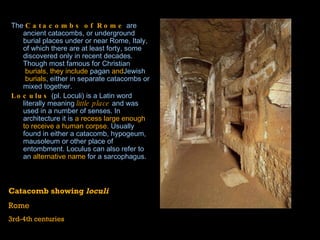
The  Catacombs of Rome  are ancient  catacombs , or underground burial places under or near  Rome ,  Italy , of which there are at least forty, some discovered only in recent decades. Though most famous for  Christian  burials, they include  pagan  and Jewish  burials , either in separate catacombs or mixed together. Loculus  (pl. Loculi) is a Latin word literally meaning  little place  and was used in a number of senses. In architecture it is  a recess large enough to receive a human corpse.  Usually found in either a  catacomb ,  hypogeum ,  mausoleum  or other place of entombment. Loculus can also refer to an  alternative name  for a  sarcophagus .    Catacomb showing  loculi Rome 3rd-4th centuries
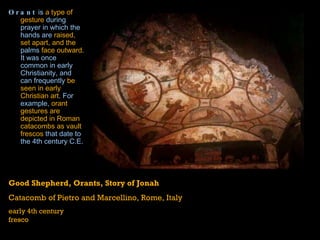
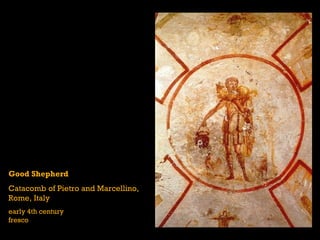
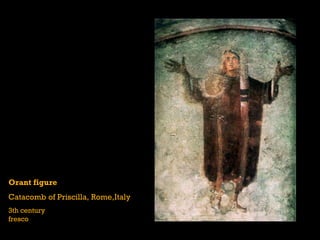
Orant  is  a type of gesture  during  prayer  in which the hands are  raised, set apart, and the  palms  face outward.  It was once common in early  Christianity , and can frequently  be seen in early Christian art . For example,  orant gestures are depicted in Roman catacombs as vault frescos  that date to the 4th century C.E.   Good Shepherd, Orants, Story of Jonah Catacomb of Pietro and Marcellino, Rome, Italy early 4th century fresco
Good Shepherd Catacomb of Pietro and Marcellino, Rome, Italy early 4th century fresco
Orant figure Catacomb of Priscilla, Rome,Italy 3th century fresco
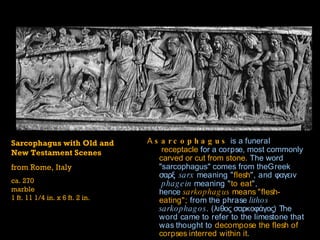
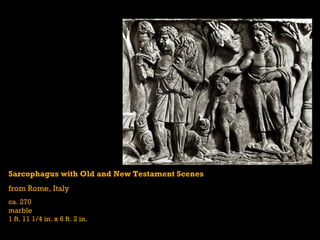
A  sarcophagus  is a  funeral   receptacle  for a  corpse , most commonly  carved or cut from stone.  The word "sarcophagus" comes from the Greek   σαρξ   sarx  meaning " flesh ", and  φαγειν   phagein  meaning " to eat ", hence  sarkophagus  means "flesh-eating";  from the phrase  lithos sarkophagos . ( λιθος   σαρκοφάγος ) The word came to refer to the  limestone  that was thought to  decompose the flesh of corpses interred within it . Sarcophagus with Old and New Testament Scenes from Rome, Italy ca. 270 marble 1 ft. 11 1/4 in. x 6 ft. 2 in.
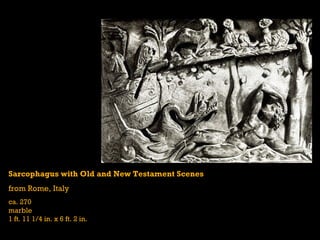
Sarcophagus with Old and New Testament Scenes from Rome, Italy ca. 270 marble 1 ft. 11 1/4 in. x 6 ft. 2 in.
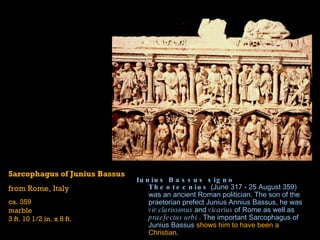
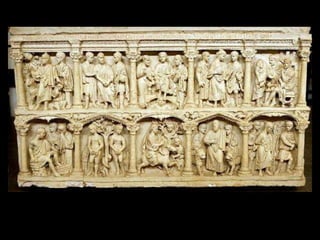
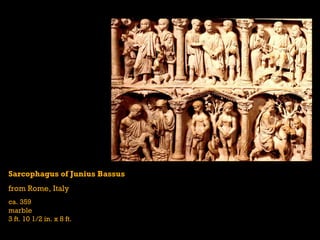
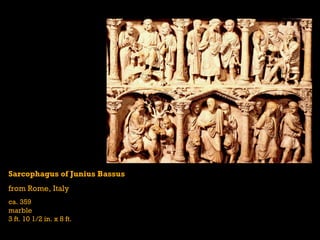
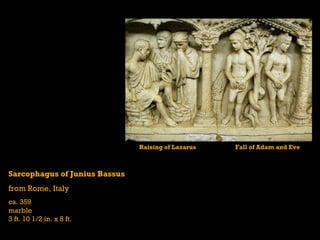
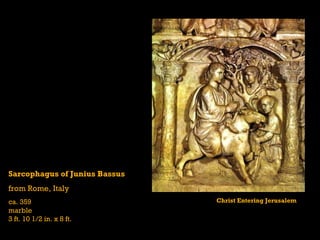
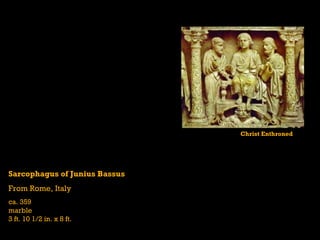
Iunius Bassus signo Theotecnius  (June 317 - 25 August 359) was an  ancient Roman  politician. The son of the  praetorian prefect   Junius   Annius   Bassus , he was  vir   clarissimus  and  vicarius  of Rome as well as  praefectus   urbi  . The important  Sarcophagus of  Junius   Bassus   shows him to have been a Christian .  Sarcophagus of Junius Bassus from Rome, Italy ca. 359 marble 3 ft. 10 1/2 in. x 8 ft.
 
Early Christian Art -This is the art and architecture produced for the unsplited Christian church. This art extends over the Late Antique period, Roman art and architecture (the late 2nd - 7th century), and the Byzantine art and architecture (from 5th - 7th century).       Before the Edict of Milan (313), which made Christianity the Roman Empire's state religion,  Christian art was restricted to the decoration of the hidden places of worship . Most early religious artists worked in manner that was  derived from Roman art, appropriately stylized to suit the spirituality of the religion .  Early Christians  used the  same artistic media as the surrounding pagan culture. These media included  fresco ,  mosaics ,  sculpture , and  manuscript illumination . Early Christian art  not only used Roman forms, it also used Roman styles . Late classical style included a  proportional portrayal of the human body  and  impressionistic presentation of space . Late classical style is seen in early Christian frescos, such as those in the catacombs of Rome.
Sarcophagus of Junius Bassus from Rome, Italy ca. 359 marble 3 ft. 10 1/2 in. x 8 ft.
Sarcophagus of Junius Bassus from Rome, Italy ca. 359 marble 3 ft. 10 1/2 in. x 8 ft. Raising of Lazarus    Fall of Adam and Eve
Sarcophagus of Junius Bassus from Rome, Italy ca. 359 marble 3 ft. 10 1/2 in. x 8 ft. Christ Entering Jerusalem
Sarcophagus of Junius Bassus From Rome, Italy ca. 359 marble 3 ft. 10 1/2 in. x 8 ft. Christ Enthroned
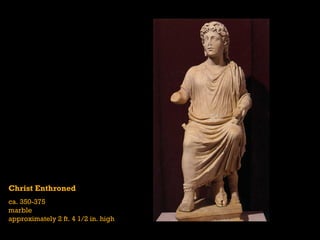
Christ Enthroned ca. 350-375 marble approximately 2 ft. 4 1/2 in. high
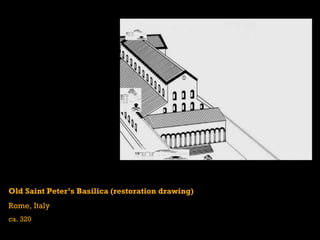
Old Saint Peter’s Basilica (restoration drawing) Rome, Italy ca. 320
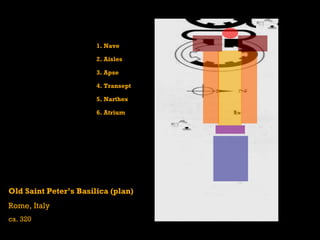
Old Saint Peter’s Basilica (plan) Rome, Italy ca. 320 1. Nave 2. Aisles 3. Apse 4. Transept 5. Narthex 6. Atrium
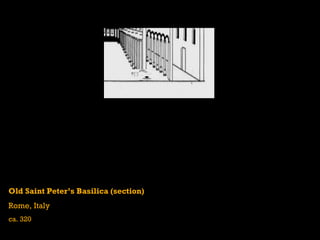
Old Saint Peter’s Basilica (section) Rome, Italy ca. 320
 
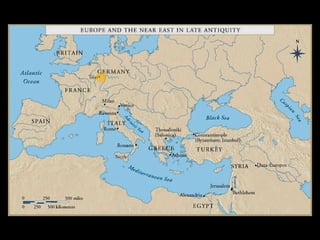
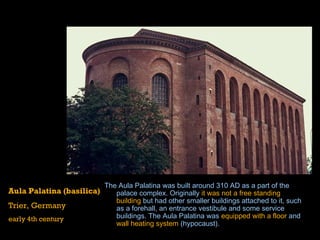
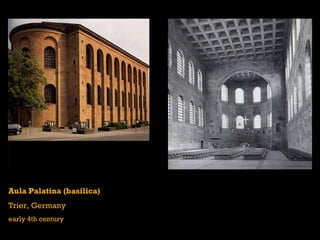
The Aula Palatina was built around  310  AD as a part of the  palace  complex. Originally  it was not a free standing building  but had other smaller buildings attached to it, such as a forehall, an entrance  vestibule  and some service buildings. The Aula Palatina was  equipped with a floor  and  wall heating system  ( hypocaust ).  Aula Palatina (basilica) Trier, Germany early 4th century
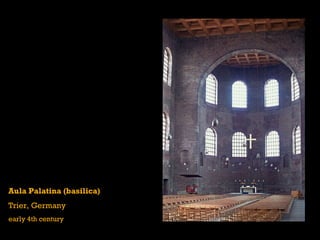
Aula Palatina (basilica) Trier, Germany early 4th century
 
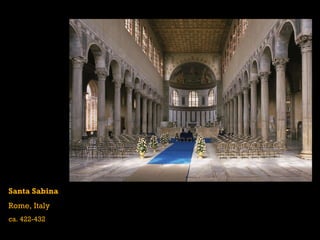
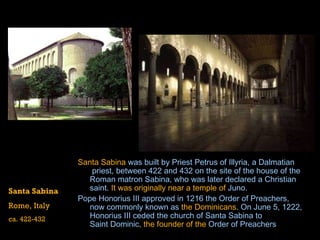
Santa Sabina  was built by  Priest  Petrus  of  Illyria , a  Dalmatian  priest, between 422 and 432 on the site of the house of the Roman matron  Sabina , who was later declared a Christian saint.  It was originally near a temple of   Juno .  Pope  Honorius  III  approved in 1216 the  Order of Preachers , now commonly known as  the Dominicans . On June 5, 1222, Honorius III ceded the church of Santa Sabina to  Saint Dominic , the founder of the  Order of Preachers   Santa Sabina Rome, Italy ca. 422-432
Santa Sabina Rome, Italy ca. 422-432
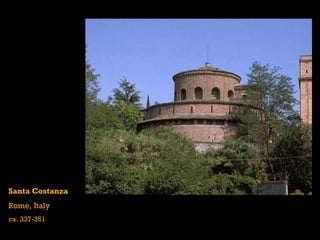
Santa Costanza Rome, Italy ca. 337-351
The church was built under  Constantine , probably  by Constantina , next to the cemetery of  Sant'Agnese   fuori  le  mura , where  Saint Agnes , who allegedly had healed Constantina, was buried. After their deaths, Constantine's daughters  Constantina and Helena  were buried here [1] . Since Constantina was venerated as saint, the mausoleum was consecrated as a church in  1254  by  Pope Alexander IV .  Santa Costanza Rome, Italy ca. 337-351
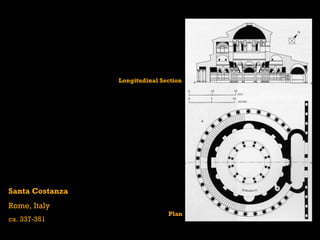
Santa Costanza Rome, Italy ca. 337-351 Longitudinal Section Plan
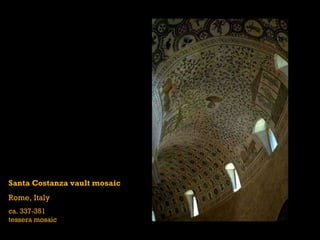
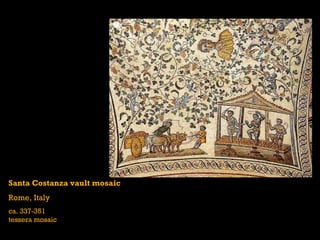
Santa Costanza vault mosaic Rome, Italy ca. 337-351 tessera mosaic
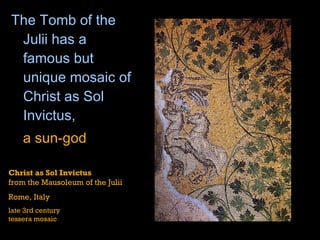
The  Tomb of the  Julii  has a famous but unique  mosaic  of Christ as  Sol  Invictus ,  a sun-god  Christ as Sol Invictus from the Mausoleum of the Julii Rome, Italy late 3rd century tessera mosaic
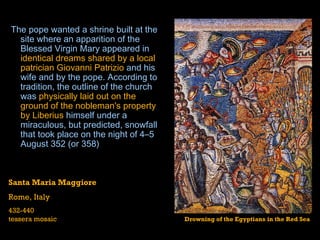
  The pope wanted a  shrine  built at the site where an  apparition  of the  Blessed Virgin Mary  appeared in  identical dreams shared by a local patrician Giovanni Patrizio  and his wife and by the pope. According to tradition, the outline of the church was  physically laid out on the ground of the nobleman's property by Liberius  himself under a miraculous, but predicted, snowfall that took place on the night of 4–5 August 352 (or 358)  Santa Maria Maggiore Rome, Italy 432-440 tessera mosaic Drowning of the Egyptians in the Red Sea
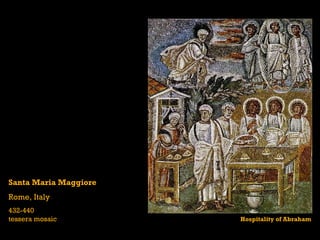
Santa Maria Maggiore Rome, Italy 432-440 tessera mosaic Hospitality of Abraham
 
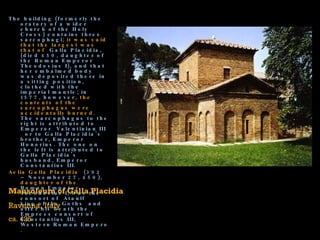
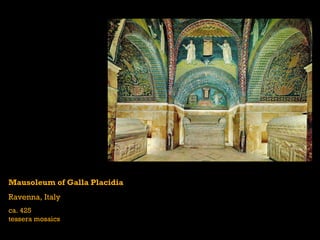
The building (formerly the oratory of a wider church of the Holy Cross) contains three  sarcophagi ;  it was said that the largest was that of  Galla   Placidia , (died 450, daughter of the Roman Emperor  Theodosius I ), and that her embalmed body was deposited there in a sitting position, clothed with the imperial mantle; in 1577, however,  the contents of the sarcophagus were accidentally burned . The sarcophagus to the right is attributed to Emperor  Valentinian  III  or to Galla Placidia's brother, Emperor  Honorius . The one on the left is attributed to Galla Placidia's husband, Emperor  Constantius  III .  Aelia Galla Placidia  (392 – November 27, 450),  daughter of the  Roman Emperor   Theodosius I , was the consort of  Ataulf   king of the Goths  and after his death the Empress consort of  Constantius  III ,  Western Roman Emperor .   Mausoleum of Galla Placidia Ravenna, Italy ca. 425
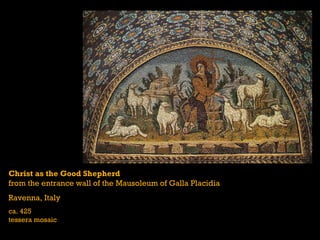
Christ as the Good Shepherd from the entrance wall of the Mausoleum of Galla Placidia Ravenna, Italy ca. 425 tessera mosaic
Mausoleum of Galla Placidia Ravenna, Italy ca. 425 tessera mosaics
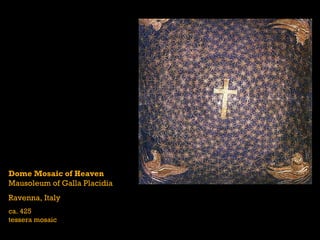
Dome Mosaic of Heaven Mausoleum of Galla Placidia Ravenna, Italy ca. 425 tessera mosaic
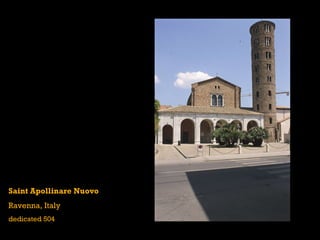
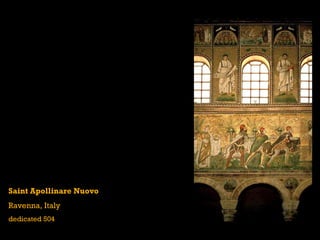
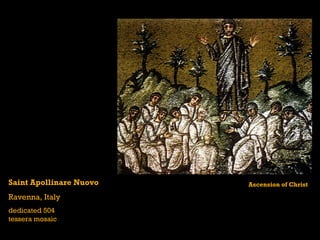
Saint Apollinare Nuovo Ravenna, Italy dedicated 504
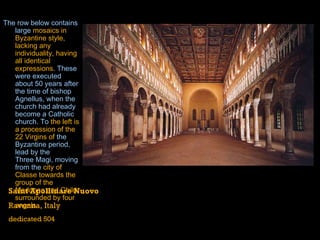
The row below contains large  mosaics in Byzantine style, lacking any individuality, having all identical expressions . These were executed about 50 years after the time of bishop Agnellus, when the church had already become a Catholic church. To  the left is a procession of the 22 Virgins of  the  Byzantine  period, lead by the  Three Magi , moving from the  city of Classe towards the group of the Madonna and Child surrounded by four angels.   Saint Apollinare Nuovo Ravenna, Italy dedicated 504
Saint Apollinare Nuovo Ravenna, Italy dedicated 504
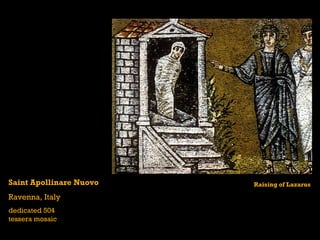
Saint Apollinare Nuovo Ravenna, Italy dedicated 504 tessera mosaic Raising of Lazarus
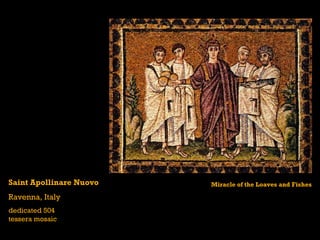
Saint Apollinare Nuovo Ravenna, Italy dedicated 504 tessera mosaic Miracle of the Loaves and Fishes
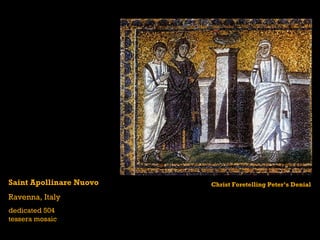
Saint Apollinare Nuovo Ravenna, Italy dedicated 504 tessera mosaic Christ Foretelling Peter’s Denial
Saint Apollinare Nuovo Ravenna, Italy dedicated 504 tessera mosaic Ascension of Christ
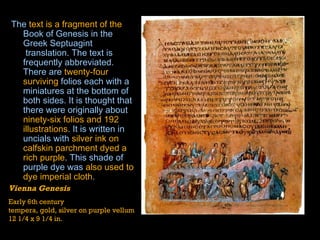
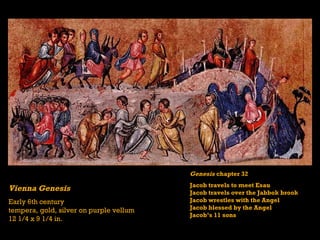
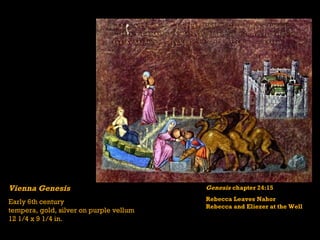
The  text is a fragment of the   Book of Genesis  in the Greek  Septuagint  translation. The text is frequently abbreviated. There are  twenty-four surviving   folios  each with a miniatures at the bottom of both sides. It is thought that there were originally about  ninety-six folios and 192 illustrations . It is written in  uncials  with  silver ink on calfskin parchment dyed a rich purple . This shade of purple dye was  also used to dye imperial cloth .  Vienna Genesis Early 6th century tempera, gold, silver on purple vellum 12 1/4 x 9 1/4 in.
Vienna Genesis Early 6th century tempera, gold, silver on purple vellum 12 1/4 x 9 1/4 in. Genesis  chapter 32 Jacob travels to meet Esau Jacob travels over the Jabbok brook Jacob wrestles with the Angel Jacob blessed by the Angel Jacob’s 11 sons
Vienna Genesis Early 6th century tempera, gold, silver on purple vellum 12 1/4 x 9 1/4 in. Genesis  chapter 24:15 Rebecca Leaves Nahor  Rebecca and Eliezer at the Well
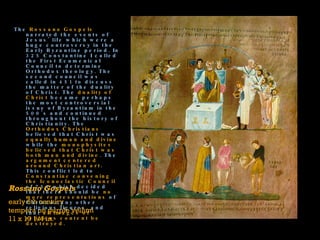
The  Rossano Gospels  narrated the events of Jesus' life which were a huge controversy in the Early Byzantine period. In 325 Constantine I called the First Ecumenical Council to determine Orthodox theology. The second council was called in 451 to discuss the matter of the duality of Christ. The  duality of Christ  became perhaps the most controversial issue of Byzantium in the 500's and continued throughout the history of Christianity. The  Orthodox Christians  believed that Christ was  equally human and divine  while the  monophysites believed that Christ was both man and divine . The  argument centered around Christian art . This conflict led to  Constantine convening the Iconoclastic Council  of 754 which decided that there should be  no more representations  of Christ or any other religious figures, and that  all images of religious content be destroyed.    Rossano Gospels early 6th century tempera on purple vellum 11 x 10 1/4 in.
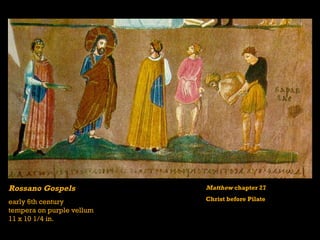
Rossano Gospels early 6th century tempera on purple vellum 11 x 10 1/4 in. Matthew  chapter 27 Christ before Pilate
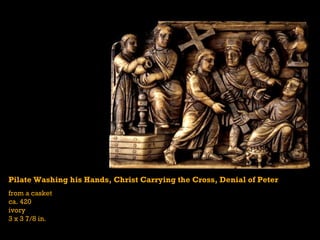
Pilate Washing his Hands, Christ Carrying the Cross, Denial of Peter from a casket ca. 420 ivory 3 x 3 7/8 in.
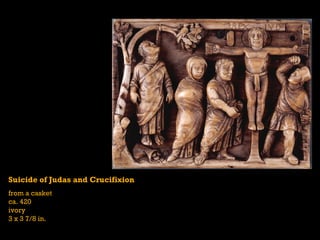
Suicide of Judas and Crucifixion from a casket ca. 420 ivory 3 x 3 7/8 in.
 

EArly Christian

  • 1.
    Late Antique and Early Christian Art William V. Ganis, PhD
  • 2.
    Judaism  is the" religion ,  philosophy , and way of life" of the  Jewish people . [1]  Judaism, originating in the Hebrew Bible (also known as the Tanakh ) and explored in later texts such as the  Talmud , is considered by Jews to be the expression of the covenantal relationship  God developed with the  Children of Israel . -Wikipedia
  • 3.
  • 4.
    Let's go backto where it all began… Ancient Jewish art goes over centuries ago. In those times the prevalent opinion was that creating art by drawing and sculpting was a violation of the second commandment " graven images". Despite this approach, Jewish people had a need to express their longing for beauty and art. Their solution was found by focusing on adornment of their ceremonial objects and producing less by using graphic arts. It can be traced back to the sources You can find several historical reports documenting the creation of Jewish art throughout history. Take the Bible for example; it records the building of altars and later of a tabernacle that the Israelites carried through their desert wandering when led out of Egypt. These creations all accumulate to one historical figure, do you know who I'm talking about? The first creator ancient Jewish art The first Jewish artist on record was named Bezalel . He was an architect, sculptor and designer of holy garments . Mostly he was known for making the Tabernacle that contained the Ark of the Covenant . Now let's move to a matter that may be puzzling you right about now… With centuries of creating why do so few objects remain? Unfortunately, because the Jews were exiled and persecuted over the years, many ancient Jewish art objects created prior to the sixteenth century did not survive . Among the items that have remained are the beautiful mosaics of Beth Alpha in Israel and segments of an ancient synagogue in Duro-Europos, Syria. But this is not all!
  • 5.
    Another reason forthe rareness of these objects After the Babylonian Captivity , Jewish cultural advancement slowed down, Jews became scattered throughout the globe, wandering and persecuted. Those living in Europe were not permitted to take part in the creation of art. This was because art was considered to be under the influence of the church. So how did this all change? The turning point… This approach began fading towards the end of the eighteen century with the growing popularity of the spirit of emancipation and the emphasis on education . This change eventually opened the doors of art academies to Jews. Parallel to this development there grew an interest in and demand for Judaica. The most significant development Around this time, the Zionist movement began to grow and the link to the land of Israel as the home of the Jewish nation became stronger. The Bezalel School of the Arts was founded in Jerusalem in 1906 . And headed by its founder, Boris Schatz , it led the first modern movement to create a contemporary Jewish style of art. When contemporary and ancient come together Jewish ceremonial art created today is influenced by the spirit of the Bezalel School but also takes the liberty to combine a variety of antique styles with modern materials such as glass, plastic and porcelain. These items are purchased all over the world, some bought by collectors, some to be used when worshiping God and others as valued gifts. But always, using Jewish art strengthens your belief in the continuity of Jewish history and cultural development
  • 6.
    Chronology of EarlyChristianity Crucifixion of Christ ca. 29 Crucifixion of St. Peter ca. 64 Persecution of Christians Trajan Decius 249-251 Diocletian 303-305 Edict of Milan 313 Foundation of Constantinople 324 Christianity becomes state religion 390 Fall of Rome to Alaric the Visigoth 410
  • 7.
  • 8.
    Synagogue Dura Europos,Syria ca. 245-256 Synagogue   is a  Jewish  house of prayer. The synagogue contains a forecourt and house of assembly with painted walls depicting people and animals, and a  Torah  shrine in the western wall facing Jerusalem . The paintings cover the walls of the main "Assembly Room", using three levels of pictures over a  dado   frieze  of symbols in most places, reaching a height of about 7 metres. The scenes depicted are drawn from the  Hebrew Bible  and include many narrative scenes, and some single figure "portraits" - 58 scenes in total, probably representing about 60% of the original number. They include the  Sacrifice of Isaac  and other  Genesis  stories,  Moses  receiving the  Tablets of the Law , Moses leading the  Hebrews  out of  Egypt , the visions of  Ezekiel , and many others. The  Hand of God   motif  is used to represent divine intervention in a scene. 
  • 9.
    The paintings coverthe walls of the main "Assembly Room", using three levels of pictures over a  dado   frieze  of symbols in most places, reaching a height of about 7 metres. Synagogue Interior Wall paintings of Old Testament scenes from Dura Europos, Syria ca. 245-256 tempera on plaster
  • 10.
    The scenes depictedare drawn from the  Hebrew Bible  and include many narrative scenes, and some single figure "portraits" - 58 scenes in total, probably representing about 60% of the original number. Synagogue Interior Wall paintings of Old Testament scenes from Dura Europos, Syria ca. 245-256 tempera on plaster Ark of the Covenant in the Temple of Dagon
  • 11.
    Reconstruction of Christian Community House Dura Europos, Syria ca. 240-256
  • 12.
    Baptistery from Christian Community House Dura Europos, Syria ca. 240-256
  • 13.
    Baptistery from Christian Community House Dura Europos, Syria ca. 240-256 tempera paintings Christ Walks on Water
  • 14.
    Baptistery from Christian Community House Dura Europos, Syria ca. 240-256 tempera paintings Christ the Good Shepherd
  • 15.
    Baptistery from Christian Community House Dura Europos, Syria ca. 240-256 tempera paintings Christ Healing the Paralytic
  • 16.
  • 17.
    The  Catacombs ofRome  are ancient  catacombs , or underground burial places under or near  Rome ,  Italy , of which there are at least forty, some discovered only in recent decades. Though most famous for  Christian  burials, they include  pagan  and Jewish  burials , either in separate catacombs or mixed together. Loculus  (pl. Loculi) is a Latin word literally meaning  little place  and was used in a number of senses. In architecture it is a recess large enough to receive a human corpse. Usually found in either a  catacomb ,  hypogeum ,  mausoleum  or other place of entombment. Loculus can also refer to an alternative name for a  sarcophagus .   Catacomb showing loculi Rome 3rd-4th centuries
  • 18.
    Orant  is a type of gesture during  prayer  in which the hands are raised, set apart, and the  palms  face outward. It was once common in early Christianity , and can frequently be seen in early Christian art . For example, orant gestures are depicted in Roman catacombs as vault frescos that date to the 4th century C.E. Good Shepherd, Orants, Story of Jonah Catacomb of Pietro and Marcellino, Rome, Italy early 4th century fresco
  • 19.
    Good Shepherd Catacombof Pietro and Marcellino, Rome, Italy early 4th century fresco
  • 20.
    Orant figure Catacombof Priscilla, Rome,Italy 3th century fresco
  • 21.
    A  sarcophagus  isa  funeral   receptacle for a  corpse , most commonly carved or cut from stone. The word "sarcophagus" comes from the Greek   σαρξ   sarx  meaning " flesh ", and  φαγειν   phagein  meaning " to eat ", hence  sarkophagus  means "flesh-eating"; from the phrase  lithos sarkophagos . ( λιθος   σαρκοφάγος ) The word came to refer to the  limestone  that was thought to decompose the flesh of corpses interred within it . Sarcophagus with Old and New Testament Scenes from Rome, Italy ca. 270 marble 1 ft. 11 1/4 in. x 6 ft. 2 in.
  • 22.
    Sarcophagus with Oldand New Testament Scenes from Rome, Italy ca. 270 marble 1 ft. 11 1/4 in. x 6 ft. 2 in.
  • 23.
    Sarcophagus with Oldand New Testament Scenes from Rome, Italy ca. 270 marble 1 ft. 11 1/4 in. x 6 ft. 2 in.
  • 24.
    Iunius Bassus signoTheotecnius  (June 317 - 25 August 359) was an  ancient Roman  politician. The son of the  praetorian prefect   Junius Annius Bassus , he was  vir clarissimus  and vicarius  of Rome as well as  praefectus urbi  . The important  Sarcophagus of Junius Bassus   shows him to have been a Christian . Sarcophagus of Junius Bassus from Rome, Italy ca. 359 marble 3 ft. 10 1/2 in. x 8 ft.
  • 25.
  • 26.
    Early Christian Art-This is the art and architecture produced for the unsplited Christian church. This art extends over the Late Antique period, Roman art and architecture (the late 2nd - 7th century), and the Byzantine art and architecture (from 5th - 7th century).      Before the Edict of Milan (313), which made Christianity the Roman Empire's state religion, Christian art was restricted to the decoration of the hidden places of worship . Most early religious artists worked in manner that was derived from Roman art, appropriately stylized to suit the spirituality of the religion . Early Christians  used the same artistic media as the surrounding pagan culture. These media included  fresco ,  mosaics ,  sculpture , and manuscript illumination . Early Christian art not only used Roman forms, it also used Roman styles . Late classical style included a proportional portrayal of the human body and impressionistic presentation of space . Late classical style is seen in early Christian frescos, such as those in the catacombs of Rome.
  • 27.
    Sarcophagus of JuniusBassus from Rome, Italy ca. 359 marble 3 ft. 10 1/2 in. x 8 ft.
  • 28.
    Sarcophagus of JuniusBassus from Rome, Italy ca. 359 marble 3 ft. 10 1/2 in. x 8 ft.
  • 29.
    Sarcophagus of JuniusBassus from Rome, Italy ca. 359 marble 3 ft. 10 1/2 in. x 8 ft. Raising of Lazarus Fall of Adam and Eve
  • 30.
    Sarcophagus of JuniusBassus from Rome, Italy ca. 359 marble 3 ft. 10 1/2 in. x 8 ft. Christ Entering Jerusalem
  • 31.
    Sarcophagus of JuniusBassus From Rome, Italy ca. 359 marble 3 ft. 10 1/2 in. x 8 ft. Christ Enthroned
  • 32.
    Christ Enthroned ca.350-375 marble approximately 2 ft. 4 1/2 in. high
  • 33.
    Old Saint Peter’sBasilica (restoration drawing) Rome, Italy ca. 320
  • 34.
    Old Saint Peter’sBasilica (plan) Rome, Italy ca. 320 1. Nave 2. Aisles 3. Apse 4. Transept 5. Narthex 6. Atrium
  • 35.
    Old Saint Peter’sBasilica (section) Rome, Italy ca. 320
  • 36.
  • 37.
    The Aula Palatinawas built around  310  AD as a part of the  palace  complex. Originally it was not a free standing building but had other smaller buildings attached to it, such as a forehall, an entrance  vestibule  and some service buildings. The Aula Palatina was equipped with a floor and wall heating system ( hypocaust ). Aula Palatina (basilica) Trier, Germany early 4th century
  • 38.
    Aula Palatina (basilica)Trier, Germany early 4th century
  • 39.
    Aula Palatina (basilica)Trier, Germany early 4th century
  • 40.
  • 41.
    Santa Sabina was built by  Priest Petrus  of  Illyria , a  Dalmatian  priest, between 422 and 432 on the site of the house of the Roman matron  Sabina , who was later declared a Christian saint. It was originally near a temple of   Juno . Pope Honorius III  approved in 1216 the  Order of Preachers , now commonly known as the Dominicans . On June 5, 1222, Honorius III ceded the church of Santa Sabina to  Saint Dominic , the founder of the  Order of Preachers Santa Sabina Rome, Italy ca. 422-432
  • 42.
    Santa Sabina Rome,Italy ca. 422-432
  • 43.
    Santa Costanza Rome,Italy ca. 337-351
  • 44.
    The church wasbuilt under Constantine , probably by Constantina , next to the cemetery of  Sant'Agnese fuori le mura , where  Saint Agnes , who allegedly had healed Constantina, was buried. After their deaths, Constantine's daughters Constantina and Helena were buried here [1] . Since Constantina was venerated as saint, the mausoleum was consecrated as a church in  1254  by  Pope Alexander IV . Santa Costanza Rome, Italy ca. 337-351
  • 45.
    Santa Costanza Rome,Italy ca. 337-351 Longitudinal Section Plan
  • 46.
    Santa Costanza vaultmosaic Rome, Italy ca. 337-351 tessera mosaic
  • 47.
    Santa Costanza vaultmosaic Rome, Italy ca. 337-351 tessera mosaic
  • 48.
    The  Tomb ofthe Julii  has a famous but unique  mosaic  of Christ as  Sol Invictus , a sun-god Christ as Sol Invictus from the Mausoleum of the Julii Rome, Italy late 3rd century tessera mosaic
  • 49.
      The popewanted a  shrine  built at the site where an  apparition  of the  Blessed Virgin Mary  appeared in identical dreams shared by a local patrician Giovanni Patrizio and his wife and by the pope. According to tradition, the outline of the church was physically laid out on the ground of the nobleman's property by Liberius himself under a miraculous, but predicted, snowfall that took place on the night of 4–5 August 352 (or 358) Santa Maria Maggiore Rome, Italy 432-440 tessera mosaic Drowning of the Egyptians in the Red Sea
  • 50.
    Santa Maria MaggioreRome, Italy 432-440 tessera mosaic Hospitality of Abraham
  • 51.
  • 52.
    The building (formerlythe oratory of a wider church of the Holy Cross) contains three  sarcophagi ; it was said that the largest was that of  Galla Placidia , (died 450, daughter of the Roman Emperor  Theodosius I ), and that her embalmed body was deposited there in a sitting position, clothed with the imperial mantle; in 1577, however, the contents of the sarcophagus were accidentally burned . The sarcophagus to the right is attributed to Emperor  Valentinian III  or to Galla Placidia's brother, Emperor  Honorius . The one on the left is attributed to Galla Placidia's husband, Emperor  Constantius III . Aelia Galla Placidia  (392 – November 27, 450), daughter of the  Roman Emperor   Theodosius I , was the consort of  Ataulf   king of the Goths  and after his death the Empress consort of  Constantius III ,  Western Roman Emperor . Mausoleum of Galla Placidia Ravenna, Italy ca. 425
  • 53.
    Christ as theGood Shepherd from the entrance wall of the Mausoleum of Galla Placidia Ravenna, Italy ca. 425 tessera mosaic
  • 54.
    Mausoleum of GallaPlacidia Ravenna, Italy ca. 425 tessera mosaics
  • 55.
    Dome Mosaic ofHeaven Mausoleum of Galla Placidia Ravenna, Italy ca. 425 tessera mosaic
  • 56.
    Saint Apollinare NuovoRavenna, Italy dedicated 504
  • 57.
    The row belowcontains large mosaics in Byzantine style, lacking any individuality, having all identical expressions . These were executed about 50 years after the time of bishop Agnellus, when the church had already become a Catholic church. To the left is a procession of the 22 Virgins of the  Byzantine  period, lead by the  Three Magi , moving from the city of Classe towards the group of the Madonna and Child surrounded by four angels. Saint Apollinare Nuovo Ravenna, Italy dedicated 504
  • 58.
    Saint Apollinare NuovoRavenna, Italy dedicated 504
  • 59.
    Saint Apollinare NuovoRavenna, Italy dedicated 504 tessera mosaic Raising of Lazarus
  • 60.
    Saint Apollinare NuovoRavenna, Italy dedicated 504 tessera mosaic Miracle of the Loaves and Fishes
  • 61.
    Saint Apollinare NuovoRavenna, Italy dedicated 504 tessera mosaic Christ Foretelling Peter’s Denial
  • 62.
    Saint Apollinare NuovoRavenna, Italy dedicated 504 tessera mosaic Ascension of Christ
  • 63.
    The textis a fragment of the   Book of Genesis  in the Greek  Septuagint  translation. The text is frequently abbreviated. There are twenty-four surviving   folios  each with a miniatures at the bottom of both sides. It is thought that there were originally about ninety-six folios and 192 illustrations . It is written in  uncials  with silver ink on calfskin parchment dyed a rich purple . This shade of purple dye was also used to dye imperial cloth . Vienna Genesis Early 6th century tempera, gold, silver on purple vellum 12 1/4 x 9 1/4 in.
  • 64.
    Vienna Genesis Early6th century tempera, gold, silver on purple vellum 12 1/4 x 9 1/4 in. Genesis chapter 32 Jacob travels to meet Esau Jacob travels over the Jabbok brook Jacob wrestles with the Angel Jacob blessed by the Angel Jacob’s 11 sons
  • 65.
    Vienna Genesis Early6th century tempera, gold, silver on purple vellum 12 1/4 x 9 1/4 in. Genesis chapter 24:15 Rebecca Leaves Nahor Rebecca and Eliezer at the Well
  • 66.
    The RossanoGospels narrated the events of Jesus' life which were a huge controversy in the Early Byzantine period. In 325 Constantine I called the First Ecumenical Council to determine Orthodox theology. The second council was called in 451 to discuss the matter of the duality of Christ. The duality of Christ became perhaps the most controversial issue of Byzantium in the 500's and continued throughout the history of Christianity. The Orthodox Christians believed that Christ was equally human and divine while the monophysites believed that Christ was both man and divine . The argument centered around Christian art . This conflict led to Constantine convening the Iconoclastic Council of 754 which decided that there should be no more representations of Christ or any other religious figures, and that all images of religious content be destroyed.   Rossano Gospels early 6th century tempera on purple vellum 11 x 10 1/4 in.
  • 67.
    Rossano Gospels early6th century tempera on purple vellum 11 x 10 1/4 in. Matthew chapter 27 Christ before Pilate
  • 68.
    Pilate Washing hisHands, Christ Carrying the Cross, Denial of Peter from a casket ca. 420 ivory 3 x 3 7/8 in.
  • 69.
    Suicide of Judasand Crucifixion from a casket ca. 420 ivory 3 x 3 7/8 in.
  • 70.