Byzantine Art
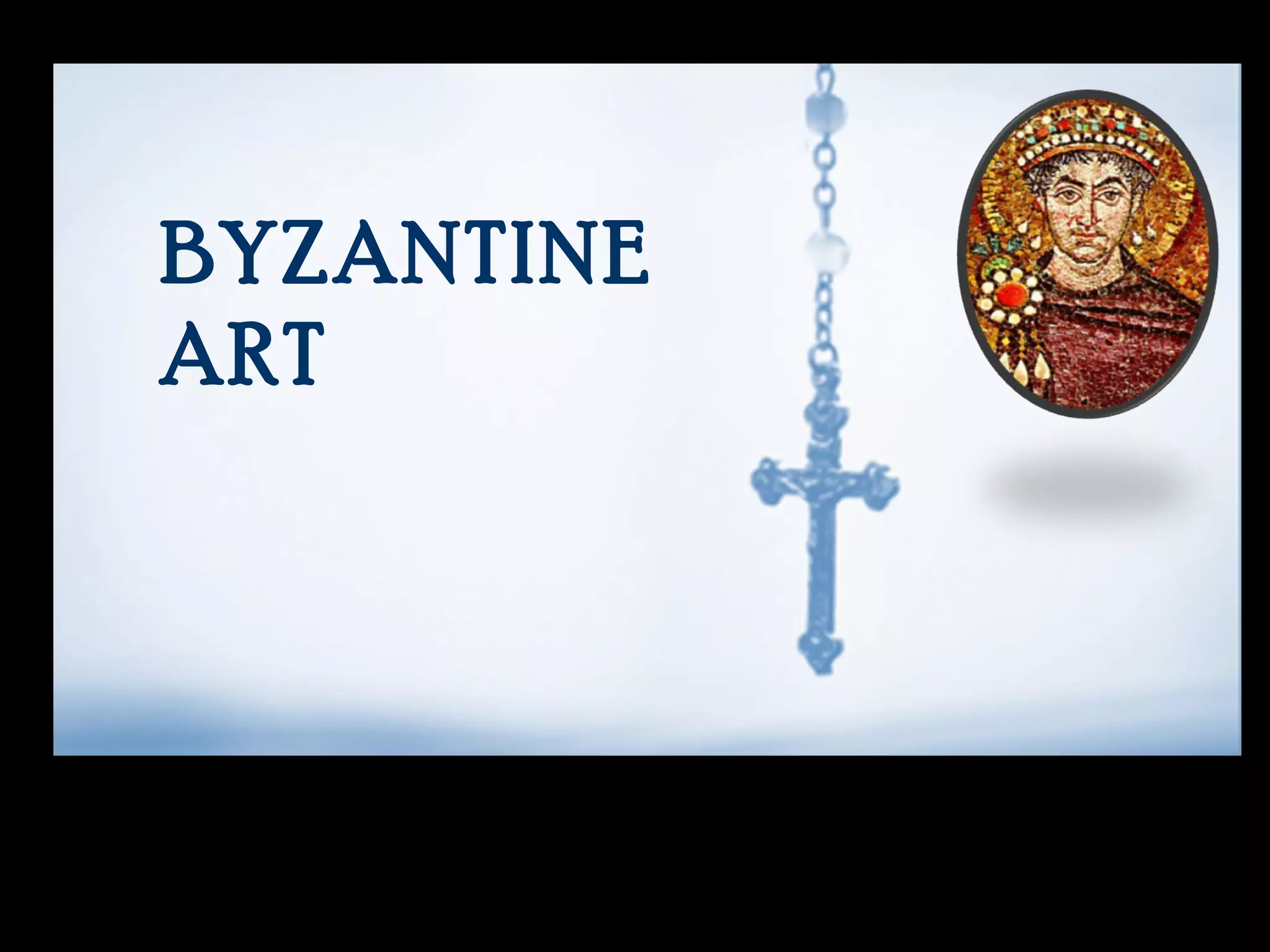
BYZANTINE
ART
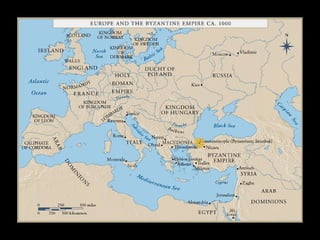
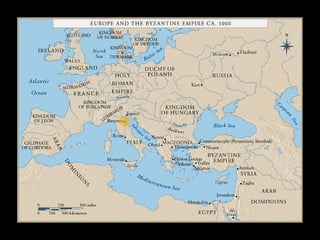
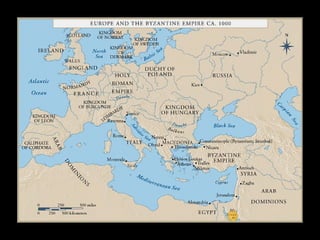
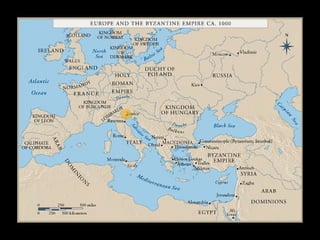
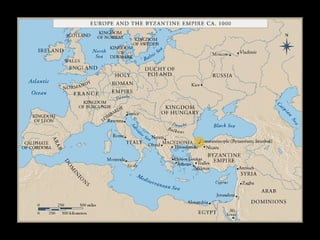
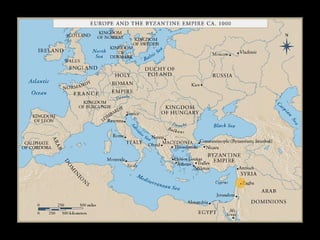
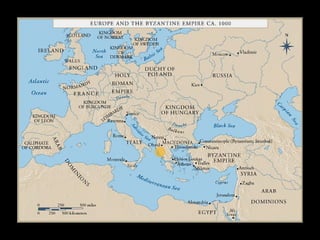
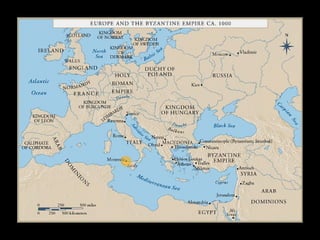
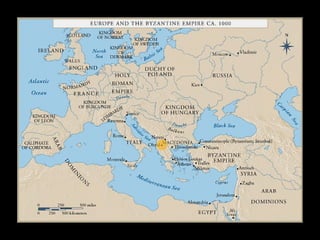
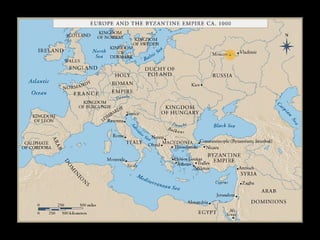
• Byzantine art belonged principally to the Eastern Roman
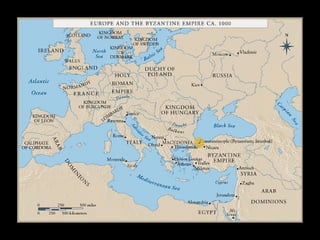
empire with its magnificent centre, Constantinople
(Istanbul)
• In 330AD the emperor constantine transferred his
capital from Rome to the site of the ancient Greek
colony called Byzantium, to which he gave his own
name: constantinople (the city of constantine)
• Byzantine Art began with foundation of the city by
constantine in 4th
century and reached its maturity in 6th
century.
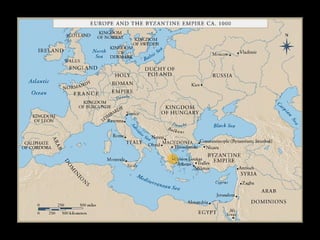
• Two golden ages mentioned in Byzatine period
• Justinian (527 – 565) – Hagia sophia, San vitale
• Basil I (867 – 1204) smaller churches – St. Mark
How constantinople imbortant
• It’s lies at southeastern tip of Europe only narrow strip of water
separate it from Asia Minor.
• Three sides sea and one side land. With excellent harbours.
(Strategically important place)
• Being in the centre of the Roman Empire, the government there
had an ideally commanding position.
• Politically and powerfully it’s centre
• Commercially it was at the cross road of two important trade or
commercial route
– Between Europe and Asia – Silk Route
– Between the Mediterranean and Black sea
• Aesthetically it’s position was outstandingly beautiful
• Strong political background in here so concerned
about security of people. Thus administration officers,
military officers occupied as democracy.
• They lived as metropolitan life with multi cultural
racial centre.
• Money economy through Trade and commerce.
• Surplus money sent to government through taxation.
So equality with out class different in social.
• That money sent to churches , cathedrals through
government’s patronage to religion.
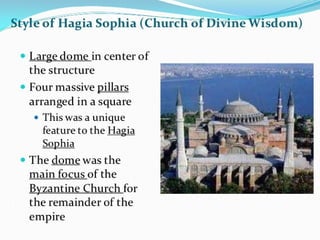
• Byzantine Architecture was predominantly an ecclesiastical or
church Art; for although contemporary writers mention the
splendor of royal palaces, the secular buildings that have
survived are few and rather unimportant.
• The byzantine church is of a central plan> if it is square or
polygonal in plan in contrast to the longitudinal type of the Early
Christian Basilica.
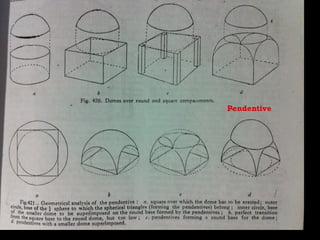
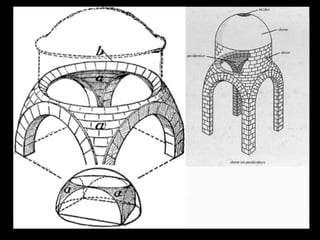
Pendentive
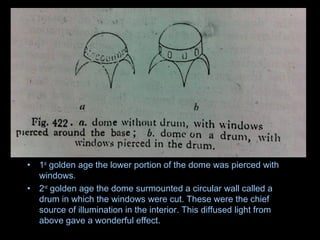
• 1st
golden age the lower portion of the dome was pierced with
windows.
• 2nd
golden age the dome surmounted a circular wall called a
drum in which the windows were cut. These were the chief
source of illumination in the interior. This diffused light from
above gave a wonderful effect.
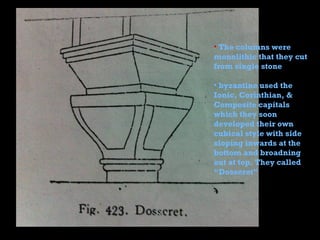
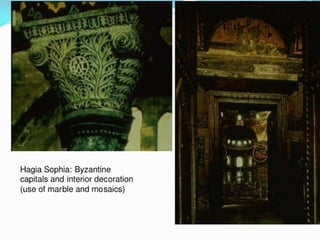
• The columns were
monolithic that they cut
from single stone
• byzantine used the
Ionic, Corinthian, &
Composite capitals
which they soon
developed their own
cubical style with side
sloping inwards at the
bottom and broadning
out at top. They called
“Dosseret”
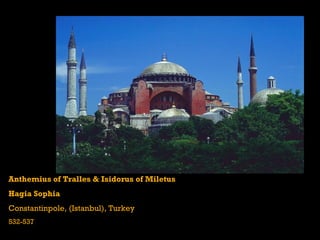
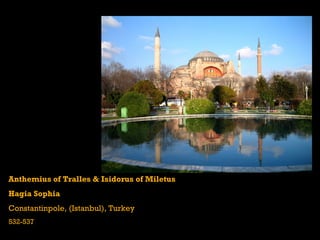
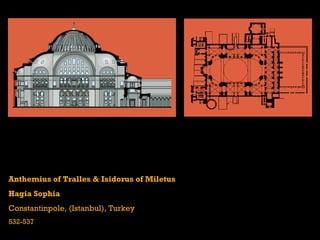
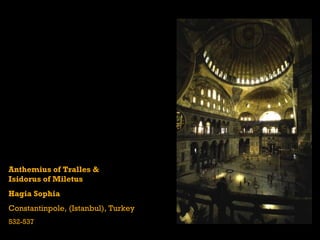
Anthemius of Tralles & Isidorus of Miletus
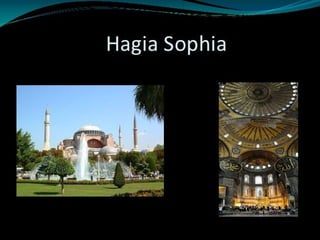
Hagia Sophia
Constantinpole, (Istanbul), Turkey
532-537
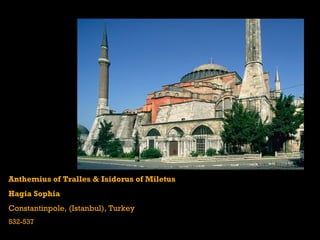
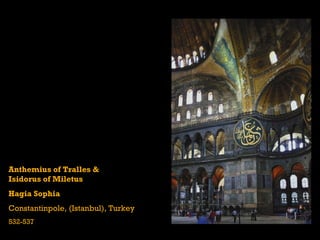
Anthemius of Tralles & Isidorus of Miletus
Hagia Sophia
Constantinpole, (Istanbul), Turkey
532-537
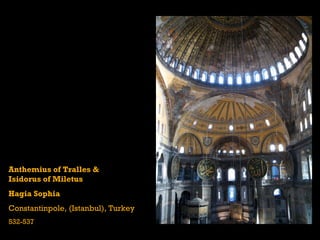
Anthemius of Tralles & Isidorus of Miletus
Hagia Sophia
Constantinpole, (Istanbul), Turkey
532-537
Anthemius of Tralles & Isidorus of Miletus
Hagia Sophia
Constantinpole, (Istanbul), Turkey
532-537
Anthemius of Tralles &
Isidorus of Miletus
Hagia Sophia
Constantinpole, (Istanbul), Turkey
532-537
Anthemius of Tralles &
Isidorus of Miletus
Hagia Sophia
Constantinpole, (Istanbul), Turkey
532-537
Anthemius of Tralles &
Isidorus of Miletus
Hagia Sophia
Constantinpole, (Istanbul), Turkey
532-537
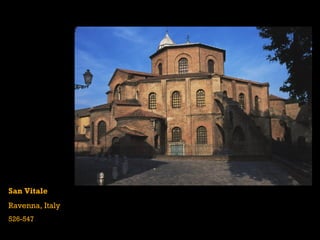
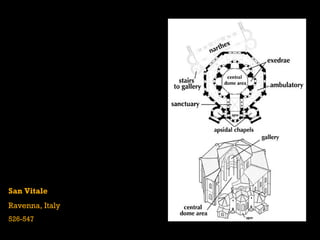
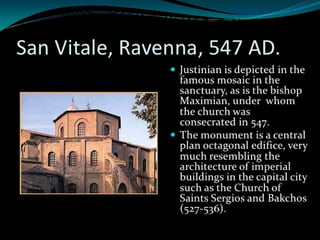
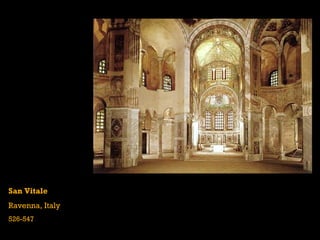
San Vitale
Ravenna, Italy
526-547
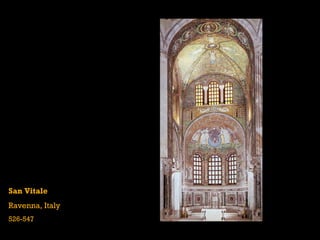
San Vitale
Ravenna, Italy
526-547
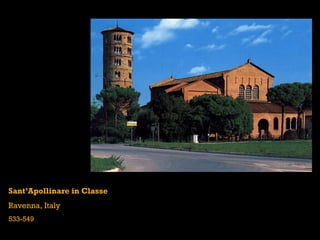
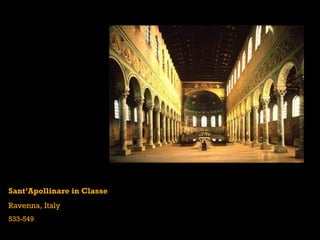
Sant’Apollinare in Classe
Ravenna, Italy
533-549
Sant’Apollinare in Classe
Ravenna, Italy
533-549
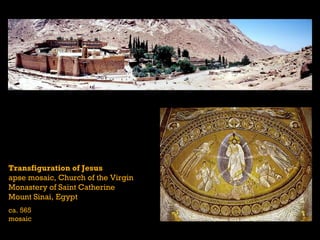
Transfiguration of Jesus
apse mosaic, Church of the Virgin
Monastery of Saint Catherine
Mount Sinai, Egypt
ca. 565
mosaic
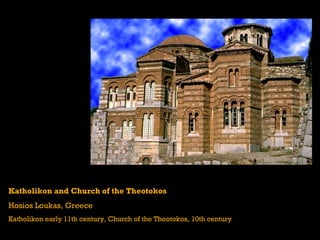
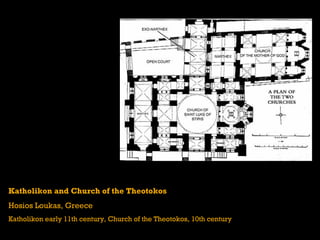
Katholikon and Church of the Theotokos
Hosios Loukas, Greece
Katholikon early 11th century, Church of the Theotokos, 10th century
Katholikon and Church of the Theotokos
Hosios Loukas, Greece
Katholikon early 11th century, Church of the Theotokos, 10th century
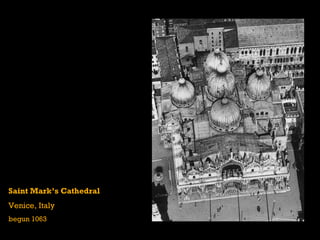
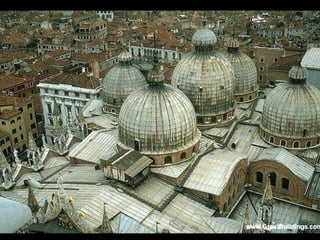
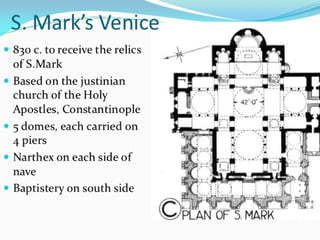
Saint Mark’s Cathedral
Venice, Italy
begun 1063
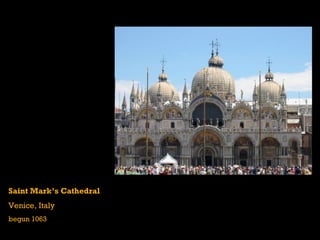
Saint Mark’s Cathedral
Venice, Italy
begun 1063
Paintings
Byzantine artists showed their greatest originality and
accomplishment in pictorial representation on flat
surface.
• Mosaics
• Wall paintings
• Manuscript illumination
• icons
Mosaics characters
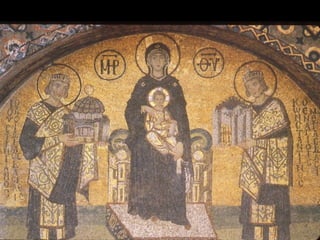
• Chief concern was spiritual rather than physical vision.
• Material details were ignored – they preferred to concentrate on
pictorial rather than sculptural art.
• Exact anatomy and representative were disregarded.
• Instead of using the landscapes of the classical style as a
background, the figures were surrounded by golden light as if
they are out side of space and time.
• Garments are heavy and stiff with stylized folds – they cover thin
elongated seemingly weightless bodies.
• instead of employing light and shade, they made clear outline
by means of vivid colors
• Stiffly stylized gestures, often repeated.
• Figures are shown in front view – three quarter view being
abandoned.
• Perspective is not confined to one vanishing point :
– the same composition may include views on the eye level, above it or
below. Multiple perspective may be included.
– Some times reverse perspective is used in place of the right one
• Not physical position but spiritual importance determine the size
of the figures..
– Every thing is deeply solemn, according to their conception of the Almighty
• The whole church was intended to symbolize heaven.
• The subjects were almost always religious, although sometimes
historical personage also shown.
– These scenes were intended to teach religion and arouse devotion.
• Mosaic scenes were arranged according to a traditional law.
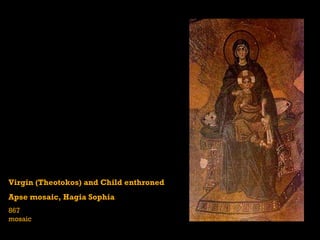
Virgin (Theotokos) and Child enthroned
Apse mosaic, Hagia Sophia
867
mosaic
San Vitale
Ravenna, Italy
526-547
San Vitale
Ravenna, Italy
526-547
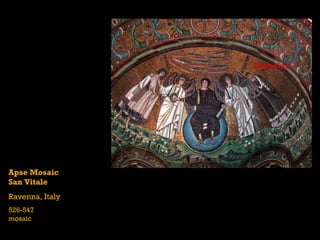
Apse Mosaic
San Vitale
Ravenna, Italy
526-547
mosaic
Ecdesius
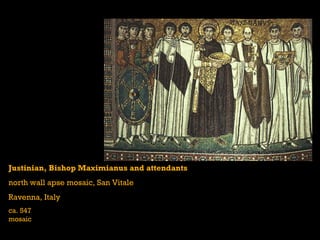
Justinian, Bishop Maximianus and attendants
north wall apse mosaic, San Vitale
Ravenna, Italy
ca. 547
mosaic
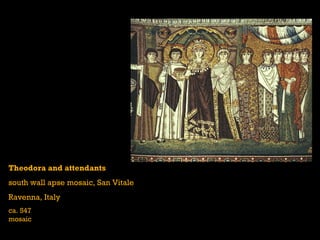
Theodora and attendants
south wall apse mosaic, San Vitale
Ravenna, Italy
ca. 547
mosaic
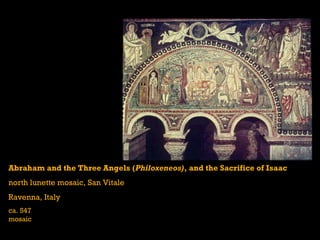
Abraham and the Three Angels (Philoxeneos), and the Sacrifice of Isaac
north lunette mosaic, San Vitale
Ravenna, Italy
ca. 547
mosaic
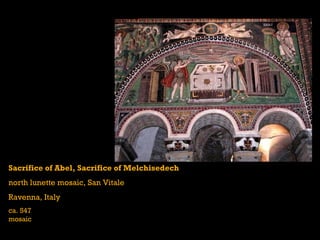
Sacrifice of Abel, Sacrifice of Melchisedech
north lunette mosaic, San Vitale
Ravenna, Italy
ca. 547
mosaic
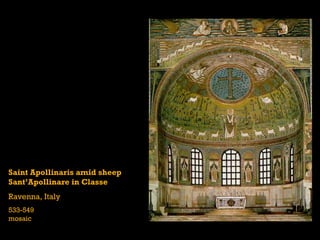
Saint Apollinaris amid sheep
Sant’Apollinare in Classe
Ravenna, Italy
533-549
mosaic
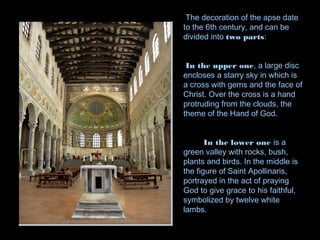
The decoration of the apse date
to the 6th century, and can be
divided into two parts:
In the upper one, a large disc
encloses a starry sky in which is
a cross with gems and the face of
Christ. Over the cross is a hand
protruding from the clouds, the
theme of the Hand of God.
In the lower one is a
green valley with rocks, bush,
plants and birds. In the middle is
the figure of Saint Apollinaris,
portrayed in the act of praying
God to give grace to his faithful,
symbolized by twelve white
lambs.
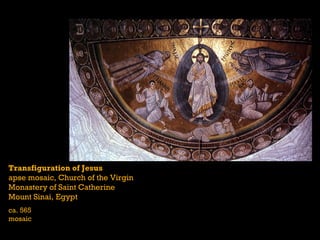
Transfiguration of Jesus
apse mosaic, Church of the Virgin
Monastery of Saint Catherine
Mount Sinai, Egypt
ca. 565
mosaic
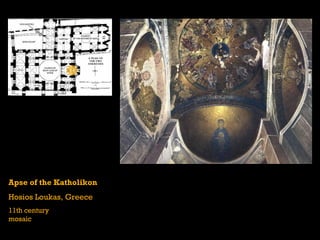
Apse of the Katholikon
Hosios Loukas, Greece
11th century
mosaic
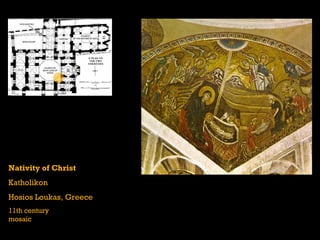
Nativity of Christ
Katholikon
Hosios Loukas, Greece
11th century
mosaic
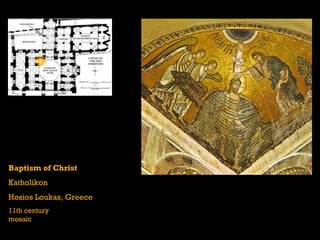
Baptism of Christ
Katholikon
Hosios Loukas, Greece
11th century
mosaic
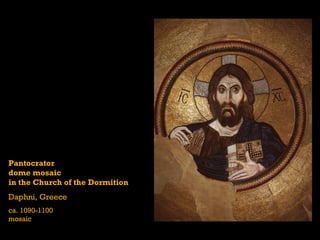
Pantocrator
dome mosaic
in the Church of the Dormition
Daphni, Greece
ca. 1090-1100
mosaic
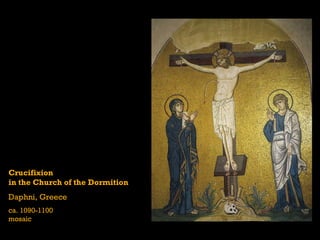
Crucifixion
in the Church of the Dormition
Daphni, Greece
ca. 1090-1100
mosaic
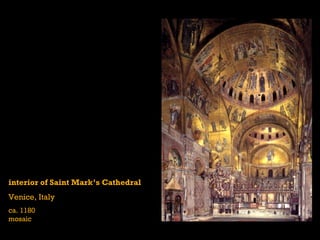
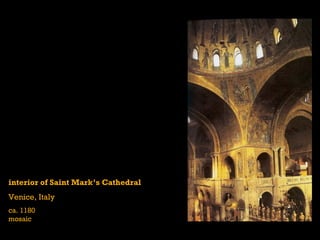
interior of Saint Mark’s Cathedral
Venice, Italy
ca. 1180
mosaic
interior of Saint Mark’s Cathedral
Venice, Italy
ca. 1180
mosaic
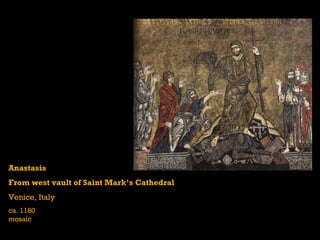
Anastasis
From west vault of Saint Mark’s Cathedral
Venice, Italy
ca. 1180
mosaic
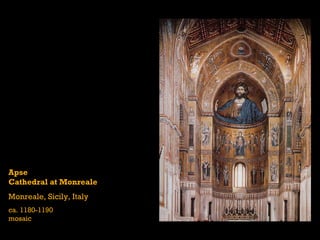
Apse
Cathedral at Monreale
Monreale, Sicily, Italy
ca. 1180-1190
mosaic
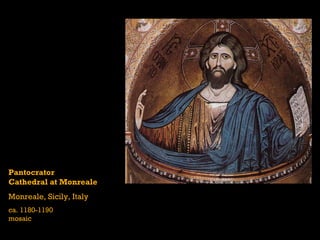
Pantocrator
Cathedral at Monreale
Monreale, Sicily, Italy
ca. 1180-1190
mosaic
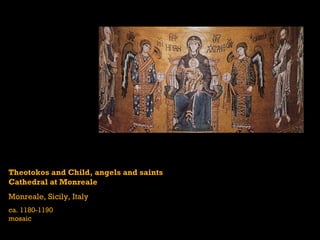
Theotokos and Child, angels and saints
Cathedral at Monreale
Monreale, Sicily, Italy
ca. 1180-1190
mosaic
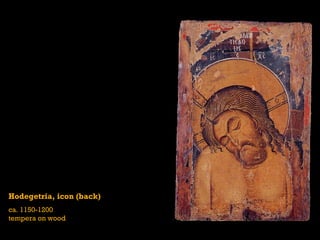
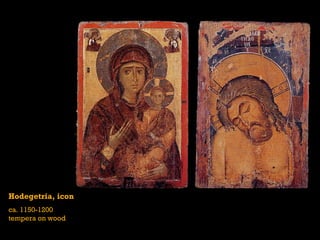
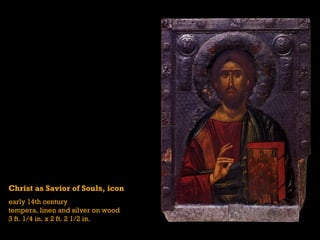
Icons
• Icons or devotional pictures for piety, with no particular story to
tell, also became more and more popular.
• They represented the Savior, the virgin Mary and Saints.
• The ground was a wooden panel, often carved with thin cloth.
• On this were painted the figures.
• The pigments were mixed with egg – white to make them adhere.
• From Constantinople, icon painting passed into the Balkans &
Russia, where the people were very fond of these pictures.
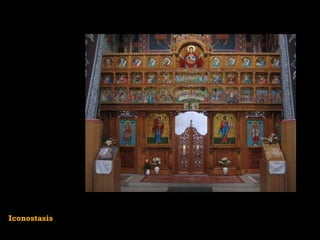
• In the 14th
Century, the iconostasis was introduced in the
churches.
• It is a wooden screen dividing the sanctuary from the nave, on
which the icons are hung in rows.
• They are also treasured in private houses.
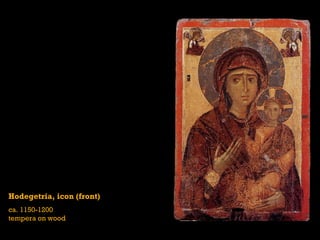
Hodegetria, icon (front)
ca. 1150-1200
tempera on wood
Hodegetria, icon (back)
ca. 1150-1200
tempera on wood
Hodegetria, icon
ca. 1150-1200
tempera on wood
Christ as Savior of Souls, icon
early 14th century
tempera, linen and silver on wood
3 ft. 1/4 in. x 2 ft. 2 1/2 in.
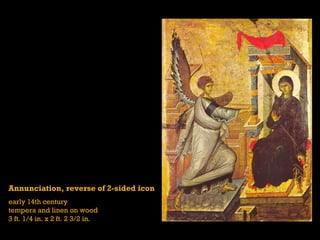
Annunciation, reverse of 2-sided icon
early 14th century
tempera and linen on wood
3 ft. 1/4 in. x 2 ft. 2 3/2 in.
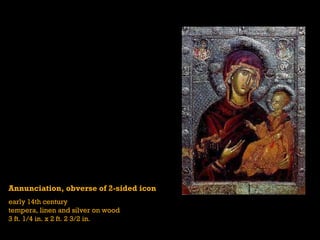
Annunciation, obverse of 2-sided icon
early 14th century
tempera, linen and silver on wood
3 ft. 1/4 in. x 2 ft. 2 3/2 in.
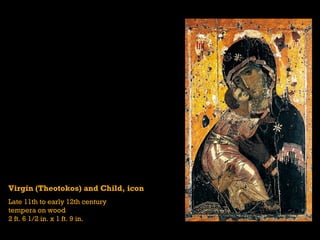
Virgin (Theotokos) and Child, icon
Late 11th to early 12th century
tempera on wood
2 ft. 6 1/2 in. x 1 ft. 9 in.
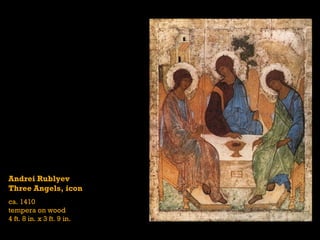
Andrei Rublyev
Three Angels, icon
ca. 1410
tempera on wood
4 ft. 8 in. x 3 ft. 9 in.
Iconostasis
Manuscript illustration or
miniature
• Manuscript illustration or miniature also flourished in Byzantium.
• This art began in Alexandria, Egypt in the Hellenistic period.
• Byzantine Artist however as in most of their Art, adapted a stylized
form.
• Their work was especially popular for illustrating liturgical books, to
help explain the meaning of difficult scriptural passages.
• Sometimes they were painted on gold, silver or purple backgrounds.
• The drapery outlines and lettering of the text were done in gold.
• The figures stressed the spiritual by emphasizing the heads and
eyes more than the bodies.
• They were arranged in rhythmic pattern.
• These miniatures are a precious heirloom of Byzantium from where
it spread westward.
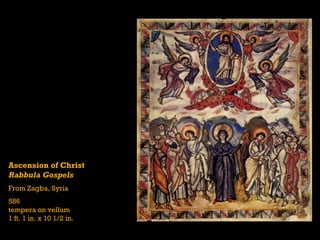
Ascension of Christ
Rabbula Gospels
From Zagba, Syria
586
tempera on vellum
1 ft. 1 in. x 10 1/2 in.
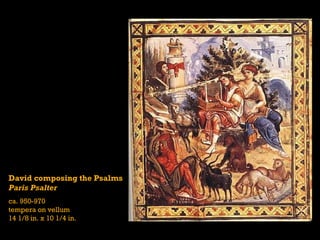
David composing the Psalms
Paris Psalter
ca. 950-970
tempera on vellum
14 1/8 in. x 10 1/4 in.
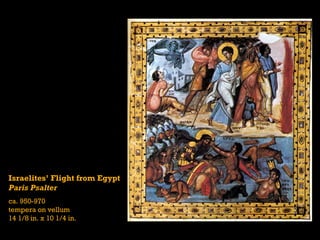
Israelites’ Flight from Egypt
Paris Psalter
ca. 950-970
tempera on vellum
14 1/8 in. x 10 1/4 in.
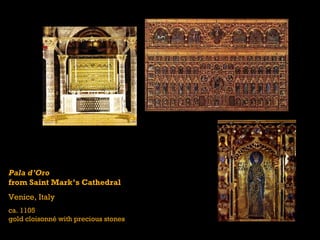
Pala d’Oro
from Saint Mark’s Cathedral
Venice, Italy
ca. 1105
gold cloisonné with precious stones
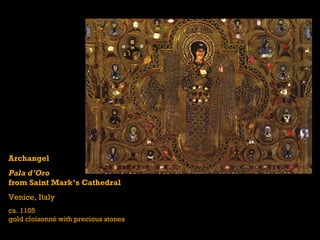
Archangel
Pala d’Oro
from Saint Mark’s Cathedral
Venice, Italy
ca. 1105
gold cloisonné with precious stones
Wall paintings
• Which developed simultaneously with mosaic.
• It became especially popular during the 2nd
golden
age & in the 14th
century.
• It was used chiefly in monastic centers outside
Constantinople, in Asia minor, especially Cappadocia
& in the Balkans.
• Where art reflected ordinary human feelings rather
than rigid court formalism.
• Especially Byzantine power declined this popular art
replaced more & more the costly mosaics and the
new style had great influence on later art in the west.
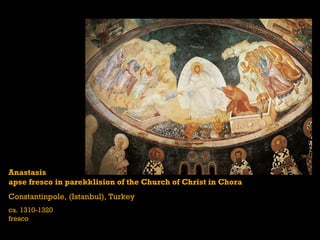
Anastasis
apse fresco in parekklision of the Church of Christ in Chora
Constantinpole, (Istanbul), Turkey
ca. 1310-1320
fresco
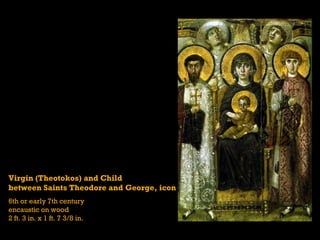
Virgin (Theotokos) and Child
between Saints Theodore and George, icon
6th or early 7th century
encaustic on wood
2 ft. 3 in. x 1 ft. 7 3/8 in.
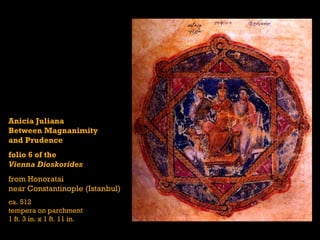
Anicia Juliana
Between Magnanimity
and Prudence
folio 6 of the
Vienna Dioskorides
from Honoratai
near Constantinople (Istanbul)
ca. 512
tempera on parchment
1 ft. 3 in. x 1 ft. 11 in.
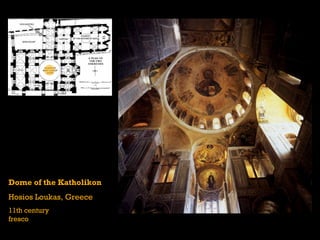
Dome of the Katholikon
Hosios Loukas, Greece
11th century
fresco
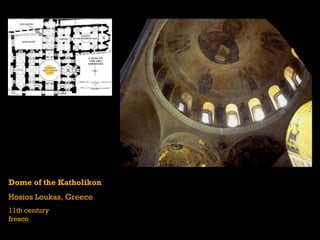
Dome of the Katholikon
Hosios Loukas, Greece
11th century
fresco
Sculpture
• We know from many literary sources that the emperor Constantine took many
celebrated statues from ancient monuments to adorn his new capital.
• In the forum of Constantinople he set up a representation of the good
shepherd and another figure of the redeemer near the imperial palace.
• Other emperors and military leaders had their image in various public
places.
• Only one of these still exist namely the colossal one in bronze of the
emperor Heralicus.
• We can study byzantine sculpture from numerous decorative carvings still existing
in the churches. Which were very ornate.
• Although mosaic, paintings, colored marble on the wall and floor larger part than
carvings.
• The horizontal bands & cornices separating the different storey, the arcades,
capitals & stone railings were richly carved.
• Although intricate design did not stand out in high relief
• The sculptor used the drill more than the chisel. They bored many holes
in between the incised carving, thus giving the surface a lace like effect.
• The motifs used were vines and rosette; capitals were decorated with
foliage, basket work, & monograms.
• The acanthus leaf was very common, but it was conventionalized, having
very pointed leaves.
• Best knowledge we can get of byzantine sculpture is through
the numerous small ivory carvings in relief, mostly on panels.
• When two small panels are attached to each other, we call them
diptychs.
• A triptych has a central one, with two small side panels or
wings.
– Some times these panels represent the coronations of an emperor and
empress.: the saviour stands in middle and places a crown on the head of
imperial couples standing beside. – this signifies that imperial power comes
from god.
– most favored subject in small ivory or stone panels is perhaps the virgin
mary represented either as mother , queen or ornate - that is standing with
hands raised in prayer.
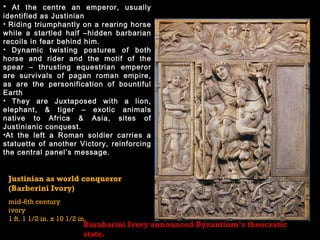
Justinian as world conqueror
(Barberini Ivory)
mid-6th century
ivory
1 ft. 1 1/2 in. x 10 1/2 in.
• At the centre an emperor, usually
identified as Justinian
• Riding triumphantly on a rearing horse
while a startled half –hidden barbarian
recoils in fear behind him.
• Dynamic twisting postures of both
horse and rider and the motif of the
spear – thrusting equestrian emperor
are survivals of pagan roman empire,
as are the personification of bountiful
Earth
• They are Juxtaposed with a lion,
elephant, & tiger – exotic animals
native to Africa & Asia, sites of
Justinianic conquest.
•At the left a Roman soldier carries a
statuette of another Victory, reinforcing
the central panel’s message.
Barabarini Ivory announced Byzantium’s theocratic
state.
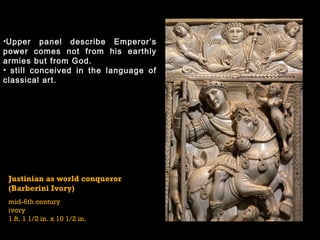
Justinian as world conqueror
(Barberini Ivory)
mid-6th century
ivory
1 ft. 1 1/2 in. x 10 1/2 in.
•Upper panel describe Emperor’s
power comes not from his earthly
armies but from God.
• still conceived in the language of
classical art.
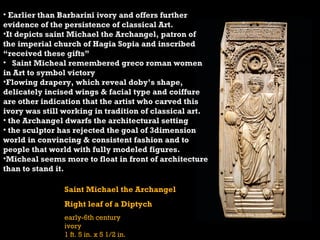
Saint Michael the Archangel
Right leaf of a Diptych
early-6th century
ivory
1 ft. 5 in. x 5 1/2 in.
• Earlier than Barbarini ivory and offers further
evidence of the persistence of classical Art.
•It depicts saint Michael the Archangel, patron of
the imperial church of Hagia Sopia and inscribed
“received these gifts”
• Saint Micheal remembered greco roman women
in Art to symbol victory
•Flowing drapery, which reveal doby’s shape,
delicately incised wings & facial type and coiffure
are other indication that the artist who carved this
ivory was still working in tradition of classical art.
• the Archangel dwarfs the architectural setting
• the sculptor has rejected the goal of 3dimension
world in convincing & consistent fashion and to
people that world with fully modeled figures.
•Micheal seems more to float in front of architecture
than to stand it.
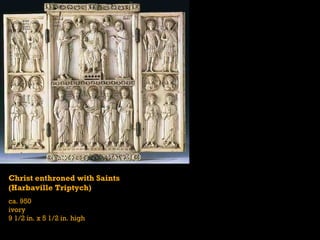
Christ enthroned with Saints
(Harbaville Triptych)
ca. 950
ivory
9 1/2 in. x 5 1/2 in. high

Byzantine Art

  • 1.
  • 4.
    • Byzantine artbelonged principally to the Eastern Roman empire with its magnificent centre, Constantinople (Istanbul) • In 330AD the emperor constantine transferred his capital from Rome to the site of the ancient Greek colony called Byzantium, to which he gave his own name: constantinople (the city of constantine) • Byzantine Art began with foundation of the city by constantine in 4th century and reached its maturity in 6th century. • Two golden ages mentioned in Byzatine period • Justinian (527 – 565) – Hagia sophia, San vitale • Basil I (867 – 1204) smaller churches – St. Mark
  • 5.
    How constantinople imbortant •It’s lies at southeastern tip of Europe only narrow strip of water separate it from Asia Minor. • Three sides sea and one side land. With excellent harbours. (Strategically important place) • Being in the centre of the Roman Empire, the government there had an ideally commanding position. • Politically and powerfully it’s centre • Commercially it was at the cross road of two important trade or commercial route – Between Europe and Asia – Silk Route – Between the Mediterranean and Black sea • Aesthetically it’s position was outstandingly beautiful
  • 6.
    • Strong politicalbackground in here so concerned about security of people. Thus administration officers, military officers occupied as democracy. • They lived as metropolitan life with multi cultural racial centre. • Money economy through Trade and commerce. • Surplus money sent to government through taxation. So equality with out class different in social. • That money sent to churches , cathedrals through government’s patronage to religion.
  • 7.
    • Byzantine Architecturewas predominantly an ecclesiastical or church Art; for although contemporary writers mention the splendor of royal palaces, the secular buildings that have survived are few and rather unimportant. • The byzantine church is of a central plan> if it is square or polygonal in plan in contrast to the longitudinal type of the Early Christian Basilica.
  • 9.
  • 10.
    • 1st golden agethe lower portion of the dome was pierced with windows. • 2nd golden age the dome surmounted a circular wall called a drum in which the windows were cut. These were the chief source of illumination in the interior. This diffused light from above gave a wonderful effect.
  • 11.
    • The columnswere monolithic that they cut from single stone • byzantine used the Ionic, Corinthian, & Composite capitals which they soon developed their own cubical style with side sloping inwards at the bottom and broadning out at top. They called “Dosseret”
  • 15.
    Anthemius of Tralles& Isidorus of Miletus Hagia Sophia Constantinpole, (Istanbul), Turkey 532-537
  • 16.
    Anthemius of Tralles& Isidorus of Miletus Hagia Sophia Constantinpole, (Istanbul), Turkey 532-537
  • 18.
    Anthemius of Tralles& Isidorus of Miletus Hagia Sophia Constantinpole, (Istanbul), Turkey 532-537
  • 20.
    Anthemius of Tralles& Isidorus of Miletus Hagia Sophia Constantinpole, (Istanbul), Turkey 532-537
  • 21.
    Anthemius of Tralles& Isidorus of Miletus Hagia Sophia Constantinpole, (Istanbul), Turkey 532-537
  • 22.
    Anthemius of Tralles& Isidorus of Miletus Hagia Sophia Constantinpole, (Istanbul), Turkey 532-537
  • 23.
    Anthemius of Tralles& Isidorus of Miletus Hagia Sophia Constantinpole, (Istanbul), Turkey 532-537
  • 31.
  • 32.
  • 34.
  • 35.
  • 37.
    Transfiguration of Jesus apsemosaic, Church of the Virgin Monastery of Saint Catherine Mount Sinai, Egypt ca. 565 mosaic
  • 39.
    Katholikon and Churchof the Theotokos Hosios Loukas, Greece Katholikon early 11th century, Church of the Theotokos, 10th century
  • 40.
    Katholikon and Churchof the Theotokos Hosios Loukas, Greece Katholikon early 11th century, Church of the Theotokos, 10th century
  • 42.
  • 46.
  • 47.
    Paintings Byzantine artists showedtheir greatest originality and accomplishment in pictorial representation on flat surface. • Mosaics • Wall paintings • Manuscript illumination • icons
  • 48.
    Mosaics characters • Chiefconcern was spiritual rather than physical vision. • Material details were ignored – they preferred to concentrate on pictorial rather than sculptural art. • Exact anatomy and representative were disregarded. • Instead of using the landscapes of the classical style as a background, the figures were surrounded by golden light as if they are out side of space and time. • Garments are heavy and stiff with stylized folds – they cover thin elongated seemingly weightless bodies. • instead of employing light and shade, they made clear outline by means of vivid colors • Stiffly stylized gestures, often repeated. • Figures are shown in front view – three quarter view being abandoned.
  • 49.
    • Perspective isnot confined to one vanishing point : – the same composition may include views on the eye level, above it or below. Multiple perspective may be included. – Some times reverse perspective is used in place of the right one • Not physical position but spiritual importance determine the size of the figures.. – Every thing is deeply solemn, according to their conception of the Almighty • The whole church was intended to symbolize heaven. • The subjects were almost always religious, although sometimes historical personage also shown. – These scenes were intended to teach religion and arouse devotion. • Mosaic scenes were arranged according to a traditional law.
  • 51.
    Virgin (Theotokos) andChild enthroned Apse mosaic, Hagia Sophia 867 mosaic
  • 52.
  • 53.
  • 54.
    Apse Mosaic San Vitale Ravenna,Italy 526-547 mosaic Ecdesius
  • 55.
    Justinian, Bishop Maximianusand attendants north wall apse mosaic, San Vitale Ravenna, Italy ca. 547 mosaic
  • 56.
    Theodora and attendants southwall apse mosaic, San Vitale Ravenna, Italy ca. 547 mosaic
  • 57.
    Abraham and theThree Angels (Philoxeneos), and the Sacrifice of Isaac north lunette mosaic, San Vitale Ravenna, Italy ca. 547 mosaic
  • 58.
    Sacrifice of Abel,Sacrifice of Melchisedech north lunette mosaic, San Vitale Ravenna, Italy ca. 547 mosaic
  • 59.
    Saint Apollinaris amidsheep Sant’Apollinare in Classe Ravenna, Italy 533-549 mosaic
  • 60.
    The decoration ofthe apse date to the 6th century, and can be divided into two parts: In the upper one, a large disc encloses a starry sky in which is a cross with gems and the face of Christ. Over the cross is a hand protruding from the clouds, the theme of the Hand of God. In the lower one is a green valley with rocks, bush, plants and birds. In the middle is the figure of Saint Apollinaris, portrayed in the act of praying God to give grace to his faithful, symbolized by twelve white lambs.
  • 61.
    Transfiguration of Jesus apsemosaic, Church of the Virgin Monastery of Saint Catherine Mount Sinai, Egypt ca. 565 mosaic
  • 64.
    Apse of theKatholikon Hosios Loukas, Greece 11th century mosaic
  • 65.
    Nativity of Christ Katholikon HosiosLoukas, Greece 11th century mosaic
  • 66.
    Baptism of Christ Katholikon HosiosLoukas, Greece 11th century mosaic
  • 68.
    Pantocrator dome mosaic in theChurch of the Dormition Daphni, Greece ca. 1090-1100 mosaic
  • 69.
    Crucifixion in the Churchof the Dormition Daphni, Greece ca. 1090-1100 mosaic
  • 70.
    interior of SaintMark’s Cathedral Venice, Italy ca. 1180 mosaic
  • 71.
    interior of SaintMark’s Cathedral Venice, Italy ca. 1180 mosaic
  • 72.
    Anastasis From west vaultof Saint Mark’s Cathedral Venice, Italy ca. 1180 mosaic
  • 74.
    Apse Cathedral at Monreale Monreale,Sicily, Italy ca. 1180-1190 mosaic
  • 75.
    Pantocrator Cathedral at Monreale Monreale,Sicily, Italy ca. 1180-1190 mosaic
  • 76.
    Theotokos and Child,angels and saints Cathedral at Monreale Monreale, Sicily, Italy ca. 1180-1190 mosaic
  • 77.
    Icons • Icons ordevotional pictures for piety, with no particular story to tell, also became more and more popular. • They represented the Savior, the virgin Mary and Saints. • The ground was a wooden panel, often carved with thin cloth. • On this were painted the figures. • The pigments were mixed with egg – white to make them adhere. • From Constantinople, icon painting passed into the Balkans & Russia, where the people were very fond of these pictures. • In the 14th Century, the iconostasis was introduced in the churches. • It is a wooden screen dividing the sanctuary from the nave, on which the icons are hung in rows. • They are also treasured in private houses.
  • 78.
    Hodegetria, icon (front) ca.1150-1200 tempera on wood
  • 79.
    Hodegetria, icon (back) ca.1150-1200 tempera on wood
  • 80.
  • 82.
    Christ as Saviorof Souls, icon early 14th century tempera, linen and silver on wood 3 ft. 1/4 in. x 2 ft. 2 1/2 in.
  • 83.
    Annunciation, reverse of2-sided icon early 14th century tempera and linen on wood 3 ft. 1/4 in. x 2 ft. 2 3/2 in.
  • 84.
    Annunciation, obverse of2-sided icon early 14th century tempera, linen and silver on wood 3 ft. 1/4 in. x 2 ft. 2 3/2 in.
  • 86.
    Virgin (Theotokos) andChild, icon Late 11th to early 12th century tempera on wood 2 ft. 6 1/2 in. x 1 ft. 9 in.
  • 87.
    Andrei Rublyev Three Angels,icon ca. 1410 tempera on wood 4 ft. 8 in. x 3 ft. 9 in.
  • 88.
  • 89.
    Manuscript illustration or miniature •Manuscript illustration or miniature also flourished in Byzantium. • This art began in Alexandria, Egypt in the Hellenistic period. • Byzantine Artist however as in most of their Art, adapted a stylized form. • Their work was especially popular for illustrating liturgical books, to help explain the meaning of difficult scriptural passages. • Sometimes they were painted on gold, silver or purple backgrounds. • The drapery outlines and lettering of the text were done in gold. • The figures stressed the spiritual by emphasizing the heads and eyes more than the bodies. • They were arranged in rhythmic pattern. • These miniatures are a precious heirloom of Byzantium from where it spread westward.
  • 90.
    Ascension of Christ RabbulaGospels From Zagba, Syria 586 tempera on vellum 1 ft. 1 in. x 10 1/2 in.
  • 91.
    David composing thePsalms Paris Psalter ca. 950-970 tempera on vellum 14 1/8 in. x 10 1/4 in.
  • 92.
    Israelites’ Flight fromEgypt Paris Psalter ca. 950-970 tempera on vellum 14 1/8 in. x 10 1/4 in.
  • 93.
    Pala d’Oro from SaintMark’s Cathedral Venice, Italy ca. 1105 gold cloisonné with precious stones
  • 94.
    Archangel Pala d’Oro from SaintMark’s Cathedral Venice, Italy ca. 1105 gold cloisonné with precious stones
  • 95.
    Wall paintings • Whichdeveloped simultaneously with mosaic. • It became especially popular during the 2nd golden age & in the 14th century. • It was used chiefly in monastic centers outside Constantinople, in Asia minor, especially Cappadocia & in the Balkans. • Where art reflected ordinary human feelings rather than rigid court formalism. • Especially Byzantine power declined this popular art replaced more & more the costly mosaics and the new style had great influence on later art in the west.
  • 97.
    Anastasis apse fresco inparekklision of the Church of Christ in Chora Constantinpole, (Istanbul), Turkey ca. 1310-1320 fresco
  • 98.
    Virgin (Theotokos) andChild between Saints Theodore and George, icon 6th or early 7th century encaustic on wood 2 ft. 3 in. x 1 ft. 7 3/8 in.
  • 99.
    Anicia Juliana Between Magnanimity andPrudence folio 6 of the Vienna Dioskorides from Honoratai near Constantinople (Istanbul) ca. 512 tempera on parchment 1 ft. 3 in. x 1 ft. 11 in.
  • 100.
    Dome of theKatholikon Hosios Loukas, Greece 11th century fresco
  • 101.
    Dome of theKatholikon Hosios Loukas, Greece 11th century fresco
  • 102.
    Sculpture • We knowfrom many literary sources that the emperor Constantine took many celebrated statues from ancient monuments to adorn his new capital. • In the forum of Constantinople he set up a representation of the good shepherd and another figure of the redeemer near the imperial palace. • Other emperors and military leaders had their image in various public places. • Only one of these still exist namely the colossal one in bronze of the emperor Heralicus. • We can study byzantine sculpture from numerous decorative carvings still existing in the churches. Which were very ornate. • Although mosaic, paintings, colored marble on the wall and floor larger part than carvings. • The horizontal bands & cornices separating the different storey, the arcades, capitals & stone railings were richly carved. • Although intricate design did not stand out in high relief • The sculptor used the drill more than the chisel. They bored many holes in between the incised carving, thus giving the surface a lace like effect. • The motifs used were vines and rosette; capitals were decorated with foliage, basket work, & monograms. • The acanthus leaf was very common, but it was conventionalized, having very pointed leaves.
  • 103.
    • Best knowledgewe can get of byzantine sculpture is through the numerous small ivory carvings in relief, mostly on panels. • When two small panels are attached to each other, we call them diptychs. • A triptych has a central one, with two small side panels or wings. – Some times these panels represent the coronations of an emperor and empress.: the saviour stands in middle and places a crown on the head of imperial couples standing beside. – this signifies that imperial power comes from god. – most favored subject in small ivory or stone panels is perhaps the virgin mary represented either as mother , queen or ornate - that is standing with hands raised in prayer.
  • 104.
    Justinian as worldconqueror (Barberini Ivory) mid-6th century ivory 1 ft. 1 1/2 in. x 10 1/2 in. • At the centre an emperor, usually identified as Justinian • Riding triumphantly on a rearing horse while a startled half –hidden barbarian recoils in fear behind him. • Dynamic twisting postures of both horse and rider and the motif of the spear – thrusting equestrian emperor are survivals of pagan roman empire, as are the personification of bountiful Earth • They are Juxtaposed with a lion, elephant, & tiger – exotic animals native to Africa & Asia, sites of Justinianic conquest. •At the left a Roman soldier carries a statuette of another Victory, reinforcing the central panel’s message. Barabarini Ivory announced Byzantium’s theocratic state.
  • 105.
    Justinian as worldconqueror (Barberini Ivory) mid-6th century ivory 1 ft. 1 1/2 in. x 10 1/2 in. •Upper panel describe Emperor’s power comes not from his earthly armies but from God. • still conceived in the language of classical art.
  • 106.
    Saint Michael theArchangel Right leaf of a Diptych early-6th century ivory 1 ft. 5 in. x 5 1/2 in. • Earlier than Barbarini ivory and offers further evidence of the persistence of classical Art. •It depicts saint Michael the Archangel, patron of the imperial church of Hagia Sopia and inscribed “received these gifts” • Saint Micheal remembered greco roman women in Art to symbol victory •Flowing drapery, which reveal doby’s shape, delicately incised wings & facial type and coiffure are other indication that the artist who carved this ivory was still working in tradition of classical art. • the Archangel dwarfs the architectural setting • the sculptor has rejected the goal of 3dimension world in convincing & consistent fashion and to people that world with fully modeled figures. •Micheal seems more to float in front of architecture than to stand it.
  • 107.
    Christ enthroned withSaints (Harbaville Triptych) ca. 950 ivory 9 1/2 in. x 5 1/2 in. high

Editor's Notes

  • #4 Slide concept by William V. Ganis, PhD FOR EDUCATIONAL USE ONLY For publication, reproduction or transmission of images, please contact individual artists, estates, photographers and exhibiting institutions for permissions and rights.
  • #16 Slide concept by William V. Ganis, PhD FOR EDUCATIONAL USE ONLY For publication, reproduction or transmission of images, please contact individual artists, estates, photographers and exhibiting institutions for permissions and rights.
  • #17 Slide concept by William V. Ganis, PhD FOR EDUCATIONAL USE ONLY For publication, reproduction or transmission of images, please contact individual artists, estates, photographers and exhibiting institutions for permissions and rights.
  • #19 Slide concept by William V. Ganis, PhD FOR EDUCATIONAL USE ONLY For publication, reproduction or transmission of images, please contact individual artists, estates, photographers and exhibiting institutions for permissions and rights.
  • #21 Slide concept by William V. Ganis, PhD FOR EDUCATIONAL USE ONLY For publication, reproduction or transmission of images, please contact individual artists, estates, photographers and exhibiting institutions for permissions and rights.
  • #22 Slide concept by William V. Ganis, PhD FOR EDUCATIONAL USE ONLY For publication, reproduction or transmission of images, please contact individual artists, estates, photographers and exhibiting institutions for permissions and rights.
  • #23 Slide concept by William V. Ganis, PhD FOR EDUCATIONAL USE ONLY For publication, reproduction or transmission of images, please contact individual artists, estates, photographers and exhibiting institutions for permissions and rights.
  • #24 Slide concept by William V. Ganis, PhD FOR EDUCATIONAL USE ONLY For publication, reproduction or transmission of images, please contact individual artists, estates, photographers and exhibiting institutions for permissions and rights.
  • #31 Slide concept by William V. Ganis, PhD FOR EDUCATIONAL USE ONLY For publication, reproduction or transmission of images, please contact individual artists, estates, photographers and exhibiting institutions for permissions and rights.
  • #32 Slide concept by William V. Ganis, PhD FOR EDUCATIONAL USE ONLY For publication, reproduction or transmission of images, please contact individual artists, estates, photographers and exhibiting institutions for permissions and rights.
  • #33 Slide concept by William V. Ganis, PhD FOR EDUCATIONAL USE ONLY For publication, reproduction or transmission of images, please contact individual artists, estates, photographers and exhibiting institutions for permissions and rights.
  • #35 Slide concept by William V. Ganis, PhD FOR EDUCATIONAL USE ONLY For publication, reproduction or transmission of images, please contact individual artists, estates, photographers and exhibiting institutions for permissions and rights.
  • #36 Slide concept by William V. Ganis, PhD FOR EDUCATIONAL USE ONLY For publication, reproduction or transmission of images, please contact individual artists, estates, photographers and exhibiting institutions for permissions and rights.
  • #37 Slide concept by William V. Ganis, PhD FOR EDUCATIONAL USE ONLY For publication, reproduction or transmission of images, please contact individual artists, estates, photographers and exhibiting institutions for permissions and rights.
  • #38 Slide concept by William V. Ganis, PhD FOR EDUCATIONAL USE ONLY For publication, reproduction or transmission of images, please contact individual artists, estates, photographers and exhibiting institutions for permissions and rights.
  • #39 Slide concept by William V. Ganis, PhD FOR EDUCATIONAL USE ONLY For publication, reproduction or transmission of images, please contact individual artists, estates, photographers and exhibiting institutions for permissions and rights.
  • #40 Slide concept by William V. Ganis, PhD FOR EDUCATIONAL USE ONLY For publication, reproduction or transmission of images, please contact individual artists, estates, photographers and exhibiting institutions for permissions and rights.
  • #41 Slide concept by William V. Ganis, PhD FOR EDUCATIONAL USE ONLY For publication, reproduction or transmission of images, please contact individual artists, estates, photographers and exhibiting institutions for permissions and rights.
  • #42 Slide concept by William V. Ganis, PhD FOR EDUCATIONAL USE ONLY For publication, reproduction or transmission of images, please contact individual artists, estates, photographers and exhibiting institutions for permissions and rights.
  • #43 Slide concept by William V. Ganis, PhD FOR EDUCATIONAL USE ONLY For publication, reproduction or transmission of images, please contact individual artists, estates, photographers and exhibiting institutions for permissions and rights.
  • #47 Slide concept by William V. Ganis, PhD FOR EDUCATIONAL USE ONLY For publication, reproduction or transmission of images, please contact individual artists, estates, photographers and exhibiting institutions for permissions and rights.
  • #52 Slide concept by William V. Ganis, PhD FOR EDUCATIONAL USE ONLY For publication, reproduction or transmission of images, please contact individual artists, estates, photographers and exhibiting institutions for permissions and rights.
  • #53 Slide concept by William V. Ganis, PhD FOR EDUCATIONAL USE ONLY For publication, reproduction or transmission of images, please contact individual artists, estates, photographers and exhibiting institutions for permissions and rights.
  • #54 Slide concept by William V. Ganis, PhD FOR EDUCATIONAL USE ONLY For publication, reproduction or transmission of images, please contact individual artists, estates, photographers and exhibiting institutions for permissions and rights.
  • #55 Slide concept by William V. Ganis, PhD FOR EDUCATIONAL USE ONLY For publication, reproduction or transmission of images, please contact individual artists, estates, photographers and exhibiting institutions for permissions and rights.
  • #56 Slide concept by William V. Ganis, PhD FOR EDUCATIONAL USE ONLY For publication, reproduction or transmission of images, please contact individual artists, estates, photographers and exhibiting institutions for permissions and rights.
  • #57 Slide concept by William V. Ganis, PhD FOR EDUCATIONAL USE ONLY For publication, reproduction or transmission of images, please contact individual artists, estates, photographers and exhibiting institutions for permissions and rights.
  • #58 Slide concept by William V. Ganis, PhD FOR EDUCATIONAL USE ONLY For publication, reproduction or transmission of images, please contact individual artists, estates, photographers and exhibiting institutions for permissions and rights.
  • #59 Slide concept by William V. Ganis, PhD FOR EDUCATIONAL USE ONLY For publication, reproduction or transmission of images, please contact individual artists, estates, photographers and exhibiting institutions for permissions and rights.
  • #60 Slide concept by William V. Ganis, PhD FOR EDUCATIONAL USE ONLY For publication, reproduction or transmission of images, please contact individual artists, estates, photographers and exhibiting institutions for permissions and rights.
  • #62 Slide concept by William V. Ganis, PhD FOR EDUCATIONAL USE ONLY For publication, reproduction or transmission of images, please contact individual artists, estates, photographers and exhibiting institutions for permissions and rights.
  • #63 Slide concept by William V. Ganis, PhD FOR EDUCATIONAL USE ONLY For publication, reproduction or transmission of images, please contact individual artists, estates, photographers and exhibiting institutions for permissions and rights.
  • #64 Slide concept by William V. Ganis, PhD FOR EDUCATIONAL USE ONLY For publication, reproduction or transmission of images, please contact individual artists, estates, photographers and exhibiting institutions for permissions and rights.
  • #65 Slide concept by William V. Ganis, PhD FOR EDUCATIONAL USE ONLY For publication, reproduction or transmission of images, please contact individual artists, estates, photographers and exhibiting institutions for permissions and rights.
  • #66 Slide concept by William V. Ganis, PhD FOR EDUCATIONAL USE ONLY For publication, reproduction or transmission of images, please contact individual artists, estates, photographers and exhibiting institutions for permissions and rights.
  • #67 Slide concept by William V. Ganis, PhD FOR EDUCATIONAL USE ONLY For publication, reproduction or transmission of images, please contact individual artists, estates, photographers and exhibiting institutions for permissions and rights.
  • #68 Slide concept by William V. Ganis, PhD FOR EDUCATIONAL USE ONLY For publication, reproduction or transmission of images, please contact individual artists, estates, photographers and exhibiting institutions for permissions and rights.
  • #69 Slide concept by William V. Ganis, PhD FOR EDUCATIONAL USE ONLY For publication, reproduction or transmission of images, please contact individual artists, estates, photographers and exhibiting institutions for permissions and rights.
  • #70 Slide concept by William V. Ganis, PhD FOR EDUCATIONAL USE ONLY For publication, reproduction or transmission of images, please contact individual artists, estates, photographers and exhibiting institutions for permissions and rights.
  • #71 Slide concept by William V. Ganis, PhD FOR EDUCATIONAL USE ONLY For publication, reproduction or transmission of images, please contact individual artists, estates, photographers and exhibiting institutions for permissions and rights.
  • #72 Slide concept by William V. Ganis, PhD FOR EDUCATIONAL USE ONLY For publication, reproduction or transmission of images, please contact individual artists, estates, photographers and exhibiting institutions for permissions and rights.
  • #73 Slide concept by William V. Ganis, PhD FOR EDUCATIONAL USE ONLY For publication, reproduction or transmission of images, please contact individual artists, estates, photographers and exhibiting institutions for permissions and rights.
  • #74 Slide concept by William V. Ganis, PhD FOR EDUCATIONAL USE ONLY For publication, reproduction or transmission of images, please contact individual artists, estates, photographers and exhibiting institutions for permissions and rights.
  • #75 Slide concept by William V. Ganis, PhD FOR EDUCATIONAL USE ONLY For publication, reproduction or transmission of images, please contact individual artists, estates, photographers and exhibiting institutions for permissions and rights.
  • #76 Slide concept by William V. Ganis, PhD FOR EDUCATIONAL USE ONLY For publication, reproduction or transmission of images, please contact individual artists, estates, photographers and exhibiting institutions for permissions and rights.
  • #77 Slide concept by William V. Ganis, PhD FOR EDUCATIONAL USE ONLY For publication, reproduction or transmission of images, please contact individual artists, estates, photographers and exhibiting institutions for permissions and rights.
  • #79 Slide concept by William V. Ganis, PhD FOR EDUCATIONAL USE ONLY For publication, reproduction or transmission of images, please contact individual artists, estates, photographers and exhibiting institutions for permissions and rights.
  • #80 Slide concept by William V. Ganis, PhD FOR EDUCATIONAL USE ONLY For publication, reproduction or transmission of images, please contact individual artists, estates, photographers and exhibiting institutions for permissions and rights.
  • #81 Slide concept by William V. Ganis, PhD FOR EDUCATIONAL USE ONLY For publication, reproduction or transmission of images, please contact individual artists, estates, photographers and exhibiting institutions for permissions and rights.
  • #82 Slide concept by William V. Ganis, PhD FOR EDUCATIONAL USE ONLY For publication, reproduction or transmission of images, please contact individual artists, estates, photographers and exhibiting institutions for permissions and rights.
  • #83 Slide concept by William V. Ganis, PhD FOR EDUCATIONAL USE ONLY For publication, reproduction or transmission of images, please contact individual artists, estates, photographers and exhibiting institutions for permissions and rights.
  • #84 Slide concept by William V. Ganis, PhD FOR EDUCATIONAL USE ONLY For publication, reproduction or transmission of images, please contact individual artists, estates, photographers and exhibiting institutions for permissions and rights.
  • #85 Slide concept by William V. Ganis, PhD FOR EDUCATIONAL USE ONLY For publication, reproduction or transmission of images, please contact individual artists, estates, photographers and exhibiting institutions for permissions and rights.
  • #86 Slide concept by William V. Ganis, PhD FOR EDUCATIONAL USE ONLY For publication, reproduction or transmission of images, please contact individual artists, estates, photographers and exhibiting institutions for permissions and rights.
  • #87 Slide concept by William V. Ganis, PhD FOR EDUCATIONAL USE ONLY For publication, reproduction or transmission of images, please contact individual artists, estates, photographers and exhibiting institutions for permissions and rights.
  • #88 Slide concept by William V. Ganis, PhD FOR EDUCATIONAL USE ONLY For publication, reproduction or transmission of images, please contact individual artists, estates, photographers and exhibiting institutions for permissions and rights.
  • #89 Slide concept by William V. Ganis, PhD FOR EDUCATIONAL USE ONLY For publication, reproduction or transmission of images, please contact individual artists, estates, photographers and exhibiting institutions for permissions and rights.
  • #91 Slide concept by William V. Ganis, PhD FOR EDUCATIONAL USE ONLY For publication, reproduction or transmission of images, please contact individual artists, estates, photographers and exhibiting institutions for permissions and rights.
  • #92 Slide concept by William V. Ganis, PhD FOR EDUCATIONAL USE ONLY For publication, reproduction or transmission of images, please contact individual artists, estates, photographers and exhibiting institutions for permissions and rights.
  • #93 Slide concept by William V. Ganis, PhD FOR EDUCATIONAL USE ONLY For publication, reproduction or transmission of images, please contact individual artists, estates, photographers and exhibiting institutions for permissions and rights.
  • #94 Slide concept by William V. Ganis, PhD FOR EDUCATIONAL USE ONLY For publication, reproduction or transmission of images, please contact individual artists, estates, photographers and exhibiting institutions for permissions and rights.
  • #95 Slide concept by William V. Ganis, PhD FOR EDUCATIONAL USE ONLY For publication, reproduction or transmission of images, please contact individual artists, estates, photographers and exhibiting institutions for permissions and rights.
  • #97 Slide concept by William V. Ganis, PhD FOR EDUCATIONAL USE ONLY For publication, reproduction or transmission of images, please contact individual artists, estates, photographers and exhibiting institutions for permissions and rights.
  • #98 Slide concept by William V. Ganis, PhD FOR EDUCATIONAL USE ONLY For publication, reproduction or transmission of images, please contact individual artists, estates, photographers and exhibiting institutions for permissions and rights.
  • #99 Slide concept by William V. Ganis, PhD FOR EDUCATIONAL USE ONLY For publication, reproduction or transmission of images, please contact individual artists, estates, photographers and exhibiting institutions for permissions and rights.
  • #100 Slide concept by William V. Ganis, PhD FOR EDUCATIONAL USE ONLY For publication, reproduction or transmission of images, please contact individual artists, estates, photographers and exhibiting institutions for permissions and rights.
  • #101 Slide concept by William V. Ganis, PhD FOR EDUCATIONAL USE ONLY For publication, reproduction or transmission of images, please contact individual artists, estates, photographers and exhibiting institutions for permissions and rights.
  • #102 Slide concept by William V. Ganis, PhD FOR EDUCATIONAL USE ONLY For publication, reproduction or transmission of images, please contact individual artists, estates, photographers and exhibiting institutions for permissions and rights.
  • #105 Slide concept by William V. Ganis, PhD FOR EDUCATIONAL USE ONLY For publication, reproduction or transmission of images, please contact individual artists, estates, photographers and exhibiting institutions for permissions and rights.
  • #106 Slide concept by William V. Ganis, PhD FOR EDUCATIONAL USE ONLY For publication, reproduction or transmission of images, please contact individual artists, estates, photographers and exhibiting institutions for permissions and rights.
  • #107 Slide concept by William V. Ganis, PhD FOR EDUCATIONAL USE ONLY For publication, reproduction or transmission of images, please contact individual artists, estates, photographers and exhibiting institutions for permissions and rights.
  • #108 Slide concept by William V. Ganis, PhD FOR EDUCATIONAL USE ONLY For publication, reproduction or transmission of images, please contact individual artists, estates, photographers and exhibiting institutions for permissions and rights.