Neonatal cardiac failure- 
Pathophysiological basis 
Dr.Gopakumar Hariharan 
Senior Registrar, 
Neonatal and Paediatric Intensive care
Neonatal cardiac failure 
• Case scenario 
• Fetal circulation and neonatal heart 
• Pathophysiology 
• Basis of Management
Case scenario 
• Ex 31 weeker, now corrected age 38 weeks 
• Holt Oram syndrome – Hypoplastic radius and Cardiac defect – Large AVSD 
• Initial management for respiratory distress syndrome 
• Prolonged non invasive respiratory support 
• Cardiac failure – Frusemide and Captopril 
• Transfer to Melbourne for definitive surgery
Challenges with Neonatal cardiac failure 

• Unique anatomic and physiologic factors 

• Different etiologies of cardiac failure 
• Functional and structural differences between mature and immature 
myocardium
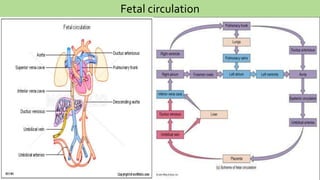
Fetal circulation
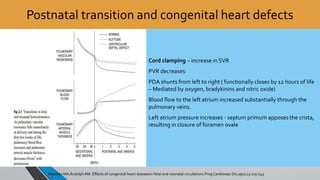
Postnatal transition and congenital heart defects 
Cord clamping – increase in SVR 
PVR decreases 
PDA shunts from left to right ( functionally closes by 12 hours of life 
– Mediated by oxygen, bradykinins and nitric oxide) 
Blood flow to the left atrium increased substantially through the 
pulmonary veins. 
Left atrium pressure increases - septum primum apposes the crista, 
resulting in closure of foramen ovale 
Heyman MA,RudolphAM. Effects of congenital heart diseaseon fetal and neonatal circulations.Prog Cardiovasc Dis.1972;15:115-143
Reduction in PVR 
• Fall in PVR- contributed by improved ventilation and oxygenation 
• Increase in oxygenation - modest increase in pulmonary blood flow and 
decrease in mean pulmonary artery pressure. 
• Oxygen modulates the production of the vasoactive substances nitric oxide 
and prostacyclin
Neonatal cardiac failure - etiology 
• Systolic Vs Diastolic 
• Right sided Vs Left sided 
• Low output Vs High output
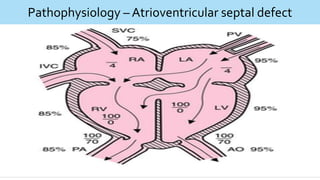
Pathophysiology – Atrioventricular septal defect 
•
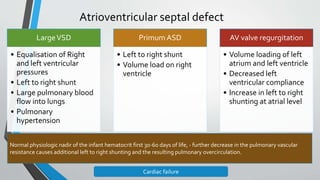
Atrioventricular septal defect 
Large VSD 
• Equalisation of Right 
and left ventricular 
pressures 
• Left to right shunt 
• Large pulmonary blood 
flow into lungs 
• Pulmonary 
hypertension 
Primum ASD 
• Left to right shunt 
• Volume load on right 
ventricle 
AV valve regurgitation 
• Volume loading of left 
atrium and left ventricle 
• Decreased left 
ventricular compliance 
• Increase in left to right 
shunting at atrial level 
Normal physiologic nadir of the infant hematocrit first 30-60 days of life, - further decrease in the pulmonary vascular 
resistance causes additional left to right shunting and the resulting pulmonary overcirculation. 
Cardiac failure
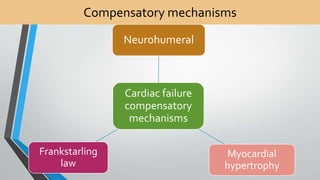
Compensatory mechanisms 
Neurohumeral 
Cardiac failure 
compensatory 
mechanisms 
Myocardial 
hypertrophy 
Frankstarling 
law
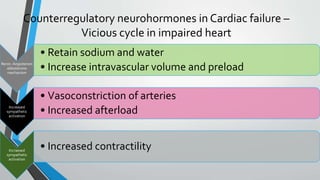
Counterregulatory neurohormones in Cardiac failure – 
Vicious cycle in impaired heart 
Renin-Angiotensin 
aldosterone 
mechanism 
• Retain sodium and water 
• Increase intravascular volume and preload 
Increased 
sympathetic 
activation 
• Vasoconstriction of arteries 
• Increased afterload 
Incraesed 
sympathetic 
activation 
• Increased contractility
Frank Starling Principle 
If the initial (resting) length of 
(i) Either an individual myocardial cell (or ) 
(ii) Whole of ventricle 
Is incr. WITH IN LIMITS 
The force generated by the 
contractile Fibers (or) cardiac output 
as a whole increases
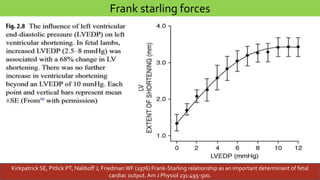
Frank starling forces 
Kirkpatrick SE, Pitlick PT, Naliboff J, Friedman WF (1976) Frank-Starling relationship as an important determinant of fetal 
cardiac output. Am J Physiol 231:495-500.
Neonatal myocardium 
• Left ventricular mass increase in postnatal period – initially hyperplasia and later 
hyperplastic 
• Myocyte proliferation occurs more rapidly in the left than the right – due to 
increased demands of a high vascular resistance 
• myocyte hypertrophy accounts for most of the increase in ventricular mass 
subsequently ( mediated by increased work load, circulating growth factors and 
catacholamines). 
• Acidic fibroblast growth factors and transforming growth factors produced by the 
cardiac myocyte may mediate cellular proliferation and differentiation.
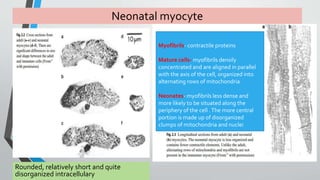
Neonatal myocyte 
Rounded, relatively short and quite 
disorganized intracellulary 
Myofibrils- contractile proteins 
Mature cells- myofibrils densily 
concentrated and are aligned in parallel 
with the axis of the cell, organized into 
alternating rows of mitochondria 
Neonates- myofibrils less dense and 
more likely to be situated along the 
periphery of the cell . The more central 
portion is made up of disorganized 
clumps of mitochondria and nuclei
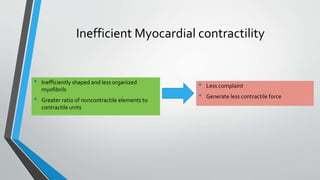
Inefficient Myocardial contractility 
• Less complaint 
• Generate less contractile force 
• Inefficiently shaped and less organized 
myofibrils 
• Greater ratio of noncontractile elements to 
contractile units
So.. Why is our baby working hard
Contributory Factors 
• Premature lungs 
• Preterm infants develop symptoms earlier as their PVR is lower due to 
inadequate mascularisation of the pulmonary arteries 
• Increased preload from Neurohumeral mechanisms 
• Increased afterload from high Sympathetic activity 
• Insufficient ventricular contractility
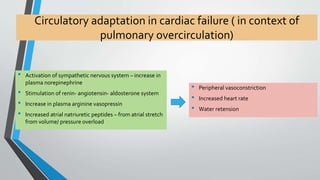
Circulatory adaptation in cardiac failure ( in context of 
pulmonary overcirculation) 
• Activation of sympathetic nervous system – increase in 
plasma norepinephrine 
• Stimulation of renin- angiotensin- aldosterone system 
• Increase in plasma arginine vasopressin 
• Increased atrial natriuretic peptides – from atrial stretch 
from volume/ pressure overload 
• Peripheral vasoconstriction 
• Increased heart rate 
• Water retension
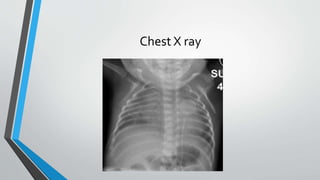
Chest X ray
Goals of management 
• Provide symptomatic relief 
• Correct metabolic 
abnormalities 
• Reverse haemodynamic 
derangements
Decreased myocardial contractility 
• Unload myocardium with diuretics 
• Reduce afterload
Medical management
Diuretics 
• Initial treatment in decompensated cardiac failure 
• Diuretic resistance – add intravenous thiazide diuretics( 
chlorthiazide) 
• Continuous loop diuretic infusion 
Monitoring 
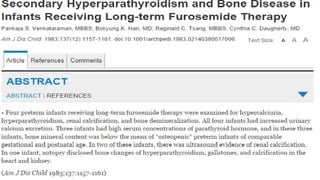
• Electrolyte disturbance – profound urinary 
loss of potassium, magnesium and calcium 
due to immature renal secretory control in 
neonates 
• Renal insufficiency 
• Hypotension
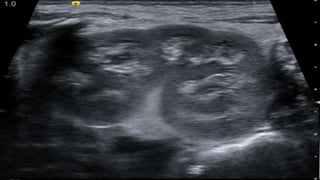
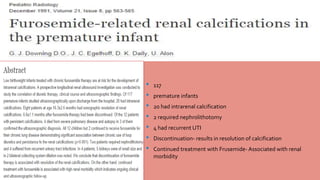
• 117 
• premature infants 
• 20 had intrarenal calcification 
• 2 required nephrolithotomy 
• 4 had recurrent UTI 
• Discontinuation- results in resolution of calcification 
• Continued treatment with Frusemide- Associated with renal 
morbidity
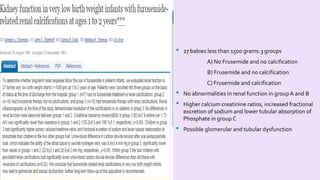
• 27 babies less than 1500 grams.3 groups 
A) No Frusemide and no calcification 
B) Frusemide and no calcification 
C) Frusemide and calcification 
• No abnormalities in renal function in group A and B 
• Higher calcium creatinine ratios, increased fractional 
excretion of sodium and lower tubular absorption of 
Phosphate in group C 
• Possible glomerular and tubular dysfunction
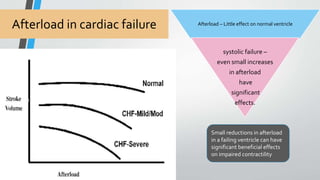
Afterload in cardiac failure Afterload – Little effect on normal ventricle 
systolic failure – 
even small increases 
in afterload 
have 
significant 
effects. 
Small reductions in afterload 
in a failing ventricle can have 
significant beneficial effects 
on impaired contractility
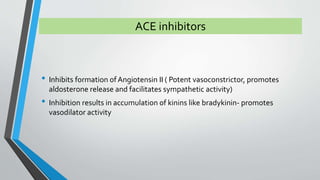
ACE inhibitors 
• Inhibits formation of Angiotensin II ( Potent vasoconstrictor, promotes 
aldosterone release and facilitates sympathetic activity) 
• Inhibition results in accumulation of kinins like bradykinin- promotes 
vasodilator activity
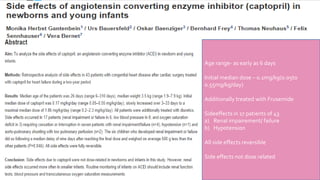
Age range- as early as 6 days 
Initial median dose – 0.1mg/kg(0.05to 
0.55mg/kg/day) 
Additionally treated with Frusemide 
Sideeffects in 17 patients of 43 
a) Renal impairement/ failure 
b) Hypotension 
All side effects reversible 
Side effects not dose related
Deficient Calcium transport mechanism – ? Role for 
calcium 
• Cardiac myocyte membrane(sarcolemma) – has ion channels and pumps-allows 
transport of calcium and other ions 
• Immature heart- more dependent on extracellular calcium for myocardial 
contraction 
• Sarcoplasmic reticulum of fetal sheep- low density of calcium channels and 
decreased pump activity 
• Importance- Frusemide and calcium loss??
NETS- Challenges
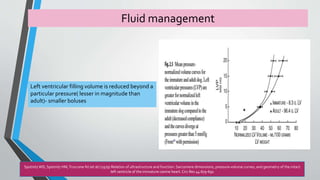
Fluid management 
Left ventricular filling volume is reduced beyond a 
particular pressure( lesser in magnitude than 
adult)- smaller boluses 
SpotnitzWD, Spotnitz HM, Truccone NJ (et al) (1979) Relation of ultrastructure and function. Sarcomere dimensions, pressure-volume curves, and geometry of the intact 
left ventricle of the immature canine heart. Circ Res 44:679-691
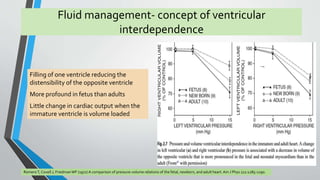
Fluid management- concept of ventricular 
interdependence 
Filling of one ventricle reducing the 
distensibility of the opposite ventricle 
More profound in fetus than adults 
Little change in cardiac output when the 
immature ventricle is volume loaded 
Romero T, Covell J, Friedman WF (1972) A comparison of pressure-volume relations of the fetal, newborn, and adult heart. Am J Phys 222:1285-1290.
NETS 
• Respiratory support – CPAP 
• Anticipation of increased oxygen requirement 
• Intravenous diuretics 
• Nasogastric tube for venting
Surgical management 
A medical perspective
Evaluation 
TAR – hematology for thrombocytopenia 
Holtoram- Kidneys , heart scans 
Vateryl
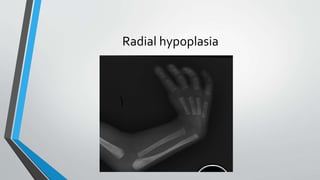
Radial hypoplasia
Thumb hypoplasia 
• Pollicisation - converts index finger into thumb – prehensile hand with a thumb and three fingers – 
improved function and appearance 
• Toe to hand transfer( second toe) – excellent improvement in function and appearance 
• Role for physiotherapist and occupational therapist 
• Therapy ideally started in the neonatal period- especially with restricted interphalangeal joint 
extension 
• Gain in length – distraction techniques
(A) Child with pollicisation of the index finger to make a thumb. 
Watson S Arch Dis Child 2000;83:10-17 
Copyright © BMJ Publishing Group Ltd & Royal College of Paediatrics and Child Health. All rights reserved.
Radial club hand 
• Therapy, splints and stretching should start in 
the neonatal period 
• Distal radial hypoplasia responds well to 
treatment 
• Severe from- absence with forearm at right 
angles – no major respose 
• Hypoplastic thumbs- stabilized and given more 
movements by tendon transfers
Summary 
• Neonatal Myocardium anatomically different 
• Complex pathology 
• Pathophysiological understanding to direct treatment
Thank You

Neonatal cardiac failure

  • 1.
    Neonatal cardiac failure- Pathophysiological basis Dr.Gopakumar Hariharan Senior Registrar, Neonatal and Paediatric Intensive care
  • 2.
    Neonatal cardiac failure • Case scenario • Fetal circulation and neonatal heart • Pathophysiology • Basis of Management
  • 3.
    Case scenario •Ex 31 weeker, now corrected age 38 weeks • Holt Oram syndrome – Hypoplastic radius and Cardiac defect – Large AVSD • Initial management for respiratory distress syndrome • Prolonged non invasive respiratory support • Cardiac failure – Frusemide and Captopril • Transfer to Melbourne for definitive surgery
  • 4.
    Challenges with Neonatalcardiac failure • Unique anatomic and physiologic factors • Different etiologies of cardiac failure • Functional and structural differences between mature and immature myocardium
  • 5.
  • 6.
    Postnatal transition andcongenital heart defects Cord clamping – increase in SVR PVR decreases PDA shunts from left to right ( functionally closes by 12 hours of life – Mediated by oxygen, bradykinins and nitric oxide) Blood flow to the left atrium increased substantially through the pulmonary veins. Left atrium pressure increases - septum primum apposes the crista, resulting in closure of foramen ovale Heyman MA,RudolphAM. Effects of congenital heart diseaseon fetal and neonatal circulations.Prog Cardiovasc Dis.1972;15:115-143
  • 7.
    Reduction in PVR • Fall in PVR- contributed by improved ventilation and oxygenation • Increase in oxygenation - modest increase in pulmonary blood flow and decrease in mean pulmonary artery pressure. • Oxygen modulates the production of the vasoactive substances nitric oxide and prostacyclin
  • 8.
    Neonatal cardiac failure- etiology • Systolic Vs Diastolic • Right sided Vs Left sided • Low output Vs High output
  • 9.
  • 10.
    Atrioventricular septal defect Large VSD • Equalisation of Right and left ventricular pressures • Left to right shunt • Large pulmonary blood flow into lungs • Pulmonary hypertension Primum ASD • Left to right shunt • Volume load on right ventricle AV valve regurgitation • Volume loading of left atrium and left ventricle • Decreased left ventricular compliance • Increase in left to right shunting at atrial level Normal physiologic nadir of the infant hematocrit first 30-60 days of life, - further decrease in the pulmonary vascular resistance causes additional left to right shunting and the resulting pulmonary overcirculation. Cardiac failure
  • 11.
    Compensatory mechanisms Neurohumeral Cardiac failure compensatory mechanisms Myocardial hypertrophy Frankstarling law
  • 12.
    Counterregulatory neurohormones inCardiac failure – Vicious cycle in impaired heart Renin-Angiotensin aldosterone mechanism • Retain sodium and water • Increase intravascular volume and preload Increased sympathetic activation • Vasoconstriction of arteries • Increased afterload Incraesed sympathetic activation • Increased contractility
  • 13.
    Frank Starling Principle If the initial (resting) length of (i) Either an individual myocardial cell (or ) (ii) Whole of ventricle Is incr. WITH IN LIMITS The force generated by the contractile Fibers (or) cardiac output as a whole increases
  • 14.
    Frank starling forces Kirkpatrick SE, Pitlick PT, Naliboff J, Friedman WF (1976) Frank-Starling relationship as an important determinant of fetal cardiac output. Am J Physiol 231:495-500.
  • 15.
    Neonatal myocardium •Left ventricular mass increase in postnatal period – initially hyperplasia and later hyperplastic • Myocyte proliferation occurs more rapidly in the left than the right – due to increased demands of a high vascular resistance • myocyte hypertrophy accounts for most of the increase in ventricular mass subsequently ( mediated by increased work load, circulating growth factors and catacholamines). • Acidic fibroblast growth factors and transforming growth factors produced by the cardiac myocyte may mediate cellular proliferation and differentiation.
  • 16.
    Neonatal myocyte Rounded,relatively short and quite disorganized intracellulary Myofibrils- contractile proteins Mature cells- myofibrils densily concentrated and are aligned in parallel with the axis of the cell, organized into alternating rows of mitochondria Neonates- myofibrils less dense and more likely to be situated along the periphery of the cell . The more central portion is made up of disorganized clumps of mitochondria and nuclei
  • 17.
    Inefficient Myocardial contractility • Less complaint • Generate less contractile force • Inefficiently shaped and less organized myofibrils • Greater ratio of noncontractile elements to contractile units
  • 18.
    So.. Why isour baby working hard
  • 19.
    Contributory Factors •Premature lungs • Preterm infants develop symptoms earlier as their PVR is lower due to inadequate mascularisation of the pulmonary arteries • Increased preload from Neurohumeral mechanisms • Increased afterload from high Sympathetic activity • Insufficient ventricular contractility
  • 20.
    Circulatory adaptation incardiac failure ( in context of pulmonary overcirculation) • Activation of sympathetic nervous system – increase in plasma norepinephrine • Stimulation of renin- angiotensin- aldosterone system • Increase in plasma arginine vasopressin • Increased atrial natriuretic peptides – from atrial stretch from volume/ pressure overload • Peripheral vasoconstriction • Increased heart rate • Water retension
  • 21.
  • 22.
    Goals of management • Provide symptomatic relief • Correct metabolic abnormalities • Reverse haemodynamic derangements
  • 23.
    Decreased myocardial contractility • Unload myocardium with diuretics • Reduce afterload
  • 24.
  • 25.
    Diuretics • Initialtreatment in decompensated cardiac failure • Diuretic resistance – add intravenous thiazide diuretics( chlorthiazide) • Continuous loop diuretic infusion Monitoring • Electrolyte disturbance – profound urinary loss of potassium, magnesium and calcium due to immature renal secretory control in neonates • Renal insufficiency • Hypotension
  • 27.
    • 117 •premature infants • 20 had intrarenal calcification • 2 required nephrolithotomy • 4 had recurrent UTI • Discontinuation- results in resolution of calcification • Continued treatment with Frusemide- Associated with renal morbidity
  • 28.
    • 27 babiesless than 1500 grams.3 groups A) No Frusemide and no calcification B) Frusemide and no calcification C) Frusemide and calcification • No abnormalities in renal function in group A and B • Higher calcium creatinine ratios, increased fractional excretion of sodium and lower tubular absorption of Phosphate in group C • Possible glomerular and tubular dysfunction
  • 30.
    Afterload in cardiacfailure Afterload – Little effect on normal ventricle systolic failure – even small increases in afterload have significant effects. Small reductions in afterload in a failing ventricle can have significant beneficial effects on impaired contractility
  • 31.
    ACE inhibitors •Inhibits formation of Angiotensin II ( Potent vasoconstrictor, promotes aldosterone release and facilitates sympathetic activity) • Inhibition results in accumulation of kinins like bradykinin- promotes vasodilator activity
  • 32.
    Age range- asearly as 6 days Initial median dose – 0.1mg/kg(0.05to 0.55mg/kg/day) Additionally treated with Frusemide Sideeffects in 17 patients of 43 a) Renal impairement/ failure b) Hypotension All side effects reversible Side effects not dose related
  • 33.
    Deficient Calcium transportmechanism – ? Role for calcium • Cardiac myocyte membrane(sarcolemma) – has ion channels and pumps-allows transport of calcium and other ions • Immature heart- more dependent on extracellular calcium for myocardial contraction • Sarcoplasmic reticulum of fetal sheep- low density of calcium channels and decreased pump activity • Importance- Frusemide and calcium loss??
  • 35.
  • 36.
    Fluid management Leftventricular filling volume is reduced beyond a particular pressure( lesser in magnitude than adult)- smaller boluses SpotnitzWD, Spotnitz HM, Truccone NJ (et al) (1979) Relation of ultrastructure and function. Sarcomere dimensions, pressure-volume curves, and geometry of the intact left ventricle of the immature canine heart. Circ Res 44:679-691
  • 37.
    Fluid management- conceptof ventricular interdependence Filling of one ventricle reducing the distensibility of the opposite ventricle More profound in fetus than adults Little change in cardiac output when the immature ventricle is volume loaded Romero T, Covell J, Friedman WF (1972) A comparison of pressure-volume relations of the fetal, newborn, and adult heart. Am J Phys 222:1285-1290.
  • 38.
    NETS • Respiratorysupport – CPAP • Anticipation of increased oxygen requirement • Intravenous diuretics • Nasogastric tube for venting
  • 39.
    Surgical management Amedical perspective
  • 40.
    Evaluation TAR –hematology for thrombocytopenia Holtoram- Kidneys , heart scans Vateryl
  • 41.
  • 42.
    Thumb hypoplasia •Pollicisation - converts index finger into thumb – prehensile hand with a thumb and three fingers – improved function and appearance • Toe to hand transfer( second toe) – excellent improvement in function and appearance • Role for physiotherapist and occupational therapist • Therapy ideally started in the neonatal period- especially with restricted interphalangeal joint extension • Gain in length – distraction techniques
  • 43.
    (A) Child withpollicisation of the index finger to make a thumb. Watson S Arch Dis Child 2000;83:10-17 Copyright © BMJ Publishing Group Ltd & Royal College of Paediatrics and Child Health. All rights reserved.
  • 44.
    Radial club hand • Therapy, splints and stretching should start in the neonatal period • Distal radial hypoplasia responds well to treatment • Severe from- absence with forearm at right angles – no major respose • Hypoplastic thumbs- stabilized and given more movements by tendon transfers
  • 46.
    Summary • NeonatalMyocardium anatomically different • Complex pathology • Pathophysiological understanding to direct treatment
  • 47.