CHILDHOOD
TUBERCULOSIS
Tuberculosis
 Tuberculosis is a chronic infectious disease caused by
Mycobacterium tuberculosis characterized by vague
constitutional symptoms and a protracted course of
illness with remissions and exacerbations.
 Tuberculosis is the reaction of tissues of the human
host to the presence and multiplication of Mycobacterium
tuberculosis.
 The clinical states arising from TB infection are the
outcome between the capacity of the host to contain
and eliminate the organism versus the capacity of the
organism to multiply and proliferate.
Portal of entry for tuberculosis
 Inhalation of Tubercle bacilli in >95% (M.TB)
 Ingestion of milk containing Bovine
Tubercle bacilli (M. bovis)
 Contamination of superficial skin or
mucous membrane lesion with tubercle
bacilli
 Congenital infection when mother has
lymphohematogenous spread during pregnancy
OR tuberculous endometritis
Primary tuberculous infection
Primary Focus (Ghon’s focus)
 at the site of first implantation
 usually single and Subpleural
 in most, - heals and disappears, or
 - fibroses or calcifies.
Primary Complex:
 primary focus + Hilar lymphnodes + draining
lymphatics
 complications arise more commonly from regional
adenitis than from the primary focus
Primary infection
Children vs. Adults
 In adults,
- regional lymphadenitis less marked
- bronchial erosion less frequent
- less risk of dissemination
 Thus, adult primary infection tends to be
more local and pulmonary.
Progressive primary tuberculosis
 Progression of TB depends on the age of
the child, number of tubercle bacilli, and
host resistance.
 Apparently healed focus or nodes may contain
viable organisms for many years.
 During 1st 4-8 weeks, organisms are disseminated
in the blood stream.
Progressive pulmonary disease
 Progressive primary infection: Progression of
recently acquired pulmonary primary
infection
 Endogenous exacerbation: reactivity of
organisms and breakdown of primary
lesions acquired > 5 years previously
 Exogenous exacerbation: Re-infection by newly
acquired bacilli in persons with healed primary
lesions
Symptoms of childhood
tuberculosis
1. Failure to thrive } &
2. Intermittent fever } are the commonest symptoms
3. Pleural effusion
4. Ascites
5. Abdominal mass (Painless)
6. Limp / Arthritis
7. Painless lymphadenopathy
8. Persistent skin ulcer
9. Sterile pyuria
10. Meningitis
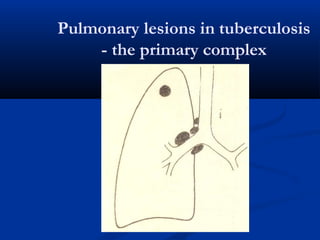
Pulmonary lesions in tuberculosis
- the primary complex
Complications of the primary
focus
1. Rupture of focus into pleural space
causing serous effusion
2. Rupture of focus into bronchus
causing cavitation
3. Enlarged focus, sometimes laminated or “coin”
shadow
Complications of regional nodes
1. Incomplete (ball-valve) bronchial obstruction,
emphysema of middle & lower lobes
2. Complete bronchial obstruction, collapse
of right lower lobe
3. Erosion of node into bronchus &
segmental consolidation
4. Rupture of node into pericardium:
tuberculous pericardial effusion
Sequelae of bronchial complications
1. Stricture of bronchus at site of erosion
2. Cylindrical bronchiectasis in area of old
collapse
3. Wedge shadow: contracture & fibrosis
of segmental lesion
4. Linear scar of fibrosis following
segmental lesion
Symptoms
 Primary complex – mild fever, anorexia, weight
loss, decreased activity, cough
 Progressive primary complex – high grade fever,
cough. Expectoration and hemoptysis – usually
associated with cavity and ulceration of
bronchus.
Abnormal chest signs – decreased air entry,
dullness, creps
 Endobronchial tb – wheeze!!
Fever, troublesome cough, dyspnea, wheezing
and cyanosis
 Pleural effusion – follows a rupture of a
subpleural focus. Also by hematogenous spread
from primary focus. Occurs coz of
hypersensitivity to tuberculoproteins.
Fever, cough, dyspnea, pleuritic chest pain.
Miliary tuberculosis


most common within 1st3 to 6 months after
infection
due to heavy hematogenous spread of
tubercle

bacilli
Onset: Insidious, with
Fever and weight loss
Palpable liver and/or spleen
Tachypnoea with normal chest findings
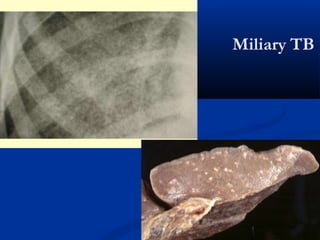
Miliary tuberculosis
 Hematogenous dissemination leads to progressive
development of small lesions throughout the body,
with tubercles in the
 lung, spleen, liver,
 bone marrow, heart, pancreas
 brain, choroid, skin
 Radiologic diagnosis:
 “Snow storm” appearance
(Multiple small lung nodules 1mm size and above in
both lung fields).
Miliary TB
Cutaneous Tuberculosis
1. Associated with primary complex

(Direct inoculation into Traumatized Area)
- Painless nodule, leading to non healing ulcer with regional
lymphadenitis
 - Scrofuloderma over ruptured caseous lymph node
2. Associated with Hematogenous dissemination


- Papulonecrotic tuberculids
papules with soft centers on trunk, thighs and face
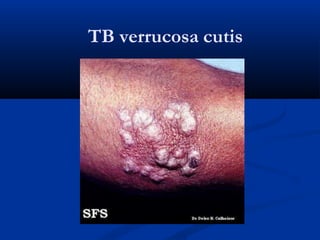
- Tuberculosis verrucosa cutis
Large tuberculids on arms and legs
3. Associated with hypersensitivity to tuberculin
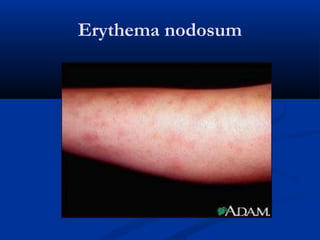
 - Erythema nodosum
painful indurated nodules on shins, elbows, forearms that
subside in 2-3 weeks
TB verrucosa cutis
Erythema nodosum
Tuberculosis of superficial
lymph nodes (scrofula)
 Tonsillar / submandibular
(Spread from paratracheal nodes)
 Supraclavicular
(From primary lesion in upper lobe)
 Axillary / epitrochlear
(From skin lesion on hand)
 Inguinal
(From ulcer on sole of foot)
Ocular Tuberculosis
 Primary tuberculous conjunctivitis (after trauma)
Yellowish – gray nodules on palpebral conjunctiva
with preauricular adenopathy
 Phlyctenular conjunctivitis (Hypersensitivity)
Nodules on limbus recurring in crops for weeks
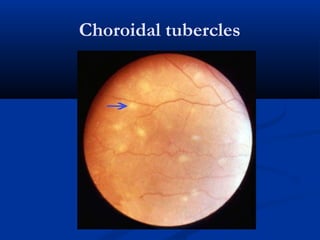
 Tubercles of choroid (with miliary TB)
Choroidal tubercles
Tuberculous otitis media
 Primary with Preauricular adenitis
 Metastatic spread with primary elsewhere
 Symptoms: Painless otorrhea, may be blood-
stained
Complications: Secondary infection



Deafness
TB meningitis
GI and Abdominal TB
 Hematogenous spread from lungs or swallowing
of infected sputum.
 Painless ulcer in gingivolabial sulcus with
submental or submandibular adenopathy
 Ulcer on tonsil
 Esophageal diverticulum secondary to rupture
of mediastinal nodes into lumen
 Tuberculous toxemia
 Present with colicky abdominal pain, vomiting and
constipation.
 Abdomen feels doughy.
 Rolled up omentum and enlarged lymph nodes may
appear as irregular nodular masses with ascites
 Tuberculous enteritis
Ulcers, mesenteric adenitis, peritonitis
Adhesions, subacute intestinal obstruction,
Hepatosplenomegaly
Renal tuberculosis
 Tubercles in glomeruli lead to shedding
of tubercle bacilli into tubules
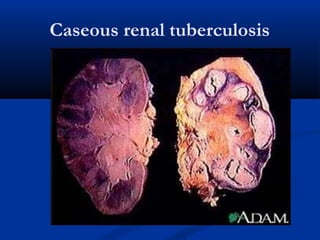
 Caseous mass / Cavity between cortex and
pyramids
 TB of bladder (Tuberculous cystitis)
 Symptoms: dysuria, hematuria,
pyuria with TB bacilli
Caseous renal tuberculosis
Skeletal tuberculosis
 Bones involved in order of frequency:
Vertebrae > knee > hip > elbow
Upper extremities and non-weight-bearing bones
(skull, clavicle) rarely involved
 Tuberculous spondylitis most commonly
Thoracic / Lumbar / Both (Decreasing frequency)
 X-ray findings:
Narrowing of disc space, Collapse of
vertebral body
Extensive destruction with kyphosis (Pott disease)
 Complications:Para vertebral abscess (Pott abscess)
Psoas Abscess. Paraplegia, Quadriplegia (cervical)
Genital tuberculosis
 Uncommon before puberty
 Usually due to lympho-hematogenous spread
 Occasionally by direct extension from
adjacent lesion of bone, gut, or urinary
tract
Genital tuberculosis
 Salpingitis
 Endometritis
 Oophoritis
 Cervicitis
 Infertility is commonest sequel
 in males:
 Primary tuberculosis of penis after
circumcision with inguinal adenopathy
 Epididymitis / Epididymo – orchitis in early
childhood
Tuberculous meningitis
TB meningitis seen in 1/300 Primary infections
Pathophysiology:
Rupture of a subcortical caseous focus (Rich’s) into the
subarachnoid space.
Inflammatory exudates form about base of brain and
along cerebral vessels as they pass over hemispheres.
Raised intracranial pressure due to increased secretion
of CSF
Adhesions along base and roof of 4thventricles lead to
obstruction to CSF flow and hydrocephalus,
involvement of cranial nerves III VI VII and optic chiasma.
Cerebral endarteritis narrows lumen, reduces blood flow,
leads to cerebral thrombosis and infarction.
Stages of TB meningitis
Stage I Irritability, anorexia, personality change
Stage II
Occasional vomiting, fever
Poor school performance
Focal neurological signs, cranial nerve palsies,
Seizures, hemiplegia, squint
Stage III Loss of consciousness, Coma, Papilloedema
Decerebrate rigidity
Complications of TB meningitis
Hydrocephalus
Subdural effusion
Late: Hemiplegia / Paraplegia
Intellectual impairment
Blindness
Deafness
Intracranial calcifications leading to
hypothalamic and pituitary dysfunction
- Growth failure
- Diabetes insipidus
- Failure of development of secondary
sexual characteristics
Diagnosis of TB meningitis
 Signs of meningeal irritation
 X-ray chest
 CT scan – basal exudates, inflammatory granulomas etc
 Tuberculin testing
 Retinoscopy for choroidal tubercles
 Lumbar puncture
Elevated CSF pressure(30 – 40cm h2o)
Cobweb Coagulum/ pellicle on standing
100 – 500 WBCs / cu.mm
>40 mg% protein
Low / Normal sugar
AFB smear & culture
Prognosis in TB meningitis
100% mortality in 3-4 weeks without treatment
100% survival with treatment started in Stage I
75% survival with treatment started in Stage II
Stage III – variable survival, all will have sequelae
Direct tests for tuberculosis
 Ziehl-Neelsen staining for AFB in clinical specimens
(sputum, gastric juice, biopsy)
 AFB culture on Lowenstein-Jensen solid medium (4
weeks)
 PCR amplification of targeted mycobacterial DNA
sequences
 DNA probes: fluorescence in situ hybridization assays
Culture
 LJ medium
 BACTEC radiometric assay
 Septichek AFB system
 MGIT – mycobacterial growth indicator tube
system
 PCR – rapid results
 Serodiagnosis – ELISA
 QuantiFERON- TB test (QFT) – for diagnosing
latent TB. Based on IFN-gamma released from
sensitized lymphocytes.
ELISPOT
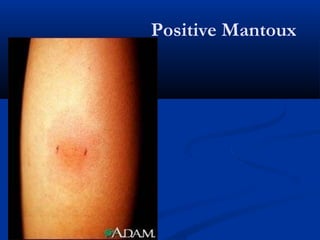
Positive Mantoux
Mantoux Test
 MC used test for establishing diagnosis of TB
in children
 Delayed type hypersensitivity reaction
 0.1 ml of 5 TU PPD is injected intradermally
into the volar aspect of the forearm (or 2 TU
of PPD RT 23)
 A weal of 5 mm should be raised
 Reaction is read after 48 – 72 hrs
 Look for induration and erythema
Observation and Inference
 48-72 hours later  diameter of induration
is measured transversely to the long axis of
the forearm.
 Induration > 10mm is suggestive of
natural infection.
 5-10 mm  borderline; considered positive in
immunocompromised host
 <5mm  Negative mantoux test does not rule
out TB
False Negatives
 Test done in incubation period of TB
 For several weeks following measles
 During Corticosteroid therapy
 Overwhelming TB infection (milliary, meningits)
 Severe Malnutrition
 If given Sub Cutaneous instead of Intra dermal
 Inactive Tuberculin
False positive
 Atypical mycobacteria
 BCG vaccine
 Infection at site of test
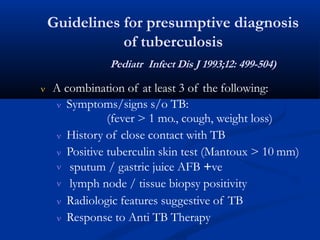
Guidelines for presumptive diagnosis
of tuberculosis
Pediatr Infect Dis J 1993;12: 499-504)
 A combination of at least 3 of the following:
 Symptoms/signs s/o TB:
(fever > 1 mo., cough, weight loss)
 History of close contact with TB
 Positive tuberculin skin test (Mantoux > 10 mm)


sputum / gastric juice AFB +ve
lymph node / tissue biopsy positivity
 Radiologic features suggestive of TB
 Response to Anti TB Therapy
 History of contact = any child who lives in a
household with an adult taking ATT or has
taken therapy in the past 2 years
Radiology
 In extra pulmonary tb, presence of lesions on chest
radiograph supports diagnosis.
 Enlarged lymph nodes in hila, right paratracheal region
 Consolidation in progressive primary disease –
heterogenous, poorly marginated with predilection to
apical or posterior segments of upper lobe or
superior segments of lower lobe.
 Bronchiectasis
 Pleural effusion
 Miliary tb – millet sized lesions
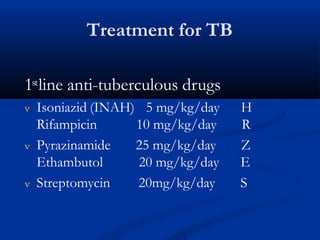
Treatment for TB
1stline anti-tuberculous drugs
 Isoniazid (INAH)
Rifampicin
 Pyrazinamide
Ethambutol
 Streptomycin
5 mg/kg/day H
10 mg/kg/day R
25 mg/kg/day Z
20 mg/kg/day E
20mg/kg/day S
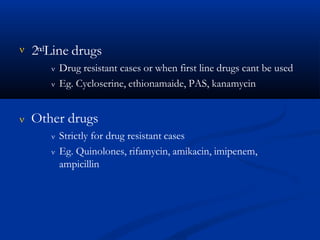
 2ndLine drugs
 Drug resistant cases or when first line drugs cant be used
 Eg. Cycloserine, ethionamaide, PAS, kanamycin
 Other drugs
 Strictly for drug resistant cases
 Eg. Quinolones, rifamycin, amikacin, imipenem,
ampicillin
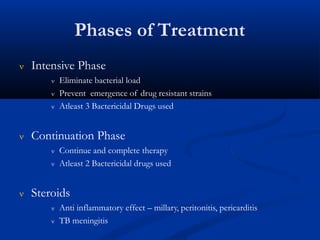
Phases of Treatment
 Intensive Phase
 Eliminate bacterial load
 Prevent emergence of drug resistant strains
 Atleast 3 Bactericidal Drugs used
 Continuation Phase
 Continue and complete therapy
 Atleast 2 Bactericidal drugs used
 Steroids
 Anti inflammatory effect – millary, peritonitis, pericarditis
 TB meningitis
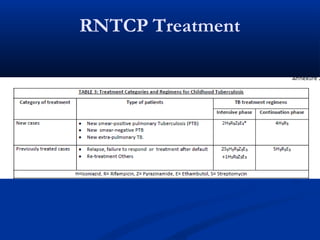
RNTCP Treatment
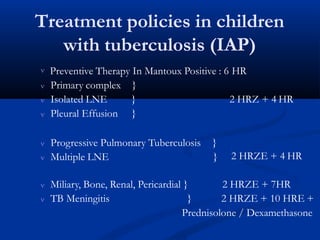
Treatment policies in children
with tuberculosis (IAP)
 Preventive Therapy In Mantoux Positive : 6 HR
 Primary complex
 Isolated LNE
}
} 2 HRZ + 4 HR
 Pleural Effusion }
 Progressive Pulmonary Tuberculosis }
 Multiple LNE } 2 HRZE + 4 HR
 Miliary, Bone, Renal, Pericardial }
 TB Meningitis }
2 HRZE + 7HR
2 HRZE + 10 HRE +
Prednisolone / Dexamethasone
The 5 components of DOTS
Political & administrative commitment
Diagnosis by good quality sputum microscopy
Adequate supply of good quality drugs
Directly observed treatment
Systematic monitoring & Accountability
Drug Resistance
 Natural or Primary
 Acquired
 Initial
 Multidrug resistance (MDR)
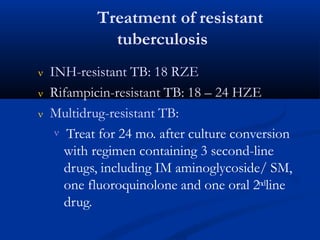
Treatment of resistant
tuberculosis
 INH-resistant TB: 18 RZE
 Rifampicin-resistant TB: 18 – 24 HZE
 Multidrug-resistant TB:
 Treat for 24 mo. after culture conversion
with regimen containing 3 second-line
drugs, including IM aminoglycoside/ SM,
one fluoroquinolone and one oral 2ndline
drug.
References
 Nelson’s textbook of paediatrics
 OP Ghai – Essential Paediatrics
 Preventive and Social Medicine – Park & Park
 The Internet…

childhoodtb-131227001838-phpapp02.pptx

  • 1.
  • 2.
    Tuberculosis  Tuberculosis isa chronic infectious disease caused by Mycobacterium tuberculosis characterized by vague constitutional symptoms and a protracted course of illness with remissions and exacerbations.  Tuberculosis is the reaction of tissues of the human host to the presence and multiplication of Mycobacterium tuberculosis.  The clinical states arising from TB infection are the outcome between the capacity of the host to contain and eliminate the organism versus the capacity of the organism to multiply and proliferate.
  • 3.
    Portal of entryfor tuberculosis  Inhalation of Tubercle bacilli in >95% (M.TB)  Ingestion of milk containing Bovine Tubercle bacilli (M. bovis)  Contamination of superficial skin or mucous membrane lesion with tubercle bacilli  Congenital infection when mother has lymphohematogenous spread during pregnancy OR tuberculous endometritis
  • 4.
    Primary tuberculous infection PrimaryFocus (Ghon’s focus)  at the site of first implantation  usually single and Subpleural  in most, - heals and disappears, or  - fibroses or calcifies. Primary Complex:  primary focus + Hilar lymphnodes + draining lymphatics  complications arise more commonly from regional adenitis than from the primary focus
  • 5.
    Primary infection Children vs.Adults  In adults, - regional lymphadenitis less marked - bronchial erosion less frequent - less risk of dissemination  Thus, adult primary infection tends to be more local and pulmonary.
  • 6.
    Progressive primary tuberculosis Progression of TB depends on the age of the child, number of tubercle bacilli, and host resistance.  Apparently healed focus or nodes may contain viable organisms for many years.  During 1st 4-8 weeks, organisms are disseminated in the blood stream.
  • 7.
    Progressive pulmonary disease Progressive primary infection: Progression of recently acquired pulmonary primary infection  Endogenous exacerbation: reactivity of organisms and breakdown of primary lesions acquired > 5 years previously  Exogenous exacerbation: Re-infection by newly acquired bacilli in persons with healed primary lesions
  • 8.
    Symptoms of childhood tuberculosis 1.Failure to thrive } & 2. Intermittent fever } are the commonest symptoms 3. Pleural effusion 4. Ascites 5. Abdominal mass (Painless) 6. Limp / Arthritis 7. Painless lymphadenopathy 8. Persistent skin ulcer 9. Sterile pyuria 10. Meningitis
  • 9.
    Pulmonary lesions intuberculosis - the primary complex
  • 10.
    Complications of theprimary focus 1. Rupture of focus into pleural space causing serous effusion 2. Rupture of focus into bronchus causing cavitation 3. Enlarged focus, sometimes laminated or “coin” shadow
  • 11.
    Complications of regionalnodes 1. Incomplete (ball-valve) bronchial obstruction, emphysema of middle & lower lobes 2. Complete bronchial obstruction, collapse of right lower lobe 3. Erosion of node into bronchus & segmental consolidation 4. Rupture of node into pericardium: tuberculous pericardial effusion
  • 12.
    Sequelae of bronchialcomplications 1. Stricture of bronchus at site of erosion 2. Cylindrical bronchiectasis in area of old collapse 3. Wedge shadow: contracture & fibrosis of segmental lesion 4. Linear scar of fibrosis following segmental lesion
  • 13.
    Symptoms  Primary complex– mild fever, anorexia, weight loss, decreased activity, cough  Progressive primary complex – high grade fever, cough. Expectoration and hemoptysis – usually associated with cavity and ulceration of bronchus. Abnormal chest signs – decreased air entry, dullness, creps
  • 14.
     Endobronchial tb– wheeze!! Fever, troublesome cough, dyspnea, wheezing and cyanosis  Pleural effusion – follows a rupture of a subpleural focus. Also by hematogenous spread from primary focus. Occurs coz of hypersensitivity to tuberculoproteins. Fever, cough, dyspnea, pleuritic chest pain.
  • 15.
    Miliary tuberculosis   most commonwithin 1st3 to 6 months after infection due to heavy hematogenous spread of tubercle  bacilli Onset: Insidious, with Fever and weight loss Palpable liver and/or spleen Tachypnoea with normal chest findings
  • 16.
    Miliary tuberculosis  Hematogenousdissemination leads to progressive development of small lesions throughout the body, with tubercles in the  lung, spleen, liver,  bone marrow, heart, pancreas  brain, choroid, skin  Radiologic diagnosis:  “Snow storm” appearance (Multiple small lung nodules 1mm size and above in both lung fields).
  • 17.
  • 18.
    Cutaneous Tuberculosis 1. Associatedwith primary complex  (Direct inoculation into Traumatized Area) - Painless nodule, leading to non healing ulcer with regional lymphadenitis  - Scrofuloderma over ruptured caseous lymph node 2. Associated with Hematogenous dissemination   - Papulonecrotic tuberculids papules with soft centers on trunk, thighs and face - Tuberculosis verrucosa cutis Large tuberculids on arms and legs 3. Associated with hypersensitivity to tuberculin  - Erythema nodosum painful indurated nodules on shins, elbows, forearms that subside in 2-3 weeks
  • 19.
  • 20.
  • 21.
    Tuberculosis of superficial lymphnodes (scrofula)  Tonsillar / submandibular (Spread from paratracheal nodes)  Supraclavicular (From primary lesion in upper lobe)  Axillary / epitrochlear (From skin lesion on hand)  Inguinal (From ulcer on sole of foot)
  • 22.
    Ocular Tuberculosis  Primarytuberculous conjunctivitis (after trauma) Yellowish – gray nodules on palpebral conjunctiva with preauricular adenopathy  Phlyctenular conjunctivitis (Hypersensitivity) Nodules on limbus recurring in crops for weeks  Tubercles of choroid (with miliary TB)
  • 23.
  • 24.
    Tuberculous otitis media Primary with Preauricular adenitis  Metastatic spread with primary elsewhere  Symptoms: Painless otorrhea, may be blood- stained Complications: Secondary infection    Deafness TB meningitis
  • 25.
    GI and AbdominalTB  Hematogenous spread from lungs or swallowing of infected sputum.  Painless ulcer in gingivolabial sulcus with submental or submandibular adenopathy  Ulcer on tonsil  Esophageal diverticulum secondary to rupture of mediastinal nodes into lumen
  • 26.
     Tuberculous toxemia Present with colicky abdominal pain, vomiting and constipation.  Abdomen feels doughy.  Rolled up omentum and enlarged lymph nodes may appear as irregular nodular masses with ascites  Tuberculous enteritis Ulcers, mesenteric adenitis, peritonitis Adhesions, subacute intestinal obstruction, Hepatosplenomegaly
  • 27.
    Renal tuberculosis  Tuberclesin glomeruli lead to shedding of tubercle bacilli into tubules  Caseous mass / Cavity between cortex and pyramids  TB of bladder (Tuberculous cystitis)  Symptoms: dysuria, hematuria, pyuria with TB bacilli
  • 28.
  • 29.
    Skeletal tuberculosis  Bonesinvolved in order of frequency: Vertebrae > knee > hip > elbow Upper extremities and non-weight-bearing bones (skull, clavicle) rarely involved  Tuberculous spondylitis most commonly Thoracic / Lumbar / Both (Decreasing frequency)  X-ray findings: Narrowing of disc space, Collapse of vertebral body Extensive destruction with kyphosis (Pott disease)  Complications:Para vertebral abscess (Pott abscess) Psoas Abscess. Paraplegia, Quadriplegia (cervical)
  • 30.
    Genital tuberculosis  Uncommonbefore puberty  Usually due to lympho-hematogenous spread  Occasionally by direct extension from adjacent lesion of bone, gut, or urinary tract
  • 31.
    Genital tuberculosis  Salpingitis Endometritis  Oophoritis  Cervicitis  Infertility is commonest sequel  in males:  Primary tuberculosis of penis after circumcision with inguinal adenopathy  Epididymitis / Epididymo – orchitis in early childhood
  • 32.
    Tuberculous meningitis TB meningitisseen in 1/300 Primary infections Pathophysiology: Rupture of a subcortical caseous focus (Rich’s) into the subarachnoid space. Inflammatory exudates form about base of brain and along cerebral vessels as they pass over hemispheres. Raised intracranial pressure due to increased secretion of CSF Adhesions along base and roof of 4thventricles lead to obstruction to CSF flow and hydrocephalus, involvement of cranial nerves III VI VII and optic chiasma. Cerebral endarteritis narrows lumen, reduces blood flow, leads to cerebral thrombosis and infarction.
  • 33.
    Stages of TBmeningitis Stage I Irritability, anorexia, personality change Stage II Occasional vomiting, fever Poor school performance Focal neurological signs, cranial nerve palsies, Seizures, hemiplegia, squint Stage III Loss of consciousness, Coma, Papilloedema Decerebrate rigidity
  • 34.
    Complications of TBmeningitis Hydrocephalus Subdural effusion Late: Hemiplegia / Paraplegia Intellectual impairment Blindness Deafness Intracranial calcifications leading to hypothalamic and pituitary dysfunction - Growth failure - Diabetes insipidus - Failure of development of secondary sexual characteristics
  • 35.
    Diagnosis of TBmeningitis  Signs of meningeal irritation  X-ray chest  CT scan – basal exudates, inflammatory granulomas etc  Tuberculin testing  Retinoscopy for choroidal tubercles  Lumbar puncture Elevated CSF pressure(30 – 40cm h2o) Cobweb Coagulum/ pellicle on standing 100 – 500 WBCs / cu.mm >40 mg% protein Low / Normal sugar AFB smear & culture
  • 36.
    Prognosis in TBmeningitis 100% mortality in 3-4 weeks without treatment 100% survival with treatment started in Stage I 75% survival with treatment started in Stage II Stage III – variable survival, all will have sequelae
  • 37.
    Direct tests fortuberculosis  Ziehl-Neelsen staining for AFB in clinical specimens (sputum, gastric juice, biopsy)  AFB culture on Lowenstein-Jensen solid medium (4 weeks)  PCR amplification of targeted mycobacterial DNA sequences  DNA probes: fluorescence in situ hybridization assays
  • 38.
    Culture  LJ medium BACTEC radiometric assay  Septichek AFB system  MGIT – mycobacterial growth indicator tube system
  • 39.
     PCR –rapid results  Serodiagnosis – ELISA  QuantiFERON- TB test (QFT) – for diagnosing latent TB. Based on IFN-gamma released from sensitized lymphocytes. ELISPOT
  • 40.
  • 41.
    Mantoux Test  MCused test for establishing diagnosis of TB in children  Delayed type hypersensitivity reaction  0.1 ml of 5 TU PPD is injected intradermally into the volar aspect of the forearm (or 2 TU of PPD RT 23)  A weal of 5 mm should be raised  Reaction is read after 48 – 72 hrs  Look for induration and erythema
  • 42.
    Observation and Inference 48-72 hours later  diameter of induration is measured transversely to the long axis of the forearm.  Induration > 10mm is suggestive of natural infection.  5-10 mm  borderline; considered positive in immunocompromised host  <5mm  Negative mantoux test does not rule out TB
  • 43.
    False Negatives  Testdone in incubation period of TB  For several weeks following measles  During Corticosteroid therapy  Overwhelming TB infection (milliary, meningits)  Severe Malnutrition  If given Sub Cutaneous instead of Intra dermal  Inactive Tuberculin
  • 44.
    False positive  Atypicalmycobacteria  BCG vaccine  Infection at site of test
  • 45.
    Guidelines for presumptivediagnosis of tuberculosis Pediatr Infect Dis J 1993;12: 499-504)  A combination of at least 3 of the following:  Symptoms/signs s/o TB: (fever > 1 mo., cough, weight loss)  History of close contact with TB  Positive tuberculin skin test (Mantoux > 10 mm)   sputum / gastric juice AFB +ve lymph node / tissue biopsy positivity  Radiologic features suggestive of TB  Response to Anti TB Therapy
  • 46.
     History ofcontact = any child who lives in a household with an adult taking ATT or has taken therapy in the past 2 years
  • 47.
    Radiology  In extrapulmonary tb, presence of lesions on chest radiograph supports diagnosis.  Enlarged lymph nodes in hila, right paratracheal region  Consolidation in progressive primary disease – heterogenous, poorly marginated with predilection to apical or posterior segments of upper lobe or superior segments of lower lobe.  Bronchiectasis  Pleural effusion  Miliary tb – millet sized lesions
  • 48.
    Treatment for TB 1stlineanti-tuberculous drugs  Isoniazid (INAH) Rifampicin  Pyrazinamide Ethambutol  Streptomycin 5 mg/kg/day H 10 mg/kg/day R 25 mg/kg/day Z 20 mg/kg/day E 20mg/kg/day S
  • 49.
     2ndLine drugs Drug resistant cases or when first line drugs cant be used  Eg. Cycloserine, ethionamaide, PAS, kanamycin  Other drugs  Strictly for drug resistant cases  Eg. Quinolones, rifamycin, amikacin, imipenem, ampicillin
  • 50.
    Phases of Treatment Intensive Phase  Eliminate bacterial load  Prevent emergence of drug resistant strains  Atleast 3 Bactericidal Drugs used  Continuation Phase  Continue and complete therapy  Atleast 2 Bactericidal drugs used  Steroids  Anti inflammatory effect – millary, peritonitis, pericarditis  TB meningitis
  • 51.
  • 52.
    Treatment policies inchildren with tuberculosis (IAP)  Preventive Therapy In Mantoux Positive : 6 HR  Primary complex  Isolated LNE } } 2 HRZ + 4 HR  Pleural Effusion }  Progressive Pulmonary Tuberculosis }  Multiple LNE } 2 HRZE + 4 HR  Miliary, Bone, Renal, Pericardial }  TB Meningitis } 2 HRZE + 7HR 2 HRZE + 10 HRE + Prednisolone / Dexamethasone
  • 53.
    The 5 componentsof DOTS Political & administrative commitment Diagnosis by good quality sputum microscopy Adequate supply of good quality drugs Directly observed treatment Systematic monitoring & Accountability
  • 54.
    Drug Resistance  Naturalor Primary  Acquired  Initial  Multidrug resistance (MDR)
  • 55.
    Treatment of resistant tuberculosis INH-resistant TB: 18 RZE  Rifampicin-resistant TB: 18 – 24 HZE  Multidrug-resistant TB:  Treat for 24 mo. after culture conversion with regimen containing 3 second-line drugs, including IM aminoglycoside/ SM, one fluoroquinolone and one oral 2ndline drug.
  • 57.
    References  Nelson’s textbookof paediatrics  OP Ghai – Essential Paediatrics  Preventive and Social Medicine – Park & Park  The Internet…