Pediatric Asthma
What is New??
DR. NAZLEEN SHAKIR
Objectives
are to answer these questions
 When to diagnose asthma in a child??
 Are there tests to aid in diagnosis??
 What is Asthma Predictive Index API??
 What are the goals of asthma management?? And how to achieve them??
 What are the new guidelines for asthma management in children??
Pediatric Asthma
 The most commonly encountered childhood chronic disease
 Occurring in approximately 13.5% of children
 Due to the interplay between patient, family physician (the managing
physician here), and the environment, asthma often proves challenging to
control
Definition??
 Asthma is a heterogeneous disease, usually characterized by
chronic airway inflammation
 It is defined by the history of respiratory symptoms such as
wheezes, shortness of breath, chest tightness and cough that
vary over time and in intensity, together with variable
expiratory airflow limitations.
Case Scenario
 A three years old boy presents to your office with complain of cough and
wheeze for 3 weeks duration. He has history of eczema and two other
episodes of wheeze during the last year
 Would you diagnose asthma in this child??
Asthma-like symptoms??
Reactive airway disease??
Recurrent wheeze??
 Recurrent wheeze occurs in large proportion of children 5 years and younger, typically with viral
upper respiratory tract infections
 Deciding when this is the initial presentation of asthma is DIFFICULT
Asthma in under 5 years
Euphemisms
with uncertain
clinical
usefulness
When to Diagnose asthma in under 5??
Asthma is likely in young children with history of wheeze when they have:
 Wheezing or coughing that occurs with exercise, laughing or crying in the
absence of an apparent respiratory infection
 History of other allergic disease (eczema or allergic rhinitis) or asthma in the
first degree relatives
 Clinical improvement during 2-3 months of controller treatment, and
worsening after cessation
Are there tests to aid in diagnosis??
No tests diagnose asthma with certainty in under 5 years
 A therapeutic trial for at least 2-3 months with SABA and regular low dose ICS
 Tests for atopy; skin prick test or allergen specific immunoglobulins (absence of
atopy does not rule out asthma)
 Chest X-ray to exclude structural abnormalities when expected
 Lung function tests?? Difficult in 4 years and younger
 FeNO (Fractional concentration of Exhaled Nitric Oxide); it is becoming popular
• In pre-school children with recurrent cough and wheeze, elevated FeNO >4
weeks from any URTI, predicted physician-diagnosed asthma at school age
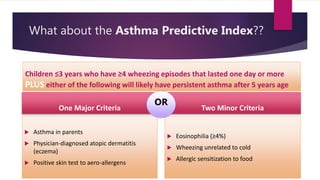
What about the Asthma Predictive Index??
Children ≤3 years who have ≥4 wheezing episodes that lasted one day or more
PLUS either of the following will likely have persistent asthma after 5 years age
 Asthma in parents
 Physician-diagnosed atopic dermatitis
(eczema)
 Positive skin test to aero-allergens
Two Minor Criteria
 Eosinophilia (≥4%)
 Wheezing unrelated to cold
 Allergic sensitization to food
One Major Criteria
OR
Goals of asthma management??
 Achieve asthma control (control of symptoms)
 Reduce the need for rescue inhalers
 Maintain near-normal pulmonary function and minimize impaired lung
development and drug side effects
 Maintain normal activity levels (including exercise and other physical activity
and attendance at school)
 Step-down therapy; minimum possible medication to maintain control
 Satisfy parents' expectations for asthma care
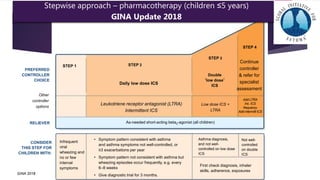
Stepwise approach – pharmacotherapy (children ≤5 years)
GINA Update 2018
GINA 2018
Infrequent
viral
wheezing and
no or few
interval
symptoms
• Symptom pattern consistent with asthma
and asthma symptoms not well-controlled, or
≥3 exacerbations per year
• Symptom pattern not consistent with asthma but
wheezing episodes occur frequently, e.g. every
6–8 weeks
• Give diagnostic trial for 3 months.
Asthma diagnosis,
and not well-
controlled on low dose
ICS
Not well-
controlled
on double
ICS
First check diagnosis, inhaler
skills, adherence, exposures
CONSIDER
THIS STEP FOR
CHILDREN WITH:
RELIEVER
Other
controller
options
PREFERRED
CONTROLLER
CHOICE
As-needed short-acting beta2-agonist (all children)
Leukotriene receptor antagonist (LTRA)
Intermittent ICS
Low dose ICS +
LTRA
Add LTRA
Inc. ICS
frequency
Add intermitt ICS
Daily low dose ICS
Double
‘low dose’
ICS
Continue
controller
& refer for
specialist
assessment
STEP 1 STEP 2
STEP 3
STEP 4
GINA 2018
Infrequent
viral
wheezing and
no or few
interval
symptoms
Symptom pattern consistent with asthma
and asthma symptoms not well-controlled, or
≥3 exacerbations per year
Symptom pattern not consistent with asthma but
wheezing episodes occur frequently, e.g. every
6–8 weeks.
Give diagnostic trial for 3 months.
Asthma diagnosis,
and not well-
controlled on low dose
ICS
Not well-
controlled
on double
ICS
First check diagnosis, inhaler
skills, adherence, exposures
CONSIDER
THIS STEP FOR
CHILDREN WITH:
RELIEVER
Other
controller
options
PREFERRED
CONTROLLER
CHOICE
As-needed short-acting beta2-agonist (all children)
Leukotriene receptor antagonist (LTRA)
Intermittent ICS
Low dose ICS +
LTRA
Add LTRA
Inc. ICS
frequency
Add intermitt ICS
Daily low dose ICS
Double
‘low dose’
ICS
Continue
controller
& refer for
specialist
assessment
STEP 1 STEP 2
STEP 3
STEP 4
Stepwise approach – pharmacotherapy (children ≤5 years)
GINA Update 2018
What was
known???
What is NEW in GINA 2018??
 Step 2 (initial controller treatment) for children with frequent viral-
induced wheezing and with interval asthma symptoms
 A trial of regular low-dose ICS should be undertaken first
 As-needed (prn) or episodic ICS may be considered
 The reduction in exacerbations seems similar for regular and high dose
episodic ICS (Kaiser Pediatr 2015)
 LTRA is another controller option
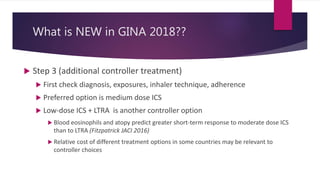
What is NEW in GINA 2018??
 Step 3 (additional controller treatment)
 First check diagnosis, exposures, inhaler technique, adherence
 Preferred option is medium dose ICS
 Low-dose ICS + LTRA is another controller option
 Blood eosinophils and atopy predict greater short-term response to moderate dose ICS
than to LTRA (Fitzpatrick JACI 2016)
 Relative cost of different treatment options in some countries may be relevant to
controller choices
Assessing
severity and
initiating
therapy in
children who
are not
currently on
long term
control
medications
Well
controlled
No well controlled
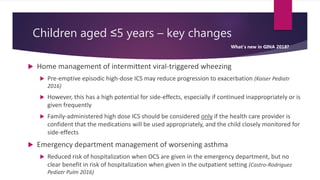
Children aged ≤5 years – key changes
 Home management of intermittent viral-triggered wheezing
 Pre-emptive episodic high-dose ICS may reduce progression to exacerbation (Kaiser Pediatr
2016)
 However, this has a high potential for side-effects, especially if continued inappropriately or is
given frequently
 Family-administered high dose ICS should be considered only if the health care provider is
confident that the medications will be used appropriately, and the child closely monitored for
side-effects
 Emergency department management of worsening asthma
 Reduced risk of hospitalization when OCS are given in the emergency department, but no
clear benefit in risk of hospitalization when given in the outpatient setting (Castro-Rodriguez
Pediatr Pulm 2016)
What’s new in GINA 2018?
Inhalers OR Nebulizers???
MDI are as effective as
Nebulizers for asthma
exacerbations
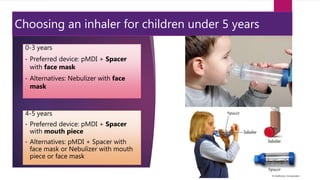
Choosing an inhaler for children under 5 years
0-3 years
• Preferred device: pMDI + Spacer
with face mask
• Alternatives: Nebulizer with face
mask
4-5 years
• Preferred device: pMDI + Spacer
with mouth piece
• Alternatives: pMDI + Spacer with
face mask or Nebulizer with mouth
piece or face mask
‘Low dose’ inhaled corticosteroids (mcg/day)
for children ≤5 years – updated 2018
This is not a table of equivalence
A low daily dose is defined as the lowest approved dose for which safety and effectiveness have been adequately
studied in this age group
Inhaled corticosteroid
Low daily dose, mcg
(with lower limit of age-group studied)
Beclometasone dipropionate (HFA) 100 (ages ≥5 years)
Budesonide (nebulized) 500 (ages ≥1 year)
Fluticasone propionate (HFA) 100 (ages ≥4 years)
Mometasone furoate 110 (ages ≥4 years)
Budesonide (pMDI + spacer) Not sufficiently studied in this age group
Ciclesonide Not sufficiently studied in this age group
Triamcinolone acetonide Not sufficiently studied in this age group
TREATMENT of acute exacerbations
 In young children (0-3 years), SABAs delivered by MDI with a spacer were more effective in
reducing admission rates than nebulizers
 In older children (3-18 years), SABAs delivered via spacer reduced ED length of stay, but did not
significantly affect hospitalization rates. Additionally, SABAs administered with anticholinergics
such as ipratropium bromide were more effective than SABAs alone in reducing admissions
 Dexamethasone and prednisone are the 2 most commonly used systemic steroids, and studies
haven't indicated superiority of either. There is no difference in efficacy between oral and
intravenous steroids
 Recent clinical trial found a 2-day course of dexamethasone (0.6 mg/kg) had similar efficacy with
fewer adverse effects when compared to a 5-day course of prednisone (1-2 mg/kg/day)
GINA 2018?
What are Non-pharmacological strategies for
asthma management???
 Education of parent/carer and the child (depending on child’s age)
 Skill training for effective use of inhaler devices and encouragement of
good adherence
 Monitoring of symptoms by parent/carer
 A written asthma action plan
ENVIRONMENTAL measures???
 Removal of pets from home and most specifically from child’s bedroom
 Seal or filter air ducts that lead to child’s bedroom
 Maintain relative humidity below 50%
 Encase mattress and possibly pillows in mite allergen impermeable covers
 Launder bed linens in hot water (55◦ C)
 Remove carpeting if possible or vacuum weekly
 Stay indoor with windows closed during peak season especially in the afternoon
 Parents should stop smoking or smoke outside
 If smoking outside, wear a “smoking jacket”
 Don’t smoke in the car
Other changes
 Primary prevention of asthma
 A systematic review of randomized controlled trials on maternal dietary
intake of fish or long-chain polyunsaturated fatty acids during pregnancy
showed no consistent effects on the risk of wheeze, asthma or atopy in the
child (Best Am J Clin Nutr 2016)
 One recent study demonstrated decreased wheeze/asthma in pre-school
children at high risk for asthma when mothers were given a high dose fish
oil supplement in the third trimester (Bisgard NEJM 2016); but ‘fish oil’ is not
well defined, and the optimal dosing regimen has not been established
What’s new in GINA 2018?
Reducing the burden of asthma
 Avoiding tobacco smoke exposure
 Lessening maternal obesity
 Decreasing maternal antibiotic and acetaminophen use, and curtailing stress
 Evidence suggests that after birth, breastfeeding and reducing childhood
obesity can help lower the risk of asthma
 Atopic disease, in general, can be reduced by breastfeeding until at least 4
months, as well as encouraging a varied diet that does not restrict potential
allergens during pregnancy or lactation, and introducing foods (including
potential allergens) after the age of 4 months
Finally Key recommendations are
 Reassure parents that metered-dose inhalers are as effective as nebulizers for asthma exacerbations.
A
 Use a 2-day course of systemic steroids for asthma exacerbations rather than extended regimens. B
 Develop an asthma action plan for every patient with asthma to decrease acute care visits. B
 Guidelines emphasize stepwise treatment, based on symptom severity, to maximize quality of life
while minimizing morbidity
 Consider de-escalating care when symptoms are controlled to minimize adverse effects
 Inhaled SABA are the mainstay of treatment for intermittent asthma, as well as asthma exacerbations
 Self-management strategies reduces asthma morbidity in both adults and children. A
 Good communication by the health care providers is essential as the basis for good outcomes. B
References
 Global Initiative for Asthma (GINA 2018)
 National Heart, Lung, Blood Institute (NHLBI), EPR 3
 National Asthma Education and Prevention Program (NAEPP)

Pediatrics asthma

  • 1.
    Pediatric Asthma What isNew?? DR. NAZLEEN SHAKIR
  • 2.
    Objectives are to answerthese questions  When to diagnose asthma in a child??  Are there tests to aid in diagnosis??  What is Asthma Predictive Index API??  What are the goals of asthma management?? And how to achieve them??  What are the new guidelines for asthma management in children??
  • 3.
    Pediatric Asthma  Themost commonly encountered childhood chronic disease  Occurring in approximately 13.5% of children  Due to the interplay between patient, family physician (the managing physician here), and the environment, asthma often proves challenging to control
  • 4.
    Definition??  Asthma isa heterogeneous disease, usually characterized by chronic airway inflammation  It is defined by the history of respiratory symptoms such as wheezes, shortness of breath, chest tightness and cough that vary over time and in intensity, together with variable expiratory airflow limitations.
  • 5.
    Case Scenario  Athree years old boy presents to your office with complain of cough and wheeze for 3 weeks duration. He has history of eczema and two other episodes of wheeze during the last year  Would you diagnose asthma in this child??
  • 6.
    Asthma-like symptoms?? Reactive airwaydisease?? Recurrent wheeze??  Recurrent wheeze occurs in large proportion of children 5 years and younger, typically with viral upper respiratory tract infections  Deciding when this is the initial presentation of asthma is DIFFICULT Asthma in under 5 years Euphemisms with uncertain clinical usefulness
  • 7.
    When to Diagnoseasthma in under 5?? Asthma is likely in young children with history of wheeze when they have:  Wheezing or coughing that occurs with exercise, laughing or crying in the absence of an apparent respiratory infection  History of other allergic disease (eczema or allergic rhinitis) or asthma in the first degree relatives  Clinical improvement during 2-3 months of controller treatment, and worsening after cessation
  • 8.
    Are there teststo aid in diagnosis?? No tests diagnose asthma with certainty in under 5 years  A therapeutic trial for at least 2-3 months with SABA and regular low dose ICS  Tests for atopy; skin prick test or allergen specific immunoglobulins (absence of atopy does not rule out asthma)  Chest X-ray to exclude structural abnormalities when expected  Lung function tests?? Difficult in 4 years and younger  FeNO (Fractional concentration of Exhaled Nitric Oxide); it is becoming popular • In pre-school children with recurrent cough and wheeze, elevated FeNO >4 weeks from any URTI, predicted physician-diagnosed asthma at school age
  • 9.
    What about theAsthma Predictive Index?? Children ≤3 years who have ≥4 wheezing episodes that lasted one day or more PLUS either of the following will likely have persistent asthma after 5 years age  Asthma in parents  Physician-diagnosed atopic dermatitis (eczema)  Positive skin test to aero-allergens Two Minor Criteria  Eosinophilia (≥4%)  Wheezing unrelated to cold  Allergic sensitization to food One Major Criteria OR
  • 10.
    Goals of asthmamanagement??  Achieve asthma control (control of symptoms)  Reduce the need for rescue inhalers  Maintain near-normal pulmonary function and minimize impaired lung development and drug side effects  Maintain normal activity levels (including exercise and other physical activity and attendance at school)  Step-down therapy; minimum possible medication to maintain control  Satisfy parents' expectations for asthma care
  • 11.
    Stepwise approach –pharmacotherapy (children ≤5 years) GINA Update 2018 GINA 2018 Infrequent viral wheezing and no or few interval symptoms • Symptom pattern consistent with asthma and asthma symptoms not well-controlled, or ≥3 exacerbations per year • Symptom pattern not consistent with asthma but wheezing episodes occur frequently, e.g. every 6–8 weeks • Give diagnostic trial for 3 months. Asthma diagnosis, and not well- controlled on low dose ICS Not well- controlled on double ICS First check diagnosis, inhaler skills, adherence, exposures CONSIDER THIS STEP FOR CHILDREN WITH: RELIEVER Other controller options PREFERRED CONTROLLER CHOICE As-needed short-acting beta2-agonist (all children) Leukotriene receptor antagonist (LTRA) Intermittent ICS Low dose ICS + LTRA Add LTRA Inc. ICS frequency Add intermitt ICS Daily low dose ICS Double ‘low dose’ ICS Continue controller & refer for specialist assessment STEP 1 STEP 2 STEP 3 STEP 4
  • 12.
    GINA 2018 Infrequent viral wheezing and noor few interval symptoms Symptom pattern consistent with asthma and asthma symptoms not well-controlled, or ≥3 exacerbations per year Symptom pattern not consistent with asthma but wheezing episodes occur frequently, e.g. every 6–8 weeks. Give diagnostic trial for 3 months. Asthma diagnosis, and not well- controlled on low dose ICS Not well- controlled on double ICS First check diagnosis, inhaler skills, adherence, exposures CONSIDER THIS STEP FOR CHILDREN WITH: RELIEVER Other controller options PREFERRED CONTROLLER CHOICE As-needed short-acting beta2-agonist (all children) Leukotriene receptor antagonist (LTRA) Intermittent ICS Low dose ICS + LTRA Add LTRA Inc. ICS frequency Add intermitt ICS Daily low dose ICS Double ‘low dose’ ICS Continue controller & refer for specialist assessment STEP 1 STEP 2 STEP 3 STEP 4 Stepwise approach – pharmacotherapy (children ≤5 years) GINA Update 2018
  • 13.
  • 14.
    What is NEWin GINA 2018??  Step 2 (initial controller treatment) for children with frequent viral- induced wheezing and with interval asthma symptoms  A trial of regular low-dose ICS should be undertaken first  As-needed (prn) or episodic ICS may be considered  The reduction in exacerbations seems similar for regular and high dose episodic ICS (Kaiser Pediatr 2015)  LTRA is another controller option
  • 15.
    What is NEWin GINA 2018??  Step 3 (additional controller treatment)  First check diagnosis, exposures, inhaler technique, adherence  Preferred option is medium dose ICS  Low-dose ICS + LTRA is another controller option  Blood eosinophils and atopy predict greater short-term response to moderate dose ICS than to LTRA (Fitzpatrick JACI 2016)  Relative cost of different treatment options in some countries may be relevant to controller choices
  • 16.
    Assessing severity and initiating therapy in childrenwho are not currently on long term control medications Well controlled No well controlled
  • 17.
    Children aged ≤5years – key changes  Home management of intermittent viral-triggered wheezing  Pre-emptive episodic high-dose ICS may reduce progression to exacerbation (Kaiser Pediatr 2016)  However, this has a high potential for side-effects, especially if continued inappropriately or is given frequently  Family-administered high dose ICS should be considered only if the health care provider is confident that the medications will be used appropriately, and the child closely monitored for side-effects  Emergency department management of worsening asthma  Reduced risk of hospitalization when OCS are given in the emergency department, but no clear benefit in risk of hospitalization when given in the outpatient setting (Castro-Rodriguez Pediatr Pulm 2016) What’s new in GINA 2018?
  • 18.
    Inhalers OR Nebulizers??? MDIare as effective as Nebulizers for asthma exacerbations
  • 19.
    Choosing an inhalerfor children under 5 years 0-3 years • Preferred device: pMDI + Spacer with face mask • Alternatives: Nebulizer with face mask 4-5 years • Preferred device: pMDI + Spacer with mouth piece • Alternatives: pMDI + Spacer with face mask or Nebulizer with mouth piece or face mask
  • 20.
    ‘Low dose’ inhaledcorticosteroids (mcg/day) for children ≤5 years – updated 2018 This is not a table of equivalence A low daily dose is defined as the lowest approved dose for which safety and effectiveness have been adequately studied in this age group Inhaled corticosteroid Low daily dose, mcg (with lower limit of age-group studied) Beclometasone dipropionate (HFA) 100 (ages ≥5 years) Budesonide (nebulized) 500 (ages ≥1 year) Fluticasone propionate (HFA) 100 (ages ≥4 years) Mometasone furoate 110 (ages ≥4 years) Budesonide (pMDI + spacer) Not sufficiently studied in this age group Ciclesonide Not sufficiently studied in this age group Triamcinolone acetonide Not sufficiently studied in this age group
  • 21.
    TREATMENT of acuteexacerbations  In young children (0-3 years), SABAs delivered by MDI with a spacer were more effective in reducing admission rates than nebulizers  In older children (3-18 years), SABAs delivered via spacer reduced ED length of stay, but did not significantly affect hospitalization rates. Additionally, SABAs administered with anticholinergics such as ipratropium bromide were more effective than SABAs alone in reducing admissions  Dexamethasone and prednisone are the 2 most commonly used systemic steroids, and studies haven't indicated superiority of either. There is no difference in efficacy between oral and intravenous steroids  Recent clinical trial found a 2-day course of dexamethasone (0.6 mg/kg) had similar efficacy with fewer adverse effects when compared to a 5-day course of prednisone (1-2 mg/kg/day) GINA 2018?
  • 22.
    What are Non-pharmacologicalstrategies for asthma management???  Education of parent/carer and the child (depending on child’s age)  Skill training for effective use of inhaler devices and encouragement of good adherence  Monitoring of symptoms by parent/carer  A written asthma action plan
  • 23.
    ENVIRONMENTAL measures???  Removalof pets from home and most specifically from child’s bedroom  Seal or filter air ducts that lead to child’s bedroom  Maintain relative humidity below 50%  Encase mattress and possibly pillows in mite allergen impermeable covers  Launder bed linens in hot water (55◦ C)  Remove carpeting if possible or vacuum weekly  Stay indoor with windows closed during peak season especially in the afternoon  Parents should stop smoking or smoke outside  If smoking outside, wear a “smoking jacket”  Don’t smoke in the car
  • 24.
    Other changes  Primaryprevention of asthma  A systematic review of randomized controlled trials on maternal dietary intake of fish or long-chain polyunsaturated fatty acids during pregnancy showed no consistent effects on the risk of wheeze, asthma or atopy in the child (Best Am J Clin Nutr 2016)  One recent study demonstrated decreased wheeze/asthma in pre-school children at high risk for asthma when mothers were given a high dose fish oil supplement in the third trimester (Bisgard NEJM 2016); but ‘fish oil’ is not well defined, and the optimal dosing regimen has not been established What’s new in GINA 2018?
  • 25.
    Reducing the burdenof asthma  Avoiding tobacco smoke exposure  Lessening maternal obesity  Decreasing maternal antibiotic and acetaminophen use, and curtailing stress  Evidence suggests that after birth, breastfeeding and reducing childhood obesity can help lower the risk of asthma  Atopic disease, in general, can be reduced by breastfeeding until at least 4 months, as well as encouraging a varied diet that does not restrict potential allergens during pregnancy or lactation, and introducing foods (including potential allergens) after the age of 4 months
  • 26.
    Finally Key recommendationsare  Reassure parents that metered-dose inhalers are as effective as nebulizers for asthma exacerbations. A  Use a 2-day course of systemic steroids for asthma exacerbations rather than extended regimens. B  Develop an asthma action plan for every patient with asthma to decrease acute care visits. B  Guidelines emphasize stepwise treatment, based on symptom severity, to maximize quality of life while minimizing morbidity  Consider de-escalating care when symptoms are controlled to minimize adverse effects  Inhaled SABA are the mainstay of treatment for intermittent asthma, as well as asthma exacerbations  Self-management strategies reduces asthma morbidity in both adults and children. A  Good communication by the health care providers is essential as the basis for good outcomes. B
  • 27.
    References  Global Initiativefor Asthma (GINA 2018)  National Heart, Lung, Blood Institute (NHLBI), EPR 3  National Asthma Education and Prevention Program (NAEPP)

Editor's Notes

  • #10 Seventy-six (76%) of children diagnosed with asthma after six years of age (considered persistent or life-long asthma) had a positive asthma predictive index before three years of age Ninety-seven (97%) of children who did not have asthma after six years of age had a negative asthma predictive index before 3 years of age.
  • #18 1. Kaiser SV, Huynh T, Bacharier LB, Rosenthal JL, Bakel LA, Parkin PC, Cabana MD. Preventing exacerbations in preschoolers with recurrent wheeze: A meta-analysis. Pediatrics 2016;137. 2. Castro-Rodriguez JA, Beckhaus AA, Forno E. Efficacy of oral corticosteroids in the treatment of acute wheezing episodes in asthmatic preschoolers: Systematic review with meta-analysis. Pediatr Pulmonol 2016;51:868-76.
  • #25 1. Best KP, Gold M, Kennedy D, Martin J, Makrides M. Omega-3 long-chain PUFA intake during pregnancy and allergic disease outcomes in the offspring: a systematic review and meta-analysis of observational studies and randomized controlled trials. Am J Clin Nutr 2016;103:128-43. 2. Bisgaard H, Stokholm J, Chawes BL, Vissing NH, Bjarnadottir E, Schoos AM, Wolsk HM, et al. Fish oil-derived fatty acids in pregnancy and wheeze and asthma in offspring. N Engl J Med 2016;375:2530-9.