Tuberculosis – an overview Presented by: Dave Jay S. Manriquez RN. February 1, 2009
TB  - Prevalence 1/3 rd  of humanity (2 billion people) infected One new infection every second 8.8 million new cases per year 1.6 million deaths/year Kills more humans per year than any other infectious disease
TB – worldwide distribution
  Estimated Tuberculosis Case Rates, 1997   India    1,799,000 China:   1,402,000 Indonesia:    583,000 Bangladesh:    300,000 Pakistan:    261,000 Nigeria   253,000 Philippines   222,000 South Africa   170,000 Russian Federation   156,000 Ethiopia   156,000 Vietnam   145,000 Democratic Republic of Congo   129,000  Adapted from Dye C, Scheele S, Dolin P, et al. Consensus statement. Global burden of  tuberculosis : Estimated incidence, prevalence, and mortality by country. WHO Global Surveillance and Monitoring Project. JAMA. 1999;282:677–686.
TB global stats 1/3 rd  of all new incident cases in Asia ½ of all deaths from tb occur in Asia In Africa, grew rapidly over last two decades due to HIV Period of decline, altered by worldwide epidemic of HIV
Bach Christian Hospital TB stats  (2002) 141 new cases of tuberculosis  (over 11 new cases per month) 840 total TB patients under treatment  100 patients discharged having completed treatment
TB and HIV
Tuberculosis and HIV -  over 8 million coinfected -  reactivation rates 20 times higher than in non HIV-infected persons - 50% with dual infection develop active tb
Tuberculosis - resistance ½ of all new cases have some resistance Worst in 6 Asian countries of Bangladesh, China, India, Indonesia, Pakistan and Philippines Every country has resistance to at least one single drug
MDR Tuberculosis Defined as resistance to at least INH and rifampicin 450,000 cases per year XDR – extensive drug resistance  Generally where there is also HIV
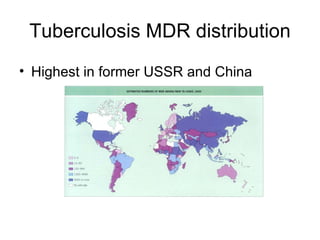
Tuberculosis MDR distribution Highest in former USSR and China
Mycobacterium others, generally opportunistic and assoc. with HIV M. Avium Intracellulare M. Asiaticum M. Flavenscens M. fortuitum complex M. Heamophilum M. Kanasasii M. Malmoense M. Marinum  M. Scrofulaceum M. Simiae  M. Genavense  M. xenopi
Mycobacterium tuberculosis- the pathogen – AFB staining
Mycobacterium tuberculosis – immune response Principle response is formation of a  granuloma  – monocyte and t cells are with multi-nucleated giant cells on the edge of an area of caseation Caseous necrosis and calcium deposition
Tuberculosis - pathology Caseous necrosis in kidney
Tuberculosis – clinical presentation  Primary tb in childhood Inhalation of organisms Formation of hilar LAD Only 5% develop symptomatic disease 30% develop established infection 3-5% chance of reactivation 1/3 rd  of adult presentations due to new infection
Primary Tuberculosis -hilar adenopathy and infiltrate
Pulmonary Tuberculosis Most cases reactivation of disease acquired years earlier Predominant symptoms of cough (78%), weight loss (74%), fatigue (68%), fever (60%), night sweats (55%), hemoptysis (33%)
Pulmonary Tuberculosis – CXR findings Apical lesions – mod. and severe w/cavity
Chest X-Ray findings, atypical Pneumonic consolidation
Pulmonary Tuberculosis – pleural effusion Usually appear 3-6 months after primary disease With or without lung infection Usually unilateral Predominance of lymphs Exudative w/protein >3 gms/dl Often AFB neg, cx positive
Miliary tuberculosis In immune-suppressed Follows blood-borne dissemination  May present as FUO High mortality rate
Miliary Tuberculosis - choroidal
Extra-pulmonary TB Scrofula (lymphadenitis) most frequent extrapulmonary manifestation 80% cervical Nearly always PPD positive Granulomas on biopsy Persistent nodes after tx common
Extrapulmonary tb - GI Anywhere from mouth to anus 70% w/advanced pulmonary get GI Small bowell- ileocecal valve Perforations common Responds well to tx
tapeworms roundworms
Extrapulmonary TB - peritonitis Ascites, pain, +/- fever, wt. loss Ascitic fluid seldom AFB positive Culture positive in only 25% Need tissue biopsy Diagnosis often delayed
Extrapulmonary TB - meningitis In early childhood, post-primary May present with subtle symptoms 3/4ths with miliary pattern on CXR AFB positive in 37% initially, 90% after 4 th  spinal tap
Extrapulmonary TB – osteomyelitis Pott’s most common – 50% of all osteo Low thoracic most common Anterior destruction
Extrapulmonary TB - arthritis Chronic, progressive, monoarticular Usually hip or knee AFB positive in only 1/4 th Ideally, synovial biopsy
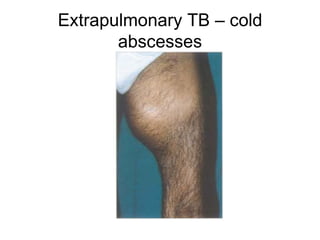
Extrapulmonary TB – cold abscesses
Extrapulmonary TB - urogenital Often asymptomatic, but kidney most commonly affected May present with cystitis symptoms, sterile pyuria Cultures 90% sensitive Males – scrotal mass, oligospermia Female – infertility with hematogenous focus in endosalpinx
Tuberculosis – laboratory investigations AFB – inexpensive Cultures – expensive, sensitivities helpful in MDR PCR – out of reach in poorer countries ESR – inexpensive and helpful, decreases with treatment Anemia of chronic disease
Tuberculosis - PPD 10mm – 90% infected >15mm – virtually all 5-10mm – may be result of BCG Unless recent BCG administration, if >10mm, then not from BCG
BCG vaccine Routinely administered in much of the world Efficacy 60-80%, though not uniformly
Tuberculosis - treatment INH (isoniazid) – bactericidal Most common side effect hepatotoxicity  Check LFTs (20% of patients) If occurs, may reintroduce one med at a time Other side effect – peripheral neuritis, prevented by coadministration of piridoxine
Tuberculosis - treatment Rifampin Bactericidal Many interactions with other drugs Hepatotoxicity
 
Tuberculosis - treatment Pyrizinimide GI intolerance Hepatotoxicity – from elevated transaminases to liver failure
Tuberculosis - treatment Ethambutol  -bactericidal -side effect – retrobulbar neuritis, presenting initially with blurred vision
Tuberculosis – treatment Streptomycin First antituberculous med Side effects of ototoxicity, nephrotoxicity Given IM
Tuberculosis – treatment Second line drugs Ethionamide Ciprofloxacin Capreomycin Kanamycin Amikacin Cycloserine Thiacetazone
Tuberculosis – treatment Bacteria killed over 6-mo period, but patient clinically improves in a few weeks Can do a 1-3 month interval AFB or culture evaluation Can follow ESR/weights
Tuberculosis - treatment Variety of regimens BCH regimen - for first 2 months, four drugs (INH/rifampin, pyrizinamide, ethambutal - next four months, only INH/rifampin - CNS – 12 months - depending on clinical scenario DOTS  Use of steroids
Leprosy Organism – mycobacterium leprae Infection of skin and nerves
Leprosy  Prevalence - 10-15 million in 1950s -  600,000 in 2000  Countries affected (>1/10,000) 122 in 1985 15 in 2000 83% in India, Brazil, Myanmar, Madagascar, Nepal, Mozambique
Leprosy - transmission Generally nasal secretions, particularly in lepromatous Importance of proximity, but most cases sporadic
Leprosy - presentation Subclinical more common than clinical, as incubation 4-10 years Clinical – tuberculoid vs. lepromatous
 
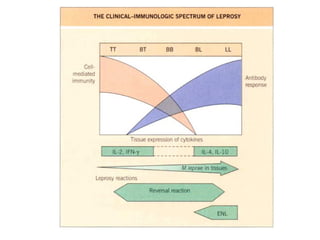
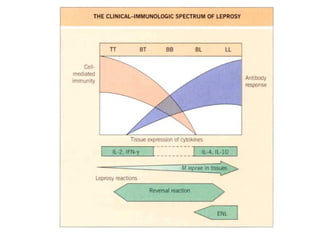
Leprosy – clinical presentation Tuberculoid – limited by vigorous cell-mediated response Lepromatous – proliferation of bacteria with extensive skin and nerve involvement
Leprosy - tuberculoid
Leprosy - lepromatous
 
Leprosy – borderline tuberculoid
Leprosy – mid borderline
 
Leprosy – clinical presentation Reversal reactions Occur in all forms except polar tuberculoid Sometimes after initiation of treatment Inflammation of existing lesions or new skin lesions, may present with acutely swollen nerves Respond to steroids
Leprosy – reversal reactions
Leprosy - treatment Combination therapy with dapsone, rifampin, clofazimine, quinolones, minocycline, azithromycin Multibacillary vs. paucibacillary High dose steroids for reversal reactions

Tuberculosis and Leprosy

  • 1.
    Tuberculosis – anoverview Presented by: Dave Jay S. Manriquez RN. February 1, 2009
  • 2.
    TB -Prevalence 1/3 rd of humanity (2 billion people) infected One new infection every second 8.8 million new cases per year 1.6 million deaths/year Kills more humans per year than any other infectious disease
  • 3.
    TB – worldwidedistribution
  • 4.
      Estimated TuberculosisCase Rates, 1997 India 1,799,000 China: 1,402,000 Indonesia: 583,000 Bangladesh: 300,000 Pakistan: 261,000 Nigeria 253,000 Philippines 222,000 South Africa 170,000 Russian Federation 156,000 Ethiopia 156,000 Vietnam 145,000 Democratic Republic of Congo 129,000  Adapted from Dye C, Scheele S, Dolin P, et al. Consensus statement. Global burden of tuberculosis : Estimated incidence, prevalence, and mortality by country. WHO Global Surveillance and Monitoring Project. JAMA. 1999;282:677–686.
  • 5.
    TB global stats1/3 rd of all new incident cases in Asia ½ of all deaths from tb occur in Asia In Africa, grew rapidly over last two decades due to HIV Period of decline, altered by worldwide epidemic of HIV
  • 6.
    Bach Christian HospitalTB stats (2002) 141 new cases of tuberculosis (over 11 new cases per month) 840 total TB patients under treatment 100 patients discharged having completed treatment
  • 7.
  • 8.
    Tuberculosis and HIV- over 8 million coinfected - reactivation rates 20 times higher than in non HIV-infected persons - 50% with dual infection develop active tb
  • 9.
    Tuberculosis - resistance½ of all new cases have some resistance Worst in 6 Asian countries of Bangladesh, China, India, Indonesia, Pakistan and Philippines Every country has resistance to at least one single drug
  • 10.
    MDR Tuberculosis Definedas resistance to at least INH and rifampicin 450,000 cases per year XDR – extensive drug resistance Generally where there is also HIV
  • 11.
    Tuberculosis MDR distributionHighest in former USSR and China
  • 12.
    Mycobacterium others, generallyopportunistic and assoc. with HIV M. Avium Intracellulare M. Asiaticum M. Flavenscens M. fortuitum complex M. Heamophilum M. Kanasasii M. Malmoense M. Marinum M. Scrofulaceum M. Simiae M. Genavense M. xenopi
  • 13.
    Mycobacterium tuberculosis- thepathogen – AFB staining
  • 14.
    Mycobacterium tuberculosis –immune response Principle response is formation of a granuloma – monocyte and t cells are with multi-nucleated giant cells on the edge of an area of caseation Caseous necrosis and calcium deposition
  • 15.
    Tuberculosis - pathologyCaseous necrosis in kidney
  • 16.
    Tuberculosis – clinicalpresentation Primary tb in childhood Inhalation of organisms Formation of hilar LAD Only 5% develop symptomatic disease 30% develop established infection 3-5% chance of reactivation 1/3 rd of adult presentations due to new infection
  • 17.
    Primary Tuberculosis -hilaradenopathy and infiltrate
  • 18.
    Pulmonary Tuberculosis Mostcases reactivation of disease acquired years earlier Predominant symptoms of cough (78%), weight loss (74%), fatigue (68%), fever (60%), night sweats (55%), hemoptysis (33%)
  • 19.
    Pulmonary Tuberculosis –CXR findings Apical lesions – mod. and severe w/cavity
  • 20.
    Chest X-Ray findings,atypical Pneumonic consolidation
  • 21.
    Pulmonary Tuberculosis –pleural effusion Usually appear 3-6 months after primary disease With or without lung infection Usually unilateral Predominance of lymphs Exudative w/protein >3 gms/dl Often AFB neg, cx positive
  • 22.
    Miliary tuberculosis Inimmune-suppressed Follows blood-borne dissemination May present as FUO High mortality rate
  • 23.
  • 24.
    Extra-pulmonary TB Scrofula(lymphadenitis) most frequent extrapulmonary manifestation 80% cervical Nearly always PPD positive Granulomas on biopsy Persistent nodes after tx common
  • 25.
    Extrapulmonary tb -GI Anywhere from mouth to anus 70% w/advanced pulmonary get GI Small bowell- ileocecal valve Perforations common Responds well to tx
  • 26.
  • 27.
    Extrapulmonary TB -peritonitis Ascites, pain, +/- fever, wt. loss Ascitic fluid seldom AFB positive Culture positive in only 25% Need tissue biopsy Diagnosis often delayed
  • 28.
    Extrapulmonary TB -meningitis In early childhood, post-primary May present with subtle symptoms 3/4ths with miliary pattern on CXR AFB positive in 37% initially, 90% after 4 th spinal tap
  • 29.
    Extrapulmonary TB –osteomyelitis Pott’s most common – 50% of all osteo Low thoracic most common Anterior destruction
  • 30.
    Extrapulmonary TB -arthritis Chronic, progressive, monoarticular Usually hip or knee AFB positive in only 1/4 th Ideally, synovial biopsy
  • 31.
    Extrapulmonary TB –cold abscesses
  • 32.
    Extrapulmonary TB -urogenital Often asymptomatic, but kidney most commonly affected May present with cystitis symptoms, sterile pyuria Cultures 90% sensitive Males – scrotal mass, oligospermia Female – infertility with hematogenous focus in endosalpinx
  • 33.
    Tuberculosis – laboratoryinvestigations AFB – inexpensive Cultures – expensive, sensitivities helpful in MDR PCR – out of reach in poorer countries ESR – inexpensive and helpful, decreases with treatment Anemia of chronic disease
  • 34.
    Tuberculosis - PPD10mm – 90% infected >15mm – virtually all 5-10mm – may be result of BCG Unless recent BCG administration, if >10mm, then not from BCG
  • 35.
    BCG vaccine Routinelyadministered in much of the world Efficacy 60-80%, though not uniformly
  • 36.
    Tuberculosis - treatmentINH (isoniazid) – bactericidal Most common side effect hepatotoxicity Check LFTs (20% of patients) If occurs, may reintroduce one med at a time Other side effect – peripheral neuritis, prevented by coadministration of piridoxine
  • 37.
    Tuberculosis - treatmentRifampin Bactericidal Many interactions with other drugs Hepatotoxicity
  • 38.
  • 39.
    Tuberculosis - treatmentPyrizinimide GI intolerance Hepatotoxicity – from elevated transaminases to liver failure
  • 40.
    Tuberculosis - treatmentEthambutol -bactericidal -side effect – retrobulbar neuritis, presenting initially with blurred vision
  • 41.
    Tuberculosis – treatmentStreptomycin First antituberculous med Side effects of ototoxicity, nephrotoxicity Given IM
  • 42.
    Tuberculosis – treatmentSecond line drugs Ethionamide Ciprofloxacin Capreomycin Kanamycin Amikacin Cycloserine Thiacetazone
  • 43.
    Tuberculosis – treatmentBacteria killed over 6-mo period, but patient clinically improves in a few weeks Can do a 1-3 month interval AFB or culture evaluation Can follow ESR/weights
  • 44.
    Tuberculosis - treatmentVariety of regimens BCH regimen - for first 2 months, four drugs (INH/rifampin, pyrizinamide, ethambutal - next four months, only INH/rifampin - CNS – 12 months - depending on clinical scenario DOTS Use of steroids
  • 45.
    Leprosy Organism –mycobacterium leprae Infection of skin and nerves
  • 46.
    Leprosy Prevalence- 10-15 million in 1950s - 600,000 in 2000 Countries affected (>1/10,000) 122 in 1985 15 in 2000 83% in India, Brazil, Myanmar, Madagascar, Nepal, Mozambique
  • 47.
    Leprosy - transmissionGenerally nasal secretions, particularly in lepromatous Importance of proximity, but most cases sporadic
  • 48.
    Leprosy - presentationSubclinical more common than clinical, as incubation 4-10 years Clinical – tuberculoid vs. lepromatous
  • 49.
  • 50.
    Leprosy – clinicalpresentation Tuberculoid – limited by vigorous cell-mediated response Lepromatous – proliferation of bacteria with extensive skin and nerve involvement
  • 51.
  • 52.
  • 53.
  • 54.
  • 55.
  • 56.
    Leprosy – midborderline
  • 57.
  • 58.
    Leprosy – clinicalpresentation Reversal reactions Occur in all forms except polar tuberculoid Sometimes after initiation of treatment Inflammation of existing lesions or new skin lesions, may present with acutely swollen nerves Respond to steroids
  • 59.
  • 60.
    Leprosy - treatmentCombination therapy with dapsone, rifampin, clofazimine, quinolones, minocycline, azithromycin Multibacillary vs. paucibacillary High dose steroids for reversal reactions