Childhood tuberculosis
Dr Mundada Shivprasad
MD DNB
Professor and HOD PEDIATRICS
GMC LATUR
objective
1. Epidemiology
2. Pulmonary TB
3. Extra pulmonary TB
4. Diagnosis
5. Guidelines for treatment
6. Drug resistant TB
7. Recent changes
INTRODUCTION
• Since the declaration by WHO of a “global tb
emergency” in 1993 publications have
addressed imp aspects of TB.
• BY contrast paediatric tb is realtively
NEGLECTED ,mainly due greater challenges in
diagnosis and lower priority traditionally
afforded to children in TB control programmes
.
EPIDEMIOLOGY
• Transmission :Mycobacterium tuberculosis
usually occurs by inhalation of tubercule
bacilli in aerosolised respiratory droplets
derived from infectious case.
• ARI :Annual Risk of Of Infection ,traditionally
estimated by using childhood tubercullin
survey.
• Differences in the pathophysiology and clinical
presentation of TB in children make diagnosis
more challenging than in adults
• following infection several factors appear to
influence the balance of risk between latent
TB infection (LTBI) or progression to active
disease, including age and
nutritional, vaccination and immune status
Risk of pulmonary and extra-pulmonary disease in children
following infection with MTB
Risk of disease following primary infection (%)
Age at infection
(years)
Disseminated/T
BM
*
Pulmonary TB No disease Comments
<1
10-20 30-40 50 High rates of
morbidity and
mortality
1-2 2-5 10-20 75-80
2-5 0.5 5 95
5-10 <0.5 2 98 “Safe school
years”
>10 <0.5 10-20 80-90 Effusions or
adult-type
pulmonary
disease
Estimating the global disease burden
Poor case ascertainment, a lack of resources for
active case finding in most settings, and limited
paediatric surveillance data from TB control
programmes all hamper efforts to define
accurately the global burden of childhood TB.
Until recently under the WHO Directly Observed
Treatment, Short Course (DOTS) strategy only
smear positive cases have been reported for
children.
• Limited surveillance data prevent reliable
estimates of the contribution of TB to
childhood mortality. Nevertheless, pneumonia
is the commonest cause of childhood death
globally and TB is an important cause of
pneumonia in many settings so may
contribute significantly to global childhood
deaths.
• Recent WHO guidance recommending
reporting of all cases of childhood TB (smear
positive, smear negative and extrapulmonary)
in two age bands (0-4 and 5-14 years) takes an
important step in this direction
Pathophysiology of TB in children
• Following infection children have a higher risk not only
of progression to disease, but also of extra pulmonary
dissemination and death. Infants have a particularly
high morbidity and mortality from TB. While many
factors including host genetics, microbial virulence and
underlying conditions that impair immune competence
(e.g. malnutrition and HIV infection) determine the
outcome of infection, it is likely that the high rate of
progressive TB seen in young children is largely a
reflection on the immaturity of the immune response.
Differences in childhood immune responses to TB
• The alveolar macrophage is the first line of
defense in the innate immune response to TB
• reduced microbial killing and diminished
monocyte recruitment to the site of infection
in infants compared to adults.Thus
impairment of innate pulmonary defenses in
the neonate and infant may allow
mycobacteria to overwhelm the effects of the
innate immune system
• Antigen specific response is also poor in
neonate and infant so the child shows active
disease faster.
• HIV : No other factor has fuelled the global TB
epidemic more than the HIV co-epidemic.
• Malnutrition
• Vitamin D
Clinical spectrum
EXTRA PULMONARY TB
Fever /cough 2weeks ,Loss of weight
Recent contact with an infectious case
Chest xray
Pulmonary lesion seen
Board spectrum antibiotic for 5 7 to 10 days
Clinical and radiological no response
Sputum /gastric aspirate for AFB, mountoux test
Bacteriological
negative for AFB
If radiology is
suggestive
Negative skin test
Rule out alternative diagnosis
Positive for
AFB
CONFIRMED
CASE
Positive skin test
Probable
case
•Never treat pulmonary TB without an attempt to
demonstrate AFB
•NO role of BCG test ,elisa or PCR
•There is no role of empirical trial of anti tubercular
therapy
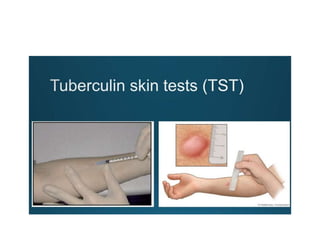
Tuberculin test /montoux test
• 5 TU PPD
• 6mm wheal after Injection
• Preferred is 1 TU
• Width of reaction in horizontal plane is noted
• Considered positive if the induration is 10 mm
or more
• Time:
• Bcg test not recommended .
Chest radiograph
• It merely localizes the site of pathology not
etilogy
• There r no pathgnomonic radiological signs TB
• In relevent clinical condition certain
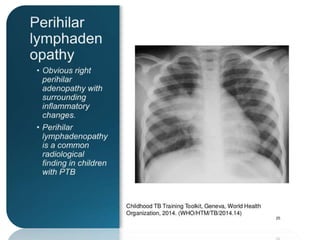
radiological lesions (miliary,hilar ln
,fibrocaceous cavitatory lesions)
• in clinical practice non resolving chest
shadows despite antibiotic therapy in
symptomatic child >>>> TB
Bacteriology
• Gold standard
• Difficult in children
• Gastric aspirate
• Induction of sputum
• BAL ,SCOPY
• Ziehl neelsen stain can reveal AFB ONLY IF
sample contains >10,000 bacilli per ml
• Culture.:
serodiagnostic
• No specific antigen that can confirm natural
infection and disease
• Often negative in Paucibacillary disease
• Antibody : same problem cannot differentiate
natural from BCG infection
• Thus both TB Ag and Ab TB ELISA TEST are not
recommended for diagnosis
Interferon gamma release assays
IGRAS
• Newer generation test which measure the
production of interferon gamma by peripheral
mononuclear cells .
• Does not differentiate disease and infection
PCR TEST
RECOMMENDED
Control program -RNTCP
• Control has not been achieved due to poor
therapeutic practices
• Threat of poorly treatable rifampicin resistant
tb warrants first line drugs be used
appropriately
• Indian program is first program in world to
provide pediatric patient wise boxes .
chemoprophylaxis
• 6 month chemoprophylaxis is recommended
for all under 6 years age contacts of infectious
case irrespective of their BCG or nutritional
status .
• PPD positive children over 6 years age and
who do not have any evidence of active
disease but are planned immunosuppressive
therapy >>>chemoprophylaxis
FOLLOW UP
• fever ..2 to 4 weeks
• weight gain
• SYMPTOMS persist ..investigate,…give extra I
month intensive phase
• LFT: routine monitoring not advised .biochemical
derangement without increase in billirubin level
may be tolerated till enzymes remain upto 5
times the normal range.
• If jaundice developed..stop till it become normal
• Re-introduced in sequential order R>>I>>>PY
• DRUGS are added every 5 to 7 days
Special situation
• MDRTB: refer to expert
• Suspecting HIV
• NEONATE born to mother with tuberculosis
INH for three month .
• Sepration of neonate from mother not
required except 1 DRTB,2 ill requiring
hospitalisation 3 non adherent to treatment
Recent changes in guidelines …ped
• New goals
1. Relapse free cure
2. Prevention of drug resistant
3. Break the chain of transmission by rendering
the pt non infectious
Recent changes in guidelines …ped
• Presumptive TB : Fever /cough 2weeks
,Loss of weight Recent contact with an
infectious case
• Diagnosis of tuberculosis based only on X RAY
to be called as CLINICALLY DIAGNOSED TB
• MDR ,PDR,XDR
CBNAAT
• Offers very high sensitivity and specificity .
• Sensitvity =98 %, (smear +),68% (smear -)
• Specificity =98%
• Rapid diagnosis.
• Provide information on drug susceptibility to
rifamipicin
• Use of CBNAAT for diagnosis of EPTB
EPTB
HIV +TB Ssuspects
Pediatric TB SUSPECTS
CBNAAT CRITERIA
Any follow up sputum +in cat 1 patients
All RTT cases (cat 2cases)
Contacts of MDR
• USE of only daily regimen of therapy only
• Etambutol added in cat I
• NEW regimen :
DST : rapid drug susceptibility testing of at least rifampicin is
recommended at the time of diagnosis tb
• Newer drug: DELAMINID
Type of TB case Treatment regimen
in IP
Treatment regimen
CP
NEW 2HRZE 4HRE
Previously treated 2HRZES+1HRZE 5HRE
Take home
• Confirm diagnosis by gold standard AFB
detection
• In presumptive case confirm with CBNAAT
• If not confirm with any test and child remain
presumptive clinical diagnosis can start cat 1
• Notify cases and help yourself and nation to
eliminate TB
•Thank you

Tb child

  • 1.
    Childhood tuberculosis Dr MundadaShivprasad MD DNB Professor and HOD PEDIATRICS GMC LATUR
  • 2.
    objective 1. Epidemiology 2. PulmonaryTB 3. Extra pulmonary TB 4. Diagnosis 5. Guidelines for treatment 6. Drug resistant TB 7. Recent changes
  • 3.
    INTRODUCTION • Since thedeclaration by WHO of a “global tb emergency” in 1993 publications have addressed imp aspects of TB. • BY contrast paediatric tb is realtively NEGLECTED ,mainly due greater challenges in diagnosis and lower priority traditionally afforded to children in TB control programmes .
  • 4.
    EPIDEMIOLOGY • Transmission :Mycobacteriumtuberculosis usually occurs by inhalation of tubercule bacilli in aerosolised respiratory droplets derived from infectious case. • ARI :Annual Risk of Of Infection ,traditionally estimated by using childhood tubercullin survey.
  • 5.
    • Differences inthe pathophysiology and clinical presentation of TB in children make diagnosis more challenging than in adults • following infection several factors appear to influence the balance of risk between latent TB infection (LTBI) or progression to active disease, including age and nutritional, vaccination and immune status
  • 6.
    Risk of pulmonaryand extra-pulmonary disease in children following infection with MTB Risk of disease following primary infection (%) Age at infection (years) Disseminated/T BM * Pulmonary TB No disease Comments <1 10-20 30-40 50 High rates of morbidity and mortality 1-2 2-5 10-20 75-80 2-5 0.5 5 95 5-10 <0.5 2 98 “Safe school years” >10 <0.5 10-20 80-90 Effusions or adult-type pulmonary disease
  • 7.
    Estimating the globaldisease burden Poor case ascertainment, a lack of resources for active case finding in most settings, and limited paediatric surveillance data from TB control programmes all hamper efforts to define accurately the global burden of childhood TB. Until recently under the WHO Directly Observed Treatment, Short Course (DOTS) strategy only smear positive cases have been reported for children.
  • 8.
    • Limited surveillancedata prevent reliable estimates of the contribution of TB to childhood mortality. Nevertheless, pneumonia is the commonest cause of childhood death globally and TB is an important cause of pneumonia in many settings so may contribute significantly to global childhood deaths.
  • 9.
    • Recent WHOguidance recommending reporting of all cases of childhood TB (smear positive, smear negative and extrapulmonary) in two age bands (0-4 and 5-14 years) takes an important step in this direction
  • 10.
    Pathophysiology of TBin children • Following infection children have a higher risk not only of progression to disease, but also of extra pulmonary dissemination and death. Infants have a particularly high morbidity and mortality from TB. While many factors including host genetics, microbial virulence and underlying conditions that impair immune competence (e.g. malnutrition and HIV infection) determine the outcome of infection, it is likely that the high rate of progressive TB seen in young children is largely a reflection on the immaturity of the immune response.
  • 11.
    Differences in childhoodimmune responses to TB • The alveolar macrophage is the first line of defense in the innate immune response to TB • reduced microbial killing and diminished monocyte recruitment to the site of infection in infants compared to adults.Thus impairment of innate pulmonary defenses in the neonate and infant may allow mycobacteria to overwhelm the effects of the innate immune system
  • 12.
    • Antigen specificresponse is also poor in neonate and infant so the child shows active disease faster. • HIV : No other factor has fuelled the global TB epidemic more than the HIV co-epidemic. • Malnutrition • Vitamin D
  • 13.
  • 18.
  • 30.
    Fever /cough 2weeks,Loss of weight Recent contact with an infectious case Chest xray Pulmonary lesion seen Board spectrum antibiotic for 5 7 to 10 days Clinical and radiological no response
  • 31.
    Sputum /gastric aspiratefor AFB, mountoux test Bacteriological negative for AFB If radiology is suggestive Negative skin test Rule out alternative diagnosis Positive for AFB CONFIRMED CASE Positive skin test Probable case
  • 32.
    •Never treat pulmonaryTB without an attempt to demonstrate AFB •NO role of BCG test ,elisa or PCR •There is no role of empirical trial of anti tubercular therapy
  • 33.
    Tuberculin test /montouxtest • 5 TU PPD • 6mm wheal after Injection • Preferred is 1 TU • Width of reaction in horizontal plane is noted • Considered positive if the induration is 10 mm or more • Time:
  • 35.
    • Bcg testnot recommended .
  • 36.
    Chest radiograph • Itmerely localizes the site of pathology not etilogy • There r no pathgnomonic radiological signs TB • In relevent clinical condition certain radiological lesions (miliary,hilar ln ,fibrocaceous cavitatory lesions) • in clinical practice non resolving chest shadows despite antibiotic therapy in symptomatic child >>>> TB
  • 37.
    Bacteriology • Gold standard •Difficult in children • Gastric aspirate • Induction of sputum • BAL ,SCOPY • Ziehl neelsen stain can reveal AFB ONLY IF sample contains >10,000 bacilli per ml • Culture.:
  • 38.
    serodiagnostic • No specificantigen that can confirm natural infection and disease • Often negative in Paucibacillary disease • Antibody : same problem cannot differentiate natural from BCG infection • Thus both TB Ag and Ab TB ELISA TEST are not recommended for diagnosis
  • 39.
    Interferon gamma releaseassays IGRAS • Newer generation test which measure the production of interferon gamma by peripheral mononuclear cells . • Does not differentiate disease and infection
  • 40.
  • 44.
    Control program -RNTCP •Control has not been achieved due to poor therapeutic practices • Threat of poorly treatable rifampicin resistant tb warrants first line drugs be used appropriately • Indian program is first program in world to provide pediatric patient wise boxes .
  • 45.
    chemoprophylaxis • 6 monthchemoprophylaxis is recommended for all under 6 years age contacts of infectious case irrespective of their BCG or nutritional status . • PPD positive children over 6 years age and who do not have any evidence of active disease but are planned immunosuppressive therapy >>>chemoprophylaxis
  • 46.
    FOLLOW UP • fever..2 to 4 weeks • weight gain • SYMPTOMS persist ..investigate,…give extra I month intensive phase • LFT: routine monitoring not advised .biochemical derangement without increase in billirubin level may be tolerated till enzymes remain upto 5 times the normal range. • If jaundice developed..stop till it become normal
  • 47.
    • Re-introduced insequential order R>>I>>>PY • DRUGS are added every 5 to 7 days
  • 48.
    Special situation • MDRTB:refer to expert • Suspecting HIV • NEONATE born to mother with tuberculosis INH for three month . • Sepration of neonate from mother not required except 1 DRTB,2 ill requiring hospitalisation 3 non adherent to treatment
  • 49.
    Recent changes inguidelines …ped • New goals 1. Relapse free cure 2. Prevention of drug resistant 3. Break the chain of transmission by rendering the pt non infectious
  • 50.
    Recent changes inguidelines …ped • Presumptive TB : Fever /cough 2weeks ,Loss of weight Recent contact with an infectious case • Diagnosis of tuberculosis based only on X RAY to be called as CLINICALLY DIAGNOSED TB • MDR ,PDR,XDR
  • 51.
    CBNAAT • Offers veryhigh sensitivity and specificity . • Sensitvity =98 %, (smear +),68% (smear -) • Specificity =98% • Rapid diagnosis. • Provide information on drug susceptibility to rifamipicin • Use of CBNAAT for diagnosis of EPTB
  • 52.
    EPTB HIV +TB Ssuspects PediatricTB SUSPECTS CBNAAT CRITERIA Any follow up sputum +in cat 1 patients All RTT cases (cat 2cases) Contacts of MDR
  • 53.
    • USE ofonly daily regimen of therapy only • Etambutol added in cat I • NEW regimen : DST : rapid drug susceptibility testing of at least rifampicin is recommended at the time of diagnosis tb • Newer drug: DELAMINID Type of TB case Treatment regimen in IP Treatment regimen CP NEW 2HRZE 4HRE Previously treated 2HRZES+1HRZE 5HRE
  • 54.
    Take home • Confirmdiagnosis by gold standard AFB detection • In presumptive case confirm with CBNAAT • If not confirm with any test and child remain presumptive clinical diagnosis can start cat 1 • Notify cases and help yourself and nation to eliminate TB
  • 55.