AIR POLLUTION DISPERSION AND MODELING USING COMPUTERS By:- KETAN WADODKAR Enroll no. 10519013 Guided by:- U.B. CHITRANSHI
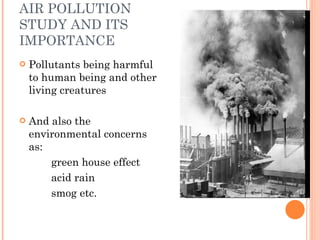
Pollutants being harmful to human being and other living creatures And also the environmental concerns as: green house effect acid rain smog etc. AIR POLLUTION STUDY AND ITS IMPORTANCE
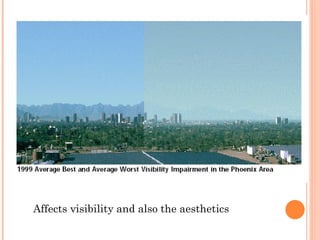
Affects visibility and also the aesthetics
HOW THEY MOVE / TRANSPORT OF AIR POLLUTANT BASICS
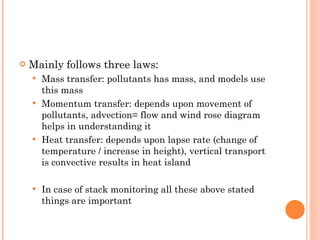
Mainly follows three laws: Mass transfer: pollutants has mass, and models use this mass Momentum transfer: depends upon movement of pollutants, advection= flow and wind rose diagram helps in understanding it Heat transfer: depends upon lapse rate (change of temperature / increase in height), vertical transport is convective results in heat island In case of stack monitoring all these above stated things are important
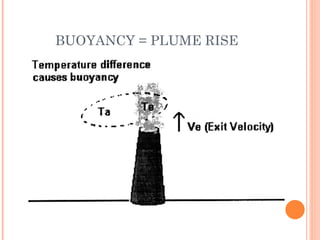
BUOYANCY = PLUME RISE
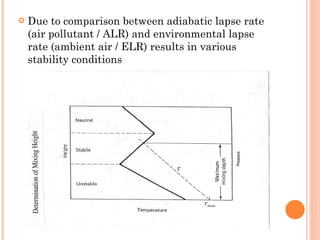
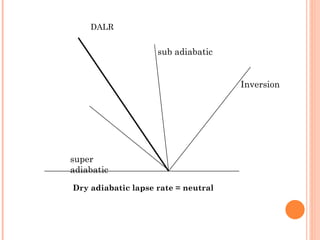
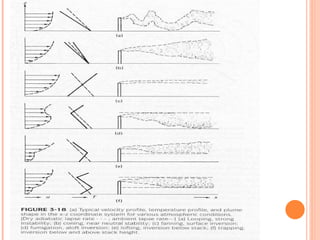
Due to comparison between adiabatic lapse rate (air pollutant / ALR) and environmental lapse rate (ambient air / ELR) results in various stability conditions
Inversion super adiabatic sub adiabatic Dry adiabatic lapse rate = neutral DALR
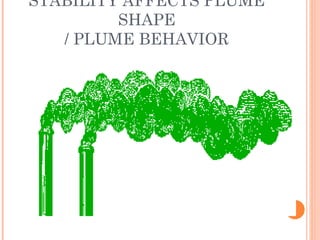
STABILITY AFFECTS PLUME SHAPE / PLUME BEHAVIOR
 
AIR POLLUTION DISPERSION MODELING
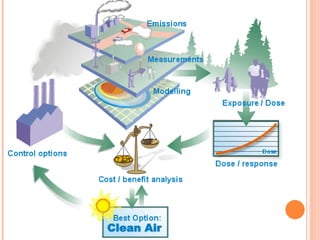
WHAT IS DISPERSION MODELING It is an attempt to describe relationship between emission, occurring concentration and deposition It gives complete analysis of what emission sources have lead to concentration depositions Mathematical models use analytical and numerical formulations, usually implemented on computers
WHY DISPERSION MODELING IS REQUIRED To predict ambient air concentration which will result from a emission source To plan and execute air pollution control program considering cost effectiveness For environmental impact assessment Quantify the impact of process improvements Evaluating the  performance of emission control techniques Optimization of stack height, diameter Planning the control of air pollution episodes
 
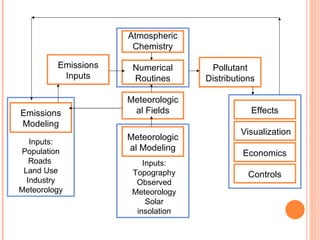
Emissions Modeling Controls Economics Visualization Effects Pollutant Distributions Meteorological Fields Numerical Routines Atmospheric Chemistry Meteorological Modeling Emissions Inputs Inputs: Population Roads  Land Use Industry Meteorology Inputs: Topography Observed Meteorology Solar insolation
BASICS OF AIR POLLUTION DISPERSION MODELS All air pollution models are based on the simple Material Balance Principles The general material balance equation for a air pollution model can be written as follows: Accumulation Rate = (All flow rates in)-(All flow rates out) + (Creation rate) – (Destruction Rate)
INPUT DATA REQUIRED FOR DISPERSION MODELS Meteorological conditions Emissions parameters Terrain elevations at the source location and at the receptor location. Details of obstructions if any
TYPES OF AIR POLLUTION DISPERSION MODELS Box model Gaussian model Lagrangian model Eulerian model Dense Gas model
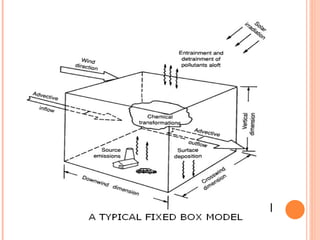
BOX MODEL (FIXED BOX MODEL) It is simplest type of model It assumes the air shed is box shaped It assumes that air pollution present in the box are homogenously distributed and hence air pollutant concentration is estimated within the air shed It has very limited ability to accurately predict dispersion of air pollutant over an air shed
 
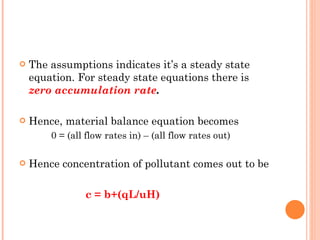
The assumptions indicates it’s a steady state equation. For steady state equations there is  zero accumulation rate . Hence, material balance equation becomes 0 = (all flow rates in) – (all flow rates out) Hence concentration of pollutant comes out to be   c = b+(qL/uH)
GAUSSIAN DISPERSION MODEL It is most commonly used model type and one of the oldest The pollutant follow a normal probability distribution Used for dispersion of continuous, buoyant air pollutant plume originating from ground level or elevated sources Primary algorithm used is  Generalized Dispersion Equation for a Continuous Point-Source Plume
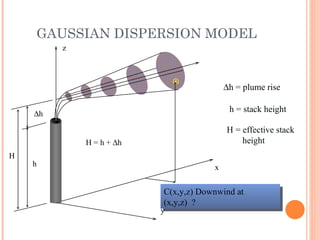
GAUSSIAN DISPERSION MODEL C(x,y,z) Downwind at (x,y,z)  ?  h h H z x y   h = plume rise h = stack height H = effective stack height H = h +   h
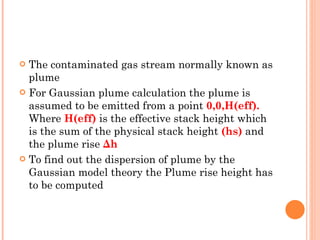
The contaminated gas stream normally known as plume For Gaussian plume calculation the plume is assumed to be emitted from a point  0,0,H(eff).  Where  H(eff)   is the effective stack height which is the sum of the physical stack height  (hs)   and the plume rise   Δh To find out the dispersion of plume by the Gaussian model theory the Plume rise height has to be computed
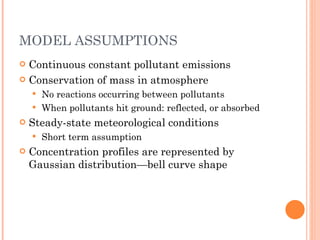
MODEL ASSUMPTIONS Continuous constant pollutant emissions Conservation of mass in atmosphere No reactions occurring between pollutants When pollutants hit ground: reflected, or absorbed Steady-state meteorological conditions Short term assumption Concentration profiles are represented by Gaussian distribution—bell curve shape
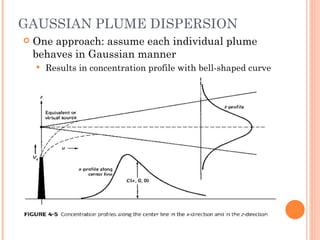
GAUSSIAN PLUME DISPERSION One approach: assume each individual plume behaves in Gaussian manner Results in concentration profile with bell-shaped curve
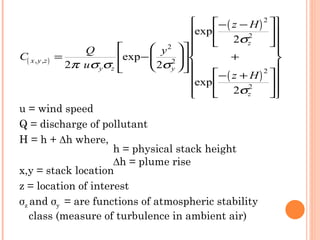
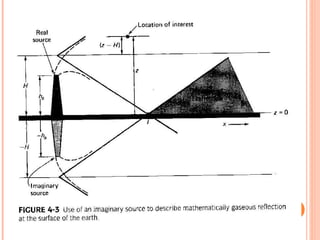
u = wind speed Q = discharge of pollutant H = h + ∆h where,  x,y = stack location z = location of interest σ z  and σ y  = are functions of atmospheric stability class (measure of turbulence in ambient air) h = physical stack height ∆ h = plume rise
FIGURE 4-3 WARK, WARNER & DAVIS Use of an imaginary source to describe reflection at the ground
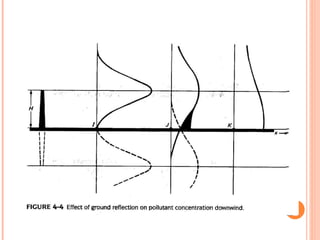
FIGURE 4-4 WARK, WARNER & DAVIS Effect of ground reflection on pollutant concentration
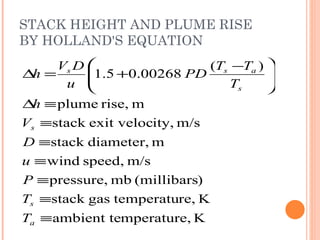
STACK HEIGHT AND PLUME RISE BY HOLLAND'S EQUATION
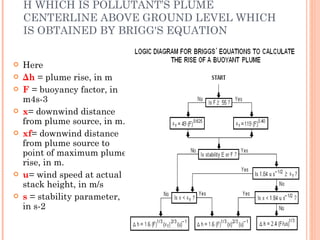
AS GAUSSIANS MODEL REQUIRES INPUT OF H WHICH IS POLLUTANT’S PLUME CENTERLINE ABOVE GROUND LEVEL WHICH IS OBTAINED BY BRIGG'S EQUATION Here  Δh   = plume rise, in m F   = buoyancy factor, in m4s-3 x = downwind distance from plume source, in m. xf = downwind distance from plume source to point of maximum plume rise, in m. u = wind speed at actual stack height, in m/s s   = stability parameter, in s-2
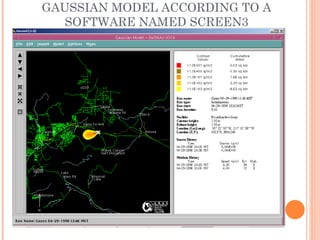
GAUSSIAN MODEL ACCORDING TO A SOFTWARE NAMED SCREEN3
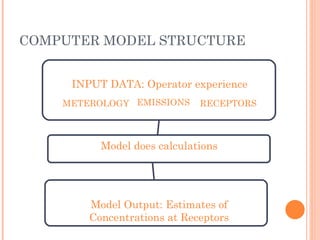
COMPUTER MODEL STRUCTURE INPUT DATA: Operator experience METEROLOGY EMISSIONS RECEPTORS Model Output: Estimates of Concentrations at Receptors Model does calculations
LAGRANGIAN MODEL a Lagrangian dispersion model mathematically follows pollution plume parcels The Lagrangian model then calculates the air pollution dispersion by computing the statistics of the trajectories of a large number of the pollution plume parcels It uses a moving   frame of reference  as the parcels move from their initial location It is based on fluid element that follow instantaneous flow
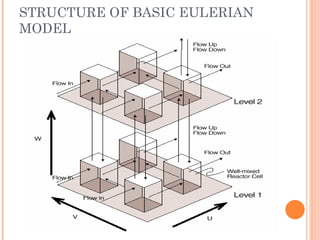
EULERIAN MODEL In this model, chemical species moves in fixed grid It uses numerical terms to solve equation of mass conservation of pollutant Its difficult to solve the numerical framework in this model. Its advantage is well defined 3D formulation which is necessary in some complex regional scale air pollution problems
STRUCTURE OF BASIC EULERIAN MODEL
DENSE GAS MODELS Dense gas model  — Dense gas models are models that simulate the dispersion of dense gas pollution plumes (i.e., pollution plumes that are heavier than air).  The air dispersion models used nowadays are: ADMS 3 AERMOD CALPUFF DISPERSION21 ISC3 MERCURE NAME PUFF-PLUME SIRANE Some of these models which are mentioned above are described in brief in the following slides.
ADMS 3 (Atmospheric dispersion modeling system) : It is an advanced model for calculating atmospheric pollutant emitted continuously (from point, line area volume source) or intermittently (from point source) AERMOD: It is steady state Gaussian plume model for short range about 50kms It uses a single wind field to transport emitted species A meteorological data preprocessor (AERMET) that accepts surface meteorological data, upper air soundings, and optionally, data from on-site instrument towers.  A terrain preprocessor (AERMAP) whose main purpose is to provide a physical relationship between terrain features and the behavior of air pollution plumes
CALPUFF: It advanced Gaussian puff modeling system Used for longer range transport of pollutant and their effect on Federal class I areas model is designed to simulate the dispersion of buoyant, puff or continuous point and area pollution sources as well as the dispersion of buoyant, continuous line sources model also  includes algorithms for handling the effect of downwash by nearby buildings in the path of the pollution plumes
ISC 3 : Steady state Gaussian plume model for analyzing pollutant concentration for industrial complex This model can account for the following: settling and dry deposition of particles; downwash; point, area, line, and volume sources; plume rise as a function of downwind distance; separation of point sources; and limited terrain adjustment ISC3 operates in both long-term and short-term modes
Puff plume: PUFF-PLUME is a model used to help predict how air pollution disperses in the atmosphere It is a Gaussian atmospheric transport chemical/radionuclide dispersion model that includes wet and dry deposition, real-time input of meteorological observations and forecasts, dose estimates from inhalation and gamma shine (i.e., radiation), and puff or continuous plume dispersion modes
 

Airpollution Dispersion And Modelling Using Computers Ub Chitranshi

  • 1.
    AIR POLLUTION DISPERSIONAND MODELING USING COMPUTERS By:- KETAN WADODKAR Enroll no. 10519013 Guided by:- U.B. CHITRANSHI
  • 2.
    Pollutants being harmfulto human being and other living creatures And also the environmental concerns as: green house effect acid rain smog etc. AIR POLLUTION STUDY AND ITS IMPORTANCE
  • 3.
    Affects visibility andalso the aesthetics
  • 4.
    HOW THEY MOVE/ TRANSPORT OF AIR POLLUTANT BASICS
  • 5.
    Mainly follows threelaws: Mass transfer: pollutants has mass, and models use this mass Momentum transfer: depends upon movement of pollutants, advection= flow and wind rose diagram helps in understanding it Heat transfer: depends upon lapse rate (change of temperature / increase in height), vertical transport is convective results in heat island In case of stack monitoring all these above stated things are important
  • 6.
  • 7.
    Due to comparisonbetween adiabatic lapse rate (air pollutant / ALR) and environmental lapse rate (ambient air / ELR) results in various stability conditions
  • 8.
    Inversion super adiabaticsub adiabatic Dry adiabatic lapse rate = neutral DALR
  • 9.
    STABILITY AFFECTS PLUMESHAPE / PLUME BEHAVIOR
  • 10.
  • 11.
  • 12.
    WHAT IS DISPERSIONMODELING It is an attempt to describe relationship between emission, occurring concentration and deposition It gives complete analysis of what emission sources have lead to concentration depositions Mathematical models use analytical and numerical formulations, usually implemented on computers
  • 13.
    WHY DISPERSION MODELINGIS REQUIRED To predict ambient air concentration which will result from a emission source To plan and execute air pollution control program considering cost effectiveness For environmental impact assessment Quantify the impact of process improvements Evaluating the performance of emission control techniques Optimization of stack height, diameter Planning the control of air pollution episodes
  • 14.
  • 15.
    Emissions Modeling ControlsEconomics Visualization Effects Pollutant Distributions Meteorological Fields Numerical Routines Atmospheric Chemistry Meteorological Modeling Emissions Inputs Inputs: Population Roads Land Use Industry Meteorology Inputs: Topography Observed Meteorology Solar insolation
  • 16.
    BASICS OF AIRPOLLUTION DISPERSION MODELS All air pollution models are based on the simple Material Balance Principles The general material balance equation for a air pollution model can be written as follows: Accumulation Rate = (All flow rates in)-(All flow rates out) + (Creation rate) – (Destruction Rate)
  • 17.
    INPUT DATA REQUIREDFOR DISPERSION MODELS Meteorological conditions Emissions parameters Terrain elevations at the source location and at the receptor location. Details of obstructions if any
  • 18.
    TYPES OF AIRPOLLUTION DISPERSION MODELS Box model Gaussian model Lagrangian model Eulerian model Dense Gas model
  • 19.
    BOX MODEL (FIXEDBOX MODEL) It is simplest type of model It assumes the air shed is box shaped It assumes that air pollution present in the box are homogenously distributed and hence air pollutant concentration is estimated within the air shed It has very limited ability to accurately predict dispersion of air pollutant over an air shed
  • 20.
  • 21.
    The assumptions indicatesit’s a steady state equation. For steady state equations there is zero accumulation rate . Hence, material balance equation becomes 0 = (all flow rates in) – (all flow rates out) Hence concentration of pollutant comes out to be c = b+(qL/uH)
  • 22.
    GAUSSIAN DISPERSION MODELIt is most commonly used model type and one of the oldest The pollutant follow a normal probability distribution Used for dispersion of continuous, buoyant air pollutant plume originating from ground level or elevated sources Primary algorithm used is Generalized Dispersion Equation for a Continuous Point-Source Plume
  • 23.
    GAUSSIAN DISPERSION MODELC(x,y,z) Downwind at (x,y,z) ?  h h H z x y   h = plume rise h = stack height H = effective stack height H = h +  h
  • 24.
    The contaminated gasstream normally known as plume For Gaussian plume calculation the plume is assumed to be emitted from a point 0,0,H(eff). Where H(eff) is the effective stack height which is the sum of the physical stack height (hs) and the plume rise Δh To find out the dispersion of plume by the Gaussian model theory the Plume rise height has to be computed
  • 25.
    MODEL ASSUMPTIONS Continuousconstant pollutant emissions Conservation of mass in atmosphere No reactions occurring between pollutants When pollutants hit ground: reflected, or absorbed Steady-state meteorological conditions Short term assumption Concentration profiles are represented by Gaussian distribution—bell curve shape
  • 26.
    GAUSSIAN PLUME DISPERSIONOne approach: assume each individual plume behaves in Gaussian manner Results in concentration profile with bell-shaped curve
  • 27.
    u = windspeed Q = discharge of pollutant H = h + ∆h where, x,y = stack location z = location of interest σ z and σ y = are functions of atmospheric stability class (measure of turbulence in ambient air) h = physical stack height ∆ h = plume rise
  • 28.
    FIGURE 4-3 WARK,WARNER & DAVIS Use of an imaginary source to describe reflection at the ground
  • 29.
    FIGURE 4-4 WARK,WARNER & DAVIS Effect of ground reflection on pollutant concentration
  • 30.
    STACK HEIGHT ANDPLUME RISE BY HOLLAND'S EQUATION
  • 31.
    AS GAUSSIANS MODELREQUIRES INPUT OF H WHICH IS POLLUTANT’S PLUME CENTERLINE ABOVE GROUND LEVEL WHICH IS OBTAINED BY BRIGG'S EQUATION Here Δh = plume rise, in m F   = buoyancy factor, in m4s-3 x = downwind distance from plume source, in m. xf = downwind distance from plume source to point of maximum plume rise, in m. u = wind speed at actual stack height, in m/s s   = stability parameter, in s-2
  • 32.
    GAUSSIAN MODEL ACCORDINGTO A SOFTWARE NAMED SCREEN3
  • 33.
    COMPUTER MODEL STRUCTUREINPUT DATA: Operator experience METEROLOGY EMISSIONS RECEPTORS Model Output: Estimates of Concentrations at Receptors Model does calculations
  • 34.
    LAGRANGIAN MODEL aLagrangian dispersion model mathematically follows pollution plume parcels The Lagrangian model then calculates the air pollution dispersion by computing the statistics of the trajectories of a large number of the pollution plume parcels It uses a moving   frame of reference  as the parcels move from their initial location It is based on fluid element that follow instantaneous flow
  • 35.
    EULERIAN MODEL Inthis model, chemical species moves in fixed grid It uses numerical terms to solve equation of mass conservation of pollutant Its difficult to solve the numerical framework in this model. Its advantage is well defined 3D formulation which is necessary in some complex regional scale air pollution problems
  • 36.
    STRUCTURE OF BASICEULERIAN MODEL
  • 37.
    DENSE GAS MODELSDense gas model  — Dense gas models are models that simulate the dispersion of dense gas pollution plumes (i.e., pollution plumes that are heavier than air). The air dispersion models used nowadays are: ADMS 3 AERMOD CALPUFF DISPERSION21 ISC3 MERCURE NAME PUFF-PLUME SIRANE Some of these models which are mentioned above are described in brief in the following slides.
  • 38.
    ADMS 3 (Atmosphericdispersion modeling system) : It is an advanced model for calculating atmospheric pollutant emitted continuously (from point, line area volume source) or intermittently (from point source) AERMOD: It is steady state Gaussian plume model for short range about 50kms It uses a single wind field to transport emitted species A meteorological data preprocessor (AERMET) that accepts surface meteorological data, upper air soundings, and optionally, data from on-site instrument towers. A terrain preprocessor (AERMAP) whose main purpose is to provide a physical relationship between terrain features and the behavior of air pollution plumes
  • 39.
    CALPUFF: It advancedGaussian puff modeling system Used for longer range transport of pollutant and their effect on Federal class I areas model is designed to simulate the dispersion of buoyant, puff or continuous point and area pollution sources as well as the dispersion of buoyant, continuous line sources model also includes algorithms for handling the effect of downwash by nearby buildings in the path of the pollution plumes
  • 40.
    ISC 3 :Steady state Gaussian plume model for analyzing pollutant concentration for industrial complex This model can account for the following: settling and dry deposition of particles; downwash; point, area, line, and volume sources; plume rise as a function of downwind distance; separation of point sources; and limited terrain adjustment ISC3 operates in both long-term and short-term modes
  • 41.
    Puff plume: PUFF-PLUME isa model used to help predict how air pollution disperses in the atmosphere It is a Gaussian atmospheric transport chemical/radionuclide dispersion model that includes wet and dry deposition, real-time input of meteorological observations and forecasts, dose estimates from inhalation and gamma shine (i.e., radiation), and puff or continuous plume dispersion modes
  • 42.

Editor's Notes

  • #10 Why? To predict or to understand the meteorology at that height and temperature. Use with method 9 (smoke school) Important to start seeing the release height of stack in relationship to the temperature profile