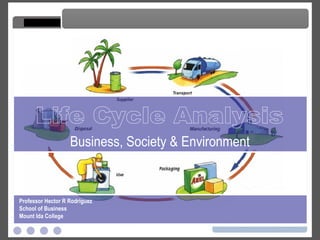
Life Cycle Analysis Business, Society & Environment Professor Hector R Rodriguez School of Business Mount Ida College Life Cycle Analysis
Society The Corporation and Its Stakeholders People for the Ethical Treatment of Animals Corporate Citizenship The Social Responsibility of Business The Shareholder Primacy Norm CSR, Citizenship and Sustainability Reporting Responsible Investing The Community and the Corporation Taxation and Corporate Citizenship Corporate Philanthropy Programs Employees and the Corporation Managing a Diverse Workforce Environment A Balanced Look at Climate Change Non-anthropogenic Causes of Climate Change Sulfates, Urban Warming and Permafrost Conventional Energy The Kyoto Protocol Green Building Green Information Technology Transportation, Electric Vehicles and the Environment Geo-Engineering Carbon Capture and Storage Renewable Energy Solid, Toxic and Hazardous Waste Forests, Paper and Carbon Sinks Life Cycle Analysis Water Use and Management Water Pollution Course Map – Topics Covered in Course
The term “life cycle” refers to the major activities in the course of the product’s life-span from its manufacture, use, and maintenance, to its final disposal, including the raw material acquisition required to manufacture the product.  By including the impacts throughout the product life cycle, LCA provides a comprehensive view of the environmental aspects of the product or process and a more accurate picture of the true environmental trade-offs in product and process selection.  Usually follows international rules (the ISO 14040 series standards) Source: Mary Ann Curran, “Life Cycle Assessment: Principles and Practice,” EPA: (2006) What is Life Cycle Assessment?
Identify opportunities environmental impact and waste reduction Prepare to capitalize on regulatory changes Improve product/corporate image Develop metrics and enable comparison across the company and among suppliers and partners Help to secure market and competitive positions Answer customer’s requests for environmental and social information Identify cost savings Why Conduct an LCA? Source: Mary Ann Curran, “Life Cycle Assessment: Principles and Practice,” EPA: (2006)
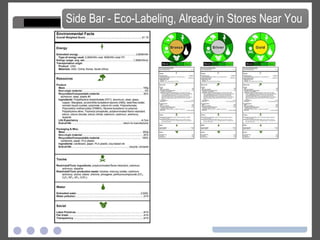
Side Bar - Eco-Labeling, Already in Stores Near You
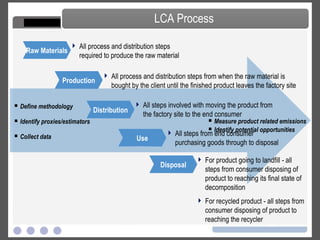
LCA Process Raw Materials All process and distribution steps required to produce the raw material Production All process and distribution steps from when the raw material is bought by the client until the finished product leaves the factory site Distribution All steps involved with moving the product from the factory site to the end consumer Use All steps from end consumer purchasing goods through to disposal Define methodology Identify proxies/estimators Collect data Measure product related emissions Identify potential opportunities Disposal For product going to landfill - all steps from consumer disposing of product to reaching its final state of decomposition For recycled product - all steps from consumer disposing of product to reaching the recycler
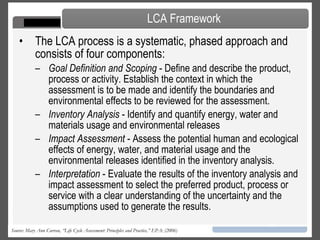
The LCA process is a systematic, phased approach and consists of four components:  Goal Definition and Scoping  - Define and describe the product, process or activity. Establish the context in which the assessment is to be made and identify the boundaries and environmental effects to be reviewed for the assessment.  Inventory Analysis  - Identify and quantify energy, water and materials usage and environmental releases  Impact Assessment  - Assess the potential human and ecological effects of energy, water, and material usage and the environmental releases identified in the inventory analysis.  Interpretation  - Evaluate the results of the inventory analysis and impact assessment to select the preferred product, process or service with a clear understanding of the uncertainty and the assumptions used to generate the results.  LCA Framework Source: Mary Ann Curran, “Life Cycle Assessment: Principles and Practice,” EPA: (2006)
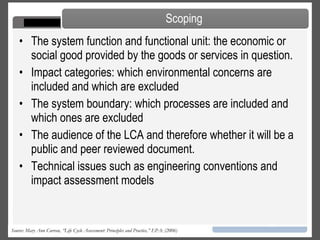
The system function and functional unit: the economic or social good provided by the goods or services in question.  Impact categories: which environmental concerns are included and which are excluded  The system boundary: which processes are included and which ones are excluded The audience of the LCA and therefore whether it will be a public and peer reviewed document. Technical issues such as engineering conventions and impact assessment models Scoping Source: Mary Ann Curran, “Life Cycle Assessment: Principles and Practice,” EPA: (2006)
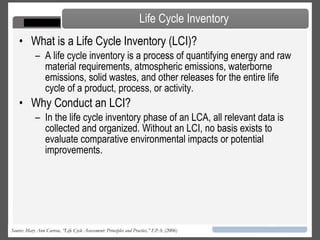
What is a Life Cycle Inventory (LCI)?  A life cycle inventory is a process of quantifying energy and raw material requirements, atmospheric emissions, waterborne emissions, solid wastes, and other releases for the entire life cycle of a product, process, or activity.  Why Conduct an LCI?  Without an LCI, no basis exists to evaluate comparative environmental impacts or potential improvements.  Life Cycle Inventory Source: Mary Ann Curran, “Life Cycle Assessment: Principles and Practice,” EPA: (2006)
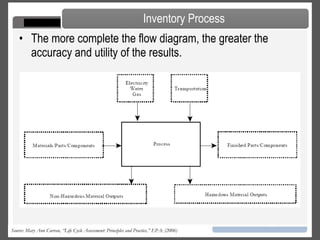
The more complete the flow diagram, the greater the accuracy and utility of the results.  Inventory Process Source: Mary Ann Curran, “Life Cycle Assessment: Principles and Practice,” EPA: (2006)
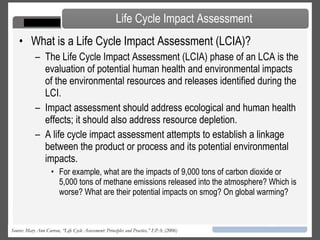
What is a Life Cycle Impact Assessment (LCIA)?  The Life Cycle Impact Assessment (LCIA) phase of an LCA is the evaluation of potential human health and environmental impacts of the environmental resources and releases identified during the LCI.  Impact assessment should address ecological and human health effects; it should also address resource depletion.  A life cycle impact assessment attempts to establish a linkage between the product or process and its potential environmental impacts.  For example, what are the impacts of 9,000 tons of carbon dioxide or 5,000 tons of methane emissions released into the atmosphere? Which is worse? What are their potential impacts on smog? On global warming?  Life Cycle Impact Assessment Source: Mary Ann Curran, “Life Cycle Assessment: Principles and Practice,” EPA: (2006)
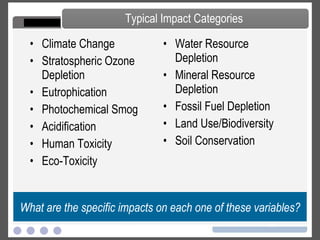
Water Resource Depletion Mineral Resource Depletion  Fossil Fuel Depletion Land Use/Biodiversity Soil Conservation Climate Change Stratospheric Ozone Depletion  Eutrophication Photochemical Smog Acidification Human Toxicity  Eco-Toxicity Typical Impact Categories What are the specific impacts on each one of these variables?
Typical Impact Categories Reducing a Product’s Environmental Footprint. This spider diagram is one way to show how a particular product’s environmental effects or “footprint” are reduced over time through incremental improvements in sustainable design. This diagram shows the dimensions of the footprint in years 2009, 2025 and 2050.
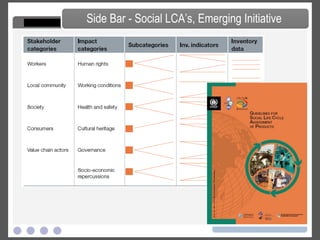
Side Bar - Social LCA’s, Emerging Initiative
Normalization, Scoring and other methods Used to clarify data for decision makers Based on value judgments, not science Important to choose these methods to support the decisions you make E.g. policy: normalized to national per capita figures E.g. comparisons between products, normalized to average product E.g. comparisons between businesses normalized to net sales After Impact Assessment
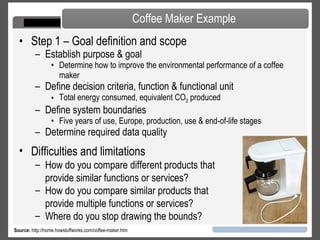
Step 1 – Goal definition and scope Establish purpose & goal Determine how to improve the environmental performance of a coffee maker Define decision criteria, function & functional unit Total energy consumed, equivalent CO 2  produced Define system boundaries Five years of use, Europe, production, use & end-of-life stages  Determine required data quality Source:  http://home.howstuffworks.com/coffee-maker.htm Coffee Maker Example Difficulties and limitations How do you compare different products that provide similar functions or services? How do you compare similar products that provide multiple functions or services? Where do you stop drawing the bounds?
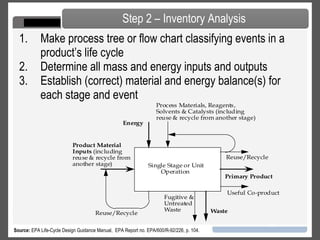
Make process tree or flow chart classifying events in a product’s life cycle Determine all mass and energy inputs and outputs Establish (correct) material and energy balance(s) for each stage and event Step 2 – Inventory Analysis Source:  EPA Life-Cycle Design Guidance Manual,  EPA Report no. EPA/600/R-92/226, p. 104.
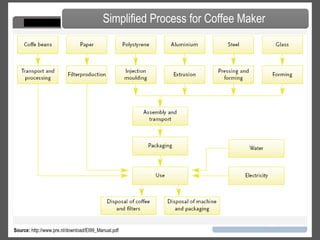
Source:  http://www.pre.nl/download/EI99_Manual.pdf Simplified Process for Coffee Maker
Finding data is hard and usually very time-consuming Published data on material loads exists, but is often inconsistent and/or not directly applicable Obtained data is usually discrete, static and linear (makes many simplifying assumptions) Mistakes are easily made in quantification Mass and energy balances may not be correct Results can be generalized improperly Difficulties and Limitations of Step 2
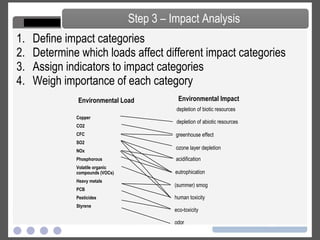
Define impact categories Determine which loads affect different impact categories Assign indicators to impact categories Weigh importance of each category Environmental Impact Environmental Load greenhouse effect ozone layer depletion eutrophication depletion of abiotic resources (summer) smog acidification Copper CO2 CFC SO2 NOx Phosphorous Volatile organic compounds (VOCs) Heavy metals PCB Pesticides Styrene eco-toxicity depletion of biotic resources human toxicity odor Step 3 – Impact Analysis
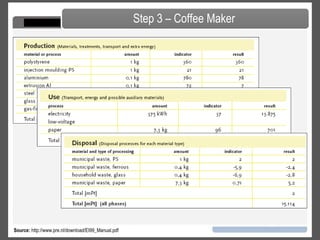
Step 3 – Coffee Maker Source:  http://www.pre.nl/download/EI99_Manual.pdf
Subjective, subjective, subjective Impact categories chosen Indicators chosen for impact categories How metrics / load affect impact indicators Weightings used for impact categories Where are the impacts occurring? U.S., Europe, Brazil? Is there damage already in the area being impacted? How much can that area take before it breaks down?  Or can it handle it without any problems? How are managers and engineers supposed to know the effects of every load on the different impacts? Difficulties and Limitations of Step 3
Identify areas & opportunities for improvement Evaluate progress versus original goal definition Target lifecycle areas/processes/events with large impacts Large amounts w/ low hazard Small amounts w/ high hazard Ask yourself:  What are the resources required and risks involved? Step 4 – Improvement Analysis
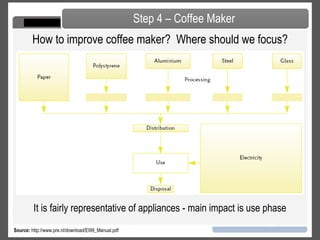
It is fairly representative of appliances - main impact is use phase How to improve coffee maker?  Where should we focus? Step 4 – Coffee Maker Source:  http://www.pre.nl/download/EI99_Manual.pdf
Life Cycle of CD or DVD
Carbon Footprint of an Automobile
Focus should be on the product’s lifecycle, not the product itself Presented the main steps of LCA (ISO 14040-14043)  Presented the limitations & difficulties of each step of LCA While LCA has variations limitations, its underlying philosophy is right on Emerging new regulations may require LCA’s (and labeling) for all consumer products Summary

Life Cycle Analysis - Environmental LCA's

  • 1.
    Life Cycle AnalysisBusiness, Society & Environment Professor Hector R Rodriguez School of Business Mount Ida College Life Cycle Analysis
  • 2.
    Society The Corporationand Its Stakeholders People for the Ethical Treatment of Animals Corporate Citizenship The Social Responsibility of Business The Shareholder Primacy Norm CSR, Citizenship and Sustainability Reporting Responsible Investing The Community and the Corporation Taxation and Corporate Citizenship Corporate Philanthropy Programs Employees and the Corporation Managing a Diverse Workforce Environment A Balanced Look at Climate Change Non-anthropogenic Causes of Climate Change Sulfates, Urban Warming and Permafrost Conventional Energy The Kyoto Protocol Green Building Green Information Technology Transportation, Electric Vehicles and the Environment Geo-Engineering Carbon Capture and Storage Renewable Energy Solid, Toxic and Hazardous Waste Forests, Paper and Carbon Sinks Life Cycle Analysis Water Use and Management Water Pollution Course Map – Topics Covered in Course
  • 3.
    The term “lifecycle” refers to the major activities in the course of the product’s life-span from its manufacture, use, and maintenance, to its final disposal, including the raw material acquisition required to manufacture the product. By including the impacts throughout the product life cycle, LCA provides a comprehensive view of the environmental aspects of the product or process and a more accurate picture of the true environmental trade-offs in product and process selection. Usually follows international rules (the ISO 14040 series standards) Source: Mary Ann Curran, “Life Cycle Assessment: Principles and Practice,” EPA: (2006) What is Life Cycle Assessment?
  • 4.
    Identify opportunities environmentalimpact and waste reduction Prepare to capitalize on regulatory changes Improve product/corporate image Develop metrics and enable comparison across the company and among suppliers and partners Help to secure market and competitive positions Answer customer’s requests for environmental and social information Identify cost savings Why Conduct an LCA? Source: Mary Ann Curran, “Life Cycle Assessment: Principles and Practice,” EPA: (2006)
  • 5.
    Side Bar -Eco-Labeling, Already in Stores Near You
  • 6.
    LCA Process RawMaterials All process and distribution steps required to produce the raw material Production All process and distribution steps from when the raw material is bought by the client until the finished product leaves the factory site Distribution All steps involved with moving the product from the factory site to the end consumer Use All steps from end consumer purchasing goods through to disposal Define methodology Identify proxies/estimators Collect data Measure product related emissions Identify potential opportunities Disposal For product going to landfill - all steps from consumer disposing of product to reaching its final state of decomposition For recycled product - all steps from consumer disposing of product to reaching the recycler
  • 7.
    The LCA processis a systematic, phased approach and consists of four components: Goal Definition and Scoping - Define and describe the product, process or activity. Establish the context in which the assessment is to be made and identify the boundaries and environmental effects to be reviewed for the assessment. Inventory Analysis - Identify and quantify energy, water and materials usage and environmental releases Impact Assessment - Assess the potential human and ecological effects of energy, water, and material usage and the environmental releases identified in the inventory analysis. Interpretation - Evaluate the results of the inventory analysis and impact assessment to select the preferred product, process or service with a clear understanding of the uncertainty and the assumptions used to generate the results. LCA Framework Source: Mary Ann Curran, “Life Cycle Assessment: Principles and Practice,” EPA: (2006)
  • 8.
    The system functionand functional unit: the economic or social good provided by the goods or services in question. Impact categories: which environmental concerns are included and which are excluded The system boundary: which processes are included and which ones are excluded The audience of the LCA and therefore whether it will be a public and peer reviewed document. Technical issues such as engineering conventions and impact assessment models Scoping Source: Mary Ann Curran, “Life Cycle Assessment: Principles and Practice,” EPA: (2006)
  • 9.
    What is aLife Cycle Inventory (LCI)? A life cycle inventory is a process of quantifying energy and raw material requirements, atmospheric emissions, waterborne emissions, solid wastes, and other releases for the entire life cycle of a product, process, or activity. Why Conduct an LCI? Without an LCI, no basis exists to evaluate comparative environmental impacts or potential improvements. Life Cycle Inventory Source: Mary Ann Curran, “Life Cycle Assessment: Principles and Practice,” EPA: (2006)
  • 10.
    The more completethe flow diagram, the greater the accuracy and utility of the results. Inventory Process Source: Mary Ann Curran, “Life Cycle Assessment: Principles and Practice,” EPA: (2006)
  • 11.
    What is aLife Cycle Impact Assessment (LCIA)? The Life Cycle Impact Assessment (LCIA) phase of an LCA is the evaluation of potential human health and environmental impacts of the environmental resources and releases identified during the LCI. Impact assessment should address ecological and human health effects; it should also address resource depletion. A life cycle impact assessment attempts to establish a linkage between the product or process and its potential environmental impacts. For example, what are the impacts of 9,000 tons of carbon dioxide or 5,000 tons of methane emissions released into the atmosphere? Which is worse? What are their potential impacts on smog? On global warming? Life Cycle Impact Assessment Source: Mary Ann Curran, “Life Cycle Assessment: Principles and Practice,” EPA: (2006)
  • 12.
    Water Resource DepletionMineral Resource Depletion Fossil Fuel Depletion Land Use/Biodiversity Soil Conservation Climate Change Stratospheric Ozone Depletion Eutrophication Photochemical Smog Acidification Human Toxicity Eco-Toxicity Typical Impact Categories What are the specific impacts on each one of these variables?
  • 13.
    Typical Impact CategoriesReducing a Product’s Environmental Footprint. This spider diagram is one way to show how a particular product’s environmental effects or “footprint” are reduced over time through incremental improvements in sustainable design. This diagram shows the dimensions of the footprint in years 2009, 2025 and 2050.
  • 14.
    Side Bar -Social LCA’s, Emerging Initiative
  • 15.
    Normalization, Scoring andother methods Used to clarify data for decision makers Based on value judgments, not science Important to choose these methods to support the decisions you make E.g. policy: normalized to national per capita figures E.g. comparisons between products, normalized to average product E.g. comparisons between businesses normalized to net sales After Impact Assessment
  • 16.
    Step 1 –Goal definition and scope Establish purpose & goal Determine how to improve the environmental performance of a coffee maker Define decision criteria, function & functional unit Total energy consumed, equivalent CO 2 produced Define system boundaries Five years of use, Europe, production, use & end-of-life stages Determine required data quality Source: http://home.howstuffworks.com/coffee-maker.htm Coffee Maker Example Difficulties and limitations How do you compare different products that provide similar functions or services? How do you compare similar products that provide multiple functions or services? Where do you stop drawing the bounds?
  • 17.
    Make process treeor flow chart classifying events in a product’s life cycle Determine all mass and energy inputs and outputs Establish (correct) material and energy balance(s) for each stage and event Step 2 – Inventory Analysis Source: EPA Life-Cycle Design Guidance Manual, EPA Report no. EPA/600/R-92/226, p. 104.
  • 18.
    Source: http://www.pre.nl/download/EI99_Manual.pdfSimplified Process for Coffee Maker
  • 19.
    Finding data ishard and usually very time-consuming Published data on material loads exists, but is often inconsistent and/or not directly applicable Obtained data is usually discrete, static and linear (makes many simplifying assumptions) Mistakes are easily made in quantification Mass and energy balances may not be correct Results can be generalized improperly Difficulties and Limitations of Step 2
  • 20.
    Define impact categoriesDetermine which loads affect different impact categories Assign indicators to impact categories Weigh importance of each category Environmental Impact Environmental Load greenhouse effect ozone layer depletion eutrophication depletion of abiotic resources (summer) smog acidification Copper CO2 CFC SO2 NOx Phosphorous Volatile organic compounds (VOCs) Heavy metals PCB Pesticides Styrene eco-toxicity depletion of biotic resources human toxicity odor Step 3 – Impact Analysis
  • 21.
    Step 3 –Coffee Maker Source: http://www.pre.nl/download/EI99_Manual.pdf
  • 22.
    Subjective, subjective, subjectiveImpact categories chosen Indicators chosen for impact categories How metrics / load affect impact indicators Weightings used for impact categories Where are the impacts occurring? U.S., Europe, Brazil? Is there damage already in the area being impacted? How much can that area take before it breaks down? Or can it handle it without any problems? How are managers and engineers supposed to know the effects of every load on the different impacts? Difficulties and Limitations of Step 3
  • 23.
    Identify areas &opportunities for improvement Evaluate progress versus original goal definition Target lifecycle areas/processes/events with large impacts Large amounts w/ low hazard Small amounts w/ high hazard Ask yourself: What are the resources required and risks involved? Step 4 – Improvement Analysis
  • 24.
    It is fairlyrepresentative of appliances - main impact is use phase How to improve coffee maker? Where should we focus? Step 4 – Coffee Maker Source: http://www.pre.nl/download/EI99_Manual.pdf
  • 25.
    Life Cycle ofCD or DVD
  • 26.
    Carbon Footprint ofan Automobile
  • 27.
    Focus should beon the product’s lifecycle, not the product itself Presented the main steps of LCA (ISO 14040-14043) Presented the limitations & difficulties of each step of LCA While LCA has variations limitations, its underlying philosophy is right on Emerging new regulations may require LCA’s (and labeling) for all consumer products Summary