Control System In Avionics
Topic:
Future Integrated Systems Concept for Preventing
Aircraft Loss-of-Control (LOC) Accidents
Group Members:
Muhammad Nauman Rafique
12063122-011
Basharat Naeem
12063122-035
Future Integrated Systems Concept for
Preventing
Aircraft Loss-of-Control (LOC) Accidents:
 Loss of control remains one of the largest contributors to aircraft fatal
accidents worldwide
 Aircraft loss-of-control accidents are highly complex in that they can result
from numerous contributing factors acting alone or in combination.
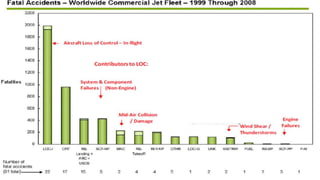
 As indicated in the incoming figure, in-flight aircraft loss of control (LOC)
resulted in 22 accidents and a total of 1,991 fatalities during this time
period (1999-2008).
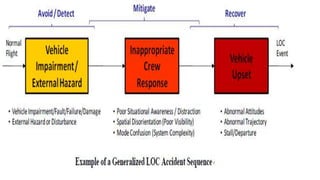
Causes of Loss-of-Control (LOC) :
 Inappropriate crew response
 Vehicle impairment ( inappropriate vehicle configuration, contaminated airfoil, and improper
 vehicle loading)
 External hazards
(wind shear, thunderstorms snow and icing conditions etc.,)
 Space disorientation ( poor visibility conditions )
 Mode confusion associated with the cockpit automation, or some other condition
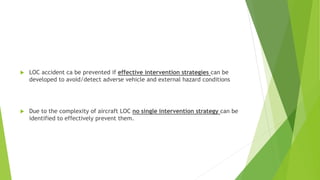
 LOC accident ca be prevented if effective intervention strategies can be
developed to avoid/detect adverse vehicle and external hazard conditions
 Due to the complexity of aircraft LOC no single intervention strategy can be
identified to effectively prevent them.
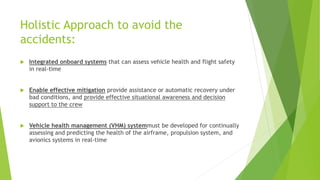
Holistic Approach to avoid the
accidents:
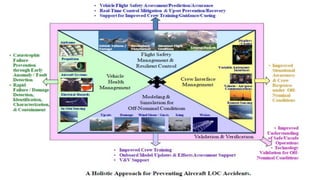
 Integrated onboard systems that can assess vehicle health and flight safety
in real-time
 Enable effective mitigation provide assistance or automatic recovery under
bad conditions, and provide effective situational awareness and decision
support to the crew
 Vehicle health management (VHM) systemmust be developed for continually
assessing and predicting the health of the airframe, propulsion system, and
avionics systems in real-time
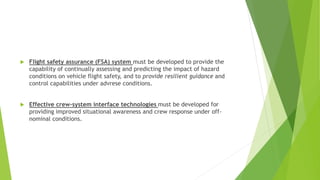
 Flight safety assurance (FSA) system must be developed to provide the
capability of continually assessing and predicting the impact of hazard
conditions on vehicle flight safety, and to provide resilient guidance and
control capabilities under advrese conditions.
 Effective crew-system interface technologies must be developed for
providing improved situational awareness and crew response under off-
nominal conditions.
 Remote sensing system must be developed for avoidance of external hazards
and disturbances.
 Validation and verification (V&V) system must be developed for the
comprehensive evaluation of these technologies, and to enable the
identification of system limitations and constraints as well as boundaries
between safe and unsafe operating conditions.
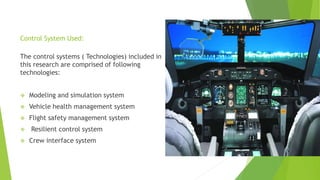
Control System Used:
The control systems ( Technologies) included in
this research are comprised of following
technologies:
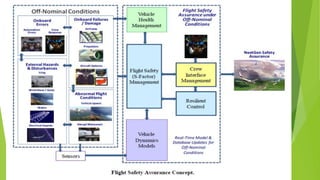
 Modeling and simulation system
 Vehicle health management system
 Flight safety management system
 Resilient control system
 Crew interface system
If an inappropriate crew response did occur ?
Then
1- The flight safety management and
2- Resilient control systems
would immediately detect risk associated with the action (or inaction), and
would mitigate their effects to restore flight safety while preventing a vehicle
upset or damage.
Source:
 Christine M. Belcastro NASA Langley Research Center, Hampton, VA, 23681
 Steven R. Jacobson† NASA Dryden Flight Research Center, Edwards, CA, 93523
Future Integrated Systems Concept for Preventing Aircraft Loss-of-Control (LOC) Accidents

Future Integrated Systems Concept for Preventing Aircraft Loss-of-Control (LOC) Accidents

  • 1.
    Control System InAvionics Topic: Future Integrated Systems Concept for Preventing Aircraft Loss-of-Control (LOC) Accidents Group Members: Muhammad Nauman Rafique 12063122-011 Basharat Naeem 12063122-035
  • 2.
    Future Integrated SystemsConcept for Preventing Aircraft Loss-of-Control (LOC) Accidents:  Loss of control remains one of the largest contributors to aircraft fatal accidents worldwide  Aircraft loss-of-control accidents are highly complex in that they can result from numerous contributing factors acting alone or in combination.  As indicated in the incoming figure, in-flight aircraft loss of control (LOC) resulted in 22 accidents and a total of 1,991 fatalities during this time period (1999-2008).
  • 4.
    Causes of Loss-of-Control(LOC) :  Inappropriate crew response  Vehicle impairment ( inappropriate vehicle configuration, contaminated airfoil, and improper  vehicle loading)  External hazards (wind shear, thunderstorms snow and icing conditions etc.,)  Space disorientation ( poor visibility conditions )  Mode confusion associated with the cockpit automation, or some other condition
  • 6.
     LOC accidentca be prevented if effective intervention strategies can be developed to avoid/detect adverse vehicle and external hazard conditions  Due to the complexity of aircraft LOC no single intervention strategy can be identified to effectively prevent them.
  • 7.
    Holistic Approach toavoid the accidents:  Integrated onboard systems that can assess vehicle health and flight safety in real-time  Enable effective mitigation provide assistance or automatic recovery under bad conditions, and provide effective situational awareness and decision support to the crew  Vehicle health management (VHM) systemmust be developed for continually assessing and predicting the health of the airframe, propulsion system, and avionics systems in real-time
  • 8.
     Flight safetyassurance (FSA) system must be developed to provide the capability of continually assessing and predicting the impact of hazard conditions on vehicle flight safety, and to provide resilient guidance and control capabilities under advrese conditions.  Effective crew-system interface technologies must be developed for providing improved situational awareness and crew response under off- nominal conditions.
  • 9.
     Remote sensingsystem must be developed for avoidance of external hazards and disturbances.  Validation and verification (V&V) system must be developed for the comprehensive evaluation of these technologies, and to enable the identification of system limitations and constraints as well as boundaries between safe and unsafe operating conditions.
  • 12.
    Control System Used: Thecontrol systems ( Technologies) included in this research are comprised of following technologies:  Modeling and simulation system  Vehicle health management system  Flight safety management system  Resilient control system  Crew interface system
  • 13.
    If an inappropriatecrew response did occur ? Then 1- The flight safety management and 2- Resilient control systems would immediately detect risk associated with the action (or inaction), and would mitigate their effects to restore flight safety while preventing a vehicle upset or damage.
  • 14.
    Source:  Christine M.Belcastro NASA Langley Research Center, Hampton, VA, 23681  Steven R. Jacobson† NASA Dryden Flight Research Center, Edwards, CA, 93523