CARNOT CYCLE
The Most Efficient Ever But Ideal
GROUP MEMBERS:
 MUHAMMAD OMER (2015-EE-468)
 WALEED TARIQ (2015-EE-406)
 ZAIN-UL-ABIDIN (2015-EE-456)
 RIDA FATIMA (2015-EE-462)
 USAMA BUTT (2015-EE-492)
CONTENTS
 INTRODUCTION
 HISTORY
 ASSUMPTIONS
 P-V DIAGRAM
 EFFICIENCY
 LIMITATIONS
 CONCLUSIONS
INTRODUCTION
 The most powerful and efficient heat cycle
consisting of two isothermal and two
adiabatic processes.
 This actually is the idealization because in
order to approach it’s efficiency the
processes involved must be reversible and
involves no change in entropy.
 A system undergoing carnot cycle is called
“Carnot Engine”.
HISTORY
 Proposed by Nicolas Léonard Sadi Carnot in
1824.
 He was a French Engineer.
 Founder of the science of thermodynamics.
 First one to recognize the relationship
between work and heat.
1796-1832
COMMON ASSUMPTIONS OF CARNOT
CYCLE
 Isothermal expansions and compressions
are considered quasi-equilibrium.
 No heat losses in pipes and other
components.
 The cycles do not have any friction. Thus,
no pressure drops in the working fluid.
 Changes in kinetic and potential energies
are negligible.
P-V DIAGRAM
Processes:-
 Isothermal Expansion
(1-2)
 Adiabatic Expansion
(2-3)
 Isothermal
Compression
(3-4)
 Adiabatic
Compression
(4-1)
4 STEPS
OF
CARNOT
CYCLE
ELABORATION
 The fig. shows the schematic and
accompanying P-V diagram of a carnot cycle
executed by water steadily circulating
through a simple vapor power plant.
 The steam exiting the boiler expands
adiabatically through the turbine and the
work is developed . The steam temperature
decreases from TH To TL.
 Two phases mixture flows through condenser
where heat rejection occurs at constant
temperature TL.
ELABORATION
 The mixture (liquid-vapour) enters the
pump (or compressor) and its pressure
increases.This is an adiabatic process and
requires input work.
 The saturated liquid at high temperature
enters the boiler,where change of phase
occurs at constant temperature TH.
CARNOT THEOREM
• No real engine can be more efficient than
a Carnot Engine operating between same
two reservoirs.
• All Carnot Engines operating between
reservoirs at the same temperature have
the same efficiency.
PROOF OF CARNOT THEOREM
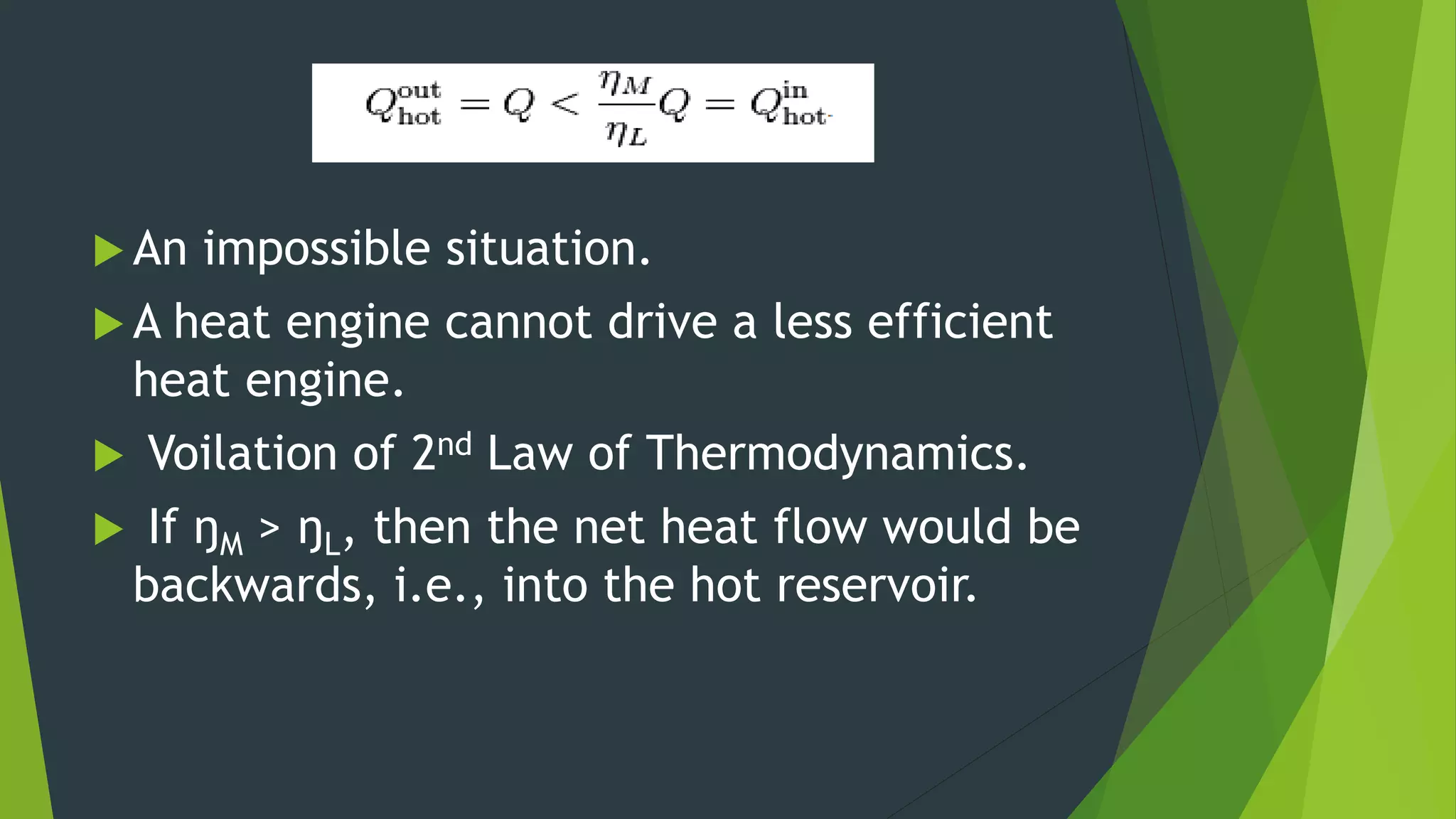
 An impossible situation.
 A heat engine cannot drive a less efficient
heat engine.
 Voilation of 2nd Law of Thermodynamics.
 If ŋM > ŋL, then the net heat flow would be
backwards, i.e., into the hot reservoir.
PROOF OF CARNOT THEOREM FOR:
 Reversible Engines :
“ All reversible engines that operate between
the same two heat reservoirs have the same
efficiency.”
 Irreversible Engines:
“ No irreversible engine is more efficient
than the Carnot engine operating between the
same two reservoirs.”
EFFICIENCY OF CARNOT CYCLE
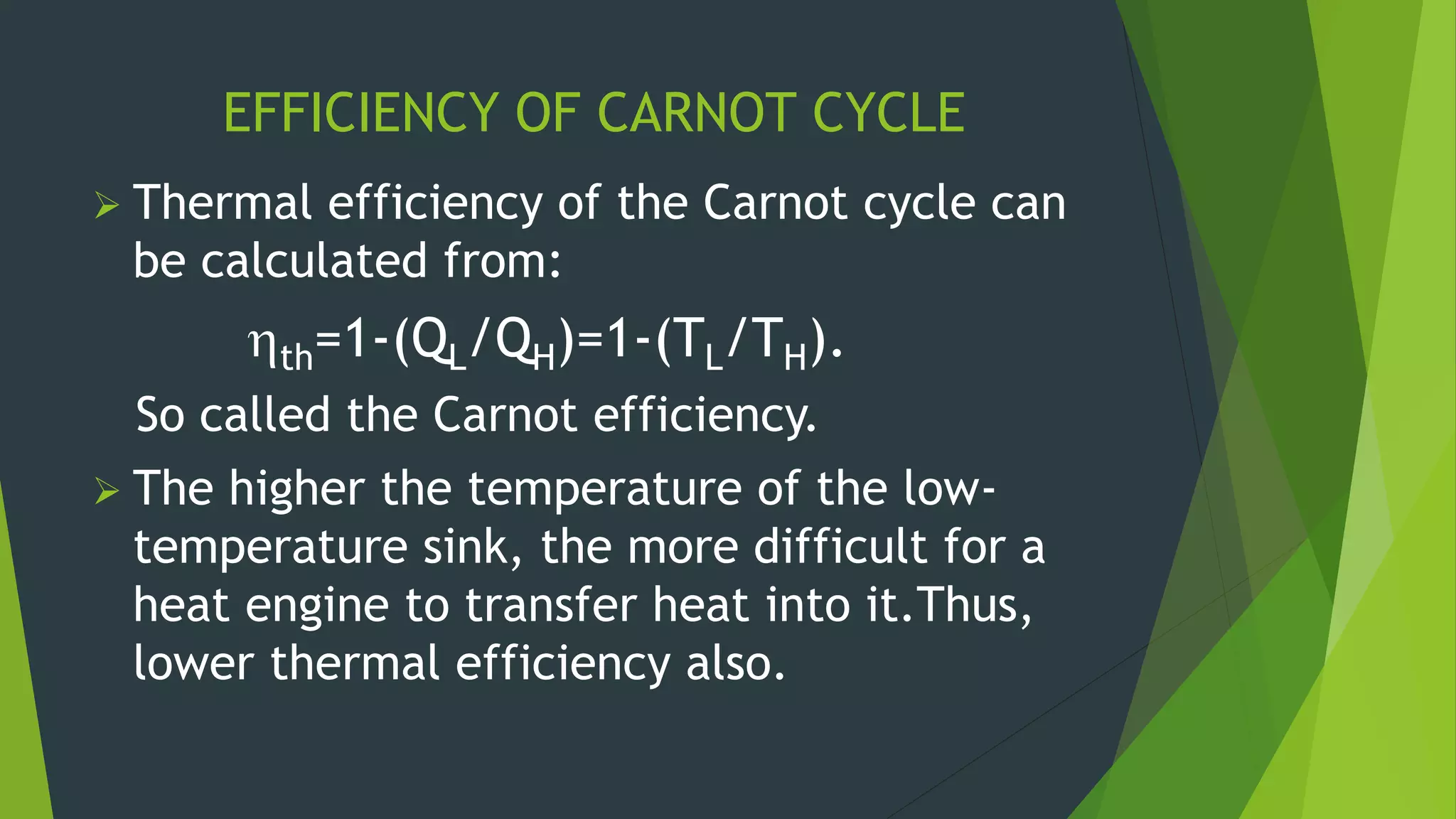
 Thermal efficiency of the Carnot cycle can
be calculated from:
th=1-(QL/QH)=1-(TL/TH).
So called the Carnot efficiency.
 The higher the temperature of the low-
temperature sink, the more difficult for a
heat engine to transfer heat into it.Thus,
lower thermal efficiency also.
LIMITATIONS OF CARNOT CYCLE
 The isentropic process 1-2 is practically not
achievable,as it is difficult to handle two
phase system.
 If the steam quality is poor then process
3-4 is difficult to carry out.
CONCLUSIONS
 We can say that Carnot Engine is one of the
most efficient one but it’s ideal one.
 Let assume for a moment that it’s not an
ideal cycle then what would happen??
 I think there will be no other engines
Because after this gorgeous thing there is
no need   
Carnot cycle
Carnot cycle
Carnot cycle

Carnot cycle

  • 2.
    CARNOT CYCLE The MostEfficient Ever But Ideal
  • 3.
    GROUP MEMBERS:  MUHAMMADOMER (2015-EE-468)  WALEED TARIQ (2015-EE-406)  ZAIN-UL-ABIDIN (2015-EE-456)  RIDA FATIMA (2015-EE-462)  USAMA BUTT (2015-EE-492)
  • 4.
    CONTENTS  INTRODUCTION  HISTORY ASSUMPTIONS  P-V DIAGRAM  EFFICIENCY  LIMITATIONS  CONCLUSIONS
  • 5.
    INTRODUCTION  The mostpowerful and efficient heat cycle consisting of two isothermal and two adiabatic processes.  This actually is the idealization because in order to approach it’s efficiency the processes involved must be reversible and involves no change in entropy.  A system undergoing carnot cycle is called “Carnot Engine”.
  • 6.
    HISTORY  Proposed byNicolas Léonard Sadi Carnot in 1824.  He was a French Engineer.  Founder of the science of thermodynamics.  First one to recognize the relationship between work and heat. 1796-1832
  • 7.
    COMMON ASSUMPTIONS OFCARNOT CYCLE  Isothermal expansions and compressions are considered quasi-equilibrium.  No heat losses in pipes and other components.  The cycles do not have any friction. Thus, no pressure drops in the working fluid.  Changes in kinetic and potential energies are negligible.
  • 8.
    P-V DIAGRAM Processes:-  IsothermalExpansion (1-2)  Adiabatic Expansion (2-3)  Isothermal Compression (3-4)  Adiabatic Compression (4-1)
  • 9.
  • 10.
    ELABORATION  The fig.shows the schematic and accompanying P-V diagram of a carnot cycle executed by water steadily circulating through a simple vapor power plant.  The steam exiting the boiler expands adiabatically through the turbine and the work is developed . The steam temperature decreases from TH To TL.  Two phases mixture flows through condenser where heat rejection occurs at constant temperature TL.
  • 11.
    ELABORATION  The mixture(liquid-vapour) enters the pump (or compressor) and its pressure increases.This is an adiabatic process and requires input work.  The saturated liquid at high temperature enters the boiler,where change of phase occurs at constant temperature TH.
  • 12.
    CARNOT THEOREM • Noreal engine can be more efficient than a Carnot Engine operating between same two reservoirs. • All Carnot Engines operating between reservoirs at the same temperature have the same efficiency.
  • 13.
  • 14.
     An impossiblesituation.  A heat engine cannot drive a less efficient heat engine.  Voilation of 2nd Law of Thermodynamics.  If ŋM > ŋL, then the net heat flow would be backwards, i.e., into the hot reservoir.
  • 15.
    PROOF OF CARNOTTHEOREM FOR:  Reversible Engines : “ All reversible engines that operate between the same two heat reservoirs have the same efficiency.”  Irreversible Engines: “ No irreversible engine is more efficient than the Carnot engine operating between the same two reservoirs.”
  • 16.
    EFFICIENCY OF CARNOTCYCLE  Thermal efficiency of the Carnot cycle can be calculated from: th=1-(QL/QH)=1-(TL/TH). So called the Carnot efficiency.  The higher the temperature of the low- temperature sink, the more difficult for a heat engine to transfer heat into it.Thus, lower thermal efficiency also.
  • 17.
    LIMITATIONS OF CARNOTCYCLE  The isentropic process 1-2 is practically not achievable,as it is difficult to handle two phase system.  If the steam quality is poor then process 3-4 is difficult to carry out.
  • 18.
    CONCLUSIONS  We cansay that Carnot Engine is one of the most efficient one but it’s ideal one.  Let assume for a moment that it’s not an ideal cycle then what would happen??  I think there will be no other engines Because after this gorgeous thing there is no need   