Overview of Reciprocating Engines
Terms
 TDC
 BDC
 Stroke
 Bore
 Displacement or swept volume
 Clearance volume 2
Overview of Reciprocating Engines Cont’d
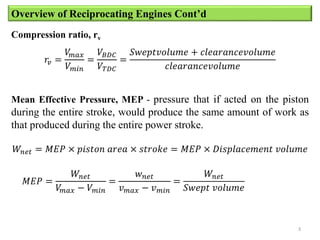
Compression ratio, rv
𝑟𝑣 =
𝑉
𝑚𝑎𝑥
𝑉𝑚𝑖𝑛
=
𝑉𝐵𝐷𝐶
𝑉𝑇𝐷𝐶
=
𝑆𝑤𝑒𝑝𝑡𝑣𝑜𝑙𝑢𝑚𝑒 + 𝑐𝑙𝑒𝑎𝑟𝑎𝑛𝑐𝑒𝑣𝑜𝑙𝑢𝑚𝑒
𝑐𝑙𝑒𝑎𝑟𝑎𝑛𝑐𝑒𝑣𝑜𝑙𝑢𝑚𝑒
Mean Effective Pressure, MEP - pressure that if acted on the piston
during the entire stroke, would produce the same amount of work as
that produced during the entire power stroke.
𝑊𝑛𝑒𝑡 = 𝑀𝐸𝑃 × 𝑝𝑖𝑠𝑡𝑜𝑛 𝑎𝑟𝑒𝑎 × 𝑠𝑡𝑟𝑜𝑘𝑒 = 𝑀𝐸𝑃 × 𝐷𝑖𝑠𝑝𝑙𝑎𝑐𝑒𝑚𝑒𝑛𝑡 𝑣𝑜𝑙𝑢𝑚𝑒
𝑀𝐸𝑃 =
𝑊𝑛𝑒𝑡
𝑉
𝑚𝑎𝑥 − 𝑉𝑚𝑖𝑛
=
𝑤𝑛𝑒𝑡
𝑣𝑚𝑎𝑥 − 𝑣𝑚𝑖𝑛
=
𝑊𝑛𝑒𝑡
𝑆𝑤𝑒𝑝𝑡 𝑣𝑜𝑙𝑢𝑚𝑒
3
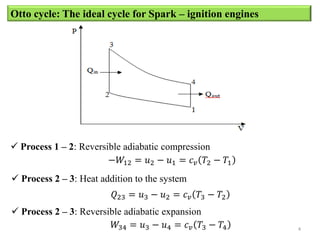
Otto cycle: The ideal cycle for Spark – ignition engines
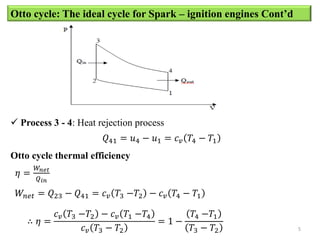
 Process 1 – 2: Reversible adiabatic compression
−𝑊12 = 𝑢2 − 𝑢1 = 𝑐𝑣 𝑇2 − 𝑇1
 Process 2 – 3: Heat addition to the system
𝑄23 = 𝑢3 − 𝑢2 = 𝑐𝑣 𝑇3 − 𝑇2
 Process 2 – 3: Reversible adiabatic expansion
𝑊34 = 𝑢3 − 𝑢4 = 𝑐𝑣 𝑇3 − 𝑇4 4
Otto cycle: The ideal cycle for Spark – ignition engines Cont’d
 Process 3 - 4: Heat rejection process
𝑄41 = 𝑢4 − 𝑢1 = 𝑐𝑣 𝑇4 − 𝑇1
Otto cycle thermal efficiency
𝜂 =
𝑊𝑛𝑒𝑡
𝑄𝑖𝑛
𝑊𝑛𝑒𝑡 = 𝑄23 − 𝑄41 = 𝑐𝑣 𝑇3 −𝑇2 − 𝑐𝑣 𝑇4 − 𝑇1
∴ 𝜂 =
𝑐𝑣 𝑇3 −𝑇2 − 𝑐𝑣 𝑇1 −𝑇4
𝑐𝑣 𝑇3 − 𝑇2
= 1 −
𝑇4 −𝑇1
𝑇3 − 𝑇2 5
Otto cycle: The ideal cycle for Spark – ignition engines Cont’d
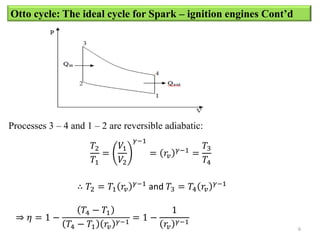
Processes 3 – 4 and 1 – 2 are reversible adiabatic:
𝑇2
𝑇1
=
𝑉1
𝑉2
𝛾−1
= 𝑟𝑣
𝛾−1
=
𝑇3
𝑇4
∴ 𝑇2 = 𝑇1 𝑟𝑣
𝛾−1
and 𝑇3 = 𝑇4 𝑟𝑣
𝛾−1
⇒ 𝜂 = 1 −
𝑇4 − 𝑇1
𝑇4 − 𝑇1 𝑟𝑣
𝛾−1
= 1 −
1
𝑟𝑣
𝛾−1
6
Deviation of the actual Otto cycles from the ideal Otto cycle
Causes
 Air is not the working fluid throughout the cycle (the gaseous
products of combustion differ from air)
 Some of the energy released during combustion goes into
dissociation of molecules and therefore not available for useful
work.
 There is heat loss through the cylinder walls
 There are friction losses between the piston and the cylinder
 There is a finite time required for the spark flame to propagate
through the entire mass of gas.
7
Diesel cycle: The ideal cycle for CI engines
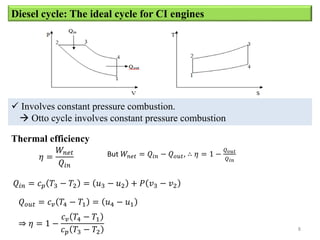
 Involves constant pressure combustion.
 Otto cycle involves constant pressure combustion
Thermal efficiency
𝜂 =
𝑊𝑛𝑒𝑡
𝑄𝑖𝑛
But 𝑊𝑛𝑒𝑡 = 𝑄𝑖𝑛 − 𝑄𝑜𝑢𝑡, ∴ 𝜂 = 1 −
𝑄𝑜𝑢𝑡
𝑄𝑖𝑛
𝑄𝑖𝑛 = 𝑐𝑝 𝑇3 − 𝑇2 = 𝑢3 − 𝑢2 + 𝑃 𝑣3 − 𝑣2
𝑄𝑜𝑢𝑡 = 𝑐𝑣 𝑇4 − 𝑇1 = 𝑢4 − 𝑢1
⇒ 𝜂 = 1 −
𝑐𝑣 𝑇4 − 𝑇1
𝑐𝑝 𝑇3 − 𝑇2
8
9
Diesel cycle Cont’d
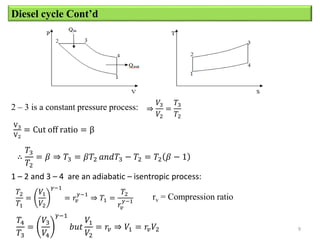
2 – 3 is a constant pressure process: ⇒
𝑉3
𝑉2
=
𝑇3
𝑇2
V3
V2
= Cut off ratio = β
∴
𝑇3
𝑇2
= 𝛽 ⇒ 𝑇3 = 𝛽𝑇2 𝑎𝑛𝑑𝑇3 − 𝑇2 = 𝑇2 𝛽 − 1
1 – 2 and 3 – 4 are an adiabatic – isentropic process:
𝑇2
𝑇1
=
𝑉1
𝑉2
𝛾−1
= 𝑟𝑣
𝛾−1
⇒ 𝑇1 =
𝑇2
𝑟𝑣
𝛾−1
rv = Compression ratio
𝑇4
𝑇3
=
𝑉3
𝑉4
𝛾−1
𝑏𝑢𝑡
𝑉1
𝑉2
= 𝑟𝑣 ⇒ 𝑉1 = 𝑟𝑣𝑉2
10
Diesel cycle Cont’d
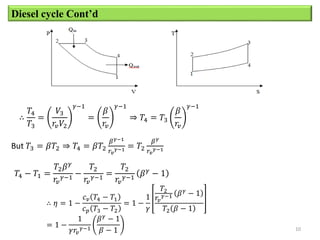
∴
𝑇4
𝑇3
=
𝑉3
𝑟𝑣𝑉2
𝛾−1
=
𝛽
𝑟𝑣
𝛾−1
⇒ 𝑇4 = 𝑇3
𝛽
𝑟𝑣
𝛾−1
But 𝑇3 = 𝛽𝑇2 ⇒ 𝑇4 = 𝛽𝑇2
𝛽𝛾−1
𝑟𝑣
𝛾−1 = 𝑇2
𝛽𝛾
𝑟𝑣
𝛾−1
𝑇4 − 𝑇1 =
𝑇2𝛽𝛾
𝑟𝑣
𝛾−1
−
𝑇2
𝑟𝑣
𝛾−1
=
𝑇2
𝑟𝑣
𝛾−1
𝛽𝛾 − 1
∴ 𝜂 = 1 −
𝑐𝑣 𝑇4 − 𝑇1
𝑐𝑝 𝑇3 − 𝑇2
= 1 −
1
𝛾
𝑇2
𝑟𝑣
𝛾−1 𝛽𝛾 − 1
𝑇2 𝛽 − 1
= 1 −
1
𝛾𝑟𝑣
𝛾−1
𝛽𝛾
− 1
𝛽 − 1
11
The dual – combustion cycle
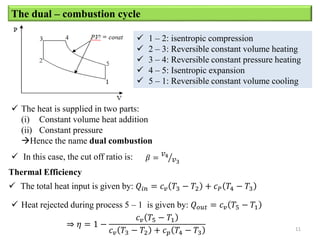
 1 – 2: isentropic compression
 2 – 3: Reversible constant volume heating
 3 – 4: Reversible constant pressure heating
 4 – 5: Isentropic expansion
 5 – 1: Reversible constant volume cooling
 The heat is supplied in two parts:
(i) Constant volume heat addition
(ii) Constant pressure
Hence the name dual combustion
 In this case, the cut off ratio is: 𝛽 =
𝑣4
𝑣3
Thermal Efficiency
 The total heat input is given by: 𝑄𝑖𝑛 = 𝑐𝑣 𝑇3 − 𝑇2 + 𝑐𝑃 𝑇4 − 𝑇3
 Heat rejected during process 5 – 1 is given by: 𝑄𝑜𝑢𝑡 = 𝑐𝑣 𝑇5 − 𝑇1
⇒ 𝜂 = 1 −
𝑐𝑣 𝑇5 − 𝑇1
𝑐𝑣 𝑇3 − 𝑇2 + 𝑐𝑝 𝑇4 − 𝑇3
12
Tutorials
Problem One (Otto cycle)
An ideal Otto cycle has a compression ratio of 8.0. At the beginning of the of the
compression process, air is at 100 kPa and 170C, and 800 kJ/kg of heat is transferred to air
during the constant volume heat – addition process. Taking the respective values of cv and γ
as 0.718 kJ/kgK and 1.4 for the compression process and 0.823 kJ/kgK and 1.333 for the
heat – addition, expansion and heat rejection processes, determine:
(i) The maximum temperature and pressure that occur during the cycle
(ii) The net work output
(iii) The thermal efficiency
(iv) The mean effective pressure
Problem Two (Diesel Cycle)
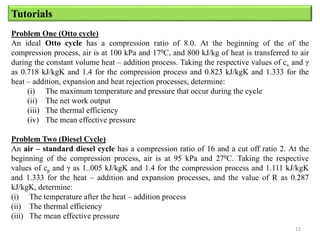
An air – standard diesel cycle has a compression ratio of 16 and a cut off ratio 2. At the
beginning of the compression process, air is at 95 kPa and 270C. Taking the respective
values of cp and γ as 1..005 kJ/kgK and 1.4 for the compression process and 1.111 kJ/kgK
and 1.333 for the heat – addition and expansion processes, and the value of R as 0.287
kJ/kgK, determine:
(i) The temperature after the heat – addition process
(ii) The thermal efficiency
(iii) The mean effective pressure
13
Tutorials Cont’d
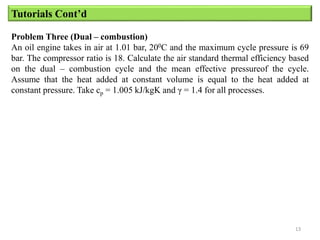
Problem Three (Dual – combustion)
An oil engine takes in air at 1.01 bar, 200C and the maximum cycle pressure is 69
bar. The compressor ratio is 18. Calculate the air standard thermal efficiency based
on the dual – combustion cycle and the mean effective pressureof the cycle.
Assume that the heat added at constant volume is equal to the heat added at
constant pressure. Take cp = 1.005 kJ/kgK and γ = 1.4 for all processes.

Lecture 7.pptx

  • 2.
    Overview of ReciprocatingEngines Terms  TDC  BDC  Stroke  Bore  Displacement or swept volume  Clearance volume 2
  • 3.
    Overview of ReciprocatingEngines Cont’d Compression ratio, rv 𝑟𝑣 = 𝑉 𝑚𝑎𝑥 𝑉𝑚𝑖𝑛 = 𝑉𝐵𝐷𝐶 𝑉𝑇𝐷𝐶 = 𝑆𝑤𝑒𝑝𝑡𝑣𝑜𝑙𝑢𝑚𝑒 + 𝑐𝑙𝑒𝑎𝑟𝑎𝑛𝑐𝑒𝑣𝑜𝑙𝑢𝑚𝑒 𝑐𝑙𝑒𝑎𝑟𝑎𝑛𝑐𝑒𝑣𝑜𝑙𝑢𝑚𝑒 Mean Effective Pressure, MEP - pressure that if acted on the piston during the entire stroke, would produce the same amount of work as that produced during the entire power stroke. 𝑊𝑛𝑒𝑡 = 𝑀𝐸𝑃 × 𝑝𝑖𝑠𝑡𝑜𝑛 𝑎𝑟𝑒𝑎 × 𝑠𝑡𝑟𝑜𝑘𝑒 = 𝑀𝐸𝑃 × 𝐷𝑖𝑠𝑝𝑙𝑎𝑐𝑒𝑚𝑒𝑛𝑡 𝑣𝑜𝑙𝑢𝑚𝑒 𝑀𝐸𝑃 = 𝑊𝑛𝑒𝑡 𝑉 𝑚𝑎𝑥 − 𝑉𝑚𝑖𝑛 = 𝑤𝑛𝑒𝑡 𝑣𝑚𝑎𝑥 − 𝑣𝑚𝑖𝑛 = 𝑊𝑛𝑒𝑡 𝑆𝑤𝑒𝑝𝑡 𝑣𝑜𝑙𝑢𝑚𝑒 3
  • 4.
    Otto cycle: Theideal cycle for Spark – ignition engines  Process 1 – 2: Reversible adiabatic compression −𝑊12 = 𝑢2 − 𝑢1 = 𝑐𝑣 𝑇2 − 𝑇1  Process 2 – 3: Heat addition to the system 𝑄23 = 𝑢3 − 𝑢2 = 𝑐𝑣 𝑇3 − 𝑇2  Process 2 – 3: Reversible adiabatic expansion 𝑊34 = 𝑢3 − 𝑢4 = 𝑐𝑣 𝑇3 − 𝑇4 4
  • 5.
    Otto cycle: Theideal cycle for Spark – ignition engines Cont’d  Process 3 - 4: Heat rejection process 𝑄41 = 𝑢4 − 𝑢1 = 𝑐𝑣 𝑇4 − 𝑇1 Otto cycle thermal efficiency 𝜂 = 𝑊𝑛𝑒𝑡 𝑄𝑖𝑛 𝑊𝑛𝑒𝑡 = 𝑄23 − 𝑄41 = 𝑐𝑣 𝑇3 −𝑇2 − 𝑐𝑣 𝑇4 − 𝑇1 ∴ 𝜂 = 𝑐𝑣 𝑇3 −𝑇2 − 𝑐𝑣 𝑇1 −𝑇4 𝑐𝑣 𝑇3 − 𝑇2 = 1 − 𝑇4 −𝑇1 𝑇3 − 𝑇2 5
  • 6.
    Otto cycle: Theideal cycle for Spark – ignition engines Cont’d Processes 3 – 4 and 1 – 2 are reversible adiabatic: 𝑇2 𝑇1 = 𝑉1 𝑉2 𝛾−1 = 𝑟𝑣 𝛾−1 = 𝑇3 𝑇4 ∴ 𝑇2 = 𝑇1 𝑟𝑣 𝛾−1 and 𝑇3 = 𝑇4 𝑟𝑣 𝛾−1 ⇒ 𝜂 = 1 − 𝑇4 − 𝑇1 𝑇4 − 𝑇1 𝑟𝑣 𝛾−1 = 1 − 1 𝑟𝑣 𝛾−1 6
  • 7.
    Deviation of theactual Otto cycles from the ideal Otto cycle Causes  Air is not the working fluid throughout the cycle (the gaseous products of combustion differ from air)  Some of the energy released during combustion goes into dissociation of molecules and therefore not available for useful work.  There is heat loss through the cylinder walls  There are friction losses between the piston and the cylinder  There is a finite time required for the spark flame to propagate through the entire mass of gas. 7
  • 8.
    Diesel cycle: Theideal cycle for CI engines  Involves constant pressure combustion.  Otto cycle involves constant pressure combustion Thermal efficiency 𝜂 = 𝑊𝑛𝑒𝑡 𝑄𝑖𝑛 But 𝑊𝑛𝑒𝑡 = 𝑄𝑖𝑛 − 𝑄𝑜𝑢𝑡, ∴ 𝜂 = 1 − 𝑄𝑜𝑢𝑡 𝑄𝑖𝑛 𝑄𝑖𝑛 = 𝑐𝑝 𝑇3 − 𝑇2 = 𝑢3 − 𝑢2 + 𝑃 𝑣3 − 𝑣2 𝑄𝑜𝑢𝑡 = 𝑐𝑣 𝑇4 − 𝑇1 = 𝑢4 − 𝑢1 ⇒ 𝜂 = 1 − 𝑐𝑣 𝑇4 − 𝑇1 𝑐𝑝 𝑇3 − 𝑇2 8
  • 9.
    9 Diesel cycle Cont’d 2– 3 is a constant pressure process: ⇒ 𝑉3 𝑉2 = 𝑇3 𝑇2 V3 V2 = Cut off ratio = β ∴ 𝑇3 𝑇2 = 𝛽 ⇒ 𝑇3 = 𝛽𝑇2 𝑎𝑛𝑑𝑇3 − 𝑇2 = 𝑇2 𝛽 − 1 1 – 2 and 3 – 4 are an adiabatic – isentropic process: 𝑇2 𝑇1 = 𝑉1 𝑉2 𝛾−1 = 𝑟𝑣 𝛾−1 ⇒ 𝑇1 = 𝑇2 𝑟𝑣 𝛾−1 rv = Compression ratio 𝑇4 𝑇3 = 𝑉3 𝑉4 𝛾−1 𝑏𝑢𝑡 𝑉1 𝑉2 = 𝑟𝑣 ⇒ 𝑉1 = 𝑟𝑣𝑉2
  • 10.
    10 Diesel cycle Cont’d ∴ 𝑇4 𝑇3 = 𝑉3 𝑟𝑣𝑉2 𝛾−1 = 𝛽 𝑟𝑣 𝛾−1 ⇒𝑇4 = 𝑇3 𝛽 𝑟𝑣 𝛾−1 But 𝑇3 = 𝛽𝑇2 ⇒ 𝑇4 = 𝛽𝑇2 𝛽𝛾−1 𝑟𝑣 𝛾−1 = 𝑇2 𝛽𝛾 𝑟𝑣 𝛾−1 𝑇4 − 𝑇1 = 𝑇2𝛽𝛾 𝑟𝑣 𝛾−1 − 𝑇2 𝑟𝑣 𝛾−1 = 𝑇2 𝑟𝑣 𝛾−1 𝛽𝛾 − 1 ∴ 𝜂 = 1 − 𝑐𝑣 𝑇4 − 𝑇1 𝑐𝑝 𝑇3 − 𝑇2 = 1 − 1 𝛾 𝑇2 𝑟𝑣 𝛾−1 𝛽𝛾 − 1 𝑇2 𝛽 − 1 = 1 − 1 𝛾𝑟𝑣 𝛾−1 𝛽𝛾 − 1 𝛽 − 1
  • 11.
    11 The dual –combustion cycle  1 – 2: isentropic compression  2 – 3: Reversible constant volume heating  3 – 4: Reversible constant pressure heating  4 – 5: Isentropic expansion  5 – 1: Reversible constant volume cooling  The heat is supplied in two parts: (i) Constant volume heat addition (ii) Constant pressure Hence the name dual combustion  In this case, the cut off ratio is: 𝛽 = 𝑣4 𝑣3 Thermal Efficiency  The total heat input is given by: 𝑄𝑖𝑛 = 𝑐𝑣 𝑇3 − 𝑇2 + 𝑐𝑃 𝑇4 − 𝑇3  Heat rejected during process 5 – 1 is given by: 𝑄𝑜𝑢𝑡 = 𝑐𝑣 𝑇5 − 𝑇1 ⇒ 𝜂 = 1 − 𝑐𝑣 𝑇5 − 𝑇1 𝑐𝑣 𝑇3 − 𝑇2 + 𝑐𝑝 𝑇4 − 𝑇3
  • 12.
    12 Tutorials Problem One (Ottocycle) An ideal Otto cycle has a compression ratio of 8.0. At the beginning of the of the compression process, air is at 100 kPa and 170C, and 800 kJ/kg of heat is transferred to air during the constant volume heat – addition process. Taking the respective values of cv and γ as 0.718 kJ/kgK and 1.4 for the compression process and 0.823 kJ/kgK and 1.333 for the heat – addition, expansion and heat rejection processes, determine: (i) The maximum temperature and pressure that occur during the cycle (ii) The net work output (iii) The thermal efficiency (iv) The mean effective pressure Problem Two (Diesel Cycle) An air – standard diesel cycle has a compression ratio of 16 and a cut off ratio 2. At the beginning of the compression process, air is at 95 kPa and 270C. Taking the respective values of cp and γ as 1..005 kJ/kgK and 1.4 for the compression process and 1.111 kJ/kgK and 1.333 for the heat – addition and expansion processes, and the value of R as 0.287 kJ/kgK, determine: (i) The temperature after the heat – addition process (ii) The thermal efficiency (iii) The mean effective pressure
  • 13.
    13 Tutorials Cont’d Problem Three(Dual – combustion) An oil engine takes in air at 1.01 bar, 200C and the maximum cycle pressure is 69 bar. The compressor ratio is 18. Calculate the air standard thermal efficiency based on the dual – combustion cycle and the mean effective pressureof the cycle. Assume that the heat added at constant volume is equal to the heat added at constant pressure. Take cp = 1.005 kJ/kgK and γ = 1.4 for all processes.