Pharmacotherapy for
constipation and Diarrhoea
By dr. Chintan Doshi
CONSTIPATION-PATHOPHYSIOLOGY
• Decreased intestinal and colonic motility and
excessive fluid uptake.
• It is not a disease but a symptom that may
result from a broad variety of underlying
causes
CAUSES
• Congenital.
• Inadequate dietary fiber and fluid ingestion.
• Ignoring defecatory urge.
• Drugs and toxins.
• Neurogenic, metabolic and endocrine
conditions.
• Structural abnormalities in the GI tract.
Non pharmacological approaches
• ↑ in roughage in daily diet
• ↑ in fluid intake
• ↑ in physical activity
• Not neglecting natures call
• Avoidance of constipating drug
• Correcting under lying pathology : vitamin B 1
deficiency, hypothyroidism, D.M
PHARMACOLOGICAL TREATMENT
• LAXATIVES or APERIENT: milder action ,
elimination of soft but formed stool.
• PURGATIVE or CATHARTIC: stronger action ,
resulting in more watery evacuation.
classification
• BULK FORMING
• STOOL SOFTENERS
• OSMOTIC
• STIMULANT
Bulk forming
• Dietary fiber: Bran, Psyllium (Plantago),
Ispaghula, Methylcellulose
Stool softener
• Docusates (DOSS), Liquid paraffin
Stimulant purgatives
(a) Diphenylmethanes
• Phenolphthalein, Bisacodyl, Sodium picosulfate
Contd.
(b) Anthraquinones (Emodins)
• Senna, Cascara sagrada
(c) 5-HT4 agonist
• Prucalopride
(d) Fixed oil
• Castor oil
contd
Osmotic purgatives
• Magnesium salts: sulfate, hydroxide
• Sodium salts: sulfate, phosphate
• Sod. pot. tartrate
• Lactulose
LAXATIVES
• INDICATION:
• To treat constipation
• To avoid straining at stool in cases like hernia,
CVS disease.
• Before or after any anorectal surgery
• In bedridden patients
• Before surgical, radiological and endoscopic
procedure where empty bowel is desirable
BULK FORMING LAXATIVES
 1. Dietary fiber: BRAN
• Content: unabsorable cell wall + cellulose, lignin,
gums , pectins
• M/A: absorb water in intestine , swells, ↑ water
content of faeces – soften it and facilitate colonic
transit
• Bacterial degradation in colon of pectins→
osmotically active products → water retention
• Fiber ↑ bacterial growth in colon: ↑ fecal mass
Advantage $ use
• First line approach for simple constipation
• Prevention of functional constipation
• Bind bile acid and ↑ fecal excretion →
degradation of cholesterol in liver ↑→ plasma
LDL ↓
• ↓ recto sigmoid intraluminal pressure: relives
symptom of IBS ( pain , constipation)
Contd…
• Side effects and drawbacks:
• Unpalatable
• Effect appears in 1-3 days
• Do not soften already formed stool
• Flatulence
• Not to be used in ptn with : gut ulceration,
adhesions , stenosis- faecal impaction
2.Physllium and ispaghula
• Natural colloidal mucilage → absorb water to
form gelatinous mass
• Ispaghual (3-8g) mixed with cold water or
juice
• Effect: 1-3 days
• Not to be swallowed dry: esophageal
impaction
3. methycellulose
• Semisynthetic
• Collodial , hydrophilic derivative
• DOSE:4–6 g/day
Stool softener
 1. docusates (dioctyl sodium sulfosuccinate : DOSS)
• M/A: anionic detergent , soften the stools by net
water accumulation in the lumen
• Emulsifies the colonic content :↑ water entry into
feaces
• Dose : 100-400 mg orally/day
• Latency period: 1-3 days
• Use : straining at stool to be avoided
Contd…
Side effects:
• Bitter taste: nausea
• Cramps , abdominal pain
• Hepatotoxicity ( prolonged use)
• Caution: ↑ absorption of liquid paraffin ,
should not be given together
2. Liquid paraffin
• M/A: pharmacologically inert
• Feacal lubricant
• Stool softener:↓ water absorption from stool.
• Dose: 15-30ml/day
• Latency: 1-3 days
Disadvantages:
• Unpalatable
Contd…
• Passes from intestinal mucosa→ lymph→
foreign body granulomas in lymph node,
spleen , liver
• Lipid pneumonia
• Fat soluble vitamin deficiency
• Interfere with healing in anorectal region
STIMULANT PURGATIVE
 M/A:
• Direct ↑ in motility by action on myentric plexus
 Fluid accumulation in gut by following :
• inhibit Na-K ATPase of villous cells- impairing
electrolyte and water absorption
• ++ adenyl cyclase in crypt cell- ↑ water and
electrolyte secretion
• ↑ PG synthesis in mucosa : ↑ secretion
Contd…
• ↑ structural injury to absorbing intestinal
mucosal cells
• ↑ NO synthesis : ↑ secretion and inhibit non
propulsive contractions in colon
disadvantages
• Larger dose : excessive purgation , fluid and
electrolyte imbalance
• Hypokalemia
• Long term use: colonic atony
• C/I in pregnancy
• C/I : in acute and subacute intestinal
obstruction
1.Diphenophthalein
Bisacodyl :
• M/A: activated in intestine by deacetylation
• Primary site : colon → irritate mucosa, mild
inflammation → secretion ↑
• Semi formed stool : 6-8hrs
• Dose : 5-15 mg
• S/E: abdominal cramps ,Skin rash, FDE
CONTD…
2. Sodium picosulfate:
• Activated in colon → stimulate peristalsis,
water and electrolyte reabsorbtion
• Dose : 5-10mg
• Latency:6-8 hrs
• S/E : colonic atony , hypokalemia
2.anthraquinones(senna, cascara)
• M/A: plant purgative (anthraquinone glycoside)→
reach colon →bacterial action → anthrol ( active),
which act:
• Locally
• Absorbed into circulation , excreted in bile and act on
small intestine
• Active principle : myentric plexus to ↑ peristalsis and
segmentation
• Latency: 6-8 hrs
Contd…
S/E:
• Skin rashes
• Fixed drug eruption
• Colonic atony
• Mucosal pigmentation
OTHER DRUGS
• PRUCALOPRIDE:
• M/A: selective 5 –HT4 agonist→stimulate
entric neurons → release Ach → cause
propulsive contraction in ileum and colon
• Use: chronic constipation unresponsive to
other drugs
• S/E: headache , dizziness, abdominal pain
• Dose: 2mg OD
TEGASEROD
• 5-HT4 receptor agoinst
• Withdrawn : ↑ risk of edema, stroke, heart
attack
• Reason: affinity for 5-HT 1B/1D receptor
LUBIPROSTONE
• M/A :
• PG analogue →stimulate Cl channel in
intestinal mucosa → ↑ secretion
• Use: constipation-predominant IBS
Caster Oil
• Oldest purgatives
• Obtained from the seeds of Ricinus communis
• M/O:
• Decreased intestinal absorption of water and
electrolytes
• Enhanced secretion
Contd.
 Dose: 15–25 ml (adults)
• 5–15 ml (children) in morning
• Disadvantages:
• Unpalatability
• Frequent cramping
• Dehydration
• after-constipation
• Regular use: Damage intestinal mucosa
Osmotic purgative
M/A : solute not absorbed in intestine→ retain
water osmotically → distend bowel → ↑
peristalsis indirectly
• Mg ions release CCK → motility , secretion ↑
• Mg sulfate: 5-15g , bitter in taste
• Mg hydroxide ( milk magnesia): 30 ml , effect
in 2-3 hrs
• Na sulfate : 10-15 g
drawbacks
• Mg salts: C/I in renal insufficiency
• Na salts: C/I in CHF
• Fluid and electrolyte imbalance
• Unpleasant
• Watery stool and after constipation
• So, not preferred for treatment of constipation.
• Used before surgery or colonoscopy, food or drug
poisoning, tapeworm infestation
lactulose
• Non absorbable and indigestible disaccharide
• ↑ fecal bulk by hydrophilic action and osmotic
action
• Dose : 10 g BD
• Latency : 1-3 days
S/E: Flatulence
• Cramps
• nausea
Diarrhoea
 Definition: diarrhea is too frequent , often too
precipitate passage of poorly formed stools .
• WHO definition – 3 or more loose or watery stools in
a period of 24 hrs
 Because of :
• ↓ water and electrolyte absorption
• ↑ secretion by intestinal mucosa
• ↑ luminal osmotic load
• Inflammation of mucosa and exudation into lumen
management
• Treatment of fluid depletion , shock and
acidosis
• Maintenance of nutrition
• Drug therapy
Rehydration
 1. intravenous rehydration:
• Indication :
• Fluid loss is severe > 10% body weight
• Patient is loosing fluid>.10ml/kg/hr
• Unable to take orally
• DHAKA FLUID:
• Nacl: 5g(85mM)
• Kcl : 1g(13mM) 1L of water or 5% glucose
• NaHCO: 4g(48mM)
ORAL REHYDRATION THERAPY (ORT)
• Indication: in mild (5-7%BW) or moderate (7-10%
BW) fluid loss
 Rationale of ORS composition:
• 1. should be isotonic and hypotonic
• 2.molar ratio of glucose should be more then sodium
• 3 enough K and bicarbonate should be provided to
make up the losses
• Tri sodium citrate included in place of sodium
bicarbonate
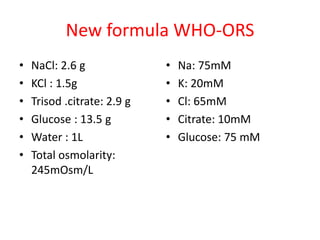
New formula WHO-ORS
• NaCl: 2.6 g
• KCl : 1.5g
• Trisod .citrate: 2.9 g
• Glucose : 13.5 g
• Water : 1L
• Total osmolarity:
245mOsm/L
• Na: 75mM
• K: 20mM
• Cl: 65mM
• Citrate: 10mM
• Glucose: 75 mM
Mechanism
• It capitalizes on the intactness of glucose
coupled Na+ absorption, even when other
mechanisms have failed or when intestinal
secretion is excessive
CONTD…
Advantages of the New ORS:
• lower osmolarity
• improves the efficacy of ORS
• reduces the need for unscheduled
intravenous infusions
• lowers stool volume
• causes less vomiting compared with
standard ORS
Contd.
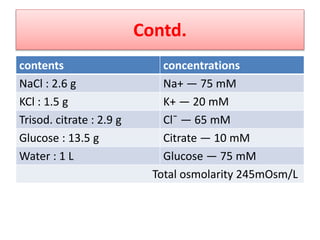
contents concentrations
NaCl : 2.6 g Na+ — 75 mM
KCl : 1.5 g K+ — 20 mM
Trisod. citrate : 2.9 g Cl¯ — 65 mM
Glucose : 13.5 g Citrate — 10 mM
Water : 1 L Glucose — 75 mM
Total osmolarity 245mOsm/L
• Non-diarrhoeal uses of ORT
(a)Postsurgical, postburn and post-trauma
maintenance of hydration and nutrition (in
place of i.v. infusion).
(b) Heat stroke.
(c) During changeover from intravenous to
enteral alimentation.
CONTD….
Administration:
• Initially 5-7% BW volume equivalent is given in
2-4hrs
• AIM: to restore and maintain hydration,
electrolyte until diarrhoea stops
Zinc in pediatric diarrhoea
• reduces severity and duration of diarrhea
 reduces stool output and frequency
 reduces need for hospitalization
• prevents subsequent episodes of diarrhea
• Treatment Dose of Elemental Zinc: (14
days)
 20 mg/kg/day children 6 month & above
 10 mg/kg/day infants below 6 month
Mechanism Of Zinc
• Reduce fluid secretion in the intestine by
indirectly inhibiting cAMP dependent Cl¯
transport across the mucosa
• Strengthen the immune response
• Help regeneration of intestinal epithelium.
Drug therapy
• 1. antimicrobials in diarrhoea.
• A) no use: non infective diarrhoea
• Rota virus
• Coelic disease
• IBS
• Thyrotoxicosis
CONTD…
 B) useful only in severe cases:
• 1) travelers diarrhoea: ETEC
• Drugs: cotrimoxazole, norfloxacin
• RIFAXIMIN: oral rifamycin
• Recently approved by US-FDA for emperic therapy of
travellers diarrhoea
• Dose: 200 mg TDS
• S/E: Flatulence, abdominal pain, headache
Contd..
 Sheigella: when blood and mucus in stool
• Drugs: cipro/norfloxacin, cotrimaxzole
 Non typhoid salmonella:
• Fluroquinolones, cotrimaxzole
 Yersinia enterocolitica
• Cotrimoxazole, Ciprofloxacin
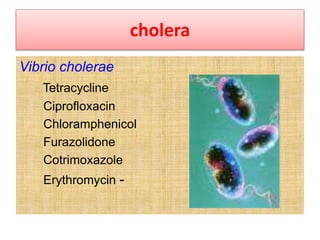
cholera
Vibrio cholerae
Tetracycline
Ciprofloxacin
Chloramphenicol
Furazolidone
Cotrimoxazole
Erythromycin -
CONTD…
 Campylobacter jejuni:
• Drugs: norfloxacin, erythromycin
 Clostridium difficle:
• Antibiotic associated pseudomembranous colitis
• DOC: metronidazole
• Amoebiasis and giardiasis: metronidazole,
diloxanide furoate
Probiotics…
• Commonly used:
• Lactobacillus sp. , bifidobacterium,
streptococcus , enterococcus, Saccharomyces
boulardii
• S/E:
• Infection
• Acidosis
• Caution in immunocompromised ptn
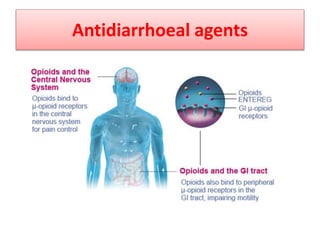
Antidiarrhoeal agents
OPOIDS(Contd…)
• M/A: stimulate mu receptor (↓ motility) and
delta receptor (↓ intestinal secretion)
Drugs:
• Loperamide: does not cross BBB, no addiction
liability
• Dose: 4mg → 2mg after each loose stool
• Action onset: 1-2 hrs
Mechanism Of Action
• Peripheral μ opioid and additional weak
anticholinergic property
• Inhibits secretion
Adverse effects
 Abdominal cramps and rashes
• Paralytic ileus and
• Toxic megacolon with abdominal distension is
a serious complication in young children
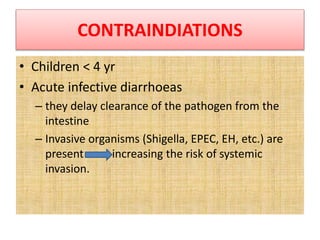
CONTRAINDIATIONS
• Children < 4 yr
• Acute infective diarrhoeas
– they delay clearance of the pathogen from the
intestine
– Invasive organisms (Shigella, EPEC, EH, etc.) are
present increasing the risk of systemic
invasion.
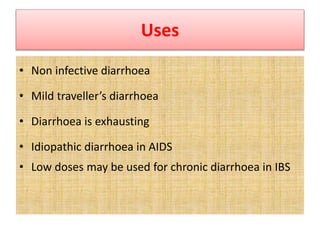
Uses
• Non infective diarrhoea
• Mild traveller’s diarrhoea
• Diarrhoea is exhausting
• Idiopathic diarrhoea in AIDS
• Low doses may be used for chronic diarrhoea in IBS
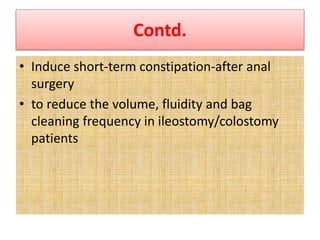
Contd.
• Induce short-term constipation-after anal
surgery
• to reduce the volume, fluidity and bag
cleaning frequency in ileostomy/colostomy
patients
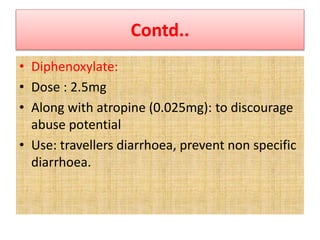
Contd..
• Diphenoxylate:
• Dose : 2.5mg
• Along with atropine (0.025mg): to discourage
abuse potential
• Use: travellers diarrhoea, prevent non specific
diarrhoea.
Contd…
• S/E:
• Abdominal discomfort
• Dry mouth
• Not to be used with patients having colilits
• Children below 2 years (paralytic ileus)
Contd…
• Racecadotril:
• M/A: enkephalinase inhibitor→ ↑ local enkephlin
conc → stimulate delta receptor in intestinal
mucosa→↓ secretion without affecting motility
• Dose: 100-300mg TDS
• Use: acute secretary diarrhoeas
• S/E: nausea
• Constipation
• Headache.
2 . anticholinergic
• M/A:
• ↓ bowel motility →↑fluid absorption
→abdominal cramps↓
• Drugs:
• Hyoscyamine
• Dicyclomine
Alpha 2 adrenergic receptor agoinst
• Clonidine (0.1mg BD, oral)
• facilitates absorption , inhibit secretion, ↑
intestinal transit time
octreotide
M/A:
• Inhibit release of 5HT, gastrin, secretin, CCK →↓
GIT motility, intestinal fluid and electrolyte
• Use: for secretory diarrhoea
• Dose: 100 microgram BD
• S/E: nausea,abdominal discomfort
• Stone formation, hypothyroidism(long term use)
adsorbents
• Kaolin and pectin:
• Hydrated Mg –Al silicate
• M/A: adsorb bacteria, enterotoxin and fluid to
↑ consistency of fluid matter.
• Bismuth subsalicylate:
• M/A: ↓ Stool frequency in acute diarrhoea
due to inhibition of PG synthesis and Cl
secretion
Drugs for irritable bowel syndrome
Introduction
• Constipation
• Diarrhoea
• Abdominal pain
• Bloating
Contd.
• Constipation predominant
• Diarrhoea predominant
Treatment
 Antidiarrhoeal drug
• Loperamide or diphenoxylate
• Fedotozine:
– Kappa antagonist
– Avoid of CNS side effect
CONTD.
Pain
 Dicyclomine or hyoscine
 Inhibit M3 receptor
 Mebeverine: reserpine analogue
 Antispasmodic and devoid of anticholenergic
side effects
Constipation
• Fiber
• Osmotic purgative :milk of magnesia
• Stool softener
Other drug
Antidepressant
 Low doses of tricyclic antidepressants
 Amitriptiline or desipramine:
 Don’t affect mood but reduce pain by act on visceral
afferent nerve fibers
 Also decrease motility:↓ stool frequency
5HT3 receptor antagonist
• Involved in visceral hyperalgesia
• Blockade ↓pain
• Alosetron is used:1 mg OD or BD
• S/E:constipation, sleep disturbances,
abdominal discomfort
– Fatal ischemic colitis has restricted its use
Tegaserod
• 5 HT4 agonist
• Use: constipation predominant IBS
• Dose:6 mg BD
• 10% bioavailability and food further reduce
• It was withdrawn: stroke and heart attack
Other drug
• Lubiprostone: chloride channel activator
• Use: constipation predominant IBS
• Dose:8 microgram BD
• S/E:nausea
• C/I:pregnancy
Contd.
Clonidine
 α2 agonist
 ↓visceral hyperalgesia
 ↑water absorption and prevent diarrhoea
 Disadvantage: Hypotension
Contd.
Buspirone
 5-HT1A partial agonist
 Anxiolytic
 Reduce gastric and colonic sensitivity
 Use as adjuvant drug
Contd.
• CCK1 antagonist like loxiglumide and dex-
loxiglumide
• 5 HT-1 agonist-sumatriptan
• Little clinical success
Alvimopan
 Inhibitors of peripheral u opioid receptor
antagonist
 Use:constipation
THANK YOU

Drugs for constipation & diarrhoea

  • 1.
    Pharmacotherapy for constipation andDiarrhoea By dr. Chintan Doshi
  • 2.
    CONSTIPATION-PATHOPHYSIOLOGY • Decreased intestinaland colonic motility and excessive fluid uptake. • It is not a disease but a symptom that may result from a broad variety of underlying causes
  • 3.
    CAUSES • Congenital. • Inadequatedietary fiber and fluid ingestion. • Ignoring defecatory urge. • Drugs and toxins. • Neurogenic, metabolic and endocrine conditions. • Structural abnormalities in the GI tract.
  • 4.
    Non pharmacological approaches •↑ in roughage in daily diet • ↑ in fluid intake • ↑ in physical activity • Not neglecting natures call • Avoidance of constipating drug • Correcting under lying pathology : vitamin B 1 deficiency, hypothyroidism, D.M
  • 5.
    PHARMACOLOGICAL TREATMENT • LAXATIVESor APERIENT: milder action , elimination of soft but formed stool. • PURGATIVE or CATHARTIC: stronger action , resulting in more watery evacuation.
  • 6.
    classification • BULK FORMING •STOOL SOFTENERS • OSMOTIC • STIMULANT
  • 7.
    Bulk forming • Dietaryfiber: Bran, Psyllium (Plantago), Ispaghula, Methylcellulose Stool softener • Docusates (DOSS), Liquid paraffin Stimulant purgatives (a) Diphenylmethanes • Phenolphthalein, Bisacodyl, Sodium picosulfate
  • 8.
    Contd. (b) Anthraquinones (Emodins) •Senna, Cascara sagrada (c) 5-HT4 agonist • Prucalopride (d) Fixed oil • Castor oil
  • 9.
    contd Osmotic purgatives • Magnesiumsalts: sulfate, hydroxide • Sodium salts: sulfate, phosphate • Sod. pot. tartrate • Lactulose
  • 10.
    LAXATIVES • INDICATION: • Totreat constipation • To avoid straining at stool in cases like hernia, CVS disease. • Before or after any anorectal surgery • In bedridden patients • Before surgical, radiological and endoscopic procedure where empty bowel is desirable
  • 11.
    BULK FORMING LAXATIVES 1. Dietary fiber: BRAN • Content: unabsorable cell wall + cellulose, lignin, gums , pectins • M/A: absorb water in intestine , swells, ↑ water content of faeces – soften it and facilitate colonic transit • Bacterial degradation in colon of pectins→ osmotically active products → water retention • Fiber ↑ bacterial growth in colon: ↑ fecal mass
  • 12.
    Advantage $ use •First line approach for simple constipation • Prevention of functional constipation • Bind bile acid and ↑ fecal excretion → degradation of cholesterol in liver ↑→ plasma LDL ↓ • ↓ recto sigmoid intraluminal pressure: relives symptom of IBS ( pain , constipation)
  • 13.
    Contd… • Side effectsand drawbacks: • Unpalatable • Effect appears in 1-3 days • Do not soften already formed stool • Flatulence • Not to be used in ptn with : gut ulceration, adhesions , stenosis- faecal impaction
  • 14.
    2.Physllium and ispaghula •Natural colloidal mucilage → absorb water to form gelatinous mass • Ispaghual (3-8g) mixed with cold water or juice • Effect: 1-3 days • Not to be swallowed dry: esophageal impaction
  • 15.
    3. methycellulose • Semisynthetic •Collodial , hydrophilic derivative • DOSE:4–6 g/day
  • 16.
    Stool softener  1.docusates (dioctyl sodium sulfosuccinate : DOSS) • M/A: anionic detergent , soften the stools by net water accumulation in the lumen • Emulsifies the colonic content :↑ water entry into feaces • Dose : 100-400 mg orally/day • Latency period: 1-3 days • Use : straining at stool to be avoided
  • 17.
    Contd… Side effects: • Bittertaste: nausea • Cramps , abdominal pain • Hepatotoxicity ( prolonged use) • Caution: ↑ absorption of liquid paraffin , should not be given together
  • 18.
    2. Liquid paraffin •M/A: pharmacologically inert • Feacal lubricant • Stool softener:↓ water absorption from stool. • Dose: 15-30ml/day • Latency: 1-3 days Disadvantages: • Unpalatable
  • 19.
    Contd… • Passes fromintestinal mucosa→ lymph→ foreign body granulomas in lymph node, spleen , liver • Lipid pneumonia • Fat soluble vitamin deficiency • Interfere with healing in anorectal region
  • 20.
    STIMULANT PURGATIVE  M/A: •Direct ↑ in motility by action on myentric plexus  Fluid accumulation in gut by following : • inhibit Na-K ATPase of villous cells- impairing electrolyte and water absorption • ++ adenyl cyclase in crypt cell- ↑ water and electrolyte secretion • ↑ PG synthesis in mucosa : ↑ secretion
  • 21.
    Contd… • ↑ structuralinjury to absorbing intestinal mucosal cells • ↑ NO synthesis : ↑ secretion and inhibit non propulsive contractions in colon
  • 22.
    disadvantages • Larger dose: excessive purgation , fluid and electrolyte imbalance • Hypokalemia • Long term use: colonic atony • C/I in pregnancy • C/I : in acute and subacute intestinal obstruction
  • 23.
    1.Diphenophthalein Bisacodyl : • M/A:activated in intestine by deacetylation • Primary site : colon → irritate mucosa, mild inflammation → secretion ↑ • Semi formed stool : 6-8hrs • Dose : 5-15 mg • S/E: abdominal cramps ,Skin rash, FDE
  • 24.
    CONTD… 2. Sodium picosulfate: •Activated in colon → stimulate peristalsis, water and electrolyte reabsorbtion • Dose : 5-10mg • Latency:6-8 hrs • S/E : colonic atony , hypokalemia
  • 25.
    2.anthraquinones(senna, cascara) • M/A:plant purgative (anthraquinone glycoside)→ reach colon →bacterial action → anthrol ( active), which act: • Locally • Absorbed into circulation , excreted in bile and act on small intestine • Active principle : myentric plexus to ↑ peristalsis and segmentation • Latency: 6-8 hrs
  • 26.
    Contd… S/E: • Skin rashes •Fixed drug eruption • Colonic atony • Mucosal pigmentation
  • 27.
    OTHER DRUGS • PRUCALOPRIDE: •M/A: selective 5 –HT4 agonist→stimulate entric neurons → release Ach → cause propulsive contraction in ileum and colon • Use: chronic constipation unresponsive to other drugs • S/E: headache , dizziness, abdominal pain • Dose: 2mg OD
  • 28.
    TEGASEROD • 5-HT4 receptoragoinst • Withdrawn : ↑ risk of edema, stroke, heart attack • Reason: affinity for 5-HT 1B/1D receptor
  • 29.
    LUBIPROSTONE • M/A : •PG analogue →stimulate Cl channel in intestinal mucosa → ↑ secretion • Use: constipation-predominant IBS
  • 30.
    Caster Oil • Oldestpurgatives • Obtained from the seeds of Ricinus communis • M/O: • Decreased intestinal absorption of water and electrolytes • Enhanced secretion
  • 31.
    Contd.  Dose: 15–25ml (adults) • 5–15 ml (children) in morning • Disadvantages: • Unpalatability • Frequent cramping • Dehydration • after-constipation • Regular use: Damage intestinal mucosa
  • 32.
    Osmotic purgative M/A :solute not absorbed in intestine→ retain water osmotically → distend bowel → ↑ peristalsis indirectly • Mg ions release CCK → motility , secretion ↑ • Mg sulfate: 5-15g , bitter in taste • Mg hydroxide ( milk magnesia): 30 ml , effect in 2-3 hrs • Na sulfate : 10-15 g
  • 33.
    drawbacks • Mg salts:C/I in renal insufficiency • Na salts: C/I in CHF • Fluid and electrolyte imbalance • Unpleasant • Watery stool and after constipation • So, not preferred for treatment of constipation. • Used before surgery or colonoscopy, food or drug poisoning, tapeworm infestation
  • 34.
    lactulose • Non absorbableand indigestible disaccharide • ↑ fecal bulk by hydrophilic action and osmotic action • Dose : 10 g BD • Latency : 1-3 days S/E: Flatulence • Cramps • nausea
  • 35.
    Diarrhoea  Definition: diarrheais too frequent , often too precipitate passage of poorly formed stools . • WHO definition – 3 or more loose or watery stools in a period of 24 hrs  Because of : • ↓ water and electrolyte absorption • ↑ secretion by intestinal mucosa • ↑ luminal osmotic load • Inflammation of mucosa and exudation into lumen
  • 36.
    management • Treatment offluid depletion , shock and acidosis • Maintenance of nutrition • Drug therapy
  • 37.
    Rehydration  1. intravenousrehydration: • Indication : • Fluid loss is severe > 10% body weight • Patient is loosing fluid>.10ml/kg/hr • Unable to take orally • DHAKA FLUID: • Nacl: 5g(85mM) • Kcl : 1g(13mM) 1L of water or 5% glucose • NaHCO: 4g(48mM)
  • 38.
    ORAL REHYDRATION THERAPY(ORT) • Indication: in mild (5-7%BW) or moderate (7-10% BW) fluid loss  Rationale of ORS composition: • 1. should be isotonic and hypotonic • 2.molar ratio of glucose should be more then sodium • 3 enough K and bicarbonate should be provided to make up the losses • Tri sodium citrate included in place of sodium bicarbonate
  • 39.
    New formula WHO-ORS •NaCl: 2.6 g • KCl : 1.5g • Trisod .citrate: 2.9 g • Glucose : 13.5 g • Water : 1L • Total osmolarity: 245mOsm/L • Na: 75mM • K: 20mM • Cl: 65mM • Citrate: 10mM • Glucose: 75 mM
  • 40.
    Mechanism • It capitalizeson the intactness of glucose coupled Na+ absorption, even when other mechanisms have failed or when intestinal secretion is excessive
  • 41.
    CONTD… Advantages of theNew ORS: • lower osmolarity • improves the efficacy of ORS • reduces the need for unscheduled intravenous infusions • lowers stool volume • causes less vomiting compared with standard ORS
  • 42.
    Contd. contents concentrations NaCl :2.6 g Na+ — 75 mM KCl : 1.5 g K+ — 20 mM Trisod. citrate : 2.9 g Cl¯ — 65 mM Glucose : 13.5 g Citrate — 10 mM Water : 1 L Glucose — 75 mM Total osmolarity 245mOsm/L
  • 43.
    • Non-diarrhoeal usesof ORT (a)Postsurgical, postburn and post-trauma maintenance of hydration and nutrition (in place of i.v. infusion). (b) Heat stroke. (c) During changeover from intravenous to enteral alimentation.
  • 44.
    CONTD…. Administration: • Initially 5-7%BW volume equivalent is given in 2-4hrs • AIM: to restore and maintain hydration, electrolyte until diarrhoea stops
  • 45.
    Zinc in pediatricdiarrhoea • reduces severity and duration of diarrhea  reduces stool output and frequency  reduces need for hospitalization • prevents subsequent episodes of diarrhea • Treatment Dose of Elemental Zinc: (14 days)  20 mg/kg/day children 6 month & above  10 mg/kg/day infants below 6 month
  • 46.
    Mechanism Of Zinc •Reduce fluid secretion in the intestine by indirectly inhibiting cAMP dependent Cl¯ transport across the mucosa • Strengthen the immune response • Help regeneration of intestinal epithelium.
  • 47.
    Drug therapy • 1.antimicrobials in diarrhoea. • A) no use: non infective diarrhoea • Rota virus • Coelic disease • IBS • Thyrotoxicosis
  • 48.
    CONTD…  B) usefulonly in severe cases: • 1) travelers diarrhoea: ETEC • Drugs: cotrimoxazole, norfloxacin • RIFAXIMIN: oral rifamycin • Recently approved by US-FDA for emperic therapy of travellers diarrhoea • Dose: 200 mg TDS • S/E: Flatulence, abdominal pain, headache
  • 49.
    Contd..  Sheigella: whenblood and mucus in stool • Drugs: cipro/norfloxacin, cotrimaxzole  Non typhoid salmonella: • Fluroquinolones, cotrimaxzole  Yersinia enterocolitica • Cotrimoxazole, Ciprofloxacin
  • 50.
  • 51.
    CONTD…  Campylobacter jejuni: •Drugs: norfloxacin, erythromycin  Clostridium difficle: • Antibiotic associated pseudomembranous colitis • DOC: metronidazole • Amoebiasis and giardiasis: metronidazole, diloxanide furoate
  • 52.
    Probiotics… • Commonly used: •Lactobacillus sp. , bifidobacterium, streptococcus , enterococcus, Saccharomyces boulardii • S/E: • Infection • Acidosis • Caution in immunocompromised ptn
  • 53.
  • 54.
    OPOIDS(Contd…) • M/A: stimulatemu receptor (↓ motility) and delta receptor (↓ intestinal secretion) Drugs: • Loperamide: does not cross BBB, no addiction liability • Dose: 4mg → 2mg after each loose stool • Action onset: 1-2 hrs
  • 55.
    Mechanism Of Action •Peripheral μ opioid and additional weak anticholinergic property • Inhibits secretion Adverse effects  Abdominal cramps and rashes • Paralytic ileus and • Toxic megacolon with abdominal distension is a serious complication in young children
  • 56.
    CONTRAINDIATIONS • Children <4 yr • Acute infective diarrhoeas – they delay clearance of the pathogen from the intestine – Invasive organisms (Shigella, EPEC, EH, etc.) are present increasing the risk of systemic invasion.
  • 57.
    Uses • Non infectivediarrhoea • Mild traveller’s diarrhoea • Diarrhoea is exhausting • Idiopathic diarrhoea in AIDS • Low doses may be used for chronic diarrhoea in IBS
  • 58.
    Contd. • Induce short-termconstipation-after anal surgery • to reduce the volume, fluidity and bag cleaning frequency in ileostomy/colostomy patients
  • 59.
    Contd.. • Diphenoxylate: • Dose: 2.5mg • Along with atropine (0.025mg): to discourage abuse potential • Use: travellers diarrhoea, prevent non specific diarrhoea.
  • 60.
    Contd… • S/E: • Abdominaldiscomfort • Dry mouth • Not to be used with patients having colilits • Children below 2 years (paralytic ileus)
  • 61.
    Contd… • Racecadotril: • M/A:enkephalinase inhibitor→ ↑ local enkephlin conc → stimulate delta receptor in intestinal mucosa→↓ secretion without affecting motility • Dose: 100-300mg TDS • Use: acute secretary diarrhoeas • S/E: nausea • Constipation • Headache.
  • 62.
    2 . anticholinergic •M/A: • ↓ bowel motility →↑fluid absorption →abdominal cramps↓ • Drugs: • Hyoscyamine • Dicyclomine
  • 63.
    Alpha 2 adrenergicreceptor agoinst • Clonidine (0.1mg BD, oral) • facilitates absorption , inhibit secretion, ↑ intestinal transit time
  • 64.
    octreotide M/A: • Inhibit releaseof 5HT, gastrin, secretin, CCK →↓ GIT motility, intestinal fluid and electrolyte • Use: for secretory diarrhoea • Dose: 100 microgram BD • S/E: nausea,abdominal discomfort • Stone formation, hypothyroidism(long term use)
  • 65.
    adsorbents • Kaolin andpectin: • Hydrated Mg –Al silicate • M/A: adsorb bacteria, enterotoxin and fluid to ↑ consistency of fluid matter. • Bismuth subsalicylate: • M/A: ↓ Stool frequency in acute diarrhoea due to inhibition of PG synthesis and Cl secretion
  • 66.
    Drugs for irritablebowel syndrome Introduction • Constipation • Diarrhoea • Abdominal pain • Bloating
  • 67.
  • 68.
    Treatment  Antidiarrhoeal drug •Loperamide or diphenoxylate • Fedotozine: – Kappa antagonist – Avoid of CNS side effect
  • 69.
    CONTD. Pain  Dicyclomine orhyoscine  Inhibit M3 receptor  Mebeverine: reserpine analogue  Antispasmodic and devoid of anticholenergic side effects
  • 70.
    Constipation • Fiber • Osmoticpurgative :milk of magnesia • Stool softener
  • 71.
    Other drug Antidepressant  Lowdoses of tricyclic antidepressants  Amitriptiline or desipramine:  Don’t affect mood but reduce pain by act on visceral afferent nerve fibers  Also decrease motility:↓ stool frequency
  • 72.
    5HT3 receptor antagonist •Involved in visceral hyperalgesia • Blockade ↓pain • Alosetron is used:1 mg OD or BD • S/E:constipation, sleep disturbances, abdominal discomfort – Fatal ischemic colitis has restricted its use
  • 73.
    Tegaserod • 5 HT4agonist • Use: constipation predominant IBS • Dose:6 mg BD • 10% bioavailability and food further reduce • It was withdrawn: stroke and heart attack
  • 74.
    Other drug • Lubiprostone:chloride channel activator • Use: constipation predominant IBS • Dose:8 microgram BD • S/E:nausea • C/I:pregnancy
  • 75.
    Contd. Clonidine  α2 agonist ↓visceral hyperalgesia  ↑water absorption and prevent diarrhoea  Disadvantage: Hypotension
  • 76.
    Contd. Buspirone  5-HT1A partialagonist  Anxiolytic  Reduce gastric and colonic sensitivity  Use as adjuvant drug
  • 77.
    Contd. • CCK1 antagonistlike loxiglumide and dex- loxiglumide • 5 HT-1 agonist-sumatriptan • Little clinical success Alvimopan  Inhibitors of peripheral u opioid receptor antagonist  Use:constipation
  • 78.

Editor's Notes

  • #73 Ondansetron is not used