Mr. Vishal Balakrushna Jadhav
Assistant Professor (Pharmacology)
School of Pharmaceutical Sciences, Sandip University, Nashik
1
 Anti-rheumatoid drugs
 Classification of anti-rheumatoid drugs
 Pharmacology of disease modifying antirheumatic drugs (DMARDs)
 Pharmacology of adjuvant drugs
2
Drugs (except corticosteroids) which suppress the rheumatoid
process, bring about a remission and retard disease progression,
but do not have nonspecific antiinflammatory or analgesic action.
Used in rheumatoid arthritis (RA) in addition to NSAIDs and are also
referred to as disease modifying antirheumatic drugs (DMARDs)
or slow acting antirheumatic drugs (SAARDs).
The onset of benefit with DMARDs takes a few months of regular
treatment and relapse occur a few months after cessation of
therapy.
Recently, some biological agents (antibodies and other proteins)
have been added for resistant cases.
3
4
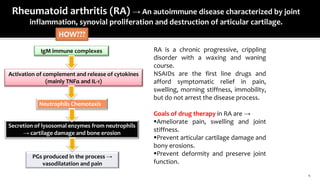
Rheumatoid arthritis (RA) → An autoimmune disease characterized by joint
inflammation, synovial proliferation and destruction of articular cartilage.
IgM immune complexes
HOW???
Activation of complement and release of cytokines
(mainly TNFα and IL-1)
Neutrophils Chemotaxis
Secretion of lysosomal enzymes from neutrophils
→ cartilage damage and bone erosion
PGs produced in the process →
vasodilatation and pain
RA is a chronic progressive, crippling
disorder with a waxing and waning
course.
NSAIDs are the first line drugs and
afford symptomatic relief in pain,
swelling, morning stiffness, immobility,
but do not arrest the disease process.
Goals of drug therapy in RA are →
Ameliorate pain, swelling and joint
stiffness.
Prevent articular cartilage damage and
bony erosions.
Prevent deformity and preserve joint
function.
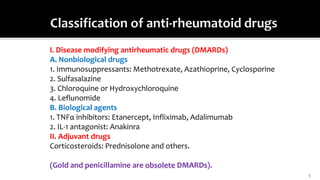
I. Disease modifying antirheumatic drugs (DMARDs)
A. Nonbiological drugs
1. Immunosuppressants: Methotrexate, Azathioprine, Cyclosporine
2. Sulfasalazine
3. Chloroquine or Hydroxychloroquine
4. Leflunomide
B. Biological agents
1. TNFα inhibitors: Etanercept, Infliximab, Adalimumab
2. IL-1 antagonist: Anakinra
II. Adjuvant drugs
Corticosteroids: Prednisolone and others.
(Gold and penicillamine are obsolete DMARDs).
5
1. Immunosuppressants: Methotrexate, Azathioprine, Cyclosporine
6
Methotrexate (Mtx)
Dihydrofolate reductase inhibitor, immunosuppressant and antiinflammatory.
Inhibition of cytokine production, chemotaxis and cell-mediated immune reaction →
afford benefits in RA.
Administration of oral low-dose (7.5–15 mg) weekly Mtx regimen → improvement of
RA patients acceptability.
Relatively rapid (4–6 weeks) onset of symptom relief → preferred for initial
treatment.
Mtx is now the DMARD of first choice for most patients of RA including cases of
juvenile RA.
Response is more predictable and sustained over long-term.
Combination regimens of 2 or 3 DMARDs include Mtx.
Pharmacokinetics Oral bioavailability of Mtx is variable and may be affected by food.
Its excretion is delayed in renal disease: not recommended for such patients.
Interaction Probenecid and aspirin increase Mtx levels and toxicity.
Combination of trimethoprim + Mtx → additive inhibition of dihydrofolate reductase →
bone marrow depression.
Adverse effects Oral ulceration and g.i. upset are the major side effects of low dose Mtx
regimen. With prolonged therapy, dose dependent progressive liver damage leading
to cirrhosis occurs in some patients (this is not seen with short courses used in
cancer). Incidence of chest infection is increased.
Contraindication Pregnancy, breast-feeding, liver disease, active infection, leucopenia
and peptic ulcer.
Marketed preparations NEOTREXATE, BIOTREXATE 2.5 mg tab.
7
Azathioprine
Purine synthase inhibitor acts after getting converted to 6-mercaptopurine by the
enzyme thiopurine methyl transferase (TPMT).
A potent suppressant of cell-mediated immunity → selectively affect differentiation and
function of T-cells and natural killer cells.
Suppresses inflammation.
Remission is induced in smaller percentage of RA patients → hence less commonly used.
Given along with corticosteroids → a steroid sparing effect, for which it is primarily used
now, especially in cases with systemic manifestations.
Not combined with Mtx.
Dose 50–150 mg/day; IMURAN 50 mg tab.
Marketed preparations IMURAN 50 mg tab.
8
Other immunosuppresants like cyclosporine,
chlorambucil, cyclophosphamide are rarely used
in RA; are reserved for cases not responding to
other DMARDs.
2. Sulfasalazine
9
A compound of sulfapyridine and 5-amino salicylic acid (5-ASA) → exerts antiinflammatory
activity in the bowel and is useful in ulcerative colitis.
Suppresses the disease in significant number of RA patients → mechanism of action is not
known.
Sulfapyridine split off in the colon by bacterial action and absorbed systemically as an active
moiety (contrast ulcerative colitis, in which 5-ASA acting locally in the colon as an active
component).
Generation of superoxide radicals and cytokine secretion by inflammatory cells may be
suppressed.
Efficacy of sulfasalazine in RA is modest and side effects may be unpleasant→
neutropenia/thrombocytopenia occurs in about 10% patients and hepatitis is possible.
It is used as a second line drug for milder cases or is combined with Mtx.
Dose 1–3 g/day in 2–3 divided doses.
Marketed preparations SALAZOPYRIN, SAZO-EN 0.5 g tab.
3. Chloroquine or Hydroxychloroquine
10
Antimalarial drugs found to induce remission in upto 50% patients of RA, but take 3–6 months.
Advantage → relatively low toxicity, but efficacy is also low; bony erosions are not prevented.
Mechanism of action is not known, however, reduce monocyte IL–I, consequently inhibiting B
lymphocytes. Antigen processing may be interfered. Lysosomal stabilization and free radical
scavenging are the other proposed mechanisms.
Adverse effects For RA, these drugs have to be given for long periods → accumulate in tissues
(especially melanin containing tissue) and produce toxicity, most disturbing of which is retinal
damage and corneal opacity. This is less common and reversible in case of hydroxychloroquine,
which is preferred over chloroquine. Other adverse effects are rashes, graying of hair, irritable
bowel syndrome, myopathy and neuropathy.
Use Chloroquine/hydroxychloroquine are employed in milder non-erosive disease, especially
when only one or a few joints are involved, or they are combined with Mtx/sulfasalazine.
Dose Chloroquine 150 mg (base) per day. Hydroxychloroquine 400 mg/day for 4–6 weeks,
followed by 200 mg/day for maintenance.
Marketed preparations ZHQUINE, ZYQ 200 mg tab.
4. Leflunomide
11
An immunomodulator inhibits proliferation of stimulated lymphocytes in patients with active
RA → suppresses arthritic symptoms and retards radiological progression of disease.
In clinical trials its efficacy has been rated comparable to Mtx and onset of benefit is as fast
(4 weeks).
Rapidly converted in the body to an active metabolite teriflunomide which inhibits
dihydroorotate dehydrogenase and pyrimidine synthesis in actively dividing cells.
Antibody production by B-cells may be depressed.
The active metabolite has a long t½ of 2–3 weeks; leflunomide, therefore, is given in a loading
dose of 100 mg daily for 3 days followed by 20 mg OD.
Adverse effects Diarrhoea, headache, nausea, rashes, loss of hair, thrombocytopenia,
leucopenia, increased chances of chest infection and raised hepatic transaminases.
It is not to be used in children and pregnant/ lactating women.
Leflunomide is an alternative to Mtx or can be added to it, but the combination is more
hepatotoxic. Combination with sulfasalazine improves benefit.
Marketed preparations LEFRA 10 mg, 20 mg tabs.
12
.
Gold
Injected i.m. as gold sodium thiomalate, gold is the oldest drug capable of
arresting progression of RA. Because of high toxicity (hypertension,
dermatitis, stomatitis, kidney/ liver/bone marrow damage) it has gone out
of use.
Auranofin
The orally active gold compound is less effective and less toxic (causes
diarrhoea, abdominal cramps etc.), but has been replaced now by better
drugs.
d-Penicillamine
It is a copper chelating agent with a gold like action in RA. Toxicity is also
similar and it is no longer used in this disease.
13
.
Recently, several recombinant proteins/monoclonal antibodies that
bind and inhibit cytokines, especially TNFα or IL-1 have been
produced and found to afford substantial benefit in autoimmune
diseases like RA, inflammatory bowel diseases, psoriasis,
scleroderma, etc.
All of them produce prominent adverse effects, are expensive, and
are used only as reserve drugs for severe refractory disease.
1. TNFα inhibitors: Etanercept, Infliximab, Adalimumab
14
TNFα plays a key role in the inflammatory cascade of RA by activating membrane
bound receptors (TNFR1 and TNFR2) on the surface of T-cells, macrophages, etc.
Exogenously administered soluble TNF-receptor protein or antibody can neutralize it
and interrupt there action.
TNF inhibitors mainly suppress macrophage and T-cell function → inflammatory
changes in the joint revert and new erosions are slowed.
Quicker response than nonbiologic DMARDs has been obtained.
Though effective as monotherapy, they are generally added to Mtx when response to
the Mtx is not adequate or in rapidly progressing cases.
Susceptibility to infections, including tuberculosis and pneumocystis pneumonia is
increased.
15
.
Etanercept
A recombinant fusion protein of TNF-receptor and Fc portion of human IgG1.
Administered by s.c. injection 50 mg weekly.
Pain, redness, itching and swelling occur at injection site and chest infections may
be increased, but immunogenicity is not a clinical problem.
Dose 25–50 mg s.c. once or twice weekly;
Marketed preparations ENBREL, ENBROL 25 mg in 0.5 ml, 50 mg in 1 ml inj.
Infliximab
A chimeral monoclonal antibody which binds and neutralizes TNFα.
3–5 mg/kg is infused i.v. every 4–8 weeks.
An acute reaction comprising of fever, chills, urticaria, bronchospasm, rarely
anaphylaxis may follow the infusion. Susceptibility to respiratory infections is
increased and worsening of CHF has been noted.
It is usually combined with Mtx which improves the response and decreases
antibody formation against infliximab.
16
.
Adalimumab
A recombinant monoclonal anti-TNF antibody administered s.c. 40 mg every 2
weeks.
Injection site reaction and respiratory infections are the common adverse effects.
Combination with Mtx is advised to improve the response and decrease antibody
formation.
2. IL-1 antagonist: Anakinra
17
Anakinra
A recombinant human IL-1 receptor antagonist.
Clinically less effective than TNF inhibitors → used in cases who have failed on one or
more DMARDs.
Dose 100 mg s.c. daily.
Adverse effects Local reaction and chest infections.
Abatacept which inhibits T-cell activation, and Rituximab a monoclonal antibody
that destroys and depletes B-cells, are other newer biologicals being used in
refractory RA.
18
Glucocorticoids have potent immunosuppressant and antiinflammatory activity →
can be introduced almost at any stage in RA along with first or second line drugs, if
potent antiinflammatory action is required while continuing the NSAID ± DMARD.
Symptomatic relief is prompt and marked but no arrest of rheumatoid process → joint
destruction may be slowed and bony erosions delayed.
Long-term use of corticosteroids carries serious disadvantages. Therefore either-
low doses (5–10 mg prednisolone or equivalent) are used to supplement NSAIDs
(once used in this manner, it is difficult to withdraw the steroid → exacerbation is
mostly precipitated and the patient becomes steroid dependent), or
high doses are employed over short periods in cases with severe systemic
manifestations (organ-threatening disease, vasculitis) while the patient awaits
response from a remission inducing drug.
In cases with single or a few joint involvement with severe symptoms, intraarticular
injection of a soluble glucocorticoid affords relief for several weeks; joint damage may
be slowed. This procedure should not be repeated before 4–6 months.
19

g. Antirheumatic drugs.pdf

  • 1.
    Mr. Vishal BalakrushnaJadhav Assistant Professor (Pharmacology) School of Pharmaceutical Sciences, Sandip University, Nashik 1
  • 2.
     Anti-rheumatoid drugs Classification of anti-rheumatoid drugs  Pharmacology of disease modifying antirheumatic drugs (DMARDs)  Pharmacology of adjuvant drugs 2
  • 3.
    Drugs (except corticosteroids)which suppress the rheumatoid process, bring about a remission and retard disease progression, but do not have nonspecific antiinflammatory or analgesic action. Used in rheumatoid arthritis (RA) in addition to NSAIDs and are also referred to as disease modifying antirheumatic drugs (DMARDs) or slow acting antirheumatic drugs (SAARDs). The onset of benefit with DMARDs takes a few months of regular treatment and relapse occur a few months after cessation of therapy. Recently, some biological agents (antibodies and other proteins) have been added for resistant cases. 3
  • 4.
    4 Rheumatoid arthritis (RA)→ An autoimmune disease characterized by joint inflammation, synovial proliferation and destruction of articular cartilage. IgM immune complexes HOW??? Activation of complement and release of cytokines (mainly TNFα and IL-1) Neutrophils Chemotaxis Secretion of lysosomal enzymes from neutrophils → cartilage damage and bone erosion PGs produced in the process → vasodilatation and pain RA is a chronic progressive, crippling disorder with a waxing and waning course. NSAIDs are the first line drugs and afford symptomatic relief in pain, swelling, morning stiffness, immobility, but do not arrest the disease process. Goals of drug therapy in RA are → Ameliorate pain, swelling and joint stiffness. Prevent articular cartilage damage and bony erosions. Prevent deformity and preserve joint function.
  • 5.
    I. Disease modifyingantirheumatic drugs (DMARDs) A. Nonbiological drugs 1. Immunosuppressants: Methotrexate, Azathioprine, Cyclosporine 2. Sulfasalazine 3. Chloroquine or Hydroxychloroquine 4. Leflunomide B. Biological agents 1. TNFα inhibitors: Etanercept, Infliximab, Adalimumab 2. IL-1 antagonist: Anakinra II. Adjuvant drugs Corticosteroids: Prednisolone and others. (Gold and penicillamine are obsolete DMARDs). 5
  • 6.
    1. Immunosuppressants: Methotrexate,Azathioprine, Cyclosporine 6 Methotrexate (Mtx) Dihydrofolate reductase inhibitor, immunosuppressant and antiinflammatory. Inhibition of cytokine production, chemotaxis and cell-mediated immune reaction → afford benefits in RA. Administration of oral low-dose (7.5–15 mg) weekly Mtx regimen → improvement of RA patients acceptability. Relatively rapid (4–6 weeks) onset of symptom relief → preferred for initial treatment. Mtx is now the DMARD of first choice for most patients of RA including cases of juvenile RA. Response is more predictable and sustained over long-term. Combination regimens of 2 or 3 DMARDs include Mtx.
  • 7.
    Pharmacokinetics Oral bioavailabilityof Mtx is variable and may be affected by food. Its excretion is delayed in renal disease: not recommended for such patients. Interaction Probenecid and aspirin increase Mtx levels and toxicity. Combination of trimethoprim + Mtx → additive inhibition of dihydrofolate reductase → bone marrow depression. Adverse effects Oral ulceration and g.i. upset are the major side effects of low dose Mtx regimen. With prolonged therapy, dose dependent progressive liver damage leading to cirrhosis occurs in some patients (this is not seen with short courses used in cancer). Incidence of chest infection is increased. Contraindication Pregnancy, breast-feeding, liver disease, active infection, leucopenia and peptic ulcer. Marketed preparations NEOTREXATE, BIOTREXATE 2.5 mg tab. 7
  • 8.
    Azathioprine Purine synthase inhibitoracts after getting converted to 6-mercaptopurine by the enzyme thiopurine methyl transferase (TPMT). A potent suppressant of cell-mediated immunity → selectively affect differentiation and function of T-cells and natural killer cells. Suppresses inflammation. Remission is induced in smaller percentage of RA patients → hence less commonly used. Given along with corticosteroids → a steroid sparing effect, for which it is primarily used now, especially in cases with systemic manifestations. Not combined with Mtx. Dose 50–150 mg/day; IMURAN 50 mg tab. Marketed preparations IMURAN 50 mg tab. 8 Other immunosuppresants like cyclosporine, chlorambucil, cyclophosphamide are rarely used in RA; are reserved for cases not responding to other DMARDs.
  • 9.
    2. Sulfasalazine 9 A compoundof sulfapyridine and 5-amino salicylic acid (5-ASA) → exerts antiinflammatory activity in the bowel and is useful in ulcerative colitis. Suppresses the disease in significant number of RA patients → mechanism of action is not known. Sulfapyridine split off in the colon by bacterial action and absorbed systemically as an active moiety (contrast ulcerative colitis, in which 5-ASA acting locally in the colon as an active component). Generation of superoxide radicals and cytokine secretion by inflammatory cells may be suppressed. Efficacy of sulfasalazine in RA is modest and side effects may be unpleasant→ neutropenia/thrombocytopenia occurs in about 10% patients and hepatitis is possible. It is used as a second line drug for milder cases or is combined with Mtx. Dose 1–3 g/day in 2–3 divided doses. Marketed preparations SALAZOPYRIN, SAZO-EN 0.5 g tab.
  • 10.
    3. Chloroquine orHydroxychloroquine 10 Antimalarial drugs found to induce remission in upto 50% patients of RA, but take 3–6 months. Advantage → relatively low toxicity, but efficacy is also low; bony erosions are not prevented. Mechanism of action is not known, however, reduce monocyte IL–I, consequently inhibiting B lymphocytes. Antigen processing may be interfered. Lysosomal stabilization and free radical scavenging are the other proposed mechanisms. Adverse effects For RA, these drugs have to be given for long periods → accumulate in tissues (especially melanin containing tissue) and produce toxicity, most disturbing of which is retinal damage and corneal opacity. This is less common and reversible in case of hydroxychloroquine, which is preferred over chloroquine. Other adverse effects are rashes, graying of hair, irritable bowel syndrome, myopathy and neuropathy. Use Chloroquine/hydroxychloroquine are employed in milder non-erosive disease, especially when only one or a few joints are involved, or they are combined with Mtx/sulfasalazine. Dose Chloroquine 150 mg (base) per day. Hydroxychloroquine 400 mg/day for 4–6 weeks, followed by 200 mg/day for maintenance. Marketed preparations ZHQUINE, ZYQ 200 mg tab.
  • 11.
    4. Leflunomide 11 An immunomodulatorinhibits proliferation of stimulated lymphocytes in patients with active RA → suppresses arthritic symptoms and retards radiological progression of disease. In clinical trials its efficacy has been rated comparable to Mtx and onset of benefit is as fast (4 weeks). Rapidly converted in the body to an active metabolite teriflunomide which inhibits dihydroorotate dehydrogenase and pyrimidine synthesis in actively dividing cells. Antibody production by B-cells may be depressed. The active metabolite has a long t½ of 2–3 weeks; leflunomide, therefore, is given in a loading dose of 100 mg daily for 3 days followed by 20 mg OD. Adverse effects Diarrhoea, headache, nausea, rashes, loss of hair, thrombocytopenia, leucopenia, increased chances of chest infection and raised hepatic transaminases. It is not to be used in children and pregnant/ lactating women. Leflunomide is an alternative to Mtx or can be added to it, but the combination is more hepatotoxic. Combination with sulfasalazine improves benefit. Marketed preparations LEFRA 10 mg, 20 mg tabs.
  • 12.
    12 . Gold Injected i.m. asgold sodium thiomalate, gold is the oldest drug capable of arresting progression of RA. Because of high toxicity (hypertension, dermatitis, stomatitis, kidney/ liver/bone marrow damage) it has gone out of use. Auranofin The orally active gold compound is less effective and less toxic (causes diarrhoea, abdominal cramps etc.), but has been replaced now by better drugs. d-Penicillamine It is a copper chelating agent with a gold like action in RA. Toxicity is also similar and it is no longer used in this disease.
  • 13.
    13 . Recently, several recombinantproteins/monoclonal antibodies that bind and inhibit cytokines, especially TNFα or IL-1 have been produced and found to afford substantial benefit in autoimmune diseases like RA, inflammatory bowel diseases, psoriasis, scleroderma, etc. All of them produce prominent adverse effects, are expensive, and are used only as reserve drugs for severe refractory disease.
  • 14.
    1. TNFα inhibitors:Etanercept, Infliximab, Adalimumab 14 TNFα plays a key role in the inflammatory cascade of RA by activating membrane bound receptors (TNFR1 and TNFR2) on the surface of T-cells, macrophages, etc. Exogenously administered soluble TNF-receptor protein or antibody can neutralize it and interrupt there action. TNF inhibitors mainly suppress macrophage and T-cell function → inflammatory changes in the joint revert and new erosions are slowed. Quicker response than nonbiologic DMARDs has been obtained. Though effective as monotherapy, they are generally added to Mtx when response to the Mtx is not adequate or in rapidly progressing cases. Susceptibility to infections, including tuberculosis and pneumocystis pneumonia is increased.
  • 15.
    15 . Etanercept A recombinant fusionprotein of TNF-receptor and Fc portion of human IgG1. Administered by s.c. injection 50 mg weekly. Pain, redness, itching and swelling occur at injection site and chest infections may be increased, but immunogenicity is not a clinical problem. Dose 25–50 mg s.c. once or twice weekly; Marketed preparations ENBREL, ENBROL 25 mg in 0.5 ml, 50 mg in 1 ml inj. Infliximab A chimeral monoclonal antibody which binds and neutralizes TNFα. 3–5 mg/kg is infused i.v. every 4–8 weeks. An acute reaction comprising of fever, chills, urticaria, bronchospasm, rarely anaphylaxis may follow the infusion. Susceptibility to respiratory infections is increased and worsening of CHF has been noted. It is usually combined with Mtx which improves the response and decreases antibody formation against infliximab.
  • 16.
    16 . Adalimumab A recombinant monoclonalanti-TNF antibody administered s.c. 40 mg every 2 weeks. Injection site reaction and respiratory infections are the common adverse effects. Combination with Mtx is advised to improve the response and decrease antibody formation.
  • 17.
    2. IL-1 antagonist:Anakinra 17 Anakinra A recombinant human IL-1 receptor antagonist. Clinically less effective than TNF inhibitors → used in cases who have failed on one or more DMARDs. Dose 100 mg s.c. daily. Adverse effects Local reaction and chest infections. Abatacept which inhibits T-cell activation, and Rituximab a monoclonal antibody that destroys and depletes B-cells, are other newer biologicals being used in refractory RA.
  • 18.
    18 Glucocorticoids have potentimmunosuppressant and antiinflammatory activity → can be introduced almost at any stage in RA along with first or second line drugs, if potent antiinflammatory action is required while continuing the NSAID ± DMARD. Symptomatic relief is prompt and marked but no arrest of rheumatoid process → joint destruction may be slowed and bony erosions delayed. Long-term use of corticosteroids carries serious disadvantages. Therefore either- low doses (5–10 mg prednisolone or equivalent) are used to supplement NSAIDs (once used in this manner, it is difficult to withdraw the steroid → exacerbation is mostly precipitated and the patient becomes steroid dependent), or high doses are employed over short periods in cases with severe systemic manifestations (organ-threatening disease, vasculitis) while the patient awaits response from a remission inducing drug. In cases with single or a few joint involvement with severe symptoms, intraarticular injection of a soluble glucocorticoid affords relief for several weeks; joint damage may be slowed. This procedure should not be repeated before 4–6 months.
  • 19.