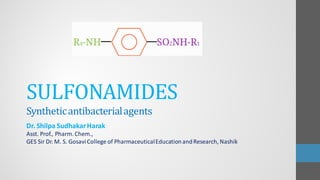
SULFONAMIDES
Syntheticantibacterialagents
Dr. Shilpa SudhakarHarak
Asst. Prof., Pharm. Chem.,
GES Sir Dr. M. S. GosaviCollege of PharmaceuticalEducationandResearch, Nashik
SulfonamidesIntroduction
• The first effective chemotherapeutic agents for systemiccure of bacterial
infections in humans.
• This decreased the morbidity and mortality of infectious diseases.
• Utility decreased due to :
 widespread resistance &
 Increased use of the broader-spectrum penicillins.
SulfonamidesIntroduction
• Sulfonamides are synthetic compounds that have activity against both gram-
positive and gram- negative bacteria.
• Now occupy a small place in the list of therapeutic agents for infectious
disease.
• However, developmentof a combination of trimethoprim and
sulfamethoxazole and its utility in treatment & prophylaxis opportunistic
microbial infections led to resurgence in the use of some sulfonamides.
History
• The discovery of sulfonamides is a significant milestone event in
the human chemotherapeutic history.
• Originally, sulfonamides were synthesized in Germany as azodyes.
• Sulfonamide azo dyes were tested because they were readily
synthesized and possessed superior staining properties.
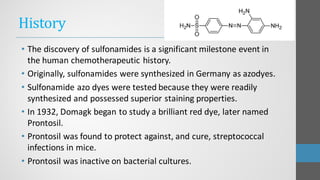
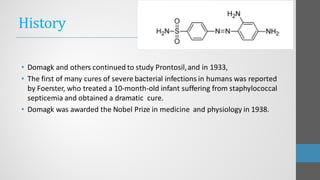
• In 1932, Domagk began to study a brilliant red dye, later named
Prontosil.
• Prontosil was found to protect against, and cure, streptococcal
infections in mice.
• Prontosil was inactive on bacterial cultures.
History
• Domagk and others continued to study Prontosil,and in 1933,
• The first of many cures of severe bacterial infections in humans was reported
by Foerster, who treated a 10-month-old infant suffering from staphylococcal
septicemia and obtained a dramatic cure.
• Domagk was awarded the Nobel Prize in medicine and physiology in 1938.
History
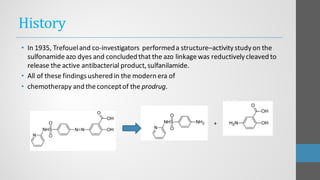
• In 1935, Trefoueland co-investigators performeda structure–activity study on the
sulfonamideazo dyes and concluded that the azo linkagewas reductively cleaved to
release the active antibacterial product,sulfanilamide.
• All of these findingsushered in the modern era of
• chemotherapy and theconceptof the prodrug.
+
Nomenclatureof the Sulfonamides
Chemistry
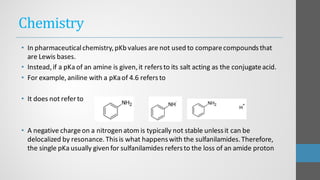
• In pharmaceuticalchemistry,pKb values are not used to comparecompoundsthat
are Lewis bases.
• Instead,if a pKa of an amine is given,it refersto its salt acting as the conjugateacid.
• For example,aniline with a pKaof 4.6 refersto
• It does not refer to
• A negative chargeon a nitrogen atom is typically not stable unlessit can be
delocalized by resonance.Thisis what happenswith the sulfanilamides.Therefore,
the single pKa usually given for sulfanilamides refersto the loss of an amide proton
Nomenclatureof the Sulfonamides
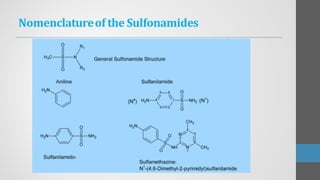
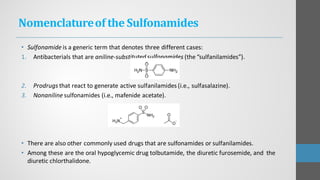
• Sulfonamide is a generic term that denotes three different cases:
1. Antibacterials that are aniline-substituted sulfonamides (the “sulfanilamides”).
2. Prodrugs that react to generate active sulfanilamides (i.e., sulfasalazine).
3. Nonaniline sulfonamides (i.e., mafenide acetate).
• There are also other commonly used drugs that are sulfonamides or sulfanilamides.
• Among these are the oral hypoglycemic drug tolbutamide, the diuretic furosemide, and the
diuretic chlorthalidone.
Ionizationof Sulfonamides
• The sulfonamidegroup,SO2NH2,tends to gain stability if it loses a proton, because
the resultingnegative chargeis resonancestabilized.
• Since the proton-donatingformof the functionalgroup is not charged,we can
characterizeit as an HA acid, along with carboxyl groups,phenols,and thiols.
• The loss of a proton can be associated with a pKafor all of the compoundsin the
series.
• For example,the pKaof sulfisoxazole (pKa 5.0) indicatesthat the sulfonamideis a
slightly weaker acid than acetic acid (pKa 4.8).
SulfonamideClassification
Sulfonamides is a bacteriostatic antibiotics which on duration of action can be
classified as:
• Short acting (4-8 h): Sulfadiazine
• Intermediate acting (8-12 h): Sulfamethoxazole
• Long acting ( ~ 7 days): Sulfadoxine, Sulfamethopyrazine
• Special purpose sulfonamides: Sulfacetamide sodium, Mafenide, Silver
sulfadiazine, Sulfasalazine
SulfonamideClassification
The sulfonamidescan be grouped into threeclasses on the basis of their use:
• oral absorbableagents,designed to give systemicdistribution;
• oral nonabsorbable agents such as sulfasalazine; and
• topical agents such as sodiumsulfacetamideophthalmicdrops.
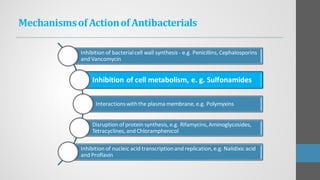
MechanismsofActionofAntibacterials
Inhibition of bacterialcell wall synthesis - e.g. Penicillins,Cephalosporins
and Vancomycin
Inhibition of cell metabolism, e. g. Sulfonamides
Interactionswiththe plasma membrane, e.g. Polymyxins
Disruption of protein synthesis,e.g. Rifamycins,Aminoglycosides,
Tetracyclines,and Chloramphenicol
Inhibition of nucleic acid transcriptionand replication,e.g. Nalidixic acid
and Proflavin
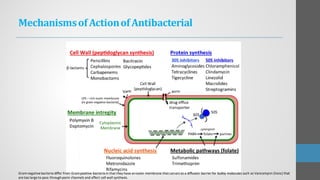
MechanismsofActionofAntibacterial
Gramnegativebacteria differ from Grampositive bacteria in that they have anouter membrane that canact as a diffusion barrier for bulkly molecules such as Vancomycin (Vanc) that
aretoo largeto pass throughporin channels and affect cell wall synthesis.
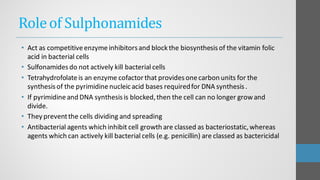
Roleof Sulphonamides
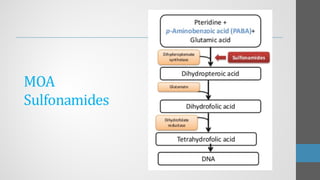
• Act as competitiveenzymeinhibitorsand block the biosynthesisof the vitamin folic
acid in bacterial cells
• Sulfonamidesdo not actively kill bacterial cells
• Tetrahydrofolateis an enzyme cofactor that providesonecarbon units for the
synthesisof the pyrimidinenucleicacid bases requiredfor DNA synthesis.
• If pyrimidineand DNA synthesisis blocked,then the cell can no longer growand
divide.
• They preventthe cells dividing and spreading
• Antibacterial agents which inhibit cell growth are classed as bacteriostatic,whereas
agents which can actively kill bacterial cells (e.g. penicillin) are classed as bactericidal
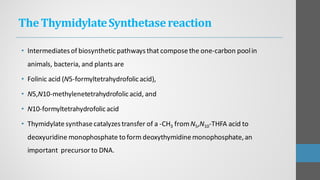
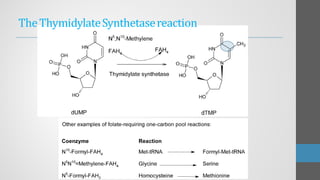
TheThymidylateSynthetasereaction
• Intermediatesof biosyntheticpathwaysthat composethe one-carbon poolin
animals, bacteria, and plants are
• Folinic acid (N5-formyltetrahydrofolicacid),
• N5,N10-methylenetetrahydrofolicacid, and
• N10-formyltetrahydrofolicacid
• Thymidylatesynthasecatalyzestransfer of a -CH3 fromN5,N10-THFA acid to
deoxyuridine monophosphate to form deoxythymidinemonophosphate,an
important precursor to DNA.
TheThymidylateSynthetasereaction
• The sulfonamidesare structuralanalogs of PABA that competitively inhibit the action
of dihydropteroatesynthase,preventing the addition of PABA to pteridine
diphosphateand blocking the net biosynthesisof folate coenzymes.
• This action arrests bacterial growth and cell division.
• The competitivenatureof the sulfonamides’action means that the drugs do no
permanentdamage to a microorganism; hence, they are bacteriostatic.
• The sulfonamidesmust be maintained at a minimum effectiveconcentration to
arrest the growth of bacteria long enough for the host’s immune systemto eradicate
them.
TheThymidylateSynthetasereaction
• Folate coenzymes are biosynthesized from dietary folic acid in humans and other animals.
• Bacteria and protozoa must biosynthesize them from PABA and pteridine diphosphate.
• Microbes cannot assimilate folic acid from the growth medium or from the host.
• One reason is that bacterial cell walls may be impermeable to folic acid.
• Trimethoprim is an inhibitor of dihydrofolate reductase, which is necessary to convert
dihydrofolic acid (FAH2) into tetrahydrofolic acid (FAH4) in bacteria.
• Trimethoprim has a high affinity for bacterial folate reductase & some affinity for human
folate reductase, and this is the cause of some of the toxic effects of the drug.
MOA
Sulfonamides
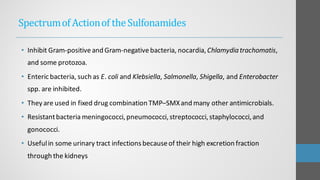
SpectrumofActionof theSulfonamides
• Inhibit Gram-positiveand Gram-negativebacteria, nocardia,Chlamydiatrachomatis,
and some protozoa.
• Entericbacteria, such as E. coli and Klebsiella, Salmonella, Shigella, and Enterobacter
spp. are inhibited.
• They are used in fixed drug combination TMP–SMXand many other antimicrobials.
• Resistantbacteria meningococci,pneumococci,streptococci,staphylococci,and
gonococci.
• Usefulin some urinary tract infectionsbecauseof their high excretion fraction
through the kidneys
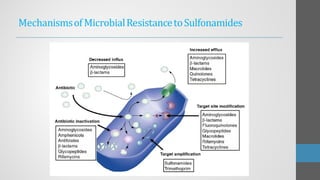
MechanismsofMicrobialResistancetoSulfonamides
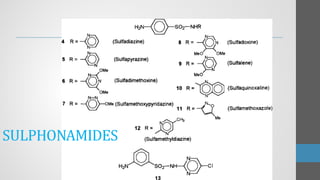
SULPHONAMIDES
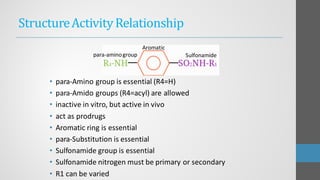
StructureActivityRelationship
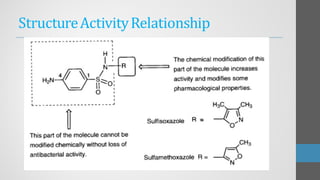
• para-Amino group is essential (R4=H)
• para-Amido groups (R4=acyl) are allowed
• inactive in vitro, but active in vivo
• act as prodrugs
• Aromatic ring is essential
• para-Substitution is essential
• Sulfonamide group is essential
• Sulfonamide nitrogen must be primary or secondary
• R1 can be varied
Aromatic
para-aminogroup Sulfonamide
StructureActivityRelationship
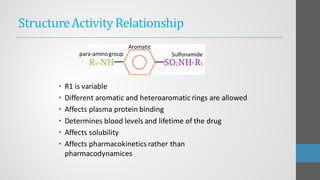
• R1 is variable
• Different aromatic and heteroaromatic rings are allowed
• Affects plasma protein binding
• Determines blood levels and lifetime of the drug
• Affects solubility
• Affects pharmacokinetics rather than
pharmacodynamices
Aromatic
para-aminogroup Sulfonamide
StructureActivityRelationship
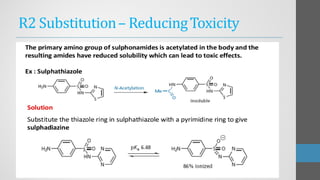
R2 Substitution– ReducingToxicity
COMPARINGSOLUBILITY
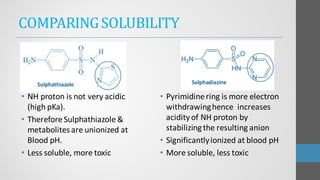
• NH proton is not very acidic
(high pKa).
• ThereforeSulphathiazole &
metabolites are unionized at
Blood pH.
• Less soluble, more toxic
• Pyrimidinering is more electron
withdrawinghence increases
acidity of NH proton by
stabilizingthe resulting anion
• Significantlyionized at blood pH
• More soluble, less toxic
ProdrugsforSulphonamide
• Amide group lowers the polarity of the sulfonamide
• Amide cannot ionise
• Alkyl group increases the hydrophobiccharacter
• Crosses the gut wall more easily
• Metabolised by enzymes (e.g. peptidases) in vivo
• Metabolism generates the primary amine
• Primary amine ionizes and can form ionic interactions
• Ionised primary amine also acts as a strong HBD
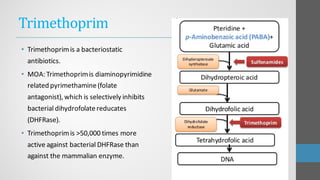
Trimethoprim
• Trimethoprimis a bacteriostatic
antibiotics.
• MOA: Trimethoprimis diaminopyrimidine
related pyrimethamine(folate
antagonist),which is selectively inhibits
bacterial dihydrofolatereducates
(DHFRase).
• Trimethoprimis >50,000 times more
active against bacterial DHFRase than
against the mammalian enzyme.
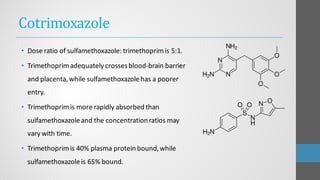
Cotrimoxazole
• Dose ratio of sulfamethoxazole: trimethoprimis 5:1.
• Trimethoprimadequately crossesblood-brain barrier
and placenta,while sulfamethoxazolehas a poorer
entry.
• Trimethoprimis more rapidly absorbed than
sulfamethoxazoleand the concentrationratios may
vary with time.
• Trimethoprimis 40% plasma protein bound,while
sulfamethoxazoleis 65% bound.
Uses of cotrimoxazole
• Urinary tract infections
• Respiratory tract infections: Upper and lower respiratory tract infections
(chronic bronchitis and facio-maxillary infections) and H. influenzae.
• Drug of choice for respiratory infection caused by Pneumocystis jiroveci and
Nocardia asteroides.
• Typhoid
• Bacterial diarrhea and dysentery
• Pneumonia (caused by Pneumocystis jiroveci)
• Chancroid (bacterial sexually transmitted infection)

Sulphonamides

  • 1.
    SULFONAMIDES Syntheticantibacterialagents Dr. Shilpa SudhakarHarak Asst.Prof., Pharm. Chem., GES Sir Dr. M. S. GosaviCollege of PharmaceuticalEducationandResearch, Nashik
  • 2.
    SulfonamidesIntroduction • The firsteffective chemotherapeutic agents for systemiccure of bacterial infections in humans. • This decreased the morbidity and mortality of infectious diseases. • Utility decreased due to :  widespread resistance &  Increased use of the broader-spectrum penicillins.
  • 3.
    SulfonamidesIntroduction • Sulfonamides aresynthetic compounds that have activity against both gram- positive and gram- negative bacteria. • Now occupy a small place in the list of therapeutic agents for infectious disease. • However, developmentof a combination of trimethoprim and sulfamethoxazole and its utility in treatment & prophylaxis opportunistic microbial infections led to resurgence in the use of some sulfonamides.
  • 4.
    History • The discoveryof sulfonamides is a significant milestone event in the human chemotherapeutic history. • Originally, sulfonamides were synthesized in Germany as azodyes. • Sulfonamide azo dyes were tested because they were readily synthesized and possessed superior staining properties. • In 1932, Domagk began to study a brilliant red dye, later named Prontosil. • Prontosil was found to protect against, and cure, streptococcal infections in mice. • Prontosil was inactive on bacterial cultures.
  • 5.
    History • Domagk andothers continued to study Prontosil,and in 1933, • The first of many cures of severe bacterial infections in humans was reported by Foerster, who treated a 10-month-old infant suffering from staphylococcal septicemia and obtained a dramatic cure. • Domagk was awarded the Nobel Prize in medicine and physiology in 1938.
  • 6.
    History • In 1935,Trefoueland co-investigators performeda structure–activity study on the sulfonamideazo dyes and concluded that the azo linkagewas reductively cleaved to release the active antibacterial product,sulfanilamide. • All of these findingsushered in the modern era of • chemotherapy and theconceptof the prodrug. +
  • 7.
  • 8.
    Chemistry • In pharmaceuticalchemistry,pKbvalues are not used to comparecompoundsthat are Lewis bases. • Instead,if a pKa of an amine is given,it refersto its salt acting as the conjugateacid. • For example,aniline with a pKaof 4.6 refersto • It does not refer to • A negative chargeon a nitrogen atom is typically not stable unlessit can be delocalized by resonance.Thisis what happenswith the sulfanilamides.Therefore, the single pKa usually given for sulfanilamides refersto the loss of an amide proton
  • 9.
    Nomenclatureof the Sulfonamides •Sulfonamide is a generic term that denotes three different cases: 1. Antibacterials that are aniline-substituted sulfonamides (the “sulfanilamides”). 2. Prodrugs that react to generate active sulfanilamides (i.e., sulfasalazine). 3. Nonaniline sulfonamides (i.e., mafenide acetate). • There are also other commonly used drugs that are sulfonamides or sulfanilamides. • Among these are the oral hypoglycemic drug tolbutamide, the diuretic furosemide, and the diuretic chlorthalidone.
  • 10.
    Ionizationof Sulfonamides • Thesulfonamidegroup,SO2NH2,tends to gain stability if it loses a proton, because the resultingnegative chargeis resonancestabilized. • Since the proton-donatingformof the functionalgroup is not charged,we can characterizeit as an HA acid, along with carboxyl groups,phenols,and thiols. • The loss of a proton can be associated with a pKafor all of the compoundsin the series. • For example,the pKaof sulfisoxazole (pKa 5.0) indicatesthat the sulfonamideis a slightly weaker acid than acetic acid (pKa 4.8).
  • 11.
    SulfonamideClassification Sulfonamides is abacteriostatic antibiotics which on duration of action can be classified as: • Short acting (4-8 h): Sulfadiazine • Intermediate acting (8-12 h): Sulfamethoxazole • Long acting ( ~ 7 days): Sulfadoxine, Sulfamethopyrazine • Special purpose sulfonamides: Sulfacetamide sodium, Mafenide, Silver sulfadiazine, Sulfasalazine
  • 12.
    SulfonamideClassification The sulfonamidescan begrouped into threeclasses on the basis of their use: • oral absorbableagents,designed to give systemicdistribution; • oral nonabsorbable agents such as sulfasalazine; and • topical agents such as sodiumsulfacetamideophthalmicdrops.
  • 13.
    MechanismsofActionofAntibacterials Inhibition of bacterialcellwall synthesis - e.g. Penicillins,Cephalosporins and Vancomycin Inhibition of cell metabolism, e. g. Sulfonamides Interactionswiththe plasma membrane, e.g. Polymyxins Disruption of protein synthesis,e.g. Rifamycins,Aminoglycosides, Tetracyclines,and Chloramphenicol Inhibition of nucleic acid transcriptionand replication,e.g. Nalidixic acid and Proflavin
  • 14.
    MechanismsofActionofAntibacterial Gramnegativebacteria differ fromGrampositive bacteria in that they have anouter membrane that canact as a diffusion barrier for bulkly molecules such as Vancomycin (Vanc) that aretoo largeto pass throughporin channels and affect cell wall synthesis.
  • 15.
    Roleof Sulphonamides • Actas competitiveenzymeinhibitorsand block the biosynthesisof the vitamin folic acid in bacterial cells • Sulfonamidesdo not actively kill bacterial cells • Tetrahydrofolateis an enzyme cofactor that providesonecarbon units for the synthesisof the pyrimidinenucleicacid bases requiredfor DNA synthesis. • If pyrimidineand DNA synthesisis blocked,then the cell can no longer growand divide. • They preventthe cells dividing and spreading • Antibacterial agents which inhibit cell growth are classed as bacteriostatic,whereas agents which can actively kill bacterial cells (e.g. penicillin) are classed as bactericidal
  • 16.
    TheThymidylateSynthetasereaction • Intermediatesof biosyntheticpathwaysthatcomposethe one-carbon poolin animals, bacteria, and plants are • Folinic acid (N5-formyltetrahydrofolicacid), • N5,N10-methylenetetrahydrofolicacid, and • N10-formyltetrahydrofolicacid • Thymidylatesynthasecatalyzestransfer of a -CH3 fromN5,N10-THFA acid to deoxyuridine monophosphate to form deoxythymidinemonophosphate,an important precursor to DNA.
  • 17.
  • 18.
    TheThymidylateSynthetasereaction • The sulfonamidesarestructuralanalogs of PABA that competitively inhibit the action of dihydropteroatesynthase,preventing the addition of PABA to pteridine diphosphateand blocking the net biosynthesisof folate coenzymes. • This action arrests bacterial growth and cell division. • The competitivenatureof the sulfonamides’action means that the drugs do no permanentdamage to a microorganism; hence, they are bacteriostatic. • The sulfonamidesmust be maintained at a minimum effectiveconcentration to arrest the growth of bacteria long enough for the host’s immune systemto eradicate them.
  • 19.
    TheThymidylateSynthetasereaction • Folate coenzymesare biosynthesized from dietary folic acid in humans and other animals. • Bacteria and protozoa must biosynthesize them from PABA and pteridine diphosphate. • Microbes cannot assimilate folic acid from the growth medium or from the host. • One reason is that bacterial cell walls may be impermeable to folic acid. • Trimethoprim is an inhibitor of dihydrofolate reductase, which is necessary to convert dihydrofolic acid (FAH2) into tetrahydrofolic acid (FAH4) in bacteria. • Trimethoprim has a high affinity for bacterial folate reductase & some affinity for human folate reductase, and this is the cause of some of the toxic effects of the drug.
  • 20.
  • 21.
    SpectrumofActionof theSulfonamides • InhibitGram-positiveand Gram-negativebacteria, nocardia,Chlamydiatrachomatis, and some protozoa. • Entericbacteria, such as E. coli and Klebsiella, Salmonella, Shigella, and Enterobacter spp. are inhibited. • They are used in fixed drug combination TMP–SMXand many other antimicrobials. • Resistantbacteria meningococci,pneumococci,streptococci,staphylococci,and gonococci. • Usefulin some urinary tract infectionsbecauseof their high excretion fraction through the kidneys
  • 22.
  • 23.
  • 24.
    StructureActivityRelationship • para-Amino groupis essential (R4=H) • para-Amido groups (R4=acyl) are allowed • inactive in vitro, but active in vivo • act as prodrugs • Aromatic ring is essential • para-Substitution is essential • Sulfonamide group is essential • Sulfonamide nitrogen must be primary or secondary • R1 can be varied Aromatic para-aminogroup Sulfonamide
  • 25.
    StructureActivityRelationship • R1 isvariable • Different aromatic and heteroaromatic rings are allowed • Affects plasma protein binding • Determines blood levels and lifetime of the drug • Affects solubility • Affects pharmacokinetics rather than pharmacodynamices Aromatic para-aminogroup Sulfonamide
  • 26.
  • 27.
  • 28.
    COMPARINGSOLUBILITY • NH protonis not very acidic (high pKa). • ThereforeSulphathiazole & metabolites are unionized at Blood pH. • Less soluble, more toxic • Pyrimidinering is more electron withdrawinghence increases acidity of NH proton by stabilizingthe resulting anion • Significantlyionized at blood pH • More soluble, less toxic
  • 29.
    ProdrugsforSulphonamide • Amide grouplowers the polarity of the sulfonamide • Amide cannot ionise • Alkyl group increases the hydrophobiccharacter • Crosses the gut wall more easily • Metabolised by enzymes (e.g. peptidases) in vivo • Metabolism generates the primary amine • Primary amine ionizes and can form ionic interactions • Ionised primary amine also acts as a strong HBD
  • 30.
    Trimethoprim • Trimethoprimis abacteriostatic antibiotics. • MOA: Trimethoprimis diaminopyrimidine related pyrimethamine(folate antagonist),which is selectively inhibits bacterial dihydrofolatereducates (DHFRase). • Trimethoprimis >50,000 times more active against bacterial DHFRase than against the mammalian enzyme.
  • 31.
    Cotrimoxazole • Dose ratioof sulfamethoxazole: trimethoprimis 5:1. • Trimethoprimadequately crossesblood-brain barrier and placenta,while sulfamethoxazolehas a poorer entry. • Trimethoprimis more rapidly absorbed than sulfamethoxazoleand the concentrationratios may vary with time. • Trimethoprimis 40% plasma protein bound,while sulfamethoxazoleis 65% bound.
  • 32.
    Uses of cotrimoxazole •Urinary tract infections • Respiratory tract infections: Upper and lower respiratory tract infections (chronic bronchitis and facio-maxillary infections) and H. influenzae. • Drug of choice for respiratory infection caused by Pneumocystis jiroveci and Nocardia asteroides. • Typhoid • Bacterial diarrhea and dysentery • Pneumonia (caused by Pneumocystis jiroveci) • Chancroid (bacterial sexually transmitted infection)