Anti-diarrheal drugs
Word meaning 
• Greek and Latin: dia, through, and rheein, to 
flow or run 
• Diarrhea is not a disease, but a symptom of 
some other problem characterized by 
“either more frequent bowel movement 
and/or the texture of the stool is thin and 
sometimes watery .”
• WHO defined as “ 3 or more than 3 loose or 
watery stools in 24 hour period.” 
• Diarrhea is abnormal: increase in frequency 
liquidity of stool.
• Main factor in causation of diarrhea. 
• Increase GI motility and 
• Decrease intestinal ability to absorb water 
from stool 
• Increase in GI secretion
Causes of diarrhea 
Diet ( eating something that is difficult to 
digest ) 
Genetic Disorder ( lactase deficiency ) 
Infection ( bacterial, viral, parasitic ) 
Drug-induced 
Stress (IBS) 
Anxiety
Classification of diarrhea 
Diarrhea may be classified into: 
- Acute ( sudden onset ) 
Food induced ( traveler’s ) 
- Chronic ( 2 weeks or longer ) 
IBD, Stress or Irritable bowel syndrome
Causes of acute infectious diarrhea 
• Noninflammatory Diarrhea 
1. Viral - Norwalk virus, Norwalk-like virus, 
Rotavirus 
2. Protozoal - Giardia lamblia, Cryptosporidium 
3. Bacterial - Preformed enterotoxin production 
Staphylococcus aureus, Bacillus 
cereus, Clostridium perfringens 
Enterotoxin production; 
Enterotoxigenic E coli 
(ETEC), Vibrio cholerae
Causes of chronic diarrhea 
• Osmotic diarrhea 
CLUES: Stool volume decreases with fasting; 
increased stool osmotic gap 
1). Disaccharidase deficiency: lactose 
intolerance 
• Secretory diarrhea 
• Drug induced diarrhea
Osmotic diarrhea 
• Under normal circumstances, the major osmoles 
are Na+, K+, Cl–, and HCO3–. The stool osmolality 
may be estimated by multiplying the stool (Na+ + 
K+) × 2 (multiplied by 2 to account for the anions) 
• The osmotic gap is the difference between the 
measured osmolality of the stool (or serum) and 
the estimated stool osmolality and is normally 
less than 50 mosm/kg
Secretory diarrhea 
• Large volume ( >1 L/d); little change with 
fasting; normal stool osmotic gap 
1. Hormonally mediated: VIPoma, carcinoid, 
medullary carcinoma of thyroid (calcitonin), 
Zollinger-Ellison syndrome (gastrin) 
2. Factitious diarrhea (laxative abuse): 
phenolphthalein, cascara, senna 
3. Villous adenoma 
4. Bile salt malabsorption (ileal resection; 
Crohn's ileitis; postcholecystectomy)
Drugs causing diarrhea 
• Magnesium antacids 
• Antibiotics :erythomycin 
• GI prokinetic drugs: cisapride 
• Quinidine 
• Prostaglandin analoguage
Patho-physiology 
Water and electrolyte are absorbed as well as secreted in intestine. 
Jejunum is freely permeable to salt and water which are passively absorbed 
secondary to nutrient( glucose, amino acid, ect,) In jejunum most water 
absorption occurs passively in response to the osmotic pressure generated by 
absorption of soluble products of digestion. 
An excess of unabsorbed material in gut cause increase water in stool thus it may 
cause diarrhea. 
In Ileum and colon active Na k ATPase mediated salt absorption. 
Inhibition of Na k ATPase cause structural damage to mucosal cell lead to 
diarrhea by reduced absorption. 
Intracellular cyclic nucleotide are important regulators of absorptive and 
secretary processes. 
Increase in cAMP and cGMP cause net loss of salt and water both by inhibition of 
NaCl absorption in villous cell and by promoting secretion in crypt cell.
Principles of management 
a) Treatment of fluid depletion 
b) Maintenance of nutrition. 
c) Drug therapy
ASSESSMENT OF DEHYDRATION 
Dehydration 
Mild Moderate Severe 
Appearance irritable, 
thirsty 
irritable, 
very 
thirsty 
lethargy, 
coma, or 
unconscious 
Anterior 
Fontanelle 
normal depressed markedly 
depressed 
Eyes normal sunken sunken
Dehydration 
Mild Moderate Severe 
Tongue normal dry very dry, 
furred 
Skin normal slow 
retraction 
very slow 
retraction 
Breathing normal rapid very rapid
Dehydration 
Mild Moderate Severe 
Pulse normal rapid and 
low 
volume 
feeble or 
imperceptible 
Urine normal dark scanty 
Weight 
loss 
< 5% 6 - 9% 10% or more
a) Rehydration therapy 
A) Oral rehydration : 
If fluid loss is 
mild < 5 % body weight 
moderate 6-9 % body weight 
B) Intra venous rehydration: 
More than 10%body weight
ORS-History 
• First developed in the early 1950’s and was 
formulated to minor ions lost in stool. 
• In the early 1960’s the mechanism by which ORT 
works, the coupled transport of sodium and glucose, 
was discovered. 
• In 1971, the efficacy of ORT demonstrated during an 
epidemic of cholera in a refugee camp in Bangladesh. 
• World Health Organization estimates that 90% of 
diarrheal deaths worldwide could be prevented with 
appropriate treatment with ORS
Oral rehydration 
Principles of oral rehydration salt/solution: 
a) Isotonic or hypotonic(total osmolarity 200- 
300) 
b)Molar ratio of glucose should be higher or 
equal than sodium. 
c)Enough potassium and bicarbonate/citrate 
should be provided to make up losses in stool.
New formula WHO-ORS 
• CONTENT CONCENTRATION 
• NaCL :2.6 gm Na 75 mM 
• KCL :1.5 gm K 20 mM 
• Trisod. Citrate:2.9 gm Cl 65 mM 
• Glucose:13.5 gm Citrate 10 mM 
• Water:1 L Glucose 75 mM 
Total osmolarity 245 mOsm/L
Questions related to ORS 
 How should I prepare ORS? 
How do I feed the solution? 
What if the child vomits? 
How do I store the ORS solution? 
How do I measure the Salt and Sugar?
Questions related to ORS 
 How should I prepare ORS? 
How do I feed the solution? 
What if the child vomits? 
How do I store the ORS solution? 
How do I measure the Salt and Sugar?
ADMINISTRATION OF ORS 
• Drink ORS at ½-1 hourly intervals. 
• Subsequently it may be left to demand but it 
should cover the rate of loss in stool. 
• 5-7.5 % BW volume equivalent is given in 2-4 
hours. In children (5 ml/kg/hr).
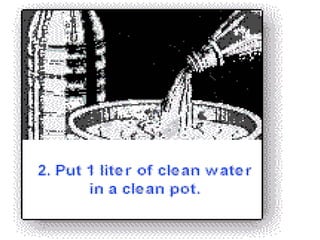
5gm of table 
salt + 
20gm sugar 
+ 
One liter of 
boiled and 
cooled water
Non diarrheal uses of ORS 
a) Post surgical, post burn and post trauma 
patient maintenance of hydration and 
nutrition. 
b) Heat stroke 
c) During change over from intravenous to 
enteral alimentation.
Intra venous rehydration 
• Use when > 10% BW 
• Recommended composition of i.v. fluid (Dhaka 
fluid): 
NaCl 85 mM=5 g 
KCL 13 mM=1 g 
NaHCO3 48mM=4 g in 1Lof water or 5% 
glucose solution.
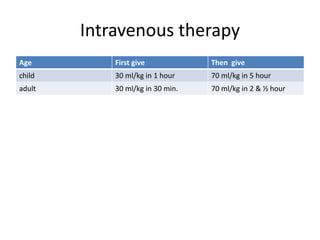
Intravenous therapy 
Age First give Then give 
child 30 ml/kg in 1 hour 70 ml/kg in 5 hour 
adult 30 ml/kg in 30 min. 70 ml/kg in 2 & ½ hour
b) Maintenance of nutrition 
• Patients of diarrhea should not be starved. 
• Fasting decreases brush border 
disacchairedase enzyme and reduces 
absorption of salt water and electrolyte and 
these may lead to prolonged diarrhea.
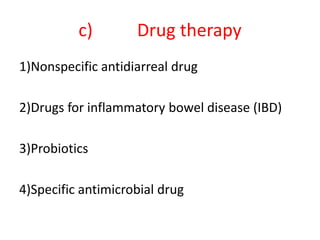
c) Drug therapy 
1)Nonspecific antidiarreal drug 
2)Drugs for inflammatory bowel disease (IBD) 
3)Probiotics 
4)Specific antimicrobial drug
1) Non specific anti diarrheal drugs. 
1) Opioid agonists: Loperamide 
Diphenoxylate 
Racecadotril 
2)Anticholinergics: Dicyclomine 
Hyoscyamine 
3)Alpha-2 Adrenergic receptor agonists: Clonidine 
4)Octereotide
Opioid agonists 
• M/A: act on mu and delta receptor 
• mu activation lead to decrease motility. 
• Delta activation lead to decrease intestinal 
secretion. 
--------------------------------------------------------------------- 
• Loperamide:4 mg followed by 2 mg after each 
loose motion maximunm up to 16 mg/day 
• Difenoxylate 2.5 mg TDS 
• Racecadotril:100-300 mg TDS
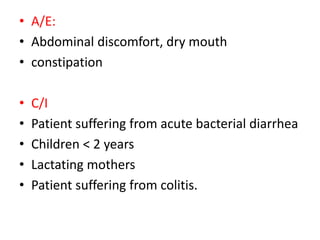
• A/E: 
• Abdominal discomfort, dry mouth 
• constipation 
• C/I 
• Patient suffering from acute bacterial diarrhea 
• Children < 2 years 
• Lactating mothers 
• Patient suffering from colitis.
Anticholinergics: 
M/A: 
• Decrease bowel motility : this lead to 
increase absorption of fluid back from 
intestinal tract 
• Decrease in abdominal cramps. 
• Not use as a mono therapy 
Can be used with combined with Opioid 
agonists
Alpha-2 Adrenergic receptor agonists 
• Facilitates absorption 
• Inhibit secretion of fluids and electrolyte 
• Specifically used in diarrhea caused by opiate 
withdrawal & diabetic diarrhea. 
• Clonidine: 0.1 mg BD oral
octereotide 
• Synthetic octapeptide 
• Decrease release of 
5HT,gastrin,secretin,motilin. 
• Reduces GI motility, intestinal fluid and 
electrolyte secretion. 
A/E:slight nausea ,abdominal discomfort and 
pain
• Mainly used for secretory diarrhea. 
• Dose: 100 mcg TDS sub cutaneously. 
• A/E 
• Short term therapy: 
• Slight nausea,abdominal discomfort,pain at a 
site of injection 
• Long term therapy: 
• Gall stone formation,hypothyroidism. 
• Impaired pancreatic secretion lead to 
steatorrhoea which can lead to fat soluble 
vitamin deficiency.
2) Drug therapy for inflammatory 
bowel disease 
ULCERATIVE COLITIS 
1. Aminosalicylates 
5-aminosalicylic acid 
Sulfasalazine(5-ASA+sulfapyridine) 
Olsalazine(5-ASA+5-ASA) 
Balsalazide (5-ASA+aminobenzoyl alanine) 
Mesalamine (TR)
• Azo compounds 
• Least absorbes from stomach. 
• When they reach terminal ileum and colon, 
colonic bacteria split azo compound by an 
azoreductase enzyme 
• Release 5-ASA at site of action. 
• 5-ASA has topically anti inflammatory action 
• Inhibit nuclear factor kb.(pro inflammatory 
cytokine)
As immunosuppressant 
Glucocorticoids 
1. Prednisone 
2. Prednisolone 
3. Hydrocortisone 
4. Budenoside 
Cyclosporin 
Azathioprine and 6-Mercaptopurin
CROHN’S DISEASE 
1)Anti –TNF alpha 
• Infliximab 
• Adalimumab 
• Certolizumab 
2)Methotrexate
1)Anti –TNF alpha 
• Monoclonal antibody –cross linked with TNF-alpha 
lead to inhibits T cell and macrophase 
functions 
• Release of other pro inflammatory cytokines is 
prevented. 
• Decrease prostaglandin secretion
Methotrexate 
• It is a cytotoxic agent 
• Useful in relapse case of crohn’s disease. 
• Act as a immunosuppressive agent and also 
• Have anti inflammatory property.
3) Probiotics 
• These are live non 
pathogenic bacteria or yeast . 
• Probiotics contain variable 
lactobacillus species and 
yeast 
• Acetic acid and propionic 
acid produced by these bacilli 
lower intestinal pH and 
inhibit growth of certain 
pathogenic intestinal 
bacteria. 
• Eg: home made curd,butter 
milk,yogurt etc.
Anti microbial drugs: regularly useful 
a)cholera: 
Tetracyclin: reduce stool volume to nearly half. 
co-trimoxazole 
For multidrug resistance cholera : 
norfloxacin/ciprofloxacin 
b)Campylobacter jejuni: 
Norfloxacin and other fluoquinolones 
c)Clostridium difficile: 
metronidazole,/vancomycin 
d)Amoebiasis: metronidazole 
e)Giardiasis: metronidazole/diloxanidefuroate
“Good nutrition and hygiene 
can prevent most diarrhea”. 
Thanks

Diarrhoea lecture

  • 1.
  • 2.
    Word meaning •Greek and Latin: dia, through, and rheein, to flow or run • Diarrhea is not a disease, but a symptom of some other problem characterized by “either more frequent bowel movement and/or the texture of the stool is thin and sometimes watery .”
  • 3.
    • WHO definedas “ 3 or more than 3 loose or watery stools in 24 hour period.” • Diarrhea is abnormal: increase in frequency liquidity of stool.
  • 4.
    • Main factorin causation of diarrhea. • Increase GI motility and • Decrease intestinal ability to absorb water from stool • Increase in GI secretion
  • 5.
    Causes of diarrhea Diet ( eating something that is difficult to digest ) Genetic Disorder ( lactase deficiency ) Infection ( bacterial, viral, parasitic ) Drug-induced Stress (IBS) Anxiety
  • 6.
    Classification of diarrhea Diarrhea may be classified into: - Acute ( sudden onset ) Food induced ( traveler’s ) - Chronic ( 2 weeks or longer ) IBD, Stress or Irritable bowel syndrome
  • 7.
    Causes of acuteinfectious diarrhea • Noninflammatory Diarrhea 1. Viral - Norwalk virus, Norwalk-like virus, Rotavirus 2. Protozoal - Giardia lamblia, Cryptosporidium 3. Bacterial - Preformed enterotoxin production Staphylococcus aureus, Bacillus cereus, Clostridium perfringens Enterotoxin production; Enterotoxigenic E coli (ETEC), Vibrio cholerae
  • 8.
    Causes of chronicdiarrhea • Osmotic diarrhea CLUES: Stool volume decreases with fasting; increased stool osmotic gap 1). Disaccharidase deficiency: lactose intolerance • Secretory diarrhea • Drug induced diarrhea
  • 9.
    Osmotic diarrhea •Under normal circumstances, the major osmoles are Na+, K+, Cl–, and HCO3–. The stool osmolality may be estimated by multiplying the stool (Na+ + K+) × 2 (multiplied by 2 to account for the anions) • The osmotic gap is the difference between the measured osmolality of the stool (or serum) and the estimated stool osmolality and is normally less than 50 mosm/kg
  • 10.
    Secretory diarrhea •Large volume ( >1 L/d); little change with fasting; normal stool osmotic gap 1. Hormonally mediated: VIPoma, carcinoid, medullary carcinoma of thyroid (calcitonin), Zollinger-Ellison syndrome (gastrin) 2. Factitious diarrhea (laxative abuse): phenolphthalein, cascara, senna 3. Villous adenoma 4. Bile salt malabsorption (ileal resection; Crohn's ileitis; postcholecystectomy)
  • 11.
    Drugs causing diarrhea • Magnesium antacids • Antibiotics :erythomycin • GI prokinetic drugs: cisapride • Quinidine • Prostaglandin analoguage
  • 12.
    Patho-physiology Water andelectrolyte are absorbed as well as secreted in intestine. Jejunum is freely permeable to salt and water which are passively absorbed secondary to nutrient( glucose, amino acid, ect,) In jejunum most water absorption occurs passively in response to the osmotic pressure generated by absorption of soluble products of digestion. An excess of unabsorbed material in gut cause increase water in stool thus it may cause diarrhea. In Ileum and colon active Na k ATPase mediated salt absorption. Inhibition of Na k ATPase cause structural damage to mucosal cell lead to diarrhea by reduced absorption. Intracellular cyclic nucleotide are important regulators of absorptive and secretary processes. Increase in cAMP and cGMP cause net loss of salt and water both by inhibition of NaCl absorption in villous cell and by promoting secretion in crypt cell.
  • 13.
    Principles of management a) Treatment of fluid depletion b) Maintenance of nutrition. c) Drug therapy
  • 14.
    ASSESSMENT OF DEHYDRATION Dehydration Mild Moderate Severe Appearance irritable, thirsty irritable, very thirsty lethargy, coma, or unconscious Anterior Fontanelle normal depressed markedly depressed Eyes normal sunken sunken
  • 15.
    Dehydration Mild ModerateSevere Tongue normal dry very dry, furred Skin normal slow retraction very slow retraction Breathing normal rapid very rapid
  • 16.
    Dehydration Mild ModerateSevere Pulse normal rapid and low volume feeble or imperceptible Urine normal dark scanty Weight loss < 5% 6 - 9% 10% or more
  • 17.
    a) Rehydration therapy A) Oral rehydration : If fluid loss is mild < 5 % body weight moderate 6-9 % body weight B) Intra venous rehydration: More than 10%body weight
  • 18.
    ORS-History • Firstdeveloped in the early 1950’s and was formulated to minor ions lost in stool. • In the early 1960’s the mechanism by which ORT works, the coupled transport of sodium and glucose, was discovered. • In 1971, the efficacy of ORT demonstrated during an epidemic of cholera in a refugee camp in Bangladesh. • World Health Organization estimates that 90% of diarrheal deaths worldwide could be prevented with appropriate treatment with ORS
  • 19.
    Oral rehydration Principlesof oral rehydration salt/solution: a) Isotonic or hypotonic(total osmolarity 200- 300) b)Molar ratio of glucose should be higher or equal than sodium. c)Enough potassium and bicarbonate/citrate should be provided to make up losses in stool.
  • 20.
    New formula WHO-ORS • CONTENT CONCENTRATION • NaCL :2.6 gm Na 75 mM • KCL :1.5 gm K 20 mM • Trisod. Citrate:2.9 gm Cl 65 mM • Glucose:13.5 gm Citrate 10 mM • Water:1 L Glucose 75 mM Total osmolarity 245 mOsm/L
  • 21.
    Questions related toORS  How should I prepare ORS? How do I feed the solution? What if the child vomits? How do I store the ORS solution? How do I measure the Salt and Sugar?
  • 26.
    Questions related toORS  How should I prepare ORS? How do I feed the solution? What if the child vomits? How do I store the ORS solution? How do I measure the Salt and Sugar?
  • 27.
    ADMINISTRATION OF ORS • Drink ORS at ½-1 hourly intervals. • Subsequently it may be left to demand but it should cover the rate of loss in stool. • 5-7.5 % BW volume equivalent is given in 2-4 hours. In children (5 ml/kg/hr).
  • 28.
    5gm of table salt + 20gm sugar + One liter of boiled and cooled water
  • 30.
    Non diarrheal usesof ORS a) Post surgical, post burn and post trauma patient maintenance of hydration and nutrition. b) Heat stroke c) During change over from intravenous to enteral alimentation.
  • 31.
    Intra venous rehydration • Use when > 10% BW • Recommended composition of i.v. fluid (Dhaka fluid): NaCl 85 mM=5 g KCL 13 mM=1 g NaHCO3 48mM=4 g in 1Lof water or 5% glucose solution.
  • 32.
    Intravenous therapy AgeFirst give Then give child 30 ml/kg in 1 hour 70 ml/kg in 5 hour adult 30 ml/kg in 30 min. 70 ml/kg in 2 & ½ hour
  • 33.
    b) Maintenance ofnutrition • Patients of diarrhea should not be starved. • Fasting decreases brush border disacchairedase enzyme and reduces absorption of salt water and electrolyte and these may lead to prolonged diarrhea.
  • 34.
    c) Drug therapy 1)Nonspecific antidiarreal drug 2)Drugs for inflammatory bowel disease (IBD) 3)Probiotics 4)Specific antimicrobial drug
  • 35.
    1) Non specificanti diarrheal drugs. 1) Opioid agonists: Loperamide Diphenoxylate Racecadotril 2)Anticholinergics: Dicyclomine Hyoscyamine 3)Alpha-2 Adrenergic receptor agonists: Clonidine 4)Octereotide
  • 36.
    Opioid agonists •M/A: act on mu and delta receptor • mu activation lead to decrease motility. • Delta activation lead to decrease intestinal secretion. --------------------------------------------------------------------- • Loperamide:4 mg followed by 2 mg after each loose motion maximunm up to 16 mg/day • Difenoxylate 2.5 mg TDS • Racecadotril:100-300 mg TDS
  • 37.
    • A/E: •Abdominal discomfort, dry mouth • constipation • C/I • Patient suffering from acute bacterial diarrhea • Children < 2 years • Lactating mothers • Patient suffering from colitis.
  • 38.
    Anticholinergics: M/A: •Decrease bowel motility : this lead to increase absorption of fluid back from intestinal tract • Decrease in abdominal cramps. • Not use as a mono therapy Can be used with combined with Opioid agonists
  • 39.
    Alpha-2 Adrenergic receptoragonists • Facilitates absorption • Inhibit secretion of fluids and electrolyte • Specifically used in diarrhea caused by opiate withdrawal & diabetic diarrhea. • Clonidine: 0.1 mg BD oral
  • 40.
    octereotide • Syntheticoctapeptide • Decrease release of 5HT,gastrin,secretin,motilin. • Reduces GI motility, intestinal fluid and electrolyte secretion. A/E:slight nausea ,abdominal discomfort and pain
  • 41.
    • Mainly usedfor secretory diarrhea. • Dose: 100 mcg TDS sub cutaneously. • A/E • Short term therapy: • Slight nausea,abdominal discomfort,pain at a site of injection • Long term therapy: • Gall stone formation,hypothyroidism. • Impaired pancreatic secretion lead to steatorrhoea which can lead to fat soluble vitamin deficiency.
  • 42.
    2) Drug therapyfor inflammatory bowel disease ULCERATIVE COLITIS 1. Aminosalicylates 5-aminosalicylic acid Sulfasalazine(5-ASA+sulfapyridine) Olsalazine(5-ASA+5-ASA) Balsalazide (5-ASA+aminobenzoyl alanine) Mesalamine (TR)
  • 43.
    • Azo compounds • Least absorbes from stomach. • When they reach terminal ileum and colon, colonic bacteria split azo compound by an azoreductase enzyme • Release 5-ASA at site of action. • 5-ASA has topically anti inflammatory action • Inhibit nuclear factor kb.(pro inflammatory cytokine)
  • 44.
    As immunosuppressant Glucocorticoids 1. Prednisone 2. Prednisolone 3. Hydrocortisone 4. Budenoside Cyclosporin Azathioprine and 6-Mercaptopurin
  • 45.
    CROHN’S DISEASE 1)Anti–TNF alpha • Infliximab • Adalimumab • Certolizumab 2)Methotrexate
  • 46.
    1)Anti –TNF alpha • Monoclonal antibody –cross linked with TNF-alpha lead to inhibits T cell and macrophase functions • Release of other pro inflammatory cytokines is prevented. • Decrease prostaglandin secretion
  • 47.
    Methotrexate • Itis a cytotoxic agent • Useful in relapse case of crohn’s disease. • Act as a immunosuppressive agent and also • Have anti inflammatory property.
  • 48.
    3) Probiotics •These are live non pathogenic bacteria or yeast . • Probiotics contain variable lactobacillus species and yeast • Acetic acid and propionic acid produced by these bacilli lower intestinal pH and inhibit growth of certain pathogenic intestinal bacteria. • Eg: home made curd,butter milk,yogurt etc.
  • 49.
    Anti microbial drugs:regularly useful a)cholera: Tetracyclin: reduce stool volume to nearly half. co-trimoxazole For multidrug resistance cholera : norfloxacin/ciprofloxacin b)Campylobacter jejuni: Norfloxacin and other fluoquinolones c)Clostridium difficile: metronidazole,/vancomycin d)Amoebiasis: metronidazole e)Giardiasis: metronidazole/diloxanidefuroate
  • 50.
    “Good nutrition andhygiene can prevent most diarrhea”. Thanks