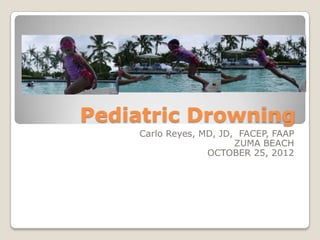
Pediatric Drowning
    Carlo Reyes, MD, JD, FACEP, FAAP
                        ZUMA BEACH
                  OCTOBER 25, 2012
   Terminology              Objectives
   Epidemiology
   Pediatric
    Characteristics:
    ◦ Mechanisms of injury
    ◦ Physiology
    ◦ Social and family
      issues
 Treatment
  Paradigm
 Prevention
Terminology
 Drowning vs. Near drowning
 Cold water (<20°C) vs. Warm water
  (>20°C) vs. “Very-cold-water” (<5°C)
 Freshwater vs. salt-water


Terminology – Old Classifications
 Drowning Process: respiratory
  impairment from submersion/immersion
  in liquid.
 Nonfatal Drowning: drowning process
  that is interrupted, and person is rescued.
 Fatal Drowning: person dies any time as
  a result of drowning.


Terminology–WHO 2002
Epidemiology
 500,000 deaths each year worldwide
 Leading cause of death worldwide in boys
  5-14
 2nd leading cause of death in US in kids
  aged 1-4.
    ◦ birth defects is the leading cause.
    ◦ Leading cause of death in some states (CA, AZ)


Epidemiology: Pediatric Drowning
1.    What is the leading cause of accidental
      death in the U.S. today?
     a)   Heart attack
     b)   Diabetes
     c)   Drowning
     d)   Car accident
     e)   Prescription pain medications


Epidemiology: QUIZ
1.   What is the leading cause of accidental
     death in the U.S. today?
     a) Heart attack
     b) Diabetes
     c) Drowning
     d) Car accident
     e) Prescription pain medications


Epidemiology: QUIZ
 Bimodal distribution: toddlers and male
  adolescents.
 Gender: male (over 1 year)
    ◦ Males 4x more likely to sustain submersion
      injury
    ◦ Males 12x more likely to be involved in boat-
      related drowning


Epidemiology: Gender
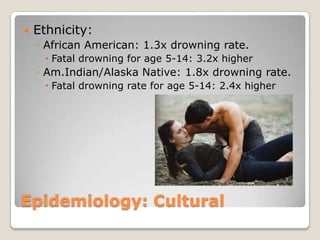
   Ethnicity:
    ◦ African American: 1.3x drowning rate.
      Fatal drowning for age 5-14: 3.2x higher
    ◦ Am.Indian/Alaska Native: 1.8x drowning rate.
      Fatal drowning rate for age 5-14: 2.4x higher


Epidemiology: Cultural
2. Dr. Reyes picked this picture because:
a) It represents the correct way to deliver
   mouth-to mouth to a drowning female.
b) I’m culturally sensitive to American-
   Indians, even if this actor may not be
   American-Indian.
c) I’m secretly with Team Jacob.
d) Robert Pattinson should not have made up
   with her
e) All of the above.


Epidemiology: Cultural Quiz
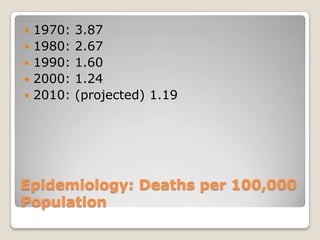
   1970:   3.87
   1980:   2.67
   1990:   1.60
   2000:   1.24
   2010:   (projected) 1.19


Epidemiology: Deaths per 100,000
Population
   For every one pediatric drowning death:
    ◦ 14 children are treated in emergency dept.
    ◦ 4 children are hospitalized.
   Annual cost of care per year in chronic
    facility: $100,000.


Epidemiology - Cost
   Less than one year:
    ◦ Bathtubs and buckets
    ◦ Child abuse/neglect
   Ages 1-4:
    ◦ Home or apartment swimming pools
    ◦ Child abuse/neglect
   Ages 5-19:
    ◦ Lakes, ponds, rivers and pools.
    ◦ Child abuse/neglect
   Most common access to water <5 years
    ◦ Pool without a fence


Mechanisms of Injury by Age
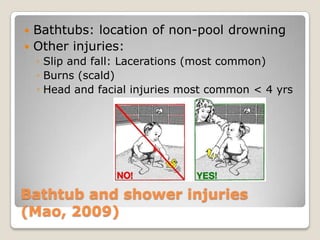
 Bathtubs: location of non-pool drowning
 Other injuries:
    ◦ Slip and fall: Lacerations (most common)
    ◦ Burns (scald)
    ◦ Head and facial injuries most common < 4 yrs


Bathtub and shower injuries
(Mao, 2009)
 Aged 10-14 most common to have injury
 Head, face, and neck injuries
    ◦ Children tend to injure head
    ◦ Adolescents tend to injure neck and extremities
 Most common mechanism: hitting diving
  board and/or platform
 Most common injury: laceration and soft
  tissue. (spinal cord injury rare)


Diving injuries (Day, 2006)
   Contributing factors: Unattended; no
    fence
   Location: Pool (bathtub in <1 year)
   Unique characteristics: Silent drowning
   Injuries: cardiopulmonary arrest
   Co-morbidities: seizure (post-ictal state)
   Unique characteristics:
    ◦ Child abuse/neglect
    ◦ Silent drowning


Toddler Typical Patient Scenario
 Contributing factors: Male, alcohol, drugs
  Location: Pool, ocean, or lake
 Scenario: Diving, or boating accident
 Injuries: HEENT injuries, overdose.
 Co-morbidities: seizure (post-
  ictal), arrhythmia, hypoglycemia/diabetes,
   Unique characteristics:
    ◦ Suicidality


Adolescent Typical Patient
Scenario
 Asymptomatic
 Symptomatic:
    ◦ Abnormal vitals
    ◦ Respiratory distress or hypoxia
    ◦ Alert or altered; Neurologic deficit
   Cardiopulmonary arrest:
    ◦ Apnea
    ◦ Asystole, Vtach/Vfib, Bradycardia
   Obviously dead: asystole, rigor mortis

Presentation Types
(Shepherd, 2009)
   “Wet drowning” (90%)
    ◦ Asphyxia  relaxation of airway  Aspiration
      of fluid (<4ml/kg)
      Salt water  surfactant washout
      Fresh water  surfactant destroyed
   “Dry drowning” (10%)
    ◦ Laryngospasm  aspiration of minimal amt.


Pathophysiology:
Wet vs Dry Drowning
 Hypoxemia  shunts off pulmonary circ.
 Hypercarbia  acidosis
 Pulmonary hypertension  ARDS
 Electrolyte Disturbances – usually from
  ingestion of large amounts of fluid, minor
  effect from aspiration of fluid


Pathophysiology:
Effects of Drowning
   Hypoxia
    ◦ Loss of consciousness
    ◦ Hypoxic-ischemic encephalopathy
 Cerebral edema (6-12 hours)
 Cold-water immersion (<20°C) is
  protective  time-to-injury is prolonged.
    ◦ Diving reflex: apnea, bradycardia, and
      vasoconstriction of nonessential vascular beds
    ◦ Decreases metabolic demand


Pathophysiology – CNS Injury
   Rule out accidental and non-accidental
    trauma
    ◦ Intracranial hemorrhage
    ◦ Maxillofacial injuries
    ◦ Cervical injuries
 Identify signs of anoxic brain injury
 If CT show signs of anoxic injury  bad
  prognosis


Role of CT in Drownings
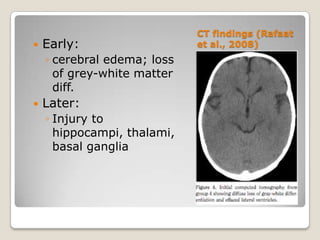
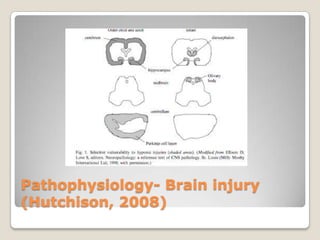
CT findings (Rafaat
   Early:                   et al., 2008)
    ◦ cerebral edema; loss
      of grey-white matter
      diff.
   Later:
    ◦ Injury to
      hippocampi, thalami,
      basal ganglia
Pathophysiology- Brain injury
(Hutchison, 2008)
   Myocardial ischemia
    ◦ Arrhythmia
    ◦ Cardiac arrest
   “Diencephalic –hypothalamaic storm”
    ◦ Late effect due to severe CNS hypoxic injury
    ◦ Hypertension, tachycardia
      diaphoresis, agitation


Hypoxic injury: Autonomic
Dysfunciton
Shallow Water Blackout
 Loss of consciousness while in water due
  to cerebral hypoxia from apnea.
 Hyperventilation drives down CO2, which
  is responsible for respiratory drive.
 Lack of respiratory drive while in water
  causes apnea, worsening hypoxia.
 Compare to Deep water blackout- seen in
  deep sea divers as they approach the
  surface and experience rapid
  depressurisation.

Shallow Water Blackout
What is it?
SHALLOW WATER BLACKOUT
http://www.youtube.com/watch?feature=pl
ayer_detailpage&v=qLe81lUbPNg


Youtube- Deep Water Blackout
Pre-Hospital Care
3.   What is the appropriate sequence in
     resuscitation for laypersons after a
     drowning?
a)   A-B-C
b)   C-A-B
c)   B-A-C
d)   C-B-A
e)   None of the above.


Pre-Hospital Care- QUIZ
3.   What is the appropriate sequence in
     resuscitation for laypersons after a
     drowning?
a)   A-B-C
b)   C-A-B
c)   B-A-C
d)   C-B-A
e)   None of the above.


Pre-Hospital Care- QUIZ
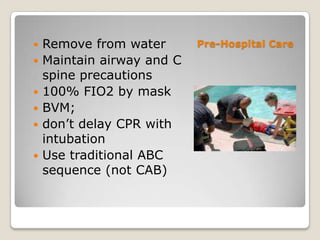
   Remove from water       Pre-Hospital Care
   Maintain airway and C
    spine precautions
   100% FIO2 by mask
   BVM;
   don’t delay CPR with
    intubation
   Use traditional ABC
    sequence (not CAB)
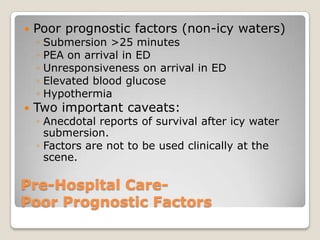
   Poor prognostic factors (non-icy waters)
    ◦   Submersion >25 minutes
    ◦   PEA on arrival in ED
    ◦   Unresponsiveness on arrival in ED
    ◦   Elevated blood glucose
    ◦   Hypothermia
   Two important caveats:
    ◦ Anecdotal reports of survival after icy water
      submersion.
    ◦ Factors are not to be used clinically at the
      scene.

Pre-Hospital Care-
Poor Prognostic Factors
The Trauma Evaluation
   Airway – Maintain C spine
   Breathing
   Circulation
   IV-O2-Monitor
   Disability – GCS, AVPU
   Exposure – Remove clothes, secondary
    survey


The Trauma Evaluation
   100% FIO2 by facemask if hypoxic
   BIPAP if awake and facemask not effective
   Intubation/RSI and immobilize neck
   Bronchoscopy- consider if hypoxic despite
    mechanical ventilation.
   ECMO – tertiary care center PICUs may
    consider.


Initial Interventions- Airway
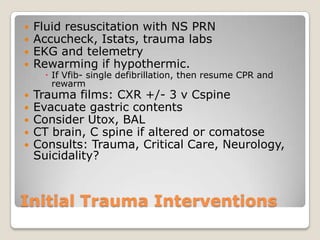
   Fluid resuscitation with NS PRN
   Accucheck, Istats, trauma labs
   EKG and telemetry
   Rewarming if hypothermic.
       If Vfib- single defibrillation, then resume CPR and
        rewarm
   Trauma films: CXR +/- 3 v Cspine
   Evacuate gastric contents
   Consider Utox, BAL
   CT brain, C spine if altered or comatose
   Consults: Trauma, Critical Care, Neurology,
    Suicidality?


Initial Trauma Interventions
 Asymptomatic  consider 8 hour
  observation or discharge.
 Symptomatic
    ◦ After stabilization  admit and observe, or
      transfer to Tertiary Care with PICU backup.
   Unstable, critical care
    ◦ Transfer to PICU


Appropriate Disposition
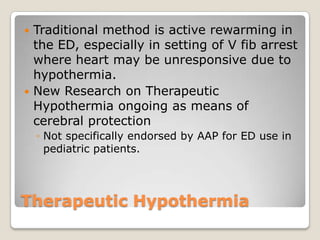
 Traditional method is active rewarming in
  the ED, especially in setting of V fib arrest
  where heart may be unresponsive due to
  hypothermia.
 New Research on Therapeutic
  Hypothermia ongoing as means of
  cerebral protection
    ◦ Not specifically endorsed by AAP for ED use in
      pediatric patients.


Therapeutic Hypothermia
   Recommended in adult Vfib arrest victims
    by AHA (2002)
    ◦ Adults – V fib most likely due to heart disease
    ◦ Peds – V fib most likely due to hypoxia/shock
 No studies in peds; 38% PICUs use it
 Target: 32°C
 Initiation: within 6 hours
 Duration: 24 hours


Therapeutic Hypothermia
Prevention
   Toddlers:
    ◦ Four-sided fence, 4 ft high, self latching and
      opens outward
    ◦ Remove toys in pool.
    ◦ Constant supervision.
   Children:
    ◦ Responsible adult present
   Adolescents:
    ◦ Avoid drinking alcohol
    ◦ Life jackets for recreational boating.


CDC: Preventative Measures
   Children: Constant supervision of all children
   Infants and toddlers:
    ◦ “Touch supervision”
    ◦ Four-sided fence
   Swimming lessons okay >4 yrs
    ◦ Doesn’t replace other measures
   Resuscitation Education:
    ◦ Bystander CPR training
    ◦ EMS Education
    ◦ ED resuscitation


AAP Preventative Measures
   Lifeguards present:
    ◦ 6% of all rescued persons needed medical
      attention
    ◦ 0.5% needed CPR
   Bystanders present:
    ◦ 30% required CPR


Lifeguard v. Bystander Study
 Terminology and Definitions
 Epidemiology
 Unique characteristics of the pediatric
  drowning patient, including:
    ◦ Mechanisms of injury.
    ◦ Physiology and response to injury.
    ◦ Social and family issues in pediatric trauma.
 The Treatment Paradigm
 Modes of Prevention


Summary
   Avarello, J. Pediatric Major Trauma: An Approach to Evaluation and Management. Emerg Med Clin N Am
    25 (2007) 803-806.
   Day, Coral et al. Diving-Related Injuries in Children <20 Years Old Treated in Emergency Departments in
    the United States; 1990-2006.
   Shepherd, S.M. and Shoff, W.H. Drowning. Updated June 9, 2009. eMedicine.medscape.com
   Fink, E. et al. A tertiary care center’s experience with therapeutic hypothermia after pediatric cardiac
    arrest. Pediatr Crit Care Med, Vol. 11, No. 1, 2010.
   Hutchison, J.S. et al. Hypothermia Therapy for Cardiac Arrest Patients. Pediatric Clin N Am 55 (2008) 529-
    544.
   Layon, A.J. and Modell, J. H. Drowning. Update 2009. Anesthesiology 2009; 110: 1390-401.
   Mao, Shengyi et al. Injuries Associated with Bathtubs and Showers Among Children in the United States.
    Pediatrics 2009; 124; 541-547.
   Nelson’s Pediatrics.
   Policy Statement: Prevention of Drowning in Infants, Children, and Adolescents. Committee on
    Injury, Violence, and Poison Prevention. Pediatrics. 2003; 112; 437-439.
   Rafaat, K.T., et al. Cranial computed tomographic findings in a large group of children with drowning:
    Diagnostic, prognostic, and forensic implications. Pediatr Crit Care Med 2008, Vol. 9., No. 6.
   Swimming Programs for Infants and Toddlers. Committee on Sports Medicine and Fitness and Committee
    on Injury and Poison Prevention. Pediatrics 2000; 105; 868-870.
   The Pediatric Emergency Medicine Resource. 4th Ed. American Academy of Pediatrics, 2004.
   Topjian, A. et al. Pediatric Cardiopulmonary Resuscitation: Advances in Science, Techniques, and
    outcomes. Pediatrics, 2008; 122; 1086-1098.
   Wagner, C. Pediatric Submersion Injuries. Air Medical Journal, Vol. 28, Issue 3 (May 2009).


References

Pediatric drowning zuma

  • 1.
    Pediatric Drowning Carlo Reyes, MD, JD, FACEP, FAAP ZUMA BEACH OCTOBER 25, 2012
  • 2.
    Terminology Objectives  Epidemiology  Pediatric Characteristics: ◦ Mechanisms of injury ◦ Physiology ◦ Social and family issues  Treatment Paradigm  Prevention
  • 3.
  • 4.
     Drowning vs.Near drowning  Cold water (<20°C) vs. Warm water (>20°C) vs. “Very-cold-water” (<5°C)  Freshwater vs. salt-water Terminology – Old Classifications
  • 5.
     Drowning Process:respiratory impairment from submersion/immersion in liquid.  Nonfatal Drowning: drowning process that is interrupted, and person is rescued.  Fatal Drowning: person dies any time as a result of drowning. Terminology–WHO 2002
  • 6.
  • 7.
     500,000 deathseach year worldwide  Leading cause of death worldwide in boys 5-14  2nd leading cause of death in US in kids aged 1-4. ◦ birth defects is the leading cause. ◦ Leading cause of death in some states (CA, AZ) Epidemiology: Pediatric Drowning
  • 8.
    1. What is the leading cause of accidental death in the U.S. today? a) Heart attack b) Diabetes c) Drowning d) Car accident e) Prescription pain medications Epidemiology: QUIZ
  • 9.
    1. What is the leading cause of accidental death in the U.S. today? a) Heart attack b) Diabetes c) Drowning d) Car accident e) Prescription pain medications Epidemiology: QUIZ
  • 10.
     Bimodal distribution:toddlers and male adolescents.  Gender: male (over 1 year) ◦ Males 4x more likely to sustain submersion injury ◦ Males 12x more likely to be involved in boat- related drowning Epidemiology: Gender
  • 11.
    Ethnicity: ◦ African American: 1.3x drowning rate.  Fatal drowning for age 5-14: 3.2x higher ◦ Am.Indian/Alaska Native: 1.8x drowning rate.  Fatal drowning rate for age 5-14: 2.4x higher Epidemiology: Cultural
  • 12.
    2. Dr. Reyespicked this picture because: a) It represents the correct way to deliver mouth-to mouth to a drowning female. b) I’m culturally sensitive to American- Indians, even if this actor may not be American-Indian. c) I’m secretly with Team Jacob. d) Robert Pattinson should not have made up with her e) All of the above. Epidemiology: Cultural Quiz
  • 13.
    1970: 3.87  1980: 2.67  1990: 1.60  2000: 1.24  2010: (projected) 1.19 Epidemiology: Deaths per 100,000 Population
  • 14.
    For every one pediatric drowning death: ◦ 14 children are treated in emergency dept. ◦ 4 children are hospitalized.  Annual cost of care per year in chronic facility: $100,000. Epidemiology - Cost
  • 15.
    Less than one year: ◦ Bathtubs and buckets ◦ Child abuse/neglect  Ages 1-4: ◦ Home or apartment swimming pools ◦ Child abuse/neglect  Ages 5-19: ◦ Lakes, ponds, rivers and pools. ◦ Child abuse/neglect  Most common access to water <5 years ◦ Pool without a fence Mechanisms of Injury by Age
  • 16.
     Bathtubs: locationof non-pool drowning  Other injuries: ◦ Slip and fall: Lacerations (most common) ◦ Burns (scald) ◦ Head and facial injuries most common < 4 yrs Bathtub and shower injuries (Mao, 2009)
  • 17.
     Aged 10-14most common to have injury  Head, face, and neck injuries ◦ Children tend to injure head ◦ Adolescents tend to injure neck and extremities  Most common mechanism: hitting diving board and/or platform  Most common injury: laceration and soft tissue. (spinal cord injury rare) Diving injuries (Day, 2006)
  • 18.
    Contributing factors: Unattended; no fence  Location: Pool (bathtub in <1 year)  Unique characteristics: Silent drowning  Injuries: cardiopulmonary arrest  Co-morbidities: seizure (post-ictal state)  Unique characteristics: ◦ Child abuse/neglect ◦ Silent drowning Toddler Typical Patient Scenario
  • 19.
     Contributing factors:Male, alcohol, drugs Location: Pool, ocean, or lake  Scenario: Diving, or boating accident  Injuries: HEENT injuries, overdose.  Co-morbidities: seizure (post- ictal), arrhythmia, hypoglycemia/diabetes, Unique characteristics: ◦ Suicidality Adolescent Typical Patient Scenario
  • 20.
     Asymptomatic  Symptomatic: ◦ Abnormal vitals ◦ Respiratory distress or hypoxia ◦ Alert or altered; Neurologic deficit  Cardiopulmonary arrest: ◦ Apnea ◦ Asystole, Vtach/Vfib, Bradycardia  Obviously dead: asystole, rigor mortis Presentation Types (Shepherd, 2009)
  • 21.
    “Wet drowning” (90%) ◦ Asphyxia  relaxation of airway  Aspiration of fluid (<4ml/kg)  Salt water  surfactant washout  Fresh water  surfactant destroyed  “Dry drowning” (10%) ◦ Laryngospasm  aspiration of minimal amt. Pathophysiology: Wet vs Dry Drowning
  • 22.
     Hypoxemia shunts off pulmonary circ.  Hypercarbia  acidosis  Pulmonary hypertension  ARDS  Electrolyte Disturbances – usually from ingestion of large amounts of fluid, minor effect from aspiration of fluid Pathophysiology: Effects of Drowning
  • 23.
    Hypoxia ◦ Loss of consciousness ◦ Hypoxic-ischemic encephalopathy  Cerebral edema (6-12 hours)  Cold-water immersion (<20°C) is protective  time-to-injury is prolonged. ◦ Diving reflex: apnea, bradycardia, and vasoconstriction of nonessential vascular beds ◦ Decreases metabolic demand Pathophysiology – CNS Injury
  • 24.
    Rule out accidental and non-accidental trauma ◦ Intracranial hemorrhage ◦ Maxillofacial injuries ◦ Cervical injuries  Identify signs of anoxic brain injury  If CT show signs of anoxic injury  bad prognosis Role of CT in Drownings
  • 25.
    CT findings (Rafaat  Early: et al., 2008) ◦ cerebral edema; loss of grey-white matter diff.  Later: ◦ Injury to hippocampi, thalami, basal ganglia
  • 26.
  • 27.
    Myocardial ischemia ◦ Arrhythmia ◦ Cardiac arrest  “Diencephalic –hypothalamaic storm” ◦ Late effect due to severe CNS hypoxic injury ◦ Hypertension, tachycardia diaphoresis, agitation Hypoxic injury: Autonomic Dysfunciton
  • 28.
  • 29.
     Loss ofconsciousness while in water due to cerebral hypoxia from apnea.  Hyperventilation drives down CO2, which is responsible for respiratory drive.  Lack of respiratory drive while in water causes apnea, worsening hypoxia.  Compare to Deep water blackout- seen in deep sea divers as they approach the surface and experience rapid depressurisation. Shallow Water Blackout What is it?
  • 30.
  • 31.
  • 32.
  • 33.
    3. What is the appropriate sequence in resuscitation for laypersons after a drowning? a) A-B-C b) C-A-B c) B-A-C d) C-B-A e) None of the above. Pre-Hospital Care- QUIZ
  • 34.
    3. What is the appropriate sequence in resuscitation for laypersons after a drowning? a) A-B-C b) C-A-B c) B-A-C d) C-B-A e) None of the above. Pre-Hospital Care- QUIZ
  • 35.
    Remove from water Pre-Hospital Care  Maintain airway and C spine precautions  100% FIO2 by mask  BVM;  don’t delay CPR with intubation  Use traditional ABC sequence (not CAB)
  • 36.
    Poor prognostic factors (non-icy waters) ◦ Submersion >25 minutes ◦ PEA on arrival in ED ◦ Unresponsiveness on arrival in ED ◦ Elevated blood glucose ◦ Hypothermia  Two important caveats: ◦ Anecdotal reports of survival after icy water submersion. ◦ Factors are not to be used clinically at the scene. Pre-Hospital Care- Poor Prognostic Factors
  • 37.
  • 38.
    Airway – Maintain C spine  Breathing  Circulation  IV-O2-Monitor  Disability – GCS, AVPU  Exposure – Remove clothes, secondary survey The Trauma Evaluation
  • 39.
    100% FIO2 by facemask if hypoxic  BIPAP if awake and facemask not effective  Intubation/RSI and immobilize neck  Bronchoscopy- consider if hypoxic despite mechanical ventilation.  ECMO – tertiary care center PICUs may consider. Initial Interventions- Airway
  • 40.
    Fluid resuscitation with NS PRN  Accucheck, Istats, trauma labs  EKG and telemetry  Rewarming if hypothermic.  If Vfib- single defibrillation, then resume CPR and rewarm  Trauma films: CXR +/- 3 v Cspine  Evacuate gastric contents  Consider Utox, BAL  CT brain, C spine if altered or comatose  Consults: Trauma, Critical Care, Neurology, Suicidality? Initial Trauma Interventions
  • 41.
     Asymptomatic consider 8 hour observation or discharge.  Symptomatic ◦ After stabilization  admit and observe, or transfer to Tertiary Care with PICU backup.  Unstable, critical care ◦ Transfer to PICU Appropriate Disposition
  • 42.
     Traditional methodis active rewarming in the ED, especially in setting of V fib arrest where heart may be unresponsive due to hypothermia.  New Research on Therapeutic Hypothermia ongoing as means of cerebral protection ◦ Not specifically endorsed by AAP for ED use in pediatric patients. Therapeutic Hypothermia
  • 43.
    Recommended in adult Vfib arrest victims by AHA (2002) ◦ Adults – V fib most likely due to heart disease ◦ Peds – V fib most likely due to hypoxia/shock  No studies in peds; 38% PICUs use it  Target: 32°C  Initiation: within 6 hours  Duration: 24 hours Therapeutic Hypothermia
  • 44.
  • 45.
    Toddlers: ◦ Four-sided fence, 4 ft high, self latching and opens outward ◦ Remove toys in pool. ◦ Constant supervision.  Children: ◦ Responsible adult present  Adolescents: ◦ Avoid drinking alcohol ◦ Life jackets for recreational boating. CDC: Preventative Measures
  • 46.
    Children: Constant supervision of all children  Infants and toddlers: ◦ “Touch supervision” ◦ Four-sided fence  Swimming lessons okay >4 yrs ◦ Doesn’t replace other measures  Resuscitation Education: ◦ Bystander CPR training ◦ EMS Education ◦ ED resuscitation AAP Preventative Measures
  • 47.
    Lifeguards present: ◦ 6% of all rescued persons needed medical attention ◦ 0.5% needed CPR  Bystanders present: ◦ 30% required CPR Lifeguard v. Bystander Study
  • 48.
     Terminology andDefinitions  Epidemiology  Unique characteristics of the pediatric drowning patient, including: ◦ Mechanisms of injury. ◦ Physiology and response to injury. ◦ Social and family issues in pediatric trauma.  The Treatment Paradigm  Modes of Prevention Summary
  • 49.
    Avarello, J. Pediatric Major Trauma: An Approach to Evaluation and Management. Emerg Med Clin N Am 25 (2007) 803-806.  Day, Coral et al. Diving-Related Injuries in Children <20 Years Old Treated in Emergency Departments in the United States; 1990-2006.  Shepherd, S.M. and Shoff, W.H. Drowning. Updated June 9, 2009. eMedicine.medscape.com  Fink, E. et al. A tertiary care center’s experience with therapeutic hypothermia after pediatric cardiac arrest. Pediatr Crit Care Med, Vol. 11, No. 1, 2010.  Hutchison, J.S. et al. Hypothermia Therapy for Cardiac Arrest Patients. Pediatric Clin N Am 55 (2008) 529- 544.  Layon, A.J. and Modell, J. H. Drowning. Update 2009. Anesthesiology 2009; 110: 1390-401.  Mao, Shengyi et al. Injuries Associated with Bathtubs and Showers Among Children in the United States. Pediatrics 2009; 124; 541-547.  Nelson’s Pediatrics.  Policy Statement: Prevention of Drowning in Infants, Children, and Adolescents. Committee on Injury, Violence, and Poison Prevention. Pediatrics. 2003; 112; 437-439.  Rafaat, K.T., et al. Cranial computed tomographic findings in a large group of children with drowning: Diagnostic, prognostic, and forensic implications. Pediatr Crit Care Med 2008, Vol. 9., No. 6.  Swimming Programs for Infants and Toddlers. Committee on Sports Medicine and Fitness and Committee on Injury and Poison Prevention. Pediatrics 2000; 105; 868-870.  The Pediatric Emergency Medicine Resource. 4th Ed. American Academy of Pediatrics, 2004.  Topjian, A. et al. Pediatric Cardiopulmonary Resuscitation: Advances in Science, Techniques, and outcomes. Pediatrics, 2008; 122; 1086-1098.  Wagner, C. Pediatric Submersion Injuries. Air Medical Journal, Vol. 28, Issue 3 (May 2009). References
Editor's Notes

  • #3 AB1195 Requirement
  • #8 Lethal Injury:50% of submersion victims die at the scene
  • #16 Adding four sided fence to pool decreases incidence of drowning by 50%
  • #17 Bathtubs and buckets – high suspicion of child abuse
  • #26 156 drownings; all patients with abnormal initial CT scans died (28 pts); 23 of 24 patients with abnormal second CT bad outcome (13 died and 10 persistent vegitative)All pts with abn CTs had GCS of 3; All pts with GCS &gt; 4 had normal CTs; abused children with abnormal CT had higher GCS.
  • #27 This diagram shows the selective areas of hypoxic brain injury in the infant on the right, and the adult and older child, on the left. On the right, the infant’s diencephalon, central part of the brain is most sensitive to hypoxia. This region regulates the autonomic functions of the body, including the blood pressure and heart rate.
  • #46 Fences has decreased submersion injuries by 50%
  • #47 2003