PREVENTION OF ACCIDENTS
IN CHILDREN
Ms. Devangi Sharma N
F.Y M.Sc(N)
CHILDREN ARE VULNERABLE TO INJURY
 Natural curiosity
 Investigative, Impulsive, Impatient
 Less careful,hyperactive
 Drive to test on new master skills
 Attempted activities before developmental
readiness
 Self-assertion and challenges to rules
 Desire for peer approval
DEFINATION
WHO defined…
An accident is an event,
independent of human will
caused by outside force
acting rapidly and
resulting in physical or
mental injury.
Contd…
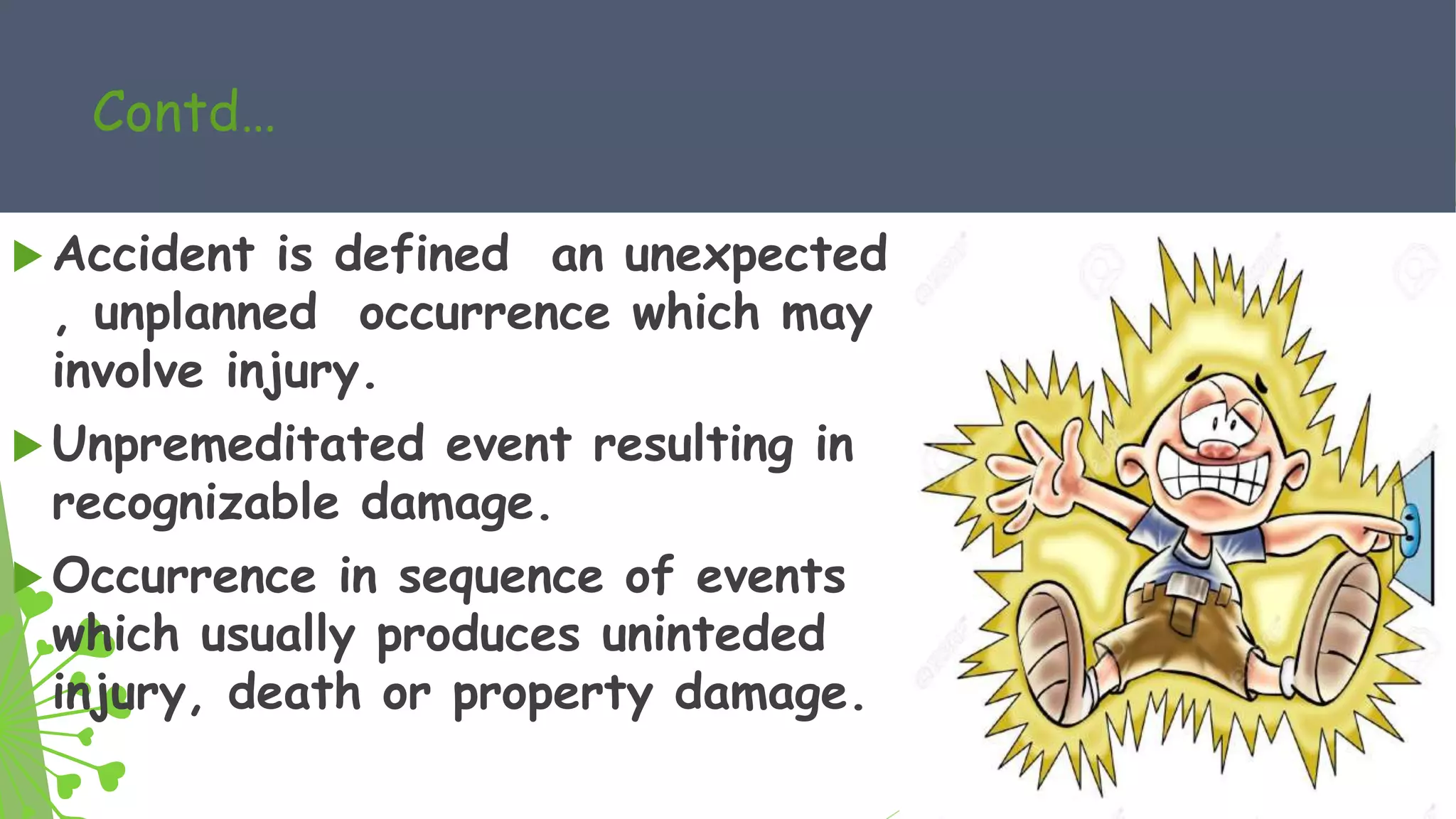
 Accident is defined an unexpected
, unplanned occurrence which may
involve injury.
 Unpremeditated event resulting in
recognizable damage.
 Occurrence in sequence of events
which usually produces uninteded
injury, death or property damage.
INJURY
It is an
intentional/unintentional
damage to body due to
exposure to an external
agent which can be thermal,
mechanical, electrical, or
chemical energy or agent.
CHILDREN ARE AT GREATER RISK
 Children live in a world built for adults: strong association
between injuries
 his age, developmental stage
 his interactions and activities with/in the world
 lack of supervision, access to protective materials
 Simply reproducing injury strategies for adults may not be
effective for children
 World becomes dangerous for them: cleaning chemicals, outlets,
ovens, sharp corners, kerosene lamps, bodies of water, traffic,
etc.
CHILDHOOD ACCIDENTS
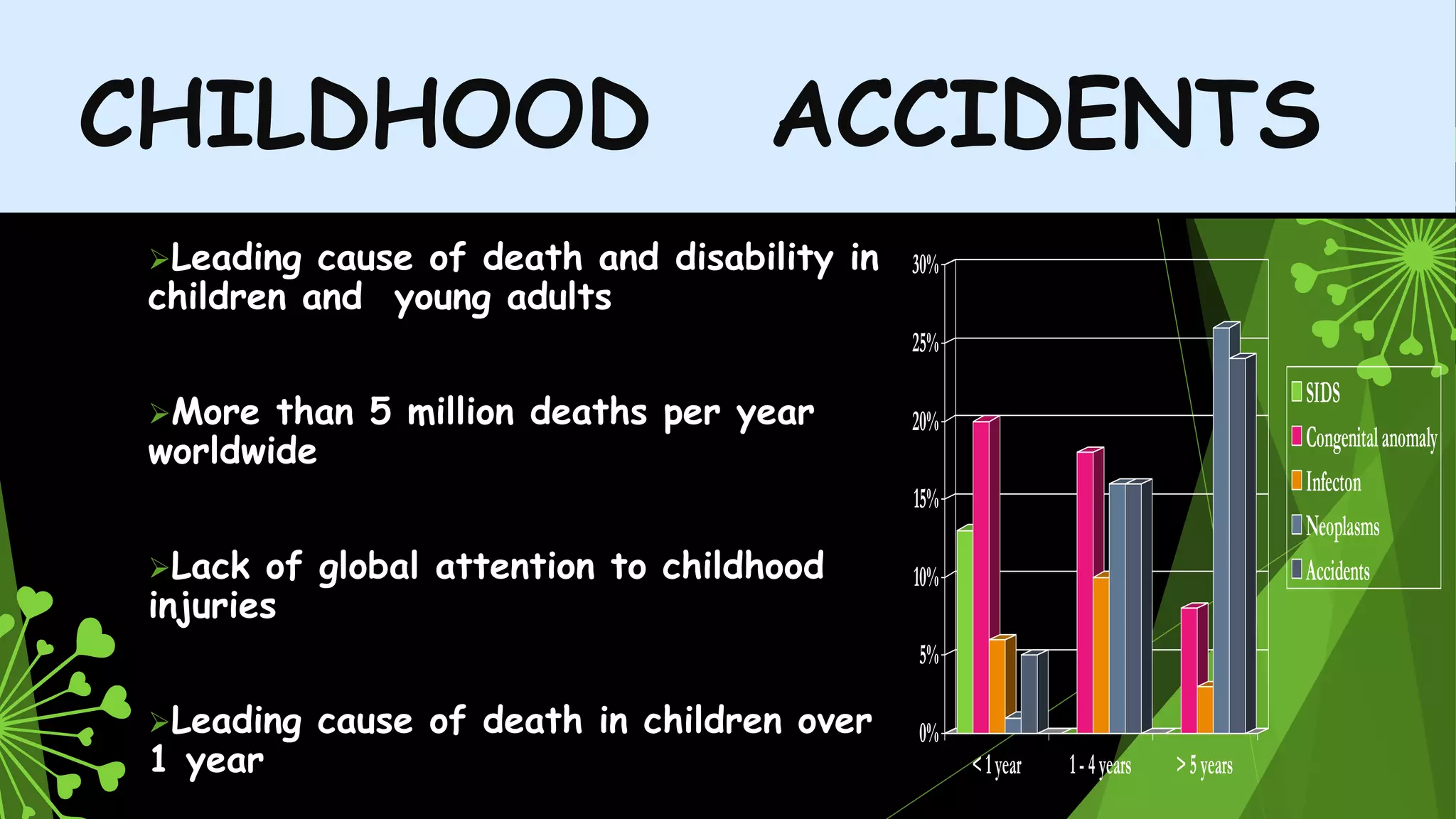
Leading cause of death and disability in
children and young adults
More than 5 million deaths per year
worldwide
Lack of global attention to childhood
injuries
Leading cause of death in children over
1 year
0%
5%
10%
15%
20%
25%
30%
<1year 1-4years >5years
SIDS
Congenitalanomaly
Infecton
Neoplasms
Accidents
INCIDENCE
TYPES OF
ACCIDENTS
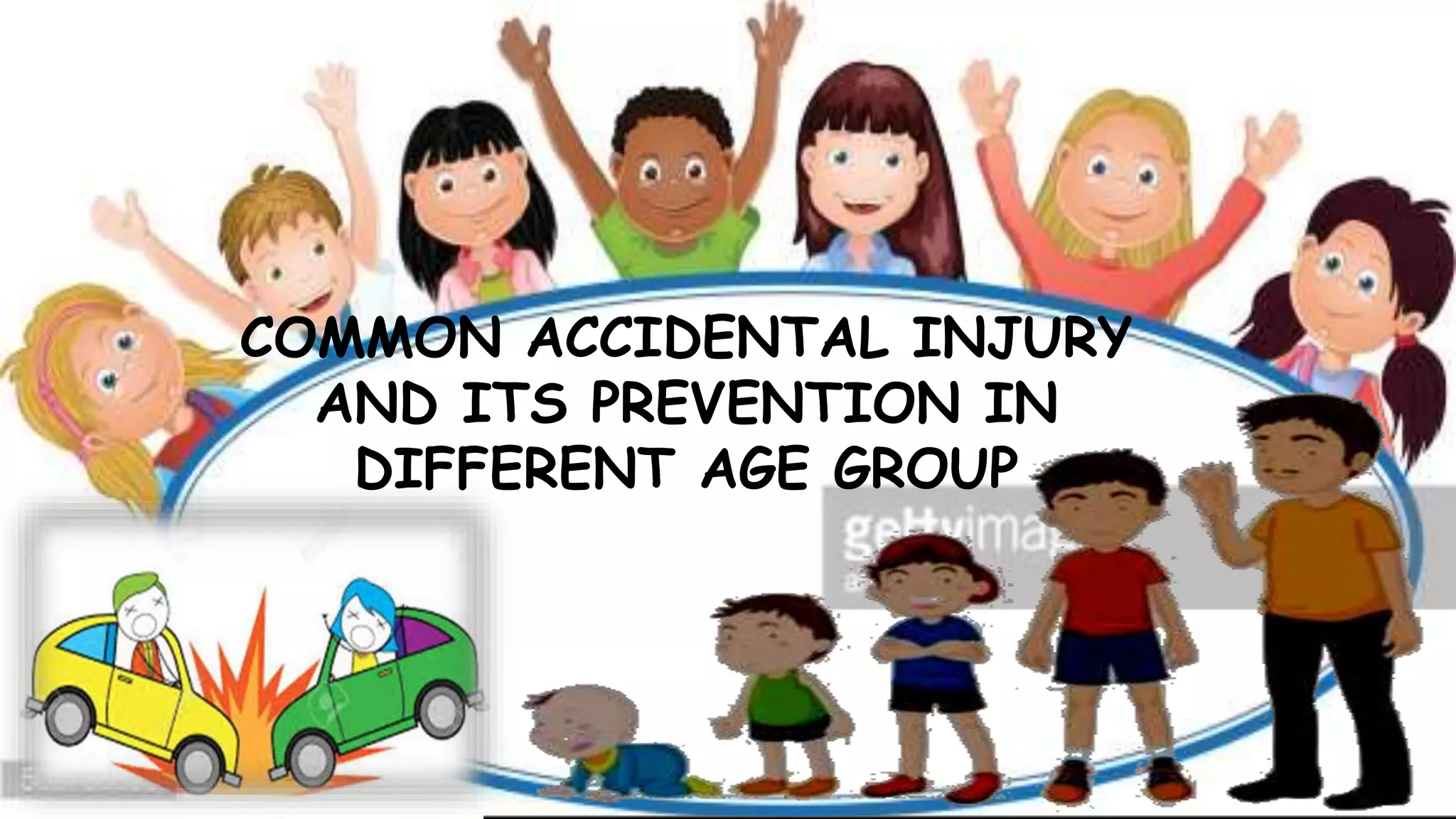
COMMON ACCIDENTAL INJURY
AND ITS PREVENTION IN
DIFFERENT AGE GROUP
INFANTS
Cuts Falls
Burns
Suffocation
Ingestion
PREVENTION
Contd…
Never leave an infant alone on cot/table/ any
unprotected place to prevent fall.
Never give very small things to child.
Toys should not have removable small parts
which can be aspirated or put into ear or nose.
Never feed solids which are difficult to swallow
/chew.
Contd…
Coins .buttons. beads,marbles must not be left
within child’s reach.
Keep the stove or fire source and hot things far
away from child.
Electrical appliances should be kept out of reach.
Never leave the infant near water tub or pond
and never go out alone.
Thermal
Falling
Avoid
Negative
Words
Contd…
Give proper directions for certain activity.
Keep constant supervision.
Keep harmful substances like hot things, drugs,
poisons,kerosene oils. electrical appliances,sharp
objects etc. out of child’s reach.
Give adequate instructions to the care taker to
look after the child and follow proper precautions.
provide safe playmaterials.
Floor should not be slippery.
Furniture should be placed firmly to prevent
falls.
Child should not be allowed to play with cord,
plastic bags or pillow to avoid suffocation.
Electric switch shoul be out of child’s reach.
Contd…
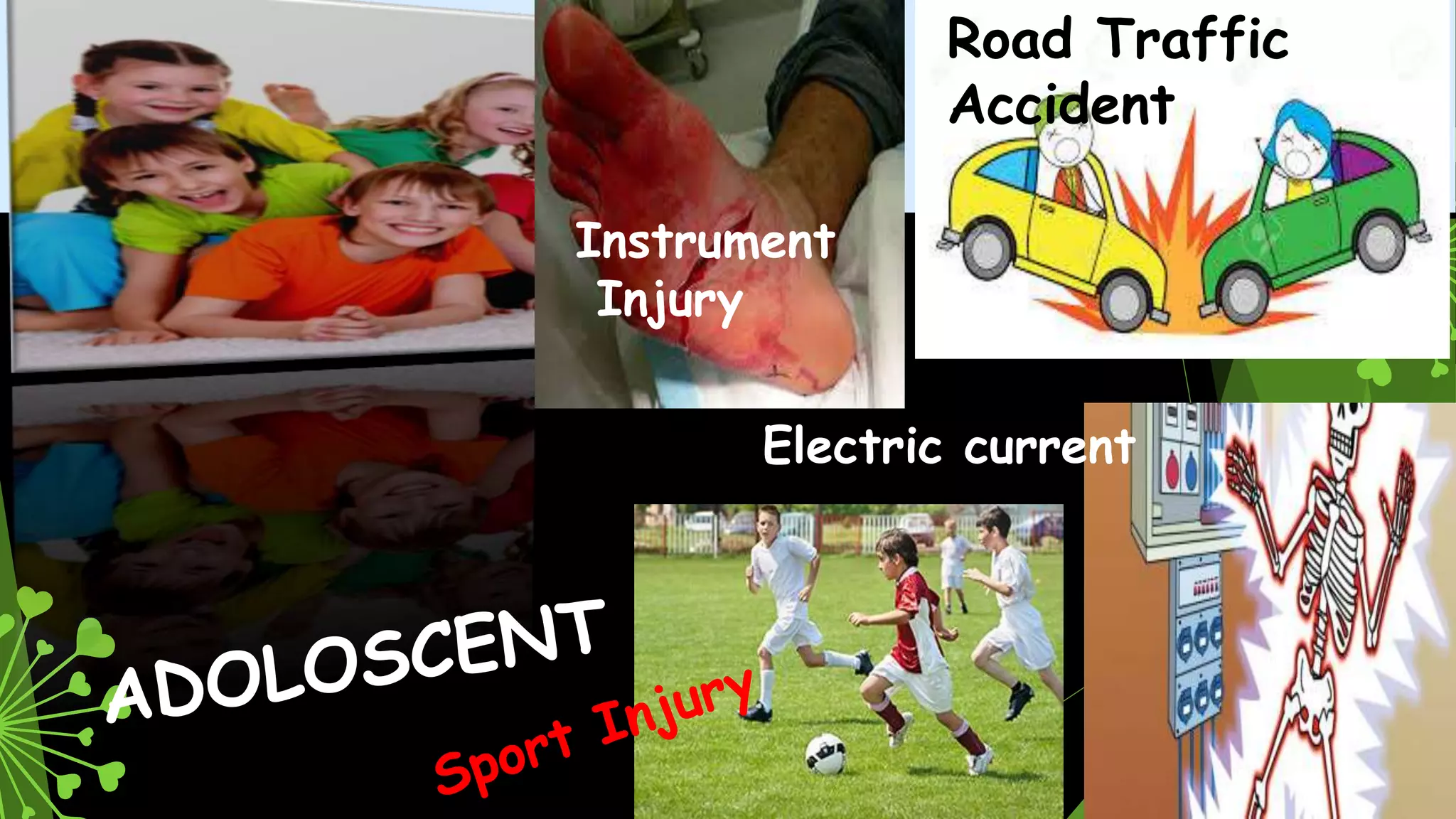
Instrument
Injury
Road Traffic
Accident
Electric current
PREVENTION
Constant
Supervision
Guidance
Training
Education
Contd…
Teach for safety precautions with fire,electricity,sharp
materials etc.
Teach the child for swimming.
Encourage the playing in safe places to and keep a keen
supervision.
Discourage the children flying kite from open roofs and
terrace.
Teach the child for the road safety and zebra crossing and
traffic rules.
Never leave the child alone in a car with the ‘keys’.
NURSES ROLE
Time
Fore
Thought
Discipline
Forethought –The anticipation of
possible risk of accidents to the child.
Time- Sufficient time should be given on
the child to keep a keen supervision.
Discipline- Should be maintained at home
to prevent accidental hazards.
e
Health Education
Provision of safe enviorment
Safe child care and prevent the accidental hazards
Assist in medical care to prevent the disability
Take public health measures to prevent road traffic
accidents: teach traffic rules,implement policies etc.
Participate in policy making nd research activities in
accident prevention.
NURSING RESPONSIBILITIES
THANK
YOU

Accident prevention in children

  • 2.
    PREVENTION OF ACCIDENTS INCHILDREN Ms. Devangi Sharma N F.Y M.Sc(N)
  • 3.
    CHILDREN ARE VULNERABLETO INJURY  Natural curiosity  Investigative, Impulsive, Impatient  Less careful,hyperactive  Drive to test on new master skills  Attempted activities before developmental readiness  Self-assertion and challenges to rules  Desire for peer approval
  • 4.
    DEFINATION WHO defined… An accidentis an event, independent of human will caused by outside force acting rapidly and resulting in physical or mental injury.
  • 5.
    Contd…  Accident isdefined an unexpected , unplanned occurrence which may involve injury.  Unpremeditated event resulting in recognizable damage.  Occurrence in sequence of events which usually produces uninteded injury, death or property damage.
  • 6.
    INJURY It is an intentional/unintentional damageto body due to exposure to an external agent which can be thermal, mechanical, electrical, or chemical energy or agent.
  • 8.
    CHILDREN ARE ATGREATER RISK  Children live in a world built for adults: strong association between injuries  his age, developmental stage  his interactions and activities with/in the world  lack of supervision, access to protective materials  Simply reproducing injury strategies for adults may not be effective for children  World becomes dangerous for them: cleaning chemicals, outlets, ovens, sharp corners, kerosene lamps, bodies of water, traffic, etc.
  • 9.
    CHILDHOOD ACCIDENTS Leading causeof death and disability in children and young adults More than 5 million deaths per year worldwide Lack of global attention to childhood injuries Leading cause of death in children over 1 year 0% 5% 10% 15% 20% 25% 30% <1year 1-4years >5years SIDS Congenitalanomaly Infecton Neoplasms Accidents
  • 10.
  • 11.
  • 12.
    COMMON ACCIDENTAL INJURY ANDITS PREVENTION IN DIFFERENT AGE GROUP
  • 13.
  • 14.
  • 15.
    Contd… Never leave aninfant alone on cot/table/ any unprotected place to prevent fall. Never give very small things to child. Toys should not have removable small parts which can be aspirated or put into ear or nose. Never feed solids which are difficult to swallow /chew.
  • 16.
    Contd… Coins .buttons. beads,marblesmust not be left within child’s reach. Keep the stove or fire source and hot things far away from child. Electrical appliances should be kept out of reach. Never leave the infant near water tub or pond and never go out alone.
  • 17.
  • 18.
  • 19.
    Contd… Give proper directionsfor certain activity. Keep constant supervision. Keep harmful substances like hot things, drugs, poisons,kerosene oils. electrical appliances,sharp objects etc. out of child’s reach. Give adequate instructions to the care taker to look after the child and follow proper precautions. provide safe playmaterials. Floor should not be slippery.
  • 20.
    Furniture should beplaced firmly to prevent falls. Child should not be allowed to play with cord, plastic bags or pillow to avoid suffocation. Electric switch shoul be out of child’s reach. Contd…
  • 21.
  • 22.
  • 23.
    Contd… Teach for safetyprecautions with fire,electricity,sharp materials etc. Teach the child for swimming. Encourage the playing in safe places to and keep a keen supervision. Discourage the children flying kite from open roofs and terrace. Teach the child for the road safety and zebra crossing and traffic rules. Never leave the child alone in a car with the ‘keys’.
  • 24.
  • 25.
    Forethought –The anticipationof possible risk of accidents to the child. Time- Sufficient time should be given on the child to keep a keen supervision. Discipline- Should be maintained at home to prevent accidental hazards.
  • 26.
    e Health Education Provision ofsafe enviorment Safe child care and prevent the accidental hazards Assist in medical care to prevent the disability Take public health measures to prevent road traffic accidents: teach traffic rules,implement policies etc. Participate in policy making nd research activities in accident prevention. NURSING RESPONSIBILITIES
  • 28.

Editor's Notes

  • #3 ΣΗΜΕΙΩΣΗ: Για να αντικαταστήσετε αυτήν την εικόνα, απλώς επιλέξτε την και διαγράψτε την. Στη συνέχεια, χρησιμοποιήστε το εικονίδιο "Εισαγωγή εικόνας", για να την αντικαταστήσετε με μία από τις δικές σας.
  • #9 The terrible toll of CI. As the father of a 2y-old, I can state with authority: when young children achieve mobility, the Keeping toddlers safe is one of the most important and harrowing jobs for parents, no matter where in the world they live. According to a new report released jointly by UNICEF and the World Health Organization (WHO), more than 2,000 children die every day as a result of accidental injuries. And every year, millions more suffer injuries that leave them with lifelong disabilities. This first-ever comprehensive assessment of unintentional injuries also found that if certain tried and true prevention measures were used worldwide, at least 1,000 children's lives could be saved every day. These measures include child-appropriate seatbelts and helmets, child-resistant medicine packaging and household product containers, swimming pool fences, and separate traffic lanes for bicycles and motorcycles, among many others. Children living in poverty face the greatest risk of life-threatening injuries because they are less likely to have access to protective measures than children from developed countries. More than 95 percent of worldwide child injury deaths occur in low and middle-income countries. As the father of a two-year-old, I can state with authority: when young children achieve mobility, the world around them becomes a lot more dangerous. Hazards are everywhere"cleaning chemicals, outlets, ovens, sharp corners, kerosene lamps and bodies of water, to name a few. Keeping toddlers safe is one of the most important and harrowing jobs for parents, no matter where in the world they live. According to a new report released jointly by UNICEF and the World Health Organization (WHO), more than 2,000 children die every day as a result of accidental injuries. And every year, millions more suffer injuries that leave them with lifelong disabilities. This first-ever comprehensive assessment of unintentional injuries also found that if certain tried and true prevention measures were used worldwide, at least 1,000 children's lives could be saved every day. These measures include child-appropriate seatbelts and helmets, child-resistant medicine packaging and household product containers, swimming pool fences, and separate traffic lanes for bicycles and motorcycles, among many others. Children living in poverty face the greatest risk of life-threatening injuries because they are less likely to have access to protective measures than children from developed countries. More than 95 percent of worldwide child injury deaths occur in low and middle-income countries. The report's authors note that child injuries have not received enough attention over the years and that the issue is often absent from child survival initiatives. UNICEF and the WHO have set out to raise awareness of this serious problem and to make sure everyone understands that these injuries are preventable.