DROWNING
AND
NEAR DROWNING
PRESENTED BY:-
Dr.K.AGASYA RAJ
WHAT IS DROWNING?
“The process of experiencing
respiratory impairment from
submersion/immersion in liquid ”
It is a form of asphyxia.
Caused due to aspiration of fluids
Epidemiology
Incidence of drowning- 2.5 lakhs to 3.5
lakhs every year
India & China account for 43% deaths.
Males>Females
1-4 yrs & 15-19 yrs(M.C)
Drowning second most common
accidental cause of death in children
Causes of Drowning
CHILDREN YOUNGER THAN 1 YR :
◦• BATHTUB(71%)
◦ • HOUSEHOLD BUCKETS(16%)
CHILDREN 1-4 YR :
◦ • POOL
◦ • IRRIGATION DITCHES
◦ • NEARBY PONDS & RIVERS.
• SCHOOL AGE CHILDREN
◦• SWIMMING OR BOATING ACTIVITIES.
◦• NATURAL WATER RESERVOIRS :
LAKES, PONDS, RIVERS, CANALS.
Causes of Drowning
ADOLESCENT
l M : F = 10 : 1.
◦(LIKELY DUE TO GREATER RISK
TAKING & ALCOHOL USE.)
◦70 % DEATHS DUE TO DROWNING IN
NATURAL WATER RESERVOIRS.
• UNDERLYING CONDITIONS
◦ EPILEPSY
◦ VENTRICULAR ARRHYTHMIAS
◦ ALCOHOL USE
◦ WATER SPORTS & RECREATIONAL
ACTIVITIES
Classification of drowning.
According to type of water
◦Fresh-water drowning: Lakes,pools,rivers
◦Salt-water drowning: seas (about 3%
saline)
• According to water temperature
◦Warm-water drowning: temperatures of >
20° C
lCold-water drowning: temperatures of
<20° C
◦Very-cold-water drowning: temperatures of
<5ºC
TYPES OF DROWNING
FOUR TYPES:-
1.WET DROWNING
2.DRY DROWNING
3.SECONDARY/NEAR DROWNING
4.IMMERSION SYNDROME
WET DROWNING
Water is inhaled into lungs
Victim has severe chest pain
On resuscitation: no pleasant
recollections
Death occurs due to Cardiac arrest or
ventricular fibrillation
Dry drowning
Water does not enter lungs
On resuscitation : panoramic views of
past life.
Death occurs by immediate sustained
laryngeal spasm due to inrush of water
into nasopharynx and larynx
Secondary drowning (near
drowning)
Refers to a submerged victim who is
resuscitated and survives for 24 hours
Death occurs ( from 1/2 h to several
days) by cerebral anoxia & irreversible
brain damage
Immersion Syndrome
Death occurs by cardiac arrest caused
by vagal inhibition (cold water
stimulating nerve endings & water
striking epigastrium & Alcohol induce
such effect)
Mostly seen in suicide cases.
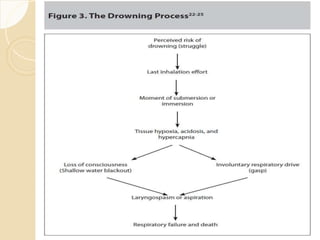
Stages of drowning
Stage of surprise(5-10 secs)
Stage of 1st resp.arrest.(1-2 min)
Stage of deep respiration(1 min)
Stage of 2nd resp.arrest (1 min)
Stage of terminal gasp.
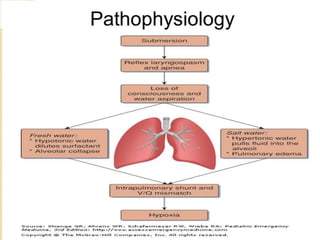
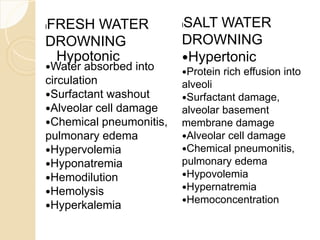
lFRESH WATER
DROWNING
Water absorbed into
circulation
Surfactant washout
Alveolar cell damage
Chemical pneumonitis,
pulmonary edema
Hypervolemia
Hyponatremia
Hemodilution
Hemolysis
Hyperkalemia
lSALT WATER
DROWNING
Hypertonic
Protein rich effusion into
alveoli
Surfactant damage,
alveolar basement
membrane damage
Alveolar cell damage
Chemical pneumonitis,
pulmonary edema
Hypovolemia
Hypernatremia
Hemoconcentration
Hypotonic
Cause of death
Asphyxia: due to airway obstruction
Hypothermia
Ventricular fibrillation: due to anoxia &
disturbed sodium-potassium ratio
Laryngeal spasm
Vagal inhibition: in icy water due to high
emotion & unexpected immersion
Exhaustion
Injury
SYMPTOMS AND SIGNS
75% of kids who develop symptoms do
so within 7 hours of event
Coma to agitated alertness
Cyanosis, coughing, and the production
of frothy white sputum
Tachypnea, tachycardia
Low-grade fever
Rales, rhonchi & less often wheezes
Signs of associated trauma to the head
and neck should be sought
History is the most important
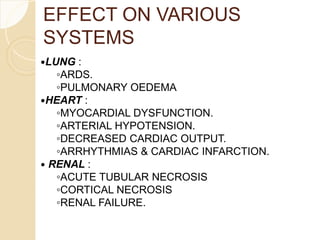
EFFECT ON VARIOUS
SYSTEMS
LUNG :
◦ARDS.
◦PULMONARY OEDEMA
HEART :
◦MYOCARDIAL DYSFUNCTION.
◦ARTERIAL HYPOTENSION.
◦DECREASED CARDIAC OUTPUT.
◦ARRHYTHMIAS & CARDIAC INFARCTION.
 RENAL :
◦ACUTE TUBULAR NECROSIS
◦CORTICAL NECROSIS
◦RENAL FAILURE.
VASCULAR ENDOTHELIAL INJURY MAY INITIATE
◦DIC,
◦HEMOLYSIS,
◦THROMBOCYTOPENIA.
 GASTROINTESTINAL DAMAGE :
◦BLOODY DIARRHEA WITH MUCOSAL
SLOUGHING.
◦SERUM LEVELS OF HEPATIC
TRANSAMINASES AND PANCREATIC
ENZYMES ARE OFTEN ACUTELY INCREASED.
VIOLATION OF NORMAL MUCOSAL
PROTECTIVE BARRIERS PREDISPOSES THE
VICTIM TO BACTEREMIA AND PULMONARY
INFECTIONS
Management
PRE-HOSPITAL MANAGEMENT
HOSPITAL BASED MANAGEMENT
lED MANAGEMENT
lPICU MANAGEMENT
◦CARDIORESPIRATORY
◦NEUROLOGICAL
◦HYPOTHERMIA
◦OTHER
Pre hospital management
ABC’s
Initiation of ventilation is the only way to
interrupt the submersion time
C-Spine control, backboard
IV, O2, monitor, pulse ox
Correction of acidosis by sodium
bicarbonate
NO HEIMLICH
Passive Rewarming
Rapid Transport
All near drowning victims need
evaluation at a medical facility
Hospital management
OBSERVATION 6-8 HRS
MONITORING-VITALS
REPEAT RESPIRATORY SYSTEM
EXAMINATION AND NEUROLOGICAL
STATUS
If SYMPTOMS DECREASE AND
SAO2 ACHIEVED VICTIM CAN BE
DISCHARGED
Hospital management
Management in ED
◦ABC’s, with C-spine control
◦IV, O2, Monitor, Pulse Ox
◦CXR
◦ABGs
◦Electrolytes
◦Trauma workup
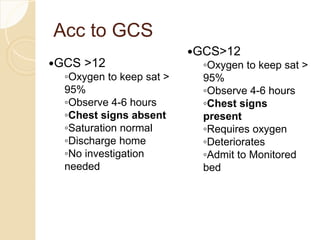
Acc to GCS
GCS >12
◦Oxygen to keep sat >
95%
◦Observe 4-6 hours
◦Chest signs absent
◦Saturation normal
◦Discharge home
◦No investigation
needed
GCS>12
◦Oxygen to keep sat >
95%
◦Observe 4-6 hours
◦Chest signs
present
◦Requires oxygen
◦Deteriorates
◦Admit to Monitored
bed
Acc to GCS
GCS <13
◦High flow oxygen
◦Intubation for low PaO2
◦CXR, Labs
◦Continuous cardiac monitoring
◦Frequent reassessments
Cardiopulmonary
resuscitationETT INTUBATION
ADEQUATE OXYGENATION
FLUID RESUSCITATION-ISOTONIC FLUIDS
INOTROPIC AGENTS SHOULD BE
JUDICIOUSLY USED
PERSISTENT CARDIOPULMONARY
ARREST ON ARRIVAL ALONG WITH
• APNEA.
• ABSENCE OF PUPILLARY RESPONSES.
• HYPERGLYCEMIA.
• SUBMERSION DURATIONS >10 MIN.
• FAILURE OF RESPONSE TO CPR GIVEN
FOR 25 MIN.
NEUROLOGICAL MANAGEMENT
HYPOTHERMIA
Passive External
Active External
Active Internal
◦IV
◦Vent
◦NG/Bladder/Peritoneal
OTHER MANAGEMENT
ISSUES
ACUTE RENAL
FAILURE :
• DIURETICS,
• FLUID RESTRICTION.
• DIALYSIS IF
REQUIRED
PROFUSE BLOODY
DIARRHEA AND
MUCOSAL SLOUGHING
:
• BOWEL REST.
• NASOGASTRIC
SUCTION.
FEVER
◦COMMON IN 50%
CASES WITHIN 24
HRS
◦PROPHYLACTIC
ANTIBIOTICS ARE
RECOMMENDED
ONLY IF
PNEUMONIA IS
SUSPECTED
Drowning
Drowning
Drowning

Drowning

  • 1.
  • 2.
    WHAT IS DROWNING? “Theprocess of experiencing respiratory impairment from submersion/immersion in liquid ” It is a form of asphyxia. Caused due to aspiration of fluids
  • 3.
    Epidemiology Incidence of drowning-2.5 lakhs to 3.5 lakhs every year India & China account for 43% deaths. Males>Females 1-4 yrs & 15-19 yrs(M.C) Drowning second most common accidental cause of death in children
  • 4.
    Causes of Drowning CHILDRENYOUNGER THAN 1 YR : ◦• BATHTUB(71%) ◦ • HOUSEHOLD BUCKETS(16%) CHILDREN 1-4 YR : ◦ • POOL ◦ • IRRIGATION DITCHES ◦ • NEARBY PONDS & RIVERS. • SCHOOL AGE CHILDREN ◦• SWIMMING OR BOATING ACTIVITIES. ◦• NATURAL WATER RESERVOIRS : LAKES, PONDS, RIVERS, CANALS.
  • 5.
    Causes of Drowning ADOLESCENT lM : F = 10 : 1. ◦(LIKELY DUE TO GREATER RISK TAKING & ALCOHOL USE.) ◦70 % DEATHS DUE TO DROWNING IN NATURAL WATER RESERVOIRS. • UNDERLYING CONDITIONS ◦ EPILEPSY ◦ VENTRICULAR ARRHYTHMIAS ◦ ALCOHOL USE ◦ WATER SPORTS & RECREATIONAL ACTIVITIES
  • 6.
    Classification of drowning. Accordingto type of water ◦Fresh-water drowning: Lakes,pools,rivers ◦Salt-water drowning: seas (about 3% saline) • According to water temperature ◦Warm-water drowning: temperatures of > 20° C lCold-water drowning: temperatures of <20° C ◦Very-cold-water drowning: temperatures of <5ºC
  • 7.
    TYPES OF DROWNING FOURTYPES:- 1.WET DROWNING 2.DRY DROWNING 3.SECONDARY/NEAR DROWNING 4.IMMERSION SYNDROME
  • 8.
    WET DROWNING Water isinhaled into lungs Victim has severe chest pain On resuscitation: no pleasant recollections Death occurs due to Cardiac arrest or ventricular fibrillation
  • 9.
    Dry drowning Water doesnot enter lungs On resuscitation : panoramic views of past life. Death occurs by immediate sustained laryngeal spasm due to inrush of water into nasopharynx and larynx
  • 10.
    Secondary drowning (near drowning) Refersto a submerged victim who is resuscitated and survives for 24 hours Death occurs ( from 1/2 h to several days) by cerebral anoxia & irreversible brain damage
  • 11.
    Immersion Syndrome Death occursby cardiac arrest caused by vagal inhibition (cold water stimulating nerve endings & water striking epigastrium & Alcohol induce such effect) Mostly seen in suicide cases.
  • 13.
    Stages of drowning Stageof surprise(5-10 secs) Stage of 1st resp.arrest.(1-2 min) Stage of deep respiration(1 min) Stage of 2nd resp.arrest (1 min) Stage of terminal gasp.
  • 15.
    lFRESH WATER DROWNING Water absorbedinto circulation Surfactant washout Alveolar cell damage Chemical pneumonitis, pulmonary edema Hypervolemia Hyponatremia Hemodilution Hemolysis Hyperkalemia lSALT WATER DROWNING Hypertonic Protein rich effusion into alveoli Surfactant damage, alveolar basement membrane damage Alveolar cell damage Chemical pneumonitis, pulmonary edema Hypovolemia Hypernatremia Hemoconcentration Hypotonic
  • 16.
    Cause of death Asphyxia:due to airway obstruction Hypothermia Ventricular fibrillation: due to anoxia & disturbed sodium-potassium ratio Laryngeal spasm Vagal inhibition: in icy water due to high emotion & unexpected immersion Exhaustion Injury
  • 17.
    SYMPTOMS AND SIGNS 75%of kids who develop symptoms do so within 7 hours of event Coma to agitated alertness Cyanosis, coughing, and the production of frothy white sputum Tachypnea, tachycardia Low-grade fever Rales, rhonchi & less often wheezes Signs of associated trauma to the head and neck should be sought History is the most important
  • 18.
    EFFECT ON VARIOUS SYSTEMS LUNG: ◦ARDS. ◦PULMONARY OEDEMA HEART : ◦MYOCARDIAL DYSFUNCTION. ◦ARTERIAL HYPOTENSION. ◦DECREASED CARDIAC OUTPUT. ◦ARRHYTHMIAS & CARDIAC INFARCTION.  RENAL : ◦ACUTE TUBULAR NECROSIS ◦CORTICAL NECROSIS ◦RENAL FAILURE.
  • 19.
    VASCULAR ENDOTHELIAL INJURYMAY INITIATE ◦DIC, ◦HEMOLYSIS, ◦THROMBOCYTOPENIA.  GASTROINTESTINAL DAMAGE : ◦BLOODY DIARRHEA WITH MUCOSAL SLOUGHING. ◦SERUM LEVELS OF HEPATIC TRANSAMINASES AND PANCREATIC ENZYMES ARE OFTEN ACUTELY INCREASED. VIOLATION OF NORMAL MUCOSAL PROTECTIVE BARRIERS PREDISPOSES THE VICTIM TO BACTEREMIA AND PULMONARY INFECTIONS
  • 20.
    Management PRE-HOSPITAL MANAGEMENT HOSPITAL BASEDMANAGEMENT lED MANAGEMENT lPICU MANAGEMENT ◦CARDIORESPIRATORY ◦NEUROLOGICAL ◦HYPOTHERMIA ◦OTHER
  • 21.
    Pre hospital management ABC’s Initiationof ventilation is the only way to interrupt the submersion time C-Spine control, backboard IV, O2, monitor, pulse ox Correction of acidosis by sodium bicarbonate NO HEIMLICH Passive Rewarming Rapid Transport All near drowning victims need evaluation at a medical facility
  • 23.
    Hospital management OBSERVATION 6-8HRS MONITORING-VITALS REPEAT RESPIRATORY SYSTEM EXAMINATION AND NEUROLOGICAL STATUS If SYMPTOMS DECREASE AND SAO2 ACHIEVED VICTIM CAN BE DISCHARGED
  • 24.
    Hospital management Management inED ◦ABC’s, with C-spine control ◦IV, O2, Monitor, Pulse Ox ◦CXR ◦ABGs ◦Electrolytes ◦Trauma workup
  • 25.
    Acc to GCS GCS>12 ◦Oxygen to keep sat > 95% ◦Observe 4-6 hours ◦Chest signs absent ◦Saturation normal ◦Discharge home ◦No investigation needed GCS>12 ◦Oxygen to keep sat > 95% ◦Observe 4-6 hours ◦Chest signs present ◦Requires oxygen ◦Deteriorates ◦Admit to Monitored bed
  • 26.
    Acc to GCS GCS<13 ◦High flow oxygen ◦Intubation for low PaO2 ◦CXR, Labs ◦Continuous cardiac monitoring ◦Frequent reassessments
  • 27.
    Cardiopulmonary resuscitationETT INTUBATION ADEQUATE OXYGENATION FLUIDRESUSCITATION-ISOTONIC FLUIDS INOTROPIC AGENTS SHOULD BE JUDICIOUSLY USED PERSISTENT CARDIOPULMONARY ARREST ON ARRIVAL ALONG WITH • APNEA. • ABSENCE OF PUPILLARY RESPONSES. • HYPERGLYCEMIA. • SUBMERSION DURATIONS >10 MIN. • FAILURE OF RESPONSE TO CPR GIVEN FOR 25 MIN.
  • 28.
  • 29.
    HYPOTHERMIA Passive External Active External ActiveInternal ◦IV ◦Vent ◦NG/Bladder/Peritoneal
  • 30.
    OTHER MANAGEMENT ISSUES ACUTE RENAL FAILURE: • DIURETICS, • FLUID RESTRICTION. • DIALYSIS IF REQUIRED PROFUSE BLOODY DIARRHEA AND MUCOSAL SLOUGHING : • BOWEL REST. • NASOGASTRIC SUCTION. FEVER ◦COMMON IN 50% CASES WITHIN 24 HRS ◦PROPHYLACTIC ANTIBIOTICS ARE RECOMMENDED ONLY IF PNEUMONIA IS SUSPECTED