COMMON ROUND
Pediatric Drowning
 PREPEARED BY DR HASAN MASRI
 SUPERVISED BY DR YEHYA AL JAMAL
5 YRS OLD MALE PT ,DISCOVERED ACCEDENTALLY WITH UNKNOWN TIME
SUBMERION IN DIRTY HALL ,THE PT ARRIVED TO ER WITH CARDIAC
ARESSTED
(CPR DONE WITH 2 DOSE OF ADRENALIN AND 1 DOSE OF ATROPIN )
THE CPR SUCCESSFUL AND THE HEART RETUREN TO BEAT IN NORMAL
PATTERN
 ON ARRIVAL THE PT
 Intubated And Wet Clothes Removed
 Modified GCS =3/15 (M=1,V=1,E=1)
 Cold Body
 Peeled Skin
 No Pain Response
 Dilated Fixed Pupils , Non Reactive To
Light
 Hr :~63
 Unrecorded BP , Sat And Temp .
 After Stabilization Pt Transferred
Immediately To PICU By Ambulance
 IN PICU THE PT CONECTED TO SIMV
 ALL LABS SENT IMMEDIATLLY TO LAB
 CXR ORDERED
 PUT UNDER HEATER TO INCRESE THE TEMP
SLOWLLY
 IV ACCESS CONECTED
 FOLYS CATH APPLIED
 THE PT ON NEUROLOGICAL EXAM :
 MODIFIED GCS = 2+1+1(4 /15)
 INTUBATED
 DILATED FIXED PUPILE
 FLEXION WITH PAIN IN LOWER LIMB
 DECORTECATED IN UPPER LIMB
 INCREASE TEMP SLOWLLY
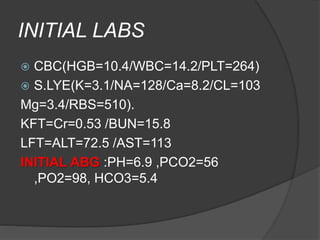
INITIAL LABS
 CBC(HGB=10.4/WBC=14.2/PLT=264)
 S.LYE(K=3.1/NA=128/Ca=8.2/CL=103
Mg=3.4/RBS=510).
KFT=Cr=0.53 /BUN=15.8
LFT=ALT=72.5 /AST=113
INITIAL ABG :PH=6.9 ,PCO2=56
,PO2=98, HCO3=5.4
 GIVEN STATE MIDAZOLAM AS TONIC MOVEMENT IN
UPPER LIMB THEN STARTED MIDAZOLAM INFUSION
 GIVEN PHYNITOIN LOADING
 ABX STARTED (ROCEPHIN + TAZOCIN )
 FLEXION WITH PAIN IN LOWER LIMB ,DECORTECATED
IN UPPER LIMB,EXTENSION OF LOWER LIMB .
GCS 5
 BRAIN CT WITHOUT CONTRAST WAS DONE AND
INITIALLY SHOW ELEMENT OF BRAIN EDEMA
 NO REPORT
 GIVEN MANITOL
 DOPAMION INFUSSION STARTED
 2ND DAY
 TAZOCIN CONT
 MIDAZOLAM INFUSION
 DOPAMION INFUSSION
 CONT 0.9 % N/S 40CC /HR (2/3 MAIN )
 CONT ON H.T.S
 MIDAZOLAM DECRESED GRADUALLY
 STARTED PHYNITOIN MAIN
 NEUROLOGICAL F/U
 SLOWLLY SLUGISH PUPILS REACTION BIL TO LIGHT
 DECORTECATED UPPER LIMB ,MINIMAL LOWER LIMB EXTENTION
TO PAIN
 INTUBATED
3RD DAY
 TAZOCIN CONT
 MIDAZOLAM INFUSION
 DOPAMION INFUSSION
 CONT 0.9 % N/S 40CC /HR (2/3 MAIN )
 CONT ON H.T.S
 DEXAMETHAZON IV GIVEN AS
PREPARATION FOR EXTUBATION
 LABS DONE
 GIVEN 200 CC PRBCS
 DOPAMIN DECRESED ACCORDING TO BP
MOUNITOR
 NEUROLOGICAL F/U
 SLUGISH PUPILS REACTION BIL
 WITHDROW FROM PAIN
 CONFUSIED
4TH DAY
 =EXTUBATED AND PUT ON N/C
 =STARTED SEPIS OF WATER
 =CONT TAZOCIN
 =D/C MIDAZOLAM
 =D/C DOPAMION INFUSSION
 =CONT ON IVF N/S 0.9%
 =D/C NACL
 =PHYSIOTHERAPY STARTED
 =STARTED ON NEB (VENTO+ ADRENALIN )
 =CXR ORDERED AND SHOWED IMPROVEMENT
 =CONT PHYNITOIN 160 MG Q 24 HR
 =D/C DEXAMETHASONE AT EVEING
 NEUROLOGICALLY :
 PT HAS SPONTANEOUS EYE OPENING
 OBEYS COMMAND
 RECOGNIZE THE MOTHER AND FATHER
5TH DAY
 =CONT TAZOCIN
 =CONT ON 0.9 % N/S
 =PHYSIOTHERAPY
 =CONT ON NEUBILIZER
 =CONT PHYNITOIN MAIN
 NEUROLOGICALLY :
 PT HAS SPONTANEOUS EYE OPENING
 OBEYS COMMAND
 RECOGNIZE THE MOTHER AND FATHER
 CAN WALK ALONE WITH HANDED
6TH DAY
 =PT OFF O2
 =CONT TAZOCIN
 =CONT ON 0.9 % N/S
 =PHYSIOTHERAY
 =CONT ON NEBULIZER (VENTO+ADRENALIN
+BUDISONID)
 =CONT PHYNITOIN MAIN
 = STARTED ON PANTOPRAZOLE
 = STARTED ON AZITHROMYCIN
 NEUROLOGICALLY :
 PT FULLY CONCIOUS ,ORINTED
 CAN WALK ALONE
THE REST OF DAYS
 = CONT ON TAZOCIN FOR 10 DAYS
AND AZITHROMYCIN 5 DAYS
 = CONT ON ADRENALINE NEB
 VENTOLINE NEB
 BUDISONIDE NEB
 = D/C PHENYTOIN ON 7TH DAY
 REACHED TO FULL FEEDING
 SEEN BY ORTHO DUE TO ARM PAIN
AND SWELLING
Terminology
“Drowning is the process of experiencing respiratory
Impairment from submersion/immersion in liquid.”
The use of confusing descriptive terms such as“near,
secondary ,wet , dry . should be abandoned.
The outcome should be denoted as :
 Nonfatal Drowning: drowning process that is interrupted, and
person is rescued.
 Fatal Drowning: person dies any time as a result of drowning.
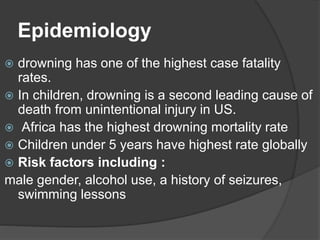
Epidemiology
 drowning has one of the highest case fatality
rates.
 In children, drowning is a second leading cause of
death from unintentional injury in US.
 Africa has the highest drowning mortality rate
 Children under 5 years have highest rate globally
 Risk factors including :
male gender, alcohol use, a history of seizures,
swimming lessons
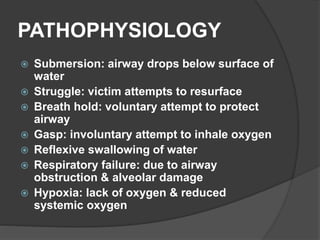
PATHOPHYSIOLOGY
 Submersion: airway drops below surface of
water
 Struggle: victim attempts to resurface
 Breath hold: voluntary attempt to protect
airway
 Gasp: involuntary attempt to inhale oxygen
 Reflexive swallowing of water
 Respiratory failure: due to airway
obstruction & alveolar damage
 Hypoxia: lack of oxygen & reduced
systemic oxygen
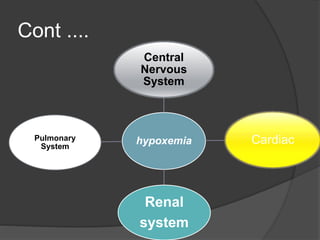
Cont ....
hypoxemia
Central
Nervous
System
Cardiac
Renal
system
Pulmonary
System
First Aid
Management
Unconscious
Immediately CPR
Transfer to
hospital
Conscious
(prolonged)
Aspiration??
YES
O2 SUPPLY
NO
PREPEAR TO ER
DEPARTMENT
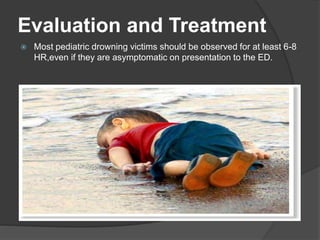
Evaluation and Treatment
 Most pediatric drowning victims should be observed for at least 6-8
HR,even if they are asymptomatic on presentation to the ED.
 Cardiorespiratory Management
 Initial resuscitation must focus on rapidly restoring
oxygenation, ventilation,and adequate circulation.
 Hypercapnia should generally be avoided in
potentially brain-injured children.
 Conditions contributing to myocardial insufficiency
should be avoided as hypothermia , acidosis
,hypoxia …etc
 Continuous ECG monitoring is mandatory for
recognition and treatment of arrhythmias
Neurologic Management
 The most effective neurologic care rapid restoration
of adequate oxygenation, ventilation, and perfusion.
-Alert victim usually have normal neurologic outcomes.
-In comatose victims, irreversible CNS injury is highly
likely.
 Fluid restriction, hyperventilation, administration of
muscle relaxants, osmotic agents, diuretics,
barbiturates, steroids, not shown any benefit for the
victim.
 EEG only limited value and is generally not
recommended,except to detect seizures or
evaluation of brain death
 Seizures should be treated if possible, No evidence
that
treatment of seizures after drowning improves outcome.
 Half of deeply comatose drowning victims admitted
to the PICU die of their hypoxic brain injury or
survive with severe neurologic damage.
Hypothermia Management
 Victims with profound hypothermia may appear
clinically dead, but full neurologic recovery is
possible, lifesaving resuscitation should not be
withheld on the basis of initial clinical presentation
unless the victim is obviously dead (dependent
lividity or rigor mortis).
 The goal is to prevent or treat moderate or severe
hypothermia.
 Rewarming efforts should usually be continued
until the temperature is 32-34°C
 Complete rewarming is not indicated for all arrest
victims before resuscitative efforts
Other Management
 Hyperglycemia is associated with a poor outcome in
pediatric drowning victims. Its etiology is unclear but
it is possibly a stress response.
 Manifestations of acute kidney injury may be seen
after hypoxic–ischemic injury Diuretics, fluid
restriction, and dialysis are occasionally needed to
treat fluid overload or electrolyte Disturbances
 Hyperthermia after drowning or other types of brain
injury may increase the risk of mortality and
exacerbate hypoxic–ischemic CNS damage.
 Generally, prophylactic antibiotics are not
recommended.
PROGNOSIS
 Based on :
 the incident and response to treatment at the scene.
 Intact survival or mild neurologic impairment has been
seen in 91% of children with submersion duration<5 min
and in 87% with resuscitation duration <10 min.
 Children with normal sinus rhythm, reactive pupils, or
neurologic responsiveness at the scene always had good
outcomes (99%)
 Poor outcome in patients with deep coma, apnea,
absence of papillary responses, and hyperglycemia in the
ED, with submersion durations >10 min, and with failure
of response to CPR given for 25 min.
 All children with resuscitation durations >25 min either
died or had severe neurologic morbidity, and all victims
with submersion durations >25 min died.
Cont
 Neurologic examination and progression
during the 1st 24-72 hr are the best
prognostic indicators of long-term CNS
outcome.
 Laboratory and technologic methods to
improve prognostic haven't yet proved
superior to neurologic examination .
The most effective way to decrease the
injury of drowning is prevention.
Thanks

Pediatric drowning

  • 1.
    COMMON ROUND Pediatric Drowning PREPEARED BY DR HASAN MASRI  SUPERVISED BY DR YEHYA AL JAMAL
  • 2.
    5 YRS OLDMALE PT ,DISCOVERED ACCEDENTALLY WITH UNKNOWN TIME SUBMERION IN DIRTY HALL ,THE PT ARRIVED TO ER WITH CARDIAC ARESSTED (CPR DONE WITH 2 DOSE OF ADRENALIN AND 1 DOSE OF ATROPIN ) THE CPR SUCCESSFUL AND THE HEART RETUREN TO BEAT IN NORMAL PATTERN
  • 3.
     ON ARRIVALTHE PT  Intubated And Wet Clothes Removed  Modified GCS =3/15 (M=1,V=1,E=1)  Cold Body  Peeled Skin  No Pain Response  Dilated Fixed Pupils , Non Reactive To Light  Hr :~63  Unrecorded BP , Sat And Temp .  After Stabilization Pt Transferred Immediately To PICU By Ambulance
  • 4.
     IN PICUTHE PT CONECTED TO SIMV  ALL LABS SENT IMMEDIATLLY TO LAB  CXR ORDERED  PUT UNDER HEATER TO INCRESE THE TEMP SLOWLLY  IV ACCESS CONECTED  FOLYS CATH APPLIED  THE PT ON NEUROLOGICAL EXAM :  MODIFIED GCS = 2+1+1(4 /15)  INTUBATED  DILATED FIXED PUPILE  FLEXION WITH PAIN IN LOWER LIMB  DECORTECATED IN UPPER LIMB  INCREASE TEMP SLOWLLY
  • 5.
    INITIAL LABS  CBC(HGB=10.4/WBC=14.2/PLT=264) S.LYE(K=3.1/NA=128/Ca=8.2/CL=103 Mg=3.4/RBS=510). KFT=Cr=0.53 /BUN=15.8 LFT=ALT=72.5 /AST=113 INITIAL ABG :PH=6.9 ,PCO2=56 ,PO2=98, HCO3=5.4
  • 6.
     GIVEN STATEMIDAZOLAM AS TONIC MOVEMENT IN UPPER LIMB THEN STARTED MIDAZOLAM INFUSION  GIVEN PHYNITOIN LOADING  ABX STARTED (ROCEPHIN + TAZOCIN )  FLEXION WITH PAIN IN LOWER LIMB ,DECORTECATED IN UPPER LIMB,EXTENSION OF LOWER LIMB . GCS 5  BRAIN CT WITHOUT CONTRAST WAS DONE AND INITIALLY SHOW ELEMENT OF BRAIN EDEMA  NO REPORT  GIVEN MANITOL  DOPAMION INFUSSION STARTED
  • 7.
     2ND DAY TAZOCIN CONT  MIDAZOLAM INFUSION  DOPAMION INFUSSION  CONT 0.9 % N/S 40CC /HR (2/3 MAIN )  CONT ON H.T.S  MIDAZOLAM DECRESED GRADUALLY  STARTED PHYNITOIN MAIN  NEUROLOGICAL F/U  SLOWLLY SLUGISH PUPILS REACTION BIL TO LIGHT  DECORTECATED UPPER LIMB ,MINIMAL LOWER LIMB EXTENTION TO PAIN  INTUBATED
  • 8.
    3RD DAY  TAZOCINCONT  MIDAZOLAM INFUSION  DOPAMION INFUSSION  CONT 0.9 % N/S 40CC /HR (2/3 MAIN )  CONT ON H.T.S  DEXAMETHAZON IV GIVEN AS PREPARATION FOR EXTUBATION  LABS DONE  GIVEN 200 CC PRBCS  DOPAMIN DECRESED ACCORDING TO BP MOUNITOR  NEUROLOGICAL F/U  SLUGISH PUPILS REACTION BIL  WITHDROW FROM PAIN  CONFUSIED
  • 9.
    4TH DAY  =EXTUBATEDAND PUT ON N/C  =STARTED SEPIS OF WATER  =CONT TAZOCIN  =D/C MIDAZOLAM  =D/C DOPAMION INFUSSION  =CONT ON IVF N/S 0.9%  =D/C NACL  =PHYSIOTHERAPY STARTED  =STARTED ON NEB (VENTO+ ADRENALIN )  =CXR ORDERED AND SHOWED IMPROVEMENT  =CONT PHYNITOIN 160 MG Q 24 HR  =D/C DEXAMETHASONE AT EVEING  NEUROLOGICALLY :  PT HAS SPONTANEOUS EYE OPENING  OBEYS COMMAND  RECOGNIZE THE MOTHER AND FATHER
  • 10.
    5TH DAY  =CONTTAZOCIN  =CONT ON 0.9 % N/S  =PHYSIOTHERAPY  =CONT ON NEUBILIZER  =CONT PHYNITOIN MAIN  NEUROLOGICALLY :  PT HAS SPONTANEOUS EYE OPENING  OBEYS COMMAND  RECOGNIZE THE MOTHER AND FATHER  CAN WALK ALONE WITH HANDED
  • 11.
    6TH DAY  =PTOFF O2  =CONT TAZOCIN  =CONT ON 0.9 % N/S  =PHYSIOTHERAY  =CONT ON NEBULIZER (VENTO+ADRENALIN +BUDISONID)  =CONT PHYNITOIN MAIN  = STARTED ON PANTOPRAZOLE  = STARTED ON AZITHROMYCIN  NEUROLOGICALLY :  PT FULLY CONCIOUS ,ORINTED  CAN WALK ALONE
  • 12.
    THE REST OFDAYS  = CONT ON TAZOCIN FOR 10 DAYS AND AZITHROMYCIN 5 DAYS  = CONT ON ADRENALINE NEB  VENTOLINE NEB  BUDISONIDE NEB  = D/C PHENYTOIN ON 7TH DAY  REACHED TO FULL FEEDING  SEEN BY ORTHO DUE TO ARM PAIN AND SWELLING
  • 14.
    Terminology “Drowning is theprocess of experiencing respiratory Impairment from submersion/immersion in liquid.” The use of confusing descriptive terms such as“near, secondary ,wet , dry . should be abandoned. The outcome should be denoted as :  Nonfatal Drowning: drowning process that is interrupted, and person is rescued.  Fatal Drowning: person dies any time as a result of drowning.
  • 15.
    Epidemiology  drowning hasone of the highest case fatality rates.  In children, drowning is a second leading cause of death from unintentional injury in US.  Africa has the highest drowning mortality rate  Children under 5 years have highest rate globally  Risk factors including : male gender, alcohol use, a history of seizures, swimming lessons
  • 16.
    PATHOPHYSIOLOGY  Submersion: airwaydrops below surface of water  Struggle: victim attempts to resurface  Breath hold: voluntary attempt to protect airway  Gasp: involuntary attempt to inhale oxygen  Reflexive swallowing of water  Respiratory failure: due to airway obstruction & alveolar damage  Hypoxia: lack of oxygen & reduced systemic oxygen
  • 17.
  • 19.
    First Aid Management Unconscious Immediately CPR Transferto hospital Conscious (prolonged) Aspiration?? YES O2 SUPPLY NO PREPEAR TO ER DEPARTMENT
  • 20.
    Evaluation and Treatment Most pediatric drowning victims should be observed for at least 6-8 HR,even if they are asymptomatic on presentation to the ED.
  • 21.
     Cardiorespiratory Management Initial resuscitation must focus on rapidly restoring oxygenation, ventilation,and adequate circulation.  Hypercapnia should generally be avoided in potentially brain-injured children.  Conditions contributing to myocardial insufficiency should be avoided as hypothermia , acidosis ,hypoxia …etc  Continuous ECG monitoring is mandatory for recognition and treatment of arrhythmias
  • 22.
    Neurologic Management  Themost effective neurologic care rapid restoration of adequate oxygenation, ventilation, and perfusion. -Alert victim usually have normal neurologic outcomes. -In comatose victims, irreversible CNS injury is highly likely.  Fluid restriction, hyperventilation, administration of muscle relaxants, osmotic agents, diuretics, barbiturates, steroids, not shown any benefit for the victim.  EEG only limited value and is generally not recommended,except to detect seizures or evaluation of brain death  Seizures should be treated if possible, No evidence that treatment of seizures after drowning improves outcome.  Half of deeply comatose drowning victims admitted to the PICU die of their hypoxic brain injury or survive with severe neurologic damage.
  • 23.
    Hypothermia Management  Victimswith profound hypothermia may appear clinically dead, but full neurologic recovery is possible, lifesaving resuscitation should not be withheld on the basis of initial clinical presentation unless the victim is obviously dead (dependent lividity or rigor mortis).  The goal is to prevent or treat moderate or severe hypothermia.  Rewarming efforts should usually be continued until the temperature is 32-34°C  Complete rewarming is not indicated for all arrest victims before resuscitative efforts
  • 24.
    Other Management  Hyperglycemiais associated with a poor outcome in pediatric drowning victims. Its etiology is unclear but it is possibly a stress response.  Manifestations of acute kidney injury may be seen after hypoxic–ischemic injury Diuretics, fluid restriction, and dialysis are occasionally needed to treat fluid overload or electrolyte Disturbances  Hyperthermia after drowning or other types of brain injury may increase the risk of mortality and exacerbate hypoxic–ischemic CNS damage.  Generally, prophylactic antibiotics are not recommended.
  • 25.
    PROGNOSIS  Based on:  the incident and response to treatment at the scene.  Intact survival or mild neurologic impairment has been seen in 91% of children with submersion duration<5 min and in 87% with resuscitation duration <10 min.  Children with normal sinus rhythm, reactive pupils, or neurologic responsiveness at the scene always had good outcomes (99%)  Poor outcome in patients with deep coma, apnea, absence of papillary responses, and hyperglycemia in the ED, with submersion durations >10 min, and with failure of response to CPR given for 25 min.  All children with resuscitation durations >25 min either died or had severe neurologic morbidity, and all victims with submersion durations >25 min died.
  • 26.
    Cont  Neurologic examinationand progression during the 1st 24-72 hr are the best prognostic indicators of long-term CNS outcome.  Laboratory and technologic methods to improve prognostic haven't yet proved superior to neurologic examination .
  • 27.
    The most effectiveway to decrease the injury of drowning is prevention. Thanks