
Prepared By: Prof D.V.Patel
• Larger number of doors cause obstructions and consume more area in
circulation.
• Door should not be located in center of length of wall.
• If there are 2 doors in room, door should preferably be located in
opposite wall, facing each other so as to provide good ventilation and
free air circulation.
• The sill of a window should be located about 70 to 80 cm about floor
level of the room.
• From the point of view of fresh air, a window should be located on
northern side and in the prevalent direction of wind.
BOTTOM
RAIL
TOP
RAIL
PANEL
Prepared By: Prof D.V.Patel
MULLION
STYLE
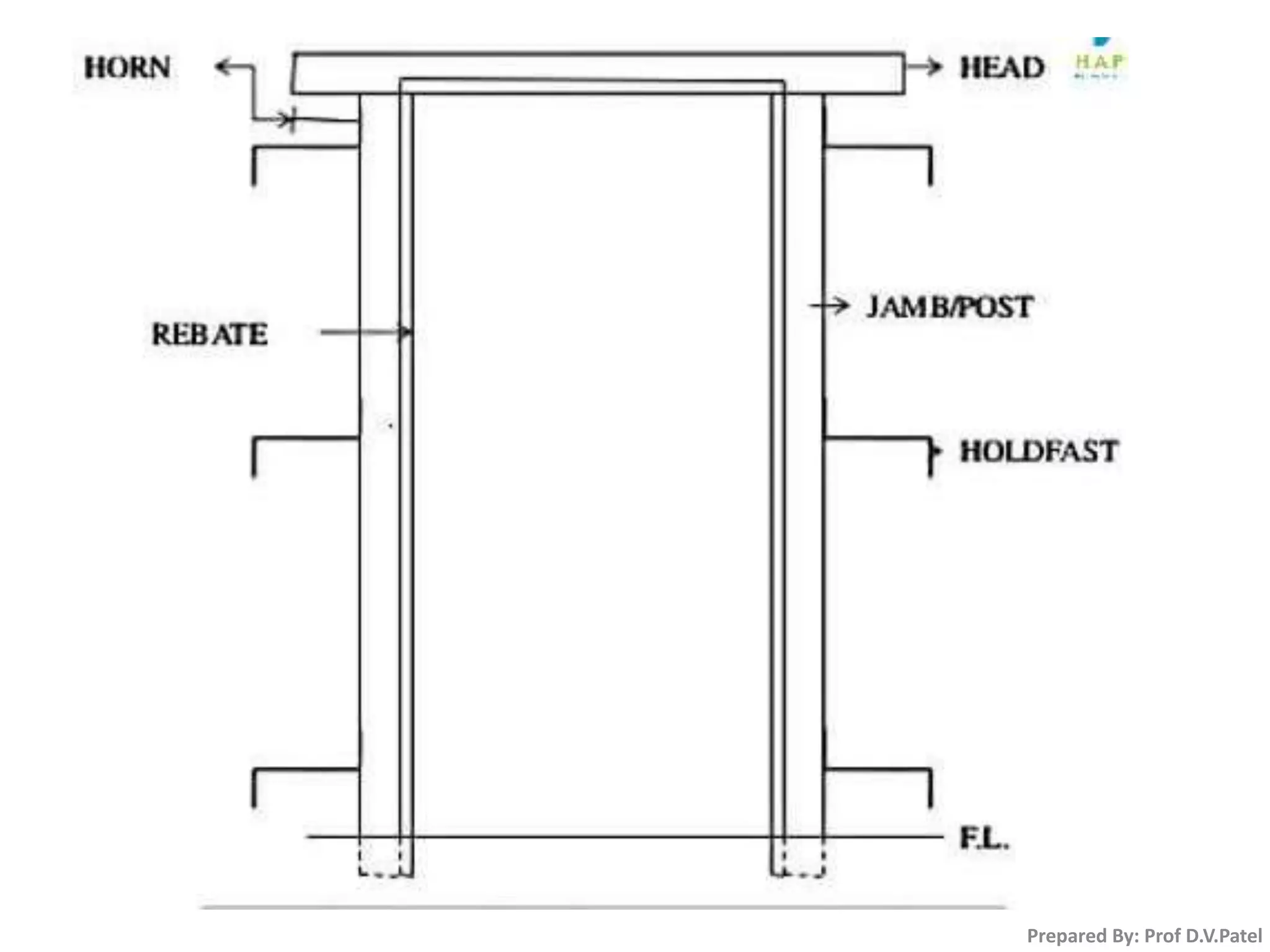
It is depression or recess made
inside the door frame to receive
the door shutter
This is vertical member of a
frame which is employed to
sub-divide a door vertically.
This is vertical outside member
of shutter of door.
Prepared By: Prof D.V.Patel
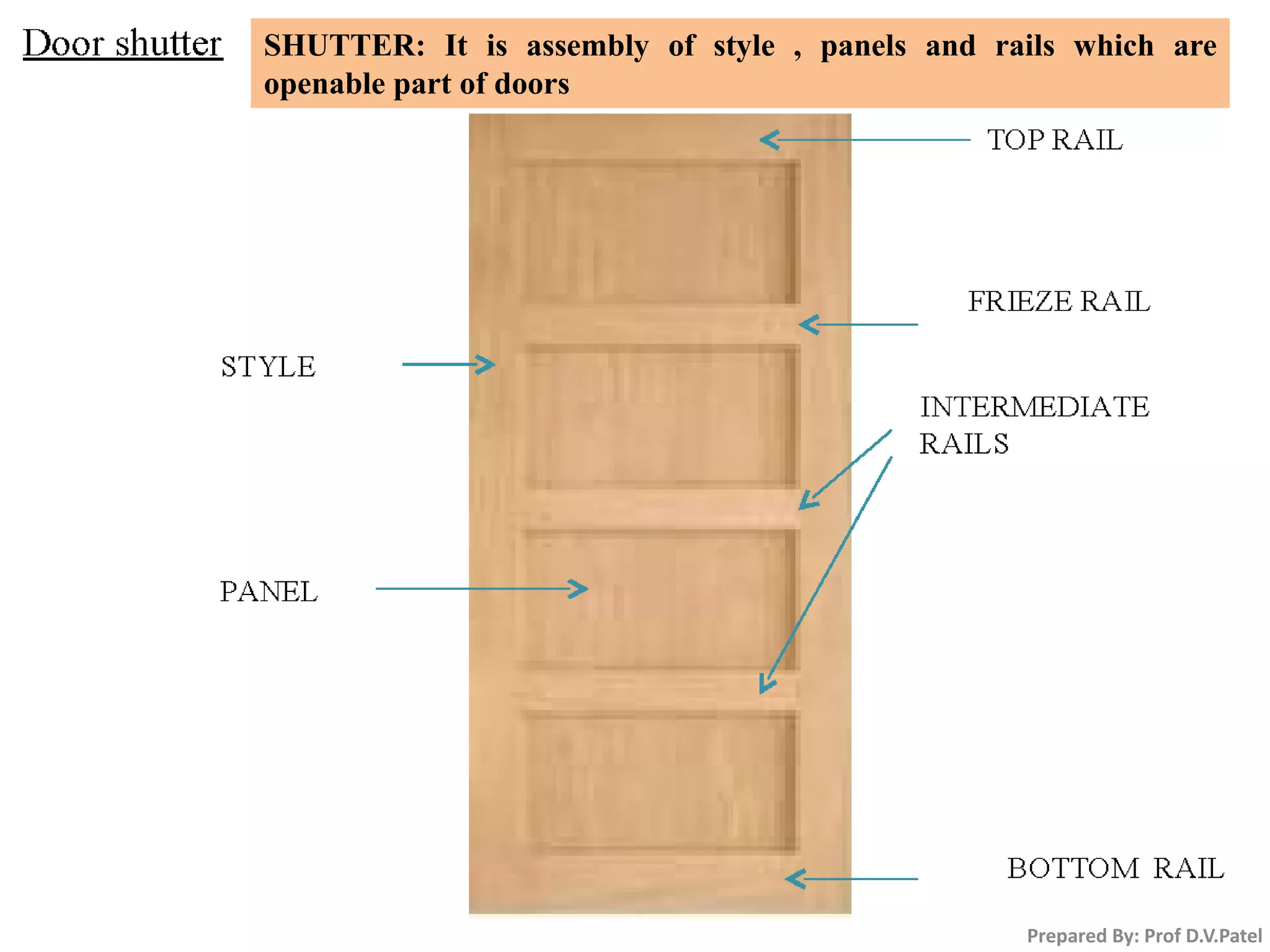
SHUTTER: It is assembly of style , panels and rails which are
openable part of doors
Prepared By: Prof D.V.Patel
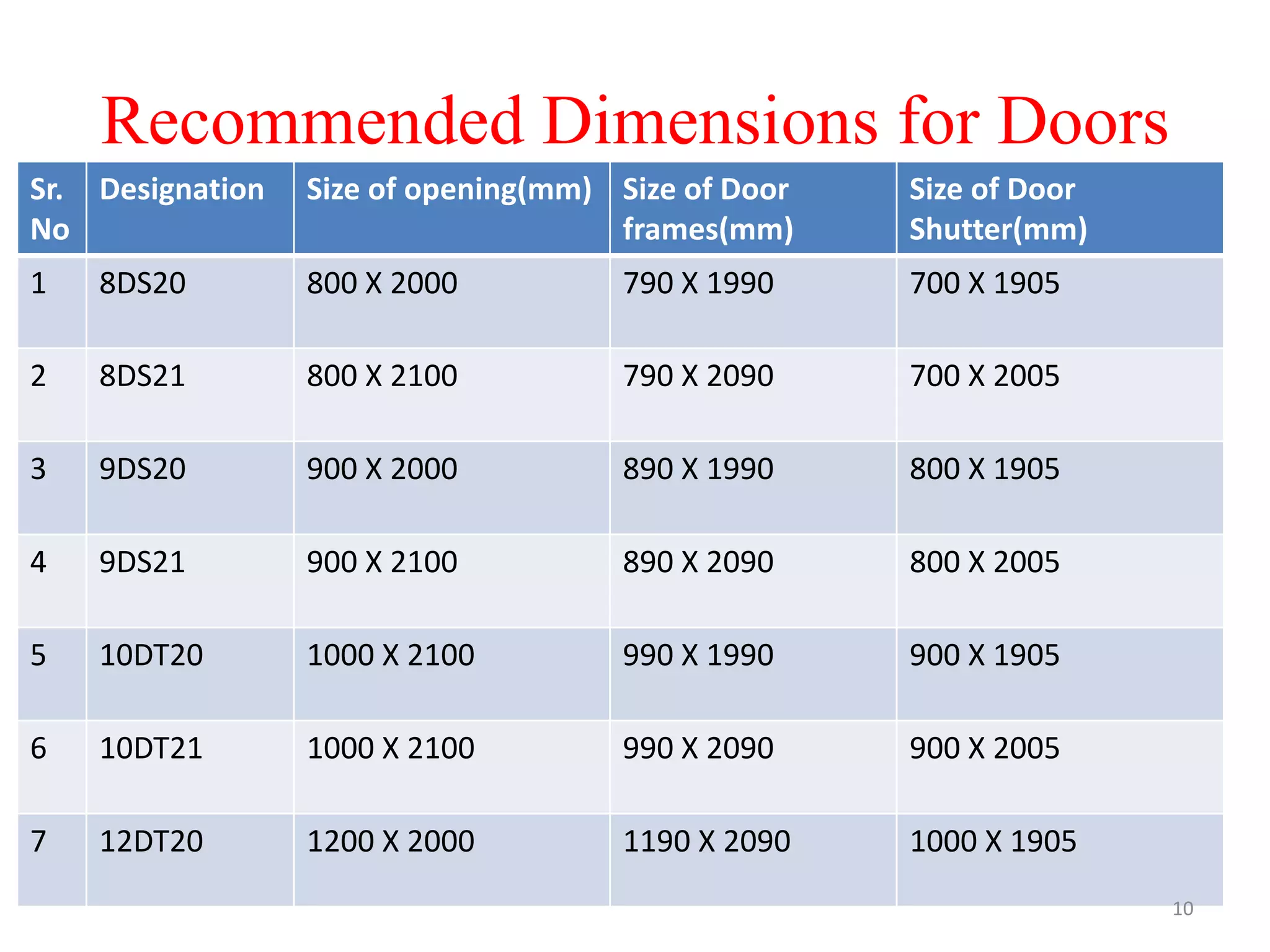
Recommended Dimensions for Doors
Sr.
No
Designation Size of opening(mm) Size of Door
frames(mm)
Size of Door
Shutter(mm)
1 8DS20 800 X 2000 790 X 1990 700 X 1905
2 8DS21 800 X 2100 790 X 2090 700 X 2005
3 9DS20 900 X 2000 890 X 1990 800 X 1905
4 9DS21 900 X 2100 890 X 2090 800 X 2005
5 10DT20 1000 X 2100 990 X 1990 900 X 1905
6 10DT21 1000 X 2100 990 X 2090 900 X 2005
7 12DT20 1200 X 2000 1190 X 2090 1000 X 1905
10
Prepared By: Prof D.V.Patel
WHAT ISDOORFRAME?
And Why it isimportant
It is the surrounding assembly into which a door
fits. Consists of two uprights, jambs and a head
over the top.
• The door frame is most important for a door.
• The primary purpose of the door frame is to
provide a support to the door.
• Door are incomplete without a FRAME.
TYPES OF DOOR FRAMES
Sr
No.
PARTICULARS DRAWBACKS
1 Wooden door
Frames
Not water proof, Termite,
maintenance
2 Aluminum door
frame
Not stable, Poor Screw
Holding, maintenance
3 Iron door frame Screws, Rusting, Low life,
fixing problem.
4 Hollow PVC door
frame
Un stable for heavy doors,
low screw holding
5 UPVC door frame High cost , unstable.
6 Cemented door
frame
Fixing problem, brittle,
heavy, not water proof.
Prepared By: Prof D.V.Patel
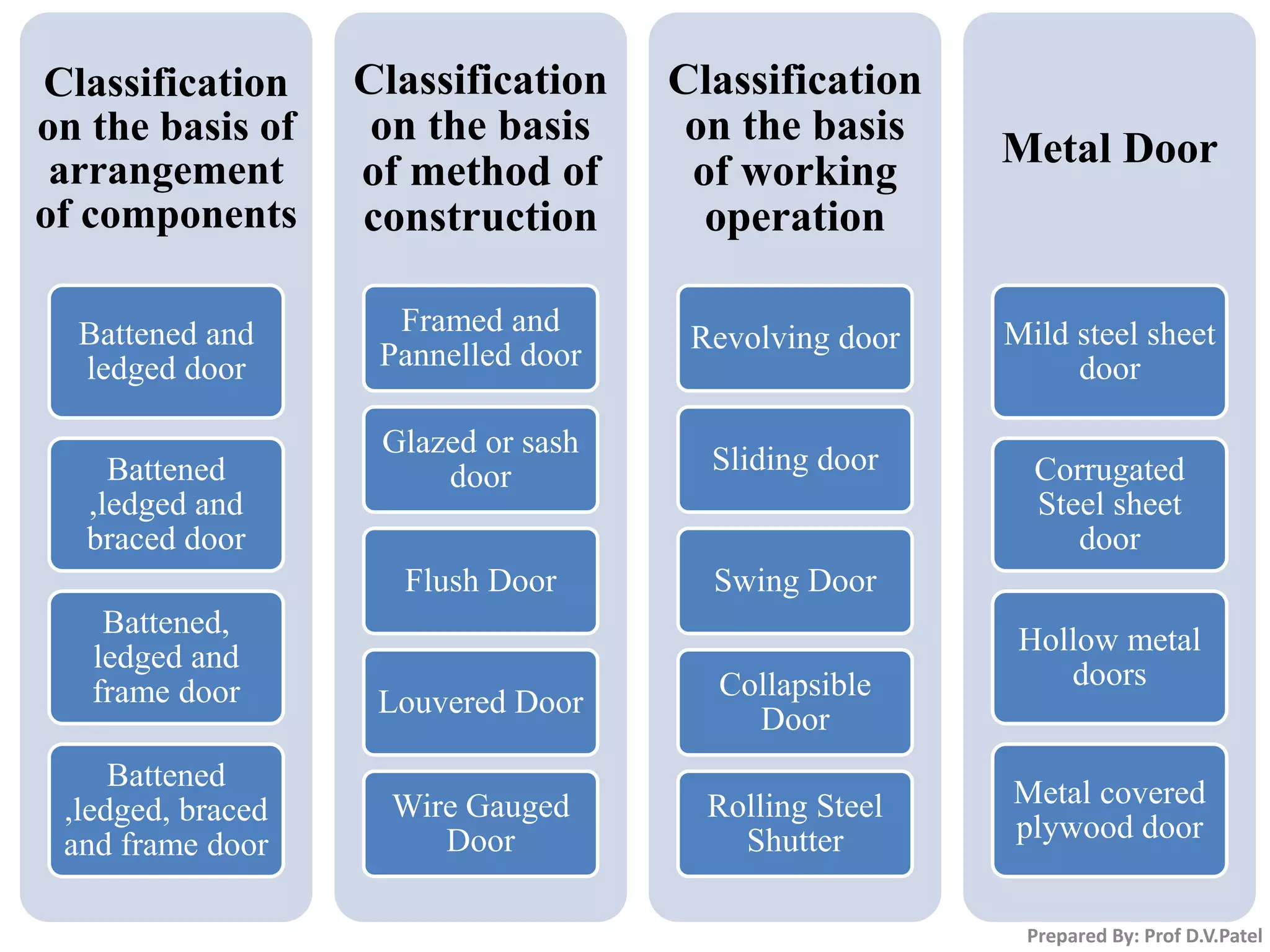
Classification
on the basis of
arrangement
of components
Battened and
ledged door
Battened
,ledged and
braced door
Battened,
ledged and
frame door
Battened
,ledged, braced
and frame door
Classification
on the basis
of method of
construction
Framed and
Pannelled door
Glazed or sash
door
Flush Door
Louvered Door
Wire Gauged
Door
Classification
on the basis
of working
operation
Revolving door
Sliding door
Swing Door
Collapsible
Door
Rolling Steel
Shutter
Metal Door
Mild steel sheet
door
Corrugated
Steel sheet
door
Hollow metal
doors
Metal covered
plywood door
Prepared By: Prof D.V.Patel
• Framework consist of
vertical styles, three ledges
and two inclined braces.
• The braces are normally
housed into rails at about
40mm from the styles.
• The thickness of styles and
top rail is same which is
equal to the thickness of
braces and battens.
• This type is suitable for
external door and door
subjected to rough handling.
Prepared By: Prof D.V.Patel
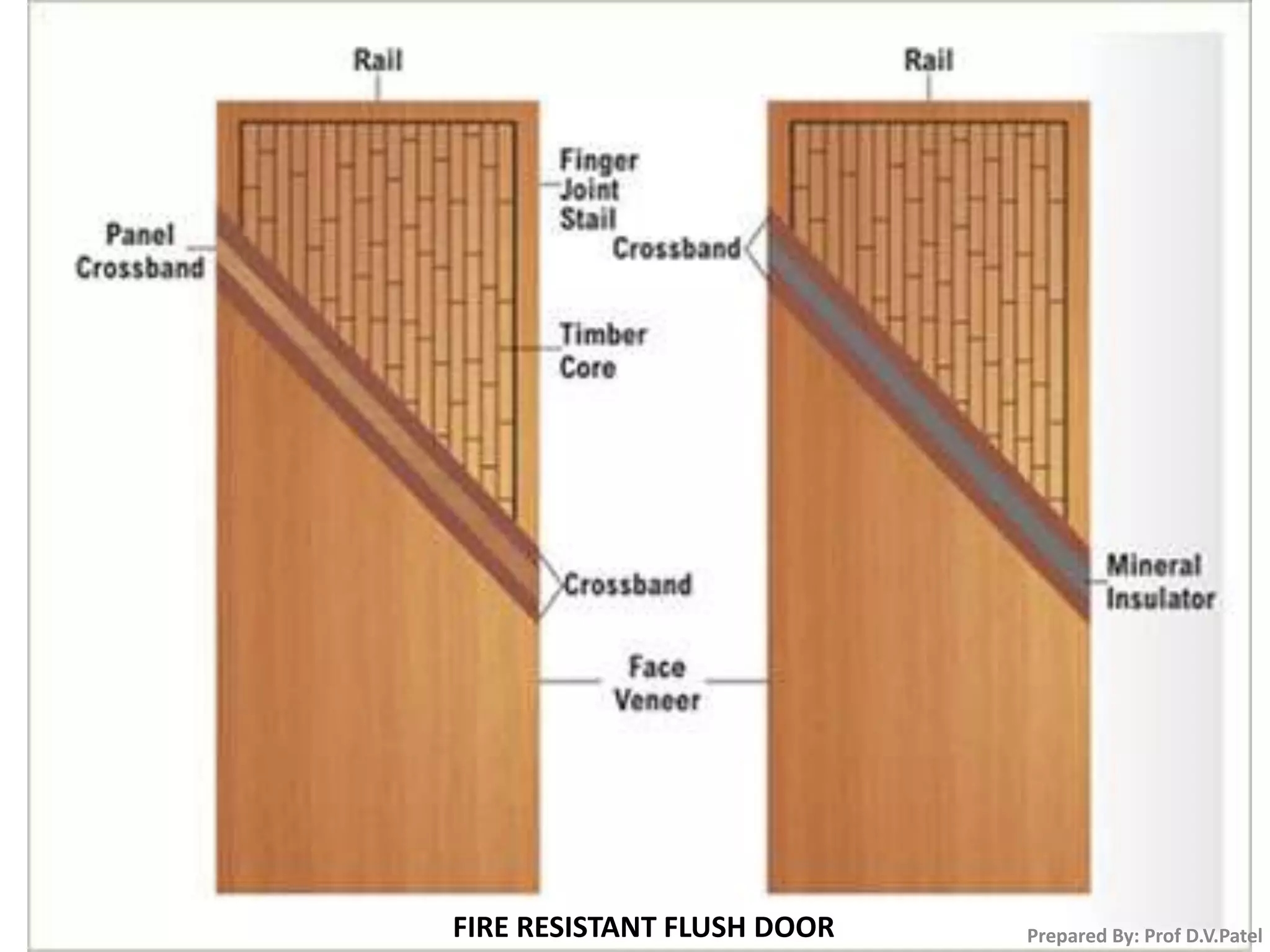
FIRE RESISTANT FLUSH DOOR Prepared By: Prof D.V.Patel
Prepared By: Prof D.V.Patel
Window is comprised of two
parts:
1. Window Frame: Window
frames are fixed to the
opening in the wall by
means of suitable hold fast.
2. Sashes or shutter Frame:
This are fixed to window
frame by means of suitable
hinges.
Functions of windows:
• To admit light and air to the
room
• To give a view to the outside
• To provide insulation against
heat loss and in some cases,
against sound.
Prepared By: Prof D.V.Patel
The Selection of size, shape ,location and number
of windows in a room depends upon the following
factors:
1.Size of the room
2.Location of the room
3.Utility of the room
4.Direction of the wall
5.Direction of the wind
6.Climatic conditions such as temp.,humidity etc.
7.Requirement of exterior view
8.Architectural treatment to the exterior of the
building
Prepared By: Prof D.V.Patel
Based on the factors consider for window, following
thumb rules are use :
1. Breadth of window = 1/8 ( Width of room + Height of
room)
2. The total area of window opening should normally vary
from 10 to 20 % of the floor area of the room.
3. The area of opening should be at least one square meter
for every 30 to 40 cubic meter inside content of the room.
4. In public building, minimum are of window should be
20% of floor area.
5. For sufficient natural light, the area of glazed panels
should at least be 8 to 10% of the floor area.
Prepared By: Prof D.V.Patel
DORMER WINDOW
The dormer protrusion on a sloped roof is determined by the size of the window
and the designer's preference. Some people add blind or false dormers as an
architectural feature in homes. But homes with an attic conversion that features an extra
bedroom or an office welcome the addition of light and extra headroom that a dormer
window brings. The dormer itself has its own roof, which can be a hip, eyebrow,
shed, segmental or gable roof, depending on the architectural design.
Prepared By: Prof D.V.Patel
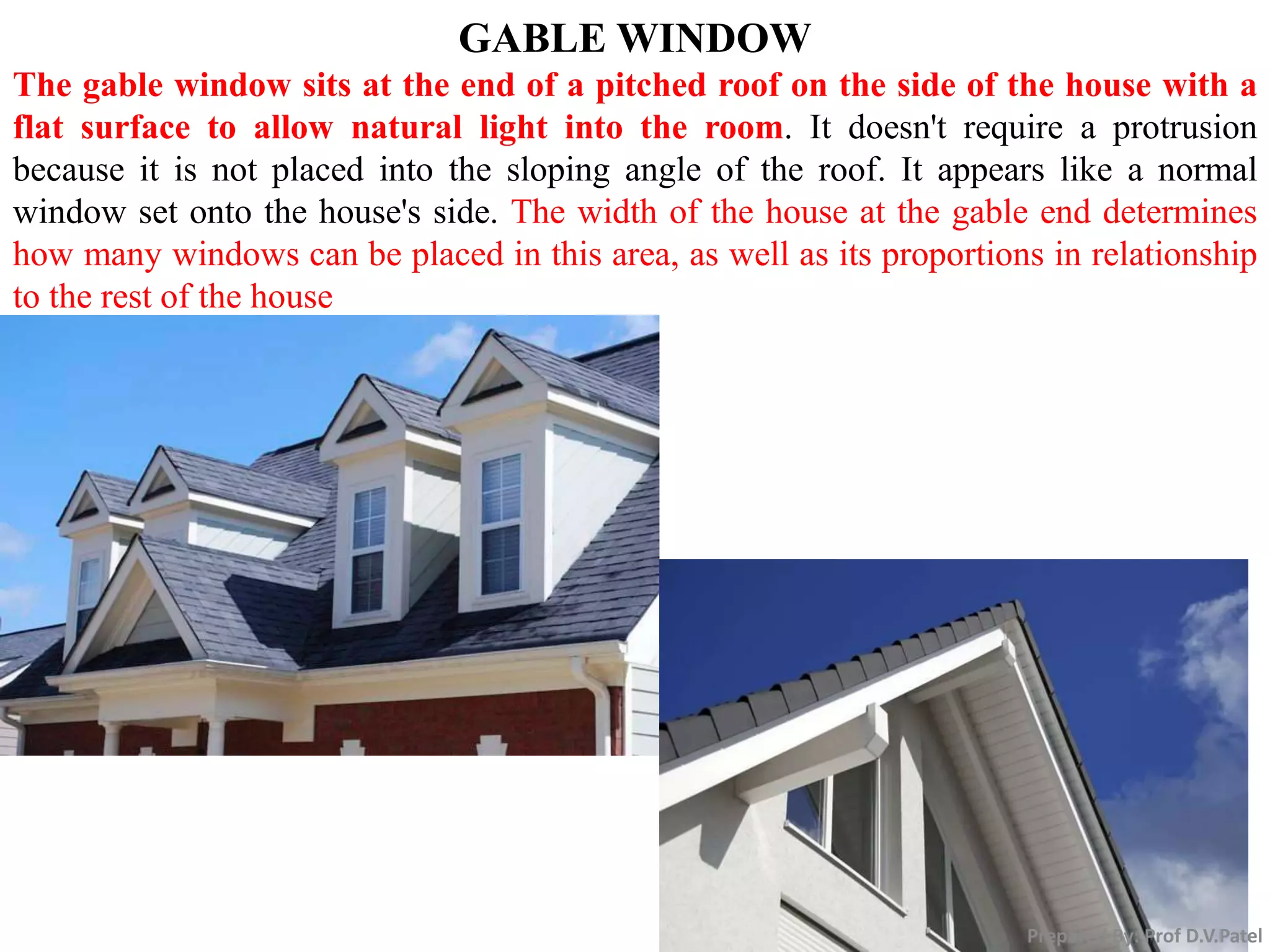
GABLE WINDOW
The gable window sits at the end of a pitched roof on the side of the house with a
flat surface to allow natural light into the room. It doesn't require a protrusion
because it is not placed into the sloping angle of the roof. It appears like a normal
window set onto the house's side. The width of the house at the gable end determines
how many windows can be placed in this area, as well as its proportions in relationship
to the rest of the house
Prepared By: Prof D.V.Patel
A fanlight is a window, often semicircular or semi-
elliptical in shape, with glazing bars or tracery sets
radiating out like an open fan. It is placed over another
window or a doorway, and is sometimes hinged to a
transom.
Prepared By: Prof D.V.Patel

Door and window

  • 1.
  • 2.
  • 3.
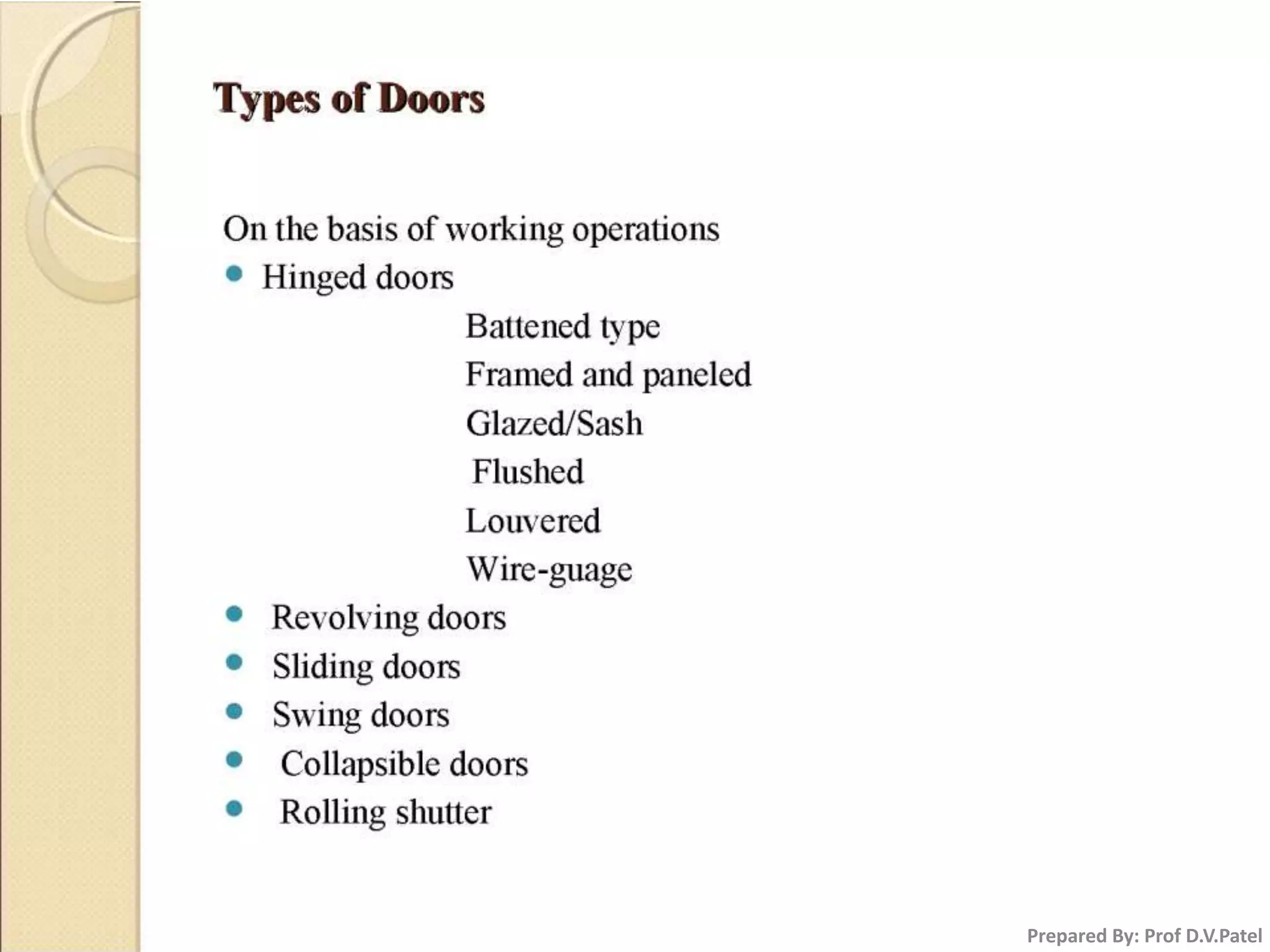
    Prepared By: ProfD.V.Patel • Larger number of doors cause obstructions and consume more area in circulation. • Door should not be located in center of length of wall. • If there are 2 doors in room, door should preferably be located in opposite wall, facing each other so as to provide good ventilation and free air circulation. • The sill of a window should be located about 70 to 80 cm about floor level of the room. • From the point of view of fresh air, a window should be located on northern side and in the prevalent direction of wind.
  • 4.
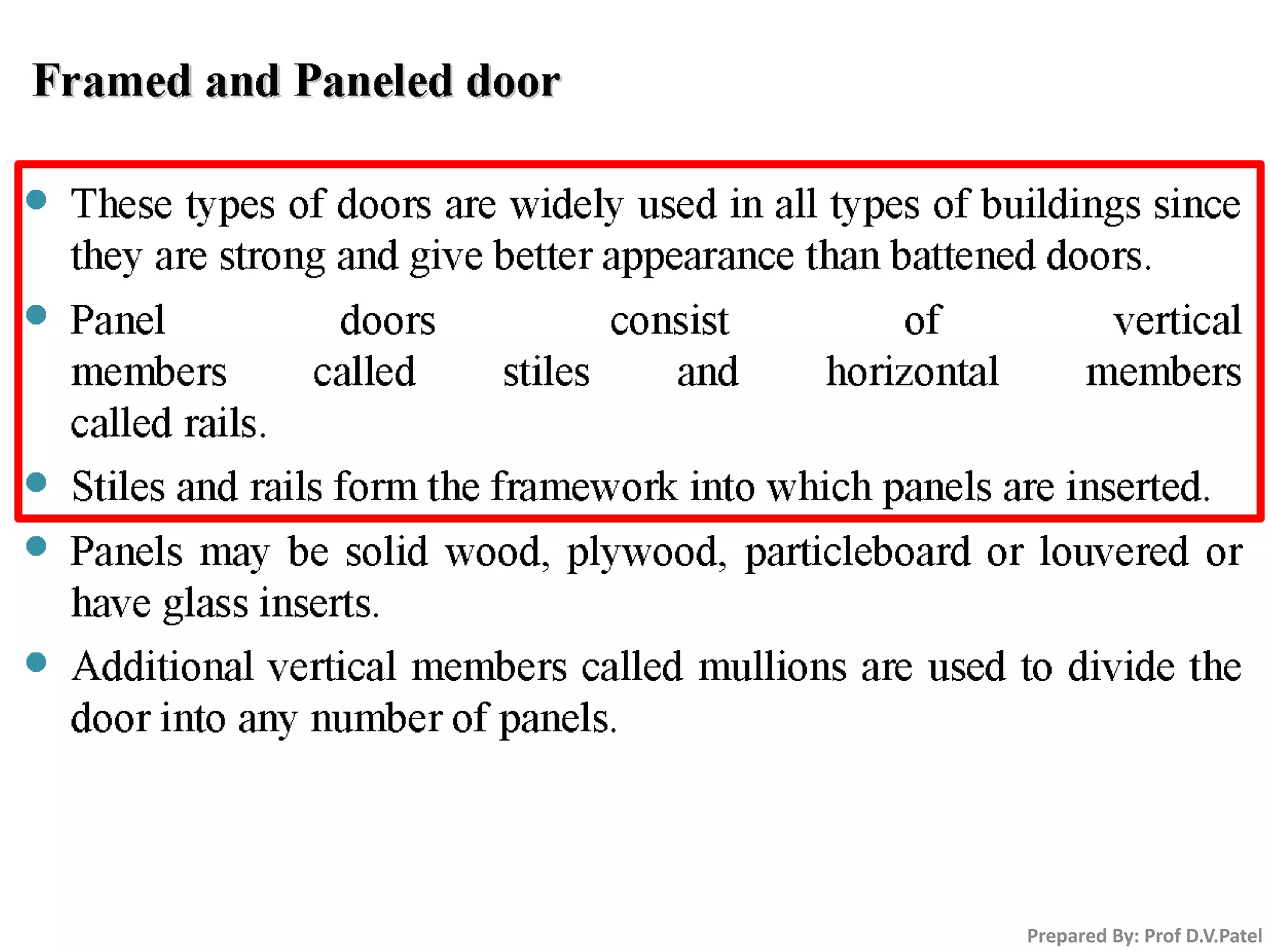
    BOTTOM RAIL TOP RAIL PANEL Prepared By: ProfD.V.Patel MULLION STYLE It is depression or recess made inside the door frame to receive the door shutter This is vertical member of a frame which is employed to sub-divide a door vertically. This is vertical outside member of shutter of door.
  • 5.
  • 6.
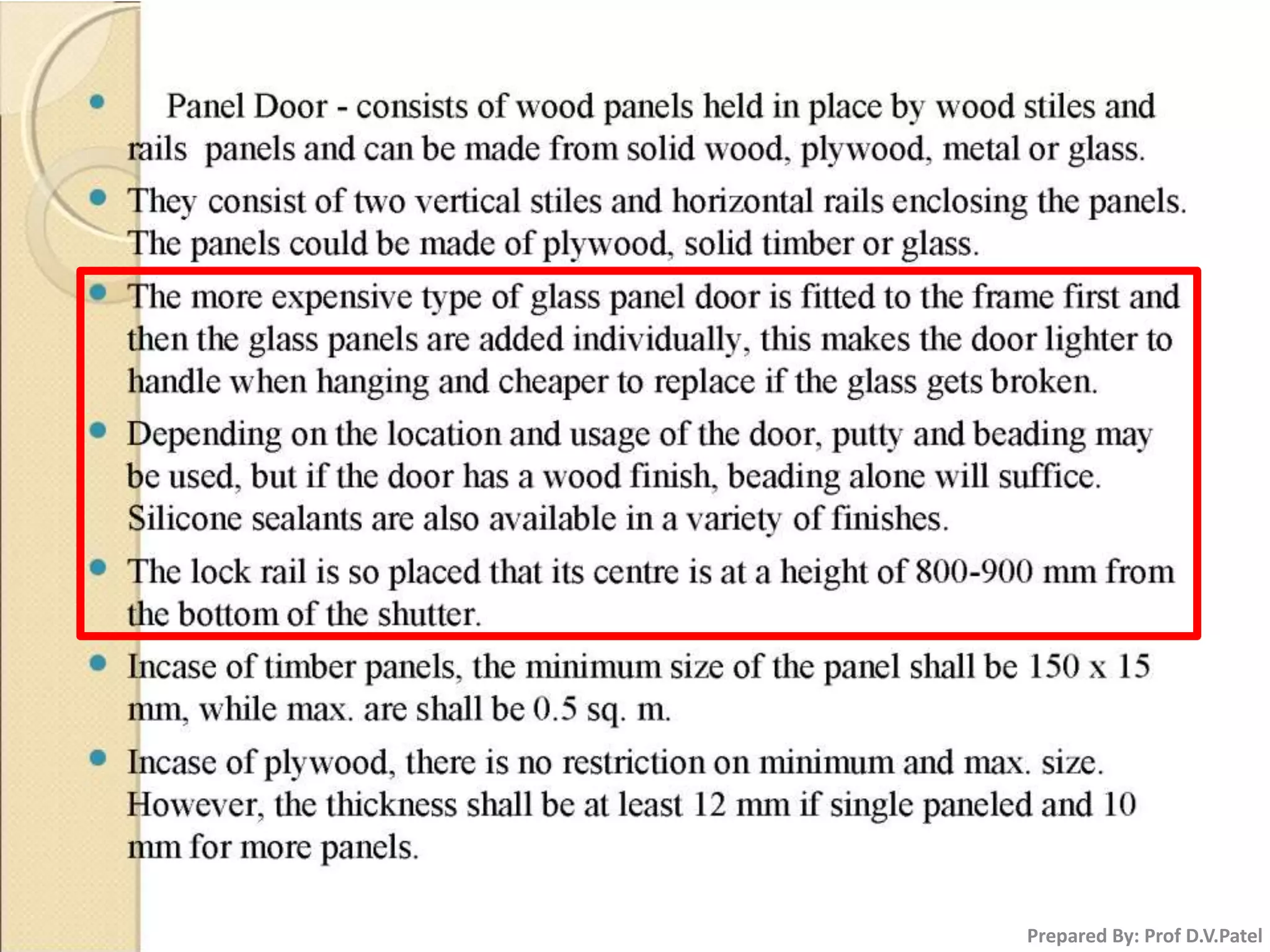
    Prepared By: ProfD.V.Patel SHUTTER: It is assembly of style , panels and rails which are openable part of doors
  • 7.
  • 8.
  • 9.
  • 10.
    Recommended Dimensions forDoors Sr. No Designation Size of opening(mm) Size of Door frames(mm) Size of Door Shutter(mm) 1 8DS20 800 X 2000 790 X 1990 700 X 1905 2 8DS21 800 X 2100 790 X 2090 700 X 2005 3 9DS20 900 X 2000 890 X 1990 800 X 1905 4 9DS21 900 X 2100 890 X 2090 800 X 2005 5 10DT20 1000 X 2100 990 X 1990 900 X 1905 6 10DT21 1000 X 2100 990 X 2090 900 X 2005 7 12DT20 1200 X 2000 1190 X 2090 1000 X 1905 10
  • 11.
  • 12.
    WHAT ISDOORFRAME? And Whyit isimportant It is the surrounding assembly into which a door fits. Consists of two uprights, jambs and a head over the top. • The door frame is most important for a door. • The primary purpose of the door frame is to provide a support to the door. • Door are incomplete without a FRAME.
  • 13.
  • 15.
    Sr No. PARTICULARS DRAWBACKS 1 Woodendoor Frames Not water proof, Termite, maintenance 2 Aluminum door frame Not stable, Poor Screw Holding, maintenance 3 Iron door frame Screws, Rusting, Low life, fixing problem. 4 Hollow PVC door frame Un stable for heavy doors, low screw holding 5 UPVC door frame High cost , unstable. 6 Cemented door frame Fixing problem, brittle, heavy, not water proof. Prepared By: Prof D.V.Patel
  • 16.
  • 17.
    Prepared By: ProfD.V.Patel Classification on the basis of arrangement of components Battened and ledged door Battened ,ledged and braced door Battened, ledged and frame door Battened ,ledged, braced and frame door Classification on the basis of method of construction Framed and Pannelled door Glazed or sash door Flush Door Louvered Door Wire Gauged Door Classification on the basis of working operation Revolving door Sliding door Swing Door Collapsible Door Rolling Steel Shutter Metal Door Mild steel sheet door Corrugated Steel sheet door Hollow metal doors Metal covered plywood door
  • 18.
  • 19.
  • 20.
  • 21.
  • 22.
  • 23.
    • Framework consistof vertical styles, three ledges and two inclined braces. • The braces are normally housed into rails at about 40mm from the styles. • The thickness of styles and top rail is same which is equal to the thickness of braces and battens. • This type is suitable for external door and door subjected to rough handling. Prepared By: Prof D.V.Patel
  • 24.
  • 25.
  • 26.
  • 27.
  • 28.
  • 29.
  • 30.
  • 31.
  • 32.
    FIRE RESISTANT FLUSHDOOR Prepared By: Prof D.V.Patel
  • 34.
  • 35.
  • 36.
  • 37.
  • 38.
  • 39.
  • 40.
  • 41.
  • 42.
  • 43.
  • 44.
  • 45.
  • 46.
  • 47.
  • 48.
  • 49.
  • 50.
  • 51.
  • 52.
  • 53.
  • 54.
  • 55.
  • 56.
    Window is comprisedof two parts: 1. Window Frame: Window frames are fixed to the opening in the wall by means of suitable hold fast. 2. Sashes or shutter Frame: This are fixed to window frame by means of suitable hinges. Functions of windows: • To admit light and air to the room • To give a view to the outside • To provide insulation against heat loss and in some cases, against sound. Prepared By: Prof D.V.Patel
  • 57.
    Prepared By: ProfD.V.Patel The Selection of size, shape ,location and number of windows in a room depends upon the following factors: 1.Size of the room 2.Location of the room 3.Utility of the room 4.Direction of the wall 5.Direction of the wind 6.Climatic conditions such as temp.,humidity etc. 7.Requirement of exterior view 8.Architectural treatment to the exterior of the building
  • 58.
    Prepared By: ProfD.V.Patel Based on the factors consider for window, following thumb rules are use : 1. Breadth of window = 1/8 ( Width of room + Height of room) 2. The total area of window opening should normally vary from 10 to 20 % of the floor area of the room. 3. The area of opening should be at least one square meter for every 30 to 40 cubic meter inside content of the room. 4. In public building, minimum are of window should be 20% of floor area. 5. For sufficient natural light, the area of glazed panels should at least be 8 to 10% of the floor area.
  • 59.
  • 60.
  • 61.
  • 62.
  • 63.
  • 64.
  • 65.
  • 66.
  • 67.
  • 68.
  • 69.
  • 70.
  • 71.
  • 72.
  • 73.
  • 74.
  • 75.
  • 76.
  • 77.
  • 78.
  • 79.
  • 80.
  • 81.
  • 82.
    DORMER WINDOW The dormerprotrusion on a sloped roof is determined by the size of the window and the designer's preference. Some people add blind or false dormers as an architectural feature in homes. But homes with an attic conversion that features an extra bedroom or an office welcome the addition of light and extra headroom that a dormer window brings. The dormer itself has its own roof, which can be a hip, eyebrow, shed, segmental or gable roof, depending on the architectural design. Prepared By: Prof D.V.Patel
  • 83.
    GABLE WINDOW The gablewindow sits at the end of a pitched roof on the side of the house with a flat surface to allow natural light into the room. It doesn't require a protrusion because it is not placed into the sloping angle of the roof. It appears like a normal window set onto the house's side. The width of the house at the gable end determines how many windows can be placed in this area, as well as its proportions in relationship to the rest of the house Prepared By: Prof D.V.Patel
  • 84.
  • 85.
  • 86.
  • 87.
  • 88.
    A fanlight isa window, often semicircular or semi- elliptical in shape, with glazing bars or tracery sets radiating out like an open fan. It is placed over another window or a doorway, and is sometimes hinged to a transom. Prepared By: Prof D.V.Patel
  • 89.