TOPIC : Doors And Windows
RAJ SONI
DOORS
 WHAT IS DOOR ?
 A door is a movable barrier secured in an opening, is
known as the doorway.
 It provides access into the room,offers privacy of sight
and sound.
 It provide access to the users of the structures.
 It also provides air circulation inside the building.
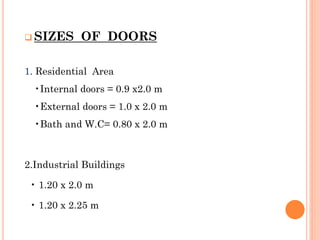
 SIZES OF DOORS
1. Residential Area
•Internal doors = 0.9 x2.0 m
•External doors = 1.0 x 2.0 m
•Bath and W.C= 0.80 x 2.0 m
2.Industrial Buildings
• 1.20 x 2.0 m
• 1.20 x 2.25 m
 LOCATION OF DOORS
 Near the corner of a room , at a distance of 20 cm.
 For providing good ventilation & air circulation,
two doors should be located in opposite walls.
 It should be located on the north side of room.
 A window should be located in opposite wall ,
facing a door or another window for cross
ventilation.
 MATERIALS
A. Frame :
Timber , Steel, Aluminium , Concrete etc.
B. Shutter :
Timber, Plywood, Glass, Block.
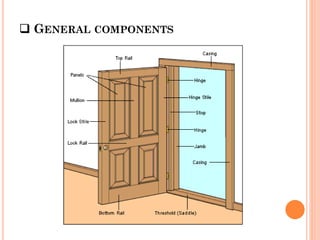
 TECHNICAL TERMS/COMPONENTS OF
DOORS
1. Frame: It is horizontal and vertical members of doors.
2. Shutter: It is opening parts of a doors or windows.
3. Head: It is top horizontal member of a frame.
4. Sill: It is bottom horizontal member of a frame.
5. Horn: It is horizontal projection of head and sill of frame.
6. Style: It is vertical outside of the shutter.
7. Top rail: It is top horizontal member of a shutter.
Bottom rail: It is bottom horizontal member of a
shutter.
8. Lock rail: : It is middle horizontal member of a shutter.
9. Panel: The area of shutter enclosed b/w rails.
10. Mullion: It is a vertical member of frame.
11. Transom: It is a vertical member of frame.
12. Jamb & Revel: Jamb is vertical wall face of opening.
: Revel is external jamb of a door.
13. Rebate: It is depression of inside the door frame shutter.
14. Frieze rail: It is fixed b/w top rail and lock rail.
15. Louvers: A glass plate are fixed inclined in framework.
16. Sash: A sash consists of two vertical styles, a top rail
and a bottom rail.
 GENERAL COMPONENTS
 TYPES OF DOORS
1. ledge door
2. ledge and braced door
3. paneled door
4. ledge ,Framed and braced door
5. glazed door
6. Flush door
7. Revolving door
8. Collapsible steel door
9. Rolling shutter door
10. louvered door
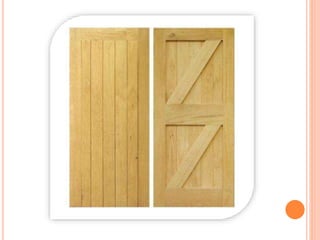
1 . LEDGED DOOR
 It is formed of vertical boards ( battons ) ,secured
by horizontal supports ( ledges ).
 Battens are 10-15 cm wide, 20-30 mm thick.
 Ledges are 10-20 cm wide ,30 mm thick.
 Used for narrow openings.
2. LEDGED & BRACED DOOR
 Similar to the ledged door but diagonal members
( braces) are provided.
 10-15 cm wide,30 mm thick.
 Useful for wide opening.
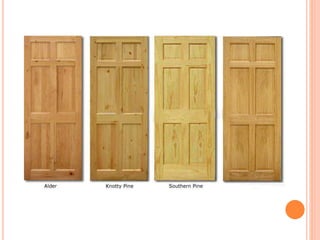
3. PENELLED DOOR
 Used in almost all types of building.
 It consists of a frame work of vertical members (
styles) & horizontal members( rails).
 Thickness of panel is about 20 mm.
 The number of panels varies from 1-6.
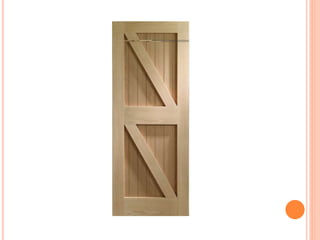
4. LEDGED ,BRACED & FRAMED DOOR
 A shutter is provided to make the doors stronger
& batter.
 Used for external use.
 Braces should incline upwards from the hanging
side.
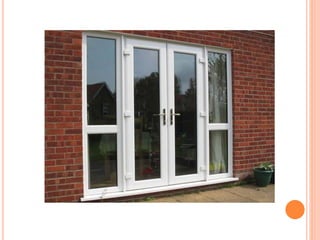
5. GLAZED DOOR
 It is provided where additional light is required
to be admitted to the room through the door.
 Used for hospitals , offices , show rooms.
 It may be fully glazed or partly glazed & partly
panelled .
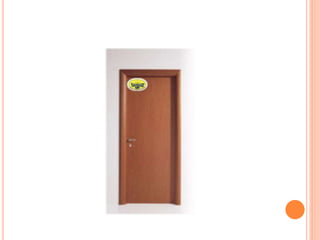
6. FLUSH DOOR
 It becomes popular because it gives massive
appearance.
 Used for residential , public & commercial buildings.
 Thickness varies from 25-40 mm.
 They are termite proof, crack proof & easy to clean.
 Two types:
1.solid core flush door
2.hollow core flush door
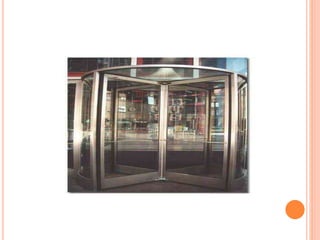
7. REVOLVING DOOR
 It consists of a central support to which four
radiating shutters are attached.
 It provides entrance on one side & exit on the
other side.
 It keeps the opening automatically closed when it
is not in use.
 These type of doors are provided where there is a
constant foot traffic.
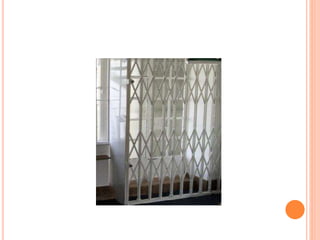
8. COLLAPSIBLE STEEL DOOR
 It consists of mild steel frame.
 Two vertical pieces of mild steel channels are
joined with the hollow portion of channel(15-20
mm).
 Vertical gap (12 mm) is created & created pieces
are joined together by pipes.
 Rollers mounted on horizontal pieces at top &
bottom.
 Door can be opened /closed by slight pull or push.
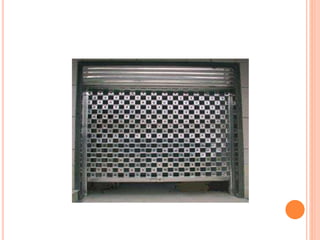
9. ROLLING STEEL SHUTTER DOOR
 It consists of frame , a drum & shutter of thin
steel plates.
 A horizontal shaft & springs are provided in the
drum at the top.
 They can be easily rolled up at the top & don’t
cause any obstruction.
 It is provided for garages , shops , godowns .
 They are not good in appearance & cause noise in
movements.
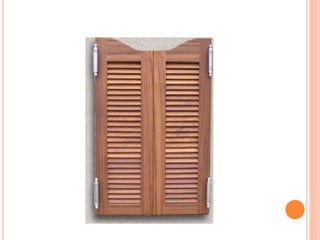
10. LOUVERED DOOR
 Shutters are provided with louvers , either fully
or partially.
 Upward & downward movement of louvers can be
carried out with the help of vertical piece of
timber.
 Used for sanitary blocks of public buildings ,
residential buildings .
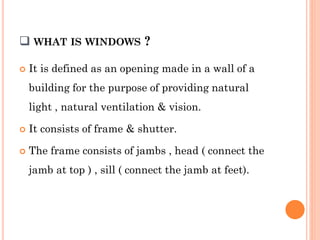
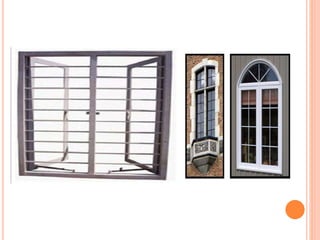
 WHAT IS WINDOWS ?
 It is defined as an opening made in a wall of a
building for the purpose of providing natural
light , natural ventilation & vision.
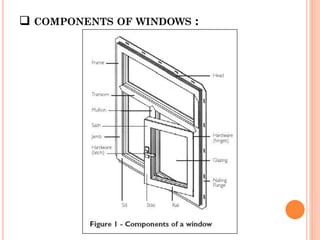
 It consists of frame & shutter.
 The frame consists of jambs , head ( connect the
jamb at top ) , sill ( connect the jamb at feet).
 COMPONENTS OF WINDOWS :
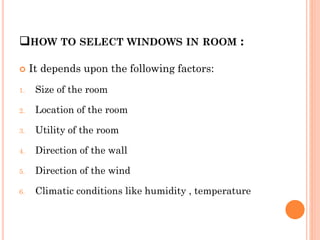
HOW TO SELECT WINDOWS IN ROOM :
 It depends upon the following factors:
1. Size of the room
2. Location of the room
3. Utility of the room
4. Direction of the wall
5. Direction of the wind
6. Climatic conditions like humidity , temperature
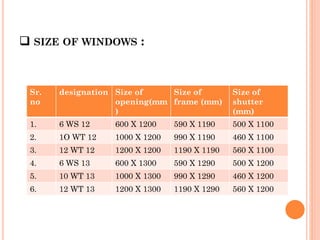
 SIZE OF WINDOWS :
Sr.
no
designation Size of
opening(mm
)
Size of
frame (mm)
Size of
shutter
(mm)
1. 6 WS 12 600 X 1200 590 X 1190 500 X 1100
2. 1O WT 12 1000 X 1200 990 X 1190 460 X 1100
3. 12 WT 12 1200 X 1200 1190 X 1190 560 X 1100
4. 6 WS 13 600 X 1300 590 X 1290 500 X 1200
5. 10 WT 13 1000 X 1300 990 X 1290 460 X 1200
6. 12 WT 13 1200 X 1300 1190 X 1290 560 X 1200
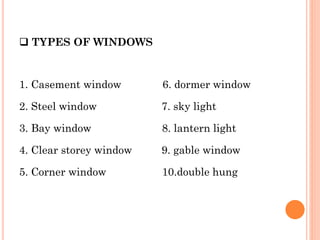
 TYPES OF WINDOWS
1. Casement window 6. dormer window
2. Steel window 7. sky light
3. Bay window 8. lantern light
4. Clear storey window 9. gable window
5. Corner window 10.double hung
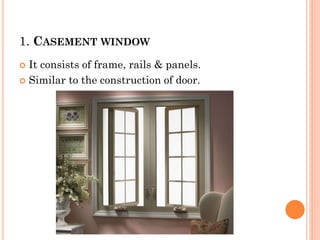
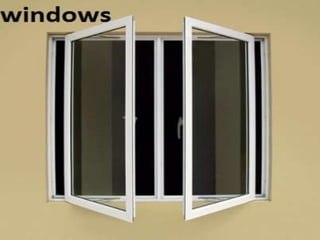
1. CASEMENT WINDOW
 It consists of frame, rails & panels.
 Similar to the construction of door.
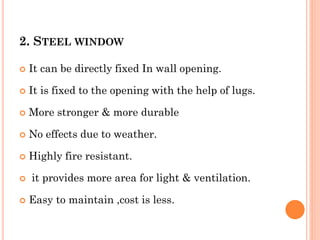
2. STEEL WINDOW
 It can be directly fixed In wall opening.
 It is fixed to the opening with the help of lugs.
 More stronger & more durable
 No effects due to weather.
 Highly fire resistant.
 it provides more area for light & ventilation.
 Easy to maintain ,cost is less.
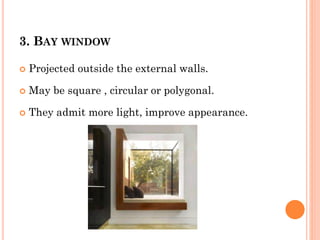
3. BAY WINDOW
 Projected outside the external walls.
 May be square , circular or polygonal.
 They admit more light, improve appearance.
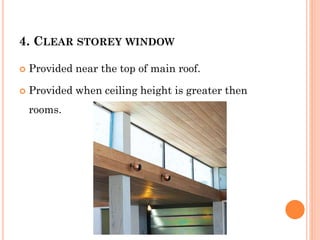
4. CLEAR STOREY WINDOW
 Provided near the top of main roof.
 Provided when ceiling height is greater then
rooms.
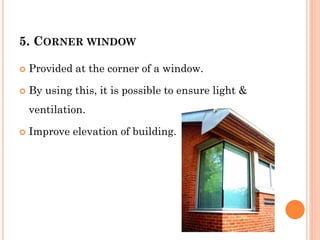
5. CORNER WINDOW
 Provided at the corner of a window.
 By using this, it is possible to ensure light &
ventilation.
 Improve elevation of building.
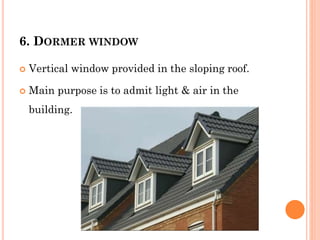
6. DORMER WINDOW
 Vertical window provided in the sloping roof.
 Main purpose is to admit light & air in the
building.
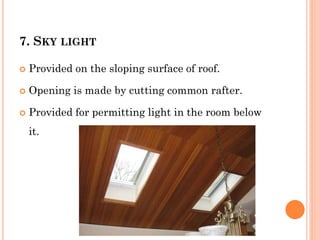
7. SKY LIGHT
 Provided on the sloping surface of roof.
 Opening is made by cutting common rafter.
 Provided for permitting light in the room below
it.
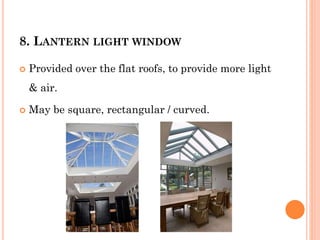
8. LANTERN LIGHT WINDOW
 Provided over the flat roofs, to provide more light
& air.
 May be square, rectangular / curved.
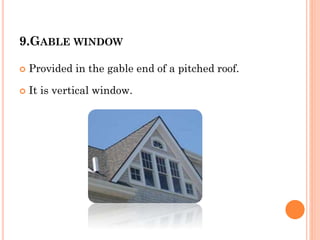
9.GABLE WINDOW
 Provided in the gable end of a pitched roof.
 It is vertical window.
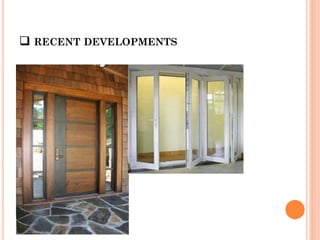
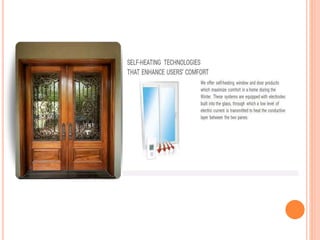
 RECENT DEVELOPMENTS
Doors & Window
Doors & Window

Doors & Window

  • 1.
    TOPIC : DoorsAnd Windows RAJ SONI
  • 2.
  • 3.
     WHAT ISDOOR ?  A door is a movable barrier secured in an opening, is known as the doorway.  It provides access into the room,offers privacy of sight and sound.  It provide access to the users of the structures.  It also provides air circulation inside the building.
  • 4.
     SIZES OFDOORS 1. Residential Area •Internal doors = 0.9 x2.0 m •External doors = 1.0 x 2.0 m •Bath and W.C= 0.80 x 2.0 m 2.Industrial Buildings • 1.20 x 2.0 m • 1.20 x 2.25 m
  • 5.
     LOCATION OFDOORS  Near the corner of a room , at a distance of 20 cm.  For providing good ventilation & air circulation, two doors should be located in opposite walls.  It should be located on the north side of room.  A window should be located in opposite wall , facing a door or another window for cross ventilation.
  • 6.
     MATERIALS A. Frame: Timber , Steel, Aluminium , Concrete etc. B. Shutter : Timber, Plywood, Glass, Block.
  • 7.
     TECHNICAL TERMS/COMPONENTSOF DOORS 1. Frame: It is horizontal and vertical members of doors. 2. Shutter: It is opening parts of a doors or windows. 3. Head: It is top horizontal member of a frame. 4. Sill: It is bottom horizontal member of a frame. 5. Horn: It is horizontal projection of head and sill of frame. 6. Style: It is vertical outside of the shutter. 7. Top rail: It is top horizontal member of a shutter. Bottom rail: It is bottom horizontal member of a shutter.
  • 8.
    8. Lock rail:: It is middle horizontal member of a shutter. 9. Panel: The area of shutter enclosed b/w rails. 10. Mullion: It is a vertical member of frame. 11. Transom: It is a vertical member of frame. 12. Jamb & Revel: Jamb is vertical wall face of opening. : Revel is external jamb of a door. 13. Rebate: It is depression of inside the door frame shutter. 14. Frieze rail: It is fixed b/w top rail and lock rail. 15. Louvers: A glass plate are fixed inclined in framework. 16. Sash: A sash consists of two vertical styles, a top rail and a bottom rail.
  • 9.
  • 10.
     TYPES OFDOORS 1. ledge door 2. ledge and braced door 3. paneled door 4. ledge ,Framed and braced door 5. glazed door 6. Flush door 7. Revolving door 8. Collapsible steel door 9. Rolling shutter door 10. louvered door
  • 11.
    1 . LEDGEDDOOR  It is formed of vertical boards ( battons ) ,secured by horizontal supports ( ledges ).  Battens are 10-15 cm wide, 20-30 mm thick.  Ledges are 10-20 cm wide ,30 mm thick.  Used for narrow openings.
  • 12.
    2. LEDGED &BRACED DOOR  Similar to the ledged door but diagonal members ( braces) are provided.  10-15 cm wide,30 mm thick.  Useful for wide opening.
  • 14.
    3. PENELLED DOOR Used in almost all types of building.  It consists of a frame work of vertical members ( styles) & horizontal members( rails).  Thickness of panel is about 20 mm.  The number of panels varies from 1-6.
  • 16.
    4. LEDGED ,BRACED& FRAMED DOOR  A shutter is provided to make the doors stronger & batter.  Used for external use.  Braces should incline upwards from the hanging side.
  • 18.
    5. GLAZED DOOR It is provided where additional light is required to be admitted to the room through the door.  Used for hospitals , offices , show rooms.  It may be fully glazed or partly glazed & partly panelled .
  • 20.
    6. FLUSH DOOR It becomes popular because it gives massive appearance.  Used for residential , public & commercial buildings.  Thickness varies from 25-40 mm.  They are termite proof, crack proof & easy to clean.  Two types: 1.solid core flush door 2.hollow core flush door
  • 22.
    7. REVOLVING DOOR It consists of a central support to which four radiating shutters are attached.  It provides entrance on one side & exit on the other side.  It keeps the opening automatically closed when it is not in use.  These type of doors are provided where there is a constant foot traffic.
  • 24.
    8. COLLAPSIBLE STEELDOOR  It consists of mild steel frame.  Two vertical pieces of mild steel channels are joined with the hollow portion of channel(15-20 mm).  Vertical gap (12 mm) is created & created pieces are joined together by pipes.  Rollers mounted on horizontal pieces at top & bottom.  Door can be opened /closed by slight pull or push.
  • 26.
    9. ROLLING STEELSHUTTER DOOR  It consists of frame , a drum & shutter of thin steel plates.  A horizontal shaft & springs are provided in the drum at the top.  They can be easily rolled up at the top & don’t cause any obstruction.  It is provided for garages , shops , godowns .  They are not good in appearance & cause noise in movements.
  • 28.
    10. LOUVERED DOOR Shutters are provided with louvers , either fully or partially.  Upward & downward movement of louvers can be carried out with the help of vertical piece of timber.  Used for sanitary blocks of public buildings , residential buildings .
  • 31.
     WHAT ISWINDOWS ?  It is defined as an opening made in a wall of a building for the purpose of providing natural light , natural ventilation & vision.  It consists of frame & shutter.  The frame consists of jambs , head ( connect the jamb at top ) , sill ( connect the jamb at feet).
  • 32.
  • 33.
    HOW TO SELECTWINDOWS IN ROOM :  It depends upon the following factors: 1. Size of the room 2. Location of the room 3. Utility of the room 4. Direction of the wall 5. Direction of the wind 6. Climatic conditions like humidity , temperature
  • 34.
     SIZE OFWINDOWS : Sr. no designation Size of opening(mm ) Size of frame (mm) Size of shutter (mm) 1. 6 WS 12 600 X 1200 590 X 1190 500 X 1100 2. 1O WT 12 1000 X 1200 990 X 1190 460 X 1100 3. 12 WT 12 1200 X 1200 1190 X 1190 560 X 1100 4. 6 WS 13 600 X 1300 590 X 1290 500 X 1200 5. 10 WT 13 1000 X 1300 990 X 1290 460 X 1200 6. 12 WT 13 1200 X 1300 1190 X 1290 560 X 1200
  • 35.
     TYPES OFWINDOWS 1. Casement window 6. dormer window 2. Steel window 7. sky light 3. Bay window 8. lantern light 4. Clear storey window 9. gable window 5. Corner window 10.double hung
  • 36.
    1. CASEMENT WINDOW It consists of frame, rails & panels.  Similar to the construction of door.
  • 37.
    2. STEEL WINDOW It can be directly fixed In wall opening.  It is fixed to the opening with the help of lugs.  More stronger & more durable  No effects due to weather.  Highly fire resistant.  it provides more area for light & ventilation.  Easy to maintain ,cost is less.
  • 39.
    3. BAY WINDOW Projected outside the external walls.  May be square , circular or polygonal.  They admit more light, improve appearance.
  • 40.
    4. CLEAR STOREYWINDOW  Provided near the top of main roof.  Provided when ceiling height is greater then rooms.
  • 41.
    5. CORNER WINDOW Provided at the corner of a window.  By using this, it is possible to ensure light & ventilation.  Improve elevation of building.
  • 42.
    6. DORMER WINDOW Vertical window provided in the sloping roof.  Main purpose is to admit light & air in the building.
  • 43.
    7. SKY LIGHT Provided on the sloping surface of roof.  Opening is made by cutting common rafter.  Provided for permitting light in the room below it.
  • 44.
    8. LANTERN LIGHTWINDOW  Provided over the flat roofs, to provide more light & air.  May be square, rectangular / curved.
  • 45.
    9.GABLE WINDOW  Providedin the gable end of a pitched roof.  It is vertical window.
  • 46.