WALL FINISHES AND WALL
PATTERNS

By
Lakshmi Menon
 Finish given to the wall to enhance the exterior






look of the structure.
Wall finishes used for the interiors are quite
delicate and need maintenance.
The new contemporary trend has brought about
great deal of increase in the usage various types of
wall finishes for the aesthetic purpose.
Concrete, masonry wall may be left exposed or
plastered.
Wood or metal stud walls can support a variety of
finishes.
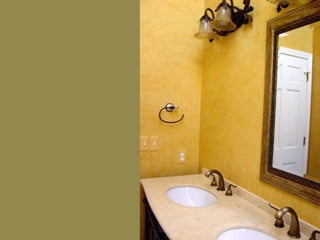
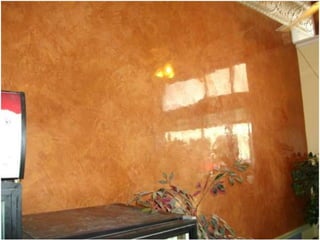
 Cement Textured Finish:

This is a decorative finish and its mortar is
prepared in cement based material. It is applied
faced plaster with a trowel and after that it is
coloured with paint.
 Cement plastered Finish:
It is prepared in the form of mortar with cement,
sand and water in proper proportions and masonry
manually to achieve a smooth finish or sand faced
finish.
Wood wall panels
 Consists of a series of thin

sheets of wood framed
together by strips of wood.
 The vertical strips are know
as stiles and the horizontal
one as rails.
 Wood panels include solid
lumber panelling, wood
veneer panelling and
plastic laminate faced wood
panelling.
 Solid wood offers durability
and creates texture.
Plywood
 Plywood is a wood panel

product made by bonding
veneers together under
heat and pressure, usually
with the grain of adjacent
plies at right angles to
each other.
 Plywood core may be
particleboard, medium
density fibreboard
(MDF), veneer core or
lumber core.
PLASTER FINISH
 Plaster of Paris Finish :

Plaster of Paris or simply
plaster is a type of building
material based on calcium
hemihydrates. This is a
smooth finish achieved by
plaster of Paris generally
applied on internal
 Gypsum Plaster : Finish This
just like plaster of Paris
finish but gypsum based
material is used to prepare
mortar. durable and finer as
compared to Plaster of Paris
Finish.
Designer Mirror Finish

 Designer mirrors are

obtained by small
pieces on walls to
create mural like
design.
Laminate Finish

 Laminate comes in

various colours and
designs. It comes in
the form of sheet and
is pasted fevicol on
Plywood.
Marble Powder Finish
 This is a very smooth

finish. The finish looks
like Marble flooring.
This finish is obtained by
marble powder, white
cement and water. It is
applied manually.
Flexible wall coverings
 Plastered walls and gypsum board walls can be

finished with a variety of flexible wall covering.
 Examples:
⁻ Wallpapers
⁻ Cloth/paper backed vinyl wall covering

⁻ Fabrics
⁻ Cork
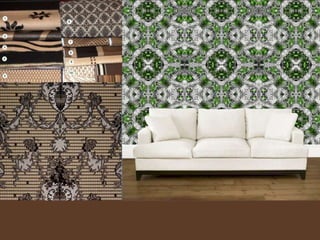
Wallpapers
 Wallpapers have a

paper face and a
paper back.
 It is not commonly
used in commercial
design as it is subject
to soiling, abrasion
and fading.
Cloth/Paper backed vinyl wall covering
 Designed for

serviceability and
durability.
 It is flame
resistant.
 Easily cleaned and
resistant to fading
and abrasion.
Fabrics
 Fabrics like wool,

linen, cotton, burlap
and grasscloth are
used.
 they require back
coating as a barrier to
prevent adhesive from
bleeding through
fabrics face and to
improve dimensional
stabilty.
Cork
 Cork from renewable

bark of the cork oak
tree is used.
 It is durable and
resilient.
 Accepts either wax or
polyurethane finishes
 Posses excellent
acoustical and thermal
rating.
Decorative Paint Finishes
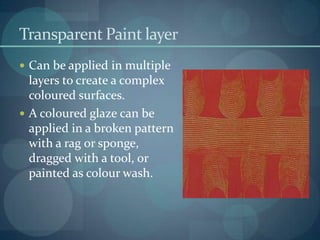
Transparent Paint layer
 Can be applied in multiple

layers to create a complex
coloured surfaces.
 A coloured glaze can be
applied in a broken pattern
with a rag or sponge,
dragged with a tool, or
painted as colour wash.
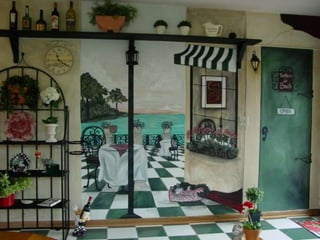
Trompe lóeil
 It is French for “fool the

eye”.
 This technique uses
perspective and shadow
to create the illusion of
three dimensional
architectural objects.
Stenciling
 Can be used to apply

border or larger
repeating patterns
Distressing Techniques
 These are used to

give a painted
surface the
appearance of
wear and tear.
Mosaic Tiles
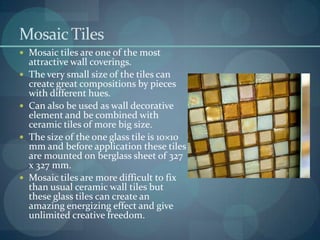
 Mosaic tiles are one of the most








attractive wall coverings.
The very small size of the tiles can
create great compositions by pieces
with different hues.
Can also be used as wall decorative
element and be combined with
ceramic tiles of more big size.
The size of the one glass tile is 10×10
mm and before application these tiles
are mounted on berglass sheet of 327
x 327 mm.
Mosaic tiles are more difficult to fix
than usual ceramic wall tiles but
these glass tiles can create an
amazing energizing effect and give
unlimited creative freedom.
Glass Mosaic Finish
 Glass mosaic tiles are

small 1”x1” on a cloth to
get a workable size 12”x12”
and this tile with an
adhesive on wall surfaces.
It can also be pasted on
curved surfaces.
Murals
 A mural is any piece of artwork painted or applied

directly on a wall, ceiling or other large permanent
surface.
 A particularly distinguishing characteristic of
mural painting is that the architectural elements
of the given space are harmoniously incorporated
into the picture.
Traditional Murals
 Many people like to express their individuality by

commissioning an artist to paint a mural in their
home, this is not an activity exclusively for owners of
large houses.
 Private commissions can be for dining rooms,
bathrooms, living rooms or, as is often the casechildren's bedrooms. A child's room can be
transformed into the 'fantasy world' of a forest or
racing track, encouraging imaginative play and an
awareness of art.
 Public commissions of murals in schools, hospitals
and retirement homes can achieve a pleasing and
welcoming atmosphere in these caring institutions.
Graffiti style murals
 As graffiti/street art

became more main stream
in the late 1990s, youth
oriented brands such as
Nike, Red Bull and Wieden
Kennedy have turned to
graffiti/street artists to
decorate walls of their
respective offices.
 This trend continued
through 2000's with
graffiti/street art gaining
more recognition from art
institutions worldwide.
Tile Murals
 Tile murals tile paintings, which cover complete walls and give a








wall painting-like impression.
Tile murals are typically found in countries around the
Mediterranean Sea such as Morocco, Tunisia and Arabic
countries, in Portugal and Spain mostly in an often monochrom
colored form, the Azulejo.
Custom printed tile murals can be produced using digital images
for kitchen backsplashes, wall displays, and flooring.
Digital photos and artwork can be resized and printed to
accommodate the desired size for the area to be decorated.
Custom tile printing uses a variety of techniques including dye
sublimation and ceramic-type laser toners.
The latter technique can yield fade-resistant custom tiles which
are suitable for long term exterior exposure.
.No. 9. Lakshmi Menon.S6 Architecture.

Wall finishes and wall patterns

  • 1.
    WALL FINISHES ANDWALL PATTERNS By Lakshmi Menon
  • 2.
     Finish givento the wall to enhance the exterior     look of the structure. Wall finishes used for the interiors are quite delicate and need maintenance. The new contemporary trend has brought about great deal of increase in the usage various types of wall finishes for the aesthetic purpose. Concrete, masonry wall may be left exposed or plastered. Wood or metal stud walls can support a variety of finishes.
  • 3.
     Cement TexturedFinish: This is a decorative finish and its mortar is prepared in cement based material. It is applied faced plaster with a trowel and after that it is coloured with paint.  Cement plastered Finish: It is prepared in the form of mortar with cement, sand and water in proper proportions and masonry manually to achieve a smooth finish or sand faced finish.
  • 5.
    Wood wall panels Consists of a series of thin sheets of wood framed together by strips of wood.  The vertical strips are know as stiles and the horizontal one as rails.  Wood panels include solid lumber panelling, wood veneer panelling and plastic laminate faced wood panelling.  Solid wood offers durability and creates texture.
  • 7.
    Plywood  Plywood isa wood panel product made by bonding veneers together under heat and pressure, usually with the grain of adjacent plies at right angles to each other.  Plywood core may be particleboard, medium density fibreboard (MDF), veneer core or lumber core.
  • 11.
    PLASTER FINISH  Plasterof Paris Finish : Plaster of Paris or simply plaster is a type of building material based on calcium hemihydrates. This is a smooth finish achieved by plaster of Paris generally applied on internal  Gypsum Plaster : Finish This just like plaster of Paris finish but gypsum based material is used to prepare mortar. durable and finer as compared to Plaster of Paris Finish.
  • 13.
    Designer Mirror Finish Designer mirrors are obtained by small pieces on walls to create mural like design.
  • 15.
    Laminate Finish  Laminatecomes in various colours and designs. It comes in the form of sheet and is pasted fevicol on Plywood.
  • 17.
    Marble Powder Finish This is a very smooth finish. The finish looks like Marble flooring. This finish is obtained by marble powder, white cement and water. It is applied manually.
  • 19.
    Flexible wall coverings Plastered walls and gypsum board walls can be finished with a variety of flexible wall covering.  Examples: ⁻ Wallpapers ⁻ Cloth/paper backed vinyl wall covering ⁻ Fabrics ⁻ Cork
  • 20.
    Wallpapers  Wallpapers havea paper face and a paper back.  It is not commonly used in commercial design as it is subject to soiling, abrasion and fading.
  • 23.
    Cloth/Paper backed vinylwall covering  Designed for serviceability and durability.  It is flame resistant.  Easily cleaned and resistant to fading and abrasion.
  • 24.
    Fabrics  Fabrics likewool, linen, cotton, burlap and grasscloth are used.  they require back coating as a barrier to prevent adhesive from bleeding through fabrics face and to improve dimensional stabilty.
  • 26.
    Cork  Cork fromrenewable bark of the cork oak tree is used.  It is durable and resilient.  Accepts either wax or polyurethane finishes  Posses excellent acoustical and thermal rating.
  • 29.
  • 30.
    Transparent Paint layer Can be applied in multiple layers to create a complex coloured surfaces.  A coloured glaze can be applied in a broken pattern with a rag or sponge, dragged with a tool, or painted as colour wash.
  • 32.
    Trompe lóeil  Itis French for “fool the eye”.  This technique uses perspective and shadow to create the illusion of three dimensional architectural objects.
  • 37.
    Stenciling  Can beused to apply border or larger repeating patterns
  • 40.
    Distressing Techniques  Theseare used to give a painted surface the appearance of wear and tear.
  • 41.
    Mosaic Tiles  Mosaictiles are one of the most     attractive wall coverings. The very small size of the tiles can create great compositions by pieces with different hues. Can also be used as wall decorative element and be combined with ceramic tiles of more big size. The size of the one glass tile is 10×10 mm and before application these tiles are mounted on berglass sheet of 327 x 327 mm. Mosaic tiles are more difficult to fix than usual ceramic wall tiles but these glass tiles can create an amazing energizing effect and give unlimited creative freedom.
  • 44.
    Glass Mosaic Finish Glass mosaic tiles are small 1”x1” on a cloth to get a workable size 12”x12” and this tile with an adhesive on wall surfaces. It can also be pasted on curved surfaces.
  • 47.
    Murals  A muralis any piece of artwork painted or applied directly on a wall, ceiling or other large permanent surface.  A particularly distinguishing characteristic of mural painting is that the architectural elements of the given space are harmoniously incorporated into the picture.
  • 48.
    Traditional Murals  Manypeople like to express their individuality by commissioning an artist to paint a mural in their home, this is not an activity exclusively for owners of large houses.  Private commissions can be for dining rooms, bathrooms, living rooms or, as is often the casechildren's bedrooms. A child's room can be transformed into the 'fantasy world' of a forest or racing track, encouraging imaginative play and an awareness of art.  Public commissions of murals in schools, hospitals and retirement homes can achieve a pleasing and welcoming atmosphere in these caring institutions.
  • 51.
    Graffiti style murals As graffiti/street art became more main stream in the late 1990s, youth oriented brands such as Nike, Red Bull and Wieden Kennedy have turned to graffiti/street artists to decorate walls of their respective offices.  This trend continued through 2000's with graffiti/street art gaining more recognition from art institutions worldwide.
  • 54.
    Tile Murals  Tilemurals tile paintings, which cover complete walls and give a      wall painting-like impression. Tile murals are typically found in countries around the Mediterranean Sea such as Morocco, Tunisia and Arabic countries, in Portugal and Spain mostly in an often monochrom colored form, the Azulejo. Custom printed tile murals can be produced using digital images for kitchen backsplashes, wall displays, and flooring. Digital photos and artwork can be resized and printed to accommodate the desired size for the area to be decorated. Custom tile printing uses a variety of techniques including dye sublimation and ceramic-type laser toners. The latter technique can yield fade-resistant custom tiles which are suitable for long term exterior exposure.
  • 56.
    .No. 9. LakshmiMenon.S6 Architecture.