BUILDING MATERIALS AND
CONSTRUCTION
TECHNOLOGY
BY- Nikhaar Mehra
B.Arch Sem2
Section B
 Houses have windows for many practical and decorative reasons.
 They have windows to provide warmth from the sun.
 This natural warmth saves money for electricity that is usually wasted on lightbulbs.
 To allow fresh air into the area and to improve ventilation –

For Ventilation
 For natural light. This saves money that is wasted on electricity in your every day life.

Windows actually keep out sound. They form a sound barrier against the outside.
 Houses have windows for all of these reasons - all equally important.
 Windows provide architectural merit and can improve quality of life.
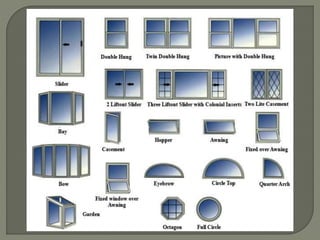
Depending upon the manner of fixing, material used for
construction,nature of operational movements of shutters etc ., the
common varieties of windows used in the buildings can be grouped as
folllows;
1. Casement windows
2. Double hung windows
3. Pivoted windows
4. Sliding windows
5. Sash/ glazed windows
6. Metal windows
7. Corner windows (glass to
glass)
8. Gable windows
9. Dormer windows
10. Bay windows
11. Clerestory windows
12.Skylights
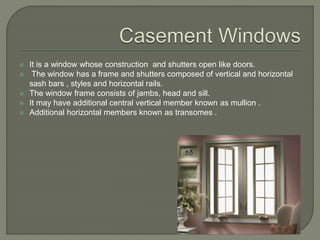
 It is a window whose construction and shutters open like doors.
 The window has a frame and shutters composed of vertical and horizontal
sash bars , styles and horizontal rails.
 The window frame consists of jambs, head and sill.
 It may have additional central vertical member known as mullion .
 Additional horizontal members known as transomes .
 Super sound insulation and highly energy efficient
 Double sealing to keep out noise, dust and
pollution
 High quality hardware that does not rust or corrode
 Multi-point locking for enhanced security
 Double/triple glazing options for better thermal and
sound insulation
 Protects against rain water seepage and storms
 Available in variety of designs, colours and
hardware
 Custom sizing available
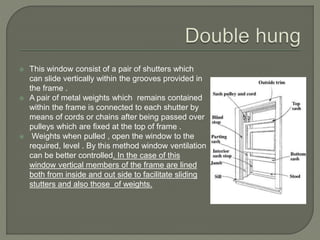
 This window consist of a pair of shutters which
can slide vertically within the grooves provided in
the frame .
 A pair of metal weights which remains contained
within the frame is connected to each shutter by
means of cords or chains after being passed over
pulleys which are fixed at the top of frame .
 Weights when pulled , open the window to the
required, level . By this method window ventilation
can be better controlled. In the case of this
window vertical members of the frame are lined
both from inside and out side to facilitate sliding
stutters and also those of weights.
ADVANTAGES DISADVANTAGES
 Versatility. s. The choice of material for
double-hung windows includes
aluminum, fiberglass, wood, and vinyl.
 Air conditioner and screen
friendly. Unlike casement windows,
double-hung windows can accept air
conditioners and screens. Because they
slide up and down instead of cranking
out or sliding to the side,
 Easy to clean. Newer double hung
windows have tilt-out upper and lower
sashes .This makes the windows easier
to clean
 Energy efficiency. Although precise
measurements are required to minimize
moisture and air leaks, high quality
double hung windows have the option of
quadruple weather stripping.
 Not as airtight as other windows. Double
hung windows have the option of quadruple
weather stripping, but without it, they’re not
as airtight as other windows, such as
casement windows or fixed windows.
 Limited ventilation. Double hung windows
work by sliding the bottom sash up or the top
sash down. This means, only half of the
window may remain open at one time.
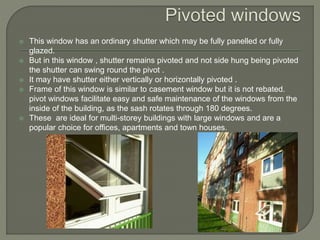
 This window has an ordinary shutter which may be fully panelled or fully
glazed.
 But in this window , shutter remains pivoted and not side hung being pivoted
the shutter can swing round the pivot .
 It may have shutter either vertically or horizontally pivoted .
 Frame of this window is similar to casement window but it is not rebated.
pivot windows facilitate easy and safe maintenance of the windows from the
inside of the building, as the sash rotates through 180 degrees.
 These are ideal for multi-storey buildings with large windows and are a
popular choice for offices, apartments and town houses.
ADVANTAGES DISADVANTAGES
 Good Ventilation. It can be placed higher
in walls than many other types of windows.
It provide natural light and ventilation,
without compromising privacy.
 Weather-tight construction, good choice
in damp climates. It protect home
against moisture, even when they’re open
during a rainstorm. Because of the way
awning windows are constructed, they
allow for nearly 100 percent of viable
ventilation, without the threat of water
seeping into the home.
 Attractive, contemporary look. Newer
windows use friction hinges at either end of
the top edge.
 Unsafe for high traffic areas of the
exterior home. If an awning window
sits overlooking sidewalks, decks,
porches, or terraces, someone can
easily collide with the windows’ jutting
sashes.
 Require frequent washing. Open
sashes on awning windows are
exposed. The open slashes slant as
well, so they can become dirty faster
than other types of windows and require
regular washing.
 Escape may be difficult. Screens and
storm windows are mounted on the
inside of awning windows.
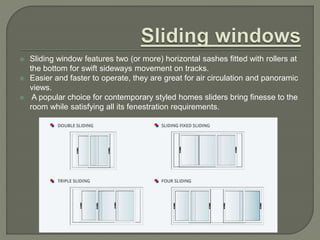
 Sliding window features two (or more) horizontal sashes fitted with rollers at
the bottom for swift sideways movement on tracks.
 Easier and faster to operate, they are great for air circulation and panoramic
views.
 A popular choice for contemporary styled homes sliders bring finesse to the
room while satisfying all its fenestration requirements.
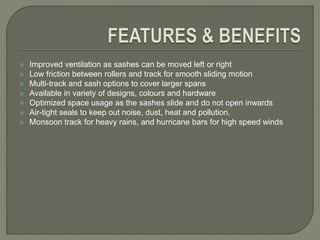
 Improved ventilation as sashes can be moved left or right
 Low friction between rollers and track for smooth sliding motion
 Multi-track and sash options to cover larger spans
 Available in variety of designs, colours and hardware
 Optimized space usage as the sashes slide and do not open inwards
 Air-tight seals to keep out noise, dust, heat and pollution.
 Monsoon track for heavy rains, and hurricane bars for high speed winds
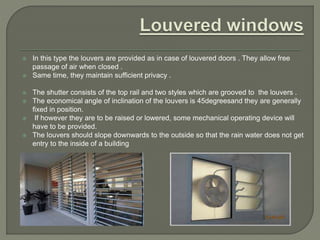
 In this type the louvers are provided as in case of louvered doors . They allow free
passage of air when closed .
 Same time, they maintain sufficient privacy .
 The shutter consists of the top rail and two styles which are grooved to the louvers .
 The economical angle of inclination of the louvers is 45degreesand they are generally
fixed in position.
 If however they are to be raised or lowered, some mechanical operating device will
have to be provided.
 The louvers should slope downwards to the outside so that the rain water does not get
entry to the inside of a building
ADVANTAGES DISADVANTAGES
 Wide Opening Capacity
Louvre windows can be opened to nearly
the full width of the window. This creates
maximum air flow, in or out.
 Adjustable Blades
You can angle the blades This allows for
easy adjustment of airflow.
 Easy Cleaning
Since they can be tilted 180 degrees,
that means you can easily clean both
sides of the glass.
 Inefficient Insulators
do not insulate well. Even if the slats are
flushed against each other, they aren’t
efficient at keeping heat from flowing in
or out of your home.
 The Slats Break
If you use glass slats, they can break
easily. For example, they can break if
you close the window with too much
force.
 The Slats can be a Hazard
Glass slats sticking out from the window
can be dangerous.
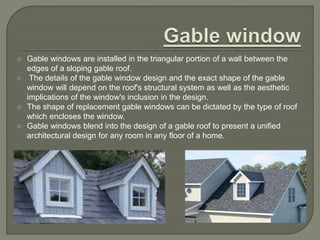
 Gable windows are installed in the triangular portion of a wall between the
edges of a sloping gable roof.
 The details of the gable window design and the exact shape of the gable
window will depend on the roof's structural system as well as the aesthetic
implications of the window's inclusion in the design.
 The shape of replacement gable windows can be dictated by the type of roof
which encloses the window.
 Gable windows blend into the design of a gable roof to present a unified
architectural design for any room in any floor of a home.
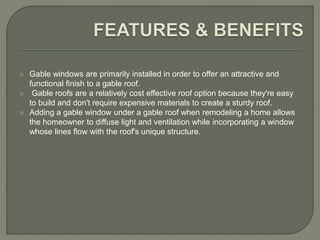
 Gable windows are primarily installed in order to offer an attractive and
functional finish to a gable roof.
 Gable roofs are a relatively cost effective roof option because they're easy
to build and don't require expensive materials to create a sturdy roof.
 Adding a gable window under a gable roof when remodeling a home allows
the homeowner to diffuse light and ventilation while incorporating a window
whose lines flow with the roof's unique structure.
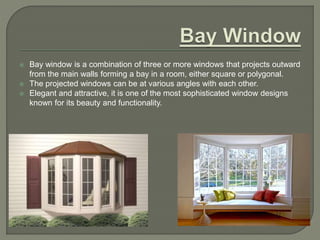
 Bay window is a combination of three or more windows that projects outward
from the main walls forming a bay in a room, either square or polygonal.
 The projected windows can be at various angles with each other.
 Elegant and attractive, it is one of the most sophisticated window designs
known for its beauty and functionality.
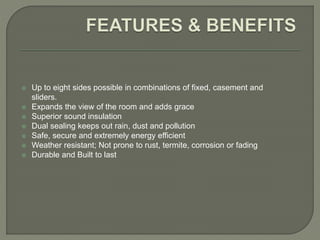
 Up to eight sides possible in combinations of fixed, casement and
sliders.
 Expands the view of the room and adds grace
 Superior sound insulation
 Dual sealing keeps out rain, dust and pollution
 Safe, secure and extremely energy efficient
 Weather resistant; Not prone to rust, termite, corrosion or fading
 Durable and Built to last
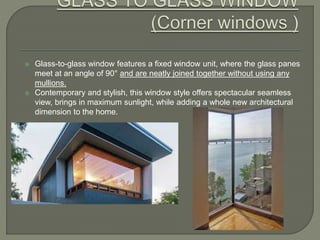
 Glass-to-glass window features a fixed window unit, where the glass panes
meet at an angle of 90° and are neatly joined together without using any
mullions.
 Contemporary and stylish, this window style offers spectacular seamless
view, brings in maximum sunlight, while adding a whole new architectural
dimension to the home.
 Large panoramic view without any hindrance from corner posts or
joints
 Allows maximum sunlight no matter the time of day
 Creates a sense of space and openness in the room
 Adds elegance to the home by becoming a design focal point
 Creates an attraction from outside as well as indoors
 Gives a sense of unity with nature while providing protection from the
elements
 Prevents dust build up and entry of unwanted pollutants into the
home
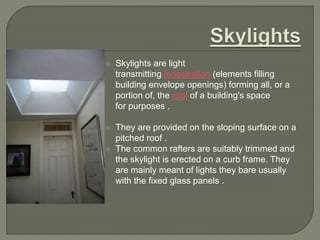
 Skylights are light
transmitting fenestration (elements filling
building envelope openings) forming all, or a
portion of, the roof of a building's space
for purposes .
 They are provided on the sloping surface on a
pitched roof .
 The common rafters are suitably trimmed and
the skylight is erected on a curb frame. They
are mainly meant of lights they bare usually
with the fixed glass panels .
ADVANTAGES DISADVANTAGES
 They provide more natural light in a room
and heat the room with 0 electricity costs.
This makes them a good investment for
the homeowner and also good for the
environment.
 They also increase the house’s value
because of the beautiful aspect they
have.
 The other advantage that a skylight offers
is a modality to observe the outdoor world
from the inside
 . By looking through the skylights, people
can observe the night sky, the stars, the
clouds and lightning.
 The view is limited only by the size of the
skylight.
 The first thing that comes in mind as a
disadvantage is the fact that you cannot
control the amount of heat that enters
through the skylight.
 This can cause the power use of the
house to rise because of the need for
more air conditioning. The same thing
applies for the winter because of the snow
and ice that gather on the skylight you
may need to use more heating energy.
 Another disadvantage is the fact that you
need to get up a ladder to clean the
skylights. This is because they are very
high and there is no other way to reach
them.
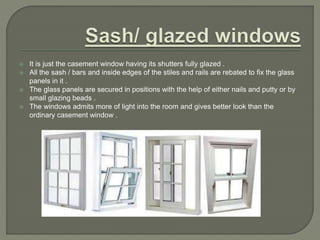
 It is just the casement window having its shutters fully glazed .
 All the sash / bars and inside edges of the stiles and rails are rebated to fix the glass
panels in it .
 The glass panels are secured in positions with the help of either nails and putty or by
small glazing beads .
 The windows admits more of light into the room and gives better look than the
ordinary casement window .
ADVANTAGES DISADVANTAGES
 Being easy to clean and
maintain
 Having high energy ratings and
efficiency
 Being air conditioner friendly
 Add that traditional curb appear
 Having limited ventilation
 Having air leakage
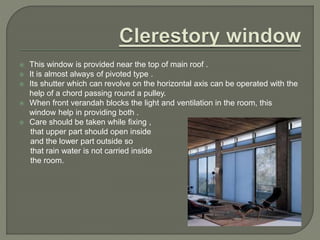
 This window is provided near the top of main roof .
 It is almost always of pivoted type .
 Its shutter which can revolve on the horizontal axis can be operated with the
help of a chord passing round a pulley.
 When front verandah blocks the light and ventilation in the room, this
window help in providing both .
 Care should be taken while fixing ,
that upper part should open inside
and the lower part outside so
that rain water is not carried inside
the room.
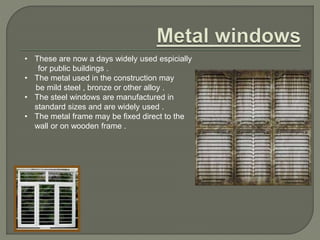
• These are now a days widely used espicially
for public buildings .
• The metal used in the construction may
be mild steel , bronze or other alloy .
• The steel windows are manufactured in
standard sizes and are widely used .
• The metal frame may be fixed direct to the
wall or on wooden frame .

Windows

  • 1.
    BUILDING MATERIALS AND CONSTRUCTION TECHNOLOGY BY-Nikhaar Mehra B.Arch Sem2 Section B
  • 2.
     Houses havewindows for many practical and decorative reasons.  They have windows to provide warmth from the sun.  This natural warmth saves money for electricity that is usually wasted on lightbulbs.  To allow fresh air into the area and to improve ventilation –  For Ventilation  For natural light. This saves money that is wasted on electricity in your every day life.  Windows actually keep out sound. They form a sound barrier against the outside.  Houses have windows for all of these reasons - all equally important.  Windows provide architectural merit and can improve quality of life.
  • 4.
    Depending upon themanner of fixing, material used for construction,nature of operational movements of shutters etc ., the common varieties of windows used in the buildings can be grouped as folllows; 1. Casement windows 2. Double hung windows 3. Pivoted windows 4. Sliding windows 5. Sash/ glazed windows 6. Metal windows 7. Corner windows (glass to glass) 8. Gable windows 9. Dormer windows 10. Bay windows 11. Clerestory windows 12.Skylights
  • 5.
     It isa window whose construction and shutters open like doors.  The window has a frame and shutters composed of vertical and horizontal sash bars , styles and horizontal rails.  The window frame consists of jambs, head and sill.  It may have additional central vertical member known as mullion .  Additional horizontal members known as transomes .
  • 6.
     Super soundinsulation and highly energy efficient  Double sealing to keep out noise, dust and pollution  High quality hardware that does not rust or corrode  Multi-point locking for enhanced security  Double/triple glazing options for better thermal and sound insulation  Protects against rain water seepage and storms  Available in variety of designs, colours and hardware  Custom sizing available
  • 7.
     This windowconsist of a pair of shutters which can slide vertically within the grooves provided in the frame .  A pair of metal weights which remains contained within the frame is connected to each shutter by means of cords or chains after being passed over pulleys which are fixed at the top of frame .  Weights when pulled , open the window to the required, level . By this method window ventilation can be better controlled. In the case of this window vertical members of the frame are lined both from inside and out side to facilitate sliding stutters and also those of weights.
  • 8.
    ADVANTAGES DISADVANTAGES  Versatility.s. The choice of material for double-hung windows includes aluminum, fiberglass, wood, and vinyl.  Air conditioner and screen friendly. Unlike casement windows, double-hung windows can accept air conditioners and screens. Because they slide up and down instead of cranking out or sliding to the side,  Easy to clean. Newer double hung windows have tilt-out upper and lower sashes .This makes the windows easier to clean  Energy efficiency. Although precise measurements are required to minimize moisture and air leaks, high quality double hung windows have the option of quadruple weather stripping.  Not as airtight as other windows. Double hung windows have the option of quadruple weather stripping, but without it, they’re not as airtight as other windows, such as casement windows or fixed windows.  Limited ventilation. Double hung windows work by sliding the bottom sash up or the top sash down. This means, only half of the window may remain open at one time.
  • 9.
     This windowhas an ordinary shutter which may be fully panelled or fully glazed.  But in this window , shutter remains pivoted and not side hung being pivoted the shutter can swing round the pivot .  It may have shutter either vertically or horizontally pivoted .  Frame of this window is similar to casement window but it is not rebated. pivot windows facilitate easy and safe maintenance of the windows from the inside of the building, as the sash rotates through 180 degrees.  These are ideal for multi-storey buildings with large windows and are a popular choice for offices, apartments and town houses.
  • 10.
    ADVANTAGES DISADVANTAGES  GoodVentilation. It can be placed higher in walls than many other types of windows. It provide natural light and ventilation, without compromising privacy.  Weather-tight construction, good choice in damp climates. It protect home against moisture, even when they’re open during a rainstorm. Because of the way awning windows are constructed, they allow for nearly 100 percent of viable ventilation, without the threat of water seeping into the home.  Attractive, contemporary look. Newer windows use friction hinges at either end of the top edge.  Unsafe for high traffic areas of the exterior home. If an awning window sits overlooking sidewalks, decks, porches, or terraces, someone can easily collide with the windows’ jutting sashes.  Require frequent washing. Open sashes on awning windows are exposed. The open slashes slant as well, so they can become dirty faster than other types of windows and require regular washing.  Escape may be difficult. Screens and storm windows are mounted on the inside of awning windows.
  • 11.
     Sliding windowfeatures two (or more) horizontal sashes fitted with rollers at the bottom for swift sideways movement on tracks.  Easier and faster to operate, they are great for air circulation and panoramic views.  A popular choice for contemporary styled homes sliders bring finesse to the room while satisfying all its fenestration requirements.
  • 12.
     Improved ventilationas sashes can be moved left or right  Low friction between rollers and track for smooth sliding motion  Multi-track and sash options to cover larger spans  Available in variety of designs, colours and hardware  Optimized space usage as the sashes slide and do not open inwards  Air-tight seals to keep out noise, dust, heat and pollution.  Monsoon track for heavy rains, and hurricane bars for high speed winds
  • 13.
     In thistype the louvers are provided as in case of louvered doors . They allow free passage of air when closed .  Same time, they maintain sufficient privacy .  The shutter consists of the top rail and two styles which are grooved to the louvers .  The economical angle of inclination of the louvers is 45degreesand they are generally fixed in position.  If however they are to be raised or lowered, some mechanical operating device will have to be provided.  The louvers should slope downwards to the outside so that the rain water does not get entry to the inside of a building
  • 14.
    ADVANTAGES DISADVANTAGES  WideOpening Capacity Louvre windows can be opened to nearly the full width of the window. This creates maximum air flow, in or out.  Adjustable Blades You can angle the blades This allows for easy adjustment of airflow.  Easy Cleaning Since they can be tilted 180 degrees, that means you can easily clean both sides of the glass.  Inefficient Insulators do not insulate well. Even if the slats are flushed against each other, they aren’t efficient at keeping heat from flowing in or out of your home.  The Slats Break If you use glass slats, they can break easily. For example, they can break if you close the window with too much force.  The Slats can be a Hazard Glass slats sticking out from the window can be dangerous.
  • 15.
     Gable windowsare installed in the triangular portion of a wall between the edges of a sloping gable roof.  The details of the gable window design and the exact shape of the gable window will depend on the roof's structural system as well as the aesthetic implications of the window's inclusion in the design.  The shape of replacement gable windows can be dictated by the type of roof which encloses the window.  Gable windows blend into the design of a gable roof to present a unified architectural design for any room in any floor of a home.
  • 16.
     Gable windowsare primarily installed in order to offer an attractive and functional finish to a gable roof.  Gable roofs are a relatively cost effective roof option because they're easy to build and don't require expensive materials to create a sturdy roof.  Adding a gable window under a gable roof when remodeling a home allows the homeowner to diffuse light and ventilation while incorporating a window whose lines flow with the roof's unique structure.
  • 17.
     Bay windowis a combination of three or more windows that projects outward from the main walls forming a bay in a room, either square or polygonal.  The projected windows can be at various angles with each other.  Elegant and attractive, it is one of the most sophisticated window designs known for its beauty and functionality.
  • 18.
     Up toeight sides possible in combinations of fixed, casement and sliders.  Expands the view of the room and adds grace  Superior sound insulation  Dual sealing keeps out rain, dust and pollution  Safe, secure and extremely energy efficient  Weather resistant; Not prone to rust, termite, corrosion or fading  Durable and Built to last
  • 19.
     Glass-to-glass windowfeatures a fixed window unit, where the glass panes meet at an angle of 90° and are neatly joined together without using any mullions.  Contemporary and stylish, this window style offers spectacular seamless view, brings in maximum sunlight, while adding a whole new architectural dimension to the home.
  • 20.
     Large panoramicview without any hindrance from corner posts or joints  Allows maximum sunlight no matter the time of day  Creates a sense of space and openness in the room  Adds elegance to the home by becoming a design focal point  Creates an attraction from outside as well as indoors  Gives a sense of unity with nature while providing protection from the elements  Prevents dust build up and entry of unwanted pollutants into the home
  • 21.
     Skylights arelight transmitting fenestration (elements filling building envelope openings) forming all, or a portion of, the roof of a building's space for purposes .  They are provided on the sloping surface on a pitched roof .  The common rafters are suitably trimmed and the skylight is erected on a curb frame. They are mainly meant of lights they bare usually with the fixed glass panels .
  • 22.
    ADVANTAGES DISADVANTAGES  Theyprovide more natural light in a room and heat the room with 0 electricity costs. This makes them a good investment for the homeowner and also good for the environment.  They also increase the house’s value because of the beautiful aspect they have.  The other advantage that a skylight offers is a modality to observe the outdoor world from the inside  . By looking through the skylights, people can observe the night sky, the stars, the clouds and lightning.  The view is limited only by the size of the skylight.  The first thing that comes in mind as a disadvantage is the fact that you cannot control the amount of heat that enters through the skylight.  This can cause the power use of the house to rise because of the need for more air conditioning. The same thing applies for the winter because of the snow and ice that gather on the skylight you may need to use more heating energy.  Another disadvantage is the fact that you need to get up a ladder to clean the skylights. This is because they are very high and there is no other way to reach them.
  • 23.
     It isjust the casement window having its shutters fully glazed .  All the sash / bars and inside edges of the stiles and rails are rebated to fix the glass panels in it .  The glass panels are secured in positions with the help of either nails and putty or by small glazing beads .  The windows admits more of light into the room and gives better look than the ordinary casement window .
  • 24.
    ADVANTAGES DISADVANTAGES  Beingeasy to clean and maintain  Having high energy ratings and efficiency  Being air conditioner friendly  Add that traditional curb appear  Having limited ventilation  Having air leakage
  • 25.
     This windowis provided near the top of main roof .  It is almost always of pivoted type .  Its shutter which can revolve on the horizontal axis can be operated with the help of a chord passing round a pulley.  When front verandah blocks the light and ventilation in the room, this window help in providing both .  Care should be taken while fixing , that upper part should open inside and the lower part outside so that rain water is not carried inside the room.
  • 26.
    • These arenow a days widely used espicially for public buildings . • The metal used in the construction may be mild steel , bronze or other alloy . • The steel windows are manufactured in standard sizes and are widely used . • The metal frame may be fixed direct to the wall or on wooden frame .