Wooden Partition & Wall
Paneling.
Ar.Vaibhav Ghodke.
Partition & Paneling.
▪ What is Partition?
▪ Types of Partition
▪ Classification of Partition.
▪ Joinery details & Finishes.
▪ Paneling
▪ Details of Paneling
What is Partition?
A structure dividing a space into two parts, especially a light interior wall.
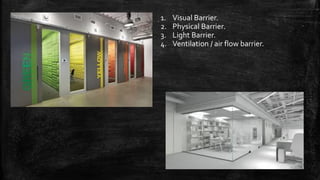
1. Visual Barrier.
2. Physical Barrier.
3. Light Barrier.
4. Ventilation / air flow barrier.
1. Partitions can be constructed so as to be load bearing or non-load bearing.
2. Traditionally, partitions were constructed of timber but the expanding use of
lightweight partitioning and lightweight insulation block walling is decreasing the
need to use timber as a material for partitions. However, it is still used for certain
work and is found extensively when carrying out repair or renovation work.
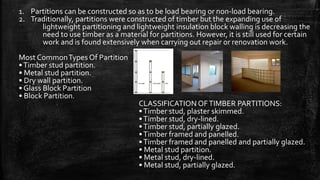
Most CommonTypes Of Partition
•Timber stud partition.
• Metal stud partition.
• Dry wall partition.
• Glass Block Partition
• Block Partition.
CLASSIFICATION OFTIMBER PARTITIONS:
•Timber stud, plaster skimmed.
•Timber stud, dry-lined.
•Timber stud, partially glazed.
•Timber framed and panelled.
•Timber framed and panelled and partially glazed.
• Metal stud partition.
• Metal stud, dry-lined.
• Metal stud, partially glazed.
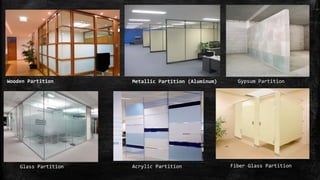
Wooden Partition Metallic Partition (Aluminum)
Glass Partition Acrylic Partition Fiber Glass Partition
Gypsum Partition
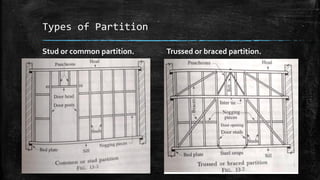
Types of Partition
Stud or common partition. Trussed or braced partition.
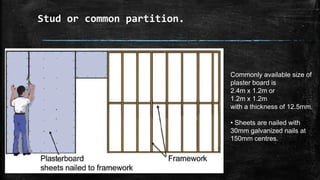
Stud or common partition.
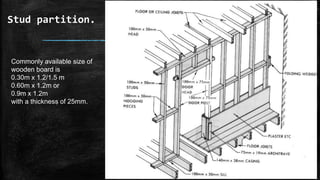
It consists of a wooden frame comprising of height vertical upright members called studs which are
fixed between two horizontal members.
The horizontal member at the foot of stud is called sill and the one at its top is called the head.The
studs are stiffened by a horizontal timber piece called nogging.
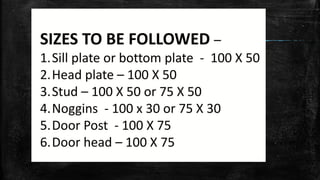
The studs are generally 10 cm. X 5 cm, in section and are spaced at an average distance of 30 t045 cm
apart.
Head and sill are members of varying sizes that are rigidly Secured to the ceiling joists and floor joists
respectively.
The door posts have sufficiently Strong studs, capable of withstanding the Impact due to the usage
of the Opening.
The studs or short length verticals provided between the door head and the partition wall head are
termed as punchers.
To increase the stability of the partition, the ends of the head and sill are usually embedded in the
sidewalls for a short distance.
The entire weight of the partition is borne by the floor and as such solid support for the sill, the
member must be ensured.
The support may be a solid wall or girder or a beam below the floor.
Trussed or braced partition.
In places where the provision of solid support below the sill is not possible, the wooden
trussed partitions have to be employed.
The weight from the trussed partition walls is borne by the side of walls and thus it may be
constructed quite independent of the floor.
Trussed partition wall structure consists of a triangulated frame-work of horizontal, vertical
and inclined wooden members.
Suitable means are employed to make the combination of the members as rigid and stable.
Trussed partition comprises of vertical upright members called studs and horizontal
members at top and bottom termed as head and sill respectively, inclined members called
braces and horizontal members stiffening the ' studs known as Nogging.
The ends of the head and sill are made to rest on the stone template embedded in the wall
at ends.
The joints are further strengthened by mild steel straps and bolts.
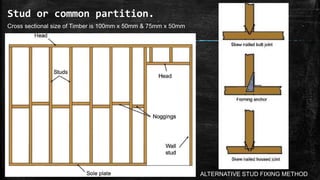
Stud or common partition.
Cross sectional size of Timber is 100mm x 50mm & 75mm x 50mm
ALTERNATIVE STUD FIXING METHOD
Stud or common partition.
Commonly available size of
plaster board is
2.4m x 1.2m or
1.2m x 1.2m
with a thickness of 12.5mm.
• Sheets are nailed with
30mm galvanized nails at
150mm centres.
Stud partition.
Commonly available size of
wooden board is
0.30m x 1.2/1.5 m
0.60m x 1.2m or
0.9m x 1.2m
with a thickness of 25mm.
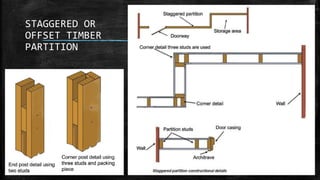
STAGGERED OR
OFFSET TIMBER
PARTITION
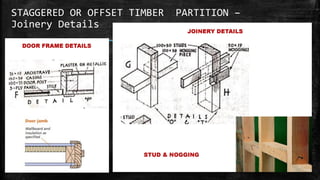
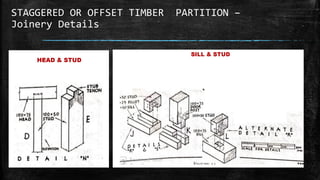
STAGGERED OR OFFSET TIMBER PARTITION –
Joinery Details
STAGGERED OR OFFSET TIMBER PARTITION –
Joinery Details
STAGGERED OR OFFSET TIMBER PARTITION –
Joinery Details
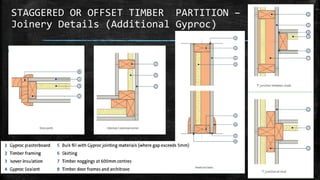
STAGGERED OR OFFSET TIMBER PARTITION –
Joinery Details (Additional Gyproc)
STAGGERED OR OFFSET TIMBER PARTITION –
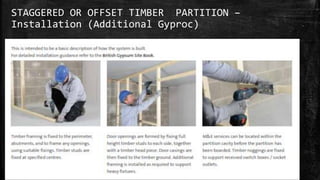
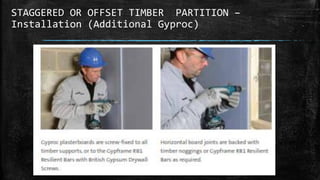
Installation (Additional Gyproc)
STAGGERED OR OFFSET TIMBER PARTITION –
Installation (Additional Gyproc)
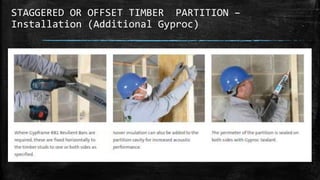
STAGGERED OR OFFSET TIMBER PARTITION –
Installation (Additional Gyproc)
What is Paneling?
Paneling is a millwork wall covering constructed from rigid or semi-rigid
components.These are traditionally interlocking wood, but could be plastic or
other materials.
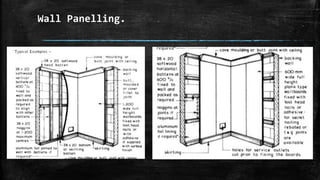
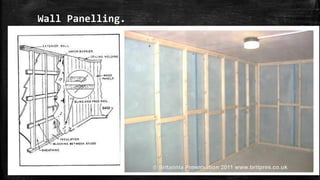
Wall Panelling.
Wall Panelling.
Wall Panelling.
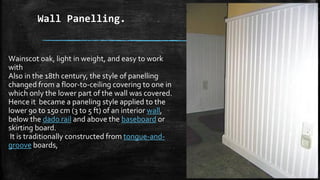
Wainscot oak, light in weight, and easy to work
with
Also in the 18th century, the style of panelling
changed from a floor-to-ceiling covering to one in
which only the lower part of the wall was covered.
Hence it became a paneling style applied to the
lower 90 to 150 cm (3 to 5 ft) of an interior wall,
below the dado rail and above the baseboard or
skirting board.
It is traditionally constructed from tongue-and-
groove boards,
Wall Panelling.
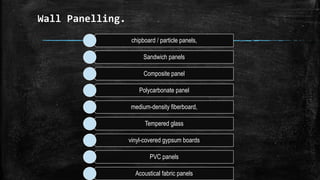
chipboard / particle panels,
Sandwich panels
Composite panel
Polycarbonate panel
medium-density fiberboard,
Tempered glass
vinyl-covered gypsum boards
PVC panels
Acoustical fabric panels
Assignments
Journal
• All joinery details 1:2
• All definitions
Drawings
• 1 Partition for anganwadi project
• Paneling for classroom / cabin
All assignments on A4 paper
Add a Slide Title - 4
Add a Slide Title - 5

Wooden partition & wall paneling

  • 1.
    Wooden Partition &Wall Paneling. Ar.Vaibhav Ghodke.
  • 2.
    Partition & Paneling. ▪What is Partition? ▪ Types of Partition ▪ Classification of Partition. ▪ Joinery details & Finishes. ▪ Paneling ▪ Details of Paneling
  • 3.
    What is Partition? Astructure dividing a space into two parts, especially a light interior wall.
  • 4.
    1. Visual Barrier. 2.Physical Barrier. 3. Light Barrier. 4. Ventilation / air flow barrier.
  • 5.
    1. Partitions canbe constructed so as to be load bearing or non-load bearing. 2. Traditionally, partitions were constructed of timber but the expanding use of lightweight partitioning and lightweight insulation block walling is decreasing the need to use timber as a material for partitions. However, it is still used for certain work and is found extensively when carrying out repair or renovation work. Most CommonTypes Of Partition •Timber stud partition. • Metal stud partition. • Dry wall partition. • Glass Block Partition • Block Partition. CLASSIFICATION OFTIMBER PARTITIONS: •Timber stud, plaster skimmed. •Timber stud, dry-lined. •Timber stud, partially glazed. •Timber framed and panelled. •Timber framed and panelled and partially glazed. • Metal stud partition. • Metal stud, dry-lined. • Metal stud, partially glazed.
  • 6.
    Wooden Partition MetallicPartition (Aluminum) Glass Partition Acrylic Partition Fiber Glass Partition Gypsum Partition
  • 7.
    Types of Partition Studor common partition. Trussed or braced partition.
  • 8.
    Stud or commonpartition. It consists of a wooden frame comprising of height vertical upright members called studs which are fixed between two horizontal members. The horizontal member at the foot of stud is called sill and the one at its top is called the head.The studs are stiffened by a horizontal timber piece called nogging. The studs are generally 10 cm. X 5 cm, in section and are spaced at an average distance of 30 t045 cm apart. Head and sill are members of varying sizes that are rigidly Secured to the ceiling joists and floor joists respectively. The door posts have sufficiently Strong studs, capable of withstanding the Impact due to the usage of the Opening. The studs or short length verticals provided between the door head and the partition wall head are termed as punchers. To increase the stability of the partition, the ends of the head and sill are usually embedded in the sidewalls for a short distance. The entire weight of the partition is borne by the floor and as such solid support for the sill, the member must be ensured. The support may be a solid wall or girder or a beam below the floor.
  • 9.
    Trussed or bracedpartition. In places where the provision of solid support below the sill is not possible, the wooden trussed partitions have to be employed. The weight from the trussed partition walls is borne by the side of walls and thus it may be constructed quite independent of the floor. Trussed partition wall structure consists of a triangulated frame-work of horizontal, vertical and inclined wooden members. Suitable means are employed to make the combination of the members as rigid and stable. Trussed partition comprises of vertical upright members called studs and horizontal members at top and bottom termed as head and sill respectively, inclined members called braces and horizontal members stiffening the ' studs known as Nogging. The ends of the head and sill are made to rest on the stone template embedded in the wall at ends. The joints are further strengthened by mild steel straps and bolts.
  • 10.
    Stud or commonpartition. Cross sectional size of Timber is 100mm x 50mm & 75mm x 50mm ALTERNATIVE STUD FIXING METHOD
  • 11.
    Stud or commonpartition. Commonly available size of plaster board is 2.4m x 1.2m or 1.2m x 1.2m with a thickness of 12.5mm. • Sheets are nailed with 30mm galvanized nails at 150mm centres.
  • 12.
    Stud partition. Commonly availablesize of wooden board is 0.30m x 1.2/1.5 m 0.60m x 1.2m or 0.9m x 1.2m with a thickness of 25mm.
  • 13.
  • 14.
    STAGGERED OR OFFSETTIMBER PARTITION – Joinery Details
  • 15.
    STAGGERED OR OFFSETTIMBER PARTITION – Joinery Details
  • 16.
    STAGGERED OR OFFSETTIMBER PARTITION – Joinery Details
  • 17.
    STAGGERED OR OFFSETTIMBER PARTITION – Joinery Details (Additional Gyproc)
  • 18.
    STAGGERED OR OFFSETTIMBER PARTITION – Installation (Additional Gyproc)
  • 19.
    STAGGERED OR OFFSETTIMBER PARTITION – Installation (Additional Gyproc)
  • 20.
    STAGGERED OR OFFSETTIMBER PARTITION – Installation (Additional Gyproc)
  • 21.
    What is Paneling? Panelingis a millwork wall covering constructed from rigid or semi-rigid components.These are traditionally interlocking wood, but could be plastic or other materials.
  • 22.
  • 23.
  • 24.
    Wall Panelling. Wainscot oak,light in weight, and easy to work with Also in the 18th century, the style of panelling changed from a floor-to-ceiling covering to one in which only the lower part of the wall was covered. Hence it became a paneling style applied to the lower 90 to 150 cm (3 to 5 ft) of an interior wall, below the dado rail and above the baseboard or skirting board. It is traditionally constructed from tongue-and- groove boards,
  • 25.
    Wall Panelling. chipboard /particle panels, Sandwich panels Composite panel Polycarbonate panel medium-density fiberboard, Tempered glass vinyl-covered gypsum boards PVC panels Acoustical fabric panels
  • 27.
    Assignments Journal • All joinerydetails 1:2 • All definitions Drawings • 1 Partition for anganwadi project • Paneling for classroom / cabin All assignments on A4 paper
  • 28.
    Add a SlideTitle - 4
  • 29.
    Add a SlideTitle - 5