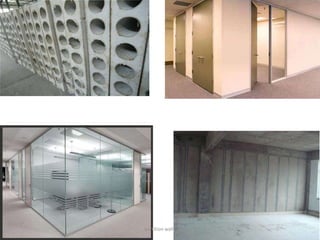

PARTITION WALLS
PRESENTED BY
AGLAIA
Introduction
• A partition wall is a non-load-bearing wall
that divides any interior space.
• It includes static walls built onto the existing
framed walls in the space or moveable
features that slide on rails or roll on casters.
• They are useful for changing the layout and
functionality of a space.
partition walls
Uses
• Creating individual cubicles in a large office
space.
• Providing a quieter reading or tutoring space in a
classroom or library.
• Dividing a shared bedroom into two separate
areas for added privacy.
• Partitioning a studio apartment to separate the
sleeping and living areas.
• Using pre-fabricated walls and screens to hide
storage space.
partition walls
Types of partition walls
• Depending on the material used, different
types of partition walls are:-
1. Brick partition wall
2. Concrete partition wall
3. Hollow partition wall
4. Glass partition
5. Block Board/Plywood partition
partition walls
Brick partition wall
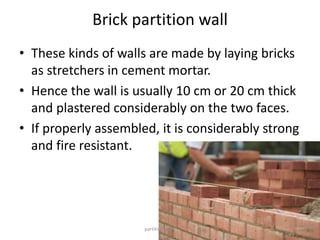
• These kinds of walls are made by laying bricks
as stretchers in cement mortar.
• Hence the wall is usually 10 cm or 20 cm thick
and plastered considerably on the two faces.
• If properly assembled, it is considerably strong
and fire resistant.
partition walls
Concrete partition wall
• These types of walls are cast monolithically with
all the intermediate columns in order to be rigid
and secure both along its length and height.
• These are generally 10 cm thick.
• Reinforcement may be or may not be provided
depending on the contractor.
• If provided, mild steel bars are set in the middle
of the wall thickness.
• Concrete mix generally adopted in the job is M15
(1:2:4).
partition walls
Hollow partition wall
• Hollow blocks which are molded out of clay,
terracotta or concrete are commonly used.
• Such partitions are light, rigid, economical,
powerful and fire resistant.
• They have great sound insulating properties.
• The thickness of this sort of partition wall
varies between 6 cm to 15 cm.
• These walls are built in a similar fashion as
brick walls.
partition walls
Glass partition
• These are being made out of sheet glass fixed in its
place with the help of steel which in turn is fixed to the
walls and the floor.
• Glass partitions are inexpensive, light, and simple in
construction and provide reasonable privacy and noise
insulation.
• The expense of maintenance of these partitions is far
more as the glass is liable to break when struck hard by
anything.
• With the introduction of reinforced glass sheets, this
threat is significantly minimized.
• Three-ply glass and armor plate glass are a few of the
varieties of sheet glass.
partition walls
Block Board/Plywood partition
• This of partition is becoming popular nowadays
as it is lightweight, cheap, durable, and strong.
• This is not permanent in nature and need to be
replaced at time intervals.
• Blockboard is more suitable for use as a partition
wall.
• They are painted from outside to protect them
from termites.
• These are not fireproof and hence care should be
taken.
partition walls
partition walls
Thank youFor more…. Mail to
aglaiaconnect2018@gmail.com
partition walls

Partition walls

  • 1.
  • 2.
    Introduction • A partitionwall is a non-load-bearing wall that divides any interior space. • It includes static walls built onto the existing framed walls in the space or moveable features that slide on rails or roll on casters. • They are useful for changing the layout and functionality of a space. partition walls
  • 3.
    Uses • Creating individualcubicles in a large office space. • Providing a quieter reading or tutoring space in a classroom or library. • Dividing a shared bedroom into two separate areas for added privacy. • Partitioning a studio apartment to separate the sleeping and living areas. • Using pre-fabricated walls and screens to hide storage space. partition walls
  • 4.
    Types of partitionwalls • Depending on the material used, different types of partition walls are:- 1. Brick partition wall 2. Concrete partition wall 3. Hollow partition wall 4. Glass partition 5. Block Board/Plywood partition partition walls
  • 5.
    Brick partition wall •These kinds of walls are made by laying bricks as stretchers in cement mortar. • Hence the wall is usually 10 cm or 20 cm thick and plastered considerably on the two faces. • If properly assembled, it is considerably strong and fire resistant. partition walls
  • 6.
    Concrete partition wall •These types of walls are cast monolithically with all the intermediate columns in order to be rigid and secure both along its length and height. • These are generally 10 cm thick. • Reinforcement may be or may not be provided depending on the contractor. • If provided, mild steel bars are set in the middle of the wall thickness. • Concrete mix generally adopted in the job is M15 (1:2:4). partition walls
  • 7.
    Hollow partition wall •Hollow blocks which are molded out of clay, terracotta or concrete are commonly used. • Such partitions are light, rigid, economical, powerful and fire resistant. • They have great sound insulating properties. • The thickness of this sort of partition wall varies between 6 cm to 15 cm. • These walls are built in a similar fashion as brick walls. partition walls
  • 8.
    Glass partition • Theseare being made out of sheet glass fixed in its place with the help of steel which in turn is fixed to the walls and the floor. • Glass partitions are inexpensive, light, and simple in construction and provide reasonable privacy and noise insulation. • The expense of maintenance of these partitions is far more as the glass is liable to break when struck hard by anything. • With the introduction of reinforced glass sheets, this threat is significantly minimized. • Three-ply glass and armor plate glass are a few of the varieties of sheet glass. partition walls
  • 9.
    Block Board/Plywood partition •This of partition is becoming popular nowadays as it is lightweight, cheap, durable, and strong. • This is not permanent in nature and need to be replaced at time intervals. • Blockboard is more suitable for use as a partition wall. • They are painted from outside to protect them from termites. • These are not fireproof and hence care should be taken. partition walls
  • 10.
  • 11.
    Thank youFor more….Mail to aglaiaconnect2018@gmail.com partition walls