



Barry Kidd 2010 1
PCR and Documentation
Documentation Pearls and Pitfalls
Barry Kidd 2010 2
Barry Kidd 2010 3
Can You Defend It?
Objectives
 Discuss the value of thorough documentation.
 Identify common errors in PCR documentation.
 Familiarize you with courtroom procedure in the
event that you are required to testify.
 Identify common lawsuits against EMS
providers and explore strategies for avoiding
such suits.
Barry Kidd 2010 4
How Is Your Documentation
Used?
 Data collection
 Patient Care
 Record keeping
 Revenue generation and collection
 Quality assurance/education
 Legal document
Barry Kidd 2010 5
Documentation
 Is the highest level of professional
accountability
 Is legally recognized as evidence
 Creates credibility
 Provides credible, pertinent patient
information
 Establishes adherence to or deviation
from the standard of care
Barry Kidd 2010 6
Documentation
“The written prehospital report legally
documents pertinent patient
information and includes all of the
events of the encounter, through final
disposition of the patient. Information
included in the report will be deemed
reliable if the report itself is concisely
accurate, well-written, and credible.”
Barry Kidd 2010 7
Accurate Reporting
• Is both precise and
comprehensive
• Is free of irrelevant opinion or
conclusion
• Accounts for errors of commission
or omission
Barry Kidd 2010 8
Common Documentation
Problems
 Deficiencies in assessment
 Discrepancies between the protocol
regimen and the documented care
 Omission of medication and treatment
record
 Omission of the patient’s response to
treatment
 Use of unapproved abbreviations or
terms
Barry Kidd 2010 9
Deficiencies in Assessment
 Omission of pertinent findings
 Omission of pertinent negatives
 Incomplete patient history
Barry Kidd 2010 10
Pertinent Findings From…
 A patient complaining of chest pain?
 A patient complaining of dyspnea?
 A patient with altered mental status?
 A patient with possible CVA?
 A pregnant patient with abdominal pain?
 A patient who experienced a syncopal
episode?
 A trauma patient?
Barry Kidd 2010 11
Pertinent Findings:
 Mechanism of injury / nature of
illness
 Patient history and physical exam
 SAMPLE, OPQRST, etc
Barry Kidd 2010 12
Pertinent Negatives
 Document the absence of any
condition you would expect to find
that is specific to that patient’s
complaint or mechanism of injury
Barry Kidd 2010 13
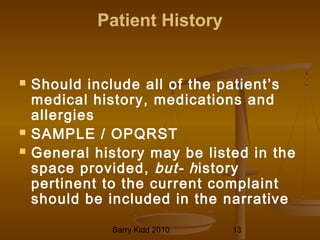
Patient History
 Should include all of the patient’s
medical history, medications and
allergies
 SAMPLE / OPQRST
 General history may be listed in the
space provided, but- history
pertinent to the current complaint
should be included in the narrative
Barry Kidd 2010 14
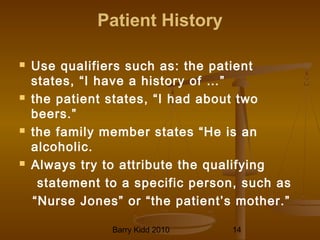
Patient History
 Use qualifiers such as: the patient
states, “I have a history of …”
 the patient states, “I had about two
beers.”
 the family member states “He is an
alcoholic.
 Always try to attribute the qualifying
statement to a specific person, such as
“Nurse Jones” or “the patient’s mother.”
Barry Kidd 2010 15
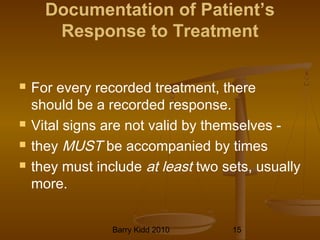
Documentation of Patient’s
Response to Treatment
 For every recorded treatment, there
should be a recorded response.
 Vital signs are not valid by themselves -
 they MUST be accompanied by times
 they must include at least two sets, usually
more.
Barry Kidd 2010 16
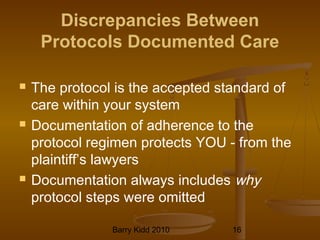
Discrepancies Between
Protocols Documented Care
 The protocol is the accepted standard of
care within your system
 Documentation of adherence to the
protocol regimen protects YOU - from the
plaintiff’s lawyers
 Documentation always includes why
protocol steps were omitted
Barry Kidd 2010 17
Abbreviations:
 Convenient
 Time saving
 A gift to poor spellers
Barry Kidd 2010 18
Abbreviations Are Not:
 The paramedic’s private medical
shorthand
 A substitute for a concisely written report
 Universally accepted by all healthcare
disciplines.
Barry Kidd 2010 19
When using abbreviations:
 Limit your abbreviations to the universally
accepted ones listed in your protocol.
 When the meaning of the abbreviation is
not apparent from the context, write it out!
Barry Kidd 2010 20
Paraglyphics (noun):
Def: “the use of medical abbreviations,
symbols and terminology in such
quantity that the content of the report is
indecipherable to everyone but the
paramedic who wrote the report.”
Barry Kidd 2010 21
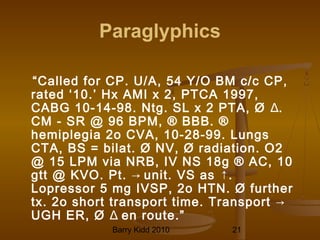
Paraglyphics
“Called for CP. U/A, 54 Y/O BM c/c CP,
rated ‘10.’ Hx AMI x 2, PTCA 1997,
CABG 10-14-98. Ntg. SL x 2 PTA, Ø Δ.
CM - SR @ 96 BPM, ® BBB. ®
hemiplegia 2o CVA, 10-28-99. Lungs
CTA, BS = bilat. Ø NV, Ø radiation. O2
@ 15 LPM via NRB, IV NS 18g ® AC, 10
gtt @ KVO. Pt. → unit. VS as ↑.
Lopressor 5 mg IVSP, 2o HTN. Ø further
tx. 2o short transport time. Transport →
UGH ER, Ø Δ en route.”
Barry Kidd 2010 22
DNR Documentation
Law protects prehospital care providers when
they honor DNR orders, official DNR bracelet or
original signed
 DNR orders must be present. Law protects
attendants who honor these DNR orders, even
if a family member orders you to attempt
resuscitation.
 If the validity of the DNR is in question, the law
also protects you if you don’t honor the DNR
Barry Kidd 2010 23
An Informed Refusal is a
Legally Defensible Refusal
 Over half of litigation against prehospital
providers involves refusals of treatment
or
transport.
Just because the patient signed a refusal
form does not relieve you of liability
The most important part of any refusal is
the provider’s written report!
Barry Kidd 2010 24
Make Me An Offer I Can’t Refuse
A mentally competent adult or
emancipated minor may refuse medical
care if:
 there is no evidence of impaired judgment
due to drugs or alcohol
 the patient is fully aware of the
consequences of their refusal
Barry Kidd 2010 25
Emancipated Minors
 Living on their own
 Self supporting
 In the armed forces
 Married under the age of 18
 A parent of a child
 It is not necessary in most
situations to demand proof of
emancipation - the minor’s claim is
usually sufficient.
Barry Kidd 2010 26
Who Cannot Refuse Care?
 Minors
 Adults with compromised mental
capacity:
 organic
 chemical
 When in doubt, consult medical
control!
Barry Kidd 2010 27
The Informed Refusal
 Assess, Advise, Alleviate
 Explicit, Exploit, Explain
 Persuade, Protocol, Protect
Barry Kidd 2010 28
Assess, Advise and Alleviate
Assess
 mental status
 legal capacity
Advise
 medical condition
 proposed treatment
Alleviate
 the use of confusing medical terminology
Barry Kidd 2010 29
Explicit, Exploit, Explain
Explicit
 explanations ensure an informed, voluntary
 refusal
Exploit
 patient uncertainty
Explain
 that the ambulance will return as needed
Barry Kidd 2010 30
Persuasion, Protocol, Protection
Persuasion
 of the patient to reconsider treatment
Protocol
 application as needed
Protection
 thorough documentation
Barry Kidd 2010 31
Protection
 Assess and document present mental
 capacity:
 “AAOx4” is worthless.
 Folstein mini mental exam
 Assess and document patient injury, illness or
other factors which may interfere with mental
capacity
 Describe the patient’s behavior
 Document presence of, and especially lack of,
significant mechanism of injury or nature of
illness
Barry Kidd 2010 32
Protection
 Explicit explanations should be provided to
ensure that the refusal is informed and
voluntary
 70-80% of patients in one study could not
recall if the risks of their refusal were
explained to them
 Document thoroughly what explicit
explanations you provided
Barry Kidd 2010 33
The Protocol As A Template
 Serves as an accountability
checklist for a legally defensible
report
 Serves as an excellent format for
trip narratives
 Use a consistent format
 CHART time sequential narrative
Barry Kidd 2010 34
Spelling and Grammar
 To other providers and especially to
potential jurors, you are what you write.
 Sloppy report writing equals sloppy care in
the eyes of the jury and the doctor.
 Would you place complete trust in
someone who cannot spell the words they
use on a daily basis?
Barry Kidd 2010 35
Trip Narratives
 Use the approved abbreviations and the
list of commonly misspelled words in your
protocol book for quick reference.
 Add words you have trouble with to the list
 Accept QA of PCRs in the manner in
which it is intended - constructive criticism
Barry Kidd 2010 36
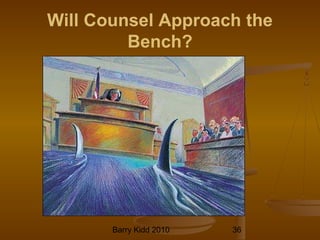
Will Counsel Approach the
Bench?
Barry Kidd 2010 37
In Court:
 You will be allowed to refer to your report
 If you didn’t write it down, it didn’t
happen……unless plaintiff’s counsel can
prove otherwise.
Barry Kidd 2010 38
QUESTIONS?QUESTIONS?

Documentation presentation

  • 1.
    Barry Kidd 20101 PCR and Documentation Documentation Pearls and Pitfalls
  • 2.
  • 3.
    Barry Kidd 20103 Can You Defend It? Objectives  Discuss the value of thorough documentation.  Identify common errors in PCR documentation.  Familiarize you with courtroom procedure in the event that you are required to testify.  Identify common lawsuits against EMS providers and explore strategies for avoiding such suits.
  • 4.
    Barry Kidd 20104 How Is Your Documentation Used?  Data collection  Patient Care  Record keeping  Revenue generation and collection  Quality assurance/education  Legal document
  • 5.
    Barry Kidd 20105 Documentation  Is the highest level of professional accountability  Is legally recognized as evidence  Creates credibility  Provides credible, pertinent patient information  Establishes adherence to or deviation from the standard of care
  • 6.
    Barry Kidd 20106 Documentation “The written prehospital report legally documents pertinent patient information and includes all of the events of the encounter, through final disposition of the patient. Information included in the report will be deemed reliable if the report itself is concisely accurate, well-written, and credible.”
  • 7.
    Barry Kidd 20107 Accurate Reporting • Is both precise and comprehensive • Is free of irrelevant opinion or conclusion • Accounts for errors of commission or omission
  • 8.
    Barry Kidd 20108 Common Documentation Problems  Deficiencies in assessment  Discrepancies between the protocol regimen and the documented care  Omission of medication and treatment record  Omission of the patient’s response to treatment  Use of unapproved abbreviations or terms
  • 9.
    Barry Kidd 20109 Deficiencies in Assessment  Omission of pertinent findings  Omission of pertinent negatives  Incomplete patient history
  • 10.
    Barry Kidd 201010 Pertinent Findings From…  A patient complaining of chest pain?  A patient complaining of dyspnea?  A patient with altered mental status?  A patient with possible CVA?  A pregnant patient with abdominal pain?  A patient who experienced a syncopal episode?  A trauma patient?
  • 11.
    Barry Kidd 201011 Pertinent Findings:  Mechanism of injury / nature of illness  Patient history and physical exam  SAMPLE, OPQRST, etc
  • 12.
    Barry Kidd 201012 Pertinent Negatives  Document the absence of any condition you would expect to find that is specific to that patient’s complaint or mechanism of injury
  • 13.
    Barry Kidd 201013 Patient History  Should include all of the patient’s medical history, medications and allergies  SAMPLE / OPQRST  General history may be listed in the space provided, but- history pertinent to the current complaint should be included in the narrative
  • 14.
    Barry Kidd 201014 Patient History  Use qualifiers such as: the patient states, “I have a history of …”  the patient states, “I had about two beers.”  the family member states “He is an alcoholic.  Always try to attribute the qualifying statement to a specific person, such as “Nurse Jones” or “the patient’s mother.”
  • 15.
    Barry Kidd 201015 Documentation of Patient’s Response to Treatment  For every recorded treatment, there should be a recorded response.  Vital signs are not valid by themselves -  they MUST be accompanied by times  they must include at least two sets, usually more.
  • 16.
    Barry Kidd 201016 Discrepancies Between Protocols Documented Care  The protocol is the accepted standard of care within your system  Documentation of adherence to the protocol regimen protects YOU - from the plaintiff’s lawyers  Documentation always includes why protocol steps were omitted
  • 17.
    Barry Kidd 201017 Abbreviations:  Convenient  Time saving  A gift to poor spellers
  • 18.
    Barry Kidd 201018 Abbreviations Are Not:  The paramedic’s private medical shorthand  A substitute for a concisely written report  Universally accepted by all healthcare disciplines.
  • 19.
    Barry Kidd 201019 When using abbreviations:  Limit your abbreviations to the universally accepted ones listed in your protocol.  When the meaning of the abbreviation is not apparent from the context, write it out!
  • 20.
    Barry Kidd 201020 Paraglyphics (noun): Def: “the use of medical abbreviations, symbols and terminology in such quantity that the content of the report is indecipherable to everyone but the paramedic who wrote the report.”
  • 21.
    Barry Kidd 201021 Paraglyphics “Called for CP. U/A, 54 Y/O BM c/c CP, rated ‘10.’ Hx AMI x 2, PTCA 1997, CABG 10-14-98. Ntg. SL x 2 PTA, Ø Δ. CM - SR @ 96 BPM, ® BBB. ® hemiplegia 2o CVA, 10-28-99. Lungs CTA, BS = bilat. Ø NV, Ø radiation. O2 @ 15 LPM via NRB, IV NS 18g ® AC, 10 gtt @ KVO. Pt. → unit. VS as ↑. Lopressor 5 mg IVSP, 2o HTN. Ø further tx. 2o short transport time. Transport → UGH ER, Ø Δ en route.”
  • 22.
    Barry Kidd 201022 DNR Documentation Law protects prehospital care providers when they honor DNR orders, official DNR bracelet or original signed  DNR orders must be present. Law protects attendants who honor these DNR orders, even if a family member orders you to attempt resuscitation.  If the validity of the DNR is in question, the law also protects you if you don’t honor the DNR
  • 23.
    Barry Kidd 201023 An Informed Refusal is a Legally Defensible Refusal  Over half of litigation against prehospital providers involves refusals of treatment or transport. Just because the patient signed a refusal form does not relieve you of liability The most important part of any refusal is the provider’s written report!
  • 24.
    Barry Kidd 201024 Make Me An Offer I Can’t Refuse A mentally competent adult or emancipated minor may refuse medical care if:  there is no evidence of impaired judgment due to drugs or alcohol  the patient is fully aware of the consequences of their refusal
  • 25.
    Barry Kidd 201025 Emancipated Minors  Living on their own  Self supporting  In the armed forces  Married under the age of 18  A parent of a child  It is not necessary in most situations to demand proof of emancipation - the minor’s claim is usually sufficient.
  • 26.
    Barry Kidd 201026 Who Cannot Refuse Care?  Minors  Adults with compromised mental capacity:  organic  chemical  When in doubt, consult medical control!
  • 27.
    Barry Kidd 201027 The Informed Refusal  Assess, Advise, Alleviate  Explicit, Exploit, Explain  Persuade, Protocol, Protect
  • 28.
    Barry Kidd 201028 Assess, Advise and Alleviate Assess  mental status  legal capacity Advise  medical condition  proposed treatment Alleviate  the use of confusing medical terminology
  • 29.
    Barry Kidd 201029 Explicit, Exploit, Explain Explicit  explanations ensure an informed, voluntary  refusal Exploit  patient uncertainty Explain  that the ambulance will return as needed
  • 30.
    Barry Kidd 201030 Persuasion, Protocol, Protection Persuasion  of the patient to reconsider treatment Protocol  application as needed Protection  thorough documentation
  • 31.
    Barry Kidd 201031 Protection  Assess and document present mental  capacity:  “AAOx4” is worthless.  Folstein mini mental exam  Assess and document patient injury, illness or other factors which may interfere with mental capacity  Describe the patient’s behavior  Document presence of, and especially lack of, significant mechanism of injury or nature of illness
  • 32.
    Barry Kidd 201032 Protection  Explicit explanations should be provided to ensure that the refusal is informed and voluntary  70-80% of patients in one study could not recall if the risks of their refusal were explained to them  Document thoroughly what explicit explanations you provided
  • 33.
    Barry Kidd 201033 The Protocol As A Template  Serves as an accountability checklist for a legally defensible report  Serves as an excellent format for trip narratives  Use a consistent format  CHART time sequential narrative
  • 34.
    Barry Kidd 201034 Spelling and Grammar  To other providers and especially to potential jurors, you are what you write.  Sloppy report writing equals sloppy care in the eyes of the jury and the doctor.  Would you place complete trust in someone who cannot spell the words they use on a daily basis?
  • 35.
    Barry Kidd 201035 Trip Narratives  Use the approved abbreviations and the list of commonly misspelled words in your protocol book for quick reference.  Add words you have trouble with to the list  Accept QA of PCRs in the manner in which it is intended - constructive criticism
  • 36.
    Barry Kidd 201036 Will Counsel Approach the Bench?
  • 37.
    Barry Kidd 201037 In Court:  You will be allowed to refer to your report  If you didn’t write it down, it didn’t happen……unless plaintiff’s counsel can prove otherwise.
  • 38.
    Barry Kidd 201038 QUESTIONS?QUESTIONS?