SOAP Made Easy
Steve Cole
Paramedic, CCEMT-P
Revision information
 Last modified 01-20-05
 For more information on this or other
presentations, contact:
– Steve Cole
– rcole@adaweb.net
– colemedic@hotmail.com
Goals
 Write consistent and comprehensive
documentation of patient care contacts.
 Write in a form acceptable through out the medical
industry.
 Write charts in a legally defensible way.
 Write charts that demonstrate indications,
responses, and other pertinent information behind
interventions we do.
 Write charts that accurately tell the impact of EMS
on any pt contact.
Basic concepts of documentation
1. BASIC "RULE" OF
DOCUMENTATION:
"IF YOU DIDN'T WRITE IT, IT DIDN'T
GET DONE!"
2. THE PROFESSIONALISM OF THE
REPORT REFLECTS ON THE
PROFESIONALISM OF THE WRITER.
3. DOCUMENT THE SAME WAY EACH
TIME .
"The best protection from liability is
good pre-hospital care."
"The best protection in a malpractice
proceeding is good documentation."
Why Document?
 Professional responsibility
 Legal protection
 Regulatory standards
 Reimbursement
The PCR as a legal document
 “Business Record”. We are in the patient
care business, it is a record of our business.
– Discoverable in court.
– Reflects directly on the credibility of the author.
 Refreshing of memory of testimony
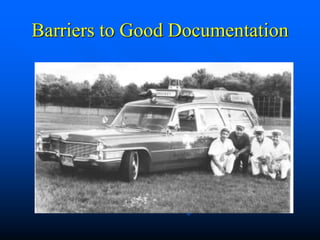
Barriers to Good Documentation
Educational Emphasis
 Covered Briefly in initial training.
– Only a few pages in most text books.
 Not tested, reviewed
 Inconsistent training methods
 Different Styles, all correct.
– Its not a “Skill Station”
Blind leading the blind
 Usually taught “on the Job”
 Sometimes those who are teaching are
teaching bad habits based on
misconceptions, out dated information, or
outright bad information.
 Only corrective action is often for billing
purposes.
"Drudgery" vs. Personal Challenge
 Improving documentation skills and
discovering enjoyment in charting requires
personal effort, study, and practice.
 Self esteem and the desire to excel can
motivate this personal effort, yielding great
personal satisfaction, a sense of
accomplishment, and professional respect.
Standards (lack there of)
 Abbreviations
 Permissible errors
 Addendums
 Format
Documentation Pitfalls
Handwriting
 Handwritten Charts
Concerns:
– Legibility
– Spelling errors
– Reluctance to rewrite
– Poor legibility = perceived
attempt to cover up
mistakes
 Solution: Computerized
Charts
– Legible
– Easy and quick to correct
– Professional appearance.
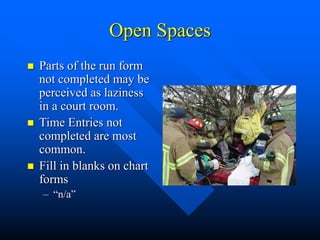
Open Spaces
 Parts of the run form
not completed may be
perceived as laziness
in a court room.
 Time Entries not
completed are most
common.
 Fill in blanks on chart
forms
– “n/a”
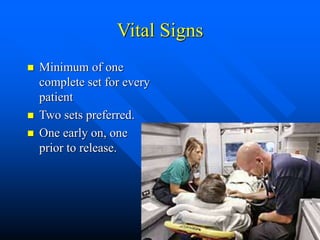
Vital Signs
 Minimum of one
complete set for every
patient
 Two sets preferred.
 One early on, one
prior to release.
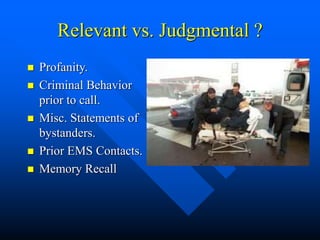
Relevant vs. Judgmental ?
 Profanity.
 Criminal Behavior
prior to call.
 Misc. Statements of
bystanders.
 Prior EMS Contacts.
 Memory Recall
Dotting the I’s
 Document the clinically significant details
 Sign every entry
 Write neatly and legibly
 Use proper spelling, grammar, and
appropriate medical phrases
 Document in blue or black ink and use
military time
Crossing the T’s
 Use authorized abbreviations
– Department approved abbreviations
 Record the patient’s name on every page
 Chart promptly
 Chart after delivery of care
Other Minutia:
 Document exact quotes
 Eliminate bias from written descriptions of
patients
 Do not tamper with records
 Correctly identify late entries
 Record only accurate information (mg , etc)
Legal
 Do not omit significant information from the chart
 Correct mistaken entries properly
– Initial, single line
– 3 mistakes total per ACEMS standards for written
documentation
 Do not rewrite the record
 Do not lose or destroy medical records (HIPAA)
 Do not add to the notes of others
LEGAL
 ALWAYS BE SURE YOUR RECORD
DOES NOT CONTRADICT ITSELF!
The importance of Perception
 Often Legal action is taken because of Act of
Omission, no Commission.
 We are (most often) sued because of something
that was not done.
– We didn’t treat a condition
– We didn’t provide transport
– We didn’t take time to…
 Many times this results in a underlying perception
that we didn’t care enough to do our job.
The importance of Perception
 It is important that our patient chart clearly
shows that we were not just bystanders to
the patients condition, but we took an active
part in being a pt advocate.
 This changes the perception from us being a
lazy medic who didn’t take the time to
transport (or treat) the patient to a caring
individual who tried to take care of a patent
but the patient (or situation) prevented it.
The importance of Perception
 Examples:
– Refusals:
» “Transport was clearly offered”
» “Informed refusal of care obtained, risks explained
including death, and pt declined”
– Getting Family, case worker, etc. involved.
– Advising the patient of alternative resources for
getting assistance.
– Calling ahead to hospital to advise them of
patients ETA if arriving via POV.
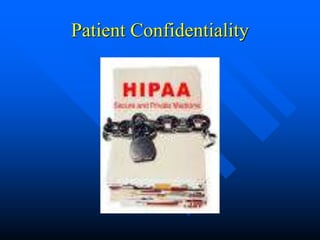
Patient Confidentiality
 Most common wrongdoing of EMS
 “What happens on the job stays on the job!”
-Be careful of what you say in restaurants,
elevators, EMS room
 If you have a patient that comes to the
station requesting a copy of PCR you must
receive written request, follow departmental
policies, etc.
Exceptions for release of data:
 “need to know”- other providers at risk
 Assault & battery, rape, abuse, etc.
 Third party billing for medicare/medicaid
 Proper subpoena
 Appropriateness of release of information
 Still need to follow policy.
Invasion of Privacy
 When you break confidentiality agreement
releasing information without patient
consent
– Discussing someone's STD with others
– Implying someone was DWI
– Discussing Domestic battery cases
What is HIPAA
 Health Insurance Portability and Accountability Act
– Est. in 1996 by The Centers for Medicaid and Medicare
(CMS)
 This is the federal regulations that are now put in place to
protect protected health information (PHI).
 Also sets forth standards for electronic health care
transactions.
– If you ask me this is like the standard patient confidentiality
practices we’ve all been taught on crack!!??
What is PHI
 Protected Health Information
– ANY information that can ID that pt to a
medical problem.
– SSN, DOB, Name
– Address
 Incidental Disclosure
– Bystanders
– Public View
– Radio
Goals of HIPAA
 Limit the non-consensual use and release of
private health information
 Give patients new rights to access their
medical records and to know who else has
accessed them
 Restrict most disclosure of health information
to the minimum needed for the intended
purpose
 Establish new requirements for access to
records by researchers and others
Goals of HIPAA
 Establish new criminal and civil sanctions for improper use or
disclosure of PHI
– Civil penalties for inappropriate disclosure are $100 per
episode and no more than $25,000 per calendar year.
– Inappropriate disclosure of PHI can be punished by $50,000
fine and up to one year in the pen.
– Obtaining PHI under false pretenses can be punished by
$100,000 fine and up to 5 years in the pen.
– PHI disclosure for commercial use, personal gain, or
malicious harm can lead to $250,000 fine and up to 10 years
in the pen. (Sorry, you can’t say Bob Dole will die before his
term is up again)
» These fines and assessments have been published but
there will be a whole separate rule published eventually
that outlines and describes the infractions and fines
further.
HIPAA
 Three Approved reasons for HIPAA
Disclosure
– Legally mandated reporting
» Subpoena
– Operational Uses
» Educational Uses
» QA/QI
– Transfer of Care
» FULL DISCLOSURE
HIPAA Compliance
 HIPAA Training
 Safeguards
– Policy
– Physical/Electronic Access controlled
 Notification of Privacy Procedures to pt’s or
family.
– Good Faith Paperwork
– Signature forms
 ALL PATIENTS YOU COLLECT PHI ON!
Types of charting
Charting systems
 Effective and efficient charting has been an
issue to medicine throughout history.
 Numerous methods of charting have
evolved over time.
 More are evolving every day.
Narrative Method
 A diary or story like approach to the
recording of patient care
 Are more efficient if used in combination
with flow sheets for recording some
repetitive data
Narrative Method
Advantages:
 Good for triage systems, quick entries
 familiar to most nurses
– can be easily combined with other methods
» “P” in SOAP
Narrative Method
Disadvantages:
 lack of structure
 task oriented and time consuming
 information may be difficult to retrieve
 does not always reflect critical thinking,
decision making and analysis
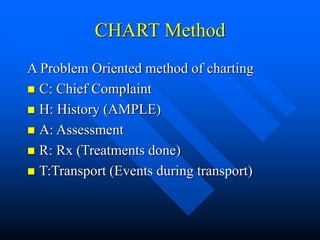
CHART Method
A Problem Oriented method of charting
 C: Chief Complaint
 H: History (AMPLE)
 A: Assessment
 R: Rx (Treatments done)
 T:Transport (Events during transport)
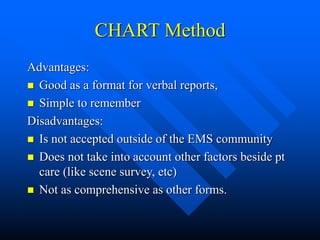
CHART Method
Advantages:
 Good as a format for verbal reports,
 Simple to remember
Disadvantages:
 Is not accepted outside of the EMS community
 Does not take into account other factors beside pt
care (like scene survey, etc)
 Not as comprehensive as other forms.
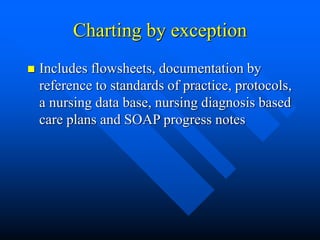
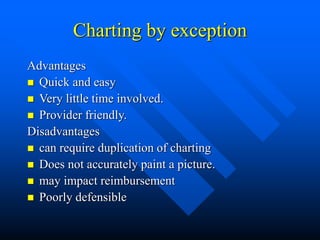
Charting by exception
 Includes flowsheets, documentation by
reference to standards of practice, protocols,
a nursing data base, nursing diagnosis based
care plans and SOAP progress notes
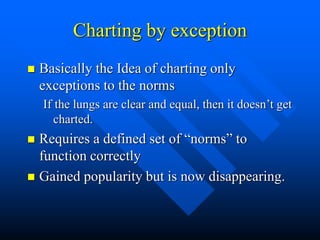
Charting by exception
 Basically the Idea of charting only
exceptions to the norms
If the lungs are clear and equal, then it doesn’t get
charted.
 Requires a defined set of “norms” to
function correctly
 Gained popularity but is now disappearing.
Charting by exception
Advantages
 Quick and easy
 Very little time involved.
 Provider friendly.
Disadvantages
 can require duplication of charting
 Does not accurately paint a picture.
 may impact reimbursement
 Poorly defensible
Computerized Charting
 One of the strongest trends in EMS
documentation throughout the US and
Canada.
 Very common in the larger Systems in this
area.
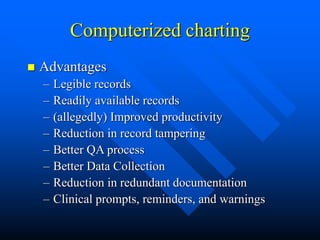
Computerized charting
 Advantages
– Legible records
– Readily available records
– (allegedly) Improved productivity
– Reduction in record tampering
– Better QA process
– Better Data Collection
– Reduction in redundant documentation
– Clinical prompts, reminders, and warnings
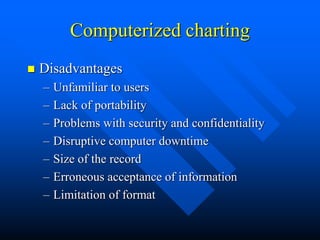
Computerized charting
 Disadvantages
– Unfamiliar to users
– Lack of portability
– Problems with security and confidentiality
– Disruptive computer downtime
– Size of the record
– Erroneous acceptance of information
– Limitation of format
Computerized charting
 Disadvantages, cont
– Resistance
– Cost
– Legal Defensibility from poorly written
narratives
– THE PT DOES NOT FIT THE COMPUTER
PROGRAM
SOAP charting
A problem oriented charting method
 Subjective data
 Objective data
 Assessment
 Plan
SOAP Method
 Has been expanded in NURSING to include
– SOAPIE
» add Interventions
» add Evaluation
– SOAPIER
» add Revision
SOAP Method
Advantages:
 well structured
 reflects the care process
 easier to track particular problems for QI
 can be used effectively with standard care plans
 frequently used in the integrated plans
 Is used through out the medical and billing
community.
SOAP Method
Disadvantages:
 requires rethinking documentation process
 can be redundant
 not the Quickest
 has met some resistance due to effort
needed to document correctly.
At Ada County EMS we have
implanted a computer charting
system , but we still write a
SOAP note with in the system.
This gives us good defensible
charts while retaining data
management and QA functions.
WHAT IS THE
SOAP?
SUBJECTIVE
 EVERYTHING you find out about the pt
from something other than direct
observation/Assessment
 Information from the pt.
 Information from the PD
 Information from the Chart (Exception:
some diagnostics)
 Information from other medical providers
prior relating to care prior to your arrival
Dispatch Information
 Keep separate from main body of the SOAP, still
important.
 Very important with multiple pt’s.
 “Medic 1 dispatched to MVC. On arrival
presented with multiple patients, this is pt 2 of 4
seen by this unit.”
 Be sure you coordinate with other providers so
your numbers match up.
 Good place to document delays, wrong directions,
etc.
S: “once upon a time”
 Your opening lines can break a subjective
– Pt. Age, C/C or reason why they were unable to
present one.
– Followed by Secondary Chief complaints.
 “Pt is a 31 y/o male with c/c of lower back
pain secondary to fall. Pt also complains of
SOB, Nausea, and dizziness”
S: Quotes
 Pt States: Exact verbage
 Pt reports: summery
 Guess what ... if the patient has a potty
mouth and this disposition or information
is important to the situation, go ahead and
include the quotes, but don't forget
quotation marks!
S: OPQRST
 Very Important when describing any type of
Pain.
 Can be used very effectively for other types
of discomfort (chest pressure, tightness, etc)
and complaints (nausea, vertigo, etc)
S: “OPQRST” Pain Questions
– Onset - when start, sudden or gradual. Activity at
onset.
– Provoke - position, movement, local or general
– Quality - sharp, dull
– Radiating - if so, from where to where
– Severity - mild-moderate-severe or scale of 1-10
– Time - how long, continuous or intermittent, worse
or better. Crescendo pattern.
S: Previous episodes
 Prior episodes, what brought it on?
 Seen By an doctor?
 Self or prescribed treatment (w/ or w/o
success)
 Crescendo pattern?
S:Pertinent positives and
negatives
 Depends on c/c
 Very important
 Can protect you or open you up
 Common ones : Chest discomfort, SOB,.
N/V, Near syncopal episodes, dizziness,
previous episodes.
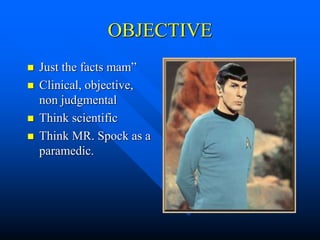
OBJECTIVE
 Just the facts mam”
 Clinical, objective,
non judgmental
 Think scientific
 Think MR. Spock as a
paramedic.
O: VEHICLE
DAMAGE/SCENE SURVEY
 General hygiene of area
– Food in fridge, Garbage overflowing, fecal
matter on floor or in bed.
 Vehicular damage (or lack there of)
– Points of impact, distance from road,
windshield starring, steering column damage,
etc.
 Pill bottles, drug paraphernalia
 Crowd/safety issues.
O: The Pt
 Who is with the pt
– PD, Nurse at bedside, family, bystander, little green
men
 Position of the pt?
– Recumbent, supine, simi-fowlers, standing
 Interventions in effect?
– O2, IV ,C-collar, Manual C-Spine,
– “Stare of life”
 What is the pt doing?
– Walking, Running, Fighting, yelling, gurgling,
tripoding
O: LOC
 LOC is the most important descriptor in the
primary survey, as it will be examined closely in
DWI cases, mental holds, criminal prosecution,
REFUSALS, etc.
 Conscious , alert, oriented to person , place, time
(x3)
 Cooperative
 Mental affect, demeanor
 Short vs long term memory
 Cognition
O: Primary Survey, rapid survey,
etc…
Examples
 LOC: Mentation, described before
 Airway: Clear, snoring
 Breathing: Labored, Non labored, retractions,
grunting, speech dyspnea, audible wheezes
 Circulation: Skin pallor, distal pulses quality
 Disability: Mini nuero, left sided deficits, slurred
speech, unstable gait, moves all ext well.
O: Head to toe
 HEENT:
 NECK/BACK:
 CHEST:
 ABD:
 PELVIS/LOWER EXT:
 UPPER EXT:
 NEURO: Detailed Neuro (optional)
O: Diagnostics
 Blood Glucose: State source (IV stick,
capillary blood)
 Pulse OX: before and after O2 or BVM,
neb, etc
 EKG/ 12 lead (if you are qualified to read,
may be cosigned by medic )
 Temp: Oral, axillary, rectal, etc
 ETCO2.
O: Vital Signs
 Vital signs may be recorded in “O”, “P”. Or
elsewhere in chart depending on PCR layout.
 Vital Signs Record: 2 Sets Minimum; "serial" VS;
Palpated vs. auscultated B/P VS: palpated B/P
documentation; respiratory rates (and techniques
for correctly counting them).
 Documentation of Orthostatic ("Postural") VS
changes: using stick figures to indicate the
patient's position during VS measurement.
Assessment
 Field Diagnosis
 No “red swollen deformed extremities”
– Call a Fx a Fx!
 R/O, Rule Out: Cop Out
 Possible, probable etc are looked down on for
billing purposes, but may be used if you don’t bill.
– OK as a supplement to a DX “Altered Mental staus ,
probable herion overdose”
 Chronic problem that got worse? : “exacerbation
of”
 VS.
 Try to have at least two diagnosis
Assessment continued
 Syndromes are a collection of predictable
symptoms from a common cause;
– Hyperventilation syndrome
 Diagnosis of exclusion
– Dx made only after all other things have been
ruled out. Common pitfall, be very careful
– Alcohol intoxication,
– Anxiety, Psuedo-Seizure
– Muscular neck pain
A: Common assessments
 Soft tissue injury secondary to fall
 Pleuratic pattern Chest wall pain
 Ischemic pattern Chest pain
 Syncope/near syncope of unclear origin
 TIA , CVA with left sided deficits
 Multi system trauma
 Hypoglycemia (may add resolved)
 Post Seizure, Active Seizure , Status epilepticus
 Altered Mental Status- Probable Heroin Overdose
The PLAN
 Chronological detail of pt contact beginning with
on scene. Use time notations.
– Exception: may place pert . Info to call that occurred
and caused a delay to pt contact, like dispatch error, ect.
– “(2030) On scene, contact delayed secondary to scene
sfety issues. EMS staged.
– “(2040) Pt contact and assessment”
 Use 3rd person.
 Both Subjective and Objective.
 Itemize
P: Interventions
 Time?
 What?
 Who?
 How Much?
 Response/adverse effects? OBJECTIVE and
SUBJECTIVE.
 Why?
 “(2031) Oxygen applied by S. Cole for SOB at 10
LPM NRB mask with pt reporting some relief. Pt
work of breathing decreases.Chest pain decreases
to 4/10.”
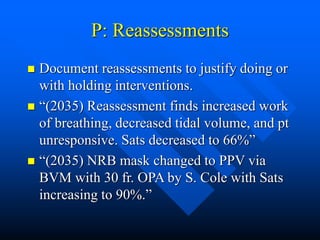
P: Reassessments
 Document reassessments to justify doing or
with holding interventions.
 “(2035) Reassessment finds increased work
of breathing, decreased tidal volume, and pt
unresponsive. Sats decreased to 66%”
 “(2035) NRB mask changed to PPV via
BVM with 30 fr. OPA by S. Cole with Sats
increasing to 90%.”
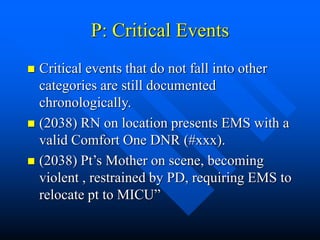
P: Critical Events
 Critical events that do not fall into other
categories are still documented
chronologically.
 (2038) RN on location presents EMS with a
valid Comfort One DNR (#xxx).
 (2038) Pt’s Mother on scene, becoming
violent , restrained by PD, requiring EMS to
relocate pt to MICU”
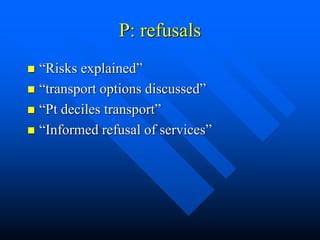
P: refusals
 “Risks explained”
 “transport options discussed”
 “Pt deciles transport”
 “Informed refusal of services”
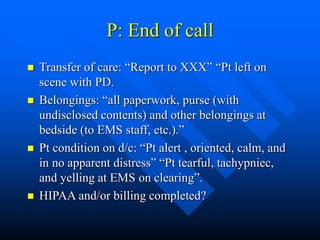
P: End of call
 Transfer of care: “Report to XXX” “Pt left on
scene with PD.
 Belongings: “all paperwork, purse (with
undisclosed contents) and other belongings at
bedside (to EMS staff, etc.).”
 Pt condition on d/c: “Pt alert , oriented, calm, and
in no apparent distress” “Pt tearful, tachypniec,
and yelling at EMS on clearing”.
 HIPAA and/or billing completed?
P: After notes
 Itemizing of :
– Drugs
– ET attempts
– Shocks
– Etc
 Other facts.
Special Situations: Crime Scenes
 You are writing a MEDICAL report, not a
criminal investigative report.
 Don’t neglect good documentation of pt
medical condition for documentation of
criminal events.
 That said, don’t neglect events pertinent to
pt’s medical condition if they involve
criminal activity.
Final thoughts
 Use protocols, articles, medical text books
to be sure you cover all points in a medical
complaint
 Use medical dictionaries frequently
 Document in third person.
 Use a set format, each and every time that
covers all facets of pt care.

2007 SOAP Made Easy- cole.ppt

  • 1.
    SOAP Made Easy SteveCole Paramedic, CCEMT-P
  • 2.
    Revision information  Lastmodified 01-20-05  For more information on this or other presentations, contact: – Steve Cole – rcole@adaweb.net – colemedic@hotmail.com
  • 3.
    Goals  Write consistentand comprehensive documentation of patient care contacts.  Write in a form acceptable through out the medical industry.  Write charts in a legally defensible way.  Write charts that demonstrate indications, responses, and other pertinent information behind interventions we do.  Write charts that accurately tell the impact of EMS on any pt contact.
  • 4.
    Basic concepts ofdocumentation 1. BASIC "RULE" OF DOCUMENTATION: "IF YOU DIDN'T WRITE IT, IT DIDN'T GET DONE!" 2. THE PROFESSIONALISM OF THE REPORT REFLECTS ON THE PROFESIONALISM OF THE WRITER. 3. DOCUMENT THE SAME WAY EACH TIME .
  • 5.
    "The best protectionfrom liability is good pre-hospital care." "The best protection in a malpractice proceeding is good documentation."
  • 6.
    Why Document?  Professionalresponsibility  Legal protection  Regulatory standards  Reimbursement
  • 7.
    The PCR asa legal document  “Business Record”. We are in the patient care business, it is a record of our business. – Discoverable in court. – Reflects directly on the credibility of the author.  Refreshing of memory of testimony
  • 8.
    Barriers to GoodDocumentation
  • 9.
    Educational Emphasis  CoveredBriefly in initial training. – Only a few pages in most text books.  Not tested, reviewed  Inconsistent training methods  Different Styles, all correct. – Its not a “Skill Station”
  • 10.
    Blind leading theblind  Usually taught “on the Job”  Sometimes those who are teaching are teaching bad habits based on misconceptions, out dated information, or outright bad information.  Only corrective action is often for billing purposes.
  • 11.
    "Drudgery" vs. PersonalChallenge  Improving documentation skills and discovering enjoyment in charting requires personal effort, study, and practice.  Self esteem and the desire to excel can motivate this personal effort, yielding great personal satisfaction, a sense of accomplishment, and professional respect.
  • 12.
    Standards (lack thereof)  Abbreviations  Permissible errors  Addendums  Format
  • 13.
  • 14.
    Handwriting  Handwritten Charts Concerns: –Legibility – Spelling errors – Reluctance to rewrite – Poor legibility = perceived attempt to cover up mistakes  Solution: Computerized Charts – Legible – Easy and quick to correct – Professional appearance.
  • 15.
    Open Spaces  Partsof the run form not completed may be perceived as laziness in a court room.  Time Entries not completed are most common.  Fill in blanks on chart forms – “n/a”
  • 16.
    Vital Signs  Minimumof one complete set for every patient  Two sets preferred.  One early on, one prior to release.
  • 17.
    Relevant vs. Judgmental?  Profanity.  Criminal Behavior prior to call.  Misc. Statements of bystanders.  Prior EMS Contacts.  Memory Recall
  • 18.
    Dotting the I’s Document the clinically significant details  Sign every entry  Write neatly and legibly  Use proper spelling, grammar, and appropriate medical phrases  Document in blue or black ink and use military time
  • 19.
    Crossing the T’s Use authorized abbreviations – Department approved abbreviations  Record the patient’s name on every page  Chart promptly  Chart after delivery of care
  • 20.
    Other Minutia:  Documentexact quotes  Eliminate bias from written descriptions of patients  Do not tamper with records  Correctly identify late entries  Record only accurate information (mg , etc)
  • 21.
    Legal  Do notomit significant information from the chart  Correct mistaken entries properly – Initial, single line – 3 mistakes total per ACEMS standards for written documentation  Do not rewrite the record  Do not lose or destroy medical records (HIPAA)  Do not add to the notes of others
  • 22.
    LEGAL  ALWAYS BESURE YOUR RECORD DOES NOT CONTRADICT ITSELF!
  • 23.
    The importance ofPerception  Often Legal action is taken because of Act of Omission, no Commission.  We are (most often) sued because of something that was not done. – We didn’t treat a condition – We didn’t provide transport – We didn’t take time to…  Many times this results in a underlying perception that we didn’t care enough to do our job.
  • 24.
    The importance ofPerception  It is important that our patient chart clearly shows that we were not just bystanders to the patients condition, but we took an active part in being a pt advocate.  This changes the perception from us being a lazy medic who didn’t take the time to transport (or treat) the patient to a caring individual who tried to take care of a patent but the patient (or situation) prevented it.
  • 25.
    The importance ofPerception  Examples: – Refusals: » “Transport was clearly offered” » “Informed refusal of care obtained, risks explained including death, and pt declined” – Getting Family, case worker, etc. involved. – Advising the patient of alternative resources for getting assistance. – Calling ahead to hospital to advise them of patients ETA if arriving via POV.
  • 26.
  • 27.
    Patient Confidentiality  Mostcommon wrongdoing of EMS  “What happens on the job stays on the job!” -Be careful of what you say in restaurants, elevators, EMS room  If you have a patient that comes to the station requesting a copy of PCR you must receive written request, follow departmental policies, etc.
  • 28.
    Exceptions for releaseof data:  “need to know”- other providers at risk  Assault & battery, rape, abuse, etc.  Third party billing for medicare/medicaid  Proper subpoena  Appropriateness of release of information  Still need to follow policy.
  • 29.
    Invasion of Privacy When you break confidentiality agreement releasing information without patient consent – Discussing someone's STD with others – Implying someone was DWI – Discussing Domestic battery cases
  • 30.
    What is HIPAA Health Insurance Portability and Accountability Act – Est. in 1996 by The Centers for Medicaid and Medicare (CMS)  This is the federal regulations that are now put in place to protect protected health information (PHI).  Also sets forth standards for electronic health care transactions. – If you ask me this is like the standard patient confidentiality practices we’ve all been taught on crack!!??
  • 31.
    What is PHI Protected Health Information – ANY information that can ID that pt to a medical problem. – SSN, DOB, Name – Address  Incidental Disclosure – Bystanders – Public View – Radio
  • 32.
    Goals of HIPAA Limit the non-consensual use and release of private health information  Give patients new rights to access their medical records and to know who else has accessed them  Restrict most disclosure of health information to the minimum needed for the intended purpose  Establish new requirements for access to records by researchers and others
  • 33.
    Goals of HIPAA Establish new criminal and civil sanctions for improper use or disclosure of PHI – Civil penalties for inappropriate disclosure are $100 per episode and no more than $25,000 per calendar year. – Inappropriate disclosure of PHI can be punished by $50,000 fine and up to one year in the pen. – Obtaining PHI under false pretenses can be punished by $100,000 fine and up to 5 years in the pen. – PHI disclosure for commercial use, personal gain, or malicious harm can lead to $250,000 fine and up to 10 years in the pen. (Sorry, you can’t say Bob Dole will die before his term is up again) » These fines and assessments have been published but there will be a whole separate rule published eventually that outlines and describes the infractions and fines further.
  • 34.
    HIPAA  Three Approvedreasons for HIPAA Disclosure – Legally mandated reporting » Subpoena – Operational Uses » Educational Uses » QA/QI – Transfer of Care » FULL DISCLOSURE
  • 35.
    HIPAA Compliance  HIPAATraining  Safeguards – Policy – Physical/Electronic Access controlled  Notification of Privacy Procedures to pt’s or family. – Good Faith Paperwork – Signature forms  ALL PATIENTS YOU COLLECT PHI ON!
  • 36.
  • 37.
    Charting systems  Effectiveand efficient charting has been an issue to medicine throughout history.  Numerous methods of charting have evolved over time.  More are evolving every day.
  • 38.
    Narrative Method  Adiary or story like approach to the recording of patient care  Are more efficient if used in combination with flow sheets for recording some repetitive data
  • 39.
    Narrative Method Advantages:  Goodfor triage systems, quick entries  familiar to most nurses – can be easily combined with other methods » “P” in SOAP
  • 40.
    Narrative Method Disadvantages:  lackof structure  task oriented and time consuming  information may be difficult to retrieve  does not always reflect critical thinking, decision making and analysis
  • 41.
    CHART Method A ProblemOriented method of charting  C: Chief Complaint  H: History (AMPLE)  A: Assessment  R: Rx (Treatments done)  T:Transport (Events during transport)
  • 42.
    CHART Method Advantages:  Goodas a format for verbal reports,  Simple to remember Disadvantages:  Is not accepted outside of the EMS community  Does not take into account other factors beside pt care (like scene survey, etc)  Not as comprehensive as other forms.
  • 43.
    Charting by exception Includes flowsheets, documentation by reference to standards of practice, protocols, a nursing data base, nursing diagnosis based care plans and SOAP progress notes
  • 44.
    Charting by exception Basically the Idea of charting only exceptions to the norms If the lungs are clear and equal, then it doesn’t get charted.  Requires a defined set of “norms” to function correctly  Gained popularity but is now disappearing.
  • 45.
    Charting by exception Advantages Quick and easy  Very little time involved.  Provider friendly. Disadvantages  can require duplication of charting  Does not accurately paint a picture.  may impact reimbursement  Poorly defensible
  • 46.
    Computerized Charting  Oneof the strongest trends in EMS documentation throughout the US and Canada.  Very common in the larger Systems in this area.
  • 47.
    Computerized charting  Advantages –Legible records – Readily available records – (allegedly) Improved productivity – Reduction in record tampering – Better QA process – Better Data Collection – Reduction in redundant documentation – Clinical prompts, reminders, and warnings
  • 48.
    Computerized charting  Disadvantages –Unfamiliar to users – Lack of portability – Problems with security and confidentiality – Disruptive computer downtime – Size of the record – Erroneous acceptance of information – Limitation of format
  • 49.
    Computerized charting  Disadvantages,cont – Resistance – Cost – Legal Defensibility from poorly written narratives – THE PT DOES NOT FIT THE COMPUTER PROGRAM
  • 50.
    SOAP charting A problemoriented charting method  Subjective data  Objective data  Assessment  Plan
  • 51.
    SOAP Method  Hasbeen expanded in NURSING to include – SOAPIE » add Interventions » add Evaluation – SOAPIER » add Revision
  • 52.
    SOAP Method Advantages:  wellstructured  reflects the care process  easier to track particular problems for QI  can be used effectively with standard care plans  frequently used in the integrated plans  Is used through out the medical and billing community.
  • 53.
    SOAP Method Disadvantages:  requiresrethinking documentation process  can be redundant  not the Quickest  has met some resistance due to effort needed to document correctly.
  • 54.
    At Ada CountyEMS we have implanted a computer charting system , but we still write a SOAP note with in the system. This gives us good defensible charts while retaining data management and QA functions.
  • 55.
  • 56.
    SUBJECTIVE  EVERYTHING youfind out about the pt from something other than direct observation/Assessment  Information from the pt.  Information from the PD  Information from the Chart (Exception: some diagnostics)  Information from other medical providers prior relating to care prior to your arrival
  • 57.
    Dispatch Information  Keepseparate from main body of the SOAP, still important.  Very important with multiple pt’s.  “Medic 1 dispatched to MVC. On arrival presented with multiple patients, this is pt 2 of 4 seen by this unit.”  Be sure you coordinate with other providers so your numbers match up.  Good place to document delays, wrong directions, etc.
  • 58.
    S: “once upona time”  Your opening lines can break a subjective – Pt. Age, C/C or reason why they were unable to present one. – Followed by Secondary Chief complaints.  “Pt is a 31 y/o male with c/c of lower back pain secondary to fall. Pt also complains of SOB, Nausea, and dizziness”
  • 59.
    S: Quotes  PtStates: Exact verbage  Pt reports: summery  Guess what ... if the patient has a potty mouth and this disposition or information is important to the situation, go ahead and include the quotes, but don't forget quotation marks!
  • 60.
    S: OPQRST  VeryImportant when describing any type of Pain.  Can be used very effectively for other types of discomfort (chest pressure, tightness, etc) and complaints (nausea, vertigo, etc)
  • 61.
    S: “OPQRST” PainQuestions – Onset - when start, sudden or gradual. Activity at onset. – Provoke - position, movement, local or general – Quality - sharp, dull – Radiating - if so, from where to where – Severity - mild-moderate-severe or scale of 1-10 – Time - how long, continuous or intermittent, worse or better. Crescendo pattern.
  • 62.
    S: Previous episodes Prior episodes, what brought it on?  Seen By an doctor?  Self or prescribed treatment (w/ or w/o success)  Crescendo pattern?
  • 63.
    S:Pertinent positives and negatives Depends on c/c  Very important  Can protect you or open you up  Common ones : Chest discomfort, SOB,. N/V, Near syncopal episodes, dizziness, previous episodes.
  • 64.
    OBJECTIVE  Just thefacts mam”  Clinical, objective, non judgmental  Think scientific  Think MR. Spock as a paramedic.
  • 65.
    O: VEHICLE DAMAGE/SCENE SURVEY General hygiene of area – Food in fridge, Garbage overflowing, fecal matter on floor or in bed.  Vehicular damage (or lack there of) – Points of impact, distance from road, windshield starring, steering column damage, etc.  Pill bottles, drug paraphernalia  Crowd/safety issues.
  • 66.
    O: The Pt Who is with the pt – PD, Nurse at bedside, family, bystander, little green men  Position of the pt? – Recumbent, supine, simi-fowlers, standing  Interventions in effect? – O2, IV ,C-collar, Manual C-Spine, – “Stare of life”  What is the pt doing? – Walking, Running, Fighting, yelling, gurgling, tripoding
  • 67.
    O: LOC  LOCis the most important descriptor in the primary survey, as it will be examined closely in DWI cases, mental holds, criminal prosecution, REFUSALS, etc.  Conscious , alert, oriented to person , place, time (x3)  Cooperative  Mental affect, demeanor  Short vs long term memory  Cognition
  • 68.
    O: Primary Survey,rapid survey, etc… Examples  LOC: Mentation, described before  Airway: Clear, snoring  Breathing: Labored, Non labored, retractions, grunting, speech dyspnea, audible wheezes  Circulation: Skin pallor, distal pulses quality  Disability: Mini nuero, left sided deficits, slurred speech, unstable gait, moves all ext well.
  • 69.
    O: Head totoe  HEENT:  NECK/BACK:  CHEST:  ABD:  PELVIS/LOWER EXT:  UPPER EXT:  NEURO: Detailed Neuro (optional)
  • 70.
    O: Diagnostics  BloodGlucose: State source (IV stick, capillary blood)  Pulse OX: before and after O2 or BVM, neb, etc  EKG/ 12 lead (if you are qualified to read, may be cosigned by medic )  Temp: Oral, axillary, rectal, etc  ETCO2.
  • 71.
    O: Vital Signs Vital signs may be recorded in “O”, “P”. Or elsewhere in chart depending on PCR layout.  Vital Signs Record: 2 Sets Minimum; "serial" VS; Palpated vs. auscultated B/P VS: palpated B/P documentation; respiratory rates (and techniques for correctly counting them).  Documentation of Orthostatic ("Postural") VS changes: using stick figures to indicate the patient's position during VS measurement.
  • 72.
    Assessment  Field Diagnosis No “red swollen deformed extremities” – Call a Fx a Fx!  R/O, Rule Out: Cop Out  Possible, probable etc are looked down on for billing purposes, but may be used if you don’t bill. – OK as a supplement to a DX “Altered Mental staus , probable herion overdose”  Chronic problem that got worse? : “exacerbation of”  VS.  Try to have at least two diagnosis
  • 73.
    Assessment continued  Syndromesare a collection of predictable symptoms from a common cause; – Hyperventilation syndrome  Diagnosis of exclusion – Dx made only after all other things have been ruled out. Common pitfall, be very careful – Alcohol intoxication, – Anxiety, Psuedo-Seizure – Muscular neck pain
  • 74.
    A: Common assessments Soft tissue injury secondary to fall  Pleuratic pattern Chest wall pain  Ischemic pattern Chest pain  Syncope/near syncope of unclear origin  TIA , CVA with left sided deficits  Multi system trauma  Hypoglycemia (may add resolved)  Post Seizure, Active Seizure , Status epilepticus  Altered Mental Status- Probable Heroin Overdose
  • 75.
    The PLAN  Chronologicaldetail of pt contact beginning with on scene. Use time notations. – Exception: may place pert . Info to call that occurred and caused a delay to pt contact, like dispatch error, ect. – “(2030) On scene, contact delayed secondary to scene sfety issues. EMS staged. – “(2040) Pt contact and assessment”  Use 3rd person.  Both Subjective and Objective.  Itemize
  • 76.
    P: Interventions  Time? What?  Who?  How Much?  Response/adverse effects? OBJECTIVE and SUBJECTIVE.  Why?  “(2031) Oxygen applied by S. Cole for SOB at 10 LPM NRB mask with pt reporting some relief. Pt work of breathing decreases.Chest pain decreases to 4/10.”
  • 77.
    P: Reassessments  Documentreassessments to justify doing or with holding interventions.  “(2035) Reassessment finds increased work of breathing, decreased tidal volume, and pt unresponsive. Sats decreased to 66%”  “(2035) NRB mask changed to PPV via BVM with 30 fr. OPA by S. Cole with Sats increasing to 90%.”
  • 78.
    P: Critical Events Critical events that do not fall into other categories are still documented chronologically.  (2038) RN on location presents EMS with a valid Comfort One DNR (#xxx).  (2038) Pt’s Mother on scene, becoming violent , restrained by PD, requiring EMS to relocate pt to MICU”
  • 79.
    P: refusals  “Risksexplained”  “transport options discussed”  “Pt deciles transport”  “Informed refusal of services”
  • 80.
    P: End ofcall  Transfer of care: “Report to XXX” “Pt left on scene with PD.  Belongings: “all paperwork, purse (with undisclosed contents) and other belongings at bedside (to EMS staff, etc.).”  Pt condition on d/c: “Pt alert , oriented, calm, and in no apparent distress” “Pt tearful, tachypniec, and yelling at EMS on clearing”.  HIPAA and/or billing completed?
  • 81.
    P: After notes Itemizing of : – Drugs – ET attempts – Shocks – Etc  Other facts.
  • 82.
    Special Situations: CrimeScenes  You are writing a MEDICAL report, not a criminal investigative report.  Don’t neglect good documentation of pt medical condition for documentation of criminal events.  That said, don’t neglect events pertinent to pt’s medical condition if they involve criminal activity.
  • 83.
    Final thoughts  Useprotocols, articles, medical text books to be sure you cover all points in a medical complaint  Use medical dictionaries frequently  Document in third person.  Use a set format, each and every time that covers all facets of pt care.