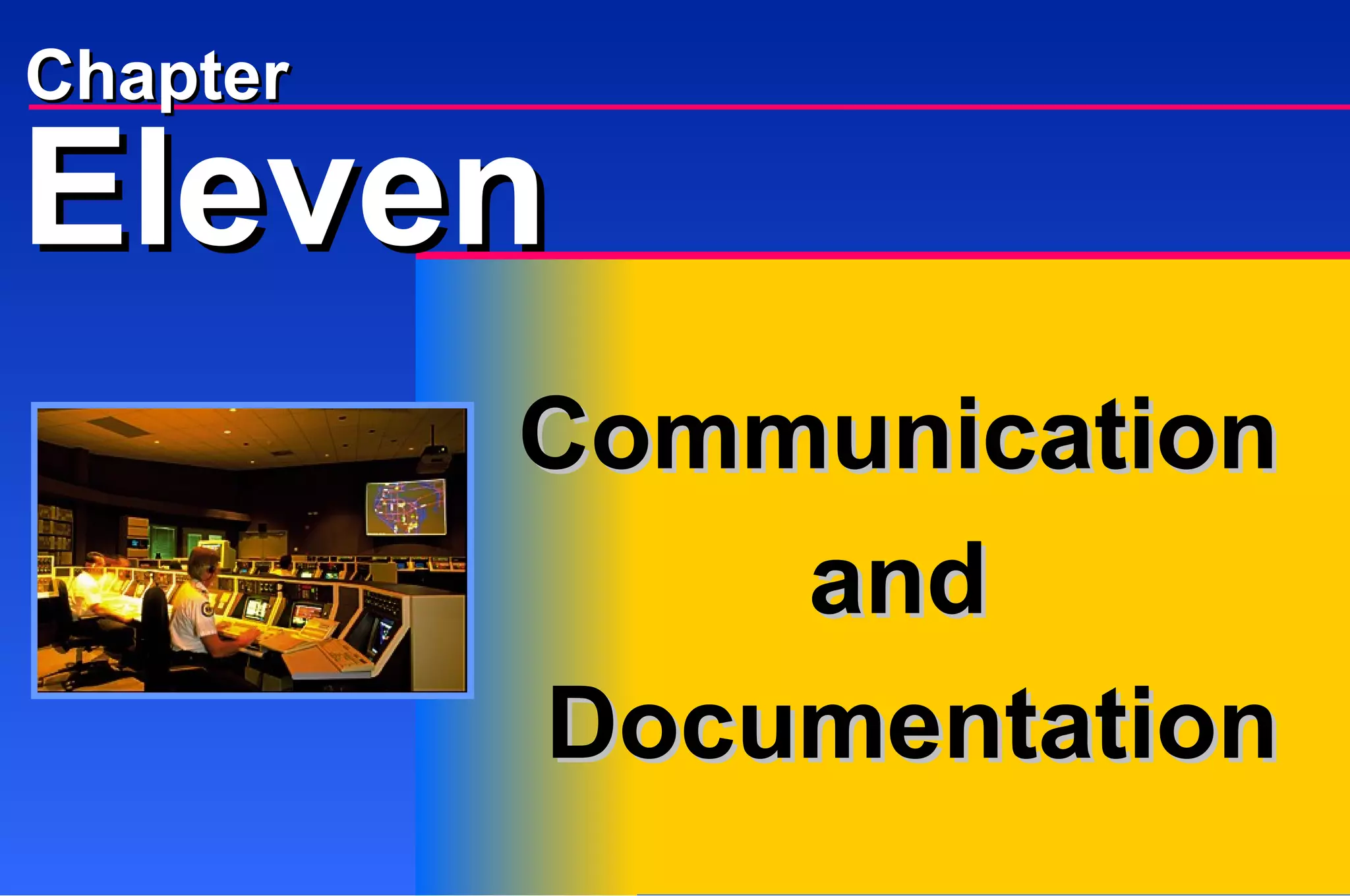
Chapter Communication and Documentation Eleven
Chapter Delivery and format of patient care    radio report Principles of radio use Purposes and principles of    documentation of patient    assessment and care Documentation of special incidents Eleven CORE CONCEPTS
C OMMUNICATIONS
Be honest. Use language the patient can  understand. Interpersonal Communication Principles (Continued)
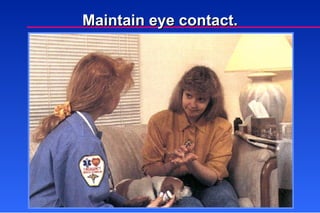
Maintain eye contact.
Be aware of your body  Speak slowly, clearly, and language. distinctly. Interpersonal Communication Principles (Continued)
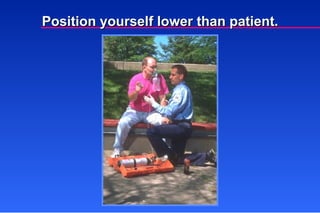
Position yourself lower than patient.
Use the patient’s proper name.  (Ask the patient what he/she wants to be called.) Act and speak in a calm, confident manner. Interpersonal Communication Principles (Continued)
Allow the patient enough time to answer each question. LISTEN! Be aware of disabilities that may   impair communications. Interpersonal Communication Principles (Continued)
Elderly patients may have visual or auditory deficits. Interpreters may be needed with non-English-speaking persons. Interpersonal Communication Principles
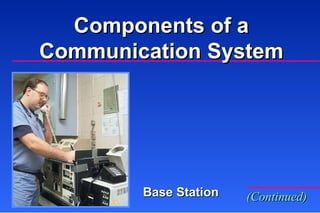
Base Station Components of a Communication System (Continued)
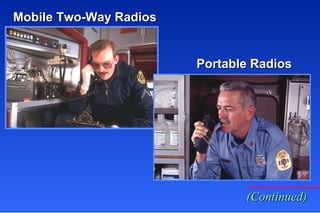
Mobile Two-Way Radios Portable Radios (Continued)
Repeaters Digital radio equipment Cellular telephones Radio frequencies assigned Communication System Components and licensed by the Federal Communications Commission
Get consultation. Obtain orders for medications/interventions. Communication  with Medical Direction (Continued)
The physician determines the need for medications  based on your report (be concise, accurate, and pertinent). (Continued) Communication  with Medical Direction
After  receiving an order: Repeat the order back word for word. Question orders that are unclear or appear to be inappropriate. Communication  with Medical Direction
Call location and information En route to scene/patient Arrival at the scene/patient En route to hospital (Continued) Communication  with Dispatch
At hospital Leaving hospital Unusual situations Request for assistance  Communication  with Dispatch
Listen before transmitting. Press “Push to Talk” (PTT) button one second before speaking. Speak slowly and clearly. (Continued) Communication Principles
Avoid slang, codes, and profanity. Do not give a patient's name over the air. Provide nonjudgmental, objective information. Communication Principles
Presents patient information to hospital. Allows hospital time to prepare. High-quality report “paints a picture” of the patient with  words. Radio Report
Unit and level of provider Estimated time of arrival Patient ’ s age and sex Chief complaint (Continued) Radio Report: Content
Brief, pertinent history of present illness Major past illnesses Mental status Vital signs (Continued) Radio Report: Content
Pertinent findings of the physical exam Emergency medical care given Response to emergency medical    care Radio Report: Content
Introduce the patient by name. Summarize information from the radio report. Verbal Communication at the Hospital radio report. Update what has changed since
D OCUMENTATION
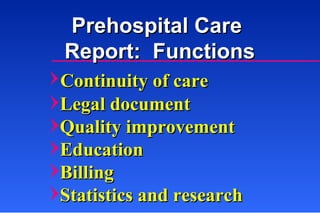
Continuity of care Legal document Quality improvement Education Billing Statistics and research Prehospital Care  Report:  Functions
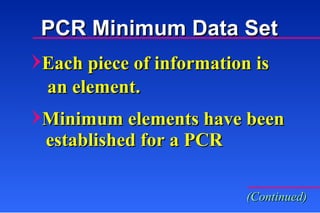
Each piece of information is  an element. Minimum elements have been established for a PCR (Continued) PCR Minimum Data Set
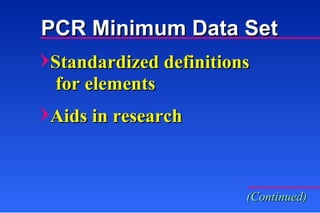
Standardized definitions for elements Aids in research (Continued) PCR Minimum Data Set
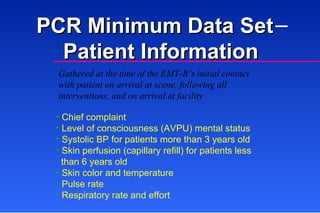
Chief complaint Level of consciousness (AVPU) mental status Systolic BP for patients more than 3 years old Skin perfusion (capillary refill) for patients less   than 6 years old Skin color and temperature Pulse rate Respiratory rate and effort  Gathered at the time of the EMT-B’s initial contact  with patient on arrival at scene, following all interventions, and on arrival at facility PCR Minimum Data Set  Patient Information
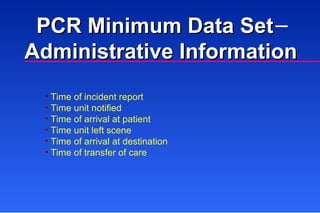
Time of incident report Time unit notified Time of arrival at patient Time unit left scene Time of arrival at destination Time of transfer of care PCR Minimum Data Set  Administrative Information
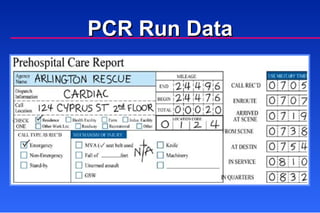
PCR Run Data
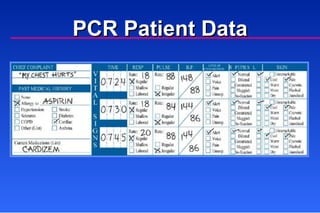
PCR Patient Data
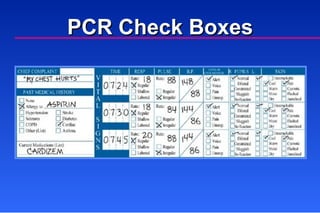
PCR Check Boxes
Avoid conclusions — be objective. Include observations of the scene. Include pertinent negatives. Avoid slang and radio codes. Use only standard abbreviations. Use correct spelling. PCR Narrative
Writing a good PCR is a skill that most people must practice to be good at.  Instead of overwhelming new EMT-Bs with this task, introduce them to it gradually.  On relatively simple calls at first, have new EMT-Bs write the form as you dictate it.  As understanding grows, have them write out the narrative section on  a blank piece of paper, not the PCR.  This allows you to suggest corrections and improvements without worrying about neatness. As EMT-Bs gain more confidence, they can write on the PCR directly for more difficult calls.  P RECEPTOR  P EARL
Confidentiality Distribution of copies PCR
May lead to revocation of certification/license. Leads to poor patient  care. (Continued) Falsification of PCR
If an error in patient care  Note steps taken (if any) to   correct the situation. occurs, document what did or didn ’ t happen.  Falsification of PCR
Correction of Errors on PCR Draw a single horizontal  . Write correct information  Do not obliterate the  line through the error. beside it. error. (Continued)
Use different color of ink. Correct error with single-line cross  Initial and date the correction. If an error is discovered after form is submitted: out. Correction of Errors on PCR
Competent adult patients  may legally refuse treatment. Patients must be informed  of the consequences of refusing care. (Continued) Patient Refusal
Try to persuade the patient to accept care and transportation. Make sure the patient can  make an informed, rational  decision. (Continued) Patient Refusal
Document all assessment  Have patient sign refusal form. Have witness sign refusal form. findings. (Continued) Patient Refusal
Document your attempts to convince patient to go to hospital. Document actions taken to  protect patient after you leave. Contact medical direction if  necessary. Patient Refusal
Insufficient time to fully MCI complete a PCR Use local forms or “tags” on the scene. Follow local MCI plan for documentation. Special Reporting Situations
Document unusual events. Document injury or exposure. Supplement or amplify  primary reports. Special Situation Reports
1. List the required elements of a radio report. 2. Describe ways to improve interpersonal communication. R EVIEW QUESTIONS

Communication and Documentation

  • 1.
    Chapter Communication andDocumentation Eleven
  • 2.
    Chapter Delivery andformat of patient care radio report Principles of radio use Purposes and principles of documentation of patient assessment and care Documentation of special incidents Eleven CORE CONCEPTS
  • 3.
  • 4.
    Be honest. Uselanguage the patient can understand. Interpersonal Communication Principles (Continued)
  • 5.
  • 6.
    Be aware ofyour body Speak slowly, clearly, and language. distinctly. Interpersonal Communication Principles (Continued)
  • 7.
  • 8.
    Use the patient’sproper name. (Ask the patient what he/she wants to be called.) Act and speak in a calm, confident manner. Interpersonal Communication Principles (Continued)
  • 9.
    Allow the patientenough time to answer each question. LISTEN! Be aware of disabilities that may impair communications. Interpersonal Communication Principles (Continued)
  • 10.
    Elderly patients mayhave visual or auditory deficits. Interpreters may be needed with non-English-speaking persons. Interpersonal Communication Principles
  • 11.
    Base Station Componentsof a Communication System (Continued)
  • 12.
    Mobile Two-Way RadiosPortable Radios (Continued)
  • 13.
    Repeaters Digital radioequipment Cellular telephones Radio frequencies assigned Communication System Components and licensed by the Federal Communications Commission
  • 14.
    Get consultation. Obtainorders for medications/interventions. Communication with Medical Direction (Continued)
  • 15.
    The physician determinesthe need for medications based on your report (be concise, accurate, and pertinent). (Continued) Communication with Medical Direction
  • 16.
    After receivingan order: Repeat the order back word for word. Question orders that are unclear or appear to be inappropriate. Communication with Medical Direction
  • 17.
    Call location andinformation En route to scene/patient Arrival at the scene/patient En route to hospital (Continued) Communication with Dispatch
  • 18.
    At hospital Leavinghospital Unusual situations Request for assistance Communication with Dispatch
  • 19.
    Listen before transmitting.Press “Push to Talk” (PTT) button one second before speaking. Speak slowly and clearly. (Continued) Communication Principles
  • 20.
    Avoid slang, codes,and profanity. Do not give a patient's name over the air. Provide nonjudgmental, objective information. Communication Principles
  • 21.
    Presents patient informationto hospital. Allows hospital time to prepare. High-quality report “paints a picture” of the patient with words. Radio Report
  • 22.
    Unit and levelof provider Estimated time of arrival Patient ’ s age and sex Chief complaint (Continued) Radio Report: Content
  • 23.
    Brief, pertinent historyof present illness Major past illnesses Mental status Vital signs (Continued) Radio Report: Content
  • 24.
    Pertinent findings ofthe physical exam Emergency medical care given Response to emergency medical care Radio Report: Content
  • 25.
    Introduce the patientby name. Summarize information from the radio report. Verbal Communication at the Hospital radio report. Update what has changed since
  • 26.
  • 27.
    Continuity of careLegal document Quality improvement Education Billing Statistics and research Prehospital Care Report: Functions
  • 28.
    Each piece ofinformation is an element. Minimum elements have been established for a PCR (Continued) PCR Minimum Data Set
  • 29.
    Standardized definitions forelements Aids in research (Continued) PCR Minimum Data Set
  • 30.
    Chief complaint Levelof consciousness (AVPU) mental status Systolic BP for patients more than 3 years old Skin perfusion (capillary refill) for patients less than 6 years old Skin color and temperature Pulse rate Respiratory rate and effort Gathered at the time of the EMT-B’s initial contact with patient on arrival at scene, following all interventions, and on arrival at facility PCR Minimum Data Set Patient Information
  • 31.
    Time of incidentreport Time unit notified Time of arrival at patient Time unit left scene Time of arrival at destination Time of transfer of care PCR Minimum Data Set Administrative Information
  • 32.
  • 33.
  • 34.
  • 35.
    Avoid conclusions —be objective. Include observations of the scene. Include pertinent negatives. Avoid slang and radio codes. Use only standard abbreviations. Use correct spelling. PCR Narrative
  • 36.
    Writing a goodPCR is a skill that most people must practice to be good at. Instead of overwhelming new EMT-Bs with this task, introduce them to it gradually. On relatively simple calls at first, have new EMT-Bs write the form as you dictate it. As understanding grows, have them write out the narrative section on a blank piece of paper, not the PCR. This allows you to suggest corrections and improvements without worrying about neatness. As EMT-Bs gain more confidence, they can write on the PCR directly for more difficult calls. P RECEPTOR P EARL
  • 37.
  • 38.
    May lead torevocation of certification/license. Leads to poor patient care. (Continued) Falsification of PCR
  • 39.
    If an errorin patient care Note steps taken (if any) to correct the situation. occurs, document what did or didn ’ t happen. Falsification of PCR
  • 40.
    Correction of Errorson PCR Draw a single horizontal . Write correct information Do not obliterate the line through the error. beside it. error. (Continued)
  • 41.
    Use different colorof ink. Correct error with single-line cross Initial and date the correction. If an error is discovered after form is submitted: out. Correction of Errors on PCR
  • 42.
    Competent adult patients may legally refuse treatment. Patients must be informed of the consequences of refusing care. (Continued) Patient Refusal
  • 43.
    Try to persuadethe patient to accept care and transportation. Make sure the patient can make an informed, rational decision. (Continued) Patient Refusal
  • 44.
    Document all assessment Have patient sign refusal form. Have witness sign refusal form. findings. (Continued) Patient Refusal
  • 45.
    Document your attemptsto convince patient to go to hospital. Document actions taken to protect patient after you leave. Contact medical direction if necessary. Patient Refusal
  • 46.
    Insufficient time tofully MCI complete a PCR Use local forms or “tags” on the scene. Follow local MCI plan for documentation. Special Reporting Situations
  • 47.
    Document unusual events.Document injury or exposure. Supplement or amplify primary reports. Special Situation Reports
  • 48.
    1. List therequired elements of a radio report. 2. Describe ways to improve interpersonal communication. R EVIEW QUESTIONS