Documentation
Topics
 Principles and Purposes of
  EMS Documentation
 Medical Terminology & Abbreviations
 Roles of Documentation
 Subjective & Objective
  Documentation
 Evaluation of a Finished Document
 Special Situations
Introduction
 Your written prehospital care
  report (PCR) is the only true
  factual record of events.
 Your PCR is your sole
  permanent, complete written
  record of events during the
  ambulance call.
Uses for PCR’s

   Medical
   Administrative
   Research
   Legal
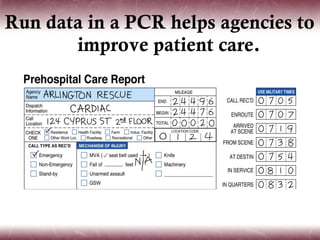
Run data in a PCR helps agencies to
       improve patient care.
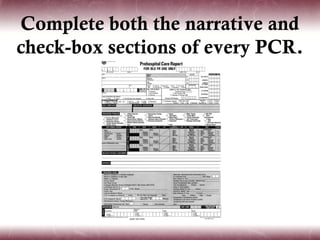
Complete both the narrative and
check-box sections of every PCR.
General Considerations
 Use appropriate medical
  terminology.
 Use acceptable and approved
  abbreviations and acronyms.
  If you do not know how to spell
  a word, look it up or use
  another word…
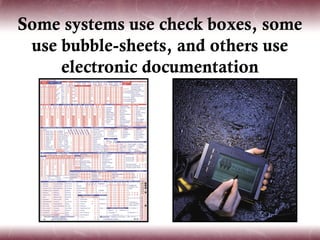
Some systems use check boxes, some
 use bubble-sheets, and others use
     electronic documentation
Times
 Whenever possible, record all
  times from the same clock.
 When that is not possible, be
  sure that all the clocks and
  watches you use are
  synchronized.
Communications
 The communications with the
  hospital are another important
  item to document.
 Document ANY medical advice or
  orders you receive and the results
  of implementing that advice and
  those orders.
Pertinent Negatives

 Document all findings of your
  assessment, even those that
  are normal.
Oral Statements
 Whenever possible, quote the
  patient—or other source of
  information—directly.
  Example: Bystanders state the
  patient was “acting bizarre and
  threatening to jump in front of
  the next passing car.”
Elements of Good Documentation

    Accuracy
    Legibility
    Timeliness
    Absence of alterations
    Professionalism
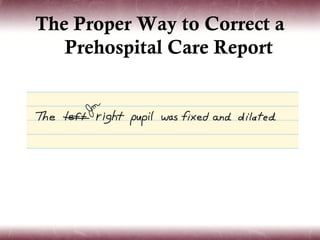
The Proper Way to Correct a
   Prehospital Care Report
Professionalism
 Never include slang, biased
  statements, or irrelevant
  opinions.
 Include only objective
  information.
 Always write and speak clearly.
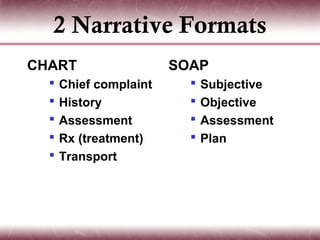
2 Narrative Formats
CHART                   SOAP
     Chief complaint        Subjective
     History                Objective
     Assessment             Assessment
     Rx (treatment)         Plan
     Transport
Narrative Writing
 Subjective part of your narrative
  comprises any information that you
  elicit during your patient’s history.
 Objective part of your narrative
  usually includes your general
  impression and any data that you
  derive through inspection,
  palpation, auscultation, percussion,
  and
  diagnostic testing.
Special Considerations

 Patient refusals
 Services not needed
 Mass casualty incidents
Patient Refusals
 Patients retain the right to refuse
  treatment or transportation if they
  are competent to make that
  decision.
 Two main types of refusals:
    Person who is not seriously
     injured and does not want to go to
     the hospital
    The patient refuses even though
     you feel he needs it.
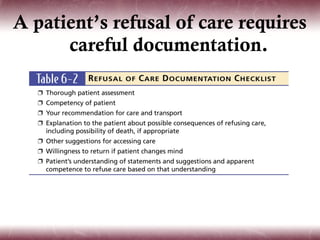
A patient’s refusal of care requires
      careful documentation.
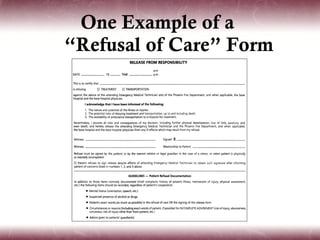
One Example of a
“Refusal of Care” Form
Services Not Needed
 Some systems allow paramedics to
  determine patients that do not
  require ambulance transportation.
 While this may help to reduce
  ambulance utilization, the risks of
  denying transport are even greater
  than those of a refusal.
 Evaluate all patients with even
  minor injuries and document
  appropriately.
Mass Casualty Incidents
 Multiple patients, mass casualties,
  and disasters all present special
  documentation problems.
 Weigh your patient’s needs against
  the demand for complete
  documentation.
 Follow local guidelines and utilize
  the appropriate forms such as
  triage tags.
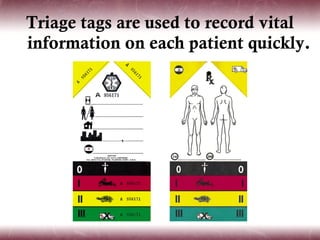
Triage tags are used to record vital
information on each patient quickly.
Consequences of
Inappropriate Documentation
 Inappropriate documentation can
  have both medical and legal
  consequences.
   Do not guess about your patient’s
    problems.
   Write neatly, clearly, and legibly.
   Complete your form completely.
   Spelling counts!
Summary
 Principles and Purposes of
  EMS Documentation
 Medical Terminology & Abbreviations
 Roles of Documentation
 Subjective & Objective
  Documentation
 Evaluation of a Finished Document
 Special Situations

Pt assess documentation

  • 1.
  • 2.
    Topics  Principles andPurposes of EMS Documentation  Medical Terminology & Abbreviations  Roles of Documentation  Subjective & Objective Documentation  Evaluation of a Finished Document  Special Situations
  • 3.
    Introduction  Your writtenprehospital care report (PCR) is the only true factual record of events.  Your PCR is your sole permanent, complete written record of events during the ambulance call.
  • 4.
    Uses for PCR’s  Medical  Administrative  Research  Legal
  • 5.
    Run data ina PCR helps agencies to improve patient care.
  • 6.
    Complete both thenarrative and check-box sections of every PCR.
  • 7.
    General Considerations  Useappropriate medical terminology.  Use acceptable and approved abbreviations and acronyms. If you do not know how to spell a word, look it up or use another word…
  • 8.
    Some systems usecheck boxes, some use bubble-sheets, and others use electronic documentation
  • 9.
    Times  Whenever possible,record all times from the same clock.  When that is not possible, be sure that all the clocks and watches you use are synchronized.
  • 10.
    Communications  The communicationswith the hospital are another important item to document.  Document ANY medical advice or orders you receive and the results of implementing that advice and those orders.
  • 11.
    Pertinent Negatives  Documentall findings of your assessment, even those that are normal.
  • 12.
    Oral Statements  Wheneverpossible, quote the patient—or other source of information—directly. Example: Bystanders state the patient was “acting bizarre and threatening to jump in front of the next passing car.”
  • 13.
    Elements of GoodDocumentation  Accuracy  Legibility  Timeliness  Absence of alterations  Professionalism
  • 14.
    The Proper Wayto Correct a Prehospital Care Report
  • 15.
    Professionalism  Never includeslang, biased statements, or irrelevant opinions.  Include only objective information.  Always write and speak clearly.
  • 16.
    2 Narrative Formats CHART SOAP  Chief complaint  Subjective  History  Objective  Assessment  Assessment  Rx (treatment)  Plan  Transport
  • 17.
    Narrative Writing  Subjectivepart of your narrative comprises any information that you elicit during your patient’s history.  Objective part of your narrative usually includes your general impression and any data that you derive through inspection, palpation, auscultation, percussion, and diagnostic testing.
  • 18.
    Special Considerations  Patientrefusals  Services not needed  Mass casualty incidents
  • 19.
    Patient Refusals  Patientsretain the right to refuse treatment or transportation if they are competent to make that decision.  Two main types of refusals:  Person who is not seriously injured and does not want to go to the hospital  The patient refuses even though you feel he needs it.
  • 20.
    A patient’s refusalof care requires careful documentation.
  • 21.
    One Example ofa “Refusal of Care” Form
  • 22.
    Services Not Needed Some systems allow paramedics to determine patients that do not require ambulance transportation.  While this may help to reduce ambulance utilization, the risks of denying transport are even greater than those of a refusal.  Evaluate all patients with even minor injuries and document appropriately.
  • 23.
    Mass Casualty Incidents Multiple patients, mass casualties, and disasters all present special documentation problems.  Weigh your patient’s needs against the demand for complete documentation.  Follow local guidelines and utilize the appropriate forms such as triage tags.
  • 24.
    Triage tags areused to record vital information on each patient quickly.
  • 25.
    Consequences of Inappropriate Documentation Inappropriate documentation can have both medical and legal consequences.  Do not guess about your patient’s problems.  Write neatly, clearly, and legibly.  Complete your form completely.  Spelling counts!
  • 26.
    Summary  Principles andPurposes of EMS Documentation  Medical Terminology & Abbreviations  Roles of Documentation  Subjective & Objective Documentation  Evaluation of a Finished Document  Special Situations

Editor's Notes

  • #5 1. Medical audit a. Run review conferences b. Other educational forums 2. Quality improvement a. Tally the individual’s performance of patient care procedures and to review individual performance b. Identify systems issues regarding quality improvement 3. Billing and administration a. Acquire the necessary billing and administrative data 4. Data collection a. Research purposes
  • #8 Let’s check out some abbreviations on page 794
  • #10 a. Time of call b. Time of dispatch c. Time of arrival at the scene d. Time(s) of medication administration and certain medical procedures as defined by local protocol e. Time of departure from the scene f. Time of arrival at the medical facility (when transporting a patient) g. Time back in service
  • #13 a. Mechanism of injury b. Patient’s behavior c. First aid interventions attempted prior to the arrival of EMS personnel d. Safety-related information, including disposition of weapons e. Information of interest to crime scene investigators f. Disposition of valuable personal property (e.g., watches, wallets)
  • #14 A. Accurate 1. Document accuracy depends on all information provided, both narrative and checkbox, being a. Precise b. Comprehensive 2. All checkbox sections of a document must show that the EMT-Critical Care Technician attended to them, even if a given section was unused on a call 3. Medical terms, abbreviations, and acronyms are properly used and correctly spelled B. Legible 1. Legibility means that handwriting, especially in the narrative portion of the document, can be read by others without difficulty 2. Checkbox marking should be clear and consistent from the top page of the document to all underlying pages C. Timely 1. Documentation should be completed ideally before the EMT-Critical Care Technician handles tasks subsequent to the patient interaction D. Unaltered 1. While writing the document, should the EMT-Critical Care Technician make an error, a single line should be drawn through the error, initialed, and dated 2. Should alterations to a document be required after the document has been submitted, see “document revision/ correction” (below) E. Free of non-professional/ extraneous information 1. Jargon 2. Slang 3. Bias 4. Libel/ slander 5. Irrelevant opinion/ impression
  • #17 Chart History of present illness Past History Current health status Assesment vitals, general impression, physical Assessment is your Field Diagnosis – includes pertinent negatives Plan (write under comments) treatments and ongoing assessment
  • #18 Subjective is OPQRST Objective There are two ways to do this Head to toe approach vs body systems approach