UNIT-III
EMERGENCY SERVICES
CODES IN A HOSPITAL
Kala Reddy Gandra
INTRODUCTION
 Hospital emergency codes are used in hospitals worldwide to
alert staff to various emergencies. The use of codes is intended to
convey essential information quickly and with minimal
misunderstanding to staff, while preventing stress and panic among
visitors to the hospital. These codes may be posted on placards
throughout the hospital, or printed on employee identification
badges for ready reference.
 Back of a hospital ID badge showing disaster codes.
 Hospital emergency codes may denote different events at different
hospitals, including those in the same community. Because many
physicians work at more than one facility, this may lead to
confusion in emergencies, so uniform systems have been proposed.
EMERGENCY CODE AND PREPARDNESS
 What Is An Emergency Code?
An emergency code is a notification of an event that
requires immediate action.
 Preparing for the Unexpected
Emergencies can strike anywhere and at any time. In
the spirit of proactivity we encourage you to have
your own emergency preparedness plan.
WHAT IS CHANGING WITH
EMERGENCY CODES?
 Emergency codes are being changed to incorporate
use of “plain-language.”
 Plain-language typically uses a phrase to identify the
type of emergency, the code itself, and the location of
the emergency.
 Example 1: “Security alert, missing person, 3rd floor east
tower.”
 Example 2: “Facility alert, fire alarm, 1st floor cafeteria.”
THE EMERGENCY CODES
 WHAT YOU SHOULD KNOW
1. Categories
2. Types of codes
 BENEFITS :
 People understand the information received without further
extensive explanation.
 People know what actions are required based on the information
received.
 All emergency responders within the hospital need to know
clearly and quickly what the emergency is, where the emergency
is, and how they should respond to effectively coordinate
activities.
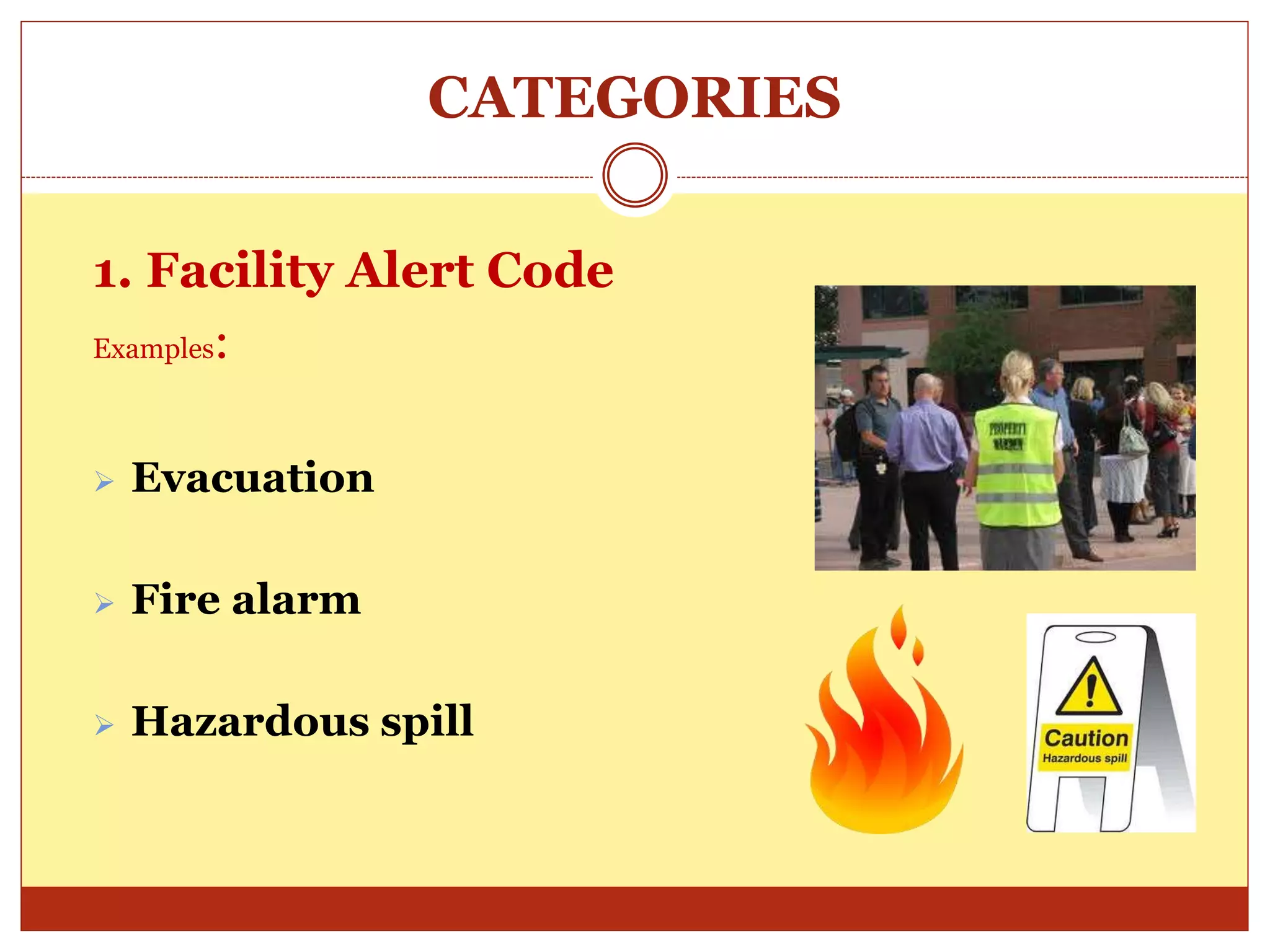
CATEGORIES
1. Facility Alert Code
Examples:
 Evacuation
 Fire alarm
 Hazardous spill
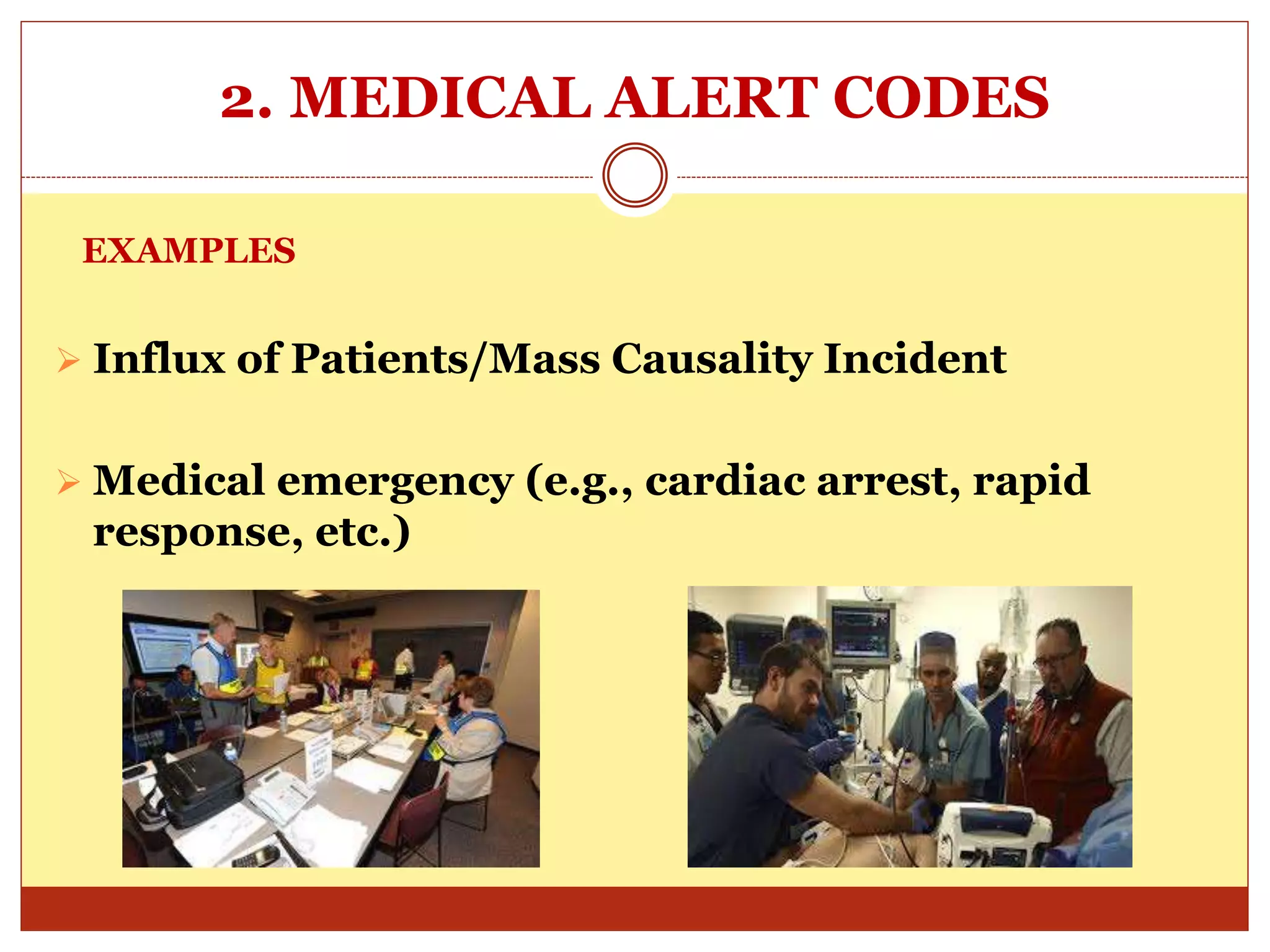
2. MEDICAL ALERT CODES
EXAMPLES
 Influx of Patients/Mass Causality Incident
 Medical emergency (e.g., cardiac arrest, rapid
response, etc.)
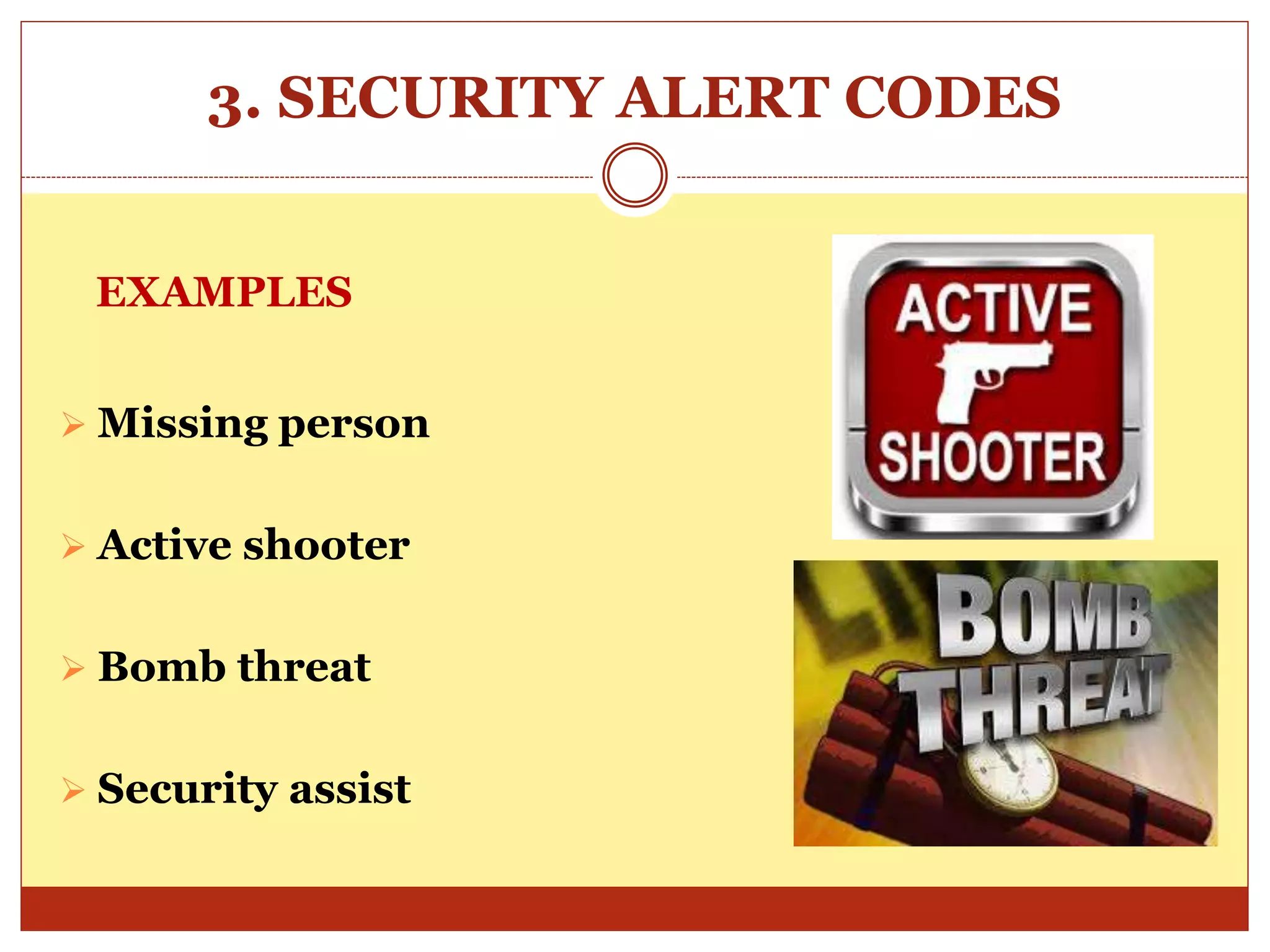
3. SECURITY ALERT CODES
EXAMPLES
 Missing person
 Active shooter
 Bomb threat
 Security assist
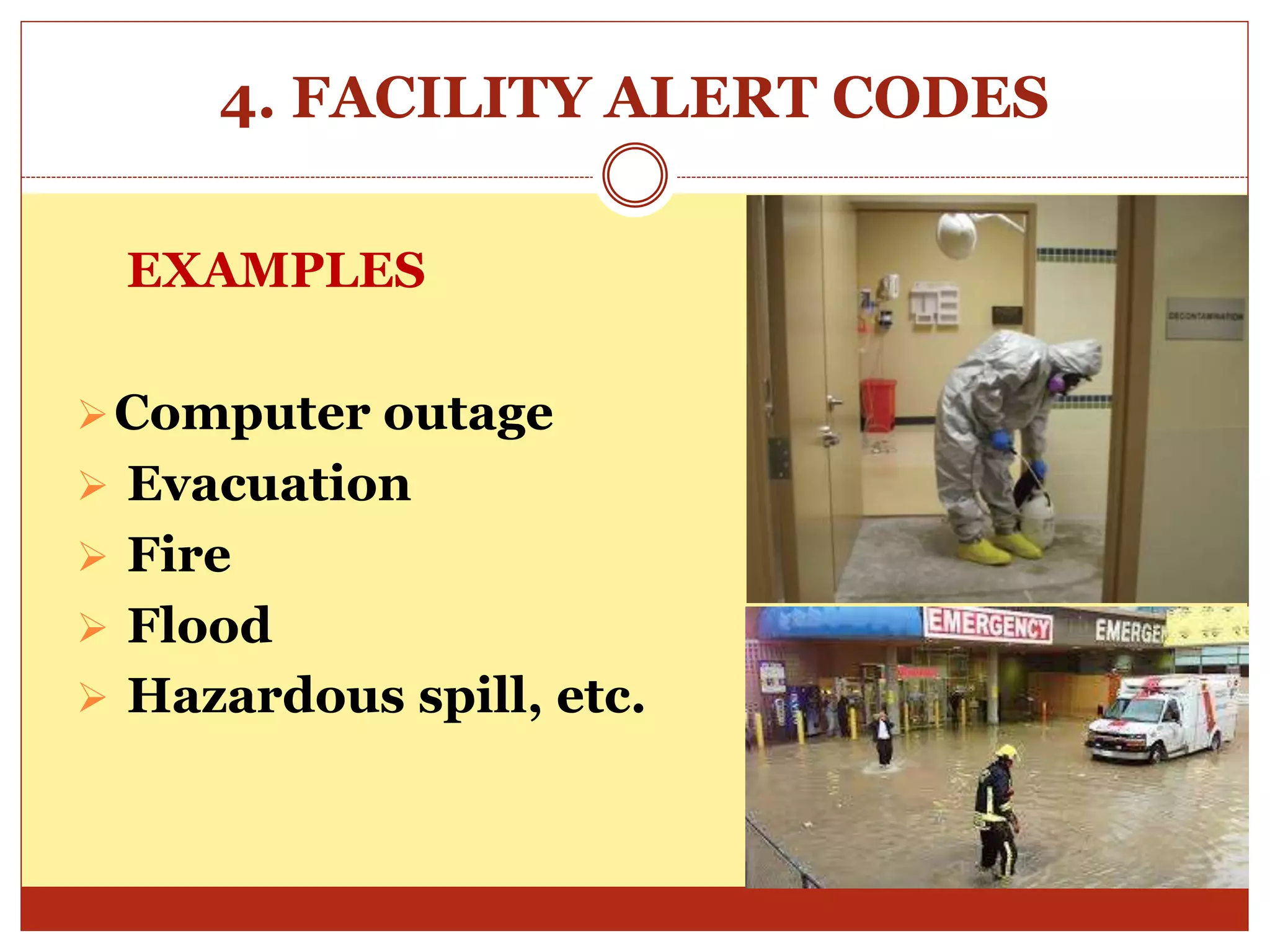
4. FACILITY ALERT CODES
EXAMPLES
Computer outage
 Evacuation
 Fire
 Flood
 Hazardous spill, etc.
TYPES OF CODES
1. Code Blue : Cardiac arrest
2. Code Red : External disaster
3. Code Brown : Internal disaster
4. Code Pink : Baby disaster
5. Code Grey : Security threats / workplace violence
6. Code Orange : Medical emergency team(MET)
 Codes shall be announced thrice over the PA system and
shall be repeated every 30 seconds for 2 minutes.
 Mock drills at least every 6 months in all shifts and done
areas specific especially in vulnerable areas like OT, ICU’ S,
Dialysis, etc.
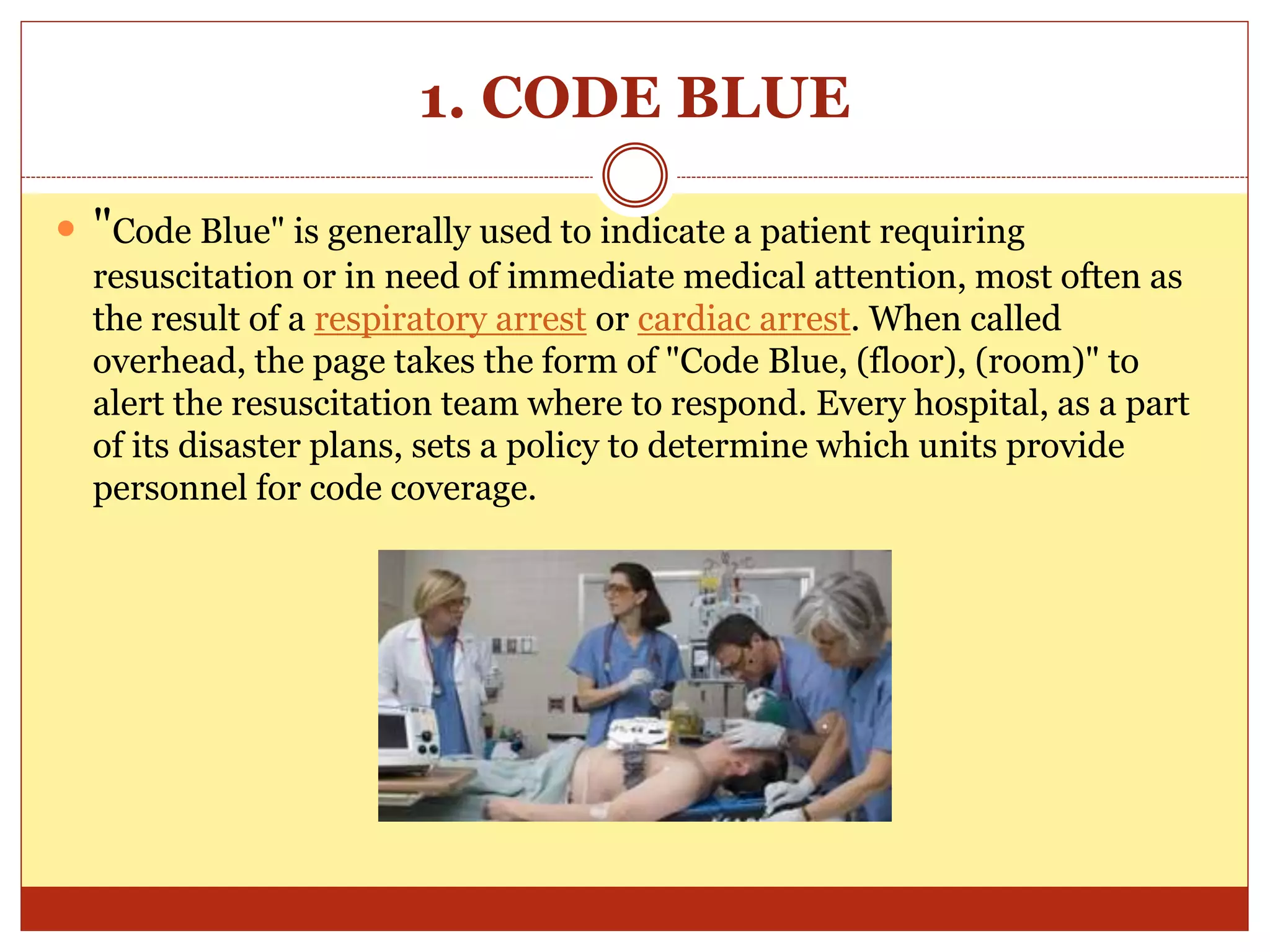
1. CODE BLUE
 "Code Blue" is generally used to indicate a patient requiring
resuscitation or in need of immediate medical attention, most often as
the result of a respiratory arrest or cardiac arrest. When called
overhead, the page takes the form of "Code Blue, (floor), (room)" to
alert the resuscitation team where to respond. Every hospital, as a part
of its disaster plans, sets a policy to determine which units provide
personnel for code coverage.
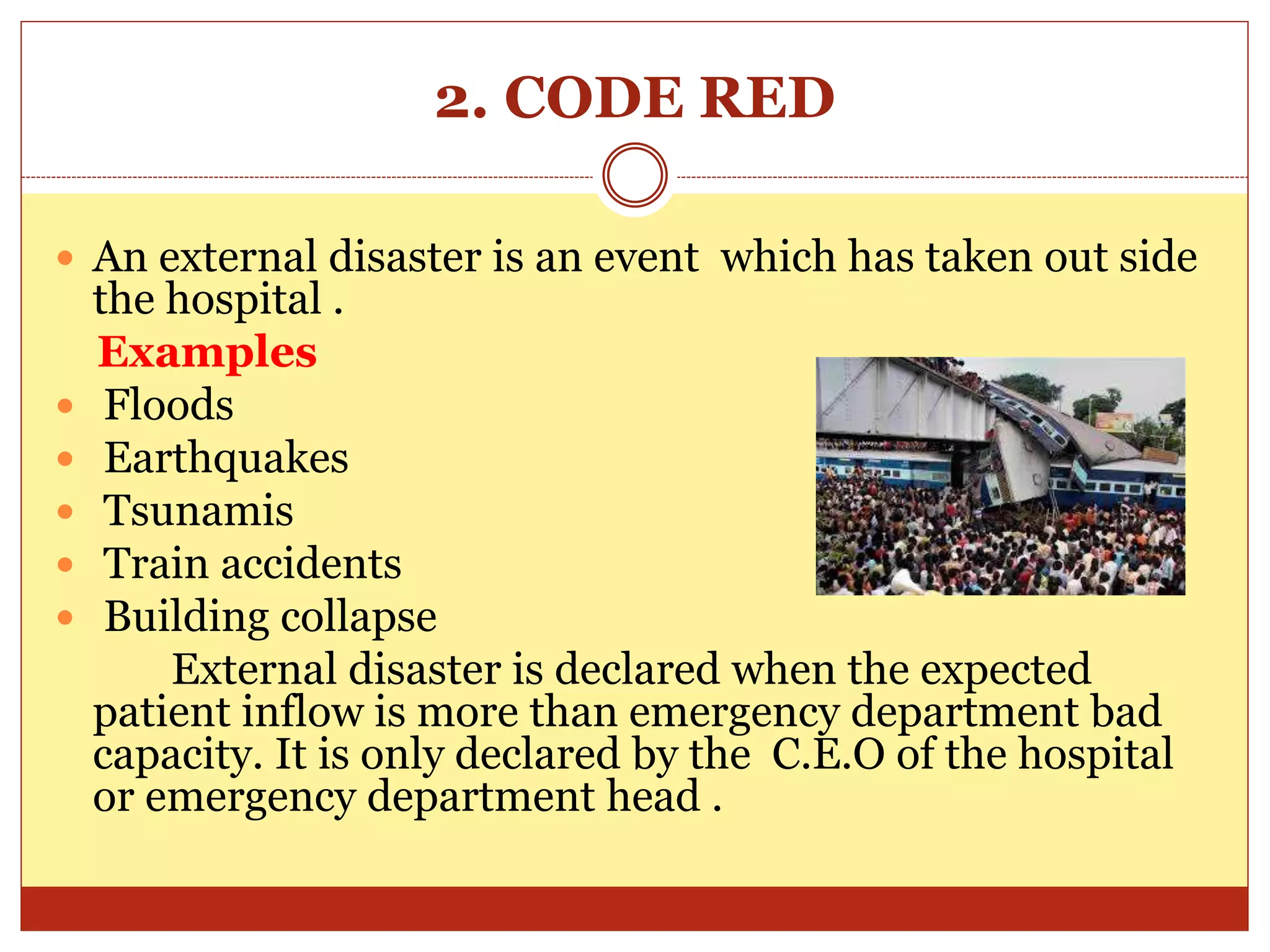
2. CODE RED
 An external disaster is an event which has taken out side
the hospital .
Examples
 Floods
 Earthquakes
 Tsunamis
 Train accidents
 Building collapse
External disaster is declared when the expected
patient inflow is more than emergency department bad
capacity. It is only declared by the C.E.O of the hospital
or emergency department head .
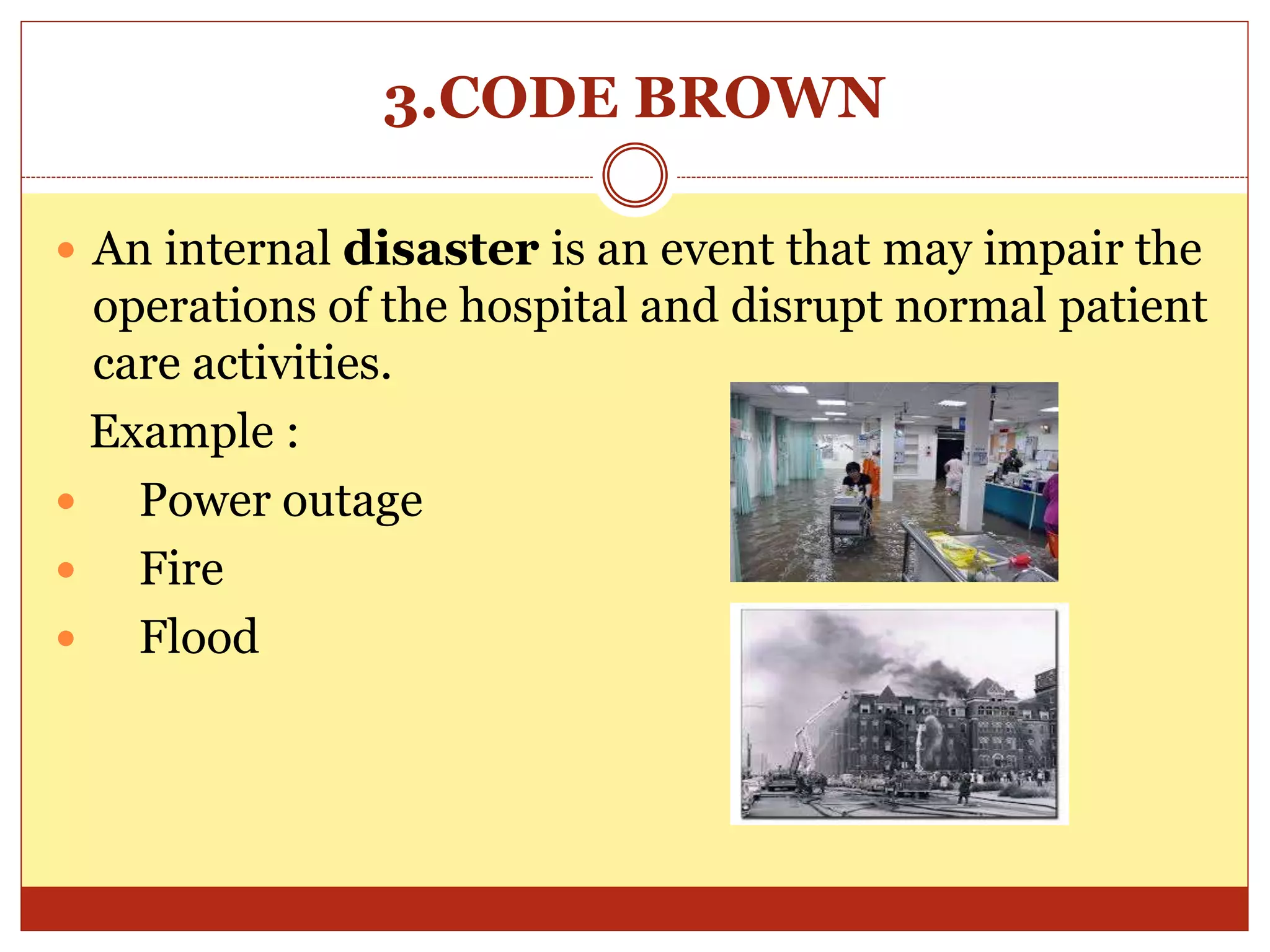
3.CODE BROWN
 An internal disaster is an event that may impair the
operations of the hospital and disrupt normal patient
care activities.
Example :
 Power outage
 Fire
 Flood
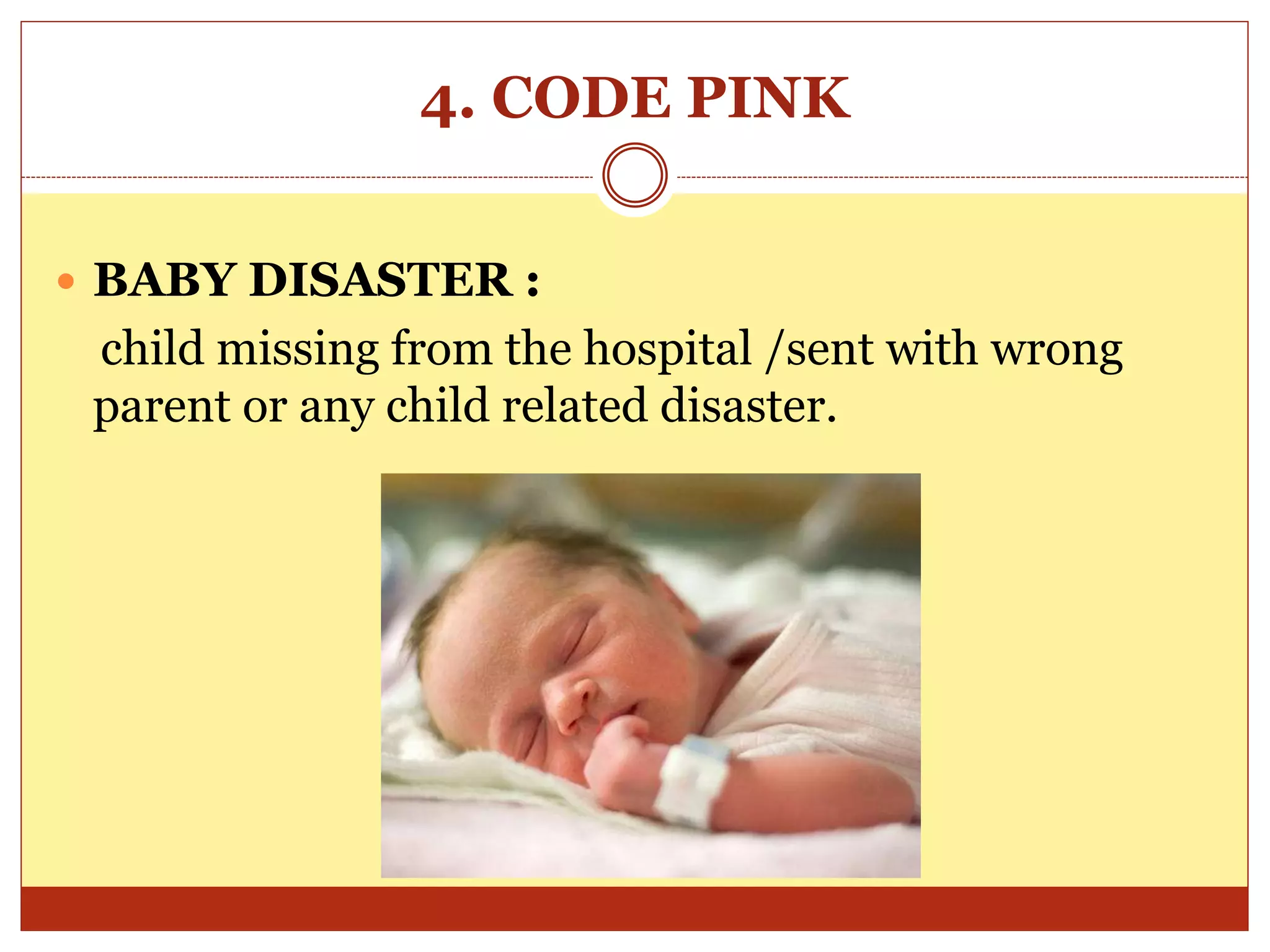
4. CODE PINK
 BABY DISASTER :
child missing from the hospital /sent with wrong
parent or any child related disaster.
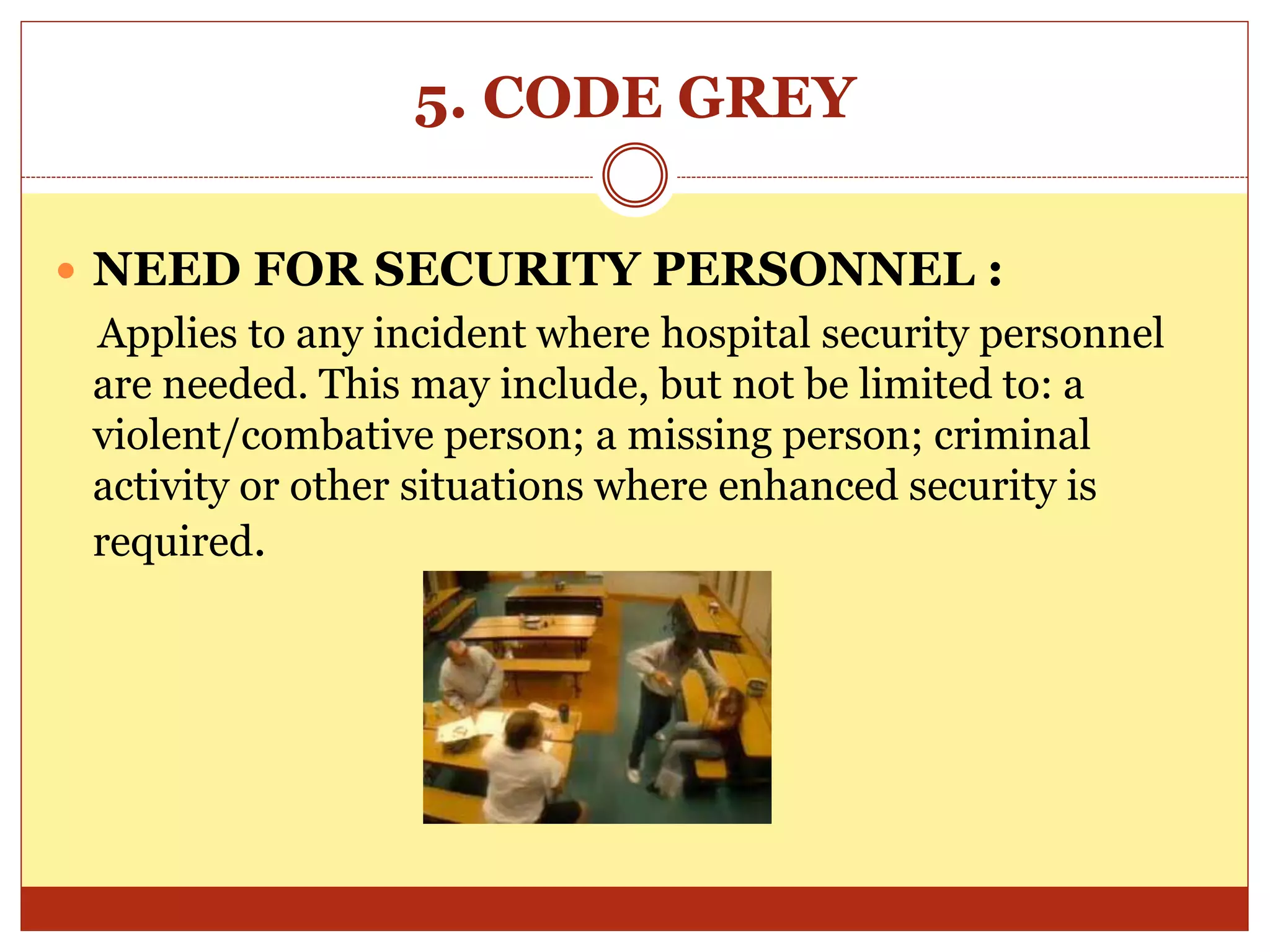
5. CODE GREY
 NEED FOR SECURITY PERSONNEL :
Applies to any incident where hospital security personnel
are needed. This may include, but not be limited to: a
violent/combative person; a missing person; criminal
activity or other situations where enhanced security is
required.
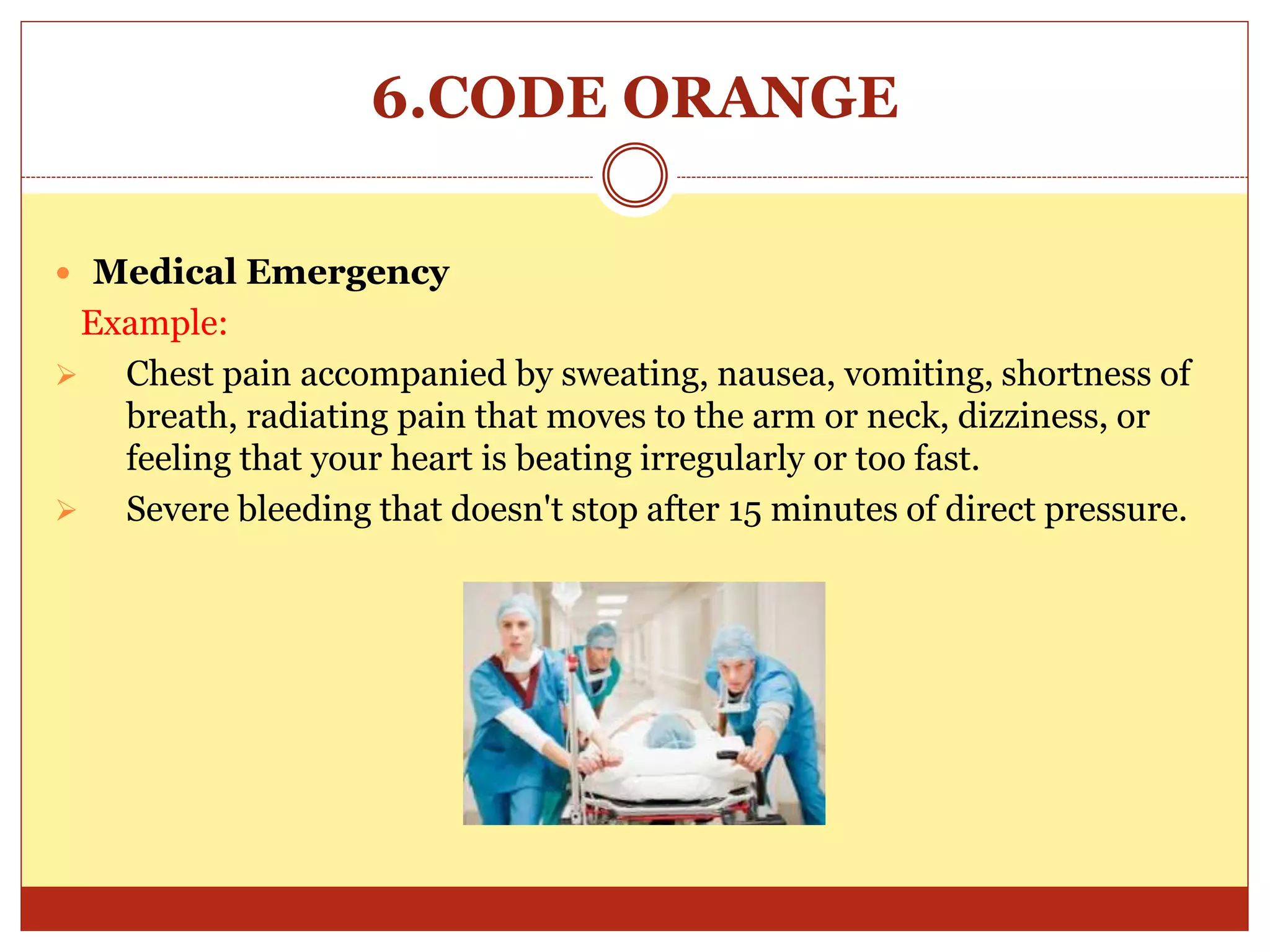
6.CODE ORANGE
 Medical Emergency
Example:
 Chest pain accompanied by sweating, nausea, vomiting, shortness of
breath, radiating pain that moves to the arm or neck, dizziness, or
feeling that your heart is beating irregularly or too fast.
 Severe bleeding that doesn't stop after 15 minutes of direct pressure.
HOW IS AN EMERGENCY CODE CALLED?
 The code should be called in a three-part statement
to include
 Alert category
 Specific code description
 Location of emergency
 Example: “Medical alert, cardiac arrest,
Room 231.”
 Additional information or instructions can be
provided if known---for example, the description
of a missing person.
How do I respond to the new emergency codes?
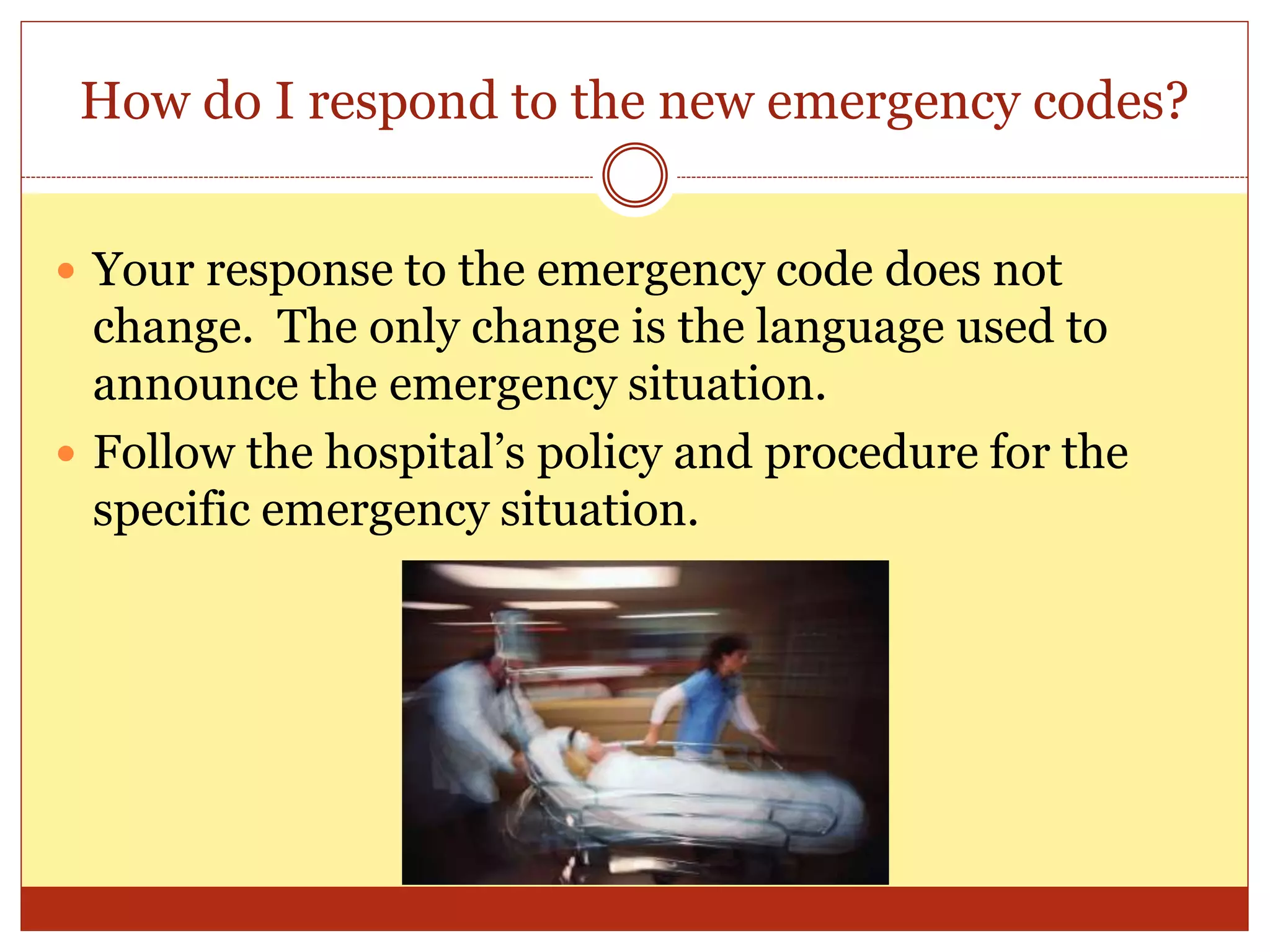
 Your response to the emergency code does not
change. The only change is the language used to
announce the emergency situation.
 Follow the hospital’s policy and procedure for the
specific emergency situation.
Presentation on emergency  codes  in a hospital

Presentation on emergency codes in a hospital

  • 1.
    UNIT-III EMERGENCY SERVICES CODES INA HOSPITAL Kala Reddy Gandra
  • 2.
    INTRODUCTION  Hospital emergencycodes are used in hospitals worldwide to alert staff to various emergencies. The use of codes is intended to convey essential information quickly and with minimal misunderstanding to staff, while preventing stress and panic among visitors to the hospital. These codes may be posted on placards throughout the hospital, or printed on employee identification badges for ready reference.  Back of a hospital ID badge showing disaster codes.  Hospital emergency codes may denote different events at different hospitals, including those in the same community. Because many physicians work at more than one facility, this may lead to confusion in emergencies, so uniform systems have been proposed.
  • 3.
    EMERGENCY CODE ANDPREPARDNESS  What Is An Emergency Code? An emergency code is a notification of an event that requires immediate action.  Preparing for the Unexpected Emergencies can strike anywhere and at any time. In the spirit of proactivity we encourage you to have your own emergency preparedness plan.
  • 4.
    WHAT IS CHANGINGWITH EMERGENCY CODES?  Emergency codes are being changed to incorporate use of “plain-language.”  Plain-language typically uses a phrase to identify the type of emergency, the code itself, and the location of the emergency.  Example 1: “Security alert, missing person, 3rd floor east tower.”  Example 2: “Facility alert, fire alarm, 1st floor cafeteria.”
  • 5.
    THE EMERGENCY CODES WHAT YOU SHOULD KNOW 1. Categories 2. Types of codes  BENEFITS :  People understand the information received without further extensive explanation.  People know what actions are required based on the information received.  All emergency responders within the hospital need to know clearly and quickly what the emergency is, where the emergency is, and how they should respond to effectively coordinate activities.
  • 6.
    CATEGORIES 1. Facility AlertCode Examples:  Evacuation  Fire alarm  Hazardous spill
  • 7.
    2. MEDICAL ALERTCODES EXAMPLES  Influx of Patients/Mass Causality Incident  Medical emergency (e.g., cardiac arrest, rapid response, etc.)
  • 8.
    3. SECURITY ALERTCODES EXAMPLES  Missing person  Active shooter  Bomb threat  Security assist
  • 9.
    4. FACILITY ALERTCODES EXAMPLES Computer outage  Evacuation  Fire  Flood  Hazardous spill, etc.
  • 10.
    TYPES OF CODES 1.Code Blue : Cardiac arrest 2. Code Red : External disaster 3. Code Brown : Internal disaster 4. Code Pink : Baby disaster 5. Code Grey : Security threats / workplace violence 6. Code Orange : Medical emergency team(MET)  Codes shall be announced thrice over the PA system and shall be repeated every 30 seconds for 2 minutes.  Mock drills at least every 6 months in all shifts and done areas specific especially in vulnerable areas like OT, ICU’ S, Dialysis, etc.
  • 11.
    1. CODE BLUE "Code Blue" is generally used to indicate a patient requiring resuscitation or in need of immediate medical attention, most often as the result of a respiratory arrest or cardiac arrest. When called overhead, the page takes the form of "Code Blue, (floor), (room)" to alert the resuscitation team where to respond. Every hospital, as a part of its disaster plans, sets a policy to determine which units provide personnel for code coverage.
  • 12.
    2. CODE RED An external disaster is an event which has taken out side the hospital . Examples  Floods  Earthquakes  Tsunamis  Train accidents  Building collapse External disaster is declared when the expected patient inflow is more than emergency department bad capacity. It is only declared by the C.E.O of the hospital or emergency department head .
  • 13.
    3.CODE BROWN  Aninternal disaster is an event that may impair the operations of the hospital and disrupt normal patient care activities. Example :  Power outage  Fire  Flood
  • 14.
    4. CODE PINK BABY DISASTER : child missing from the hospital /sent with wrong parent or any child related disaster.
  • 15.
    5. CODE GREY NEED FOR SECURITY PERSONNEL : Applies to any incident where hospital security personnel are needed. This may include, but not be limited to: a violent/combative person; a missing person; criminal activity or other situations where enhanced security is required.
  • 16.
    6.CODE ORANGE  MedicalEmergency Example:  Chest pain accompanied by sweating, nausea, vomiting, shortness of breath, radiating pain that moves to the arm or neck, dizziness, or feeling that your heart is beating irregularly or too fast.  Severe bleeding that doesn't stop after 15 minutes of direct pressure.
  • 17.
    HOW IS ANEMERGENCY CODE CALLED?  The code should be called in a three-part statement to include  Alert category  Specific code description  Location of emergency  Example: “Medical alert, cardiac arrest, Room 231.”  Additional information or instructions can be provided if known---for example, the description of a missing person.
  • 18.
    How do Irespond to the new emergency codes?  Your response to the emergency code does not change. The only change is the language used to announce the emergency situation.  Follow the hospital’s policy and procedure for the specific emergency situation.