DOCKER SECURITY OVERVIEW
(AS OF RELEASE 1.12)
Presenter Name: Sreenivas Makam
Presented at: Docker Meetup Bangalore
Presentation Date: July 9, 2016
About me
• Senior Engineering Manager at Cisco
Systems Data Center group
• Author of “Mastering CoreOS”
https://www.packtpub.com/networki
ng-and-servers/mastering-coreos/ )
• Docker
Captain(https://www.docker.com/co
mmunity/docker-captains )
• Blog:
https://sreeninet.wordpress.com/
• Code: https://github.com/smakam
• Linkedin:
https://in.linkedin.com/in/sreenivas
makam
• Twitter: @srmakam
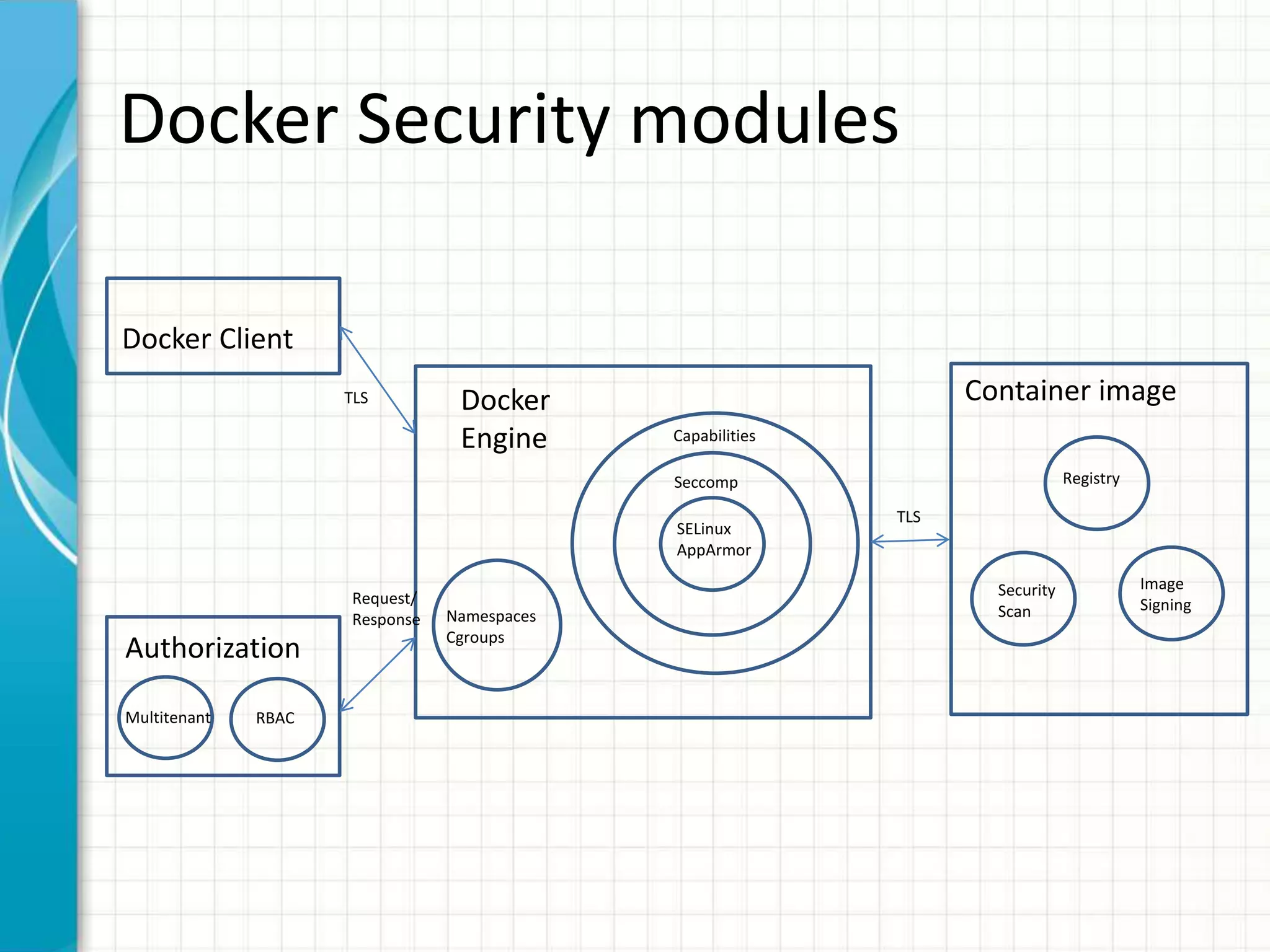
Docker Security modules
Docker
Engine
Docker Client
Authorization
Registry
SELinux
AppArmor
Seccomp
Capabilities
Namespaces
Cgroups
Multitenant
Security
Scan
Image
Signing
TLS
Request/
Response
Container image
TLS
RBAC
Linux kernel - Container Security
support
• Namespaces – PID, Mount, Network, IPC, UTC,
User.
• Cgroups – Limit CPU, Memory, IO
• Capabilities – Reduced root access. 36
capabilities to control as of kernel 3.19.0.21.
• Seccomp profiles – Control kernel system calls.
300+ system calls available that can be
controlled using these profiles.
• Special kernel modules like AppArmor, SELinux –
Provides granular control over Kernel resources.
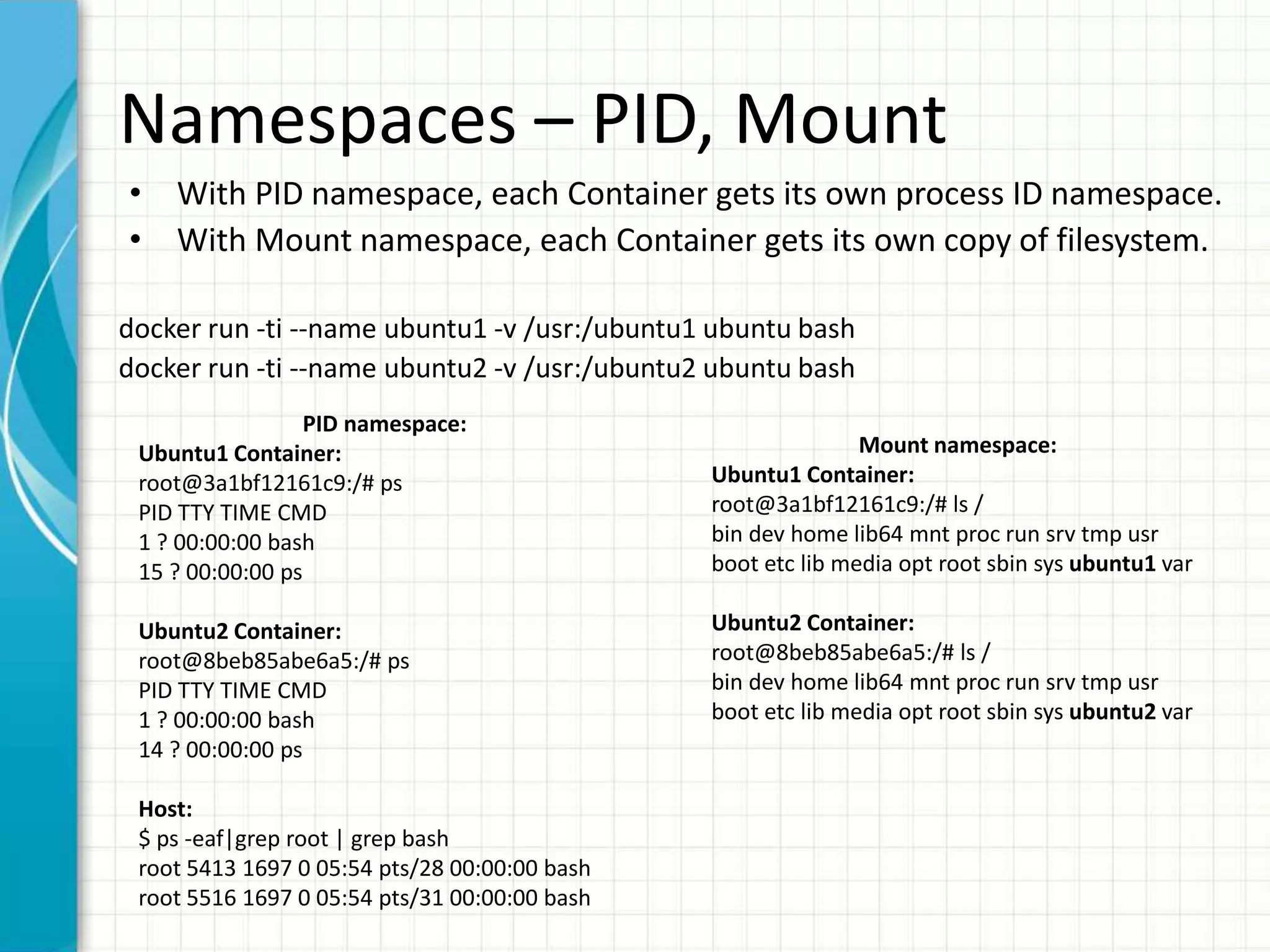
Namespaces – PID, Mount
docker run -ti --name ubuntu1 -v /usr:/ubuntu1 ubuntu bash
docker run -ti --name ubuntu2 -v /usr:/ubuntu2 ubuntu bash
PID namespace:
Ubuntu1 Container:
root@3a1bf12161c9:/# ps
PID TTY TIME CMD
1 ? 00:00:00 bash
15 ? 00:00:00 ps
Ubuntu2 Container:
root@8beb85abe6a5:/# ps
PID TTY TIME CMD
1 ? 00:00:00 bash
14 ? 00:00:00 ps
Host:
$ ps -eaf|grep root | grep bash
root 5413 1697 0 05:54 pts/28 00:00:00 bash
root 5516 1697 0 05:54 pts/31 00:00:00 bash
Mount namespace:
Ubuntu1 Container:
root@3a1bf12161c9:/# ls /
bin dev home lib64 mnt proc run srv tmp usr
boot etc lib media opt root sbin sys ubuntu1 var
Ubuntu2 Container:
root@8beb85abe6a5:/# ls /
bin dev home lib64 mnt proc run srv tmp usr
boot etc lib media opt root sbin sys ubuntu2 var
• With PID namespace, each Container gets its own process ID namespace.
• With Mount namespace, each Container gets its own copy of filesystem.
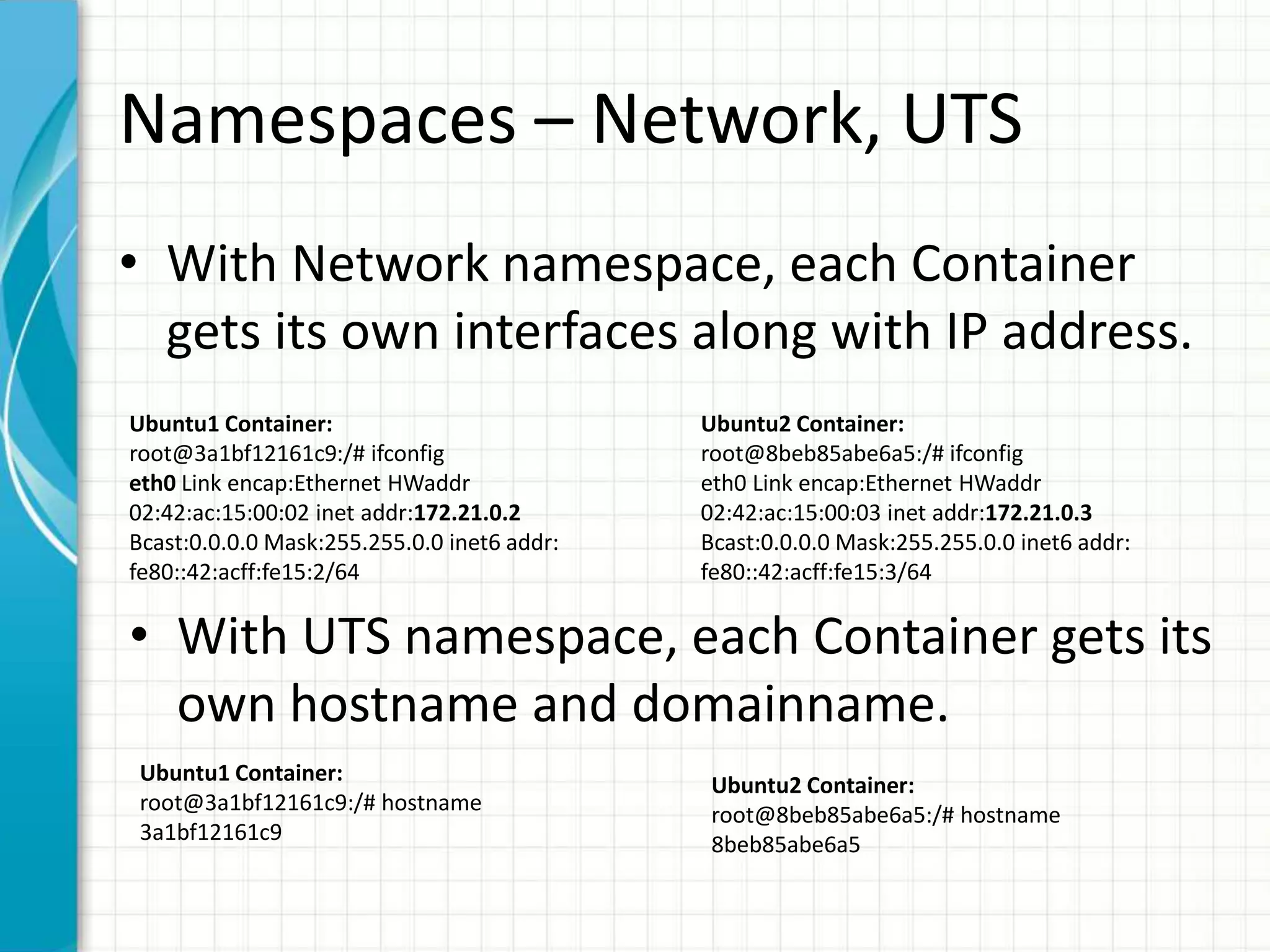
Namespaces – Network, UTS
• With Network namespace, each Container
gets its own interfaces along with IP address.
Ubuntu1 Container:
root@3a1bf12161c9:/# ifconfig
eth0 Link encap:Ethernet HWaddr
02:42:ac:15:00:02 inet addr:172.21.0.2
Bcast:0.0.0.0 Mask:255.255.0.0 inet6 addr:
fe80::42:acff:fe15:2/64
Ubuntu2 Container:
root@8beb85abe6a5:/# ifconfig
eth0 Link encap:Ethernet HWaddr
02:42:ac:15:00:03 inet addr:172.21.0.3
Bcast:0.0.0.0 Mask:255.255.0.0 inet6 addr:
fe80::42:acff:fe15:3/64
• With UTS namespace, each Container gets its
own hostname and domainname.
Ubuntu1 Container:
root@3a1bf12161c9:/# hostname
3a1bf12161c9
Ubuntu2 Container:
root@8beb85abe6a5:/# hostname
8beb85abe6a5
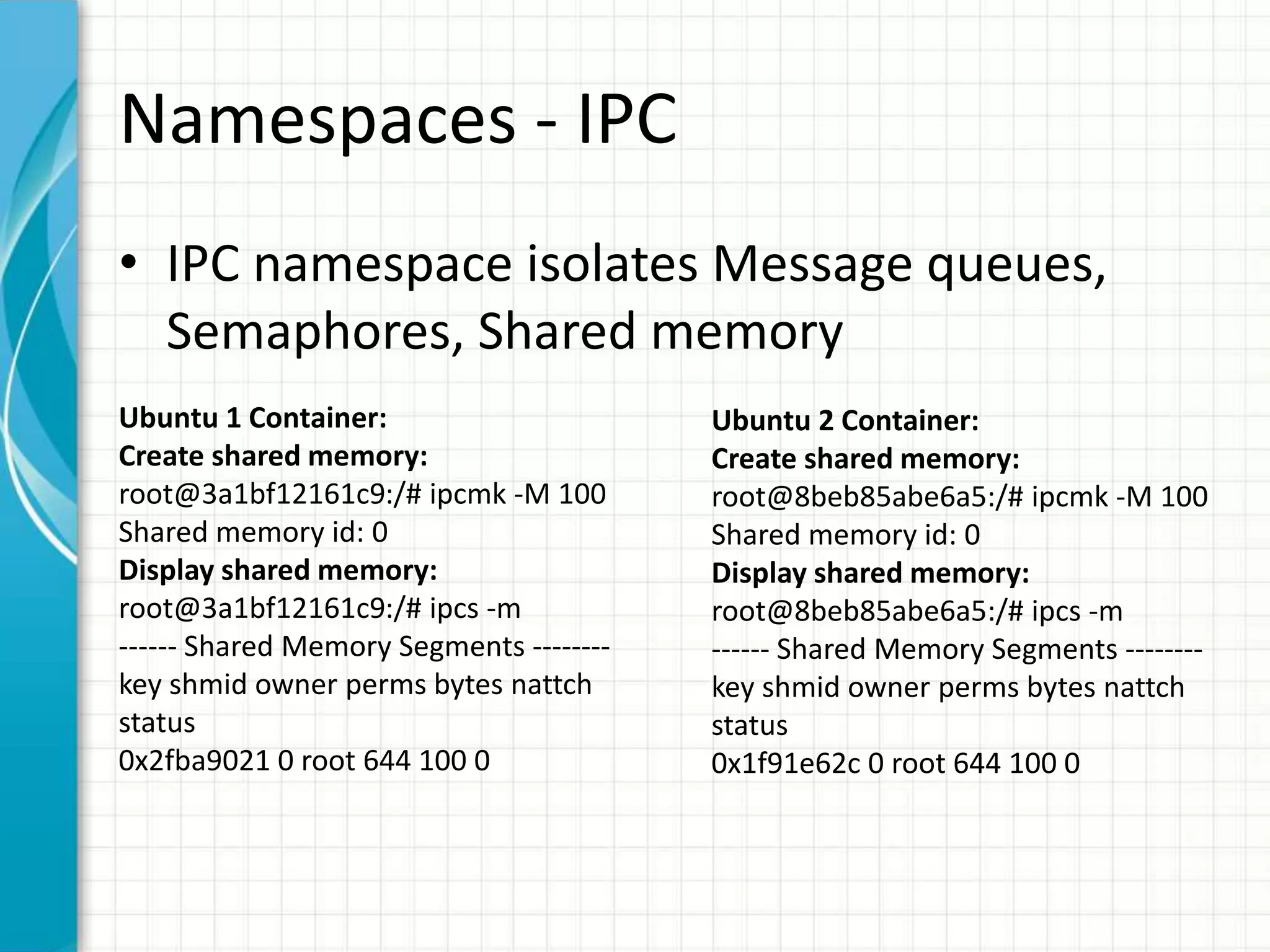
Namespaces - IPC
• IPC namespace isolates Message queues,
Semaphores, Shared memory
Ubuntu 1 Container:
Create shared memory:
root@3a1bf12161c9:/# ipcmk -M 100
Shared memory id: 0
Display shared memory:
root@3a1bf12161c9:/# ipcs -m
------ Shared Memory Segments --------
key shmid owner perms bytes nattch
status
0x2fba9021 0 root 644 100 0
Ubuntu 2 Container:
Create shared memory:
root@8beb85abe6a5:/# ipcmk -M 100
Shared memory id: 0
Display shared memory:
root@8beb85abe6a5:/# ipcs -m
------ Shared Memory Segments --------
key shmid owner perms bytes nattch
status
0x1f91e62c 0 root 644 100 0
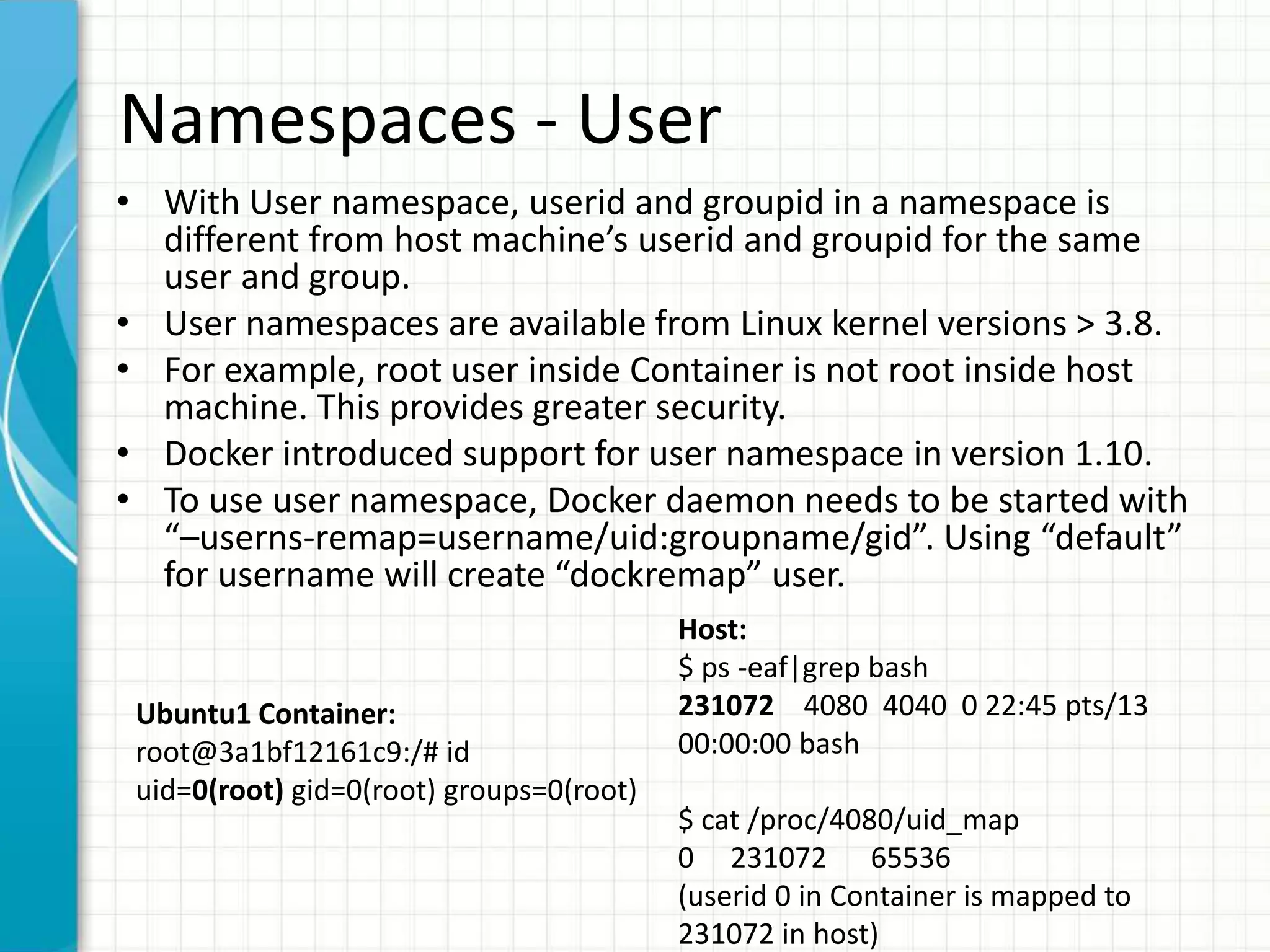
Namespaces - User
• With User namespace, userid and groupid in a namespace is
different from host machine’s userid and groupid for the same
user and group.
• User namespaces are available from Linux kernel versions > 3.8.
• For example, root user inside Container is not root inside host
machine. This provides greater security.
• Docker introduced support for user namespace in version 1.10.
• To use user namespace, Docker daemon needs to be started with
“–userns-remap=username/uid:groupname/gid”. Using “default”
for username will create “dockremap” user.
Ubuntu1 Container:
root@3a1bf12161c9:/# id
uid=0(root) gid=0(root) groups=0(root)
Host:
$ ps -eaf|grep bash
231072 4080 4040 0 22:45 pts/13
00:00:00 bash
$ cat /proc/4080/uid_map
0 231072 65536
(userid 0 in Container is mapped to
231072 in host)
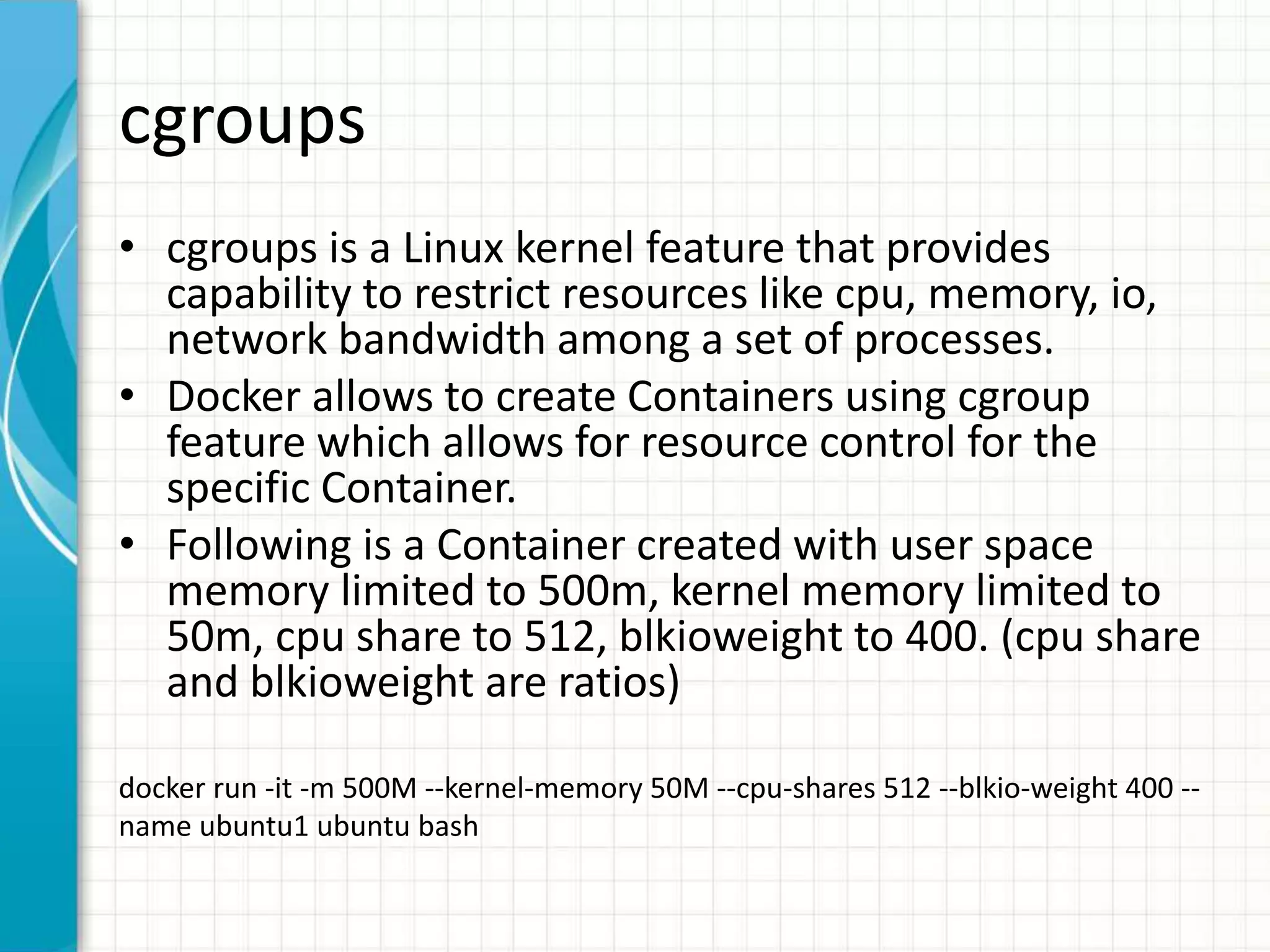
cgroups
• cgroups is a Linux kernel feature that provides
capability to restrict resources like cpu, memory, io,
network bandwidth among a set of processes.
• Docker allows to create Containers using cgroup
feature which allows for resource control for the
specific Container.
• Following is a Container created with user space
memory limited to 500m, kernel memory limited to
50m, cpu share to 512, blkioweight to 400. (cpu share
and blkioweight are ratios)
docker run -it -m 500M --kernel-memory 50M --cpu-shares 512 --blkio-weight 400 --
name ubuntu1 ubuntu bash
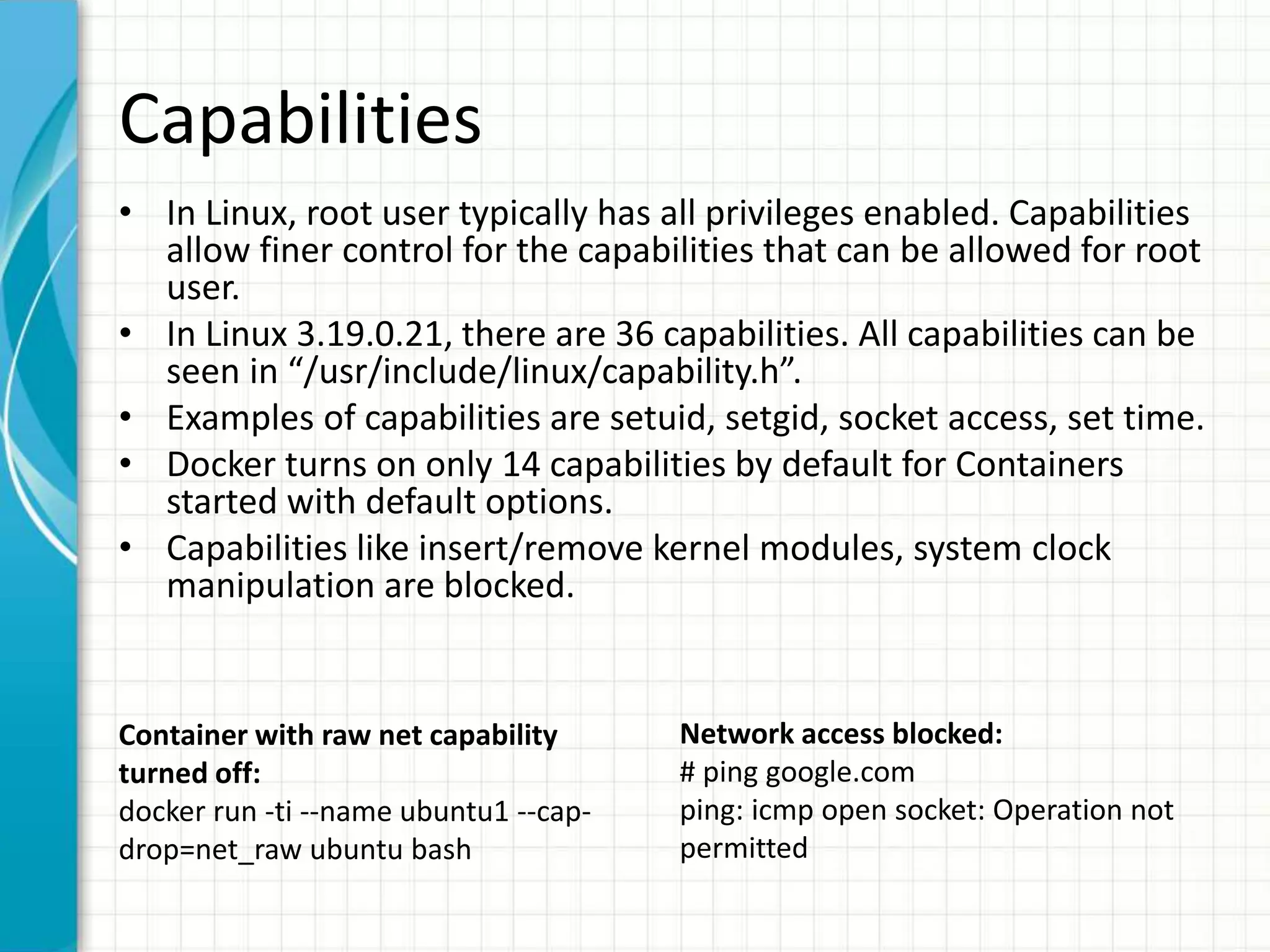
Capabilities
• In Linux, root user typically has all privileges enabled. Capabilities
allow finer control for the capabilities that can be allowed for root
user.
• In Linux 3.19.0.21, there are 36 capabilities. All capabilities can be
seen in “/usr/include/linux/capability.h”.
• Examples of capabilities are setuid, setgid, socket access, set time.
• Docker turns on only 14 capabilities by default for Containers
started with default options.
• Capabilities like insert/remove kernel modules, system clock
manipulation are blocked.
Container with raw net capability
turned off:
docker run -ti --name ubuntu1 --cap-
drop=net_raw ubuntu bash
Network access blocked:
# ping google.com
ping: icmp open socket: Operation not
permitted
Seccomp
• Linux kernel feature that limits the system calls that a
process can make based on the specified profile.
• Docker uses Seccomp to control the system calls that
Container can make.
• Examples of system calls – bind, accept, fork.
• Docker disables around 44 of 300+ system calls for
Containers started with default options. Example of
disabled system calls include mount, settimeofday.
• Default Docker Seccomp profile is available here.
Profile disabling chmod system call:
{ "defaultAction":
"SCMP_ACT_ALLOW",
"syscalls": [ { "name": "chmod",
"action": "SCMP_ACT_ERRNO" } ] }
Seccomp illustration:
$ docker run --rm -it --security-opt
seccomp:/home/smakam14/seccomp/profil
e.json busybox chmod 400 /etc/hosts
chmod: /etc/hosts: Operation not
permitted
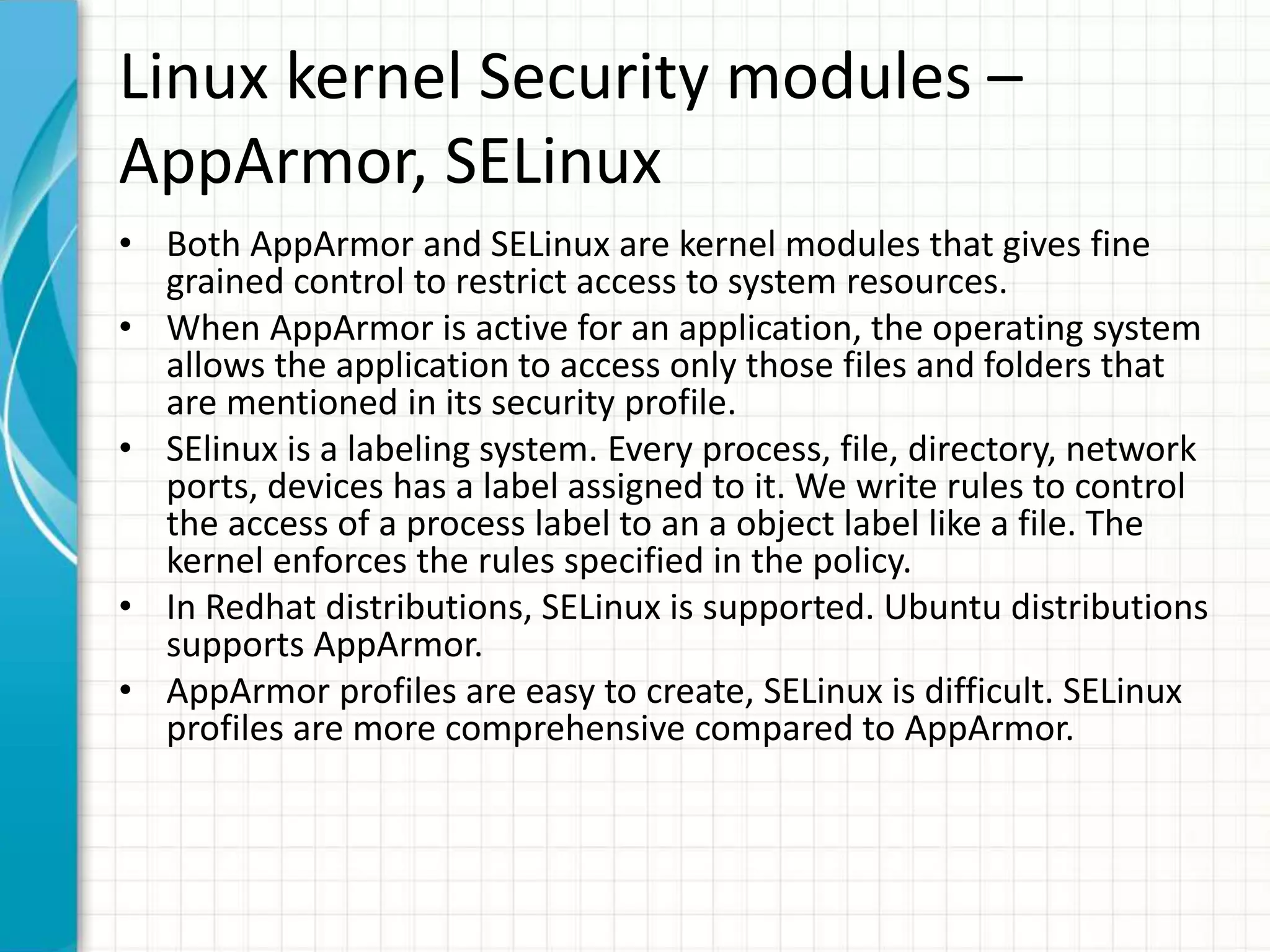
Linux kernel Security modules –
AppArmor, SELinux
• Both AppArmor and SELinux are kernel modules that gives fine
grained control to restrict access to system resources.
• When AppArmor is active for an application, the operating system
allows the application to access only those files and folders that
are mentioned in its security profile.
• SElinux is a labeling system. Every process, file, directory, network
ports, devices has a label assigned to it. We write rules to control
the access of a process label to an a object label like a file. The
kernel enforces the rules specified in the policy.
• In Redhat distributions, SELinux is supported. Ubuntu distributions
supports AppArmor.
• AppArmor profiles are easy to create, SELinux is difficult. SELinux
profiles are more comprehensive compared to AppArmor.
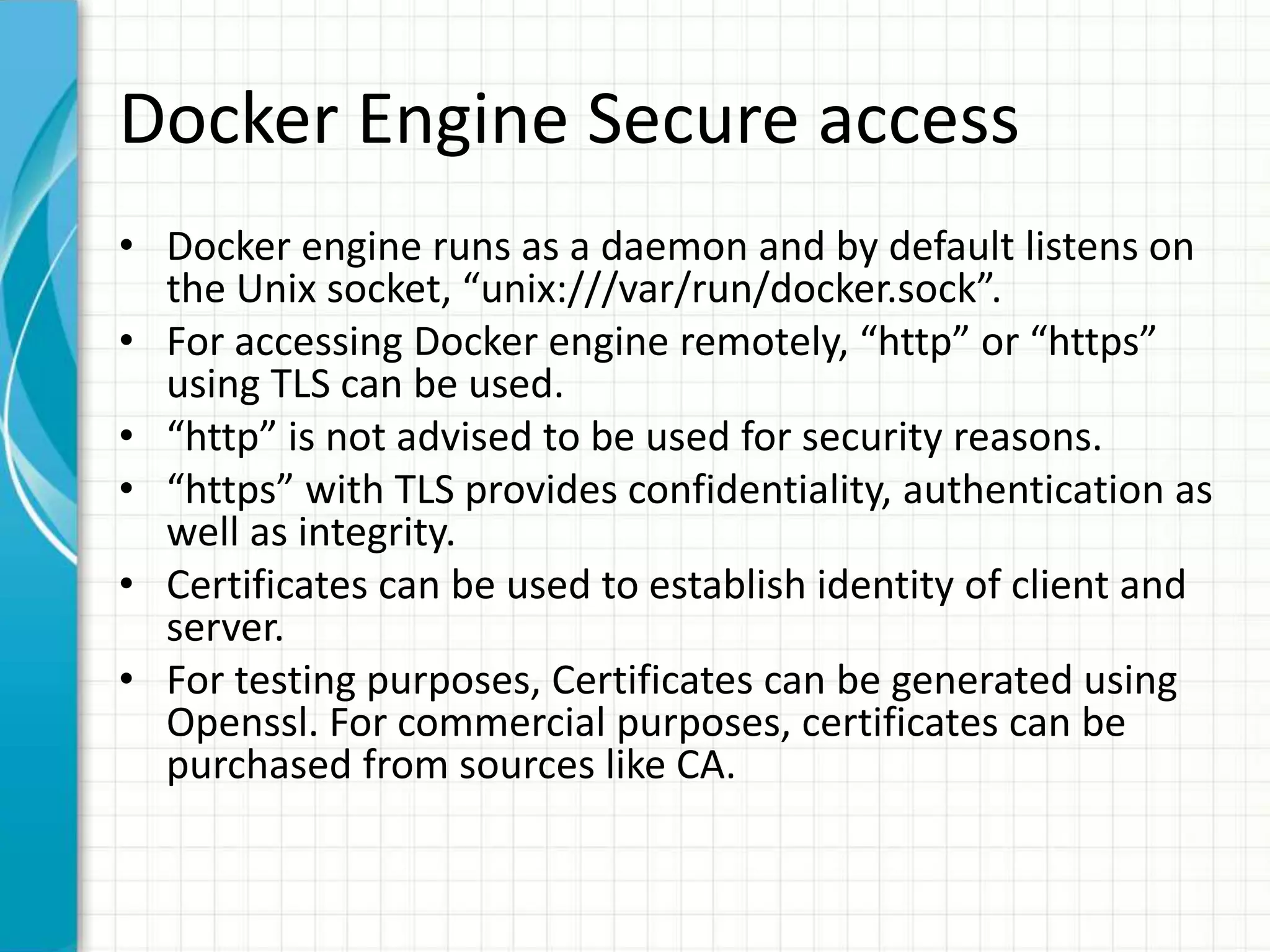
Docker Engine Secure access
• Docker engine runs as a daemon and by default listens on
the Unix socket, “unix:///var/run/docker.sock”.
• For accessing Docker engine remotely, “http” or “https”
using TLS can be used.
• “http” is not advised to be used for security reasons.
• “https” with TLS provides confidentiality, authentication as
well as integrity.
• Certificates can be used to establish identity of client and
server.
• For testing purposes, Certificates can be generated using
Openssl. For commercial purposes, certificates can be
purchased from sources like CA.
Authorization plugin
• Authorization plugin can provide granular access to the Docker daemon based on
userid, groupid, command executed, command arguments, time of day etc.
• Authorization plugin informs Docker daemon if the specific command can be
allowed or not based on the policy and the command executed.
• Twistlock authz broker is one of the first plugins that is currently available.
• In Twistlock case, policy is created as a JSON file and is given as argument to
Docker daemon.
• User identity support is not yet available in Docker engine.
• Docker Data Center and Docker cloud provides RBAC and Multi-tenant support.
Policy.json:
{"name":"policy_1","users":[""],"actions":["contain
er"] , "readonly":true} – Read-only Container policy
Starting Docker daemon with auth policy.json:
docker run -d --restart=always -v /var/lib/authz-
broker/policy.json:/var/lib/authz-broker/policy.json
-v /run/docker/plugins/:/run/docker/plugins
twistlock/authz-broker
Container image signing
• Container images needs to be signed so that the client knows that image is
coming from a trusted source and that it is not tampered with.
• Content publisher takes care of signing Container image and pushing it into the
registry.
• The Docker content trust is an implementation of the Notary open source
project. The Notary open source project is based on The Update Framework
(TUF) project.
• When content trust is enabled, we can pull only signed images.
• When content trust is not enabled, both signed and unsigned images can be
pulled.
• Docker content trust is enabled with “export DOCKER_CONTENT_TRUST=1”.
• When the publisher pushes the image for the first time using docker push, there
is a need to enter a passphrase for the root key .
• When pushing new image or new image version, publisher needs to enter
passphrase for repository key.
• Docker has also added support for hardware keys using Yubikey
• Keys should be saved safely and backups should be taken.
Container Image scanning
• Docker Security Scan scans Container images
and reports vulnerabilities.
• Scanning is done by comparing each Container
layer component with CVE databases.
• Additional binary scan is done to make sure that
the package is not tampered with.
• Pro-active notification is given to both the
publisher and user of Container images.
• Available currently in Docker hub and Docker
cloud. Will be added soon to Docker data center.
Docker Security - Best Practices
Docker enables Security by default and the default options suffice most of the needs.
Following are few best practices:
• Have separate containers for each micro-service keeping Container image size
small.
• Don’t put ssh inside container, “docker exec” can be used to ssh to Container.
• Use only signed Container images.
• Mount devices and volumes as read-only.
• Run application as non-root. If root access is needed, run as root only for limited
operations using features like Capabilities, Seccomp, SELinux/AppArmor.
• Keep OS secure with regular updates. Using Container optimized OS is an option
here since they provide automatic pushed update.
• Store root keys, passphrase in a safe place and not expose in Dockerfile. Docker
has plans to manage keys with Docker datacenter.
• Use Docker official images. These images are curated by Docker so that the
highest quality and security is maintained for the official images.
• Use Container security scanning to check for vulnerabilities.
• Use TLS for remote Docker daemon access.
References
• Docker Security
documentation(https://docs.docker.com/engine/security/security/
)
• Container namespaces (http://crosbymichael.com/creating-
containers-part-1.html)
• Docker Security article series
(https://opensource.com/business/15/3/docker-security-tuning)
• Docker Security blog series
(https://sreeninet.wordpress.com/2016/03/06/docker-security-
part-1overview/)
• Docker Security scan(https://blog.docker.com/2016/05/docker-
security-scanning/)
• Authorization plugin
(https://www.twistlock.com/2016/02/18/docker-authz-plugins-
twistlocks-contribution-to-the-docker-community/)

Docker Security Overview

  • 1.
    DOCKER SECURITY OVERVIEW (ASOF RELEASE 1.12) Presenter Name: Sreenivas Makam Presented at: Docker Meetup Bangalore Presentation Date: July 9, 2016
  • 2.
    About me • SeniorEngineering Manager at Cisco Systems Data Center group • Author of “Mastering CoreOS” https://www.packtpub.com/networki ng-and-servers/mastering-coreos/ ) • Docker Captain(https://www.docker.com/co mmunity/docker-captains ) • Blog: https://sreeninet.wordpress.com/ • Code: https://github.com/smakam • Linkedin: https://in.linkedin.com/in/sreenivas makam • Twitter: @srmakam
  • 3.
    Docker Security modules Docker Engine DockerClient Authorization Registry SELinux AppArmor Seccomp Capabilities Namespaces Cgroups Multitenant Security Scan Image Signing TLS Request/ Response Container image TLS RBAC
  • 4.
    Linux kernel -Container Security support • Namespaces – PID, Mount, Network, IPC, UTC, User. • Cgroups – Limit CPU, Memory, IO • Capabilities – Reduced root access. 36 capabilities to control as of kernel 3.19.0.21. • Seccomp profiles – Control kernel system calls. 300+ system calls available that can be controlled using these profiles. • Special kernel modules like AppArmor, SELinux – Provides granular control over Kernel resources.
  • 5.
    Namespaces – PID,Mount docker run -ti --name ubuntu1 -v /usr:/ubuntu1 ubuntu bash docker run -ti --name ubuntu2 -v /usr:/ubuntu2 ubuntu bash PID namespace: Ubuntu1 Container: root@3a1bf12161c9:/# ps PID TTY TIME CMD 1 ? 00:00:00 bash 15 ? 00:00:00 ps Ubuntu2 Container: root@8beb85abe6a5:/# ps PID TTY TIME CMD 1 ? 00:00:00 bash 14 ? 00:00:00 ps Host: $ ps -eaf|grep root | grep bash root 5413 1697 0 05:54 pts/28 00:00:00 bash root 5516 1697 0 05:54 pts/31 00:00:00 bash Mount namespace: Ubuntu1 Container: root@3a1bf12161c9:/# ls / bin dev home lib64 mnt proc run srv tmp usr boot etc lib media opt root sbin sys ubuntu1 var Ubuntu2 Container: root@8beb85abe6a5:/# ls / bin dev home lib64 mnt proc run srv tmp usr boot etc lib media opt root sbin sys ubuntu2 var • With PID namespace, each Container gets its own process ID namespace. • With Mount namespace, each Container gets its own copy of filesystem.
  • 6.
    Namespaces – Network,UTS • With Network namespace, each Container gets its own interfaces along with IP address. Ubuntu1 Container: root@3a1bf12161c9:/# ifconfig eth0 Link encap:Ethernet HWaddr 02:42:ac:15:00:02 inet addr:172.21.0.2 Bcast:0.0.0.0 Mask:255.255.0.0 inet6 addr: fe80::42:acff:fe15:2/64 Ubuntu2 Container: root@8beb85abe6a5:/# ifconfig eth0 Link encap:Ethernet HWaddr 02:42:ac:15:00:03 inet addr:172.21.0.3 Bcast:0.0.0.0 Mask:255.255.0.0 inet6 addr: fe80::42:acff:fe15:3/64 • With UTS namespace, each Container gets its own hostname and domainname. Ubuntu1 Container: root@3a1bf12161c9:/# hostname 3a1bf12161c9 Ubuntu2 Container: root@8beb85abe6a5:/# hostname 8beb85abe6a5
  • 7.
    Namespaces - IPC •IPC namespace isolates Message queues, Semaphores, Shared memory Ubuntu 1 Container: Create shared memory: root@3a1bf12161c9:/# ipcmk -M 100 Shared memory id: 0 Display shared memory: root@3a1bf12161c9:/# ipcs -m ------ Shared Memory Segments -------- key shmid owner perms bytes nattch status 0x2fba9021 0 root 644 100 0 Ubuntu 2 Container: Create shared memory: root@8beb85abe6a5:/# ipcmk -M 100 Shared memory id: 0 Display shared memory: root@8beb85abe6a5:/# ipcs -m ------ Shared Memory Segments -------- key shmid owner perms bytes nattch status 0x1f91e62c 0 root 644 100 0
  • 8.
    Namespaces - User •With User namespace, userid and groupid in a namespace is different from host machine’s userid and groupid for the same user and group. • User namespaces are available from Linux kernel versions > 3.8. • For example, root user inside Container is not root inside host machine. This provides greater security. • Docker introduced support for user namespace in version 1.10. • To use user namespace, Docker daemon needs to be started with “–userns-remap=username/uid:groupname/gid”. Using “default” for username will create “dockremap” user. Ubuntu1 Container: root@3a1bf12161c9:/# id uid=0(root) gid=0(root) groups=0(root) Host: $ ps -eaf|grep bash 231072 4080 4040 0 22:45 pts/13 00:00:00 bash $ cat /proc/4080/uid_map 0 231072 65536 (userid 0 in Container is mapped to 231072 in host)
  • 9.
    cgroups • cgroups isa Linux kernel feature that provides capability to restrict resources like cpu, memory, io, network bandwidth among a set of processes. • Docker allows to create Containers using cgroup feature which allows for resource control for the specific Container. • Following is a Container created with user space memory limited to 500m, kernel memory limited to 50m, cpu share to 512, blkioweight to 400. (cpu share and blkioweight are ratios) docker run -it -m 500M --kernel-memory 50M --cpu-shares 512 --blkio-weight 400 -- name ubuntu1 ubuntu bash
  • 10.
    Capabilities • In Linux,root user typically has all privileges enabled. Capabilities allow finer control for the capabilities that can be allowed for root user. • In Linux 3.19.0.21, there are 36 capabilities. All capabilities can be seen in “/usr/include/linux/capability.h”. • Examples of capabilities are setuid, setgid, socket access, set time. • Docker turns on only 14 capabilities by default for Containers started with default options. • Capabilities like insert/remove kernel modules, system clock manipulation are blocked. Container with raw net capability turned off: docker run -ti --name ubuntu1 --cap- drop=net_raw ubuntu bash Network access blocked: # ping google.com ping: icmp open socket: Operation not permitted
  • 11.
    Seccomp • Linux kernelfeature that limits the system calls that a process can make based on the specified profile. • Docker uses Seccomp to control the system calls that Container can make. • Examples of system calls – bind, accept, fork. • Docker disables around 44 of 300+ system calls for Containers started with default options. Example of disabled system calls include mount, settimeofday. • Default Docker Seccomp profile is available here. Profile disabling chmod system call: { "defaultAction": "SCMP_ACT_ALLOW", "syscalls": [ { "name": "chmod", "action": "SCMP_ACT_ERRNO" } ] } Seccomp illustration: $ docker run --rm -it --security-opt seccomp:/home/smakam14/seccomp/profil e.json busybox chmod 400 /etc/hosts chmod: /etc/hosts: Operation not permitted
  • 12.
    Linux kernel Securitymodules – AppArmor, SELinux • Both AppArmor and SELinux are kernel modules that gives fine grained control to restrict access to system resources. • When AppArmor is active for an application, the operating system allows the application to access only those files and folders that are mentioned in its security profile. • SElinux is a labeling system. Every process, file, directory, network ports, devices has a label assigned to it. We write rules to control the access of a process label to an a object label like a file. The kernel enforces the rules specified in the policy. • In Redhat distributions, SELinux is supported. Ubuntu distributions supports AppArmor. • AppArmor profiles are easy to create, SELinux is difficult. SELinux profiles are more comprehensive compared to AppArmor.
  • 13.
    Docker Engine Secureaccess • Docker engine runs as a daemon and by default listens on the Unix socket, “unix:///var/run/docker.sock”. • For accessing Docker engine remotely, “http” or “https” using TLS can be used. • “http” is not advised to be used for security reasons. • “https” with TLS provides confidentiality, authentication as well as integrity. • Certificates can be used to establish identity of client and server. • For testing purposes, Certificates can be generated using Openssl. For commercial purposes, certificates can be purchased from sources like CA.
  • 14.
    Authorization plugin • Authorizationplugin can provide granular access to the Docker daemon based on userid, groupid, command executed, command arguments, time of day etc. • Authorization plugin informs Docker daemon if the specific command can be allowed or not based on the policy and the command executed. • Twistlock authz broker is one of the first plugins that is currently available. • In Twistlock case, policy is created as a JSON file and is given as argument to Docker daemon. • User identity support is not yet available in Docker engine. • Docker Data Center and Docker cloud provides RBAC and Multi-tenant support. Policy.json: {"name":"policy_1","users":[""],"actions":["contain er"] , "readonly":true} – Read-only Container policy Starting Docker daemon with auth policy.json: docker run -d --restart=always -v /var/lib/authz- broker/policy.json:/var/lib/authz-broker/policy.json -v /run/docker/plugins/:/run/docker/plugins twistlock/authz-broker
  • 15.
    Container image signing •Container images needs to be signed so that the client knows that image is coming from a trusted source and that it is not tampered with. • Content publisher takes care of signing Container image and pushing it into the registry. • The Docker content trust is an implementation of the Notary open source project. The Notary open source project is based on The Update Framework (TUF) project. • When content trust is enabled, we can pull only signed images. • When content trust is not enabled, both signed and unsigned images can be pulled. • Docker content trust is enabled with “export DOCKER_CONTENT_TRUST=1”. • When the publisher pushes the image for the first time using docker push, there is a need to enter a passphrase for the root key . • When pushing new image or new image version, publisher needs to enter passphrase for repository key. • Docker has also added support for hardware keys using Yubikey • Keys should be saved safely and backups should be taken.
  • 16.
    Container Image scanning •Docker Security Scan scans Container images and reports vulnerabilities. • Scanning is done by comparing each Container layer component with CVE databases. • Additional binary scan is done to make sure that the package is not tampered with. • Pro-active notification is given to both the publisher and user of Container images. • Available currently in Docker hub and Docker cloud. Will be added soon to Docker data center.
  • 17.
    Docker Security -Best Practices Docker enables Security by default and the default options suffice most of the needs. Following are few best practices: • Have separate containers for each micro-service keeping Container image size small. • Don’t put ssh inside container, “docker exec” can be used to ssh to Container. • Use only signed Container images. • Mount devices and volumes as read-only. • Run application as non-root. If root access is needed, run as root only for limited operations using features like Capabilities, Seccomp, SELinux/AppArmor. • Keep OS secure with regular updates. Using Container optimized OS is an option here since they provide automatic pushed update. • Store root keys, passphrase in a safe place and not expose in Dockerfile. Docker has plans to manage keys with Docker datacenter. • Use Docker official images. These images are curated by Docker so that the highest quality and security is maintained for the official images. • Use Container security scanning to check for vulnerabilities. • Use TLS for remote Docker daemon access.
  • 18.
    References • Docker Security documentation(https://docs.docker.com/engine/security/security/ ) •Container namespaces (http://crosbymichael.com/creating- containers-part-1.html) • Docker Security article series (https://opensource.com/business/15/3/docker-security-tuning) • Docker Security blog series (https://sreeninet.wordpress.com/2016/03/06/docker-security- part-1overview/) • Docker Security scan(https://blog.docker.com/2016/05/docker- security-scanning/) • Authorization plugin (https://www.twistlock.com/2016/02/18/docker-authz-plugins- twistlocks-contribution-to-the-docker-community/)

Editor's Notes

  • #19 Microsoft Confidential