@OpenShift
RHOpenShift
Container Security
Presenter: Veer Muchandi
Title: Principal Architect - Container Solutions
Social Handle: @VeerMuchandi
Blogs: https://blog.openshift.com/author/veermuchandi/
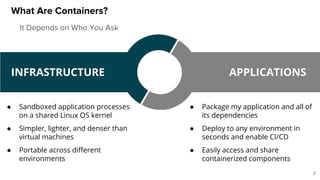
What Are Containers?
● Sandboxed application processes
on a shared Linux OS kernel
● Simpler, lighter, and denser than
virtual machines
● Portable across different
environments
● Package my application and all of
its dependencies
● Deploy to any environment in
seconds and enable CI/CD
● Easily access and share
containerized components
INFRASTRUCTURE APPLICATIONS
It Depends on Who You Ask
2
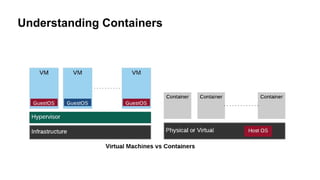
Understanding Containers
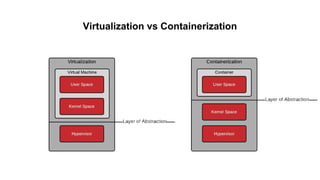
Virtualization vs Containerization
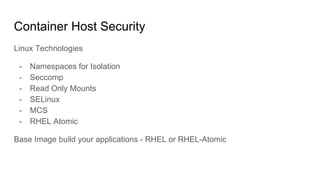
Container Host Security
Linux Technologies
- Namespaces for Isolation
- Seccomp
- Read Only Mounts
- SELinux
- MCS
- RHEL Atomic
Base Image build your applications - RHEL or RHEL-Atomic
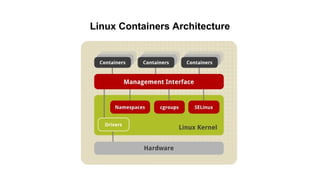
Linux Containers Architecture
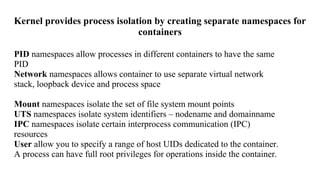
Kernel provides process isolation by creating separate namespaces for
containers
PID namespaces allow processes in different containers to have the same
PID
Network namespaces allows container to use separate virtual network
stack, loopback device and process space
Mount namespaces isolate the set of file system mount points
UTS namespaces isolate system identifiers – nodename and domainname
IPC namespaces isolate certain interprocess communication (IPC)
resources
User allow you to specify a range of host UIDs dedicated to the container.
A process can have full root privileges for operations inside the container.
Cgroups ensure that a single container cannot exhaust a large
amount of system resources
Cgroups allocate CPU time, system memory,
network bandwidth, or combinations of these
among user-defined groups of tasks
9
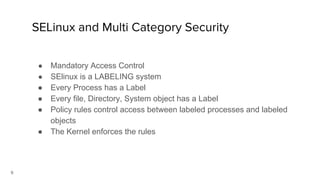
SELinux and Multi Category Security
● Mandatory Access Control
● SElinux is a LABELING system
● Every Process has a Label
● Every file, Directory, System object has a Label
● Policy rules control access between labeled processes and labeled
objects
● The Kernel enforces the rules
10
SELINUX - MAC - MCS - Process
system_u:system_r:container_runtime_t:s0
SElinux Policy module for the container
The OOTB SElinux policy container.te defines
what you can execute and access with the label
container_runtime_t
[root@osemaster ~]# ps -efZ | grep docker-containerd-shim-current
system_u:system_r:container_runtime_t:s0 root 3035 1479 0 Feb15 ? 00:00:01
/usr/bin/docker-containerd-shim-current
4d254785cbc6ee7aae8facc48555251e2385f65d89553b319b6324b1501e4b16
/var/run/docker/libcontainerd/4d254785cbc6ee7aae8facc48555251e2385f65d89553b319b6324b1501e4b16
/usr/libexec/docker/docker-runc-current
11
SELINUX - MAC - MCS - Files
container_var_lib_t / svirt_sandbox_file_t
SElinux Policy module for the container
[root@osemaster ~]# ls -lZ
/var/lib/docker/containers/97de4217a04b6532e312cfb3e4638529aeb7dfa281a2cc067e092fcee82e6737
/
-rw-r-----. root root system_u:object_r:container_var_lib_t:s0
97de4217a04b6532e312cfb3e4638529aeb7dfa281a2cc067e092fcee82e6737-json.log
-rw-rw-rw-. root root system_u:object_r:container_var_lib_t:s0 config.v2.json
-rw-rw-rw-. root root system_u:object_r:container_var_lib_t:s0 hostconfig.json
-rw-r--r--. root root system_u:object_r:svirt_sandbox_file_t:s0 hostname
-rw-r--r--. root root system_u:object_r:svirt_sandbox_file_t:s0:c0,c1 hosts
-rw-r--r--. root root system_u:object_r:svirt_sandbox_file_t:s0 resolv.conf
-rw-r--r--. root root system_u:object_r:container_var_lib_t:s0 resolv.conf.hash
drwxr-xr-x. root root system_u:object_r:svirt_sandbox_file_t:s0:c0,c1 secrets
drwx------. root root system_u:object_r:container_var_lib_t:s0 shm
12
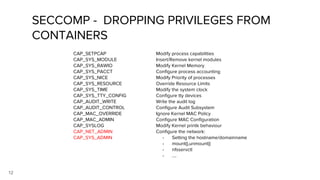
SECCOMP - DROPPING PRIVILEGES FROM
CONTAINERS
CAP_SETPCAP
CAP_SYS_MODULE
CAP_SYS_RAWIO
CAP_SYS_PACCT
CAP_SYS_NICE
CAP_SYS_RESOURCE
CAP_SYS_TIME
CAP_SYS_TTY_CONFIG
CAP_AUDIT_WRITE
CAP_AUDIT_CONTROL
CAP_MAC_OVERRIDE
CAP_MAC_ADMIN
CAP_SYSLOG
CAP_NET_ADMIN
CAP_SYS_ADMIN
Modify process capabilities
Insert/Remove kernel modules
Modify Kernel Memory
Configure process accounting
Modify Priority of processes
Override Resource Limits
Modify the system clock
Configure tty devices
Write the audit log
Configure Audit Subsystem
Ignore Kernel MAC Policy
Configure MAC Configuration
Modify Kernel printk behaviour
Configure the network:
- Setting the hostname/domainname
- mount(),unmount()
- nfsservctl
- ….
13
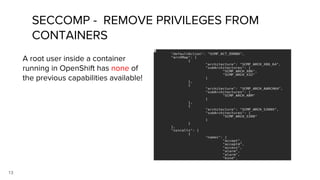
SECCOMP - REMOVE PRIVILEGES FROM
CONTAINERS
A root user inside a container
running in OpenShift has none of
the previous capabilities available!
14
Read Only Mounts
/sys
/proc/sys
/proc/sysrg-trigger
/proc/irq
/proc/bus
Container Build Time Security
- Content in the containers, Trusted Containers
- Responsibility of maintaining Container Images
- Container Registry - RBAC, Public and Private Registries
- Scanning for Vulnerabilities
- Integrating Container Scanning and SAST into CI/CD
- Future Vulnerabilities
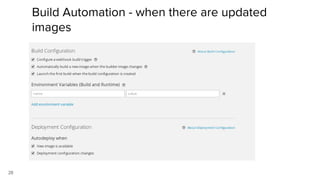
- Build Automation to rebuild during fixes
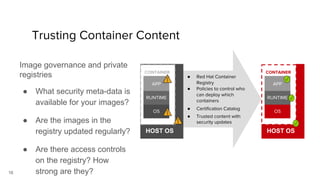
● Red Hat Container
Registry
● Policies to control who
can deploy which
containers
● Certification Catalog
● Trusted content with
security updates
HOST OS
CONTAINER
OS
RUNTIME
APP
HOST OS
CONTAINER
OS
RUNTIME
APP
16
Image governance and private
registries
● What security meta-data is
available for your images?
● Are the images in the
registry updated regularly?
● Are there access controls
on the registry? How
strong are they?
Trusting Container Content
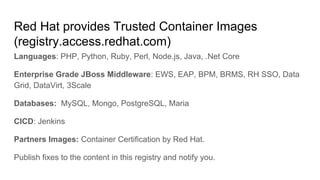
Red Hat provides Trusted Container Images
(registry.access.redhat.com)
Languages: PHP, Python, Ruby, Perl, Node.js, Java, .Net Core
Enterprise Grade JBoss Middleware: EWS, EAP, BPM, BRMS, RH SSO, Data
Grid, DataVirt, 3Scale
Databases: MySQL, Mongo, PostgreSQL, Maria
CICD: Jenkins
Partners Images: Container Certification by Red Hat.
Publish fixes to the content in this registry and notify you.
18
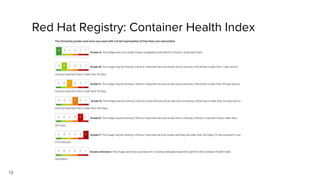
Red Hat Registry: Container Health Index
https://access.redhat.com/articles/2803031
Private Registries
What if public registry (like DockerHub) is down?
Enterprise security policies may not allow your Container Images to be pushed
outside.
Caching images in Private Registry
- Atomic Registry with RBAC
- JFrog Artifactory
- Docker Trusted Registry
20
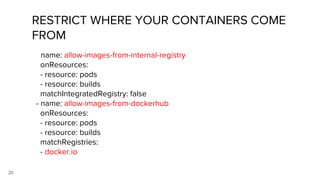
RESTRICT WHERE YOUR CONTAINERS COME
FROM
- name: allow-images-from-internal-registry
onResources:
- resource: pods
- resource: builds
matchIntegratedRegistry: false
- name: allow-images-from-dockerhub
onResources:
- resource: pods
- resource: builds
matchRegistries:
- docker.io
Responsibilities in the new paradigm
Operations
- Maintain Trusted OS Base Images (RHEL, RHEL-Atomic)
- Ensure these are good with Linux Kernel
System Engineers/Architects
- Maintain Middleware Images
- Control build process - S2I, CICD
- Reference Architectures with Trusted middleware
Development teams
- Write code that layers on approved images
- Ensure code is clean, opensource software vullnerabilities are handled
Container Scanning
Frequency
Scan containers as soon as they are created
Scan containers that get into registry
Ongoing basis- Identify any new vulnerabilities
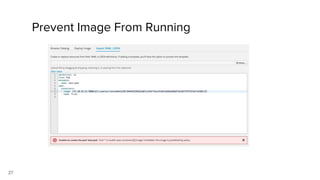
“Deny execution of containers that are vulnerable”
23
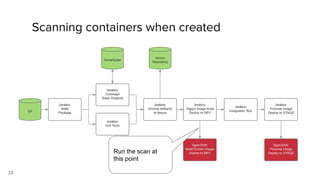
Scanning containers when created
https://www.youtube.com/watch?v=65BnTLcDAJI
Run the scan at
this point
Scanning Tools
Atomic Scan - configurable with different scanners
OpenScap Scanner - also built into CloudForms
BlackDuck
JFrog XRay
25
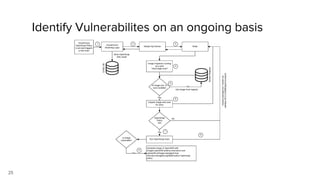
Identify Vulnerabilites on an ongoing basis
26
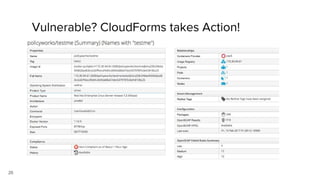
Vulnerable? CloudForms takes Action!
27
Prevent Image From Running
28
Build Automation - when there are updated
images
Container Platform Security
- Authentication
- Authorization
- Running Privileged Containers
- Network Isolation
- Securing communication between hosts
- Storage Security
- Deploying workloads to specific hosts of your choice
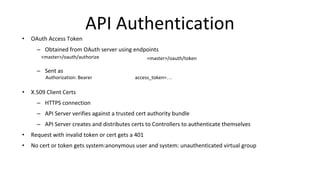
API Authentication
• OAuth Access Token
– Obtained from OAuth server using endpoints
– Sent as
• X.509 Client Certs
– HTTPS connection
– API Server verifies against a trusted cert authority bundle
– API Server creates and distributes certs to Controllers to authenticate themselves
• Request with invalid token or cert gets a 401
• No cert or token gets system:anonymous user and system: unauthenticated virtual group
<master>/oauth/authorize <master>/oauth/token
Authorization: Bearer access_token=…​
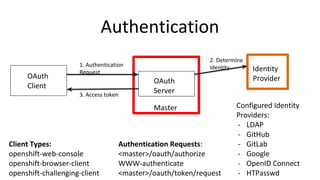
Authentication
OAuth
Client
OAuth
Server
Master
Client Types:
openshift-web-console
openshift-browser-client
openshift-challenging-client
Identity
Provider
1. Authentication
Request
2. Determine
Identity
3. Access token
Configured Identity
Providers:
- LDAP
- GitHub
- GitLab
- Google
- OpenID Connect
- HTPasswd
Authentication Requests:
<master>/oauth/authorize
WWW-authenticate
<master>/oauth/token/request
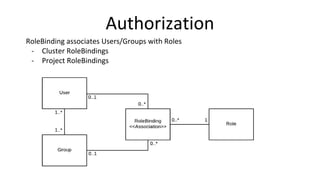
Authorization
RoleBinding associates Users/Groups with Roles
- Cluster RoleBindings
- Project RoleBindings
33
Container Deployment Permissions (SCC)
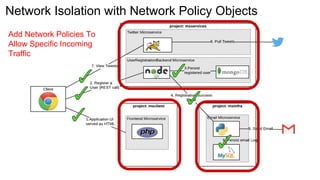
Network Isolation with Network Policy Objects
Add Network Policies To
Allow Specific Incoming
Traffic
35
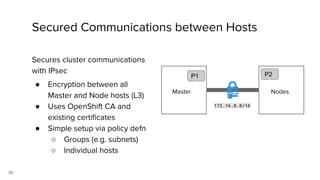
Secured Communications between Hosts
Secures cluster communications
with IPsec
● Encryption between all
Master and Node hosts (L3)
● Uses OpenShift CA and
existing certificates
● Simple setup via policy defn
○ Groups (e.g. subnets)
○ Individual hosts
Master
P1
Nodes
P2
172.16.0.0/16
36
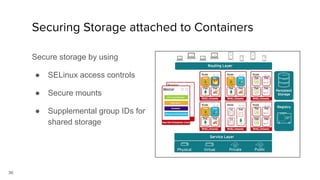
Secure storage by using
● SELinux access controls
● Secure mounts
● Supplemental group IDs for
shared storage
Securing Storage attached to Containers
37
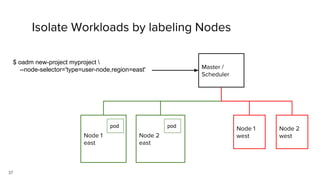
Isolate Workloads by labeling Nodes
Node 1
east
Node 2
east
Node 1
west
Node 2
west
Master /
Scheduler
$ oadm new-project myproject 
--node-selector='type=user-node,region=east'
pod pod
38
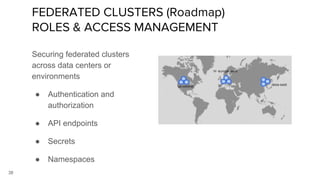
Securing federated clusters
across data centers or
environments
● Authentication and
authorization
● API endpoints
● Secrets
● Namespaces
FEDERATED CLUSTERS (Roadmap)
ROLES & ACCESS MANAGEMENT
Source: Building Globally Distributed Services using Kubernetes Cluster Federation. October 14, 2016
39
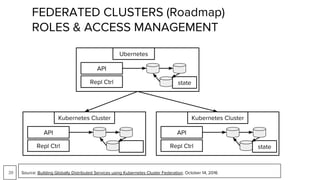
FEDERATED CLUSTERS (Roadmap)
ROLES & ACCESS MANAGEMENT
Source: Building Globally Distributed Services using Kubernetes Cluster Federation. October 14, 2016
API
Repl Ctrl
Ubernetes
state
API
Repl Ctrl
Kubernetes Cluster
state
API
Repl Ctrl
Kubernetes Cluster
state
Application Security - Running as Containers
- API Management
- Red Hat Single Sign-on
- HTTP(s)
- Securing sensitivedata as Secrets
- Calling services running outside a Container Platform
41
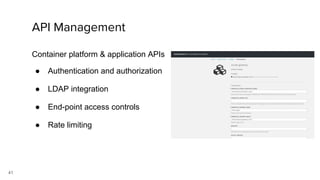
Container platform & application APIs
● Authentication and authorization
● LDAP integration
● End-point access controls
● Rate limiting
API Management
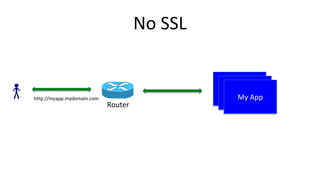
No SSL
My App
http://myapp.mydomain.com
Router
My App
My App
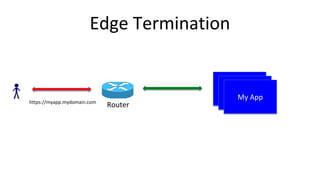
Edge Termination
My App
https://myapp.mydomain.com
Router
My App
My App
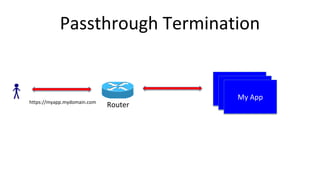
Passthrough Termination
My App
https://myapp.mydomain.com
Router
My App
My App
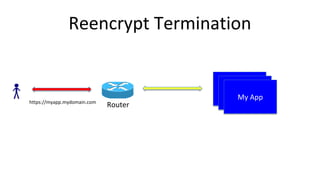
Reencrypt Termination
My App
https://myapp.mydomain.com
Router
My App
My App
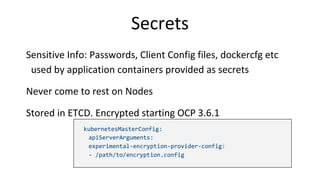
Secrets
Sensitive Info: Passwords, Client Config files, dockercfg etc
used by application containers provided as secrets
Never come to rest on Nodes
Stored in ETCD. Encrypted starting OCP 3.6.1
kubernetesMasterConfig:
apiServerArguments:
experimental-encryption-provider-config:
- /path/to/encryption.config
47
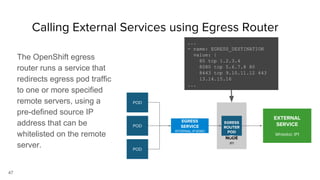
Calling External Services using Egress Router
The OpenShift egress
router runs a service that
redirects egress pod traffic
to one or more specified
remote servers, using a
pre-defined source IP
address that can be
whitelisted on the remote
server.
NODE
IP1
EGRESS
ROUTER
POD
IP1
EGRESS
SERVICE
INTERNAL-IP:8080
EXTERNAL
SERVICE
Whitelist: IP1
POD
POD
POD
...
- name: EGRESS_DESTINATION
value: |
80 tcp 1.2.3.4
8080 tcp 5.6.7.8 80
8443 tcp 9.10.11.12 443
13.14.15.16
...
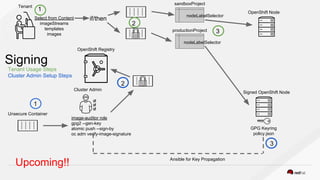
Signing
GPG Keyring
policy.json
Signed OpenShift Node
OpenShift Registry
image-auditor role
gpg2 --gen-key
atomic push --sign-by
oc adm verify-image-signature
Cluster Admin
Unsecure Container
Ansible for Key Propagation
OpenShift Node
Tenant
Select from Content
imageStreams
templates
images
if/then
sandboxProject
productionProject
nodeLabelSelector
nodeLabelSelector
1
2
3
1
Tenant Usage Steps
Cluster Admin Setup Steps
2
3
Upcoming!!
Thank you!!

Veer's Container Security

  • 1.
    @OpenShift RHOpenShift Container Security Presenter: VeerMuchandi Title: Principal Architect - Container Solutions Social Handle: @VeerMuchandi Blogs: https://blog.openshift.com/author/veermuchandi/
  • 2.
    What Are Containers? ●Sandboxed application processes on a shared Linux OS kernel ● Simpler, lighter, and denser than virtual machines ● Portable across different environments ● Package my application and all of its dependencies ● Deploy to any environment in seconds and enable CI/CD ● Easily access and share containerized components INFRASTRUCTURE APPLICATIONS It Depends on Who You Ask 2
  • 3.
  • 4.
  • 5.
    Container Host Security LinuxTechnologies - Namespaces for Isolation - Seccomp - Read Only Mounts - SELinux - MCS - RHEL Atomic Base Image build your applications - RHEL or RHEL-Atomic
  • 6.
  • 7.
    Kernel provides processisolation by creating separate namespaces for containers PID namespaces allow processes in different containers to have the same PID Network namespaces allows container to use separate virtual network stack, loopback device and process space Mount namespaces isolate the set of file system mount points UTS namespaces isolate system identifiers – nodename and domainname IPC namespaces isolate certain interprocess communication (IPC) resources User allow you to specify a range of host UIDs dedicated to the container. A process can have full root privileges for operations inside the container.
  • 8.
    Cgroups ensure thata single container cannot exhaust a large amount of system resources Cgroups allocate CPU time, system memory, network bandwidth, or combinations of these among user-defined groups of tasks
  • 9.
    9 SELinux and MultiCategory Security ● Mandatory Access Control ● SElinux is a LABELING system ● Every Process has a Label ● Every file, Directory, System object has a Label ● Policy rules control access between labeled processes and labeled objects ● The Kernel enforces the rules
  • 10.
    10 SELINUX - MAC- MCS - Process system_u:system_r:container_runtime_t:s0 SElinux Policy module for the container The OOTB SElinux policy container.te defines what you can execute and access with the label container_runtime_t [root@osemaster ~]# ps -efZ | grep docker-containerd-shim-current system_u:system_r:container_runtime_t:s0 root 3035 1479 0 Feb15 ? 00:00:01 /usr/bin/docker-containerd-shim-current 4d254785cbc6ee7aae8facc48555251e2385f65d89553b319b6324b1501e4b16 /var/run/docker/libcontainerd/4d254785cbc6ee7aae8facc48555251e2385f65d89553b319b6324b1501e4b16 /usr/libexec/docker/docker-runc-current
  • 11.
    11 SELINUX - MAC- MCS - Files container_var_lib_t / svirt_sandbox_file_t SElinux Policy module for the container [root@osemaster ~]# ls -lZ /var/lib/docker/containers/97de4217a04b6532e312cfb3e4638529aeb7dfa281a2cc067e092fcee82e6737 / -rw-r-----. root root system_u:object_r:container_var_lib_t:s0 97de4217a04b6532e312cfb3e4638529aeb7dfa281a2cc067e092fcee82e6737-json.log -rw-rw-rw-. root root system_u:object_r:container_var_lib_t:s0 config.v2.json -rw-rw-rw-. root root system_u:object_r:container_var_lib_t:s0 hostconfig.json -rw-r--r--. root root system_u:object_r:svirt_sandbox_file_t:s0 hostname -rw-r--r--. root root system_u:object_r:svirt_sandbox_file_t:s0:c0,c1 hosts -rw-r--r--. root root system_u:object_r:svirt_sandbox_file_t:s0 resolv.conf -rw-r--r--. root root system_u:object_r:container_var_lib_t:s0 resolv.conf.hash drwxr-xr-x. root root system_u:object_r:svirt_sandbox_file_t:s0:c0,c1 secrets drwx------. root root system_u:object_r:container_var_lib_t:s0 shm
  • 12.
    12 SECCOMP - DROPPINGPRIVILEGES FROM CONTAINERS CAP_SETPCAP CAP_SYS_MODULE CAP_SYS_RAWIO CAP_SYS_PACCT CAP_SYS_NICE CAP_SYS_RESOURCE CAP_SYS_TIME CAP_SYS_TTY_CONFIG CAP_AUDIT_WRITE CAP_AUDIT_CONTROL CAP_MAC_OVERRIDE CAP_MAC_ADMIN CAP_SYSLOG CAP_NET_ADMIN CAP_SYS_ADMIN Modify process capabilities Insert/Remove kernel modules Modify Kernel Memory Configure process accounting Modify Priority of processes Override Resource Limits Modify the system clock Configure tty devices Write the audit log Configure Audit Subsystem Ignore Kernel MAC Policy Configure MAC Configuration Modify Kernel printk behaviour Configure the network: - Setting the hostname/domainname - mount(),unmount() - nfsservctl - ….
  • 13.
    13 SECCOMP - REMOVEPRIVILEGES FROM CONTAINERS A root user inside a container running in OpenShift has none of the previous capabilities available!
  • 14.
  • 15.
    Container Build TimeSecurity - Content in the containers, Trusted Containers - Responsibility of maintaining Container Images - Container Registry - RBAC, Public and Private Registries - Scanning for Vulnerabilities - Integrating Container Scanning and SAST into CI/CD - Future Vulnerabilities - Build Automation to rebuild during fixes
  • 16.
    ● Red HatContainer Registry ● Policies to control who can deploy which containers ● Certification Catalog ● Trusted content with security updates HOST OS CONTAINER OS RUNTIME APP HOST OS CONTAINER OS RUNTIME APP 16 Image governance and private registries ● What security meta-data is available for your images? ● Are the images in the registry updated regularly? ● Are there access controls on the registry? How strong are they? Trusting Container Content
  • 17.
    Red Hat providesTrusted Container Images (registry.access.redhat.com) Languages: PHP, Python, Ruby, Perl, Node.js, Java, .Net Core Enterprise Grade JBoss Middleware: EWS, EAP, BPM, BRMS, RH SSO, Data Grid, DataVirt, 3Scale Databases: MySQL, Mongo, PostgreSQL, Maria CICD: Jenkins Partners Images: Container Certification by Red Hat. Publish fixes to the content in this registry and notify you.
  • 18.
    18 Red Hat Registry:Container Health Index https://access.redhat.com/articles/2803031
  • 19.
    Private Registries What ifpublic registry (like DockerHub) is down? Enterprise security policies may not allow your Container Images to be pushed outside. Caching images in Private Registry - Atomic Registry with RBAC - JFrog Artifactory - Docker Trusted Registry
  • 20.
    20 RESTRICT WHERE YOURCONTAINERS COME FROM - name: allow-images-from-internal-registry onResources: - resource: pods - resource: builds matchIntegratedRegistry: false - name: allow-images-from-dockerhub onResources: - resource: pods - resource: builds matchRegistries: - docker.io
  • 21.
    Responsibilities in thenew paradigm Operations - Maintain Trusted OS Base Images (RHEL, RHEL-Atomic) - Ensure these are good with Linux Kernel System Engineers/Architects - Maintain Middleware Images - Control build process - S2I, CICD - Reference Architectures with Trusted middleware Development teams - Write code that layers on approved images - Ensure code is clean, opensource software vullnerabilities are handled
  • 22.
    Container Scanning Frequency Scan containersas soon as they are created Scan containers that get into registry Ongoing basis- Identify any new vulnerabilities “Deny execution of containers that are vulnerable”
  • 23.
    23 Scanning containers whencreated https://www.youtube.com/watch?v=65BnTLcDAJI Run the scan at this point
  • 24.
    Scanning Tools Atomic Scan- configurable with different scanners OpenScap Scanner - also built into CloudForms BlackDuck JFrog XRay
  • 25.
  • 26.
  • 27.
  • 28.
    28 Build Automation -when there are updated images
  • 29.
    Container Platform Security -Authentication - Authorization - Running Privileged Containers - Network Isolation - Securing communication between hosts - Storage Security - Deploying workloads to specific hosts of your choice
  • 30.
    API Authentication • OAuthAccess Token – Obtained from OAuth server using endpoints – Sent as • X.509 Client Certs – HTTPS connection – API Server verifies against a trusted cert authority bundle – API Server creates and distributes certs to Controllers to authenticate themselves • Request with invalid token or cert gets a 401 • No cert or token gets system:anonymous user and system: unauthenticated virtual group <master>/oauth/authorize <master>/oauth/token Authorization: Bearer access_token=…​
  • 31.
    Authentication OAuth Client OAuth Server Master Client Types: openshift-web-console openshift-browser-client openshift-challenging-client Identity Provider 1. Authentication Request 2.Determine Identity 3. Access token Configured Identity Providers: - LDAP - GitHub - GitLab - Google - OpenID Connect - HTPasswd Authentication Requests: <master>/oauth/authorize WWW-authenticate <master>/oauth/token/request
  • 32.
    Authorization RoleBinding associates Users/Groupswith Roles - Cluster RoleBindings - Project RoleBindings
  • 33.
  • 34.
    Network Isolation withNetwork Policy Objects Add Network Policies To Allow Specific Incoming Traffic
  • 35.
    35 Secured Communications betweenHosts Secures cluster communications with IPsec ● Encryption between all Master and Node hosts (L3) ● Uses OpenShift CA and existing certificates ● Simple setup via policy defn ○ Groups (e.g. subnets) ○ Individual hosts Master P1 Nodes P2 172.16.0.0/16
  • 36.
    36 Secure storage byusing ● SELinux access controls ● Secure mounts ● Supplemental group IDs for shared storage Securing Storage attached to Containers
  • 37.
    37 Isolate Workloads bylabeling Nodes Node 1 east Node 2 east Node 1 west Node 2 west Master / Scheduler $ oadm new-project myproject --node-selector='type=user-node,region=east' pod pod
  • 38.
    38 Securing federated clusters acrossdata centers or environments ● Authentication and authorization ● API endpoints ● Secrets ● Namespaces FEDERATED CLUSTERS (Roadmap) ROLES & ACCESS MANAGEMENT Source: Building Globally Distributed Services using Kubernetes Cluster Federation. October 14, 2016
  • 39.
    39 FEDERATED CLUSTERS (Roadmap) ROLES& ACCESS MANAGEMENT Source: Building Globally Distributed Services using Kubernetes Cluster Federation. October 14, 2016 API Repl Ctrl Ubernetes state API Repl Ctrl Kubernetes Cluster state API Repl Ctrl Kubernetes Cluster state
  • 40.
    Application Security -Running as Containers - API Management - Red Hat Single Sign-on - HTTP(s) - Securing sensitivedata as Secrets - Calling services running outside a Container Platform
  • 41.
    41 Container platform &application APIs ● Authentication and authorization ● LDAP integration ● End-point access controls ● Rate limiting API Management
  • 42.
  • 43.
  • 44.
  • 45.
  • 46.
    Secrets Sensitive Info: Passwords,Client Config files, dockercfg etc used by application containers provided as secrets Never come to rest on Nodes Stored in ETCD. Encrypted starting OCP 3.6.1 kubernetesMasterConfig: apiServerArguments: experimental-encryption-provider-config: - /path/to/encryption.config
  • 47.
    47 Calling External Servicesusing Egress Router The OpenShift egress router runs a service that redirects egress pod traffic to one or more specified remote servers, using a pre-defined source IP address that can be whitelisted on the remote server. NODE IP1 EGRESS ROUTER POD IP1 EGRESS SERVICE INTERNAL-IP:8080 EXTERNAL SERVICE Whitelist: IP1 POD POD POD ... - name: EGRESS_DESTINATION value: | 80 tcp 1.2.3.4 8080 tcp 5.6.7.8 80 8443 tcp 9.10.11.12 443 13.14.15.16 ...
  • 48.
    Signing GPG Keyring policy.json Signed OpenShiftNode OpenShift Registry image-auditor role gpg2 --gen-key atomic push --sign-by oc adm verify-image-signature Cluster Admin Unsecure Container Ansible for Key Propagation OpenShift Node Tenant Select from Content imageStreams templates images if/then sandboxProject productionProject nodeLabelSelector nodeLabelSelector 1 2 3 1 Tenant Usage Steps Cluster Admin Setup Steps 2 3 Upcoming!!
  • 49.