FLORICULTURE INDUSTRY
• Post globalisation, floriculture has become an
important commercial activity in agriculture.
• Floriculture activity has evolved as a viable
and profitable alternative, with a potential to
generate remunerative self-employment
among small & marginal farmers & earn the
much needed foreign exchange in developing
countries like India.
FLORICULTURE ACTIVITY
Floriculture activity can be defined as
cultivation/production & marketing of
flowering and foliage plants,
garden-bedding plants,
Cut flowers and greens
under controlled conditions mainly for export.
Introduction
• The production is growing at a rate of 8 - 10% per
annum. There are nearly 120 countries, which are
active in floriculture production on a large scale.
• The economy of some countries - the
Netherlands, Israel and Colombia - is dependent
on floriculture industry. The estimated area under
floriculture in the world Is over 220,000 hectares.
• Developing countries have emerged as additional
production centres in the past few decades.
Economic importance of flowers
Traditional flowers Modern flowers
as loose flowers as highest value cut flowers
for hair adornment and garland making for vase/Bouquet preparation
for decoration purposes as attractive corsages eg. Orchids
for perfume extraction (Concrete and
Absolute) eg. Jasmine
for decorating the landscape and
gardening
extraction of pigments eg. Marigold,
Gomphrena.
as floral ornaments and exhibits
for their medicinal value eg. Rose,
jasmine.
also for expressing our thoughts
THE FLOWER CHAIN
Some industries based on floriculture:
• Cut flower industries
• Dry flower industries
• Perfumery industries
• Decoration committees
• Oil extracting industries
• Dyeing industries
• Pharmaceutical industries etc..
Global Status
• Growing at a compound annual growth rate
(CAGR) of about 15%,
• Global floriculture industry is likely to cross
Rs. 9 lakh crore mark by 2015 from about Rs. 6
lakh crore now.
• Global floriculture in the sense it includes all
cut flowers & foliages, bulbs, cuttings, live
plants etc..
EXPORTS OF FLORICULTURE PRODUCTS IN THE WORLD
(US$ million)
SOURCE: UN Comtrade 2004
SHARE OF TOP FLORICULTURE EXPORTERS IN THE WORLD (2004)
SOURCE: UN Comtrade 2004
• 5 leading countries in floriculture exports are,
• 1. Netherlands(57%)
• 2. Columbia (14%)
• 3. Israel(4%)
• 4. Kenya(3%)
• 5. Eucador(3%)
SHARE OF TOP FLORICULTURE IMPORTERS IN THE WORLD (2004)
SOURCE: UN Comtrade 2004
Major importing markets of floriculture products are:
• European Union Member countries(>50%)
• Germany (18%),
• The United States(13%),
• The United Kingdom (13%),
• France (10%),
• The Netherlands(8.8%),
• Italy (4%) and
• Japan (3.65%).
European Union Member countries account for
almost 70% of all imports of floriculture products.
Indian Floriculture Industry
• India has an ancient heritage when it comes
to floriculture. Commercial floriculture
however is of recent origin.
• A consistent increase in demand for cut and
potted flowers has made floriculture as one
of the important commercial trades in Indian
agriculture.
• Emphasis has been shifting from traditional
flowers to cut flowers for export purposes.
ALL INDIAAREA UNDER FLORICULTURE PRODUCTION
SOURCE: Indian Horticulture Database 2003, National Horticulture Board
Cont.,
• Growing at a compound annual growth rate
(CAGR) of about 30%,India’s floriculture
industry is likely to cross the Rs. 8000 crore
mark by 2015.
• The floriculture industry in India is poised at
about Rs.3700 crore, with just 0.61% share in
the global floriculture sector, which is likely
to reach 0.89% by 2015.
Floriculture Scenario In India
• Floriculture in India is estimated to cover an
area of 1.91 lakh ha with a production of
1031000 MT of loose flowers & 6902 million cut
flowers(NBH,2011).
• The trade of Indian flowers worth Rs.3700
crores/annum.
• Nearly 77% of area under floricultural crops is
concentrated in 7 states: Tamilnadu, Karnataka,
Andhra Pradesh, West Bengal, Haryana, Uttar
Pradesh & Delhi.
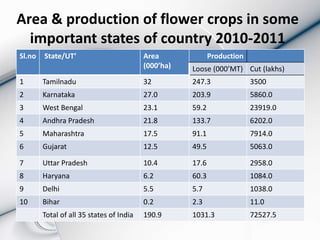
Area & production of flower crops in some
important states of country 2010-2011
Sl.no State/UT’ Area
(000’ha)
Production
Loose (000’MT) Cut (lakhs)
1 Tamilnadu 32 247.3 3500
2 Karnataka 27.0 203.9 5860.0
3 West Bengal 23.1 59.2 23919.0
4 Andhra Pradesh 21.8 133.7 6202.0
5 Maharashtra 17.5 91.1 7914.0
6 Gujarat 12.5 49.5 5063.0
7 Uttar Pradesh 10.4 17.6 2958.0
8 Haryana 6.2 60.3 1084.0
9 Delhi 5.5 5.7 1038.0
10 Bihar 0.2 2.3 11.0
Total of all 35 states of India 190.9 1031.3 72527.5
Cont.,
• With a share of about 65% rose flower
industry in India accounts for Rs.2400 crore
of the overall floriculture industry & rose
accounts for 75% of global floriculture
industry.
• About 40 crore cut roses are grown across
India every year & Karnataka alone accounts
for about 75% followed by Maharashtra,
Tamilnadu, Bihar, West Bengal etc..
Area & production of floriculture
(loose flowers )
Year Area Production
2001-02 106 535
2002-03 70 735
2003-04 101 580
2004-05 118 659
2005-06 129 654
2006-07 144 880
2007-08 166 868
2008-09 167 987
2009-10 183 1021
2010-11 191 1031
PRODUCTION TREND OF FLOWERS IN INDIA
SOURCE: Indian Horticulture Database 2003, National Horticulture Board
Export status of India
• The domestic market for flowers and flowering plants
is picking up in the country because of a growing
interest of affluent and upper middle class in indoor
plants/flowers.
• The main flowers cultivated in India for the domestic
market are marigold, aster, rose, tuberose, gladiolus,
chrysanthemums and jasmine.
• Traditional flowers like jasmine, tuberose are being
exported as fresh flowers to Malaysia, Singapore, Sri
Lanka and Gulf countries from India.
• The rose petals are also used to prepare rose water
and gulkand.
• These products are exported to UK, France, Germany
and Middle East countries.
Cont.,
• Extracting essential oils from flowers is another major
industry in India.
• Tuberose flowers are used for extraction of oils and it
is considered as the high value concrete in the world
market.
• Tissue cultured plants of jasmine, scented rose etc.
can also be propagated and supplied to Taiwan, Korea
and Japan.
• All these floricultural products can be sold in the
international market at Singapore.
• Floriculture export for financial year 2012-13 (Apr -
July)
Product Quantity
(MT)
value
(LAKHS)
FLORICULTURE 10,165.28 13,813.85
Source: APEDA Agri Exchange
REGION-WISE EXPORT OF INDIAN FLORICULTURE PRODUCTS
SOURCE: DGCIS
Exports of floriculture products from
India (2010-2011)
Sl.no Country Qty (MT) Value (Lakhs)
1 USA 7154 5687
2 Germany 4512 4281
3 Netherlands 2990 4162
4 UK 4116 3762
5 Japan 577 1152
6 U Arab Emts 813 959
7 Italy 1234 857
8 Canada 533 798
9 Belgium 762 774
10 Ethiopia 69 634
Page Total 22760 23066
Floriculture Scenario in Tamilnadu
• Flower cultivation is taken up in 16,745 ha area in
Tamil Nadu with an annual production of 1,42,333
tonnes of flowers (approximately 1.5 lakh t).
• Tamilnadu ranks first in area.
• It followed by Karnataka, West Bengal & Andhra
Pradesh.
• Also tamilnadu ranks first among the flower
producing states of India.
• It occupies 25% of the country’s flower production.
• The production of cut flowers
In 2007 : 2071 million stems
In 2011 : 6902 million stems
Cont.,
• Due to improvement in the std. of living &
quality of life which ultimately which ultimately
increases the growth of domestic & export
markets.
• In tamilnadu loose flower (jasmine,
chrysanthemum, marigold, rose, crossandra &
nerium)
 production area- 32000 ha
production – 288640 MT
• In this jasmine covers an area of 13937 ha with a
production of 111470 tonnes contributes a
major share to the floriculture trade
STRENGTHS
• Low volume high value
• Good scope for export market
• Year round production ( green house
condition – except for tulips, gladiolus &
gerbera)
• Immersive scope of value added products
(dry flowers, concrete, xanthophylls..)
• Favourable geographical situations
Scope and Employment Potential
• Climate, trained man power, skilled & unskilled
worker - Traditional flowers -large scope
• Loose flowers - Good scope - domestic & export.
• Income per unit area is much higher - more
profitable, every day income
• Suitable for small and medium level farmers.
• Foreign exchange.
• labour oriented - Even old people & disabled
persons- also promotes employment for
unemployed graduates & entrepreneurs.
CHALLENGES TO BE MET WITH
• Not fully satisfied Supply Infrastructure
• Limited Availability & high cost of Basic
Inputs including Seeds and Planting Materials
• Diversification of Products
• Quality Parameters
• Comparatively lesser Re-plantations
• Environmental Issues
• Operation of Economies of Scale
STRATEGIES THAT COULD WORK OUT
 Infrastructure Support  Packaging
 Government Support  Human Resource Development
 Selection of Product Mix  Developing Joint Ventures
 Supply of Quality Inputs  Establishment of Support
Systems
 Research and Development  Environmental Strategies
 Technology Development  Marketing Strategies
 Quality and Labeling  Consortia Approach
OPPURTUNITIES TO INDIA
• Blessed with natural & strategic location
advantages – high potential for floriculture
exports.
• Government policy:
Change in policies & thrust given to
floriculture exports
• Corporate entry:
Signals a drive towards professionalism &
availability of finance
Reference:
BOOKS:
RESEARCH PAPERS:
WEBSITES:
• www.intracen.org/trade-support/floriculture
• www3.u-toyama.ac.jp/tulip/te/nico
• www.agriexchange.apeda.gov.in/index/monthexport.aspx
Proud to be an Indian especially a Tamilian
• India is the largest supplier of roses to Japan and
Australia
• India is the largest exporter of dried flowers to
UK. (It exports dahlia, bell cups, marigold, jute
flowers, wood roses, wild lilies, helichrysum and
lotus pods)
• Tamilnadu ranks first in area of flower
production.
• Tamilnadu ranks first among the flower
producing states of India.
BY
R.ABARNA
BTH-12-001
T
H
A
N
K
Y
O
U

Floriculture industry

  • 2.
    FLORICULTURE INDUSTRY • Postglobalisation, floriculture has become an important commercial activity in agriculture. • Floriculture activity has evolved as a viable and profitable alternative, with a potential to generate remunerative self-employment among small & marginal farmers & earn the much needed foreign exchange in developing countries like India.
  • 3.
    FLORICULTURE ACTIVITY Floriculture activitycan be defined as cultivation/production & marketing of flowering and foliage plants, garden-bedding plants, Cut flowers and greens under controlled conditions mainly for export.
  • 4.
    Introduction • The productionis growing at a rate of 8 - 10% per annum. There are nearly 120 countries, which are active in floriculture production on a large scale. • The economy of some countries - the Netherlands, Israel and Colombia - is dependent on floriculture industry. The estimated area under floriculture in the world Is over 220,000 hectares. • Developing countries have emerged as additional production centres in the past few decades.
  • 5.
    Economic importance offlowers Traditional flowers Modern flowers as loose flowers as highest value cut flowers for hair adornment and garland making for vase/Bouquet preparation for decoration purposes as attractive corsages eg. Orchids for perfume extraction (Concrete and Absolute) eg. Jasmine for decorating the landscape and gardening extraction of pigments eg. Marigold, Gomphrena. as floral ornaments and exhibits for their medicinal value eg. Rose, jasmine. also for expressing our thoughts
  • 6.
  • 7.
    Some industries basedon floriculture: • Cut flower industries • Dry flower industries • Perfumery industries • Decoration committees • Oil extracting industries • Dyeing industries • Pharmaceutical industries etc..
  • 8.
    Global Status • Growingat a compound annual growth rate (CAGR) of about 15%, • Global floriculture industry is likely to cross Rs. 9 lakh crore mark by 2015 from about Rs. 6 lakh crore now. • Global floriculture in the sense it includes all cut flowers & foliages, bulbs, cuttings, live plants etc..
  • 9.
    EXPORTS OF FLORICULTUREPRODUCTS IN THE WORLD (US$ million) SOURCE: UN Comtrade 2004
  • 10.
    SHARE OF TOPFLORICULTURE EXPORTERS IN THE WORLD (2004) SOURCE: UN Comtrade 2004
  • 11.
    • 5 leadingcountries in floriculture exports are, • 1. Netherlands(57%) • 2. Columbia (14%) • 3. Israel(4%) • 4. Kenya(3%) • 5. Eucador(3%)
  • 12.
    SHARE OF TOPFLORICULTURE IMPORTERS IN THE WORLD (2004) SOURCE: UN Comtrade 2004
  • 13.
    Major importing marketsof floriculture products are: • European Union Member countries(>50%) • Germany (18%), • The United States(13%), • The United Kingdom (13%), • France (10%), • The Netherlands(8.8%), • Italy (4%) and • Japan (3.65%). European Union Member countries account for almost 70% of all imports of floriculture products.
  • 14.
    Indian Floriculture Industry •India has an ancient heritage when it comes to floriculture. Commercial floriculture however is of recent origin. • A consistent increase in demand for cut and potted flowers has made floriculture as one of the important commercial trades in Indian agriculture. • Emphasis has been shifting from traditional flowers to cut flowers for export purposes.
  • 15.
    ALL INDIAAREA UNDERFLORICULTURE PRODUCTION SOURCE: Indian Horticulture Database 2003, National Horticulture Board
  • 16.
    Cont., • Growing ata compound annual growth rate (CAGR) of about 30%,India’s floriculture industry is likely to cross the Rs. 8000 crore mark by 2015. • The floriculture industry in India is poised at about Rs.3700 crore, with just 0.61% share in the global floriculture sector, which is likely to reach 0.89% by 2015.
  • 17.
    Floriculture Scenario InIndia • Floriculture in India is estimated to cover an area of 1.91 lakh ha with a production of 1031000 MT of loose flowers & 6902 million cut flowers(NBH,2011). • The trade of Indian flowers worth Rs.3700 crores/annum. • Nearly 77% of area under floricultural crops is concentrated in 7 states: Tamilnadu, Karnataka, Andhra Pradesh, West Bengal, Haryana, Uttar Pradesh & Delhi.
  • 18.
    Area & productionof flower crops in some important states of country 2010-2011 Sl.no State/UT’ Area (000’ha) Production Loose (000’MT) Cut (lakhs) 1 Tamilnadu 32 247.3 3500 2 Karnataka 27.0 203.9 5860.0 3 West Bengal 23.1 59.2 23919.0 4 Andhra Pradesh 21.8 133.7 6202.0 5 Maharashtra 17.5 91.1 7914.0 6 Gujarat 12.5 49.5 5063.0 7 Uttar Pradesh 10.4 17.6 2958.0 8 Haryana 6.2 60.3 1084.0 9 Delhi 5.5 5.7 1038.0 10 Bihar 0.2 2.3 11.0 Total of all 35 states of India 190.9 1031.3 72527.5
  • 19.
    Cont., • With ashare of about 65% rose flower industry in India accounts for Rs.2400 crore of the overall floriculture industry & rose accounts for 75% of global floriculture industry. • About 40 crore cut roses are grown across India every year & Karnataka alone accounts for about 75% followed by Maharashtra, Tamilnadu, Bihar, West Bengal etc..
  • 20.
    Area & productionof floriculture (loose flowers ) Year Area Production 2001-02 106 535 2002-03 70 735 2003-04 101 580 2004-05 118 659 2005-06 129 654 2006-07 144 880 2007-08 166 868 2008-09 167 987 2009-10 183 1021 2010-11 191 1031
  • 21.
    PRODUCTION TREND OFFLOWERS IN INDIA SOURCE: Indian Horticulture Database 2003, National Horticulture Board
  • 22.
    Export status ofIndia • The domestic market for flowers and flowering plants is picking up in the country because of a growing interest of affluent and upper middle class in indoor plants/flowers. • The main flowers cultivated in India for the domestic market are marigold, aster, rose, tuberose, gladiolus, chrysanthemums and jasmine. • Traditional flowers like jasmine, tuberose are being exported as fresh flowers to Malaysia, Singapore, Sri Lanka and Gulf countries from India. • The rose petals are also used to prepare rose water and gulkand. • These products are exported to UK, France, Germany and Middle East countries.
  • 23.
    Cont., • Extracting essentialoils from flowers is another major industry in India. • Tuberose flowers are used for extraction of oils and it is considered as the high value concrete in the world market. • Tissue cultured plants of jasmine, scented rose etc. can also be propagated and supplied to Taiwan, Korea and Japan. • All these floricultural products can be sold in the international market at Singapore. • Floriculture export for financial year 2012-13 (Apr - July) Product Quantity (MT) value (LAKHS) FLORICULTURE 10,165.28 13,813.85 Source: APEDA Agri Exchange
  • 24.
    REGION-WISE EXPORT OFINDIAN FLORICULTURE PRODUCTS SOURCE: DGCIS
  • 25.
    Exports of floricultureproducts from India (2010-2011) Sl.no Country Qty (MT) Value (Lakhs) 1 USA 7154 5687 2 Germany 4512 4281 3 Netherlands 2990 4162 4 UK 4116 3762 5 Japan 577 1152 6 U Arab Emts 813 959 7 Italy 1234 857 8 Canada 533 798 9 Belgium 762 774 10 Ethiopia 69 634 Page Total 22760 23066
  • 26.
    Floriculture Scenario inTamilnadu • Flower cultivation is taken up in 16,745 ha area in Tamil Nadu with an annual production of 1,42,333 tonnes of flowers (approximately 1.5 lakh t). • Tamilnadu ranks first in area. • It followed by Karnataka, West Bengal & Andhra Pradesh. • Also tamilnadu ranks first among the flower producing states of India. • It occupies 25% of the country’s flower production. • The production of cut flowers In 2007 : 2071 million stems In 2011 : 6902 million stems
  • 27.
    Cont., • Due toimprovement in the std. of living & quality of life which ultimately which ultimately increases the growth of domestic & export markets. • In tamilnadu loose flower (jasmine, chrysanthemum, marigold, rose, crossandra & nerium)  production area- 32000 ha production – 288640 MT • In this jasmine covers an area of 13937 ha with a production of 111470 tonnes contributes a major share to the floriculture trade
  • 29.
    STRENGTHS • Low volumehigh value • Good scope for export market • Year round production ( green house condition – except for tulips, gladiolus & gerbera) • Immersive scope of value added products (dry flowers, concrete, xanthophylls..) • Favourable geographical situations
  • 30.
    Scope and EmploymentPotential • Climate, trained man power, skilled & unskilled worker - Traditional flowers -large scope • Loose flowers - Good scope - domestic & export. • Income per unit area is much higher - more profitable, every day income • Suitable for small and medium level farmers. • Foreign exchange. • labour oriented - Even old people & disabled persons- also promotes employment for unemployed graduates & entrepreneurs.
  • 31.
    CHALLENGES TO BEMET WITH • Not fully satisfied Supply Infrastructure • Limited Availability & high cost of Basic Inputs including Seeds and Planting Materials • Diversification of Products • Quality Parameters • Comparatively lesser Re-plantations • Environmental Issues • Operation of Economies of Scale
  • 32.
    STRATEGIES THAT COULDWORK OUT  Infrastructure Support  Packaging  Government Support  Human Resource Development  Selection of Product Mix  Developing Joint Ventures  Supply of Quality Inputs  Establishment of Support Systems  Research and Development  Environmental Strategies  Technology Development  Marketing Strategies  Quality and Labeling  Consortia Approach
  • 33.
    OPPURTUNITIES TO INDIA •Blessed with natural & strategic location advantages – high potential for floriculture exports. • Government policy: Change in policies & thrust given to floriculture exports • Corporate entry: Signals a drive towards professionalism & availability of finance
  • 34.
    Reference: BOOKS: RESEARCH PAPERS: WEBSITES: • www.intracen.org/trade-support/floriculture •www3.u-toyama.ac.jp/tulip/te/nico • www.agriexchange.apeda.gov.in/index/monthexport.aspx
  • 35.
    Proud to bean Indian especially a Tamilian • India is the largest supplier of roses to Japan and Australia • India is the largest exporter of dried flowers to UK. (It exports dahlia, bell cups, marigold, jute flowers, wood roses, wild lilies, helichrysum and lotus pods) • Tamilnadu ranks first in area of flower production. • Tamilnadu ranks first among the flower producing states of India.
  • 36.