DNA DOUBLE
HELICAL
STRUCTURE
PRESENTED BY,
JAMUNA S
M.Sc BIOCHEMISTRY
INTRODUCTION :
 Chromosomes are the carrier of genetic material.
Chromosome contain DNA, RNA, proteins.
 DNA is the genetic material in most of the organism
and higher organism.
 In 1953 , Jameson Watson and Francis Crick proposed
double helix DNA model on the basis of X-ray
diffraction studies with photographs of DNA taken by
Wilkins and Franklin.
 It is also known as Watson and Crick model DNA
structure.
 Watson and Crick shared a noble prize in 1962.
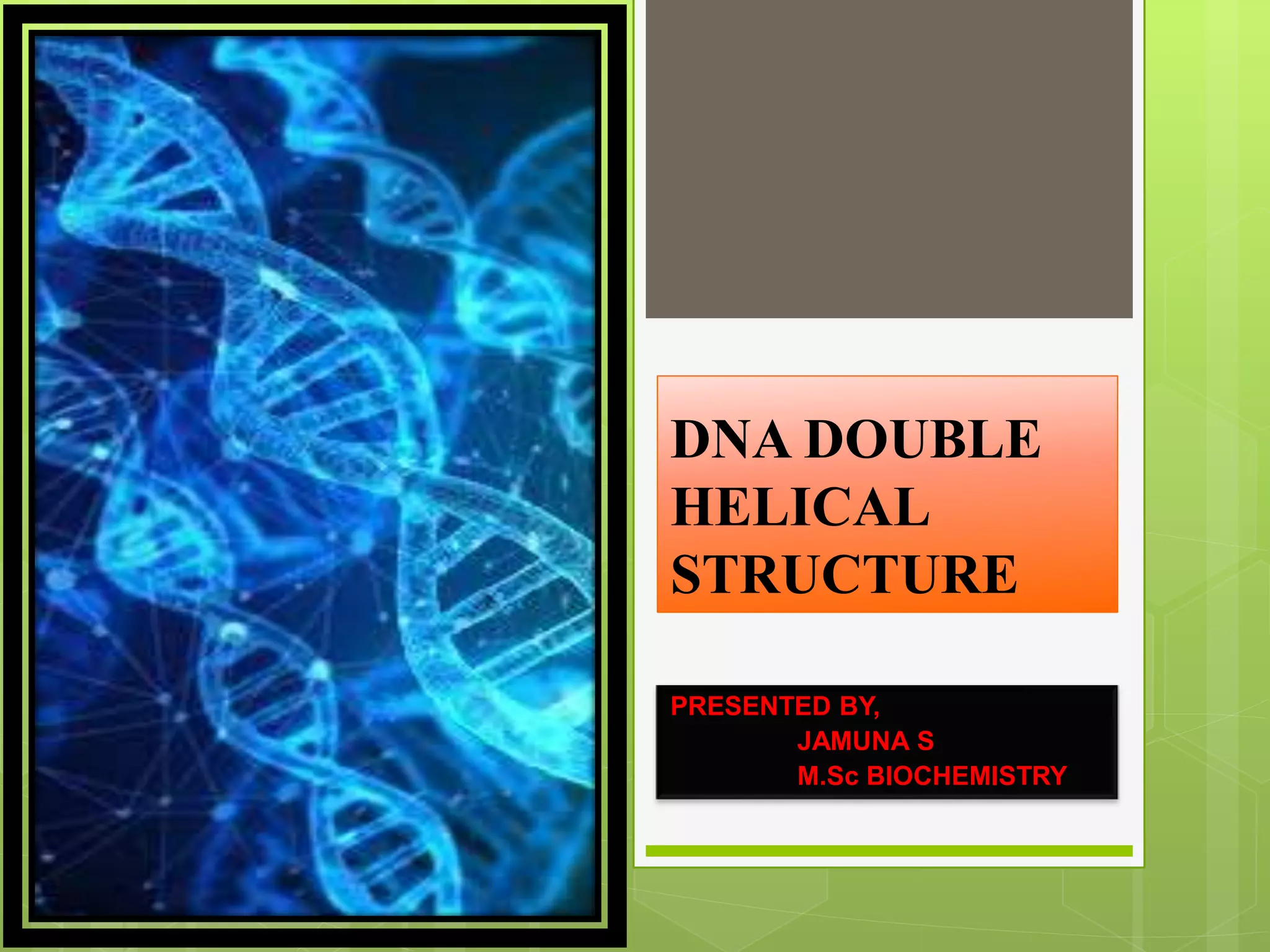
DNA is a double stranded structure in which the two
strands are coiled around each other forming a double
helix.
The DNA duplex is “coil of life”.
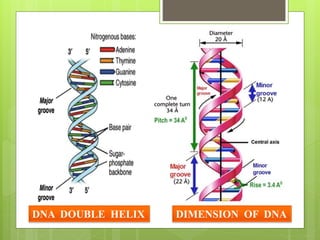
There are two grooves in DNA namely, 1. Major groove,
2. Minor groove.
The backbone of the helix is formed of sugar and
phosphate molecule. The nitrogenous bases are attached
to sugar molecule.
The two nucleotide strands are held together by unstable
hydrogen bonds.
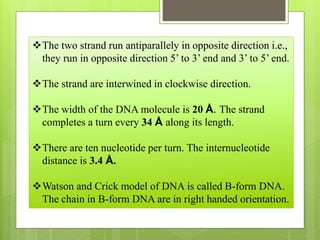
DNA DOUBLE HELIX DIMENSION OF DNA
The two strand run antiparallely in opposite direction i.e.,
they run in opposite direction 5’ to 3’ end and 3’ to 5’ end.
The strand are interwined in clockwise direction.
The width of the DNA molecule is 20 Å. The strand
completes a turn every 34 Å along its length.
There are ten nucleotide per turn. The internucleotide
distance is 3.4 Å.
Watson and Crick model of DNA is called B-form DNA.
The chain in B-form DNA are in right handed orientation.
STABILITY OF DOUBLE HELIX STRUCTURE :
 Internal and external hydrogen bonds
 Negative charge of phosphate groups
 Base pair stacking.
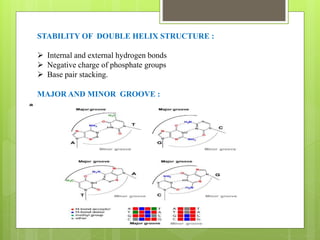
MAJOR AND MINOR GROOVE :
 Each nucleotide is made up of pentose sugar, a phosphate
group and a nitrogenous base. Deoxyribose is the
constituent sugar in DNA.
The nitrogenous bases are of two kinds,
 Purines
 Pyrimidines
 Adenine and guanine are the purines and thymine and
cytosine are pyrimidines.
The nitrogenous bases found in DNA are adenine,
guanine, cytosine and thymine.
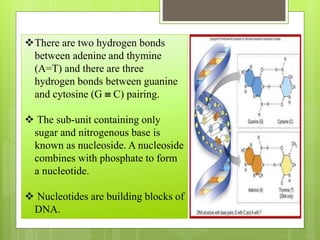
There are two hydrogen bonds
between adenine and thymine
(A=T) and there are three
hydrogen bonds between guanine
and cytosine (G  C) pairing.
 The sub-unit containing only
sugar and nitrogenous base is
known as nucleoside. A nucleoside
combines with phosphate to form
a nucleotide.
 Nucleotides are building blocks of
DNA.
 Erwin Chargaff in 1949 showed that
 (i) The bases pair in specific manner. Adenine always pairs with
thymine and guanine pairs with cytosine.
 (ii) Total amount of purine nucleotides is always equal to the total
amount of pyrimidine nucleotides i.e.[A] + [G] = [T] + [C].
 (iii) The proportion of adenine is equal to thymine and so also of
guanine is equal to cytosine. But the [A] + [T] need not necessarily
be equal to [G] + [C].
 These empirical rules regarding the composition of bases in DNA is
collectively known as Chargaff’s law or Base pair rules.
Double helical DNA - Structure and Definition.

Double helical DNA - Structure and Definition.

  • 1.
  • 2.
    INTRODUCTION :  Chromosomesare the carrier of genetic material. Chromosome contain DNA, RNA, proteins.  DNA is the genetic material in most of the organism and higher organism.  In 1953 , Jameson Watson and Francis Crick proposed double helix DNA model on the basis of X-ray diffraction studies with photographs of DNA taken by Wilkins and Franklin.  It is also known as Watson and Crick model DNA structure.  Watson and Crick shared a noble prize in 1962.
  • 3.
    DNA is adouble stranded structure in which the two strands are coiled around each other forming a double helix. The DNA duplex is “coil of life”. There are two grooves in DNA namely, 1. Major groove, 2. Minor groove. The backbone of the helix is formed of sugar and phosphate molecule. The nitrogenous bases are attached to sugar molecule. The two nucleotide strands are held together by unstable hydrogen bonds.
  • 4.
    DNA DOUBLE HELIXDIMENSION OF DNA
  • 5.
    The two strandrun antiparallely in opposite direction i.e., they run in opposite direction 5’ to 3’ end and 3’ to 5’ end. The strand are interwined in clockwise direction. The width of the DNA molecule is 20 Å. The strand completes a turn every 34 Å along its length. There are ten nucleotide per turn. The internucleotide distance is 3.4 Å. Watson and Crick model of DNA is called B-form DNA. The chain in B-form DNA are in right handed orientation.
  • 6.
    STABILITY OF DOUBLEHELIX STRUCTURE :  Internal and external hydrogen bonds  Negative charge of phosphate groups  Base pair stacking. MAJOR AND MINOR GROOVE :
  • 7.
     Each nucleotideis made up of pentose sugar, a phosphate group and a nitrogenous base. Deoxyribose is the constituent sugar in DNA. The nitrogenous bases are of two kinds,  Purines  Pyrimidines  Adenine and guanine are the purines and thymine and cytosine are pyrimidines. The nitrogenous bases found in DNA are adenine, guanine, cytosine and thymine.
  • 8.
    There are twohydrogen bonds between adenine and thymine (A=T) and there are three hydrogen bonds between guanine and cytosine (G  C) pairing.  The sub-unit containing only sugar and nitrogenous base is known as nucleoside. A nucleoside combines with phosphate to form a nucleotide.  Nucleotides are building blocks of DNA.
  • 9.
     Erwin Chargaffin 1949 showed that  (i) The bases pair in specific manner. Adenine always pairs with thymine and guanine pairs with cytosine.  (ii) Total amount of purine nucleotides is always equal to the total amount of pyrimidine nucleotides i.e.[A] + [G] = [T] + [C].  (iii) The proportion of adenine is equal to thymine and so also of guanine is equal to cytosine. But the [A] + [T] need not necessarily be equal to [G] + [C].  These empirical rules regarding the composition of bases in DNA is collectively known as Chargaff’s law or Base pair rules.