PLASTIC-EATING BACTERIa
Ideonella sakaiensis
Prepared by : Hadiah Al Mahdi
POLYETHYLENE TEREPTHALATE (PET)
• PET is widely used in plastic
bottles like Carbonate drinks,
water bottles, plastic film,
microwavable packaging.
56
6.13
PET was produced worldwide in 2013
Recycling
million tons
Plastic Recycling
• https://www.youtube.com/watch?v=_6xlNyWPpB8
Resin identification code
How to
overcome this
problem?!!
MARCH 2016
Ideonella sakaiensis
• I. sakaiensis was identified in 2016 by a
team of researchers from Kyoto Institute
of Technology and Keio University,
Japan.
• The bacterium was named from
environmental samples taken in
Sakai, Osaka Prefecture, it was given
the name Ideonella sakaiensis, strain
201-F6 .
• It is capable of breaking down PET
plastic which was isolated from outside
a plastic bottle recycling facility.
.
Morphology
1) A Gram-stain-negative 2) Aerobic
3) Non-spore-forming 4) Rod-shaped bacterium
5)Feed on PET and grew within the pH range 7–7.5 and at 30–
37 ºC
SEM image of Ideonella sakaiensis
Discovery
• Researchers collecting a variety of
environmental samples of PET debris.
• They were taken and test tubes
containing a defined culture medium
supplemented with a PET film as the
major carbon source.
• After 6 weeks, sample contained a
distinct microbial which had formed on
the PET film, and the film was showing
clear signs of degradation.
• It is successfully isolated the bacterium
capable of degrading PET.
Genome sequencing of
I.sakaiensis 201-F6
• Researcher did not finished yet the work on the
genome of bacteria so no clear view about it
They Identified 20 open reading frame (ORF)
Protein Sequencing Alignment
ISF6_4831
• It encodes a putative
lipase (PETase) that
shares amino acid
sequence identity
and catalytic
residues with a
hydrolase enzyme
(TfH ) from
thermophilic
actinomycete and
cutinase homolog
from leaf-branch
(Lcc)
Protein Sequencing Alignment
ISF6_0224
• It is protein
sequence encoded
to (MHETase) and
matches to the
tannase family,
which is known to
hydrolyze the
ester linkage of
aromatic
compounds.
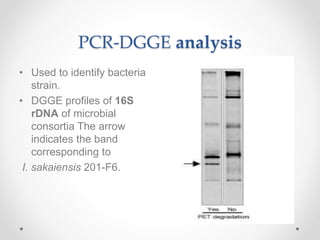
PCR-DGGE analysis
• Used to identify bacteria
strain.
• DGGE profiles of 16S
rDNA of microbial
consortia The arrow
indicates the band
corresponding to
I. sakaiensis 201-F6.
RNA-Seq transcript levels of ISF6_4831 and ISF6_0224 on
four different carbon sources
• I. sakaiensis was grown in
medium containing
maltose, TPA-Na, PET film,
or BHET), and the mRNAs
from exponentially growing
cells were subjected to
RNA-Seq analysis.
Mechanisms of hydrolysis
• Terephthalic acid,
used principally as a
precursor to
the polyester PET
used to make
clothing and plastic
bottles..
Future Recommendation
• Improve the bacterium to make it more powerful, and
genetic engineering might be applicable.
• One way of speeding things up would be to transfer the
genes that make the two enzymes into a faster growing
bacterium like Escherichia coli
Inquires..!!
• Is there any possibility for the bacteria to be more
abundant in any other regions in the world??
• Can there be any additional applications to maximize the
benefits of such ability??
• Is it possible to identify similar strains which similar
abilities??
Conclusion
• PET is used in plastic products, and its accumulation in the
environment has become a global concern.
• (PETase and MHETase) are required to enzymatically convert
PET efficiently into its two environmentally benign
monomers,terephthalic acid and ethylene glycol.
• PET degradation using microorganisms and enzymes
consumes less energy and is a more environmentally friendly
option.
• Researches achieving an ideal model for PET recycling, so
long as we are able to enhance the activity level and stability
of these newly discovered microbial enzymes.
Thank You

PET

  • 1.
  • 2.
    POLYETHYLENE TEREPTHALATE (PET) •PET is widely used in plastic bottles like Carbonate drinks, water bottles, plastic film, microwavable packaging. 56 6.13 PET was produced worldwide in 2013 Recycling million tons
  • 3.
  • 4.
  • 5.
  • 6.
  • 7.
    Ideonella sakaiensis • I.sakaiensis was identified in 2016 by a team of researchers from Kyoto Institute of Technology and Keio University, Japan. • The bacterium was named from environmental samples taken in Sakai, Osaka Prefecture, it was given the name Ideonella sakaiensis, strain 201-F6 . • It is capable of breaking down PET plastic which was isolated from outside a plastic bottle recycling facility. .
  • 8.
    Morphology 1) A Gram-stain-negative2) Aerobic 3) Non-spore-forming 4) Rod-shaped bacterium 5)Feed on PET and grew within the pH range 7–7.5 and at 30– 37 ºC SEM image of Ideonella sakaiensis
  • 9.
    Discovery • Researchers collectinga variety of environmental samples of PET debris. • They were taken and test tubes containing a defined culture medium supplemented with a PET film as the major carbon source. • After 6 weeks, sample contained a distinct microbial which had formed on the PET film, and the film was showing clear signs of degradation. • It is successfully isolated the bacterium capable of degrading PET.
  • 10.
  • 11.
    • Researcher didnot finished yet the work on the genome of bacteria so no clear view about it
  • 12.
    They Identified 20open reading frame (ORF)
  • 13.
    Protein Sequencing Alignment ISF6_4831 •It encodes a putative lipase (PETase) that shares amino acid sequence identity and catalytic residues with a hydrolase enzyme (TfH ) from thermophilic actinomycete and cutinase homolog from leaf-branch (Lcc)
  • 14.
    Protein Sequencing Alignment ISF6_0224 •It is protein sequence encoded to (MHETase) and matches to the tannase family, which is known to hydrolyze the ester linkage of aromatic compounds.
  • 15.
    PCR-DGGE analysis • Usedto identify bacteria strain. • DGGE profiles of 16S rDNA of microbial consortia The arrow indicates the band corresponding to I. sakaiensis 201-F6.
  • 16.
    RNA-Seq transcript levelsof ISF6_4831 and ISF6_0224 on four different carbon sources • I. sakaiensis was grown in medium containing maltose, TPA-Na, PET film, or BHET), and the mRNAs from exponentially growing cells were subjected to RNA-Seq analysis.
  • 17.
    Mechanisms of hydrolysis •Terephthalic acid, used principally as a precursor to the polyester PET used to make clothing and plastic bottles..
  • 18.
    Future Recommendation • Improvethe bacterium to make it more powerful, and genetic engineering might be applicable. • One way of speeding things up would be to transfer the genes that make the two enzymes into a faster growing bacterium like Escherichia coli
  • 19.
    Inquires..!! • Is thereany possibility for the bacteria to be more abundant in any other regions in the world?? • Can there be any additional applications to maximize the benefits of such ability?? • Is it possible to identify similar strains which similar abilities??
  • 20.
    Conclusion • PET isused in plastic products, and its accumulation in the environment has become a global concern. • (PETase and MHETase) are required to enzymatically convert PET efficiently into its two environmentally benign monomers,terephthalic acid and ethylene glycol. • PET degradation using microorganisms and enzymes consumes less energy and is a more environmentally friendly option. • Researches achieving an ideal model for PET recycling, so long as we are able to enhance the activity level and stability of these newly discovered microbial enzymes.
  • 21.

Editor's Notes

  • #3 PET is made from petroleum and is widely used in plastic bottles like Carbonate drinks, water bottles, peanut butter jars, plastic film, microwavable packaging. The amount recycled accounts for just 37% of the total production volume of PET bottles (6.13 million tons) About 56 million tons of PET was produced worldwide in 2013 alone 15.4 million tons were for food and liquid containers, 3.2 million tons for packaging films, and 38 million tons for synthetic fibers. Currently the main method employed for recycling PET waste uses chemical techniques, but these processes come with many problems, such as the vast amount of energy consumed.
  • #10 Researchers collecting a variety of environmental samples of PET debris in a search for bacteria which relied on the plastic for carbon growth. They were taken and test tubes containing a defined culture medium supplemented with a PET film as the major carbon source. The bacterium was observed to utilize two distinct enzymes that reacted with water to break down plastics After 6 weeks, one sediment sample contained a distinct microbial consortiumwhich had formed on the PET film, and the film was showing clear signs of degradation. From the microbial consortium, we then successfully isolated the bacterium capable of degrading PET. The bacterium was observed to utilize two distinct enzymes that reacted with water to break down plastics
  • #11  It has the ability to break down the PET polymer by 2 enzymes (PETase and MHETase
  • #14 Protein is responsible for hydrolyzes PET,that yield MHET
  • #15 Hydroxyethyl terephthalic acid (MHET) Protein is responsible for the conversion of MHET to TPA and EG in I. sakaiensis
  • #16 (left, a consortium with PET degradation activity; right, a consortium without PET degradation activity) were compared.
  • #21 Compared with chemical processes,