


Designing Learning in the
              Digital Age
             Global meta-trends impacting
                       education and training
                           Allison Miller and Michael Coghlan

                                        #DLDA
designinglearning.com.au
Allison Miller                           Michael Coghlan
Vanguard Visions Consulting                 E-learning Consultant


                        designinglearning.com.au
Share what you … know or find
• Go to tinyurl.com/9e4a5nk
• Add info, links, slides etc
• Review what others have contributed
Session Overview
• What are the global meta-trends impacting
  education?
• Anywhere, Anytime, Anyhow Education
• Learners as Pro-sumers
• Educators are ‘content purveyors’ and
  ‘learning process relayers’
• Educators as ‘lead learners’
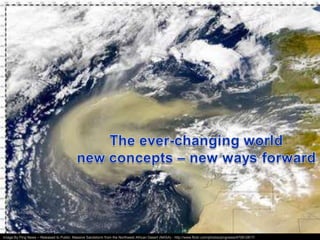
Image By Ping News – Released to Public: Massive Sandstorm from the Northwest African Desert (NASA) - http://www.flickr.com/photos/pingnews/470812817/
What are the global
meta-trends impacting
     education?
Global Meta-trends impacting Education
1.  World of work is increasingly global and collaborative
2.  Whenever, wherever learning - Multi-deviced
3.  Internet becoming a global mobile network
4.  Cloud-based, networked, video & rich media
5.  Openness - open content, data, resources -
    transparency
6. Ownership and privacy
7. Access to learning in increasing
8. Internet is challenging us to rethink learning and
    education, and our notion of literacy
9. Rise in (the recognition of) informal learning
10. Educational business models are changing
 Source: NMC Communiqué (January, 2012)
 nmc.org/pdf/2012-Horizon-Project-Retreat-Communique.pdf
Key Trends influencing (Higher) Education
1. Abundance of info challenging our roles as educators
2. More validation of lifelong learning
3. Formal/informal learning needed to face competitive
    workforce
4. Education entrepreneurship is booming
5. Shifting educational paradigms - online, hybrid and
    collaborative learning
6. Students using their own technology for learning
7. Massively open online courses (MOOCs) are proliferating
8. Open content, educational resources, and open access
9. Social media = connected /collaborative
10. Data for personalizing learning and measurement
 Source: NMC Horizon Project Short List: 2013 Higher Education Edition (December, 2012)
 nmc.org/pdf/2013-horizon-higher-ed-shortlist.pdf
Anywhere, Anytime,
 Anyhow Education
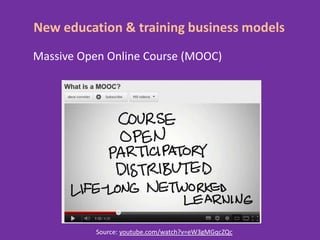
New education & training business models
Massive Open Online Course (MOOC)


           Source: youtube.com/watch?v=eW3gMGqcZQc
New education & training business models
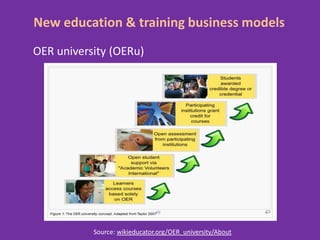
OER university (OERu)


           Source: wikieducator.org/OER_university/About
New education & training business models
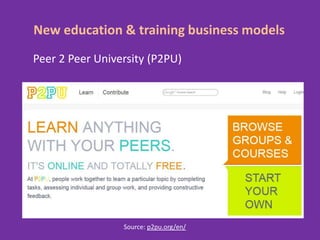
Peer 2 Peer University (P2PU)


                 Source: p2pu.org/en/
Learners as Pro-sumers


 Consumer and producer of knowledge
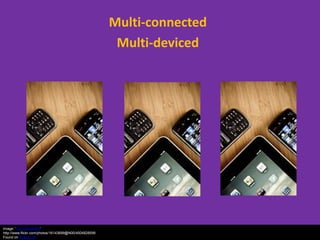
Multi-connected
                                                        Multi-deviced


Image: 'Too Connected'
http://www.flickr.com/photos/16143699@N00/4504828599
Found on flickrcc.net
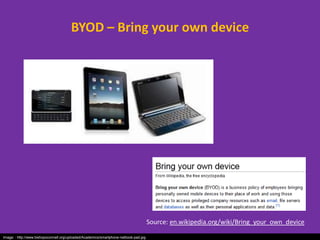
BYOD – Bring your own device


                                                                                       Source: en.wikipedia.org/wiki/Bring_your_own_device

Image: : http://www.bishopoconnell.org/uploaded/Academics/smartphone-netbook-pad.jpg
BYOD


           Chatswood Public School –
           BYOD Policy
                  bit.ly/ChatswoodPS-BYODPolicy


What are the key drivers?
  • widespread ownership of digital mobile
     devices
  • support active learning pedagogy
  • enhance and engage students
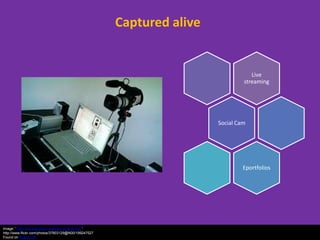
Captured alive


                                                                                   Live
                                                                                streaming


                                                                       Social Cam


                                                                                Eportfolios


Image: 'The most expensive webcam of all times?'
http://www.flickr.com/photos/37803129@N00/199247527
Found on flickrcc.net
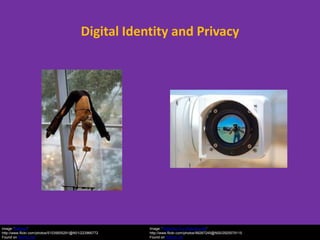
Digital Identity and Privacy


Image: 'Balance'                                         Image: 'Watching You Watching Me'
http://www.flickr.com/photos/51035655291@N01/223966772   http://www.flickr.com/photos/99287245@N00/2925579115
Found on flickrcc.net                                    Found on flickrcc.net
Open (digital) Badges


            Source: openbadges.org/en-US/about.html
Educators as ‘content
   purveyors’ and ‘learning
      process relayers’


Source:
Lindsay & Davis (2013). Flattening Classrooms, Engaging Minds
Learning Analytics


                                                                                   Source: en.wikipedia.org/wiki/Learning_analytics
                                                                                 Image: 'All of us on 1 graph'
                                                                                 http://www.flickr.com/photos/38869431@N00/5548276728
Image: http://www.elearnspace.org/blog/2010/08/25/what-are-learning-analytics/   Found on flickrcc.net
Being a digital curator

    Pinterest
  Addictomatic
   Pinboard.in
     Scoop.it
     Paper.ly
       RSS
 Diigo/Delicious
     iGoogle
 Tags/Tag clouds
The Conversation
     Others?
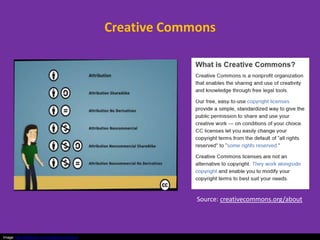
Creative Commons


                                                              Source: creativecommons.org/about


Image: http://lifehacker.com/creative-commons/
Digital Sovereignty


                                                                                                      Digitally plundering other
                                                                                                      nations’ knowledge?

                                                                                                      If our information is in the
                                                                                                      Cloud, what laws impact it?


Image: 'First Invasion of The Americas by Christopher Columbus, after Dioscoro Teofilo de la Puebla Tolin'
http://www.flickr.com/photos/9106303@N05/4003383301
Found on flickrcc.net
Educators as ‘lead
                   learners’


Source:
Steve Hargadon – Educator 2.0 – educator20.com
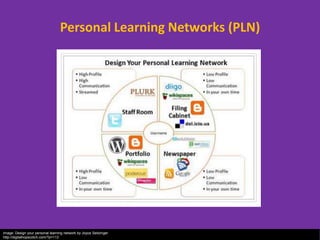
Personal Learning Networks (PLN)


Image: Design your personal learning network by Joyce Seitzinger
http://digitalhopscotch.com/?p=113
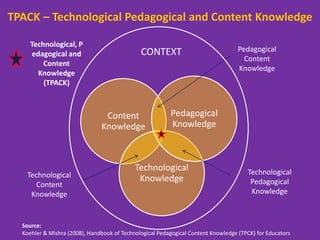
TPACK – Technological Pedagogical and Content Knowledge

     Technological, P
                                              CONTEXT                              Pedagogical
     edagogical and
                                                                                     Content
         Content
                                                                                   Knowledge
       Knowledge
         (TPACK)


                                Content                   Pedagogical
                               Knowledge                  Knowledge


                                            Technological                             Technological
   Technological                             Knowledge
      Content                                                                          Pedagogical
    Knowledge                                                                          Knowledge


  Source:
  Koehler & Mishra (2008), Handbook of Technological Pedagogical Content Knowledge (TPCK) for Educators
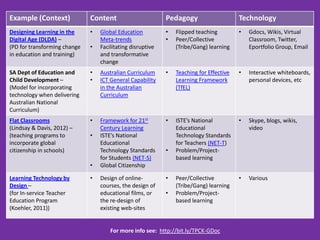
Example (Context)             Content                       Pedagogy                     Technology
Designing Learning in the     •   Global Education          •   Flipped teaching         •   Gdocs, Wikis, Virtual
Digital Age (DLDA) –              Meta-trends               •   Peer/Collective              Classroom, Twitter,
(PD for transforming change   •   Facilitating disruptive       (Tribe/Gang) learning        Eportfolio Group, Email
in education and training)        and transformative
                                  change
SA Dept of Education and      •   Australian Curriculum     •   Teaching for Effective   •   Interactive whiteboards,
Child Development –           •   ICT General Capability        Learning Framework           personal devices, etc
(Model for incorporating          in the Australian             (TfEL)
technology when delivering        Curriculum
Australian National
Curriculum)
Flat Classrooms               •   Framework for 21st        •   ISTE’s National          •   Skype, blogs, wikis,
(Lindsay & Davis, 2012) –         Century Learning              Educational                  video
(teaching programs to         •   ISTE’s National               Technology Standards
incorporate global                Educational                   for Teachers (NET-T)
citizenship in schools)           Technology Standards      •   Problem/Project-
                                  for Students (NET-S)          based learning
                              •   Global Citizenship

Learning Technology by        •   Design of online-         •   Peer/Collective          •   Various
Design –                          courses, the design of        (Tribe/Gang) learning
(for In-service Teacher           educational films, or     •   Problem/Project-
Education Program                 the re-design of              based learning
(Koehler, 2011))                  existing web-sites


                                      For more info see: http://bit.ly/TPCK-GDoc
Integrating technology is more
 about challenging our current
 beliefs about pedagogy than
     using the technology

                                                             Bartolowits (ND)
  http://edtech2.boisestate.edu/bartolowitsr/portfolio/504-synthesis-final.pdf
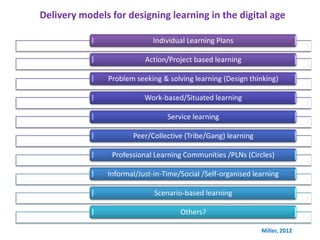
Delivery models for designing learning in the digital age

                             Individual Learning Plans

                          Action/Project based learning

               Problem seeking & solving learning (Design thinking)

                          Work-based/Situated learning

                                 Service learning

                      Peer/Collective (Tribe/Gang) learning

                Professional Learning Communities /PLNs (Circles)

               Informal/Just-in-Time/Social /Self-organised learning

                             Scenario-based learning

                                     Others?

                                                              Miller, 2012
What to know more?
Designing Learning in the Digital Age

   Workshop & Webinar Program

    Starts Melbourne – 13 March 2013


    designinglearning.com.au
Follow Designing Learning:

                    Facebook:
           facebook.com/designinglearning
                     Google+:
         bit.ly/Googleplus-designinglearning
                     LinkedIn:
           bit.ly/LinkedIn-designinglearning
                     Pinterest:
   pinterest.com/vanguardvisions/designing-learning
                      Twitter:
             twitter.com/DesignnLearning


    designinglearning.com.au
Allison Miller
                                       Michael Coghlan
          0400 732 270
                                   michaelc@chariot.net.au
 allison@vanguardvisions.com.au
                                     michaelcoghlan.net
vanguardvisionsconsulting.com.au

DLDA Global Meta-trends Impacting Education & Training -130213

  • 1.
    Designing Learning inthe Digital Age Global meta-trends impacting education and training Allison Miller and Michael Coghlan #DLDA designinglearning.com.au
  • 2.
    Allison Miller Michael Coghlan Vanguard Visions Consulting E-learning Consultant designinglearning.com.au
  • 3.
    Share what you… know or find • Go to tinyurl.com/9e4a5nk • Add info, links, slides etc • Review what others have contributed
  • 4.
    Session Overview • Whatare the global meta-trends impacting education? • Anywhere, Anytime, Anyhow Education • Learners as Pro-sumers • Educators are ‘content purveyors’ and ‘learning process relayers’ • Educators as ‘lead learners’
  • 5.
    Image By PingNews – Released to Public: Massive Sandstorm from the Northwest African Desert (NASA) - http://www.flickr.com/photos/pingnews/470812817/
  • 6.
    What are theglobal meta-trends impacting education?
  • 7.
    Global Meta-trends impactingEducation 1. World of work is increasingly global and collaborative 2. Whenever, wherever learning - Multi-deviced 3. Internet becoming a global mobile network 4. Cloud-based, networked, video & rich media 5. Openness - open content, data, resources - transparency 6. Ownership and privacy 7. Access to learning in increasing 8. Internet is challenging us to rethink learning and education, and our notion of literacy 9. Rise in (the recognition of) informal learning 10. Educational business models are changing Source: NMC Communiqué (January, 2012) nmc.org/pdf/2012-Horizon-Project-Retreat-Communique.pdf
  • 8.
    Key Trends influencing(Higher) Education 1. Abundance of info challenging our roles as educators 2. More validation of lifelong learning 3. Formal/informal learning needed to face competitive workforce 4. Education entrepreneurship is booming 5. Shifting educational paradigms - online, hybrid and collaborative learning 6. Students using their own technology for learning 7. Massively open online courses (MOOCs) are proliferating 8. Open content, educational resources, and open access 9. Social media = connected /collaborative 10. Data for personalizing learning and measurement Source: NMC Horizon Project Short List: 2013 Higher Education Edition (December, 2012) nmc.org/pdf/2013-horizon-higher-ed-shortlist.pdf
  • 9.
  • 10.
    New education &training business models Massive Open Online Course (MOOC) Source: youtube.com/watch?v=eW3gMGqcZQc
  • 11.
    New education &training business models OER university (OERu) Source: wikieducator.org/OER_university/About
  • 12.
    New education &training business models Peer 2 Peer University (P2PU) Source: p2pu.org/en/
  • 13.
    Learners as Pro-sumers Consumer and producer of knowledge
  • 14.
    Multi-connected Multi-deviced Image: 'Too Connected' http://www.flickr.com/photos/16143699@N00/4504828599 Found on flickrcc.net
  • 15.
    BYOD – Bringyour own device Source: en.wikipedia.org/wiki/Bring_your_own_device Image: : http://www.bishopoconnell.org/uploaded/Academics/smartphone-netbook-pad.jpg
  • 16.
    BYOD Chatswood Public School – BYOD Policy bit.ly/ChatswoodPS-BYODPolicy What are the key drivers? • widespread ownership of digital mobile devices • support active learning pedagogy • enhance and engage students
  • 17.
    Captured alive Live streaming Social Cam Eportfolios Image: 'The most expensive webcam of all times?' http://www.flickr.com/photos/37803129@N00/199247527 Found on flickrcc.net
  • 18.
    Digital Identity andPrivacy Image: 'Balance' Image: 'Watching You Watching Me' http://www.flickr.com/photos/51035655291@N01/223966772 http://www.flickr.com/photos/99287245@N00/2925579115 Found on flickrcc.net Found on flickrcc.net
  • 19.
    Open (digital) Badges Source: openbadges.org/en-US/about.html
  • 20.
    Educators as ‘content purveyors’ and ‘learning process relayers’ Source: Lindsay & Davis (2013). Flattening Classrooms, Engaging Minds
  • 21.
    Learning Analytics Source: en.wikipedia.org/wiki/Learning_analytics Image: 'All of us on 1 graph' http://www.flickr.com/photos/38869431@N00/5548276728 Image: http://www.elearnspace.org/blog/2010/08/25/what-are-learning-analytics/ Found on flickrcc.net
  • 22.
    Being a digitalcurator Pinterest Addictomatic Pinboard.in Scoop.it Paper.ly RSS Diigo/Delicious iGoogle Tags/Tag clouds The Conversation Others?
  • 23.
    Creative Commons Source: creativecommons.org/about Image: http://lifehacker.com/creative-commons/
  • 24.
    Digital Sovereignty Digitally plundering other nations’ knowledge? If our information is in the Cloud, what laws impact it? Image: 'First Invasion of The Americas by Christopher Columbus, after Dioscoro Teofilo de la Puebla Tolin' http://www.flickr.com/photos/9106303@N05/4003383301 Found on flickrcc.net
  • 25.
    Educators as ‘lead learners’ Source: Steve Hargadon – Educator 2.0 – educator20.com
  • 26.
    Personal Learning Networks(PLN) Image: Design your personal learning network by Joyce Seitzinger http://digitalhopscotch.com/?p=113
  • 27.
    TPACK – TechnologicalPedagogical and Content Knowledge Technological, P CONTEXT Pedagogical edagogical and Content Content Knowledge Knowledge (TPACK) Content Pedagogical Knowledge Knowledge Technological Technological Technological Knowledge Content Pedagogical Knowledge Knowledge Source: Koehler & Mishra (2008), Handbook of Technological Pedagogical Content Knowledge (TPCK) for Educators
  • 28.
    Example (Context) Content Pedagogy Technology Designing Learning in the • Global Education • Flipped teaching • Gdocs, Wikis, Virtual Digital Age (DLDA) – Meta-trends • Peer/Collective Classroom, Twitter, (PD for transforming change • Facilitating disruptive (Tribe/Gang) learning Eportfolio Group, Email in education and training) and transformative change SA Dept of Education and • Australian Curriculum • Teaching for Effective • Interactive whiteboards, Child Development – • ICT General Capability Learning Framework personal devices, etc (Model for incorporating in the Australian (TfEL) technology when delivering Curriculum Australian National Curriculum) Flat Classrooms • Framework for 21st • ISTE’s National • Skype, blogs, wikis, (Lindsay & Davis, 2012) – Century Learning Educational video (teaching programs to • ISTE’s National Technology Standards incorporate global Educational for Teachers (NET-T) citizenship in schools) Technology Standards • Problem/Project- for Students (NET-S) based learning • Global Citizenship Learning Technology by • Design of online- • Peer/Collective • Various Design – courses, the design of (Tribe/Gang) learning (for In-service Teacher educational films, or • Problem/Project- Education Program the re-design of based learning (Koehler, 2011)) existing web-sites For more info see: http://bit.ly/TPCK-GDoc
  • 29.
    Integrating technology ismore about challenging our current beliefs about pedagogy than using the technology Bartolowits (ND) http://edtech2.boisestate.edu/bartolowitsr/portfolio/504-synthesis-final.pdf
  • 30.
    Delivery models fordesigning learning in the digital age Individual Learning Plans Action/Project based learning Problem seeking & solving learning (Design thinking) Work-based/Situated learning Service learning Peer/Collective (Tribe/Gang) learning Professional Learning Communities /PLNs (Circles) Informal/Just-in-Time/Social /Self-organised learning Scenario-based learning Others? Miller, 2012
  • 31.
  • 32.
    Designing Learning inthe Digital Age Workshop & Webinar Program Starts Melbourne – 13 March 2013 designinglearning.com.au
  • 33.
    Follow Designing Learning: Facebook: facebook.com/designinglearning Google+: bit.ly/Googleplus-designinglearning LinkedIn: bit.ly/LinkedIn-designinglearning Pinterest: pinterest.com/vanguardvisions/designing-learning Twitter: twitter.com/DesignnLearning designinglearning.com.au
  • 34.
    Allison Miller Michael Coghlan 0400 732 270 michaelc@chariot.net.au allison@vanguardvisions.com.au michaelcoghlan.net vanguardvisionsconsulting.com.au

Editor's Notes

  • #2 Welcome to this session If you are going to be tweeting about this session please use the #DLDA hashtag
  • #3 Introduce Allison & Michael
  • #4 http://tinyurl.com/9e4a5nk A Google Doc where you can share information you have about these topics – based on January 2012 Meta-trends
  • #7 What are the global and key trends impacting education
  • #9 Key Trends in (higher) Education – though similar trends are emerging in other education & training sectors tooThe abundance of resources and relationships made easily accessible via the Internet is increasingly challenging us to revisit our roles as educators.Assessment and accreditation are changing to validate life-long learningBoth formal and informal learning experiences are becoming increasingly important as college graduates continue to face a highly competitive workforce.Education entrepreneurship is booming – students solving problems and creating new ideas/productsEducation paradigms are shifting to include online learning, hybrid learning, and collaborative models.Increasingly, students want to use their own technology for learning.Massively open online courses are proliferating.Open is a key trend in future education and publication, specifically in terms of open content, open educational resources, massively open online courses, and open access.Social media is changing the way people interact, present ideas and information, and judge the quality of content and contributions.There is an increasing interest in using data for personalizing the learning experience and for performance measures.NMC Horizon Project Short List2013 Higher Education Edition
  • #21 GlobalisationPortfolio CareersInnovation, initiative, leadership
  • #23 Are there any others – please share in the text chat
  • #28 Technological Pedagogical Content KnowledgeEffective teaching with technologyNo single technological solutionNeed to understand which technology supports which pedagogical approach for your disciplineEg: Online learning requires TPCK:How to present information onlineHow to connect subject matter and studentsHow to connect students to students
  • #29 For more info see: http://bit.ly/TPCK-GDoc
  • #33 Originally based on the ten global meta-trends identified by the New Media Consortium, 2013 “Designing Learning in the Digital” participants will help identify the trends impacting education and training in Australia and its neighbouring region.Modelling a ‘flipped classroom’ approach, participants will be required to undertake some of their professional development prior to attending the workshop through videos, readings and forums. This will allow participants to use their time together to collectively design and develop disruptive and transformative learning experiences.  Three webinars following the workshop will enable participants to consolidate and extend what their face to face learning.Using creative and design thinking, participants will feel empowered to pitch and establish these new ideas within their own environments.  To enable an effective workshop environment, places are limited to 50 people.