
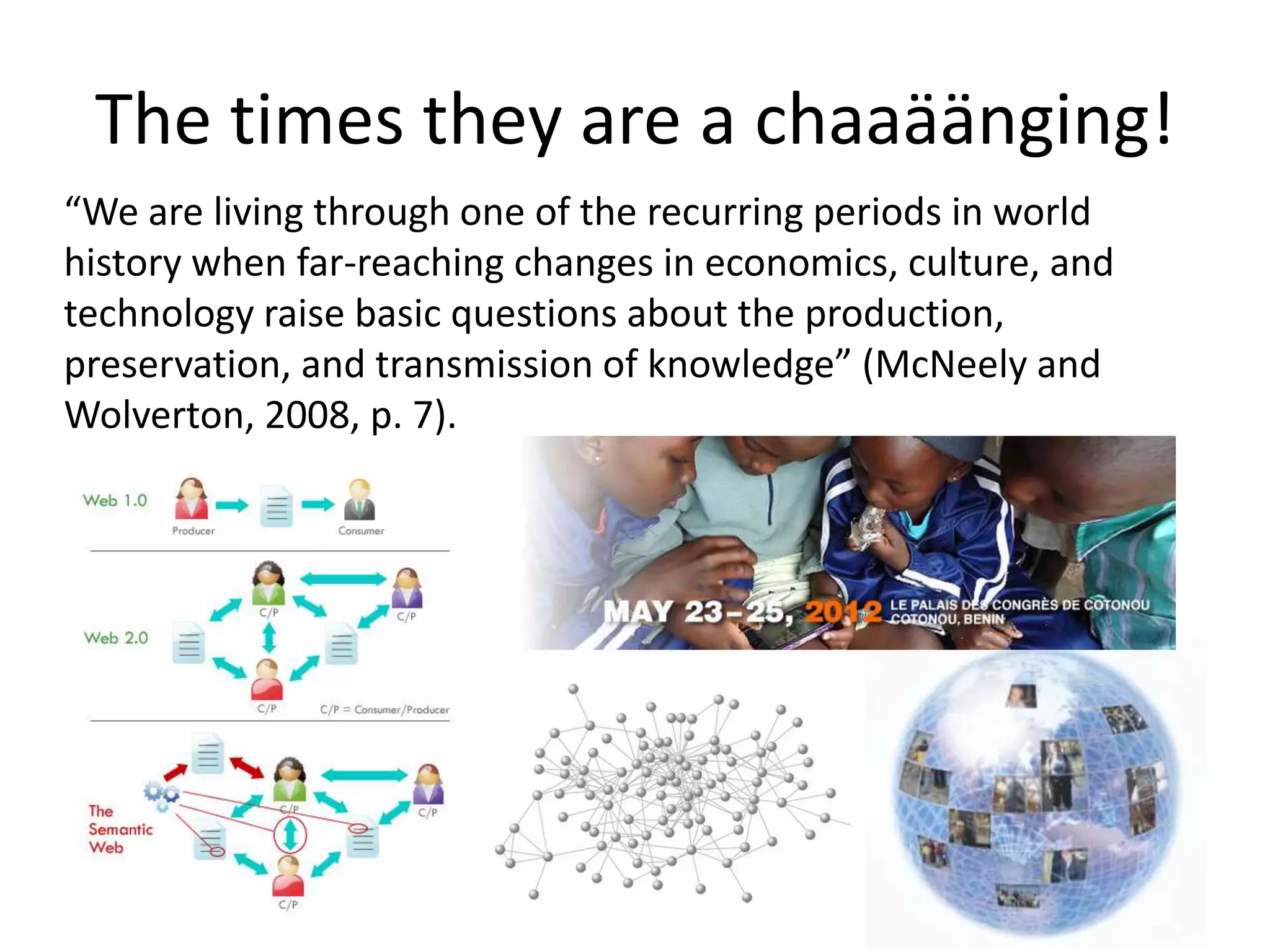
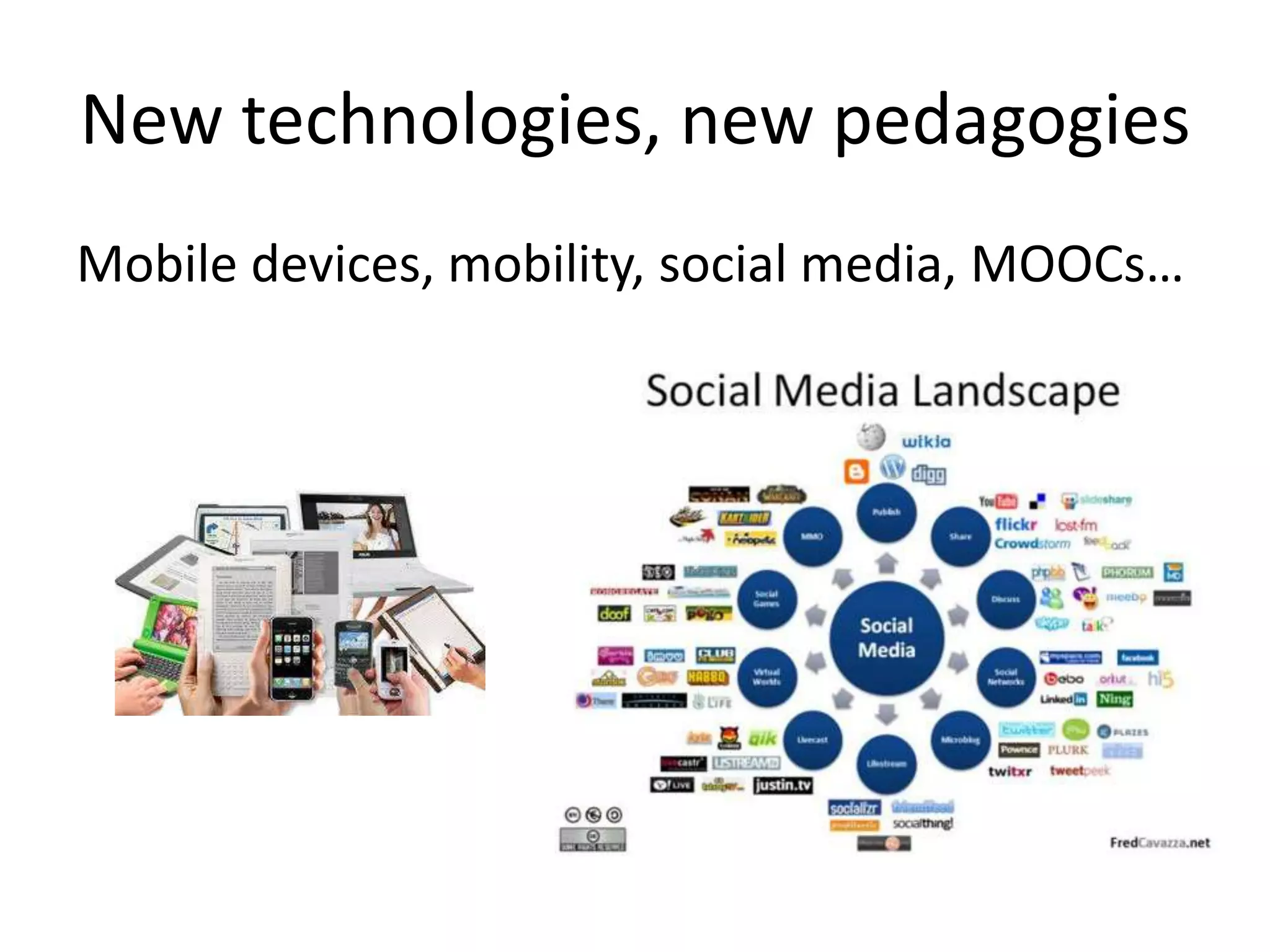
Looking at Ubiquitous MOOC
    Learner Interactions
      Inge Ignatia de Waard
Setting the stage: remember…
Background: MobiMOOC = MOOC lab


• Different facilitator approaches (passive, active,
  participatory…)
• Different course architecture (linear, branching…)
• Different learning/teaching dynamics (behaviorist => social-
  constructivist/connectivist)
• Different durations
About MobiMOOC
A Massive Open Online Course (MOOC) on mobile
learning (mLearning) => MobiMOOC
1250 learners, 17 facilitators, 9 weeks, 14 mLearning
topics:
2 core course spaces:
   Course wiki (http://mobimooc.wikispaces.com/)
   Course discussion group
    https://groups.google.com/group/mobimooc2012


•   MobiMOOC 2011, first run: April-May 2011
•   MobiMOOC 2012, September 2012
MOOCs: Appropriateness & Affinity
    90%       Of active participants said the MOOC format was
              appropriate for their learning communities

  42.5%     Of active participants connected with other participants to
            collaborate on projects after MobiMOOC

MOOCs: ubiquity through mobile
   77.5%      Accessed MobiMOOC via mobile


    61.3%      Location independence


      56.8%      Temporal independence
MOOC history

         MOOC
         history

               3
           2
                   1


MOOC                    Natural
                       learning
design                   realm
Contemporary MOOCs: 2 main types
cMOOC                                        xMOOC
First MOOC format to be developed            MOOC format on the rise at Universities
More connectivist learning oriented:         More behaviorist learning oriented:
George Siemens                               Burrhus Frederic Skinner
Based on dialogue                            Based on student/content
More informal (participant input &           More formal (behaviorist approach: easier
content production), open badges             for assessment and accreditation)
Network building, trust in collaboration,.   Less networking, trust in content and
                                             institution
Ad Hoc learner space: Learning Quilt         Fixed LMS: Coursera, Udacity…
Social media rich                            Social media used
Expert learning, Community of                Personal accreditation, lifelong learning
Practitioners (CoP), lifelong learning for   basics, personal knowledge increase,
high knowledge workers                       starting from basic information.
Room for emergence                           More stick to the plan
                            High drop out, free in most cases

                    What do you need?                     iMOOC?
cMOOC


The connectivist MOOC and the format which lead
to the name of Massive, Open, Online Course.
History
2007 – the Wiley wiki               2007: Alec Couros
                                    Social Media and Open Education
An Open Course based in a wiki
                                    An Open Course based in a wiki
Participants from around the
world contributed to the creation   Participants from around the
of the course                       world contributed to the creation
                                    of the course
Downes & Siemens, CCK08
Connectivism as core theory
           Principles of connectivism:
           • Learning and knowledge rests in diversity
              of opinions.
           • Learning is a process of connecting
              information sources.
           • Learning may reside in non-human
              appliances.
           • Capacity to know more is more critical
              than what is currently known
           • Nurturing and maintaining connections is
              needed to facilitate continual learning.
           • Ability to see connections between fields,
              ideas, and concepts is a core skill.
           • Decision-making is itself a learning
              process.

           George Siemens (2005 – Connectivism - a
           learning theory for the digital age)
xMOOC


Started with the Artificial Intelligence course of
Stanford: lots of student interest, as well as non-
Stanford students => high enrollment
www.EdX.org


•   Came from MitX, open courseware
•   Now: open, online courses for free
•   Not-for Profit foundation.
•   Goal: social agents and automated assessment editors to cater massive
    amounts of students
www.Udacity.com
www.Coursera.org


Gaining momentum as more Universities and colleges
enter. But all of xMOOC more student-content centered.
Focus of this presentation: cMOOC


•   Expert learning: people joining have their own interest
•   International openness, language sensitive and tolerant
•   Socio-constructivist
•   Connectivist: professional learning networks / community
•   Corporate CoP oriented
Natural learning environment:

              MOOC
              history

                    3
                2
                        1


     MOOC                    Natural
                            learning
     design                   realm
Dialogue and networking
Around the campfire –      One person is not enough, the team
dialogues and narratives      = network makes the genius
                                        = strength


                              By following discussions, key
                                thinkers become visible
Biggest shift => human teaching factor


Challenges for
• Overall coordinators
• Helpdesk and architecture
• Topic specific facilitators / guides-on-the-side
• Learners
                 => More interactions, more emergence!
Digital literacy is essential for all

                         Raising digital literacy
                         with emerging tools
                         increases the learners
                         capacity to function in
                         todays connected world


Most people use it, but … does it work for learning?
The coordinator & facilitators keep
    everyone extra motivated

   • Everyone knows her/his role and the challenges
     of a MOOC (chaos, overload)
   • Facilitators are guides-on-the-side
   • Round up mails are provided per week
   • Keeping people motivated by connecting and
     keeping informed and course oriented
   • Provide guidance for self-regulated learning
   • Get in touch with potential drop-outs

                     => interactions are stimulated
Overall coordinator actions


Building trust and communicate important actions:
• Mail/tweet/G+/Facebook overview
• Mail/tweet/G+/Facebook upcoming seminars
• Mail/tweet/G+/Facebook important discussions
It is all about connecting
about learner interactions
MOOC Design

         MOOC
         history

               3
           2
                   1


MOOC                    Natural
                       learning
design                   realm
MOOC Design

             Syllabus
   Core
discussion   Course
             anchor


 Social
 media       Ubiquity
 tools
The core of the course
            Course outline and expectations


            Central discussion starting and
                            meeting point
Select relevant tools with the right educational benefits and extra’s.
Mobile enabled social media     Why use it                           Knowledge Age Challenge
tool                                                                  Addressed
Blogs                            To reflect on what is learned, or    Self-regulated learning.
                                 what the learner thinks is of        Lifelong Learning.
(Examples: wordpress, blogger,   importance.                          Becoming active, critical content
posterous)                       Keeping a learning archive.          producer.
                                 Reflecting on the learning itself.   .
                                 Commenting on content.
Discussion enabler: Listserv     This type of online tool uses e-     Enabling dialogue.
                                 mail to keep everyone informed.      Collaboration.
(Examples: google groups,        With many of the listserve’s you     Self-regulated learning.
yahoo groups)                    can choose how you want your         Informal learning.
                                 mails to be delivered (e-mail
                                 digest: e.g. immediate, once a
                                 day, once a week), which adds
                                 to self-regulated learning.
                                 Generating and maintaining
                                 discussions.
                                 Getting a group feeling going via
                                 dialogue.
Social Networking                Building a network of people that    Enables networking.
                                 can add to the knowledge             Collaboration.
(examples: Facebook, Google+,    creation of the learner.             Enabling dialogue.
LinkedIn)                                                             Informal learning.
                                                                      Becoming active, critical content
                                                                      producer.


             Link to Google document with more social media tools
Ensure Ubiquity: access with BYOD
The research: learner interactions in a
      ubiquitous MOOC course


“how does mobile accessibility impact the social
learner interactions of adult learners in an
informal, open, online course?”
Personal research interest: 2 areas


Mobile learning & Massive Open Online Courses
                            (connectivist type)
A new research frontier!
            Where mLearning is
            traditionally seen as
            independent of
            time/location,
            contextualized and
            personal… the same can be
            said of MOOCs.

            Recent research hints on
            several similarities: the
            community that is built, the
            impact of social media and
            the surplus for informal and
            continuous learning...
Where can I find my research hook?
  mLearning literature => challenges
• Frohberg et al. (2009) screened 1469 publications and
  categorized 102 mobile projects => “communication
  and collaboration play a surprisingly small role in
  Mobile Learning projects” (p. 1)
• Researchers did/do mention social interactions: e.g.
  Looi et al. (2010) and Kukulska-Hulme (2009)
  mentioned the importance of moving the focus away
  from the mobile technology and towards the social
  practice it enables.
• There is also a proposal to extend the social spaces in
  which learners interact with each other, embracing
  both formal and informal learning.
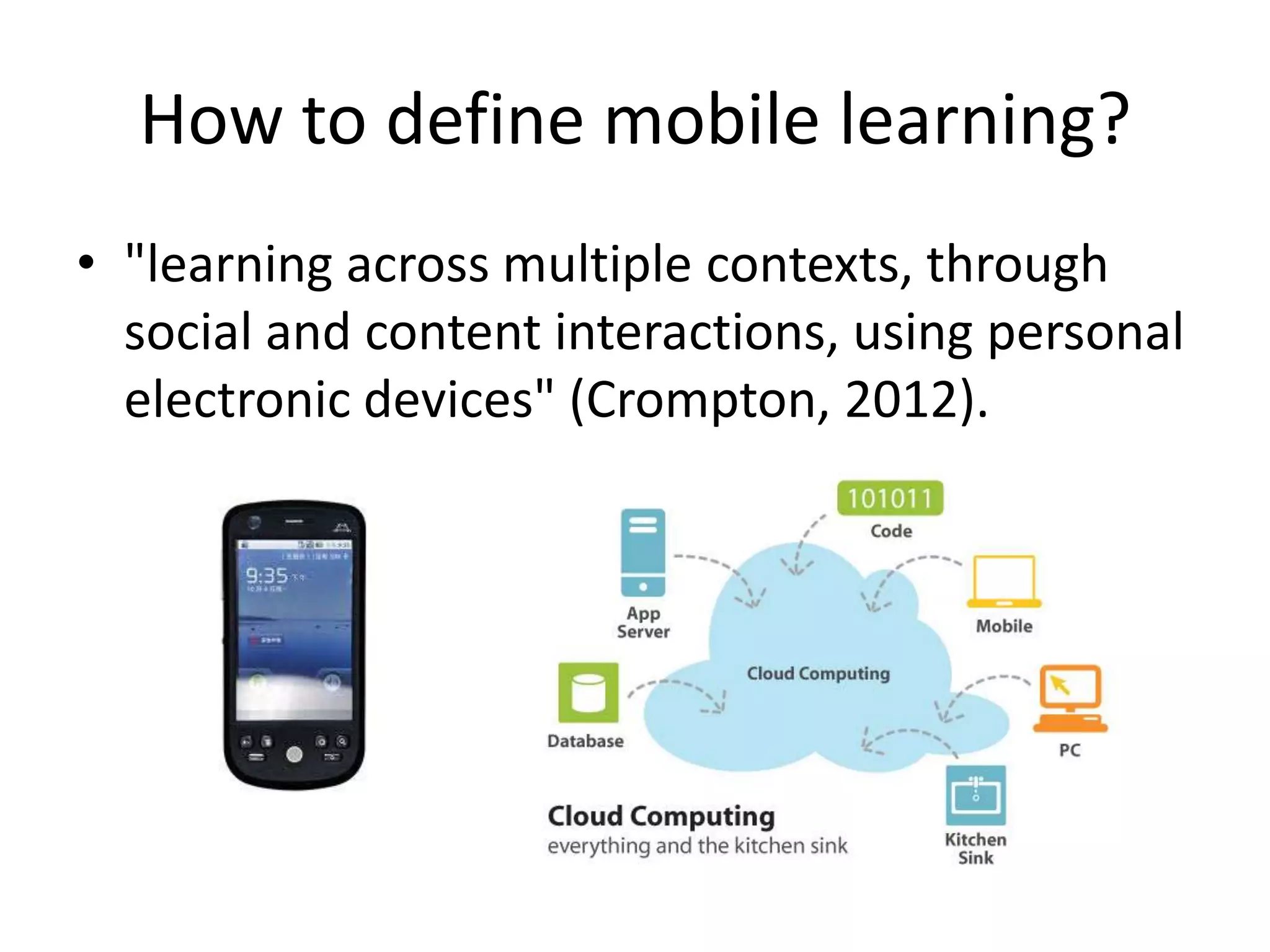
How to define mobile learning?
• "learning across multiple contexts, through
  social and content interactions, using personal
  electronic devices" (Helen Crompton, 2012).
How to define MOOC’s?


A (connectivist) Massive, Open, Online Course is a
course format which uses social media extensively to
build the ad hoc learner community and to allow
discussions, networking and resulting learning to take
place… sometimes chaos.
Bigger picture for all of us:
        why is this research needed?
     We must optimize open, online course learning.
Building a strategy for educational quality in an increasing
competitive world:

   Udacity, Coursera, EdX … all free, open, online courses by big
   universities => they corner a potential global learner market
   (marketing, profiling).
   (xMOOC = more behaviorist, student-content oriented)

We (academic, learner-centered teachers…) need to put
something of high quality to the learners in order to
attract global learners.
A research idea is born
“how does mobile accessibility impact the
social learner interactions of adult learners in
an informal, open, online course?”


                               ….. first hurdles
How to define learner interactions?
The term ‘learner interaction’ refers to all interactions that are
undertaken by (adult) learners. These interactions can cover
any content:

       social presence (social/personal) 
               cognitive presence (intellectual/academic)

These interactions are reflected in written dialogues and or
discussions, connecting to other participants via social media
commenting, engaging in informal information exchange, or
simply communicating.

• Seems easy enough ….
Aim of the research


Short run: to see whether there is an impact or a difference in
learner interactions.
Long run: improved ubiquitous learning environment, where
depending on a set of factors the learning environment is
optimized to support optimal learner interactions.
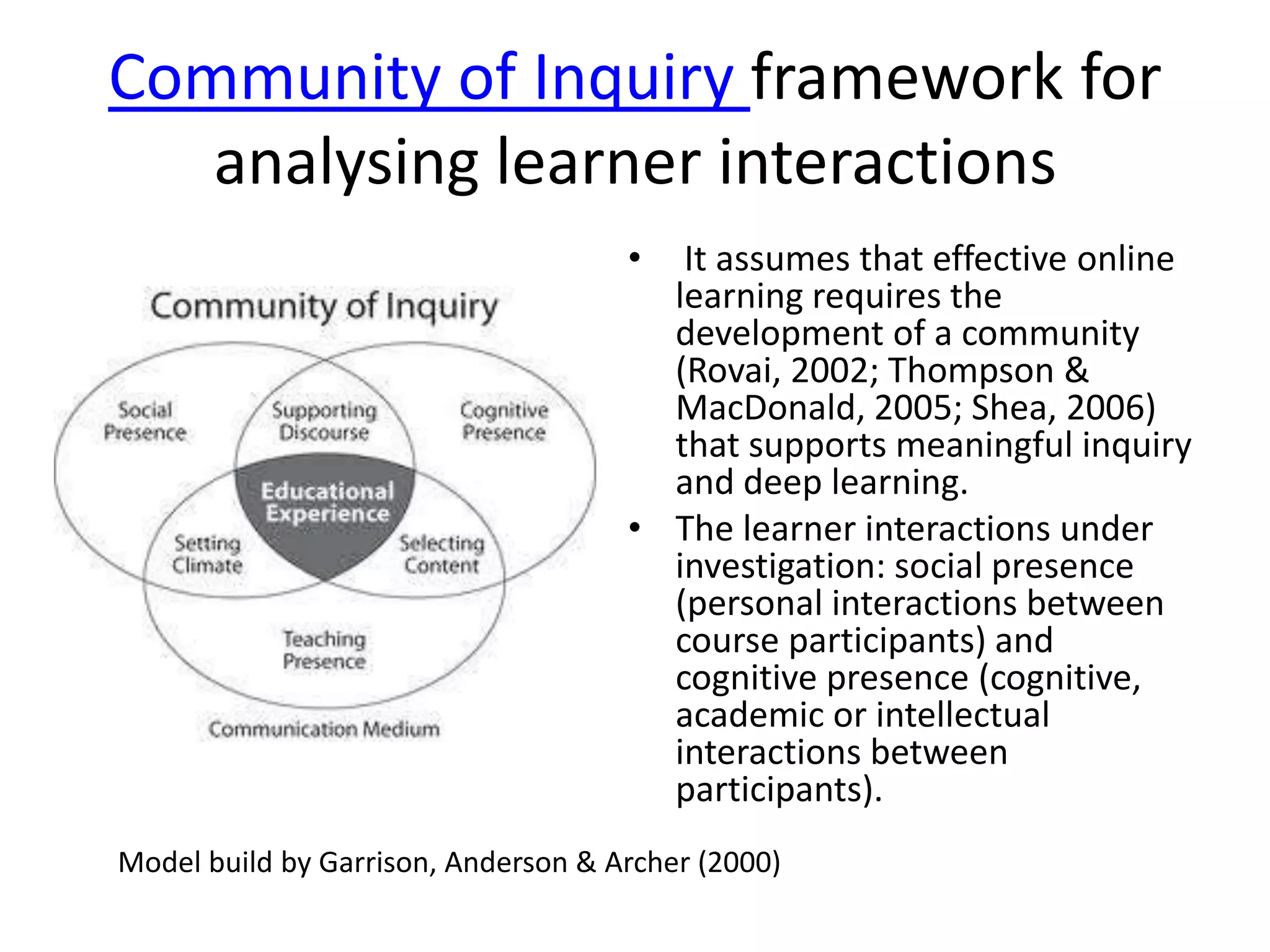
Community of Inquiry framework for
       analyzing learner interactions


•  It assumes that effective online learning requires the development
  of a community (Rovai, 2002; Thompson & MacDonald, 2005; Shea,
  2006) that supports meaningful inquiry and deep learning.
• The learner interactions under investigation: social presence
  (personal interactions between course participants) and cognitive
  presence (cognitive, academic or intellectual interactions between
  participants).
Methodology


• This study will use a sequential explanatory mixed methods design, which
  is a procedure for collecting, analyzing and “mixing” both quantitative and
  qualitative data:
    – Step 1: data from online survey
    – Step 2: 1o1 interviews qualitative data (not fully analyzed yet, coming soon)

• how are the learner dynamics different for mobile and non-mobile
  learners? (the use’s and the use not’s)
MobiMOOC 2012
Research environment

3 week MOOC on mobile learning (mLearning), Sept. 2012
12 topics: introduction to mLearning, planning mLearning,
mHealth, corporate mLearning, train-the-trainer, mobile
learning curriculum framework, global impact of mLearning,
augmented mLearning, mobiles for development (m4D),
mobile gaming, mobile activism for education, bridging
mLearning theory and practice.

MobiMOOC course wiki: http://mobimooc.wikispaces.com
Group:
https://groups.google.com/forum/#!forum/mobimooc2012
Data from online survey


• 36 respondents
• 18 participants used a mobile device to access MobiMOOC
• Sections: general information, mobile and social media use,
  types of learner interactions, mobile use during
  MobiMOOC.
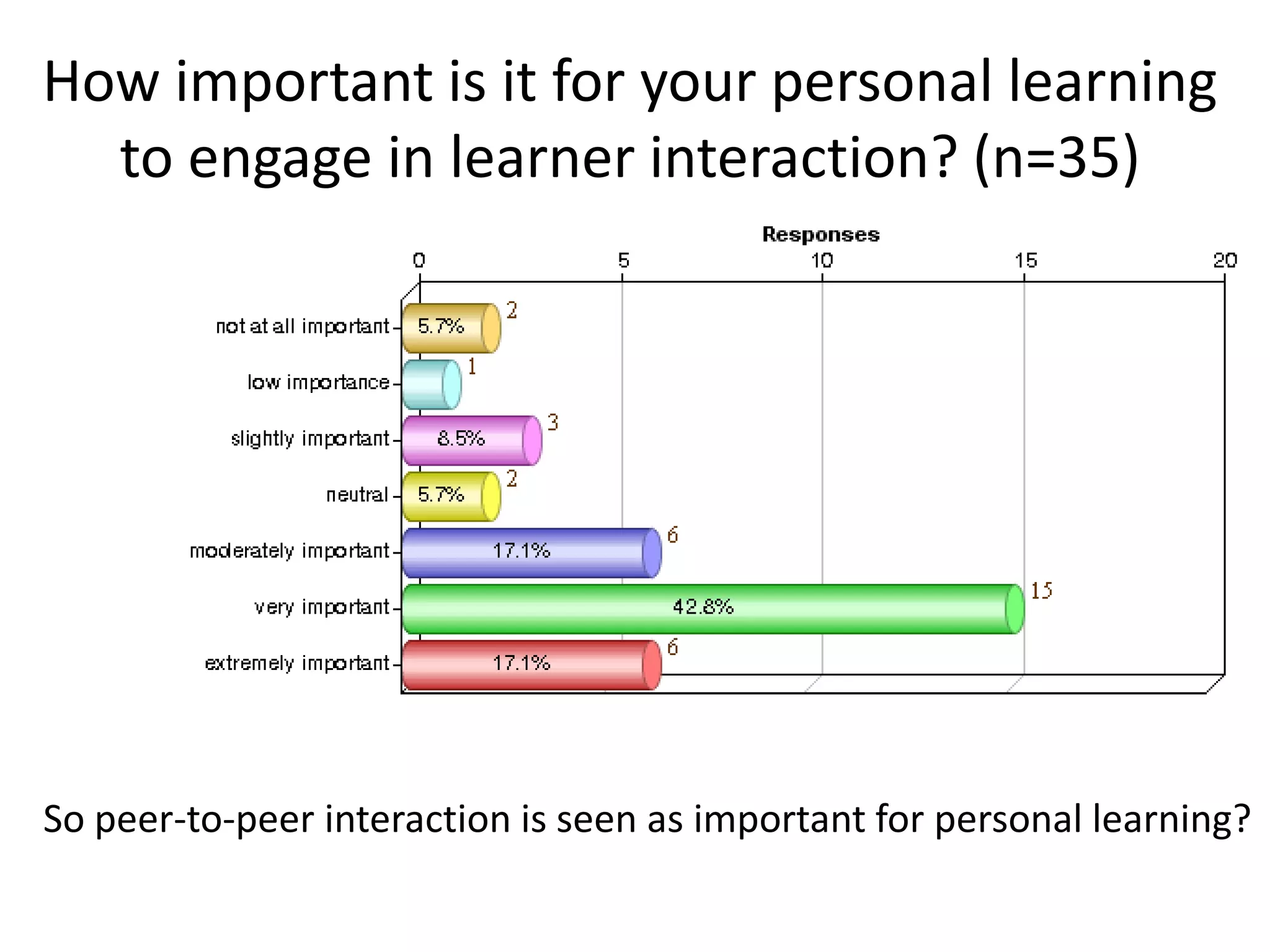
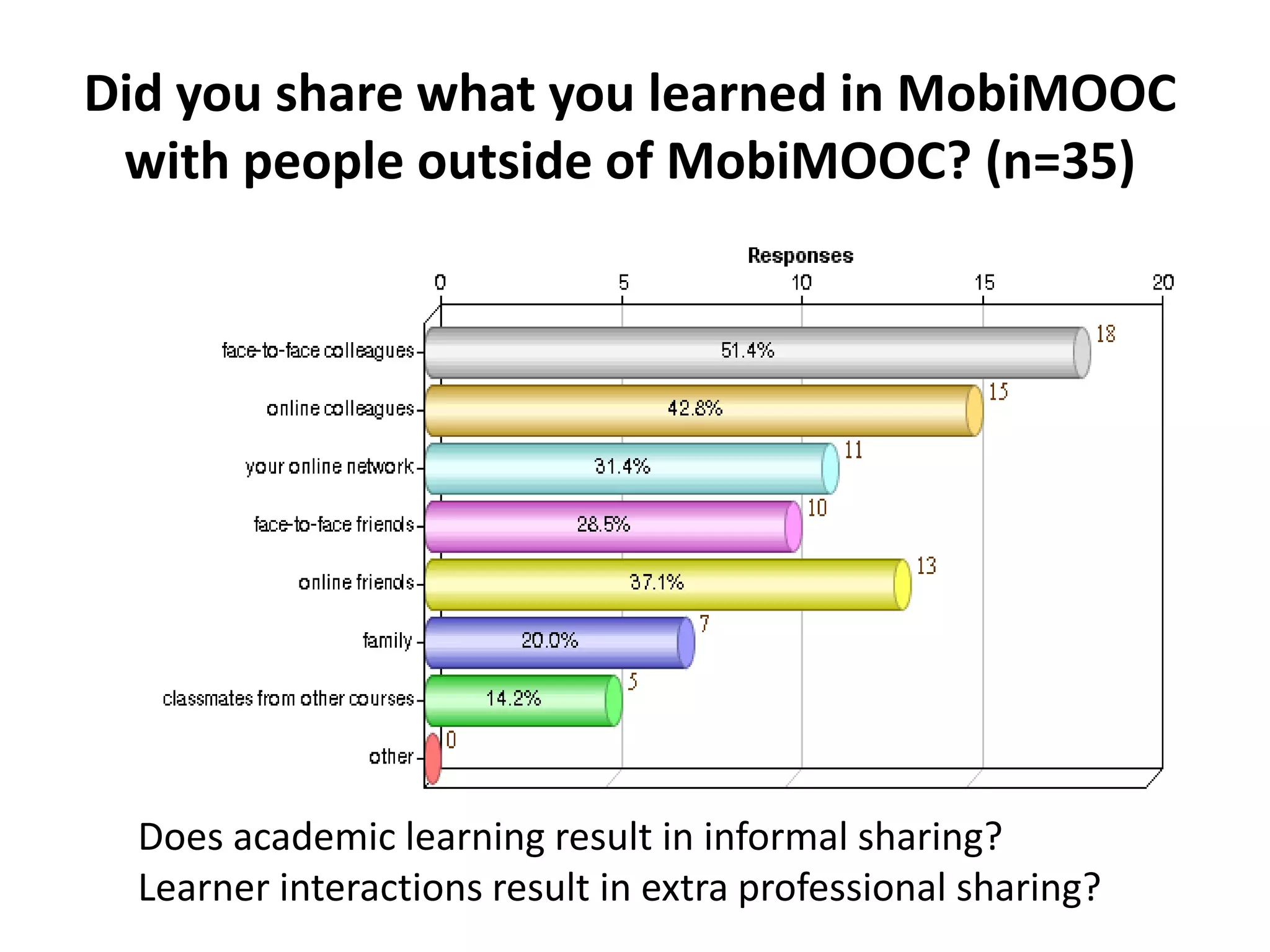
How important is it for your personal learning
  to engage in learner interaction? (n=35)
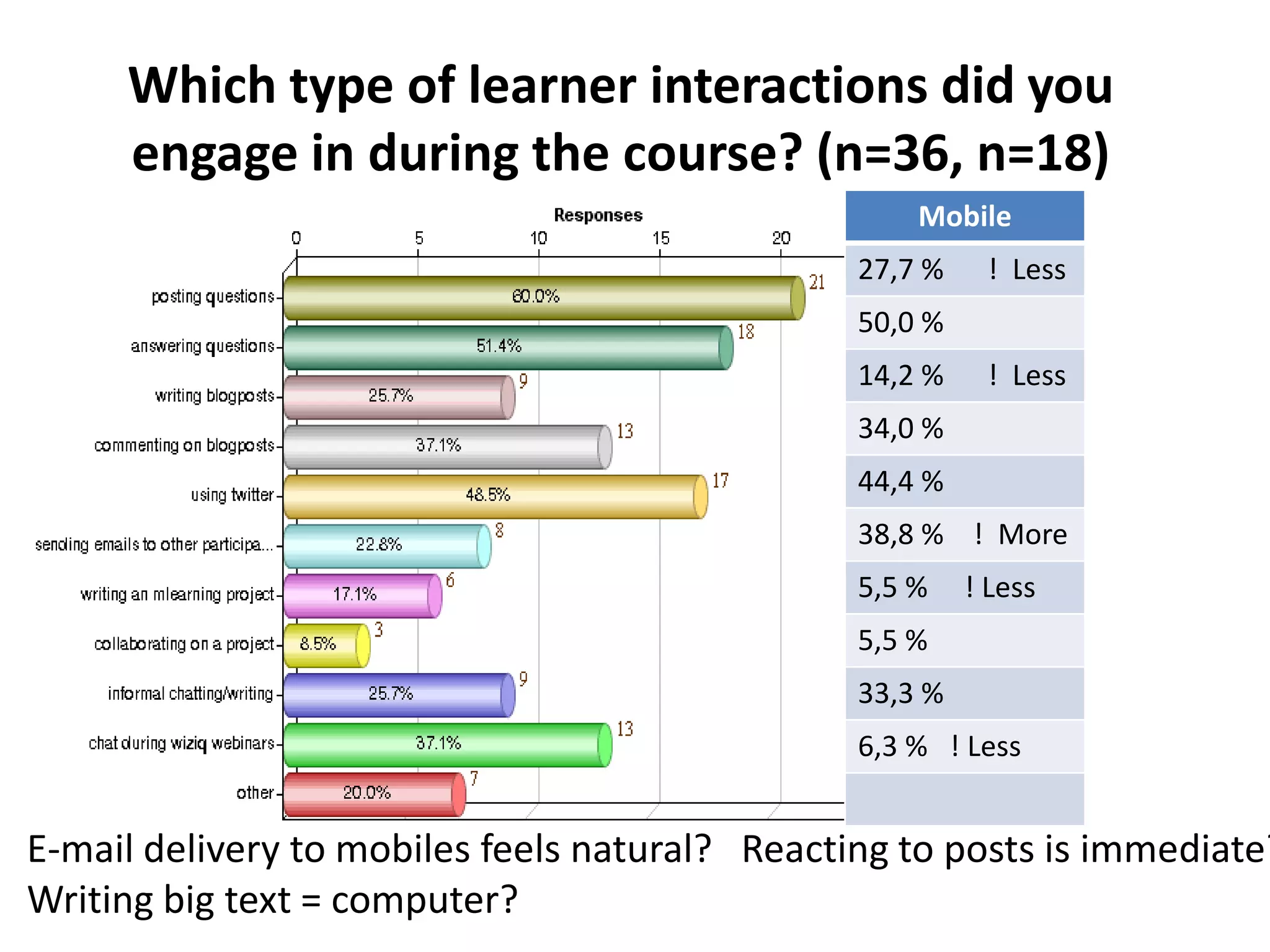
Which type of learner interactions did you
  engage in during the course? (n=36)
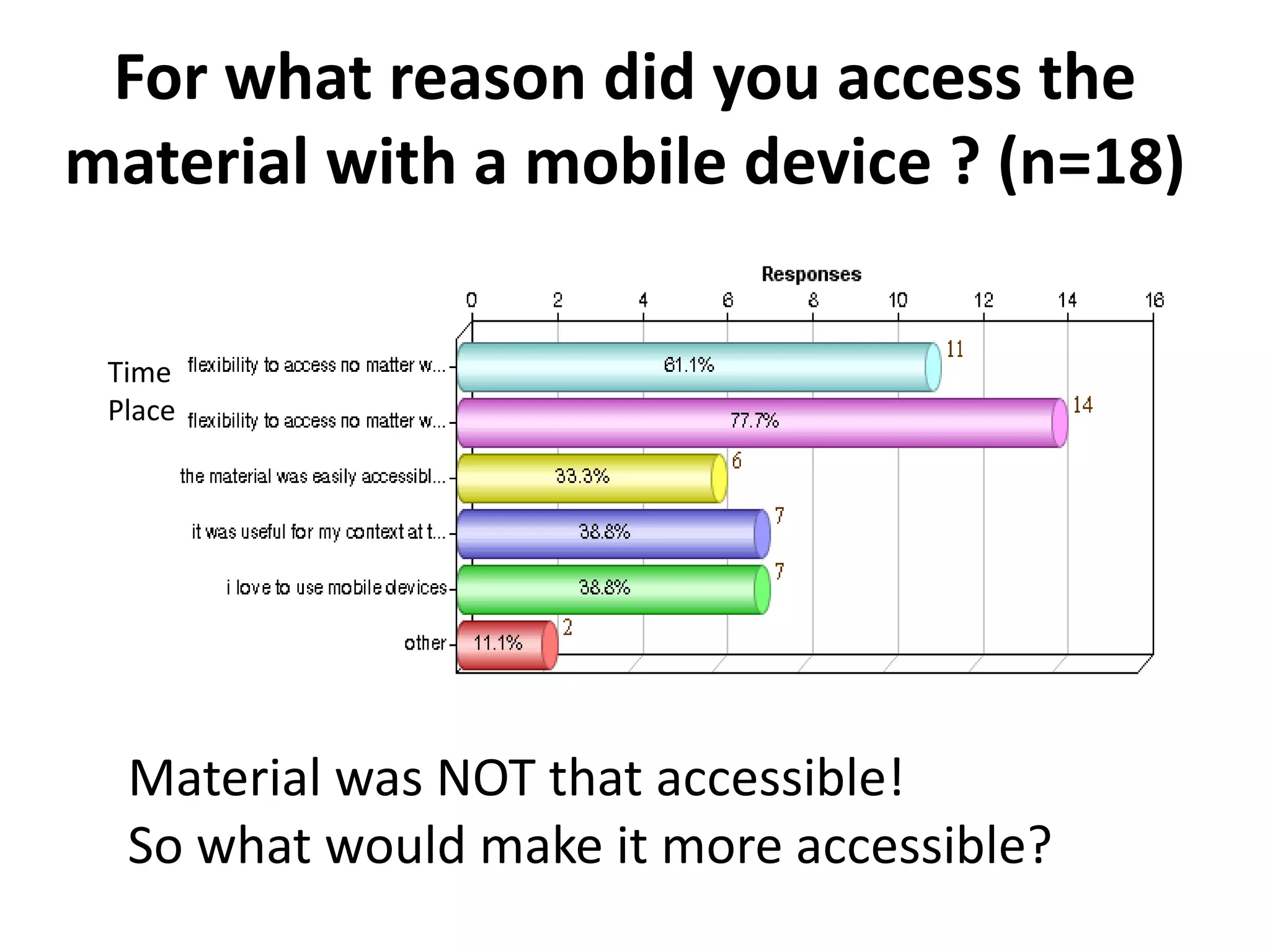
For what reason did you access the
material with a mobile device ? (n=18)


Time
Location
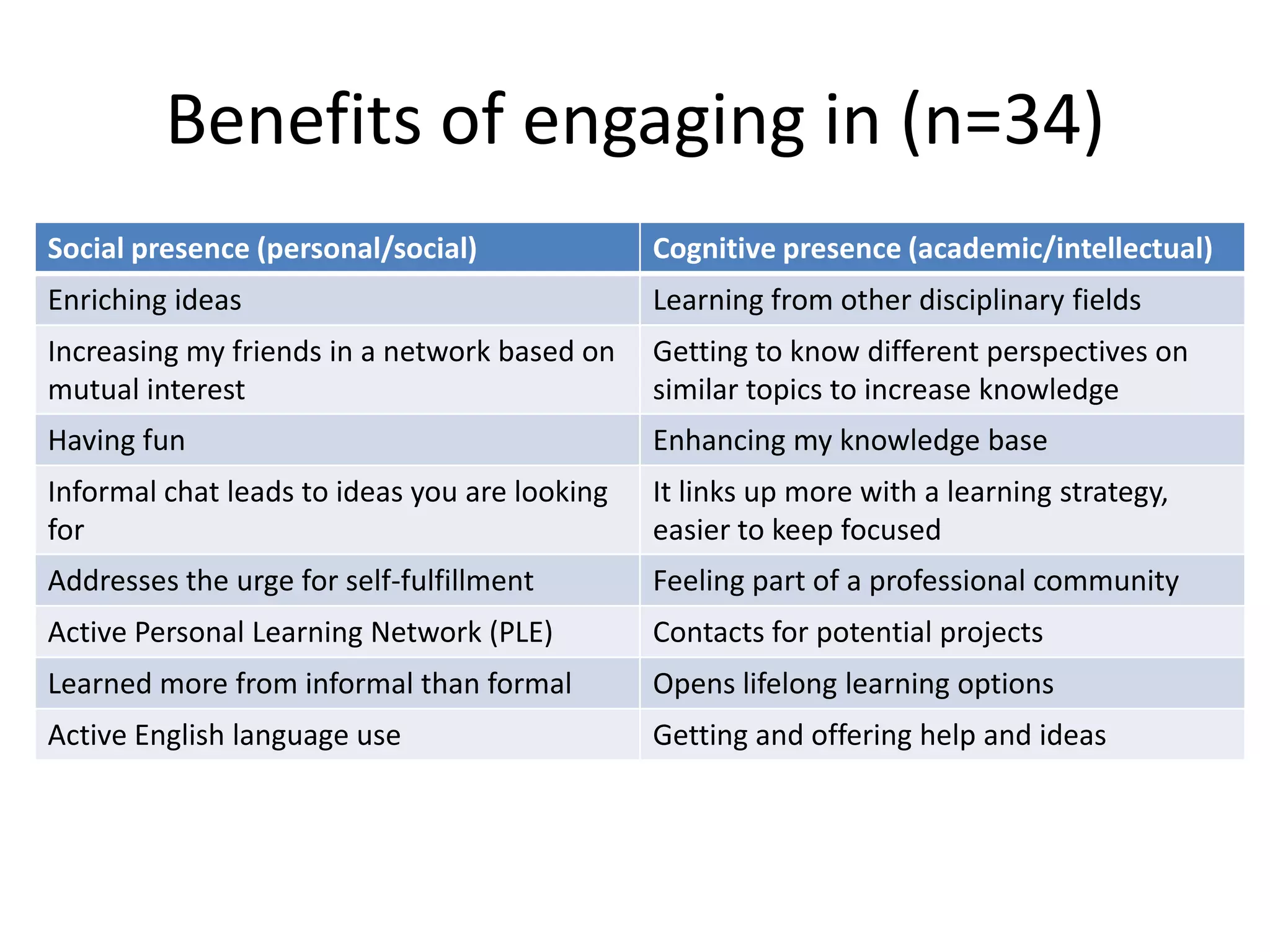
Benefits of engaging in (n=34)
Social presence (personal/social)              Cognitive presence (academic/intellectual)
Enriching ideas                                Learning from other disciplinary fields
Increasing my friends in a network based on    Getting to know different perspectives on
mutual interest                                similar topics to increase knowledge
Having fun                                     Enhancing my knowledge base
Informal chat leads to ideas you are looking   It links up more with a learning strategy,
for                                            easier to keep focused
Addresses the urge for self-fulfillment        Feeling part of a professional community
Active Personal Learning Network (PLE)         Contacts for potential projects
Learned more from informal than formal         Opens lifelong learning options
Active English language use                    Getting and offering help and ideas
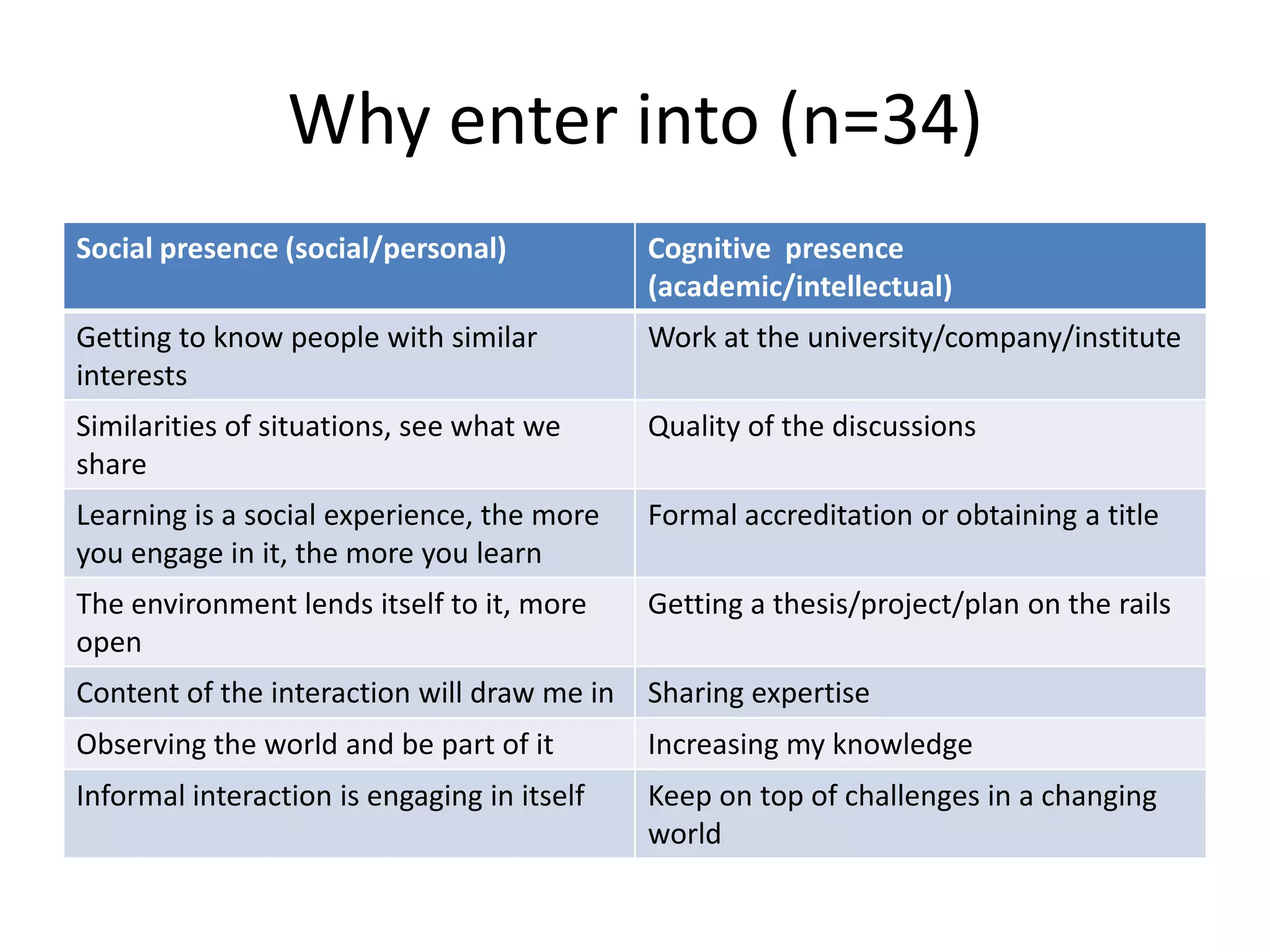
Why enter into (n=34)
Social presence (social/personal)            Cognitive presence
                                             (academic/intellectual)
Getting to know people with similar          Work at the university/company/institute
interests
Similarities of situations, see what we      Quality of the discussions
share
Learning is a social experience, the more    Formal accreditation or obtaining a title
you engage in it, the more you learn
The environment lends itself to it, more     Getting a thesis/project/plan on the rails
open
Content of the interaction will draw me in   Sharing expertise
Observing the world and be part of it        Increasing my knowledge
Informal interaction is engaging in itself   Keep on top of challenges in a changing
                                             world
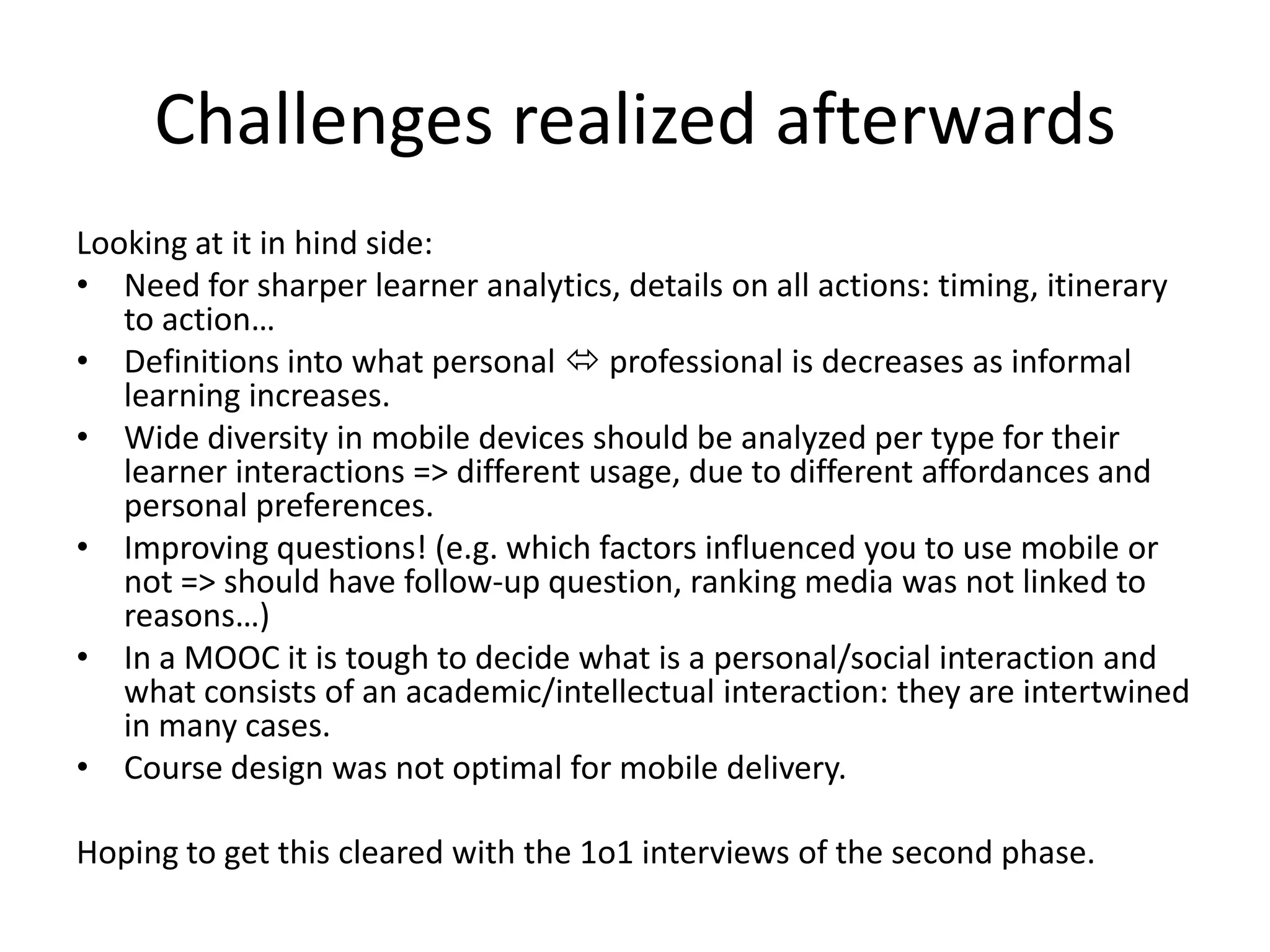
Challenges realized afterwards
Looking at it in hind side:
• Need for sharper learner analytics software, details on all actions: timing,
   itinerary to action…
• Definitions into what personal  professional is decreases as informal
   learning increases… definitions are subject to multiple, personal
   interpretations.
• Wide diversity in mobile devices should be analyzed per type for their
   learner interactions => different usage, due to different affordances and
   personal preferences.
• Improving questions! (e.g. which factors influenced you to use mobile or
   not => should have follow-up question, ranking media was not linked to
   reasons…)
• In a MOOC it is tough to decide what is a personal/social interaction and
   what consists of an academic/intellectual interaction: they are intertwined
   in many cases.

Getting some of these challenges cleared with the 101 interviews.
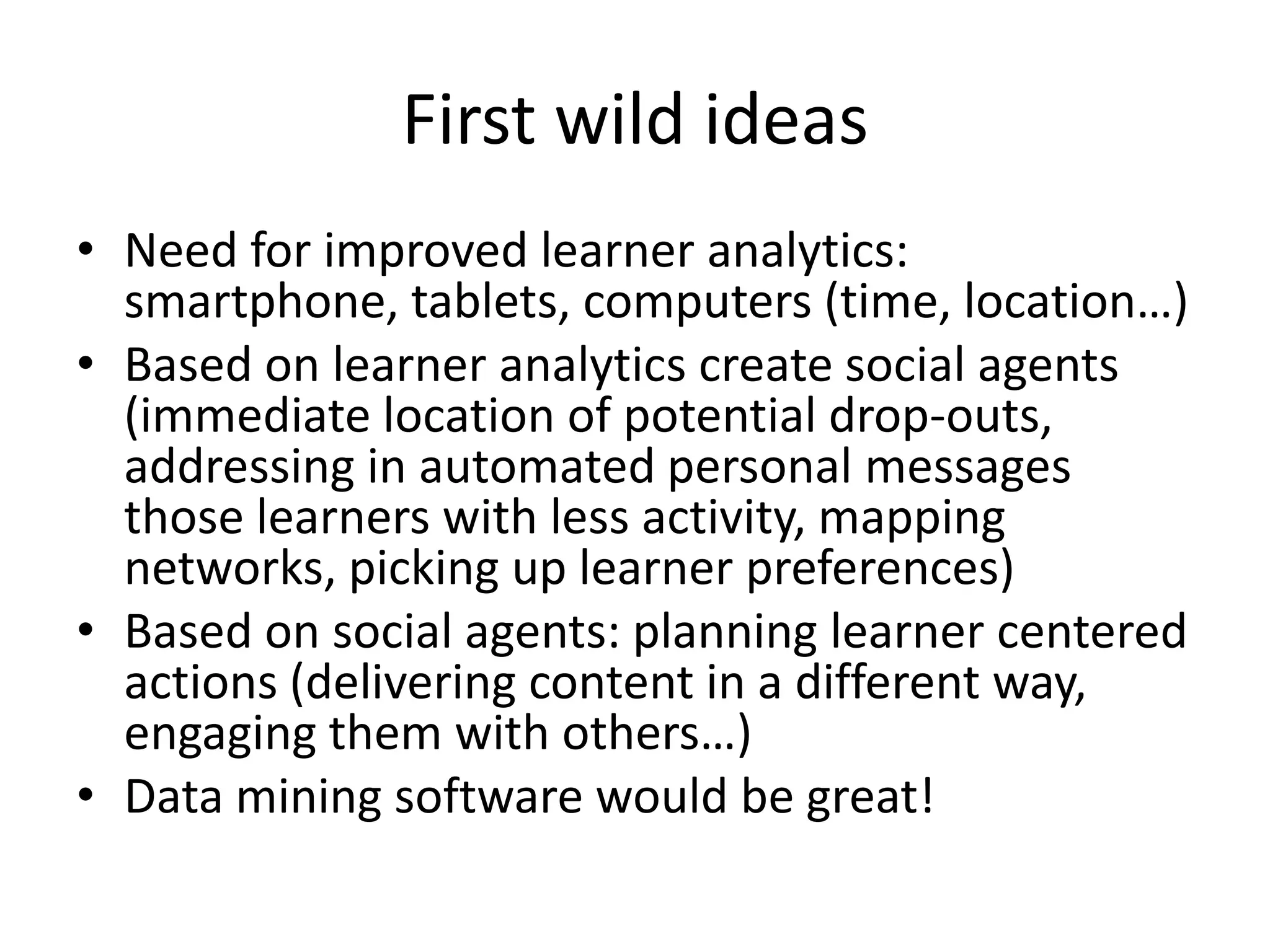
First wild ideas
• Need for improved learner analytics:
  smartphone, tablets, computers (time, location…)
• Based on learner analytics create social agents
  (immediate location of potential drop-outs,
  addressing in automated personal messages
  those learners with less activity, mapping
  networks, picking up learner preferences)
• Based on social agents: planning learner
  centered actions (delivering content in a different
  way, engaging them with others…)
• Data mining software would be great!
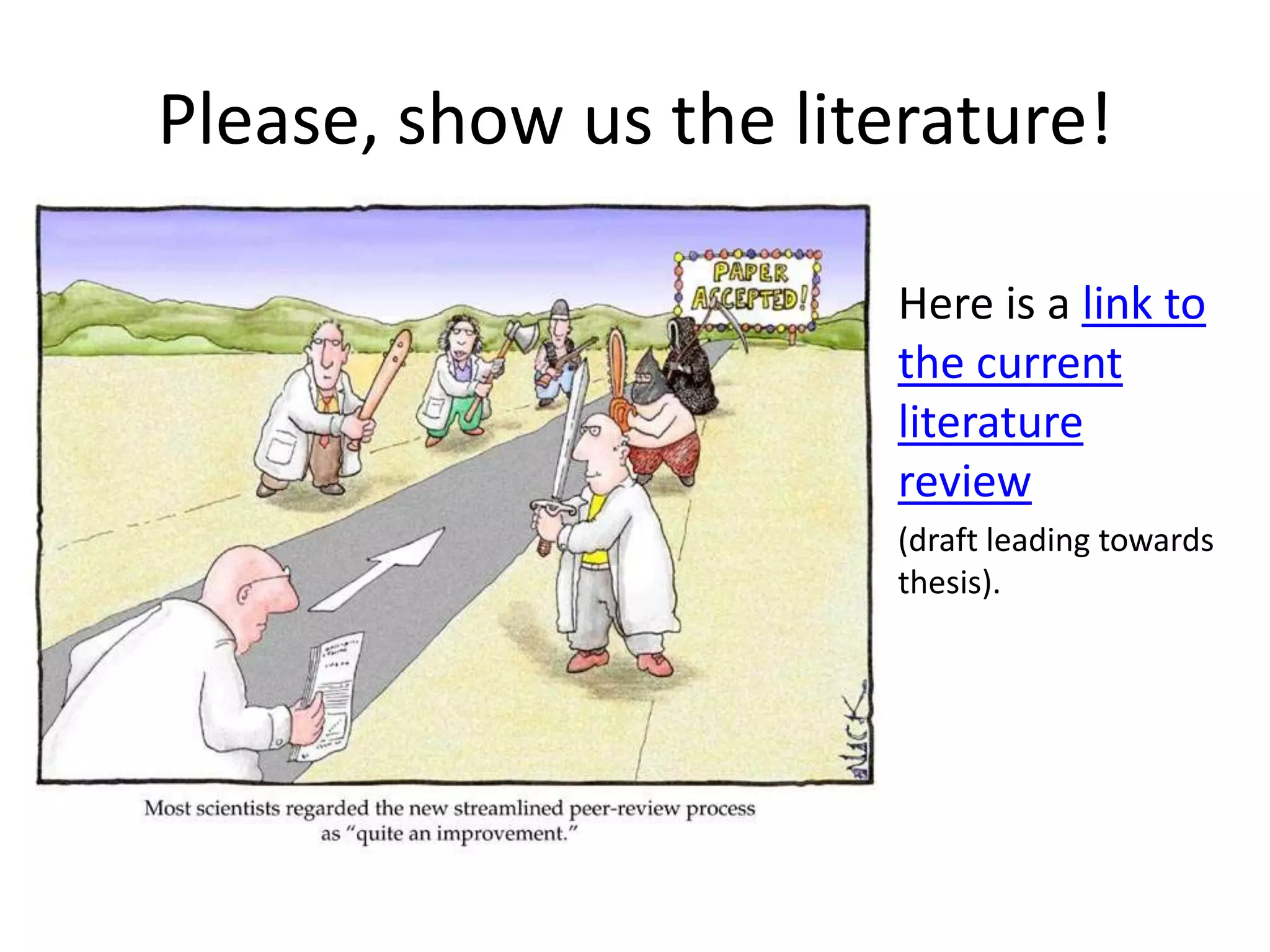
Please, show us the literature!

                        Here is a link to
                        the current
                        literature
                        review
                        (draft leading towards
                        thesis).
A warm-hearted thank you!
• A big thank you to Prof. Mohamed Ally and Prof. Marti
  Cleveland-Innes for their feedback on my thesis proposal,
  pushing me towards research.

• And a warm-hearted thank you to that wonderful
  mLearning research community, all of you, constantly
  inspiring, motivating and … making sure research is
  scrutinized at regular intervals.

• Athabasca University Rocks!            You Rock!
Contact me: questions, networking…

                      E-mail: ingedewaard (at) gmail.com

                      Blog: ignatiawebs.blogspot.com

                      Twitter: http://twitter.com/Ignatia

                      Publications:
                      http://www.ingedewaard.net/pubconsulpres.htm

                      Presentations: http://www.slideshare.net/ignatia

                      linkedIn: http://www.linkedin.com/in/ingedewaard


   And feel free to talk to me right here, right now!
                                                                    53

First research data mlearn2012 mobile access in mooc course

  • 1.
    Looking at UbiquitousMOOC Learner Interactions Inge Ignatia de Waard
  • 2.
    Setting the stage:remember…
  • 3.
    Background: MobiMOOC =MOOC lab • Different facilitator approaches (passive, active, participatory…) • Different course architecture (linear, branching…) • Different learning/teaching dynamics (behaviorist => social- constructivist/connectivist) • Different durations
  • 4.
    About MobiMOOC A MassiveOpen Online Course (MOOC) on mobile learning (mLearning) => MobiMOOC 1250 learners, 17 facilitators, 9 weeks, 14 mLearning topics: 2 core course spaces: Course wiki (http://mobimooc.wikispaces.com/) Course discussion group https://groups.google.com/group/mobimooc2012 • MobiMOOC 2011, first run: April-May 2011 • MobiMOOC 2012, September 2012
  • 5.
    MOOCs: Appropriateness &Affinity 90% Of active participants said the MOOC format was appropriate for their learning communities 42.5% Of active participants connected with other participants to collaborate on projects after MobiMOOC MOOCs: ubiquity through mobile 77.5% Accessed MobiMOOC via mobile 61.3% Location independence 56.8% Temporal independence
  • 6.
    MOOC history MOOC history 3 2 1 MOOC Natural learning design realm
  • 7.
    Contemporary MOOCs: 2main types cMOOC xMOOC First MOOC format to be developed MOOC format on the rise at Universities More connectivist learning oriented: More behaviorist learning oriented: George Siemens Burrhus Frederic Skinner Based on dialogue Based on student/content More informal (participant input & More formal (behaviorist approach: easier content production), open badges for assessment and accreditation) Network building, trust in collaboration,. Less networking, trust in content and institution Ad Hoc learner space: Learning Quilt Fixed LMS: Coursera, Udacity… Social media rich Social media used Expert learning, Community of Personal accreditation, lifelong learning Practitioners (CoP), lifelong learning for basics, personal knowledge increase, high knowledge workers starting from basic information. Room for emergence More stick to the plan High drop out, free in most cases What do you need? iMOOC?
  • 8.
    cMOOC The connectivist MOOCand the format which lead to the name of Massive, Open, Online Course.
  • 9.
    History 2007 – theWiley wiki 2007: Alec Couros Social Media and Open Education An Open Course based in a wiki An Open Course based in a wiki Participants from around the world contributed to the creation Participants from around the of the course world contributed to the creation of the course
  • 10.
  • 11.
    Connectivism as coretheory Principles of connectivism: • Learning and knowledge rests in diversity of opinions. • Learning is a process of connecting information sources. • Learning may reside in non-human appliances. • Capacity to know more is more critical than what is currently known • Nurturing and maintaining connections is needed to facilitate continual learning. • Ability to see connections between fields, ideas, and concepts is a core skill. • Decision-making is itself a learning process. George Siemens (2005 – Connectivism - a learning theory for the digital age)
  • 12.
    xMOOC Started with theArtificial Intelligence course of Stanford: lots of student interest, as well as non- Stanford students => high enrollment
  • 13.
    www.EdX.org • Came from MitX, open courseware • Now: open, online courses for free • Not-for Profit foundation. • Goal: social agents and automated assessment editors to cater massive amounts of students
  • 14.
  • 15.
    www.Coursera.org Gaining momentum asmore Universities and colleges enter. But all of xMOOC more student-content centered.
  • 16.
    Focus of thispresentation: cMOOC • Expert learning: people joining have their own interest • International openness, language sensitive and tolerant • Socio-constructivist • Connectivist: professional learning networks / community • Corporate CoP oriented
  • 17.
    Natural learning environment: MOOC history 3 2 1 MOOC Natural learning design realm
  • 18.
    Dialogue and networking Aroundthe campfire – One person is not enough, the team dialogues and narratives = network makes the genius = strength By following discussions, key thinkers become visible
  • 19.
    Biggest shift =>human teaching factor Challenges for • Overall coordinators • Helpdesk and architecture • Topic specific facilitators / guides-on-the-side • Learners => More interactions, more emergence!
  • 20.
    Digital literacy isessential for all Raising digital literacy with emerging tools increases the learners capacity to function in todays connected world Most people use it, but … does it work for learning?
  • 21.
    The coordinator &facilitators keep everyone extra motivated • Everyone knows her/his role and the challenges of a MOOC (chaos, overload) • Facilitators are guides-on-the-side • Round up mails are provided per week • Keeping people motivated by connecting and keeping informed and course oriented • Provide guidance for self-regulated learning • Get in touch with potential drop-outs => interactions are stimulated
  • 22.
    Overall coordinator actions Buildingtrust and communicate important actions: • Mail/tweet/G+/Facebook overview • Mail/tweet/G+/Facebook upcoming seminars • Mail/tweet/G+/Facebook important discussions
  • 23.
    It is allabout connecting about learner interactions
  • 24.
    MOOC Design MOOC history 3 2 1 MOOC Natural learning design realm
  • 25.
    MOOC Design Syllabus Core discussion Course anchor Social media Ubiquity tools
  • 26.
    The core ofthe course Course outline and expectations Central discussion starting and meeting point
  • 27.
    Select relevant toolswith the right educational benefits and extra’s.
  • 28.
    Mobile enabled socialmedia Why use it Knowledge Age Challenge tool Addressed Blogs To reflect on what is learned, or Self-regulated learning. what the learner thinks is of Lifelong Learning. (Examples: wordpress, blogger, importance. Becoming active, critical content posterous) Keeping a learning archive. producer. Reflecting on the learning itself. . Commenting on content. Discussion enabler: Listserv This type of online tool uses e- Enabling dialogue. mail to keep everyone informed. Collaboration. (Examples: google groups, With many of the listserve’s you Self-regulated learning. yahoo groups) can choose how you want your Informal learning. mails to be delivered (e-mail digest: e.g. immediate, once a day, once a week), which adds to self-regulated learning. Generating and maintaining discussions. Getting a group feeling going via dialogue. Social Networking Building a network of people that Enables networking. can add to the knowledge Collaboration. (examples: Facebook, Google+, creation of the learner. Enabling dialogue. LinkedIn) Informal learning. Becoming active, critical content producer. Link to Google document with more social media tools
  • 29.
  • 30.
    The research: learnerinteractions in a ubiquitous MOOC course “how does mobile accessibility impact the social learner interactions of adult learners in an informal, open, online course?”
  • 31.
    Personal research interest:2 areas Mobile learning & Massive Open Online Courses (connectivist type)
  • 32.
    A new researchfrontier! Where mLearning is traditionally seen as independent of time/location, contextualized and personal… the same can be said of MOOCs. Recent research hints on several similarities: the community that is built, the impact of social media and the surplus for informal and continuous learning...
  • 33.
    Where can Ifind my research hook? mLearning literature => challenges • Frohberg et al. (2009) screened 1469 publications and categorized 102 mobile projects => “communication and collaboration play a surprisingly small role in Mobile Learning projects” (p. 1) • Researchers did/do mention social interactions: e.g. Looi et al. (2010) and Kukulska-Hulme (2009) mentioned the importance of moving the focus away from the mobile technology and towards the social practice it enables. • There is also a proposal to extend the social spaces in which learners interact with each other, embracing both formal and informal learning.
  • 34.
    How to definemobile learning? • "learning across multiple contexts, through social and content interactions, using personal electronic devices" (Helen Crompton, 2012).
  • 35.
    How to defineMOOC’s? A (connectivist) Massive, Open, Online Course is a course format which uses social media extensively to build the ad hoc learner community and to allow discussions, networking and resulting learning to take place… sometimes chaos.
  • 36.
    Bigger picture forall of us: why is this research needed? We must optimize open, online course learning. Building a strategy for educational quality in an increasing competitive world: Udacity, Coursera, EdX … all free, open, online courses by big universities => they corner a potential global learner market (marketing, profiling). (xMOOC = more behaviorist, student-content oriented) We (academic, learner-centered teachers…) need to put something of high quality to the learners in order to attract global learners.
  • 37.
    A research ideais born “how does mobile accessibility impact the social learner interactions of adult learners in an informal, open, online course?” ….. first hurdles
  • 38.
    How to definelearner interactions? The term ‘learner interaction’ refers to all interactions that are undertaken by (adult) learners. These interactions can cover any content: social presence (social/personal)  cognitive presence (intellectual/academic) These interactions are reflected in written dialogues and or discussions, connecting to other participants via social media commenting, engaging in informal information exchange, or simply communicating. • Seems easy enough ….
  • 39.
    Aim of theresearch Short run: to see whether there is an impact or a difference in learner interactions. Long run: improved ubiquitous learning environment, where depending on a set of factors the learning environment is optimized to support optimal learner interactions.
  • 40.
    Community of Inquiryframework for analyzing learner interactions • It assumes that effective online learning requires the development of a community (Rovai, 2002; Thompson & MacDonald, 2005; Shea, 2006) that supports meaningful inquiry and deep learning. • The learner interactions under investigation: social presence (personal interactions between course participants) and cognitive presence (cognitive, academic or intellectual interactions between participants).
  • 41.
    Methodology • This studywill use a sequential explanatory mixed methods design, which is a procedure for collecting, analyzing and “mixing” both quantitative and qualitative data: – Step 1: data from online survey – Step 2: 1o1 interviews qualitative data (not fully analyzed yet, coming soon) • how are the learner dynamics different for mobile and non-mobile learners? (the use’s and the use not’s)
  • 42.
    MobiMOOC 2012 Research environment 3week MOOC on mobile learning (mLearning), Sept. 2012 12 topics: introduction to mLearning, planning mLearning, mHealth, corporate mLearning, train-the-trainer, mobile learning curriculum framework, global impact of mLearning, augmented mLearning, mobiles for development (m4D), mobile gaming, mobile activism for education, bridging mLearning theory and practice. MobiMOOC course wiki: http://mobimooc.wikispaces.com Group: https://groups.google.com/forum/#!forum/mobimooc2012
  • 43.
    Data from onlinesurvey • 36 respondents • 18 participants used a mobile device to access MobiMOOC • Sections: general information, mobile and social media use, types of learner interactions, mobile use during MobiMOOC.
  • 44.
    How important isit for your personal learning to engage in learner interaction? (n=35)
  • 45.
    Which type oflearner interactions did you engage in during the course? (n=36)
  • 46.
    For what reasondid you access the material with a mobile device ? (n=18) Time Location
  • 47.
    Benefits of engagingin (n=34) Social presence (personal/social) Cognitive presence (academic/intellectual) Enriching ideas Learning from other disciplinary fields Increasing my friends in a network based on Getting to know different perspectives on mutual interest similar topics to increase knowledge Having fun Enhancing my knowledge base Informal chat leads to ideas you are looking It links up more with a learning strategy, for easier to keep focused Addresses the urge for self-fulfillment Feeling part of a professional community Active Personal Learning Network (PLE) Contacts for potential projects Learned more from informal than formal Opens lifelong learning options Active English language use Getting and offering help and ideas
  • 48.
    Why enter into(n=34) Social presence (social/personal) Cognitive presence (academic/intellectual) Getting to know people with similar Work at the university/company/institute interests Similarities of situations, see what we Quality of the discussions share Learning is a social experience, the more Formal accreditation or obtaining a title you engage in it, the more you learn The environment lends itself to it, more Getting a thesis/project/plan on the rails open Content of the interaction will draw me in Sharing expertise Observing the world and be part of it Increasing my knowledge Informal interaction is engaging in itself Keep on top of challenges in a changing world
  • 49.
    Challenges realized afterwards Lookingat it in hind side: • Need for sharper learner analytics software, details on all actions: timing, itinerary to action… • Definitions into what personal  professional is decreases as informal learning increases… definitions are subject to multiple, personal interpretations. • Wide diversity in mobile devices should be analyzed per type for their learner interactions => different usage, due to different affordances and personal preferences. • Improving questions! (e.g. which factors influenced you to use mobile or not => should have follow-up question, ranking media was not linked to reasons…) • In a MOOC it is tough to decide what is a personal/social interaction and what consists of an academic/intellectual interaction: they are intertwined in many cases. Getting some of these challenges cleared with the 101 interviews.
  • 50.
    First wild ideas •Need for improved learner analytics: smartphone, tablets, computers (time, location…) • Based on learner analytics create social agents (immediate location of potential drop-outs, addressing in automated personal messages those learners with less activity, mapping networks, picking up learner preferences) • Based on social agents: planning learner centered actions (delivering content in a different way, engaging them with others…) • Data mining software would be great!
  • 51.
    Please, show usthe literature! Here is a link to the current literature review (draft leading towards thesis).
  • 52.
    A warm-hearted thankyou! • A big thank you to Prof. Mohamed Ally and Prof. Marti Cleveland-Innes for their feedback on my thesis proposal, pushing me towards research. • And a warm-hearted thank you to that wonderful mLearning research community, all of you, constantly inspiring, motivating and … making sure research is scrutinized at regular intervals. • Athabasca University Rocks! You Rock!
  • 53.
    Contact me: questions,networking… E-mail: ingedewaard (at) gmail.com Blog: ignatiawebs.blogspot.com Twitter: http://twitter.com/Ignatia Publications: http://www.ingedewaard.net/pubconsulpres.htm Presentations: http://www.slideshare.net/ignatia linkedIn: http://www.linkedin.com/in/ingedewaard And feel free to talk to me right here, right now! 53

Editor's Notes

  • #3 Setting the stage:look aroundyou, meet yourneighbours, we are all in thistogetherDim lights / close eyesA nicechildhoodplayground memoryWhathappens: lurkers, actors, leaders, fun…The playground intro
  • #5 How mLearning relates to MOOCsWhen looking at mLearning and MOOCs one cannot help but see similarities in its time and space autonomy, the community that is built, and the contextualization that takes place by the fact that everyone brings their experience to the center of the learning community. Connecting is now possible across time, space and contexts. mLearning, connectivism, and its practical format the MOOC, fit these new contemporary facts.
  • #6 The fact that dialogue is a core aspect of both communication and learning results in the idea that the MOOC format could also benefit other communities due to its open and human nature of constructing new knowledge as well as its very human characteristic of connecting to peers. This idea is strengthened by the fact that 90% of the participants indicated that they believe a MOOC format is appropriate for their learning communities.It also resulted in 42.5% of the participants taking the final survey indicating that they connected to other participants in order to collaborate on projects after MobiMOOC.
  • #7 History, naturallearning environment, design of architecture, cost benefit and ROI, MobiMOOC real life example
  • #10 http://www.opencontent.org/wiki/index.php?title=Intro_Open_Ed_Syllabushttp://eci831.wikispaces.com/Session+List
  • #18 History, naturallearning environment, design of architecture, cost benefit and ROI, MobiMOOC real life example
  • #25 History, naturallearning environment, design of architecture, cost benefit and ROI, MobiMOOC real life example
  • #26 Corediscussionspacesand course outlineSocial media implementationUbiquitous access: withadditional focus on mobile access and benefits of m-access (time andlocationindependence, context related)
  • #27 Variety of people, different tools anddevicesusedbyallCentral discussionspace (list serve: accessible via mobile andall, requiresonly basic digital literacy)Course outline in a centralspace, the compass to move through the course components
  • #28 Social media implementation: knowyour tool affordanceanduseDon’tjust do it for the sake of it: walk the talkAffordancesdefine the usability of the tool: sharing multimedia, setting up group activities, enhancing real life environments…Leave room for individualadditions (blogposts, other tools shared…)
  • #30 As devices go wild (tablets, smartphones, netbooks, ebooks, laptops, desktops…), keep access simple: in the Cloud (companies increasinglydevelop for the cloud, not for specificdevices)Let the learnersbringtheirowndevices (BYOD) Social media’s increasingwide access Mobile devicesrule for the modern daylearners: flexibility to learn no matter which personal or professional demandsandsituations