The future of online learning
and personal learning
networks/environment
Name: S.L Mbongwa
Stu nu: 201144405
Topic: personal
learning network
Online Learning
• Has been around since 1995 or so
• Really grew with the World Wide Web
• Has advanced tremendously
Many positive developments in the
last few years worth sharing…
Open Source Applications
• Learning Management Systems
such as Moodle, Sakai, Bodington, ATutor
• Development and CommunityTools
such as LAMS, Connexions, ELGG, Drupal,
WordPress
• Supporting Software
such as Firefox, Thunderbird,
OpenOffice, Audacity
New Environments
• Multimedia explosion
podcasts, vodcasts, YouTube, Slideshare, more
• Mobile computing
mobile phones, PDAs, etc.
• The 3D web
Second Life is a start, we will see more of this
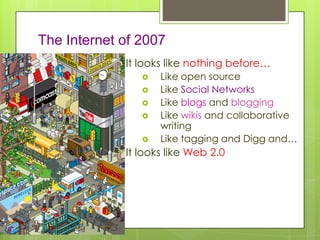
It looks like nothing before…
 Like open source
 Like Social Networks
 Like blogs and blogging
 Like wikis and collaborative
writing
 Like tagging and Digg and…
It looks like Web 2.0
The Internet of 2007
Online Learning at the Crossroads
• On the one hand – we have developed
tools and systems intended to support
traditional classroom based learning
• On the other hand – we could (should?)
be developing tools and systems to
support immersive learning
• We should be developing for
dynamic, immersive, living systems…
Web 2.0: The Learning Network
• The e-Portfolio lives in the intersection
between the worlds for
education, work, and home
• A model for e-Portfolio as a learner-
managed construct
• Key requirement is easy-to-use tools and
hosting services*
• *E.g. the “e-Portfolio-as-blog” approach
Scott Wilson:
http://www.cetis.ac.uk/members/scott/entries/20050523083528
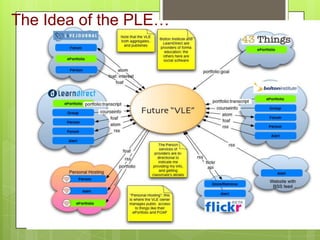
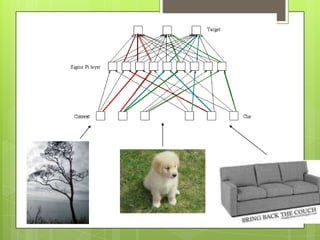
The Idea of the PLE…
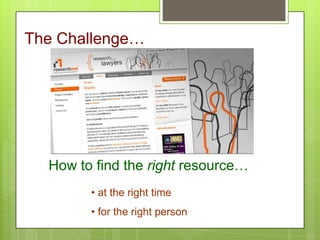
The Challenge…
How to find the right resource…
• at the right time
• for the right person
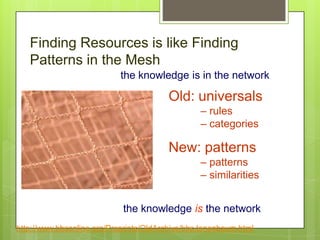
Finding Resources is like Finding
Patterns in the Mesh
the knowledge is in the network
the knowledge is the network
Old: universals
– rules
– categories
New: patterns
– patterns
– similarities
http://www.bbsonline.org/Preprints/OldArchive/bbs.tenenbaum.html
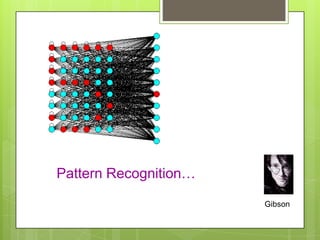
Pattern Recognition…
Gibson
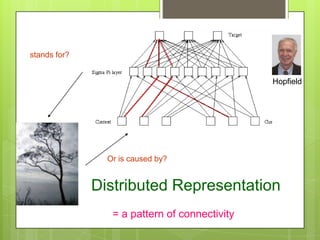
stands for?
Or is caused by?
Distributed Representation
= a pattern of connectivity
Hopfield
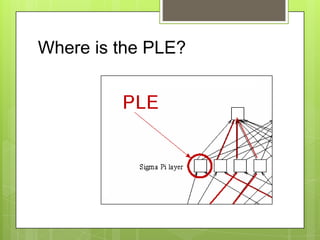
Where is the PLE?
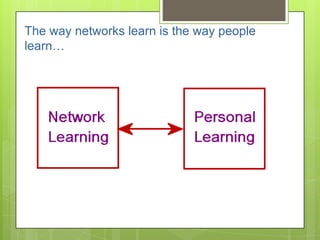
The way networks learn is the way people
learn…
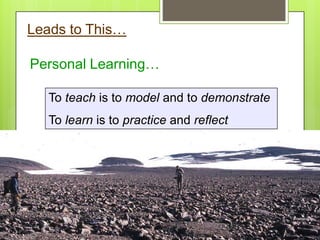
Leads to This…
Personal Learning…
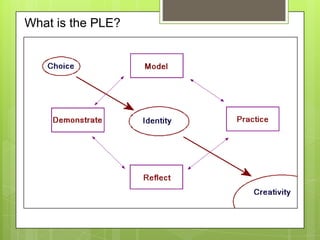
To teach is to model and to demonstrate
To learn is to practice and reflect
What is the PLE?
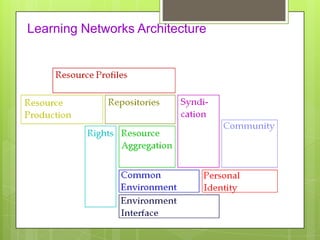
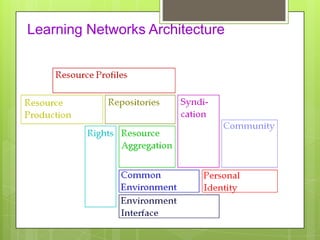
Learning Networks Architecture
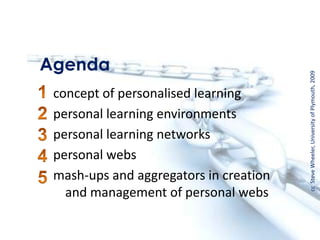
Agenda
concept of personalised learning
personal learning environments
personal learning networks
personal webs
mash-ups and aggregators in creation
and management of personal webs
ccSteveWheeler,UniversityofPlymouth,2009
Everything
is relative
ccSteveWheeler,UniversityofPlymouth,2009
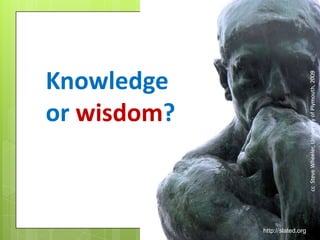
Knowledge
or wisdom?
ccSteveWheeler,UniversityofPlymouth,2009
http://slated.org
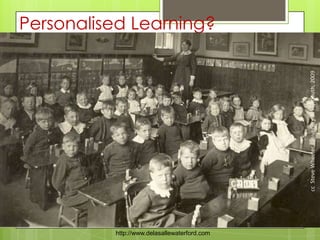
Personalised Learning?
ccSteveWheeler,UniversityofPlymouth,2009
http://www.delasallewaterford.com
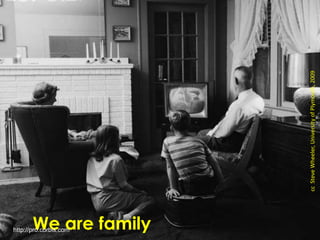
We are family
ccSteveWheeler,UniversityofPlymouth,2009
http://pro.corbis.com
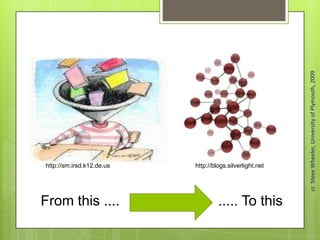
Learning Webs
From this .... ..... To this
ccSteveWheeler,UniversityofPlymouth,2009
http://sm.irsd.k12.de.us http://blogs.silverlight.net
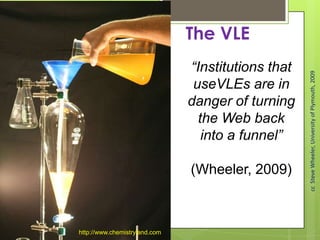
The VLE
“Institutions that
useVLEs are in
danger of turning
the Web back
into a funnel”
(Wheeler, 2009)
ccSteveWheeler,UniversityofPlymouth,2009
http://www.chemistryland.com
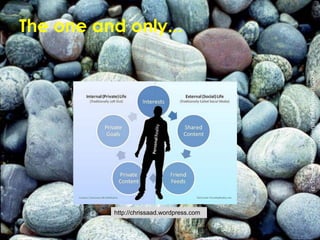
The one and only...
ccSteveWheeler,UniversityofPlymouth,2009
http://chrissaad.wordpress.com
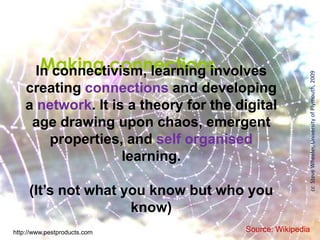
Making connectionsIn connectivism, learning involves
creating connections and developing
a network. It is a theory for the digital
age drawing upon chaos, emergent
properties, and self organised
learning.
(It’s not what you know but who you
know)
Source: Wikipedia
ccSteveWheeler,UniversityofPlymouth,2009
http://www.pestproducts.com
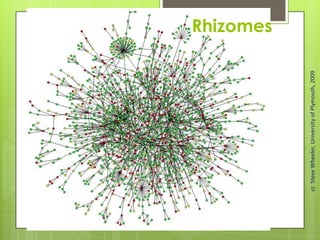
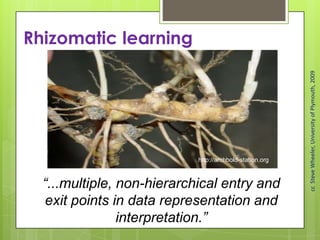
Rhizomes
ccSteveWheeler,UniversityofPlymouth,2009
“...multiple, non-hierarchical entry and
exit points in data representation and
interpretation.”
Rhizomatic learning
ccSteveWheeler,UniversityofPlymouth,2009
http://archbold-station.org
It’s Personal:
Learning
Spaces, Learning
Webs
Steve Wheeler
University of Plymouth
ccSteveWheeler,UniversityofPlymouth,2009
http://www.dailyhaha.com
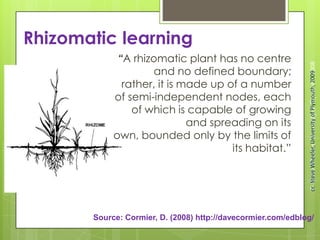
Rhizomatic learning
“A rhizomatic plant has no centre
and no defined boundary;
rather, it is made up of a number
of semi-independent nodes, each
of which is capable of growing
and spreading on its
own, bounded only by the limits of
its habitat.”
©SteveWheeler,UniversityofPlymouth,2008
Source: Cormier, D. (2008) http://davecormier.com/edblog/
ccSteveWheeler,UniversityofPlymouth,2009
Rhizomatic learning
“In the rhizomatic
view, knowledge can only be
negotiated, [and is] a personal
knowledge-creation process with
mutable goals and constantly
negotiated premises.”
Source: Cormier, D. (2008) http://davecormier.com/edblog/
©SteveWheeler,UniversityofPlymouth,2008ccSteveWheeler,UniversityofPlymouth,2009
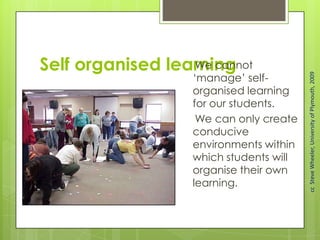
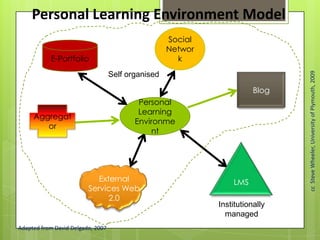
Self organised learningWe cannot
„manage‟ self-
organised learning
for our students.
We can only create
conducive
environments within
which students will
organise their own
learning.
ccSteveWheeler,UniversityofPlymouth,2009
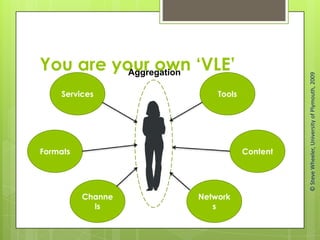
You are your own ‘VLE’
Services Tools
Formats Content
Channe
ls
Network
s
Aggregation
©SteveWheeler,UniversityofPlymouth,2009
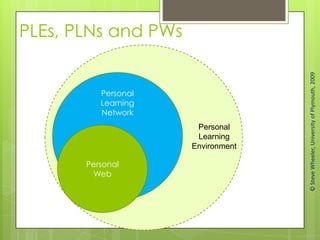
PLEs, PLNs and PWs
Personal
Learning
Network
Personal
Web
Personal
Learning
Environment
©SteveWheeler,UniversityofPlymouth,2009
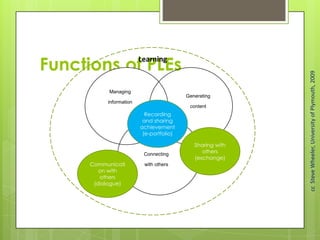
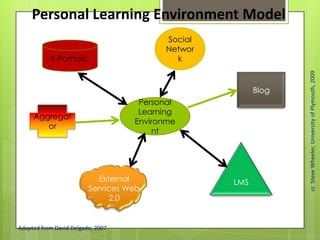
Functions of PLEs
Managing
information
Generating
content
Connecting
with othersCommunicati
on with
others
(dialogue)
Sharing with
others
(exchange)
Learning
Recording
and sharing
achievement
(e-portfolio)
ccSteveWheeler,UniversityofPlymouth,2009
Personal
Learning
Environme
nt
Blog
LMS
Social
Networ
k
External
Services Web
2.0
E-Portfolio
Aggregat
or
Adapted from David Delgado, 2007
Personal Learning Environment Model
ccSteveWheeler,UniversityofPlymouth,2009
External
Services Web
2.0
Self organised
Institutionally
managed
Adapted from David Delgado, 2007
E-Portfolio
Aggregat
or
Social
Networ
k
Personal Learning Environment Model
Blog
LMS
Personal
Learning
Environme
nt
ccSteveWheeler,UniversityofPlymouth,2009
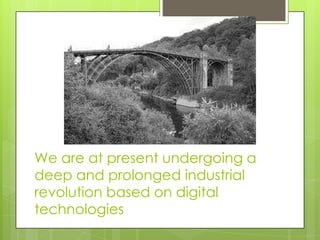
We are at present undergoing a
deep and prolonged industrial
revolution based on digital
technologies
The reform and reshaping
of social systems and
institutions has tended to
lag behind in periods of
rapid technological
change
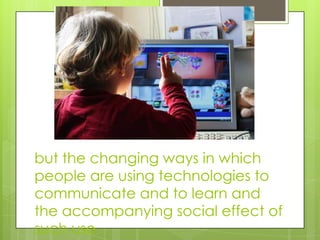
but the changing ways in which
people are using technologies to
communicate and to learn and
the accompanying social effect of
such use
The reaction of education systems and
institutions to the rise of social networking
has been at best bewilderment, at worst
downright hostility
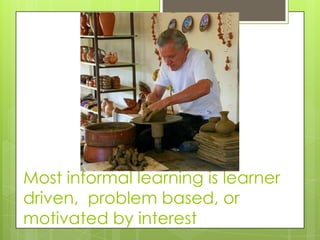
Most informal learning is learner
driven, problem based, or
motivated by interest
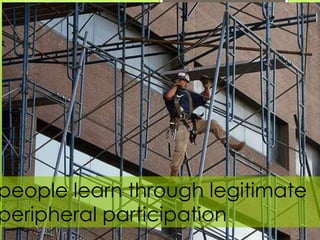
people learn through legitimate
peripheral participation
Knowing is .... located in
relations among
practitioners, their
practice, the artefacts of
that practice, and the social
organization…of
communities of practice
Lave and Wenger, 1991
Personal Learning
Environments have
the potential to
meet such a
challenge
PLEs are not another
substantiation of
educational
technology but a new
approach to learning
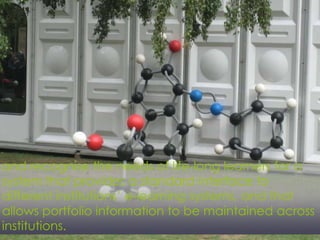
and recognise the needs of life-long learners for a
system that provides a standard interface to
different institutions‟ e-learning systems, and that
allows portfolio information to be maintained across
institutions.
the idea of a Personal
Learning Environment
recognises that learning is
continuing and seeks to
provide tools to support that
learning
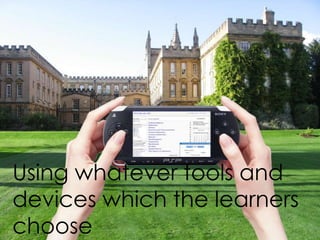
Using whatever tools and
devices which the learners
choose
PLEs can develop on the
potential of services
oriented architectures for
dispersed and networked
forms of learning and
knowledge
development.
the co-shaping of
technologies bringing
together techies and
teachers, enterprises
and institutions
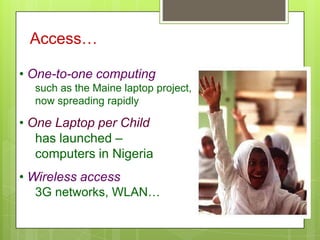
Access…
• One-to-one computing
such as the Maine laptop project,
now spreading rapidly
• One Laptop per Child
has launched –
computers in Nigeria
• Wireless access
3G networks, WLAN…
Demonstrate
- reference examples
- code library
- image samples
- thought processes
- show experts at work (Chaos Manor)
- application
- case studies
- stories
The question is, how
can we connect the
learner with the
community at work?
Practice
- scaffolded practice
- game interfaces
- sandboxes
- job aids
- flash cards
- cheat sheets
- games and simulations
- mod kits
- mmorpgs
The question is, how can
we enable access to
multiple environments
that support various
activities?
Reflection
- guided reflection
- forms-based input
- presentations and seminars
- journaling
- blogs, wikis
- communities
- discussion, sharing
The question is, how can we
assist people to see
themselves, their practice, in
a mirror?
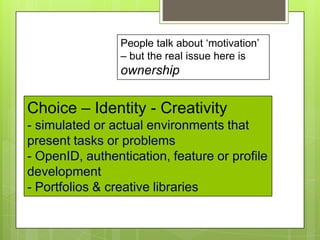
Choice – Identity - Creativity
- simulated or actual environments that
present tasks or problems
- OpenID, authentication, feature or profile
development
- Portfolios & creative libraries
People talk about „motivation‟
– but the real issue here is
ownership
Learning Networks Architecture
Personal learning : available on:
http://www.cetis.ac.uk/members/scott/entries
/20050523083528. accessed on 10/032013.
Online learning: available on
:http://www.cetis.ac.uk/members/ple/resourc
es/edf.ppt . Accessed on 10/03/2013.
Personal learning networks: available on:
http://www.cetis.ac.uk/members/scott/entries
/20050523083528 . accessed on
13/03/2013.
Personal learning environment: available on
:http://www.delasallewaterford.com.
Accessed on 13/03/2013.
Professional learning networks: available on:
leahttp://pro.corbis.comhttp://archbold-
station.org. Accessed on 25/03/2013.
Personal learning environment: available on:
http:// ://archbold-station.orghttp://archbold-
station.orghttp://archbold-station.org.
Accessed on 18/03/2013.

Professinal std3 a

  • 1.
    The future ofonline learning and personal learning networks/environment Name: S.L Mbongwa Stu nu: 201144405 Topic: personal learning network
  • 2.
    Online Learning • Hasbeen around since 1995 or so • Really grew with the World Wide Web • Has advanced tremendously Many positive developments in the last few years worth sharing…
  • 3.
    Open Source Applications •Learning Management Systems such as Moodle, Sakai, Bodington, ATutor • Development and CommunityTools such as LAMS, Connexions, ELGG, Drupal, WordPress • Supporting Software such as Firefox, Thunderbird, OpenOffice, Audacity
  • 4.
    New Environments • Multimediaexplosion podcasts, vodcasts, YouTube, Slideshare, more • Mobile computing mobile phones, PDAs, etc. • The 3D web Second Life is a start, we will see more of this
  • 5.
    It looks likenothing before…  Like open source  Like Social Networks  Like blogs and blogging  Like wikis and collaborative writing  Like tagging and Digg and… It looks like Web 2.0 The Internet of 2007
  • 6.
    Online Learning atthe Crossroads • On the one hand – we have developed tools and systems intended to support traditional classroom based learning • On the other hand – we could (should?) be developing tools and systems to support immersive learning • We should be developing for dynamic, immersive, living systems…
  • 7.
    Web 2.0: TheLearning Network • The e-Portfolio lives in the intersection between the worlds for education, work, and home • A model for e-Portfolio as a learner- managed construct • Key requirement is easy-to-use tools and hosting services* • *E.g. the “e-Portfolio-as-blog” approach Scott Wilson: http://www.cetis.ac.uk/members/scott/entries/20050523083528
  • 8.
    The Idea ofthe PLE…
  • 9.
    The Challenge… How tofind the right resource… • at the right time • for the right person
  • 10.
    Finding Resources islike Finding Patterns in the Mesh the knowledge is in the network the knowledge is the network Old: universals – rules – categories New: patterns – patterns – similarities http://www.bbsonline.org/Preprints/OldArchive/bbs.tenenbaum.html
  • 11.
  • 12.
    stands for? Or iscaused by? Distributed Representation = a pattern of connectivity Hopfield
  • 14.
  • 15.
    The way networkslearn is the way people learn…
  • 16.
    Leads to This… PersonalLearning… To teach is to model and to demonstrate To learn is to practice and reflect
  • 17.
  • 18.
  • 19.
    Agenda concept of personalisedlearning personal learning environments personal learning networks personal webs mash-ups and aggregators in creation and management of personal webs ccSteveWheeler,UniversityofPlymouth,2009
  • 20.
  • 21.
  • 22.
  • 23.
  • 24.
    Learning Webs From this.... ..... To this ccSteveWheeler,UniversityofPlymouth,2009 http://sm.irsd.k12.de.us http://blogs.silverlight.net
  • 25.
    The VLE “Institutions that useVLEsare in danger of turning the Web back into a funnel” (Wheeler, 2009) ccSteveWheeler,UniversityofPlymouth,2009 http://www.chemistryland.com
  • 26.
    The one andonly... ccSteveWheeler,UniversityofPlymouth,2009 http://chrissaad.wordpress.com
  • 27.
    Making connectionsIn connectivism,learning involves creating connections and developing a network. It is a theory for the digital age drawing upon chaos, emergent properties, and self organised learning. (It’s not what you know but who you know) Source: Wikipedia ccSteveWheeler,UniversityofPlymouth,2009 http://www.pestproducts.com
  • 28.
  • 29.
    “...multiple, non-hierarchical entryand exit points in data representation and interpretation.” Rhizomatic learning ccSteveWheeler,UniversityofPlymouth,2009 http://archbold-station.org
  • 30.
    It’s Personal: Learning Spaces, Learning Webs SteveWheeler University of Plymouth ccSteveWheeler,UniversityofPlymouth,2009 http://www.dailyhaha.com
  • 31.
    Rhizomatic learning “A rhizomaticplant has no centre and no defined boundary; rather, it is made up of a number of semi-independent nodes, each of which is capable of growing and spreading on its own, bounded only by the limits of its habitat.” ©SteveWheeler,UniversityofPlymouth,2008 Source: Cormier, D. (2008) http://davecormier.com/edblog/ ccSteveWheeler,UniversityofPlymouth,2009
  • 32.
    Rhizomatic learning “In therhizomatic view, knowledge can only be negotiated, [and is] a personal knowledge-creation process with mutable goals and constantly negotiated premises.” Source: Cormier, D. (2008) http://davecormier.com/edblog/ ©SteveWheeler,UniversityofPlymouth,2008ccSteveWheeler,UniversityofPlymouth,2009
  • 33.
    Self organised learningWecannot „manage‟ self- organised learning for our students. We can only create conducive environments within which students will organise their own learning. ccSteveWheeler,UniversityofPlymouth,2009
  • 34.
    You are yourown ‘VLE’ Services Tools Formats Content Channe ls Network s Aggregation ©SteveWheeler,UniversityofPlymouth,2009
  • 35.
    PLEs, PLNs andPWs Personal Learning Network Personal Web Personal Learning Environment ©SteveWheeler,UniversityofPlymouth,2009
  • 36.
    Functions of PLEs Managing information Generating content Connecting withothersCommunicati on with others (dialogue) Sharing with others (exchange) Learning Recording and sharing achievement (e-portfolio) ccSteveWheeler,UniversityofPlymouth,2009
  • 37.
    Personal Learning Environme nt Blog LMS Social Networ k External Services Web 2.0 E-Portfolio Aggregat or Adapted fromDavid Delgado, 2007 Personal Learning Environment Model ccSteveWheeler,UniversityofPlymouth,2009
  • 38.
    External Services Web 2.0 Self organised Institutionally managed Adaptedfrom David Delgado, 2007 E-Portfolio Aggregat or Social Networ k Personal Learning Environment Model Blog LMS Personal Learning Environme nt ccSteveWheeler,UniversityofPlymouth,2009
  • 39.
    We are atpresent undergoing a deep and prolonged industrial revolution based on digital technologies
  • 40.
    The reform andreshaping of social systems and institutions has tended to lag behind in periods of rapid technological change
  • 41.
    but the changingways in which people are using technologies to communicate and to learn and the accompanying social effect of such use
  • 42.
    The reaction ofeducation systems and institutions to the rise of social networking has been at best bewilderment, at worst downright hostility
  • 43.
    Most informal learningis learner driven, problem based, or motivated by interest
  • 44.
    people learn throughlegitimate peripheral participation
  • 45.
    Knowing is ....located in relations among practitioners, their practice, the artefacts of that practice, and the social organization…of communities of practice Lave and Wenger, 1991
  • 46.
    Personal Learning Environments have thepotential to meet such a challenge
  • 47.
    PLEs are notanother substantiation of educational technology but a new approach to learning
  • 48.
    and recognise theneeds of life-long learners for a system that provides a standard interface to different institutions‟ e-learning systems, and that allows portfolio information to be maintained across institutions.
  • 49.
    the idea ofa Personal Learning Environment recognises that learning is continuing and seeks to provide tools to support that learning
  • 50.
    Using whatever toolsand devices which the learners choose
  • 51.
    PLEs can developon the potential of services oriented architectures for dispersed and networked forms of learning and knowledge development.
  • 52.
    the co-shaping of technologiesbringing together techies and teachers, enterprises and institutions
  • 53.
    Access… • One-to-one computing suchas the Maine laptop project, now spreading rapidly • One Laptop per Child has launched – computers in Nigeria • Wireless access 3G networks, WLAN…
  • 54.
    Demonstrate - reference examples -code library - image samples - thought processes - show experts at work (Chaos Manor) - application - case studies - stories The question is, how can we connect the learner with the community at work?
  • 55.
    Practice - scaffolded practice -game interfaces - sandboxes - job aids - flash cards - cheat sheets - games and simulations - mod kits - mmorpgs The question is, how can we enable access to multiple environments that support various activities?
  • 56.
    Reflection - guided reflection -forms-based input - presentations and seminars - journaling - blogs, wikis - communities - discussion, sharing The question is, how can we assist people to see themselves, their practice, in a mirror?
  • 57.
    Choice – Identity- Creativity - simulated or actual environments that present tasks or problems - OpenID, authentication, feature or profile development - Portfolios & creative libraries People talk about „motivation‟ – but the real issue here is ownership
  • 58.
  • 59.
    Personal learning :available on: http://www.cetis.ac.uk/members/scott/entries /20050523083528. accessed on 10/032013. Online learning: available on :http://www.cetis.ac.uk/members/ple/resourc es/edf.ppt . Accessed on 10/03/2013. Personal learning networks: available on: http://www.cetis.ac.uk/members/scott/entries /20050523083528 . accessed on 13/03/2013. Personal learning environment: available on :http://www.delasallewaterford.com. Accessed on 13/03/2013. Professional learning networks: available on: leahttp://pro.corbis.comhttp://archbold- station.org. Accessed on 25/03/2013. Personal learning environment: available on: http:// ://archbold-station.orghttp://archbold- station.orghttp://archbold-station.org. Accessed on 18/03/2013.