ASSESSMENT OF CAPITAL STRUCTURE OF
   HUTCHISON WHAMPOA BASED ON
      FUTURE FINANCING NEEDS


                               BY:-
                               TANIA ROY – 423
                         NITIN MEHROTRA – 425
                           TANMAY MEHTA –527
                      UTKARSH VASHISHTA – 528
                             SAHIL VOHRA - 530
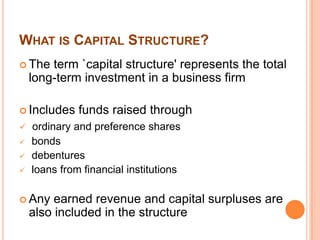
WHAT IS CAPITAL STRUCTURE?
 The   term `capital structure' represents the total
    long-term investment in a business firm

 Includes    funds raised through
   ordinary and preference shares
   bonds
   debentures
   loans from financial institutions

 Any    earned revenue and capital surpluses are
    also included in the structure
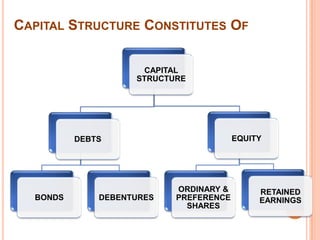
CAPITAL STRUCTURE CONSTITUTES OF


                      CAPITAL
                    STRUCTURE


          DEBTS                         EQUITY


                           ORDINARY &        RETAINED
  BONDS       DEBENTURES   PREFERENCE        EARNINGS
                             SHARES
CAPITAL STRUCTURE FOR AN ORGANISATION

   Optimum capital structure should be planned in a manner that
    ensures that the market value of its shares is maximum

   A number of factors influences the capital structure decision of a
    company and significant variations among industries and among'
    different companies

   The judgment of the person or group of persons making the
    capital structure decision plays a crucial role

   These factors are complex and qualitative as capital markets are
    not perfect and the decisions have to be taken knowing
    consequent risks
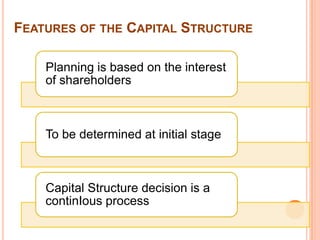
FEATURES OF THE CAPITAL STRUCTURE

    Planning is based on the interest
    of shareholders


    To be determined at initial stage


    Capital Structure decision is a
    continIous process
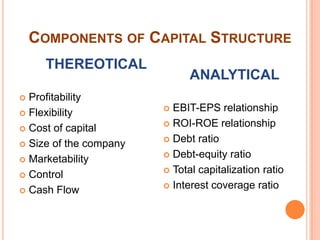
COMPONENTS OF CAPITAL STRUCTURE
      THEREOTICAL
                              ANALYTICAL
 Profitability
 Flexibility
                         EBIT-EPS relationship
                         ROI-ROE relationship
 Cost of capital
                         Debt ratio
 Size of the company
                         Debt-equity ratio
 Marketability
                         Total capitalization ratio
 Control
                         Interest coverage ratio
 Cash Flow
CASH FLOW
   Conservatism related to the assessment of liability of
    fixed charges

   Amount of fixed charges are high when large debt is
    employed

   Debt should be raised only when provision for future cash
    flow exists

   It is risky to employ sources of capital with fixed charges
    for companies whose cash inflows are unstable or
    unpredictable
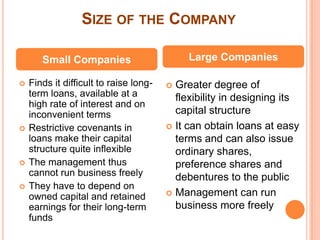
SIZE OF THE COMPANY

       Small Companies                       Large Companies

   Finds it difficult to raise long-    Greater degree of
    term loans, available at a            flexibility in designing its
    high rate of interest and on
    inconvenient terms                    capital structure
   Restrictive covenants in             It can obtain loans at easy
    loans make their capital              terms and can also issue
    structure quite inflexible            ordinary shares,
   The management thus                   preference shares and
    cannot run business freely            debentures to the public
   They have to depend on
                                         Management can run
    owned capital and retained
    earnings for their long-term          business more freely
    funds
CAPITAL STRUCTURE DECISION
THE TARGET


   Minimize the cost of capital

   Maximize the value of the firm
EBIT-EPS ANALYSIS

   How sensitive is EPS to changes in EBIT under
    different financing alternatives


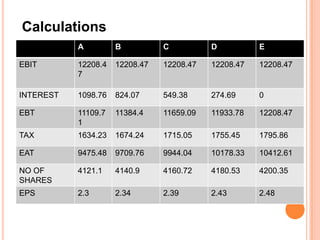
        EPS = [(EBIT – I)(1 - t)] / n

I = interest burden
t = tax rate
n = number of equity shares
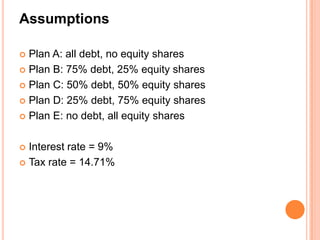
Assumptions

 Plan A: all debt, no equity shares
 Plan B: 75% debt, 25% equity shares

 Plan C: 50% debt, 50% equity shares

 Plan D: 25% debt, 75% equity shares

 Plan E: no debt, all equity shares


 Interest rate = 9%
 Tax rate = 14.71%
Calculations
               A         B          C          D          E

EBIT           12208.4   12208.47   12208.47   12208.47   12208.47
               7

INTEREST       1098.76   824.07     549.38     274.69     0

EBT            11109.7   11384.4    11659.09   11933.78   12208.47
               1
TAX            1634.23   1674.24    1715.05    1755.45    1795.86

EAT            9475.48   9709.76    9944.04    10178.33   10412.61

 NO OF          4121.1    4140.9
ALL FIGURES IN HK$ MILLIONS         4160.72    4180.53    4200.35
 SHARES
EPS            2.3       2.34       2.39       2.43       2.48
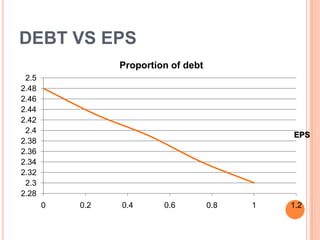
DEBT VS EPS
                 Proportion of debt
 2.5
2.48
2.46
2.44
2.42
 2.4
                                                EPS
2.38
2.36
2.34
2.32
 2.3
2.28
       0   0.2   0.4      0.6         0.8   1   1.2
HUTCHISON’S CASE
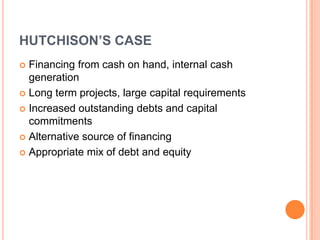
 Financing from cash on hand, internal cash
  generation
 Long term projects, large capital requirements

 Increased outstanding debts and capital
  commitments
 Alternative source of financing

 Appropriate mix of debt and equity
ROI-ROE ANALYSIS

   Relationship between return on investment and
    return on equity for different financing options


       ROE = [ROI + (ROI – r)D/E](1-t)

r = cost of debt
D/E = debt – equity ratio
t = tax rate
CALCULATIONS
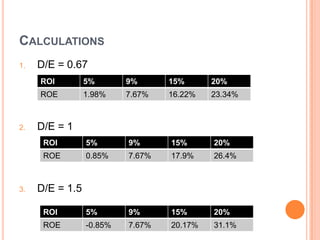
1.   D/E = 0.67
     ROI         5%       9%      15%      20%
     ROE         1.98%    7.67%   16.22%   23.34%


2.   D/E = 1
      ROI        5%       9%      15%      20%
      ROE        0.85%    7.67%   17.9%    26.4%


3.   D/E = 1.5

      ROI        5%       9%      15%      20%
      ROE        -0.85%   7.67%   20.17%   31.1%
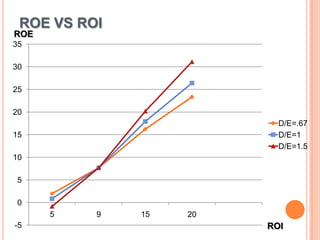
ROE VS ROI
ROE
35

30

25

20
                          D/E=.67
15                        D/E=1
                          D/E=1.5
10

5

0
      5   9   15   20
-5                      ROI
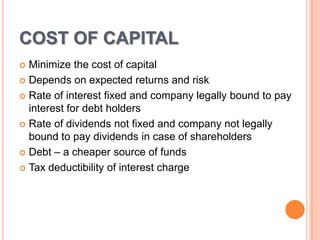
COST OF CAPITAL
 Minimize the cost of capital
 Depends on expected returns and risk

 Rate of interest fixed and company legally bound to pay
  interest for debt holders
 Rate of dividends not fixed and company not legally
  bound to pay dividends in case of shareholders
 Debt – a cheaper source of funds

 Tax deductibility of interest charge
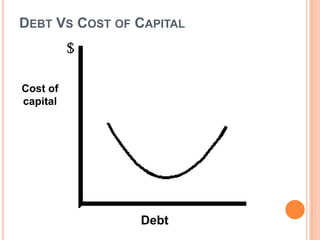
DEBT VS COST OF CAPITAL


Cost of
capital


                Debt
CONTROL

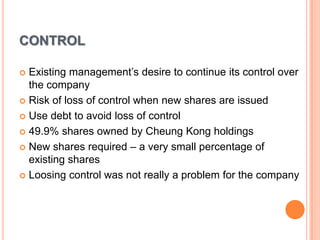
 Existing management’s desire to continue its control over
  the company
 Risk of loss of control when new shares are issued

 Use debt to avoid loss of control

 49.9% shares owned by Cheung Kong holdings

 New shares required – a very small percentage of
  existing shares
 Loosing control was not really a problem for the company
Ratios
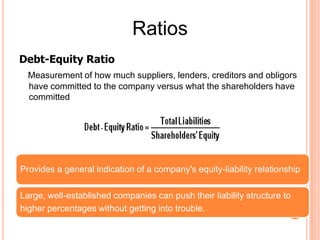
Debt-Equity Ratio
  Measurement of how much suppliers, lenders, creditors and obligors
  have committed to the company versus what the shareholders have
  committed


Provides a general indication of a company's equity-liability relationship

Large, well-established companies can push their liability structure to
higher percentages without getting into trouble.
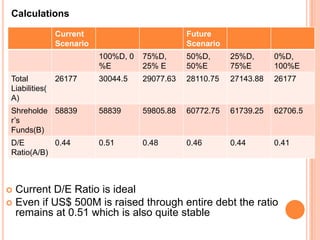
Calculations

                Current                          Future
                Scenario                         Scenario
                           100%D, 0   75%D,      50%D,      25%D,      0%D,
                           %E         25% E      50%E       75%E       100%E
 Total          26177      30044.5    29077.63   28110.75   27143.88   26177
 Liabilities(
 A)
 Shreholde 58839           58839      59805.88   60772.75   61739.25   62706.5
 r’s
 Funds(B)
 D/E        0.44           0.51       0.48       0.46       0.44       0.41
 Ratio(A/B)


 Current D/E Ratio is ideal
 Even if US$ 500M is raised through entire debt the ratio
  remains at 0.51 which is also quite stable
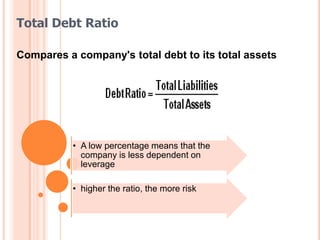
Total Debt Ratio

Compares a company's total debt to its total assets


           • A low percentage means that the
             company is less dependent on
             leverage

           • higher the ratio, the more risk
Calculations
              Current                          Future
              Scenario                         Scenario
                         100%D, 0% 75%D,       50%D,      25%D,      0%D,
                         E         25% E       50%E       75%E       100%E
Total         31503      35370.50   34403.63   33436.75   32469.88   31503
Liabilities
(A)
Shreholder’   58839      58839      59805.88   60772.75   61739.63   62706.5
s Funds(B)
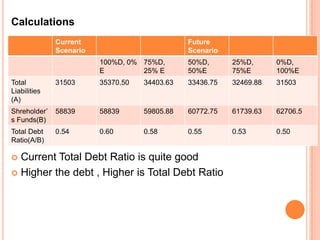
Inference0.54
Total Debt               0.60       0.58       0.55       0.53       0.50
Ratio(A/B)

 Current Total Debt Ratio is quite good
 Higher the debt , Higher is Total Debt Ratio
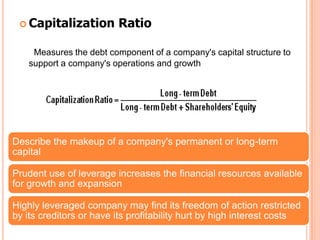
 Capitalization        Ratio

    Measures the debt component of a company's capital structure to
   support a company's operations and growth


Describe the makeup of a company's permanent or long-term
capital

Prudent use of leverage increases the financial resources available
for growth and expansion

Highly leveraged company may find its freedom of action restricted
by its creditors or have its profitability hurt by high interest costs
Calculations
               Current                         Future
               Scenario                        Scenario
                          100%D,    75%D,      50%D,      25%D,      0%D,
                          0%E       25% E      50%E       75%E       100%E
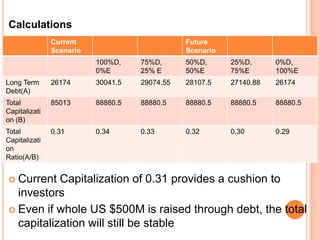
Long Term      26174      30041.5   29074.55   28107.5    27140.88   26174
Debt(A)
Total          85013      88880.5   88880.5    88880.5    88880.5    88880.5
Capitalizati
on (B)
Total          0.31       0.34      0.33       0.32       0.30       0.29
Capitalizati
Inference
on
Ratio(A/B)


 Current  Capitalization of 0.31 provides a cushion to
  investors
 Even if whole US $500M is raised through debt, the total
  capitalization will still be stable
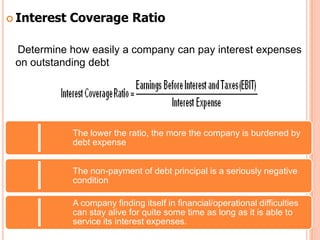
 Interest   Coverage Ratio

 Determine how easily a company can pay interest expenses
 on outstanding debt


             The lower the ratio, the more the company is burdened by
             debt expense


             The non-payment of debt principal is a seriously negative
             condition

             A company finding itself in financial/operational difficulties
             can stay alive for quite some time as long as it is able to
             service its interest expenses.
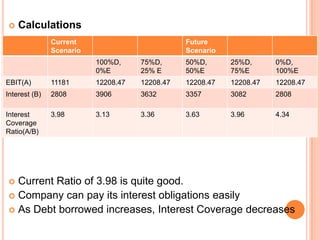
   Calculations
               Current                          Future
               Scenario                         Scenario
                          100%D,     75%D,      50%D,      25%D,      0%D,
                          0%E        25% E      50%E       75%E       100%E
EBIT(A)        11181      12208.47   12208.47   12208.47   12208.47   12208.47
Interest (B)   2808       3906       3632       3357       3082       2808

Interest       3.98       3.13       3.36       3.63       3.96       4.34
Coverage
Ratio(A/B)


 Current Ratio of 3.98 is quite good.
 Company can pay its interest obligations easily
 As Debt borrowed increases, Interest Coverage decreases
COMPARISONS
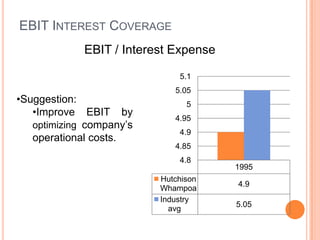
EBIT INTEREST COVERAGE
             EBIT / Interest Expense

                              5.1
                             5.05
•Suggestion:                    5
   •Improve EBIT by
                             4.95
   optimizing company’s
                              4.9
   operational costs.
                             4.85
                              4.8
                                       1995
                          Hutchison
                                       4.9
                          Whampoa
                          Industry
                                       5.05
                            avg
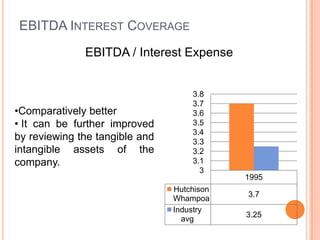
EBITDA INTEREST COVERAGE
              EBITDA / Interest Expense


                                    3.8
                                    3.7
•Comparatively better               3.6
• It can be further improved        3.5
                                    3.4
by reviewing the tangible and       3.3
intangible assets of the            3.2
company.                            3.1
                                      3
                                            1995
                                Hutchison
                                            3.7
                                Whampoa
                                Industry
                                            3.25
                                  avg
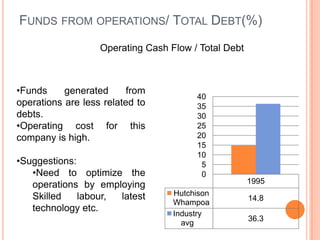
FUNDS FROM OPERATIONS/ TOTAL DEBT(%)
                   Operating Cash Flow / Total Debt


•Funds     generated      from
                                        40
operations are less related to          35
debts.                                  30
•Operating cost for this                25
company is high.                        20
                                        15
                                        10
•Suggestions:                            5
   •Need to optimize the                 0
   operations by employing                            1995
   Skilled    labour, latest       Hutchison
                                                      14.8
                                   Whampoa
   technology etc.
                                   Industry
                                                      36.3
                                     avg
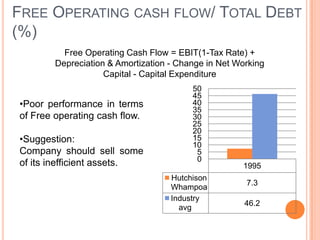
FREE OPERATING CASH FLOW/ TOTAL DEBT
(%)
          Free Operating Cash Flow = EBIT(1-Tax Rate) +
        Depreciation & Amortization - Change in Net Working
                    Capital - Capital Expenditure
                                         50
                                         45
•Poor performance in terms               40
                                         35
of Free operating cash flow.             30
                                         25
                                         20
•Suggestion:                             15
                                         10
Company should sell some                  5
                                          0
of its inefficient assets.                           1995
                                    Hutchison
                                                      7.3
                                    Whampoa
                                    Industry
                                                      46.2
                                      avg
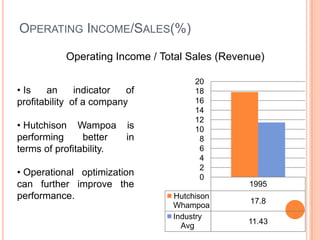
OPERATING INCOME/SALES(%)

           Operating Income / Total Sales (Revenue)

                                     20
• Is   an      indicator  of         18
profitability of a company           16
                                     14
                                     12
• Hutchison Wampoa        is         10
performing      better    in          8
terms of profitability.               6
                                      4
                                      2
• Operational optimization            0
can further improve the                        1995
performance.                    Hutchison
                                                17.8
                                Whampoa
                                Industry
                                               11.43
                                  Avg
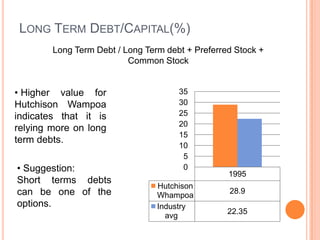
LONG TERM DEBT/CAPITAL(%)
        Long Term Debt / Long Term debt + Preferred Stock +
                          Common Stock


• Higher value for                    35
Hutchison Wampoa                      30
indicates that it is                  25
                                      20
relying more on long
                                      15
term debts.
                                      10
                                       5
• Suggestion:                          0
                                                  1995
Short terms debts
                                 Hutchison
can be one of the                                 28.9
                                 Whampoa
options.                         Industry
                                                  22.35
                                   avg
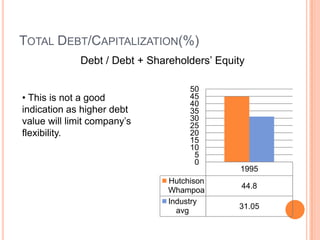
TOTAL DEBT/CAPITALIZATION(%)
             Debt / Debt + Shareholders’ Equity

                                    50
• This is not a good                45
                                    40
indication as higher debt           35
value will limit company’s          30
                                    25
flexibility.                        20
                                    15
                                    10
                                     5
                                     0
                                              1995
                               Hutchison
                                              44.8
                               Whampoa
                               Industry
                                             31.05
                                 avg
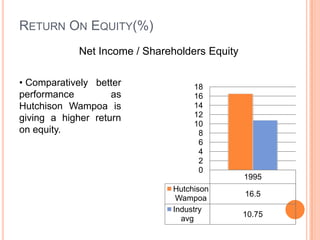
RETURN ON EQUITY(%)
            Net Income / Shareholders Equity

• Comparatively better             18
performance         as             16
Hutchison Wampoa is                14
giving a higher return             12
                                   10
on equity.                          8
                                    6
                                    4
                                    2
                                    0
                                               1995
                              Hutchison
                                               16.5
                               Wampoa
                              Industry
                                               10.75
                                avg
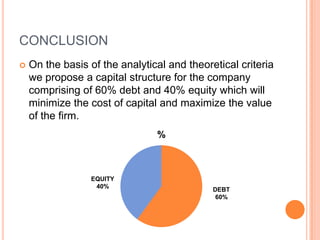
CONCLUSION
   On the basis of the analytical and theoretical criteria
    we propose a capital structure for the company
    comprising of 60% debt and 40% equity which will
    minimize the cost of capital and maximize the value
    of the firm.
                                %


                 EQUITY
                  40%
                                             DEBT
                                              60%
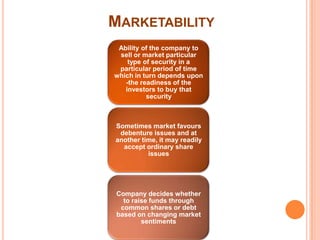
MARKETABILITY
 Ability of the company to
 sell or market particular
    type of security in a
 particular period of time
which in turn depends upon
   -the readiness of the
   investors to buy that
          security


Sometimes market favours
 debenture issues and at
another time, it may readily
  accept ordinary share
          issues


Company decides whether
  to raise funds through
 common shares or debt
based on changing market
        sentiments
FLOATATION COST

   Floatation costs are incurred when the funds are raised

   Cost of floating a debt is less than the cost of floating an
    equity issue, hence companies use debt rather than
    issuing ordinary shares

   If the owner's capital is increased by retaining the
    earnings, no floatation costs are incurred
THANK YOU

Group8 (1)

  • 1.
    ASSESSMENT OF CAPITALSTRUCTURE OF HUTCHISON WHAMPOA BASED ON FUTURE FINANCING NEEDS BY:- TANIA ROY – 423 NITIN MEHROTRA – 425 TANMAY MEHTA –527 UTKARSH VASHISHTA – 528 SAHIL VOHRA - 530
  • 2.
    WHAT IS CAPITALSTRUCTURE?  The term `capital structure' represents the total long-term investment in a business firm  Includes funds raised through  ordinary and preference shares  bonds  debentures  loans from financial institutions  Any earned revenue and capital surpluses are also included in the structure
  • 3.
    CAPITAL STRUCTURE CONSTITUTESOF CAPITAL STRUCTURE DEBTS EQUITY ORDINARY & RETAINED BONDS DEBENTURES PREFERENCE EARNINGS SHARES
  • 4.
    CAPITAL STRUCTURE FORAN ORGANISATION  Optimum capital structure should be planned in a manner that ensures that the market value of its shares is maximum  A number of factors influences the capital structure decision of a company and significant variations among industries and among' different companies  The judgment of the person or group of persons making the capital structure decision plays a crucial role  These factors are complex and qualitative as capital markets are not perfect and the decisions have to be taken knowing consequent risks
  • 5.
    FEATURES OF THECAPITAL STRUCTURE Planning is based on the interest of shareholders To be determined at initial stage Capital Structure decision is a continIous process
  • 6.
    COMPONENTS OF CAPITALSTRUCTURE THEREOTICAL ANALYTICAL  Profitability  Flexibility  EBIT-EPS relationship  ROI-ROE relationship  Cost of capital  Debt ratio  Size of the company  Debt-equity ratio  Marketability  Total capitalization ratio  Control  Interest coverage ratio  Cash Flow
  • 7.
    CASH FLOW  Conservatism related to the assessment of liability of fixed charges  Amount of fixed charges are high when large debt is employed  Debt should be raised only when provision for future cash flow exists  It is risky to employ sources of capital with fixed charges for companies whose cash inflows are unstable or unpredictable
  • 8.
    SIZE OF THECOMPANY Small Companies Large Companies  Finds it difficult to raise long-  Greater degree of term loans, available at a flexibility in designing its high rate of interest and on inconvenient terms capital structure  Restrictive covenants in  It can obtain loans at easy loans make their capital terms and can also issue structure quite inflexible ordinary shares,  The management thus preference shares and cannot run business freely debentures to the public  They have to depend on  Management can run owned capital and retained earnings for their long-term business more freely funds
  • 9.
    CAPITAL STRUCTURE DECISION THETARGET  Minimize the cost of capital  Maximize the value of the firm
  • 10.
    EBIT-EPS ANALYSIS  How sensitive is EPS to changes in EBIT under different financing alternatives EPS = [(EBIT – I)(1 - t)] / n I = interest burden t = tax rate n = number of equity shares
  • 11.
    Assumptions  Plan A:all debt, no equity shares  Plan B: 75% debt, 25% equity shares  Plan C: 50% debt, 50% equity shares  Plan D: 25% debt, 75% equity shares  Plan E: no debt, all equity shares  Interest rate = 9%  Tax rate = 14.71%
  • 12.
    Calculations A B C D E EBIT 12208.4 12208.47 12208.47 12208.47 12208.47 7 INTEREST 1098.76 824.07 549.38 274.69 0 EBT 11109.7 11384.4 11659.09 11933.78 12208.47 1 TAX 1634.23 1674.24 1715.05 1755.45 1795.86 EAT 9475.48 9709.76 9944.04 10178.33 10412.61 NO OF 4121.1 4140.9 ALL FIGURES IN HK$ MILLIONS 4160.72 4180.53 4200.35 SHARES EPS 2.3 2.34 2.39 2.43 2.48
  • 13.
    DEBT VS EPS Proportion of debt 2.5 2.48 2.46 2.44 2.42 2.4 EPS 2.38 2.36 2.34 2.32 2.3 2.28 0 0.2 0.4 0.6 0.8 1 1.2
  • 14.
    HUTCHISON’S CASE  Financingfrom cash on hand, internal cash generation  Long term projects, large capital requirements  Increased outstanding debts and capital commitments  Alternative source of financing  Appropriate mix of debt and equity
  • 15.
    ROI-ROE ANALYSIS  Relationship between return on investment and return on equity for different financing options ROE = [ROI + (ROI – r)D/E](1-t) r = cost of debt D/E = debt – equity ratio t = tax rate
  • 16.
    CALCULATIONS 1. D/E = 0.67 ROI 5% 9% 15% 20% ROE 1.98% 7.67% 16.22% 23.34% 2. D/E = 1 ROI 5% 9% 15% 20% ROE 0.85% 7.67% 17.9% 26.4% 3. D/E = 1.5 ROI 5% 9% 15% 20% ROE -0.85% 7.67% 20.17% 31.1%
  • 17.
    ROE VS ROI ROE 35 30 25 20 D/E=.67 15 D/E=1 D/E=1.5 10 5 0 5 9 15 20 -5 ROI
  • 18.
    COST OF CAPITAL Minimize the cost of capital  Depends on expected returns and risk  Rate of interest fixed and company legally bound to pay interest for debt holders  Rate of dividends not fixed and company not legally bound to pay dividends in case of shareholders  Debt – a cheaper source of funds  Tax deductibility of interest charge
  • 19.
    DEBT VS COSTOF CAPITAL Cost of capital Debt
  • 20.
    CONTROL  Existing management’sdesire to continue its control over the company  Risk of loss of control when new shares are issued  Use debt to avoid loss of control  49.9% shares owned by Cheung Kong holdings  New shares required – a very small percentage of existing shares  Loosing control was not really a problem for the company
  • 21.
    Ratios Debt-Equity Ratio Measurement of how much suppliers, lenders, creditors and obligors have committed to the company versus what the shareholders have committed Provides a general indication of a company's equity-liability relationship Large, well-established companies can push their liability structure to higher percentages without getting into trouble.
  • 22.
    Calculations Current Future Scenario Scenario 100%D, 0 75%D, 50%D, 25%D, 0%D, %E 25% E 50%E 75%E 100%E Total 26177 30044.5 29077.63 28110.75 27143.88 26177 Liabilities( A) Shreholde 58839 58839 59805.88 60772.75 61739.25 62706.5 r’s Funds(B) D/E 0.44 0.51 0.48 0.46 0.44 0.41 Ratio(A/B)  Current D/E Ratio is ideal  Even if US$ 500M is raised through entire debt the ratio remains at 0.51 which is also quite stable
  • 23.
    Total Debt Ratio Comparesa company's total debt to its total assets • A low percentage means that the company is less dependent on leverage • higher the ratio, the more risk
  • 24.
    Calculations Current Future Scenario Scenario 100%D, 0% 75%D, 50%D, 25%D, 0%D, E 25% E 50%E 75%E 100%E Total 31503 35370.50 34403.63 33436.75 32469.88 31503 Liabilities (A) Shreholder’ 58839 58839 59805.88 60772.75 61739.63 62706.5 s Funds(B) Inference0.54 Total Debt 0.60 0.58 0.55 0.53 0.50 Ratio(A/B)  Current Total Debt Ratio is quite good  Higher the debt , Higher is Total Debt Ratio
  • 25.
     Capitalization Ratio Measures the debt component of a company's capital structure to support a company's operations and growth Describe the makeup of a company's permanent or long-term capital Prudent use of leverage increases the financial resources available for growth and expansion Highly leveraged company may find its freedom of action restricted by its creditors or have its profitability hurt by high interest costs
  • 26.
    Calculations Current Future Scenario Scenario 100%D, 75%D, 50%D, 25%D, 0%D, 0%E 25% E 50%E 75%E 100%E Long Term 26174 30041.5 29074.55 28107.5 27140.88 26174 Debt(A) Total 85013 88880.5 88880.5 88880.5 88880.5 88880.5 Capitalizati on (B) Total 0.31 0.34 0.33 0.32 0.30 0.29 Capitalizati Inference on Ratio(A/B)  Current Capitalization of 0.31 provides a cushion to investors  Even if whole US $500M is raised through debt, the total capitalization will still be stable
  • 27.
     Interest Coverage Ratio Determine how easily a company can pay interest expenses on outstanding debt The lower the ratio, the more the company is burdened by debt expense The non-payment of debt principal is a seriously negative condition A company finding itself in financial/operational difficulties can stay alive for quite some time as long as it is able to service its interest expenses.
  • 28.
    Calculations Current Future Scenario Scenario 100%D, 75%D, 50%D, 25%D, 0%D, 0%E 25% E 50%E 75%E 100%E EBIT(A) 11181 12208.47 12208.47 12208.47 12208.47 12208.47 Interest (B) 2808 3906 3632 3357 3082 2808 Interest 3.98 3.13 3.36 3.63 3.96 4.34 Coverage Ratio(A/B)  Current Ratio of 3.98 is quite good.  Company can pay its interest obligations easily  As Debt borrowed increases, Interest Coverage decreases
  • 29.
  • 30.
    EBIT INTEREST COVERAGE EBIT / Interest Expense 5.1 5.05 •Suggestion: 5 •Improve EBIT by 4.95 optimizing company’s 4.9 operational costs. 4.85 4.8 1995 Hutchison 4.9 Whampoa Industry 5.05 avg
  • 31.
    EBITDA INTEREST COVERAGE EBITDA / Interest Expense 3.8 3.7 •Comparatively better 3.6 • It can be further improved 3.5 3.4 by reviewing the tangible and 3.3 intangible assets of the 3.2 company. 3.1 3 1995 Hutchison 3.7 Whampoa Industry 3.25 avg
  • 32.
    FUNDS FROM OPERATIONS/TOTAL DEBT(%) Operating Cash Flow / Total Debt •Funds generated from 40 operations are less related to 35 debts. 30 •Operating cost for this 25 company is high. 20 15 10 •Suggestions: 5 •Need to optimize the 0 operations by employing 1995 Skilled labour, latest Hutchison 14.8 Whampoa technology etc. Industry 36.3 avg
  • 33.
    FREE OPERATING CASHFLOW/ TOTAL DEBT (%) Free Operating Cash Flow = EBIT(1-Tax Rate) + Depreciation & Amortization - Change in Net Working Capital - Capital Expenditure 50 45 •Poor performance in terms 40 35 of Free operating cash flow. 30 25 20 •Suggestion: 15 10 Company should sell some 5 0 of its inefficient assets. 1995 Hutchison 7.3 Whampoa Industry 46.2 avg
  • 34.
    OPERATING INCOME/SALES(%) Operating Income / Total Sales (Revenue) 20 • Is an indicator of 18 profitability of a company 16 14 12 • Hutchison Wampoa is 10 performing better in 8 terms of profitability. 6 4 2 • Operational optimization 0 can further improve the 1995 performance. Hutchison 17.8 Whampoa Industry 11.43 Avg
  • 35.
    LONG TERM DEBT/CAPITAL(%) Long Term Debt / Long Term debt + Preferred Stock + Common Stock • Higher value for 35 Hutchison Wampoa 30 indicates that it is 25 20 relying more on long 15 term debts. 10 5 • Suggestion: 0 1995 Short terms debts Hutchison can be one of the 28.9 Whampoa options. Industry 22.35 avg
  • 36.
    TOTAL DEBT/CAPITALIZATION(%) Debt / Debt + Shareholders’ Equity 50 • This is not a good 45 40 indication as higher debt 35 value will limit company’s 30 25 flexibility. 20 15 10 5 0 1995 Hutchison 44.8 Whampoa Industry 31.05 avg
  • 37.
    RETURN ON EQUITY(%) Net Income / Shareholders Equity • Comparatively better 18 performance as 16 Hutchison Wampoa is 14 giving a higher return 12 10 on equity. 8 6 4 2 0 1995 Hutchison 16.5 Wampoa Industry 10.75 avg
  • 38.
    CONCLUSION  On the basis of the analytical and theoretical criteria we propose a capital structure for the company comprising of 60% debt and 40% equity which will minimize the cost of capital and maximize the value of the firm. % EQUITY 40% DEBT 60%
  • 39.
    MARKETABILITY Ability ofthe company to sell or market particular type of security in a particular period of time which in turn depends upon -the readiness of the investors to buy that security Sometimes market favours debenture issues and at another time, it may readily accept ordinary share issues Company decides whether to raise funds through common shares or debt based on changing market sentiments
  • 40.
    FLOATATION COST  Floatation costs are incurred when the funds are raised  Cost of floating a debt is less than the cost of floating an equity issue, hence companies use debt rather than issuing ordinary shares  If the owner's capital is increased by retaining the earnings, no floatation costs are incurred
  • 41.

Editor's Notes

  • #31 Increasing the operating income by optimizing its operational costs.
  • #32 Comparatively better, and the company should look forward towards improving it.
  • #33 Funds generated from operations are less.
  • #34 Poor performance in terms of Free operating cash flow.Suggestion:Company should not plan for expansion for its near future.
  • #36 SuggestionEmphasis should be more on Short term debt and equity
  • #38 Comparatively better performance