RATIO ANALYSIS
Jyoti Jhajhra
Assistant Professor
Govt. College Bhattu Kalan
Meaning of Ratio
A ratio is a simple arithmetical expression of
the relationship of one number to another.
Also it can be expressed as ;
ratio is one number expressed in terms of
another and can be worked out by dividing
one number into the another.
RATIO ANALYSIS
Ratio analysis is a
technique of analysis
and interpretation of
financial statements
for helping in
decision making.
INTERPRETATION
• Single absolute ratio
• Group of ratios
• Historical comparison
• Inter firm comparison
USES OR SIGNIFICANCE
• Managerial uses
- help in decision making
- financial forecasting and planning
- help in coordination
- help in control
• Utility to shareholder
• Utility to creditors
• Utility to employees
LIMITATION
• Limited use of single ratio
• Lack of adequate standard
• Change of accounting procedure
• Personal bias
• Uncomparable
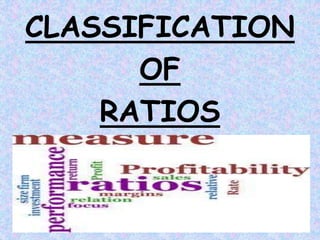
CLASSIFICATION
OF
RATIOS
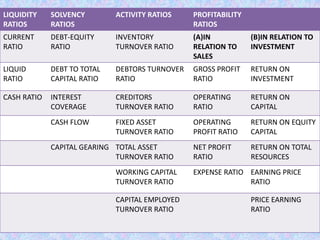
LIQUIDITY
RATIOS
SOLVENCY
RATIOS
ACTIVITY RATIOS PROFITABILITY
RATIOS
CURRENT
RATIO
DEBT-EQUITY
RATIO
INVENTORY
TURNOVER RATIO
(A)IN
RELATION TO
SALES
(B)IN RELATION TO
INVESTMENT
LIQUID
RATIO
DEBT TO TOTAL
CAPITAL RATIO
DEBTORS TURNOVER
RATIO
GROSS PROFIT
RATIO
RETURN ON
INVESTMENT
CASH RATIO INTEREST
COVERAGE
CREDITORS
TURNOVER RATIO
OPERATING
RATIO
RETURN ON
CAPITAL
CASH FLOW FIXED ASSET
TURNOVER RATIO
OPERATING
PROFIT RATIO
RETURN ON EQUITY
CAPITAL
CAPITAL GEARING TOTAL ASSET
TURNOVER RATIO
NET PROFIT
RATIO
RETURN ON TOTAL
RESOURCES
WORKING CAPITAL
TURNOVER RATIO
EXPENSE RATIO EARNING PRICE
RATIO
CAPITAL EMPLOYED
TURNOVER RATIO
PRICE EARNING
RATIO
(1.) LIQUIDITY RATIOS
Liquidity refers to the ability of the concern to
meet its current obligation as and when
these become due.
To measure the liquidity of the firm following
ratios are calculated:
 Current ratio
 Quick or acid test or liquidity ratio
 Cash ratio
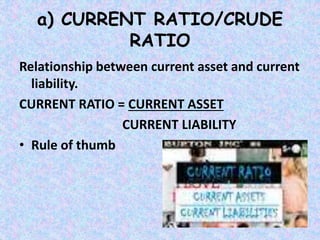
a) CURRENT RATIO/CRUDE
RATIO
Relationship between current asset and current
liability.
CURRENT RATIO = CURRENT ASSET
CURRENT LIABILITY
• Rule of thumb
b) QUICK /ACID
TEST/LIQUID RATIO
It is more rigorous test of liquidity than the
current ratio. It is the relationship between
liquid asset and quick asset and current
liabilities.
QUICK RATIO = LIQUID ASSET
CURRENT LIABILITIES
 Rule of thumb 1:1
c) CASH RATIO OR ABSOLUTE
LIQUID RATIO
CASH RATIO = ABSOLUTE LIQUID ASSET
CURRENT LIABILITIES
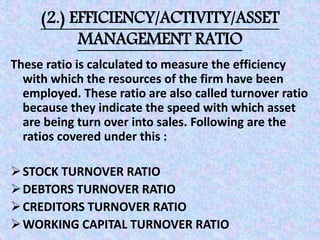
(2.) EFFICIENCY/ACTIVITY/ASSET
MANAGEMENT RATIO
These ratio is calculated to measure the efficiency
with which the resources of the firm have been
employed. These ratio are also called turnover ratio
because they indicate the speed with which asset
are being turn over into sales. Following are the
ratios covered under this :
STOCK TURNOVER RATIO
DEBTORS TURNOVER RATIO
CREDITORS TURNOVER RATIO
WORKING CAPITAL TURNOVER RATIO
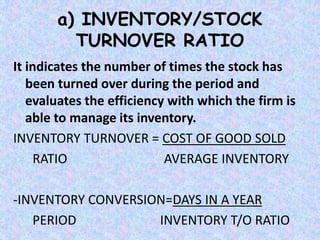
a) INVENTORY/STOCK
TURNOVER RATIO
It indicates the number of times the stock has
been turned over during the period and
evaluates the efficiency with which the firm is
able to manage its inventory.
INVENTORY TURNOVER = COST OF GOOD SOLD
RATIO AVERAGE INVENTORY
-INVENTORY CONVERSION=DAYS IN A YEAR
PERIOD INVENTORY T/O RATIO
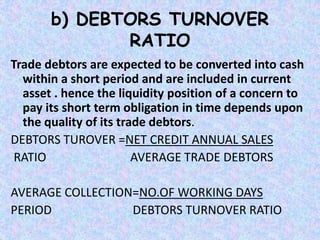
b) DEBTORS TURNOVER
RATIO
Trade debtors are expected to be converted into cash
within a short period and are included in current
asset . hence the liquidity position of a concern to
pay its short term obligation in time depends upon
the quality of its trade debtors.
DEBTORS TUROVER =NET CREDIT ANNUAL SALES
RATIO AVERAGE TRADE DEBTORS
AVERAGE COLLECTION=NO.OF WORKING DAYS
PERIOD DEBTORS TURNOVER RATIO
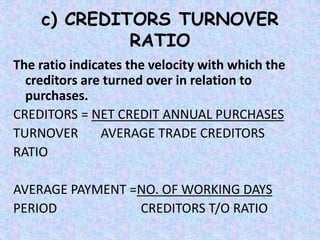
c) CREDITORS TURNOVER
RATIO
The ratio indicates the velocity with which the
creditors are turned over in relation to
purchases.
CREDITORS = NET CREDIT ANNUAL PURCHASES
TURNOVER AVERAGE TRADE CREDITORS
RATIO
AVERAGE PAYMENT =NO. OF WORKING DAYS
PERIOD CREDITORS T/O RATIO
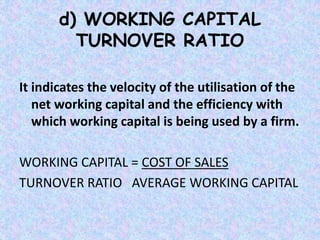
d) WORKING CAPITAL
TURNOVER RATIO
It indicates the velocity of the utilisation of the
net working capital and the efficiency with
which working capital is being used by a firm.
WORKING CAPITAL = COST OF SALES
TURNOVER RATIO AVERAGE WORKING CAPITAL
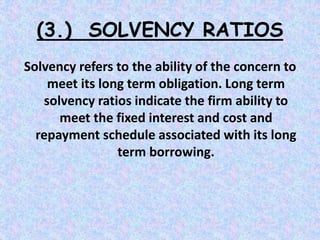
(3.) SOLVENCY RATIOS
Solvency refers to the ability of the concern to
meet its long term obligation. Long term
solvency ratios indicate the firm ability to
meet the fixed interest and cost and
repayment schedule associated with its long
term borrowing.
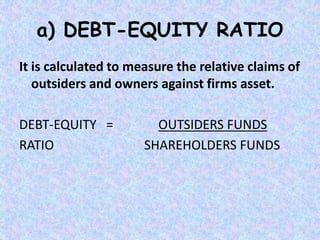
It is calculated to measure the relative claims of
outsiders and owners against firms asset.
DEBT-EQUITY = OUTSIDERS FUNDS
RATIO SHAREHOLDERS FUNDS
a) DEBT-EQUITY RATIO
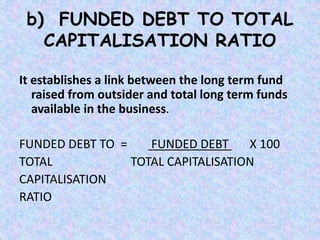
b) FUNDED DEBT TO TOTAL
CAPITALISATION RATIO
It establishes a link between the long term fund
raised from outsider and total long term funds
available in the business.
FUNDED DEBT TO = FUNDED DEBT X 100
TOTAL TOTAL CAPITALISATION
CAPITALISATION
RATIO
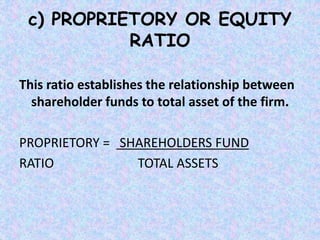
c) PROPRIETORY OR EQUITY
RATIO
This ratio establishes the relationship between
shareholder funds to total asset of the firm.
PROPRIETORY = SHAREHOLDERS FUND
RATIO TOTAL ASSETS
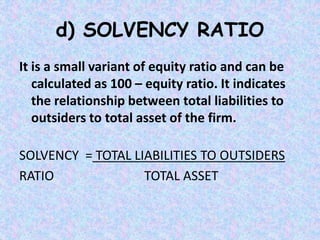
d) SOLVENCY RATIO
It is a small variant of equity ratio and can be
calculated as 100 – equity ratio. It indicates
the relationship between total liabilities to
outsiders to total asset of the firm.
SOLVENCY = TOTAL LIABILITIES TO OUTSIDERS
RATIO TOTAL ASSET
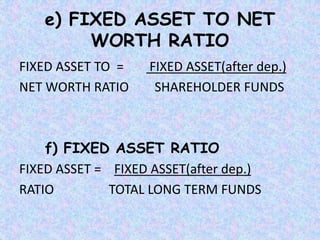
e) FIXED ASSET TO NET
WORTH RATIO
FIXED ASSET TO = FIXED ASSET(after dep.)
NET WORTH RATIO SHAREHOLDER FUNDS
f) FIXED ASSET RATIO
FIXED ASSET = FIXED ASSET(after dep.)
RATIO TOTAL LONG TERM FUNDS
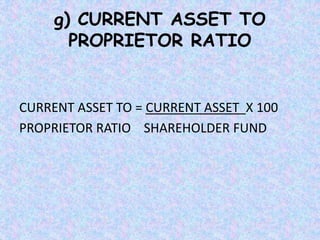
g) CURRENT ASSET TO
PROPRIETOR RATIO
CURRENT ASSET TO = CURRENT ASSET X 100
PROPRIETOR RATIO SHAREHOLDER FUND
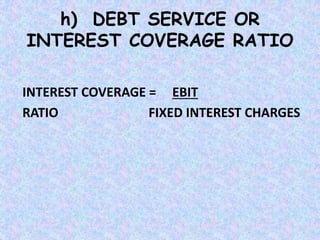
h) DEBT SERVICE OR
INTEREST COVERAGE RATIO
INTEREST COVERAGE = EBIT
RATIO FIXED INTEREST CHARGES
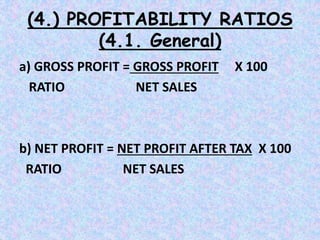
(4.) PROFITABILITY RATIOS
(4.1. General)
a) GROSS PROFIT = GROSS PROFIT X 100
RATIO NET SALES
b) NET PROFIT = NET PROFIT AFTER TAX X 100
RATIO NET SALES
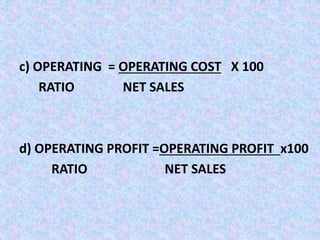
c) OPERATING = OPERATING COST X 100
RATIO NET SALES
d) OPERATING PROFIT =OPERATING PROFIT x100
RATIO NET SALES
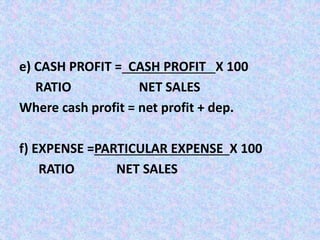
e) CASH PROFIT = CASH PROFIT X 100
RATIO NET SALES
Where cash profit = net profit + dep.
f) EXPENSE =PARTICULAR EXPENSE X 100
RATIO NET SALES
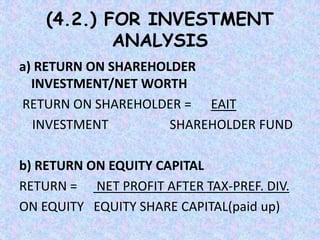
(4.2.) FOR INVESTMENT
ANALYSIS
a) RETURN ON SHAREHOLDER
INVESTMENT/NET WORTH
RETURN ON SHAREHOLDER = EAIT
INVESTMENT SHAREHOLDER FUND
b) RETURN ON EQUITY CAPITAL
RETURN = NET PROFIT AFTER TAX-PREF. DIV.
ON EQUITY EQUITY SHARE CAPITAL(paid up)
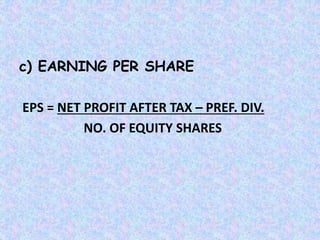
c) EARNING PER SHARE
EPS = NET PROFIT AFTER TAX – PREF. DIV.
NO. OF EQUITY SHARES
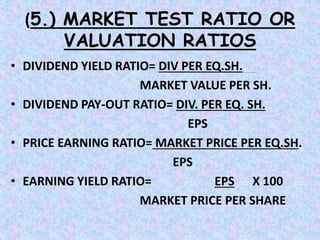
(5.) MARKET TEST RATIO OR
VALUATION RATIOS
• DIVIDEND YIELD RATIO= DIV PER EQ.SH.
MARKET VALUE PER SH.
• DIVIDEND PAY-OUT RATIO= DIV. PER EQ. SH.
EPS
• PRICE EARNING RATIO= MARKET PRICE PER EQ.SH.
EPS
• EARNING YIELD RATIO= EPS X 100
MARKET PRICE PER SHARE
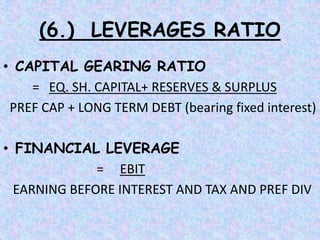
(6.) LEVERAGES RATIO
• CAPITAL GEARING RATIO
= EQ. SH. CAPITAL+ RESERVES & SURPLUS
PREF CAP + LONG TERM DEBT (bearing fixed interest)
• FINANCIAL LEVERAGE
= EBIT
EARNING BEFORE INTEREST AND TAX AND PREF DIV
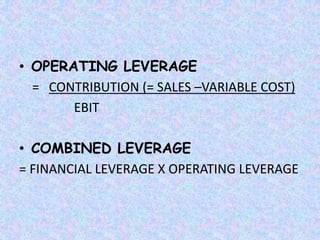
• OPERATING LEVERAGE
= CONTRIBUTION (= SALES –VARIABLE COST)
EBIT
• COMBINED LEVERAGE
= FINANCIAL LEVERAGE X OPERATING LEVERAGE
THANK YOU…

Ratio analysis

  • 1.
    RATIO ANALYSIS Jyoti Jhajhra AssistantProfessor Govt. College Bhattu Kalan
  • 2.
    Meaning of Ratio Aratio is a simple arithmetical expression of the relationship of one number to another. Also it can be expressed as ; ratio is one number expressed in terms of another and can be worked out by dividing one number into the another.
  • 3.
    RATIO ANALYSIS Ratio analysisis a technique of analysis and interpretation of financial statements for helping in decision making.
  • 4.
    INTERPRETATION • Single absoluteratio • Group of ratios • Historical comparison • Inter firm comparison
  • 5.
    USES OR SIGNIFICANCE •Managerial uses - help in decision making - financial forecasting and planning - help in coordination - help in control • Utility to shareholder • Utility to creditors • Utility to employees
  • 6.
    LIMITATION • Limited useof single ratio • Lack of adequate standard • Change of accounting procedure • Personal bias • Uncomparable
  • 7.
  • 8.
    LIQUIDITY RATIOS SOLVENCY RATIOS ACTIVITY RATIOS PROFITABILITY RATIOS CURRENT RATIO DEBT-EQUITY RATIO INVENTORY TURNOVERRATIO (A)IN RELATION TO SALES (B)IN RELATION TO INVESTMENT LIQUID RATIO DEBT TO TOTAL CAPITAL RATIO DEBTORS TURNOVER RATIO GROSS PROFIT RATIO RETURN ON INVESTMENT CASH RATIO INTEREST COVERAGE CREDITORS TURNOVER RATIO OPERATING RATIO RETURN ON CAPITAL CASH FLOW FIXED ASSET TURNOVER RATIO OPERATING PROFIT RATIO RETURN ON EQUITY CAPITAL CAPITAL GEARING TOTAL ASSET TURNOVER RATIO NET PROFIT RATIO RETURN ON TOTAL RESOURCES WORKING CAPITAL TURNOVER RATIO EXPENSE RATIO EARNING PRICE RATIO CAPITAL EMPLOYED TURNOVER RATIO PRICE EARNING RATIO
  • 9.
    (1.) LIQUIDITY RATIOS Liquidityrefers to the ability of the concern to meet its current obligation as and when these become due. To measure the liquidity of the firm following ratios are calculated:  Current ratio  Quick or acid test or liquidity ratio  Cash ratio
  • 10.
    a) CURRENT RATIO/CRUDE RATIO Relationshipbetween current asset and current liability. CURRENT RATIO = CURRENT ASSET CURRENT LIABILITY • Rule of thumb
  • 11.
    b) QUICK /ACID TEST/LIQUIDRATIO It is more rigorous test of liquidity than the current ratio. It is the relationship between liquid asset and quick asset and current liabilities. QUICK RATIO = LIQUID ASSET CURRENT LIABILITIES  Rule of thumb 1:1
  • 12.
    c) CASH RATIOOR ABSOLUTE LIQUID RATIO CASH RATIO = ABSOLUTE LIQUID ASSET CURRENT LIABILITIES
  • 13.
    (2.) EFFICIENCY/ACTIVITY/ASSET MANAGEMENT RATIO Theseratio is calculated to measure the efficiency with which the resources of the firm have been employed. These ratio are also called turnover ratio because they indicate the speed with which asset are being turn over into sales. Following are the ratios covered under this : STOCK TURNOVER RATIO DEBTORS TURNOVER RATIO CREDITORS TURNOVER RATIO WORKING CAPITAL TURNOVER RATIO
  • 14.
    a) INVENTORY/STOCK TURNOVER RATIO Itindicates the number of times the stock has been turned over during the period and evaluates the efficiency with which the firm is able to manage its inventory. INVENTORY TURNOVER = COST OF GOOD SOLD RATIO AVERAGE INVENTORY -INVENTORY CONVERSION=DAYS IN A YEAR PERIOD INVENTORY T/O RATIO
  • 15.
    b) DEBTORS TURNOVER RATIO Tradedebtors are expected to be converted into cash within a short period and are included in current asset . hence the liquidity position of a concern to pay its short term obligation in time depends upon the quality of its trade debtors. DEBTORS TUROVER =NET CREDIT ANNUAL SALES RATIO AVERAGE TRADE DEBTORS AVERAGE COLLECTION=NO.OF WORKING DAYS PERIOD DEBTORS TURNOVER RATIO
  • 16.
    c) CREDITORS TURNOVER RATIO Theratio indicates the velocity with which the creditors are turned over in relation to purchases. CREDITORS = NET CREDIT ANNUAL PURCHASES TURNOVER AVERAGE TRADE CREDITORS RATIO AVERAGE PAYMENT =NO. OF WORKING DAYS PERIOD CREDITORS T/O RATIO
  • 17.
    d) WORKING CAPITAL TURNOVERRATIO It indicates the velocity of the utilisation of the net working capital and the efficiency with which working capital is being used by a firm. WORKING CAPITAL = COST OF SALES TURNOVER RATIO AVERAGE WORKING CAPITAL
  • 18.
    (3.) SOLVENCY RATIOS Solvencyrefers to the ability of the concern to meet its long term obligation. Long term solvency ratios indicate the firm ability to meet the fixed interest and cost and repayment schedule associated with its long term borrowing.
  • 19.
    It is calculatedto measure the relative claims of outsiders and owners against firms asset. DEBT-EQUITY = OUTSIDERS FUNDS RATIO SHAREHOLDERS FUNDS a) DEBT-EQUITY RATIO
  • 20.
    b) FUNDED DEBTTO TOTAL CAPITALISATION RATIO It establishes a link between the long term fund raised from outsider and total long term funds available in the business. FUNDED DEBT TO = FUNDED DEBT X 100 TOTAL TOTAL CAPITALISATION CAPITALISATION RATIO
  • 21.
    c) PROPRIETORY OREQUITY RATIO This ratio establishes the relationship between shareholder funds to total asset of the firm. PROPRIETORY = SHAREHOLDERS FUND RATIO TOTAL ASSETS
  • 22.
    d) SOLVENCY RATIO Itis a small variant of equity ratio and can be calculated as 100 – equity ratio. It indicates the relationship between total liabilities to outsiders to total asset of the firm. SOLVENCY = TOTAL LIABILITIES TO OUTSIDERS RATIO TOTAL ASSET
  • 23.
    e) FIXED ASSETTO NET WORTH RATIO FIXED ASSET TO = FIXED ASSET(after dep.) NET WORTH RATIO SHAREHOLDER FUNDS f) FIXED ASSET RATIO FIXED ASSET = FIXED ASSET(after dep.) RATIO TOTAL LONG TERM FUNDS
  • 24.
    g) CURRENT ASSETTO PROPRIETOR RATIO CURRENT ASSET TO = CURRENT ASSET X 100 PROPRIETOR RATIO SHAREHOLDER FUND
  • 25.
    h) DEBT SERVICEOR INTEREST COVERAGE RATIO INTEREST COVERAGE = EBIT RATIO FIXED INTEREST CHARGES
  • 26.
    (4.) PROFITABILITY RATIOS (4.1.General) a) GROSS PROFIT = GROSS PROFIT X 100 RATIO NET SALES b) NET PROFIT = NET PROFIT AFTER TAX X 100 RATIO NET SALES
  • 27.
    c) OPERATING =OPERATING COST X 100 RATIO NET SALES d) OPERATING PROFIT =OPERATING PROFIT x100 RATIO NET SALES
  • 28.
    e) CASH PROFIT= CASH PROFIT X 100 RATIO NET SALES Where cash profit = net profit + dep. f) EXPENSE =PARTICULAR EXPENSE X 100 RATIO NET SALES
  • 29.
    (4.2.) FOR INVESTMENT ANALYSIS a)RETURN ON SHAREHOLDER INVESTMENT/NET WORTH RETURN ON SHAREHOLDER = EAIT INVESTMENT SHAREHOLDER FUND b) RETURN ON EQUITY CAPITAL RETURN = NET PROFIT AFTER TAX-PREF. DIV. ON EQUITY EQUITY SHARE CAPITAL(paid up)
  • 30.
    c) EARNING PERSHARE EPS = NET PROFIT AFTER TAX – PREF. DIV. NO. OF EQUITY SHARES
  • 31.
    (5.) MARKET TESTRATIO OR VALUATION RATIOS • DIVIDEND YIELD RATIO= DIV PER EQ.SH. MARKET VALUE PER SH. • DIVIDEND PAY-OUT RATIO= DIV. PER EQ. SH. EPS • PRICE EARNING RATIO= MARKET PRICE PER EQ.SH. EPS • EARNING YIELD RATIO= EPS X 100 MARKET PRICE PER SHARE
  • 32.
    (6.) LEVERAGES RATIO •CAPITAL GEARING RATIO = EQ. SH. CAPITAL+ RESERVES & SURPLUS PREF CAP + LONG TERM DEBT (bearing fixed interest) • FINANCIAL LEVERAGE = EBIT EARNING BEFORE INTEREST AND TAX AND PREF DIV
  • 33.
    • OPERATING LEVERAGE =CONTRIBUTION (= SALES –VARIABLE COST) EBIT • COMBINED LEVERAGE = FINANCIAL LEVERAGE X OPERATING LEVERAGE
  • 34.