DIVIDEND POLICYThe term dividend refers to that part of divisible profits of a company which is distributed among its shareholder.Policy means plan of action.
DIFFERENT TYPES OF DIVIDENDCash DividendStock DividendBond DividendProperty DividendComposite DividendOptional DividendInterim DividendExtra or Special Dividend
DIVIDEND THEORIESMILLER AND MODIGLIANI APPROACHDividend decision is irrelevant so far the valuation of the firm is considered.Value of the firm depends on its earning potential and investment policy.When investment decision of the firm is given, dividend decision is of no significance in determining the value of the firm.
ASSUMPTIONSThe capital market is perfect.Investors behave rationally.The firm has fixed investment policy.Risk or uncertainty does not exist.There are either no taxes or there are differences in tax rates applicable to dividends and capital gains.
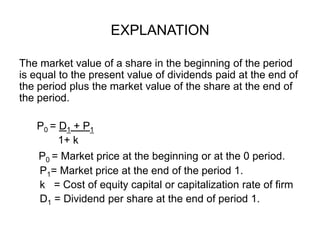
EXPLANATIONThe market value of a share in the beginning of the period is equal to the present value of dividends paid at the end of the period plus the market value of the share at the end of the period.      P0 = D1 + P11+ kP0 = Market price at the beginning or at the 0 period.      P1= Market price at the end of the period 1.k   = Cost of equity capital or capitalization rate of firm      D1 = Dividend per share at the end of period 1.
CRITICISMPerfect capital Markets.Tax differentials.Floatation Cost.Transaction Cost.Uncertainty.
WALTER’S APPROACHChoice of dividend policy affects the value of the firm.Payment of dividend may have negative or positive impact on the price of the share of the company.He argues that in the long run, share prices reflect only the present value of the expected return.
ASSUMPTIONSMarket value of shares is affected by present values of future anticipated dividends.Retained earnings of the business affect the dividend to be received in future and it also effects the market price of shares.The firms business risk does not change with additional investment.The firm finances all its investments through retained earnings, debt and new equity is not issued.All earnings are either distributed as dividends or invested internally immediately.The firm has a very long or infinite life.
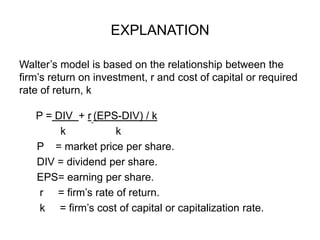
EXPLANATIONWalter’s model is based on the relationship between the firm’s return on investment, r and cost of capital or required rate of return, k     P = DIV  + r(EPS-DIV) / k              k                 k      P    = market price per share.      DIV = dividend per share.     EPS= earning per share.       r     = firm’s rate of return.      k     = firm’s cost of capital or capitalization rate.
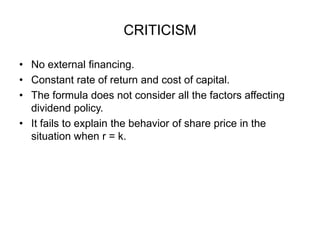
CRITICISMNo external financing.Constant rate of return and cost of capital.The formula does not consider all the factors affecting dividend policy.It fails to explain the behavior of share price in the situation when r = k.
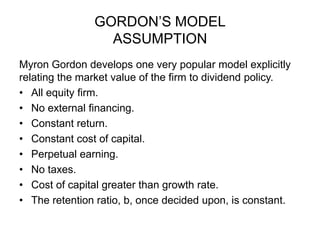
GORDON’S MODELASSUMPTIONMyron Gordon develops one very popular model explicitly relating the market value of the firm to dividend policy.All equity firm.No external financing.Constant return.Constant cost of capital.Perpetual earning.No taxes.Cost of capital greater than growth rate.The retention ratio, b, once decided upon, is constant.
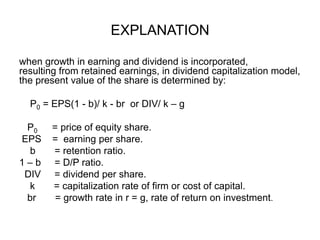
EXPLANATIONwhen growth in earning and dividend is incorporated,        resulting from retained earnings, in dividend capitalization model, the present value of the share is determined by:    P0 = EPS(1 - b)/ k - br  or DIV/ k – g   P0        = price of equity share. EPS    =  earning per share.   b       = retention ratio.1 – b     = D/P ratio. DIV     = dividend per share.    k       = capitalization rate of firm or cost of capital.br       = growth rate in r = g, rate of return on investment.

Dippla

  • 1.
    DIVIDEND POLICYThe termdividend refers to that part of divisible profits of a company which is distributed among its shareholder.Policy means plan of action.
  • 2.
    DIFFERENT TYPES OFDIVIDENDCash DividendStock DividendBond DividendProperty DividendComposite DividendOptional DividendInterim DividendExtra or Special Dividend
  • 3.
    DIVIDEND THEORIESMILLER ANDMODIGLIANI APPROACHDividend decision is irrelevant so far the valuation of the firm is considered.Value of the firm depends on its earning potential and investment policy.When investment decision of the firm is given, dividend decision is of no significance in determining the value of the firm.
  • 4.
    ASSUMPTIONSThe capital marketis perfect.Investors behave rationally.The firm has fixed investment policy.Risk or uncertainty does not exist.There are either no taxes or there are differences in tax rates applicable to dividends and capital gains.
  • 5.
    EXPLANATIONThe market valueof a share in the beginning of the period is equal to the present value of dividends paid at the end of the period plus the market value of the share at the end of the period. P0 = D1 + P11+ kP0 = Market price at the beginning or at the 0 period. P1= Market price at the end of the period 1.k = Cost of equity capital or capitalization rate of firm D1 = Dividend per share at the end of period 1.
  • 6.
    CRITICISMPerfect capital Markets.Taxdifferentials.Floatation Cost.Transaction Cost.Uncertainty.
  • 7.
    WALTER’S APPROACHChoice ofdividend policy affects the value of the firm.Payment of dividend may have negative or positive impact on the price of the share of the company.He argues that in the long run, share prices reflect only the present value of the expected return.
  • 8.
    ASSUMPTIONSMarket value ofshares is affected by present values of future anticipated dividends.Retained earnings of the business affect the dividend to be received in future and it also effects the market price of shares.The firms business risk does not change with additional investment.The firm finances all its investments through retained earnings, debt and new equity is not issued.All earnings are either distributed as dividends or invested internally immediately.The firm has a very long or infinite life.
  • 9.
    EXPLANATIONWalter’s model isbased on the relationship between the firm’s return on investment, r and cost of capital or required rate of return, k P = DIV + r(EPS-DIV) / k k k P = market price per share. DIV = dividend per share. EPS= earning per share. r = firm’s rate of return. k = firm’s cost of capital or capitalization rate.
  • 10.
    CRITICISMNo external financing.Constantrate of return and cost of capital.The formula does not consider all the factors affecting dividend policy.It fails to explain the behavior of share price in the situation when r = k.
  • 11.
    GORDON’S MODELASSUMPTIONMyron Gordondevelops one very popular model explicitly relating the market value of the firm to dividend policy.All equity firm.No external financing.Constant return.Constant cost of capital.Perpetual earning.No taxes.Cost of capital greater than growth rate.The retention ratio, b, once decided upon, is constant.
  • 12.
    EXPLANATIONwhen growth inearning and dividend is incorporated, resulting from retained earnings, in dividend capitalization model, the present value of the share is determined by: P0 = EPS(1 - b)/ k - br or DIV/ k – g P0 = price of equity share. EPS = earning per share. b = retention ratio.1 – b = D/P ratio. DIV = dividend per share. k = capitalization rate of firm or cost of capital.br = growth rate in r = g, rate of return on investment.