STOCK RETURN AND VALUATION
Features of Equity shares: 
 Uncertainty 
 No Redemption 
 Relation with earning of the company 
Approaches to valuation: 
 Accounting concept of valuation 
 Valuation based on dividends 
 Valuation based on earnings
ACCOUNTING CONCEPT OF VALUATION 
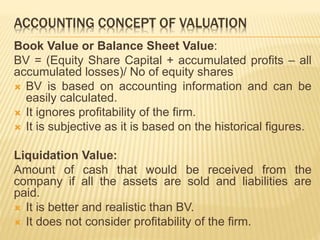
Book Value or Balance Sheet Value: 
BV = (Equity Share Capital + accumulated profits – all 
accumulated losses)/ No of equity shares 
 BV is based on accounting information and can be 
easily calculated. 
 It ignores profitability of the firm. 
 It is subjective as it is based on the historical figures. 
Liquidation Value: 
Amount of cash that would be received from the 
company if all the assets are sold and liabilities are 
paid. 
 It is better and realistic than BV. 
 It does not consider profitability of the firm.
VALUATION OF EQUITY SHARES BASED ON 
DIVIDENDS 
Assumptions: 
 The dividends are payable annually 
 The first dividend is received after one year 
from the date of acquisition/purchase 
 Sale of equity share, if any, occurs only at the 
end of a year
HOLDING PERIOD RETURN 
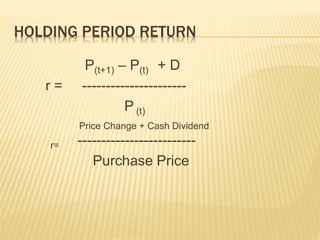
P(t+1) – P(t) + D 
r = ---------------------- 
P(t) 
Price Change + Cash Dividend 
r= ------------------------- 
Purchase Price
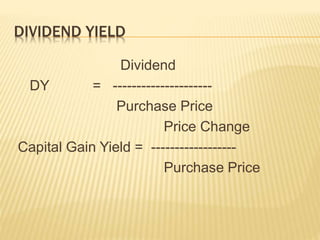
DIVIDEND YIELD 
Dividend 
DY = --------------------- 
Purchase Price 
Price Change 
Capital Gain Yield = ------------------ 
Purchase Price
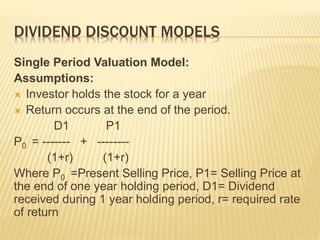
DIVIDEND DISCOUNT MODELS 
Single Period Valuation Model: 
Assumptions: 
 Investor holds the stock for a year 
 Return occurs at the end of the period. 
D1 P1 
P0 = ------- + -------- 
(1+r) (1+r) 
Where P0 =Present Selling Price, P1= Selling Price at 
the end of one year holding period, D1= Dividend 
received during 1 year holding period, r= required rate 
of return
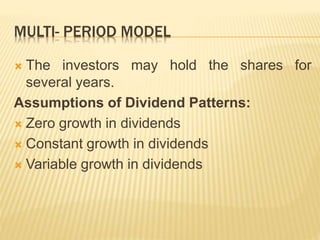
MULTI- PERIOD MODEL 
 The investors may hold the shares for 
several years. 
Assumptions of Dividend Patterns: 
 Zero growth in dividends 
 Constant growth in dividends 
 Variable growth in dividends
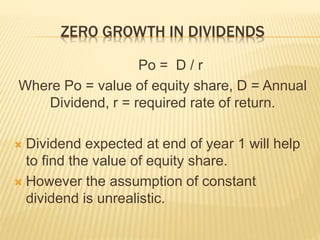
ZERO GROWTH IN DIVIDENDS 
Po = D / r 
Where Po = value of equity share, D = Annual 
Dividend, r = required rate of return. 
 Dividend expected at end of year 1 will help 
to find the value of equity share. 
 However the assumption of constant 
dividend is unrealistic.
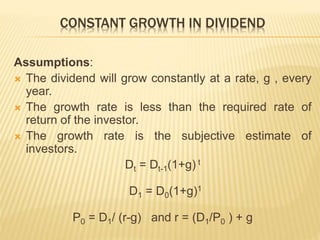
CONSTANT GROWTH IN DIVIDEND 
Assumptions: 
 The dividend will grow constantly at a rate, g , every 
year. 
 The growth rate is less than the required rate of 
return of the investor. 
 The growth rate is the subjective estimate of 
investors. 
Dt = Dt-1(1+g) t 
D1 = D0(1+g)1 
P0 = D1/ (r-g) and r = (D1/P0 ) + g
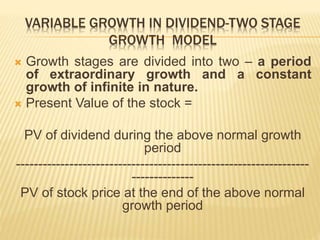
VARIABLE GROWTH IN DIVIDEND-TWO STAGE 
GROWTH MODEL 
 Growth stages are divided into two – a period 
of extraordinary growth and a constant 
growth of infinite in nature. 
 Present Value of the stock = 
PV of dividend during the above normal growth 
period 
------------------------------------------------------------------ 
-------------- 
PV of stock price at the end of the above normal 
growth period
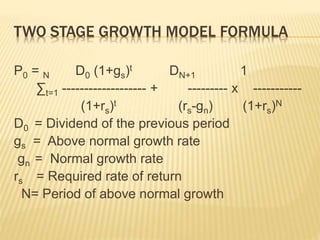
TWO STAGE GROWTH MODEL FORMULA 
P0 = N D0 (1+gs)t DN+1 1 
Σt=1 ------------------- + --------- x ----------- 
(1+rs)t (rs-gn) (1+rs)N 
D0 = Dividend of the previous period 
gs = Above normal growth rate 
gn = Normal growth rate 
rs = Required rate of return 
N= Period of above normal growth
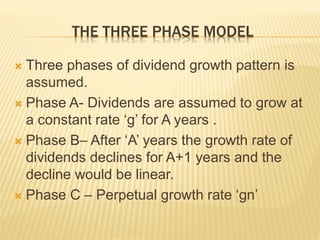
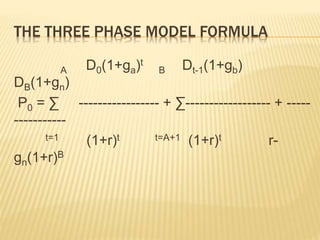
THE THREE PHASE MODEL 
 Three phases of dividend growth pattern is 
assumed. 
 Phase A- Dividends are assumed to grow at 
a constant rate ‘g’ for A years . 
 Phase B– After ‘A’ years the growth rate of 
dividends declines for A+1 years and the 
decline would be linear. 
 Phase C – Perpetual growth rate ‘gn’
THE THREE PHASE MODEL FORMULA 
A D0(1+ga)t 
B Dt-1(1+gb) 
DB(1+gn) 
P0 = Σ ----------------- + Σ------------------ + ----- 
----------- 
t=1 (1+r)t t=A+1 (1+r)t r-g 
n(1+r)B
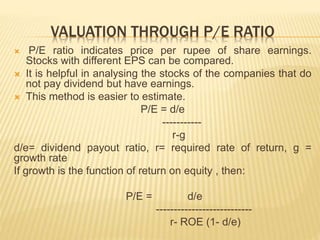
VALUATION THROUGH P/E RATIO 
 P/E ratio indicates price per rupee of share earnings. 
Stocks with different EPS can be compared. 
 It is helpful in analysing the stocks of the companies that do 
not pay dividend but have earnings. 
 This method is easier to estimate. 
P/E = d/e 
----------- 
r-g 
d/e= dividend payout ratio, r= required rate of return, g = 
growth rate 
If growth is the function of return on equity , then: 
P/E = d/e 
--------------------------- 
r- ROE (1- d/e)
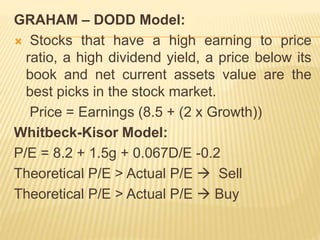
GRAHAM – DODD Model: 
 Stocks that have a high earning to price 
ratio, a high dividend yield, a price below its 
book and net current assets value are the 
best picks in the stock market. 
Price = Earnings (8.5 + (2 x Growth)) 
Whitbeck-Kisor Model: 
P/E = 8.2 + 1.5g + 0.067D/E -0.2 
Theoretical P/E > Actual P/E  Sell 
Theoretical P/E > Actual P/E  Buy

Stock return and_valuation

  • 1.
  • 2.
    Features of Equityshares:  Uncertainty  No Redemption  Relation with earning of the company Approaches to valuation:  Accounting concept of valuation  Valuation based on dividends  Valuation based on earnings
  • 3.
    ACCOUNTING CONCEPT OFVALUATION Book Value or Balance Sheet Value: BV = (Equity Share Capital + accumulated profits – all accumulated losses)/ No of equity shares  BV is based on accounting information and can be easily calculated.  It ignores profitability of the firm.  It is subjective as it is based on the historical figures. Liquidation Value: Amount of cash that would be received from the company if all the assets are sold and liabilities are paid.  It is better and realistic than BV.  It does not consider profitability of the firm.
  • 4.
    VALUATION OF EQUITYSHARES BASED ON DIVIDENDS Assumptions:  The dividends are payable annually  The first dividend is received after one year from the date of acquisition/purchase  Sale of equity share, if any, occurs only at the end of a year
  • 5.
    HOLDING PERIOD RETURN P(t+1) – P(t) + D r = ---------------------- P(t) Price Change + Cash Dividend r= ------------------------- Purchase Price
  • 6.
    DIVIDEND YIELD Dividend DY = --------------------- Purchase Price Price Change Capital Gain Yield = ------------------ Purchase Price
  • 7.
    DIVIDEND DISCOUNT MODELS Single Period Valuation Model: Assumptions:  Investor holds the stock for a year  Return occurs at the end of the period. D1 P1 P0 = ------- + -------- (1+r) (1+r) Where P0 =Present Selling Price, P1= Selling Price at the end of one year holding period, D1= Dividend received during 1 year holding period, r= required rate of return
  • 8.
    MULTI- PERIOD MODEL  The investors may hold the shares for several years. Assumptions of Dividend Patterns:  Zero growth in dividends  Constant growth in dividends  Variable growth in dividends
  • 9.
    ZERO GROWTH INDIVIDENDS Po = D / r Where Po = value of equity share, D = Annual Dividend, r = required rate of return.  Dividend expected at end of year 1 will help to find the value of equity share.  However the assumption of constant dividend is unrealistic.
  • 10.
    CONSTANT GROWTH INDIVIDEND Assumptions:  The dividend will grow constantly at a rate, g , every year.  The growth rate is less than the required rate of return of the investor.  The growth rate is the subjective estimate of investors. Dt = Dt-1(1+g) t D1 = D0(1+g)1 P0 = D1/ (r-g) and r = (D1/P0 ) + g
  • 11.
    VARIABLE GROWTH INDIVIDEND-TWO STAGE GROWTH MODEL  Growth stages are divided into two – a period of extraordinary growth and a constant growth of infinite in nature.  Present Value of the stock = PV of dividend during the above normal growth period ------------------------------------------------------------------ -------------- PV of stock price at the end of the above normal growth period
  • 12.
    TWO STAGE GROWTHMODEL FORMULA P0 = N D0 (1+gs)t DN+1 1 Σt=1 ------------------- + --------- x ----------- (1+rs)t (rs-gn) (1+rs)N D0 = Dividend of the previous period gs = Above normal growth rate gn = Normal growth rate rs = Required rate of return N= Period of above normal growth
  • 13.
    THE THREE PHASEMODEL  Three phases of dividend growth pattern is assumed.  Phase A- Dividends are assumed to grow at a constant rate ‘g’ for A years .  Phase B– After ‘A’ years the growth rate of dividends declines for A+1 years and the decline would be linear.  Phase C – Perpetual growth rate ‘gn’
  • 14.
    THE THREE PHASEMODEL FORMULA A D0(1+ga)t B Dt-1(1+gb) DB(1+gn) P0 = Σ ----------------- + Σ------------------ + ----- ----------- t=1 (1+r)t t=A+1 (1+r)t r-g n(1+r)B
  • 15.
    VALUATION THROUGH P/ERATIO  P/E ratio indicates price per rupee of share earnings. Stocks with different EPS can be compared.  It is helpful in analysing the stocks of the companies that do not pay dividend but have earnings.  This method is easier to estimate. P/E = d/e ----------- r-g d/e= dividend payout ratio, r= required rate of return, g = growth rate If growth is the function of return on equity , then: P/E = d/e --------------------------- r- ROE (1- d/e)
  • 16.
    GRAHAM – DODDModel:  Stocks that have a high earning to price ratio, a high dividend yield, a price below its book and net current assets value are the best picks in the stock market. Price = Earnings (8.5 + (2 x Growth)) Whitbeck-Kisor Model: P/E = 8.2 + 1.5g + 0.067D/E -0.2 Theoretical P/E > Actual P/E  Sell Theoretical P/E > Actual P/E  Buy