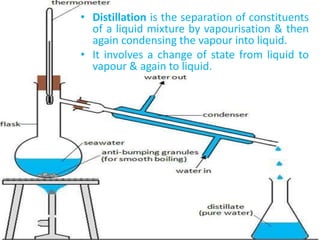
• Distillation is the separation of constituents
of a liquid mixture by vapourisation & then
again condensing the vapour into liquid.
• It involves a change of state from liquid to
vapour & again to liquid.
Pharmaceutical Applications:
1. Extraction of volatile oils from vegetable
drugs.
2. Separation of volatile substances from less
volatile impurities.
3. Separation of one liquid from one or more
other liquids, differing in their vapour
pressure.
Types of distillation:
1. Simple distillation
2. Fractional distillation
3. Steam distillation
4. Distillation under reduced pressure
5. Destructive distillation
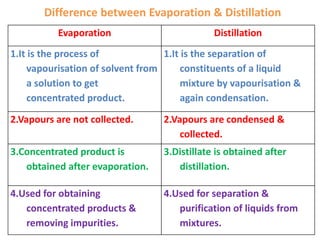
Difference between Evaporation & Distillation
Evaporation Distillation
1.It is the process of
vapourisation of solvent from
a solution to get
concentrated product.
1.It is the separation of
constituents of a liquid
mixture by vapourisation &
again condensation.
2.Vapours are not collected. 2.Vapours are condensed &
collected.
3.Concentrated product is
obtained after evaporation.
3.Distillate is obtained after
distillation.
4.Used for obtaining
concentrated products &
removing impurities.
4.Used for separation &
purification of liquids from
mixtures.
1. Simple distillation
• Simple distillation is the process of converting
liquid into vapour which is then passed through
condenser to convert vapour to liquid again.
Condensers are used to cool the vapours &
collect it to the receiver.
• It consists of a distillation flask attached to a
condenser and a receiver to collect the distillate.
Thermometer is fitted to the distillation flask to
note the temperature.
• The distillation apparatus is normally made up
of glass or metal. It is similar to evaporating still.
Applications:
1. Purification of organic liquids.
2. Separation of liquids from non-volatile
solids.
3. Preparation of ether, amyl nitrate & spirit
of nitrous ether.
4. Preparation of distilled water.
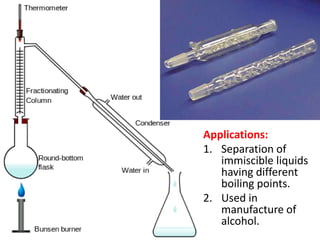
2. Fractional distillation
• It is the process for separation of miscible
volatile liquids having different boiling points.
e.g: mixture of water & alcohol
• It consists of fractionating column, through
which vapour passes before reaching
condenser. It allows more volatile component
to pass through the condenser.
• Repeated distillation of the distillates may be
done to get pure product.
Applications:
1. Separation of
immiscible liquids
having different
boiling points.
2. Used in
manufacture of
alcohol.
3. Steam distillation
• It is the distillation of two immiscible liquids of
which one is water. Different liquids have
different boiling points but when steam is
passed through it, liquids boils at lower
temperature. e.g: mixture of water &
turpentine oil
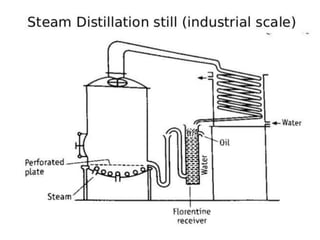
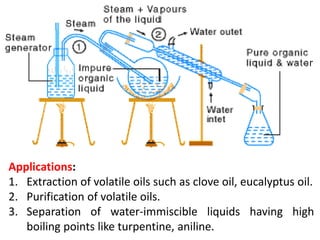
• The apparatus consists of steam generator
fitted with distillation flask & the distillate is
collected to the Florentine receiver. Florentine
receiver is used to separate oil & water.
Applications:
1. Extraction of volatile oils such as clove oil, eucalyptus oil.
2. Purification of volatile oils.
3. Separation of water-immiscible liquids having high
boiling points like turpentine, aniline.
4. Distillation under reduced pressure/Vacuum Distillation
• It is used for the distillation of thermolabile
substances. The liquid boils at vapour pressure equal
to atmospheric pressure. Boiling under reduced
pressure will also increase the rate of distillation.
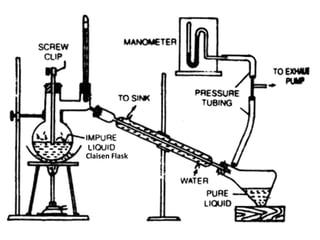
• It consists of claisen flask having two necks. The flask
is attached to condenser & finally to the receiver. The
receiver is connected to vacuum pump.
Applications:
• Distillation of thermolabile substances.
• Extraction of thermolabile substances.
• Separation of impurities.
Claisen Flask
Distillation and Evaporation

Distillation and Evaporation

  • 1.
    • Distillation isthe separation of constituents of a liquid mixture by vapourisation & then again condensing the vapour into liquid. • It involves a change of state from liquid to vapour & again to liquid.
  • 2.
    Pharmaceutical Applications: 1. Extractionof volatile oils from vegetable drugs. 2. Separation of volatile substances from less volatile impurities. 3. Separation of one liquid from one or more other liquids, differing in their vapour pressure.
  • 3.
    Types of distillation: 1.Simple distillation 2. Fractional distillation 3. Steam distillation 4. Distillation under reduced pressure 5. Destructive distillation
  • 4.
    Difference between Evaporation& Distillation Evaporation Distillation 1.It is the process of vapourisation of solvent from a solution to get concentrated product. 1.It is the separation of constituents of a liquid mixture by vapourisation & again condensation. 2.Vapours are not collected. 2.Vapours are condensed & collected. 3.Concentrated product is obtained after evaporation. 3.Distillate is obtained after distillation. 4.Used for obtaining concentrated products & removing impurities. 4.Used for separation & purification of liquids from mixtures.
  • 5.
    1. Simple distillation •Simple distillation is the process of converting liquid into vapour which is then passed through condenser to convert vapour to liquid again. Condensers are used to cool the vapours & collect it to the receiver. • It consists of a distillation flask attached to a condenser and a receiver to collect the distillate. Thermometer is fitted to the distillation flask to note the temperature. • The distillation apparatus is normally made up of glass or metal. It is similar to evaporating still.
  • 6.
    Applications: 1. Purification oforganic liquids. 2. Separation of liquids from non-volatile solids. 3. Preparation of ether, amyl nitrate & spirit of nitrous ether. 4. Preparation of distilled water.
  • 7.
    2. Fractional distillation •It is the process for separation of miscible volatile liquids having different boiling points. e.g: mixture of water & alcohol • It consists of fractionating column, through which vapour passes before reaching condenser. It allows more volatile component to pass through the condenser. • Repeated distillation of the distillates may be done to get pure product.
  • 8.
    Applications: 1. Separation of immiscibleliquids having different boiling points. 2. Used in manufacture of alcohol.
  • 9.
    3. Steam distillation •It is the distillation of two immiscible liquids of which one is water. Different liquids have different boiling points but when steam is passed through it, liquids boils at lower temperature. e.g: mixture of water & turpentine oil • The apparatus consists of steam generator fitted with distillation flask & the distillate is collected to the Florentine receiver. Florentine receiver is used to separate oil & water.
  • 11.
    Applications: 1. Extraction ofvolatile oils such as clove oil, eucalyptus oil. 2. Purification of volatile oils. 3. Separation of water-immiscible liquids having high boiling points like turpentine, aniline.
  • 12.
    4. Distillation underreduced pressure/Vacuum Distillation • It is used for the distillation of thermolabile substances. The liquid boils at vapour pressure equal to atmospheric pressure. Boiling under reduced pressure will also increase the rate of distillation. • It consists of claisen flask having two necks. The flask is attached to condenser & finally to the receiver. The receiver is connected to vacuum pump. Applications: • Distillation of thermolabile substances. • Extraction of thermolabile substances. • Separation of impurities.
  • 13.