Solubility of Drugs:
SOLUBILITY OF GASES IN LIQUID
PRESENTED BY- MR SHUBHRAT MAHESHWARI
ASSISTANT PROFESSOR
FACULTY OF PHARMACEUTICAL SCIENCES,
RAMA UNIVERISTY, KANPUR
Subject: Physical Pharmaceutics-I
Subject Code: BP302T
SOLUBILITY OF GASES IN LIQUID
• Solubility of gas in liquids is the concentration of
dissolved gas in the liquid when it is in equilibrium
with the pure gas above the solution.
• The example of gas in liquid includes effervescent
preparations containing dissolved carbon dioxide,
ammonia water and hydrochloride gas.
• Aerosol products containing nitrogen or carbon
dioxide as propellant are also considered to be
solution of gases in liquids.
SOLUBILITY OF GASES IN LIQUID
 Applications of Solubility of gases in liquid
• Preparation of reagents: Concentrated reagents are
prepared by passing the gases into water. Examples are
hydrochloric acid, sulphuric acid, nitric acid and liquid
ammonia.
• Preparation of carbonated beverages: Solubility of
carbon dioxide in water is necessary for the preparation of
soda water.
• Solubility of oxygen in blood: The major respiratory
function of the lungs is to add oxygen to the blood and to
remove carbon dioxide from it. The solubility of oxygen
in the blood is dependent upon the concentration of
haemoglobin.
 Applications(contd.)
• Transportation of anesthetic gas through blood:
Anesthetic gas such as ether has higher blood
solubility and transported away from the lungs more
rapidly than halothane.
• Oil solubility of anesthetic gases: The anaesthetic
potency of a gas and its oil solubility are well
correlated. The anesthetic gas with high oil solubility
is effective at a low alveolar concentration and has a
high potency. Thus oil solubility of an anesthetic gas
is relevant in pharmacy.
SOLUBILITY OF GASES IN LIQUID
FACTORS AFFECTING SOLUBILITY
• The solubility of gases in liquid depends on:
1. The mass of gas molecules
2. Pressure
3. Temperature
4. Presence of salt
5. Chemical reactions with solvent
SOLUBILITY OF GASES IN LIQUID
FACTORS AFFECTING SOLUBILITY
1. The Mass of Gas Molecules
• The solubility of gas molecules typically increases
with increasing mass of the gas molecules.
• The larger the mass of gas molecules, the stronger
London and Debye forces is between gas and solvent
molecules.
2. Effect of Pressure
• Gases increase in
solubility with an increase
in pressure.
• Increasing the pressure
results in more collisions
of the gas molecules with
the surface of the solvent
(more solvation); and
hence greater solubility.
• Pressure increases as gas
molecules strike the
surface to enter solution is
increased.
2. Pressure(contd.): Henry's law
• Henry's law expresses the relationship between pressure
and solubility of a gas in liquid.
• Henry's law states that the concentration of dissolved
gas is proportional to the partial pressure of the gas
above the solution at equilibrium, in a very dilute
solution at constant temperature.
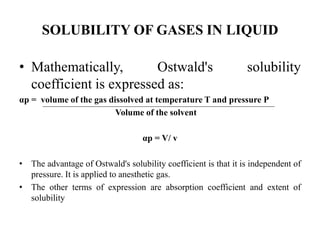
• Mathematically Henry's law can be expressed as:
C = 𝜎P
where,
C = concentration of dissolved gas, mol/litre
P = partial pressure of the gas above the solution, kPa
𝜎 = solubility coefficient, mol/l.kPa
2. Pressure(contd.): Henry's law
• Mole fraction solubility may be appropriate to use here, but in
dilute solutions, molarity may be used.
• According to Henry's law, the solubility of gas increases as the
pressure of the gas on the solution increases.
• It can be concluded that when the pressure is doubled, twice as
much of the gas dissolves in the same volume of solvent.
• Conversely, the solubility of gas decreases and the excess gas
escapes, when the pressure above the solution is decreased.
• When a mixture of gases is in contact with liquid, the partial
pressures of individual gases determine the solubility of each
gas.
• In such cases, the solubility of each gas is proportional to its
partial pressure.
Partial pressure and Vapour pressure
Partial pressure
• In a mixture of gases, each constituent gas has a
partial pressure which is the notional pressure of that
constituent gas if it alone occupied the entire volume
of the original mixture at the same temperature. The
total pressure of an ideal gas mixture is the sum of the
partial pressures of the gases in the mixture.
Vapour pressure
• Vapor pressure or equilibrium vapor pressure is
defined as the pressure exerted by a vapor in
thermodynamic equilibrium with its condensed
phases at a given temperature in a closed system.
2. Pressure(contd.): Henry's law
Limitations:
Henry's law is strictly applicable,
(a) when the temperature is maintained constant,
(b) when gas does not involve in chemical reaction with
the solvent,
(c) when gas is slightly soluble in liquids (dilute
solutions).
3. Effect of Temperature
• Temperature also influences the solubility of a gas in
a liquid.
• As the temperature increases, the solubility of gases
decreases.
• Increasing temperature causes an increase in kinetic
energy of gas molecules which leads to breakdown of
intermolecular bonds and gas escaping from solution
and also have tendency of gases to expand.
4. Effects of salts
• Addition of other substances lowers the solubility of a
gas in solutions. For example, when a small amount of
salt is added to a carbonated solution, the gas escapes
from the solution. This phenomenon is known as salting
out.
• In a gaseous solution, attraction between the gas and
solvent is effective. When the electrolytes are added,
they establish greater attraction with water molecules.
This weakens the gas-solvent interactions. Therefore,
gas releases.
• These substances may be either electrolytes such as
sodium chloride or nonelectrolytes such as sucrose.
• This effect is of great indirect importance to stabilize
aqueous solutions of vitamin A. High sugar
concentration decreases the solubility of oxygen so that
substances liable to oxidation are better protected.
5. Effect of Chemical Reaction
• Gases such as hydrogen chloride, ammonia and
carbon dioxide show deviation as a result of
chemical reaction between gas and solvent. For
these systems, Henry's law is not applicable.
• In fact, due to chemical reaction, the solubility of
the gases is higher.
• For example, hydrogen chloride is about 10,000
times more soluble in water than in liquid oxygen.
• These principles are used for the preparation of
reagents such as concentrated solutions namely
hydrochloric acid, sulphuric acid and nitric acid.
SOLUBILITY OF GASES IN LIQUID
OSTWALD'S SOLUBILITY COEFFICIENT
• Ostwald's solubility coefficient is also known as
Bunsen absorption coefficient, α.
• Ostwald's solubility coefficient is defined as the
volume of gas which dissolves in a unit volume of the
liquid at the given temperature.
SOLUBILITY OF GASES IN LIQUID
• Mathematically, Ostwald's solubility
coefficient is expressed as:
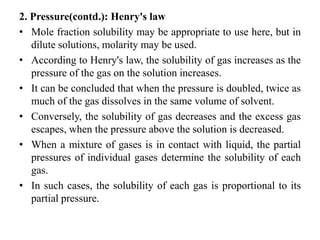
αp = volume of the gas dissolved at temperature T and pressure P
Volume of the solvent
αp = V/ v
• The advantage of Ostwald's solubility coefficient is that it is independent of
pressure. It is applied to anesthetic gas.
• The other terms of expression are absorption coefficient and extent of
solubility
Thank you.