6/21/2020 2
DISTILLATION
Copyright © 2011 Dr. Ahmed Effat
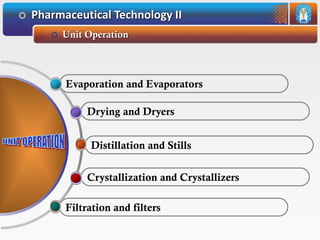
Distillation and Stills
Evaporation and Evaporators
Drying and Dryers
Pharmaceutical Technology II
Crystallization and Crystallizers
Filtration and filters
Unit Operation
Distillation
Introduction
Definition
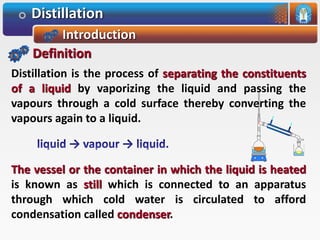
Distillation is the process of separating the constituents
of a liquid by vaporizing the liquid and passing the
vapours through a cold surface thereby converting the
vapours again to a liquid.
The vessel or the container in which the liquid is heated
is known as still which is connected to an apparatus
through which cold water is circulated to afford
condensation called condenser.
Distillation
Introduction
Definition
The vessel in which the condensed liquid is
collected is known as receiver and the liquid so
received is called distillate.
On laboratory scale the distillation apparatus
i.e. still, condenser and receiver is generally
made of glass but it may also be made from a
metal best suited to the process.
Distillation
Difference between distillation & Evaporation
1.In distillation the liquid from which the vapour arises is
heated to boiling point and maintained at this temperature
throughout the process and vapour formation occurs
throughout the liquid.
Whereas in evaporation the liquid is maintained below its
boiling point and the vapour formation occurs only at the
surface of the liquid.
2.In distillation the vapours are passed through a condenser to
re-obtain the liquid.
Whereas the vapours are not condensed to re-
obtain the liquid.
Distillation
Condenser
The selection of a suitable condenser is necessary for the success
of distillation processes.
1. The construction of the condenser should be easily cleaned so
as to remove even traces of previous product.
2. The broken parts may be easily replaced so that the cost of a
new condenser is saved.
3. It should provide the maximum cooling surface because the
rate of condensation is directly proportional to the cooling
area.
Distillation
Condenser
Characteristics of ideal condenser
4. Condensing surface should be good conductor of heat
therefore where practicable metal condensers are preferred
than glass condensers.
5. The water used for cooling the surface must leave the
condenser quickly so as to provide space for fresh water to get
in and provide cold surface.
6. The cooling water must flow in the opposite direction to that
of vapours to be condensed so that the condensed liquid
should leave the condenser in as cool a condition as possible.
Distillation
Condenser
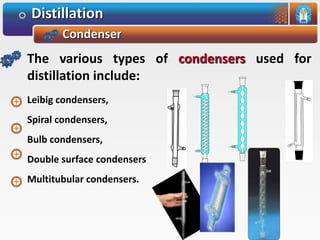
The various types of condensers used for
distillation include:
Leibig condensers,
Spiral condensers,
Bulb condensers,
Double surface condensers
Multitubular condensers.
Distillation
Types of Distillation
Simple distillation
Fractional distillation
Steam distillation
Vacuum distillation
Destructive distillation.
Different types of distillation are
1
2
3
4
5
Distillation
Types of Distillation
Simple distillation is the process of converting
a liquid into its vapours which are passed
through a cooling surface to condense the
vapours.
The condensed vapours are reformed into a
liquid which is collected in a receiver.
Simple Distillation1
Distillation
Types of Distillation
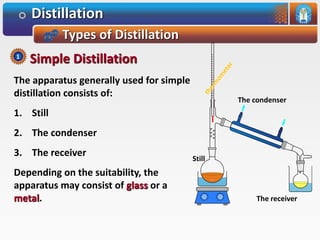
The apparatus generally used for simple
distillation consists of:
1. Still
2. The condenser
3. The receiver
Depending on the suitability, the
apparatus may consist of glass or a
metal.
Simple Distillation1
The condenser
The receiver
Still
Distillation
Types of Distillation
 Purification of organic liquids
 Separation of liquids from nonvolatile solids e.g.
recovery of alcohol in the preparation of dry extracts.
 Distilled water is an important product which is
prepared by simple distillation process.
Simple Distillation1
Distillation
Types of Distillation
Simple distillation
Fractional distillation
Steam distillation
Vacuum distillation
Destructive distillation.
Different types of distillation are
1
2
3
4
5
Distillation
Types of Distillation
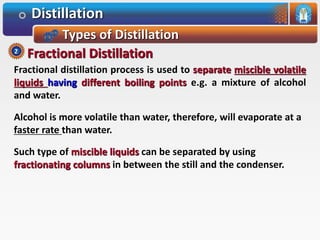
Fractional distillation process is used to separate miscible volatile
liquids having different boiling points e.g. a mixture of alcohol
and water.
Alcohol is more volatile than water, therefore, will evaporate at a
faster rate than water.
Such type of miscible liquids can be separated by using
fractionating columns in between the still and the condenser.
Fractional Distillation2
Distillation
Types of Distillation
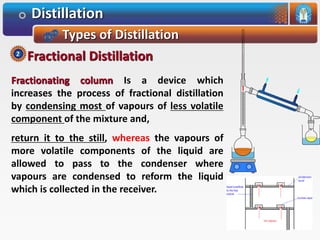
Fractionating column Is a device which
increases the process of fractional distillation
by condensing most of vapours of less volatile
component of the mixture and,
return it to the still, whereas the vapours of
more volatile components of the liquid are
allowed to pass to the condenser where
vapours are condensed to reform the liquid
which is collected in the receiver.
Fractional Distillation2
Distillation
Types of Distillation
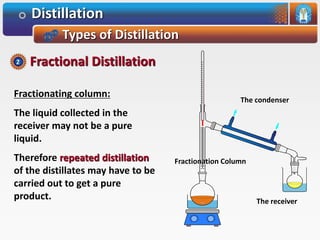
Fractionating column:
The liquid collected in the
receiver may not be a pure
liquid.
Therefore repeated distillation
of the distillates may have to be
carried out to get a pure
product.
Fractional Distillation2
The condenser
The receiver
Fractionation Column
Distillation
Types of Distillation
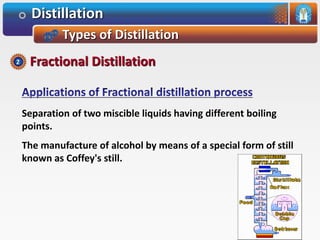
Separation of two miscible liquids having different boiling
points.
The manufacture of alcohol by means of a special form of still
known as Coffey's still.
Fractional Distillation2
Distillation
Types of Distillation
Simple distillation
Fractional distillation
Steam distillation
Vacuum distillation
Destructive distillation.
Different types of distillation are
1
2
3
4
5
Distillation
Types of Distillation
Steam distillation is used for the distillation of two immiscible
liquids one of which is water.
An immiscible liquid and water independently boils at high
temperature but when steam is passed through a mixture of
these liquids, it boils at a much lower temperature than the
boiling point of pure water.
Thus turpentine which has a, boiling point of about 160°C,
when mixed with water can be distilled at about 95.6°C, if a
current of steam is passed through it.
Steam distillation3
Distillation
Types of Distillation
Steam distillation3
Distillation
Types of Distillation
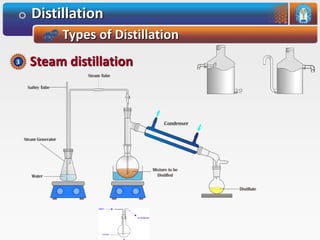
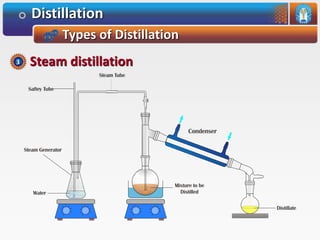
On laboratory scale the distillation apparatus consists
of steam generator fitted with a rubber stopper having
two holes.
Through one hole a long safety tube is passed which
permits the expulsion of some water if excessive
pressure is generated inside the steam generator.
Note that, escape of steam from the safety tube indicates
that the steam can is almost dry.
Steam distillation3
Distillation
Types of Distillation
Through the other hole a bent tube is passed which carries the
steam to the flask containing the liquids (volatile liquid and
small quantity of water) to be distilled.
This tube must dip almost to the bottom of the flask.
The steam can and flask containing the liquids are heated
simultaneously so that a rapid current of steam passes through
the boiling mixture in the flask.
The vapours are allowed to pass through the condenser and
condensed liquids are collected in Florentine receiver.
Steam distillation3
Distillation
Types of Distillation
Steam distillation3
Distillation
Types of Distillation
The distillate which forms two layers, one
aqueous and other non-aqueous are separated
from each other as completely as possible
using:
Florentine receivers or
Separating funnels .
Steam distillation3
Distillation
Types of Distillation
Florentine receivers:
Is a specially designed receiver meant for collecting the oil and
water in the same receiver.
They are of two types:
1. Used for separating oils lighter than water
2. Used for separating oils heavier than water
Steam distillation3
Distillation
Types of Distillation
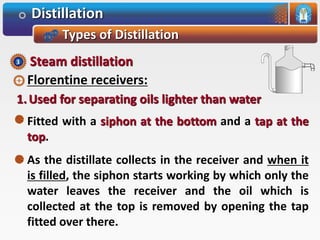
Fitted with a siphon at the bottom and a tap at the
top.
As the distillate collects in the receiver and when it
is filled, the siphon starts working by which only the
water leaves the receiver and the oil which is
collected at the top is removed by opening the tap
fitted over there.
Steam distillation3
1.Used for separating oils lighter than water
Florentine receivers:
Distillation
Types of Distillation
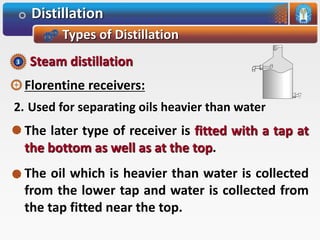
The later type of receiver is fitted with a tap at
the bottom as well as at the top.
The oil which is heavier than water is collected
from the lower tap and water is collected from
the tap fitted near the top.
Steam distillation3
2. Used for separating oils heavier than water
Florentine receivers:
Distillation
Types of Distillation
Steam distillation is used for the extraction of
most of volatile oils such as clove oil, anise oil
and eucalyptus oil etc.
The extraction is done on the same principle
that when steam is passed through a mixture
of immiscible liquids, the mixture boils below
the normal boiling point of either component.
Steam distillation3
Distillation
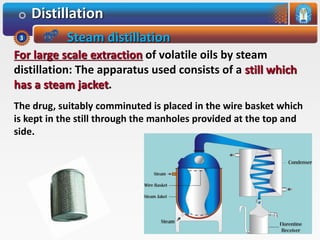
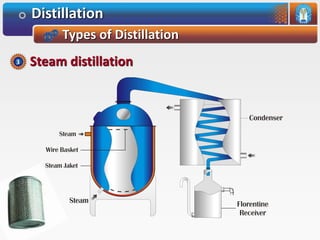
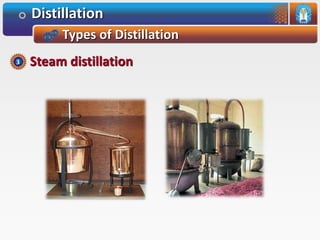
For large scale extraction of volatile oils by steam
distillation: The apparatus used consists of a still which
has a steam jacket.
The drug, suitably comminuted is placed in the wire basket which
is kept in the still through the manholes provided at the top and
side.
Steam distillation3
Distillation
Types of Distillation
The steam is introduced to the jacket of the still and
water there is made to boil.
At this point steam is introduced into the still itself
through the free-steam pipe.
The oil-vapours and steam are passed through the
condenser where they are converted into liquids
which are collected in the Florentine receiver from
where oil and water are mechanically separated and
water is returned to the still.
Steam distillation3
Distillation
Types of Distillation
Steam distillation3
Distillation
Types of Distillation
Distillation of water immiscible liquids of high boiling
points e,g turpentine and aniline
Extraction of volatile oils from their crude drugs e.g.
clove, anise and eucalyptus.
Steam distillation is also useful for the Purification of
volatile substances.
Steam distillation3
Distillation
Types of Distillation
Steam distillation3
Distillation
Types of Distillation
Simple distillation
Fractional distillation
Steam distillation
Vacuum distillation
Destructive distillation.
Different types of distillation are
1
2
3
4
5
Distillation
Types of Distillation
Distillation under reduced pressure or vacuum distillation works
on the principle that a liquid boils when its vapour pressure is
equal to the atmospheric pressure or external pressure.
From this it is clear that the liquids which are decomposed at
their boiling point under atmospheric pressure can be distilled at
a much lower temperature than its boiling point if the pressure is
reduced on the surface of the liquid.
Boiling under reduced pressure will also increase the rate of
distillation.
Distillation under reduced pressure4
Distillation
Types of Distillation
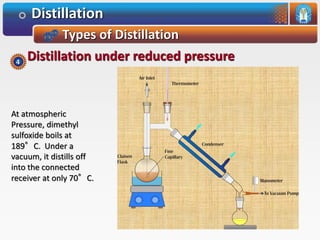
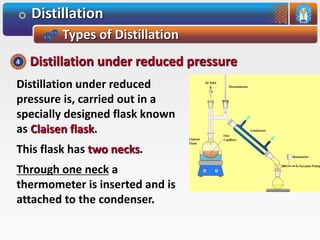
Distillation under reduced
pressure is, carried out in a
specially designed flask known
as Claisen flask.
This flask has two necks.
Through one neck a
thermometer is inserted and is
attached to the condenser.
Distillation under reduced pressure4
Distillation
Types of Distillation
Through the other neck a very fine capillary is
introduced which completely dips in the boiling
liquid.
During distillation under reduced pressure,
bumping occurs very readily which can be easily
prevented by introducing a stream of air
bubbles into the liquid through the capillary.
Distillation under reduced pressure4
Distillation
Types of Distillation
The side tube of the receiver is connected to a
vacuum pump to provide suitable vaccum.
During vacuum distillation a small pressure
gauge (manometer) should be inserted in
between the receiver and the vacuum pump.
Distillation under reduced pressure4
Distillation
Types of Distillation
Distillation under reduced pressure4
At atmospheric
Pressure, dimethyl
sulfoxide boils at
189°C. Under a
vacuum, it distills off
into the connected
receiver at only 70°C.
Distillation
Types of Distillation
For distillation, heating of the flask should not be
started until the required vacuum has been
attained above the surface of the liquid otherwise
frothing of the hot liquid will result in the receiver.
Preferably heating of the flask should be done on
water bath or oil bath maintained at about 20°C
higher than the boiling point of the liquid.
Distillation under reduced pressure4
Distillation
Types of Distillation
During vacuum distillation thin walled glass
apparatus like ordinary flat bottomed flasks and
conical flasks should never be used otherwise
collapsing of such apparatus may result.
Distillation under reduced pressure4
Distillation
Types of Distillation
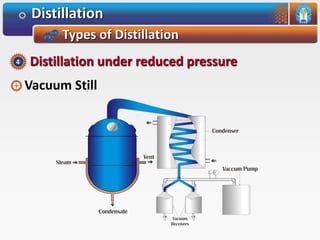
These are used for large scale distillation under reduced pressure.
They are employed for those substances which have high boiling
point at atmospheric pressure and get destroyed at high
temperatures. Vacuum stills consist of steam-jacketed stills made
of copper, stainless steel or glass and are provided with a sight
glass "observation window" to help the operator to see the
progress of distillation.
A tap is provided near the hood of the still for filling the still.
Distillation under reduced pressure4
Distillation
Types of Distillation
The reduction in pressure is effected by means of mechanical air
pumps driven by electricity.
For easy collection and removal of distillate without stopping the
distillation, two or three receivers are used which are fitted with
suitable arrangement of cocks.
These stills vary in design and are specially manufactured for the
specified job.
All the valves and cocks fitted in the vacuum stills should be of
very high quality.
Distillation under reduced pressure4
Distillation
Types of Distillation
Vacuum Still
Distillation under reduced pressure4
Distillation
Types of Distillation
Vacuum Still
Used for the distillation of thermolabile
substances.
Also commonly used for the concentration and
drying of extracts which get destroyed at high
temperatures.
Distillation under reduced pressure4
Distillation
Types of Distillation
Simple distillation
Fractional distillation
Steam distillation
Vacuum distillation
Destructive distillation.
Different types of distillation are
1
2
3
4
5
Distillation
Types of Distillation
During this process the decomposition of usually
natural products is carried out by heat and the
volatile products of decomposition are condensed
and collected.
Though it is not a pharmaceutical process but is used
in the destructive distillation of wood and coal to
produce tars which are ultimately used in the
preparation of certain medicines.
Destructive distillation5
Any Questions or Additions
THANK YOU
 Define the following terms:
[Distillation, etc]
Respond to the following questions:
Give a detailed account of ………………
Explain in details the process of …………..
Describe in details with examples the…………
With examples, illustrate the pharmaceutical applications of ……………
Group work discussional questions:
Explain in details the process of………
Describe with examples in details the…………..
With examples, illustrate the pharmaceutical applications of…….

15 distillation

  • 2.
  • 3.
    Copyright © 2011Dr. Ahmed Effat
  • 4.
    Distillation and Stills Evaporationand Evaporators Drying and Dryers Pharmaceutical Technology II Crystallization and Crystallizers Filtration and filters Unit Operation
  • 5.
    Distillation Introduction Definition Distillation is theprocess of separating the constituents of a liquid by vaporizing the liquid and passing the vapours through a cold surface thereby converting the vapours again to a liquid. The vessel or the container in which the liquid is heated is known as still which is connected to an apparatus through which cold water is circulated to afford condensation called condenser.
  • 6.
    Distillation Introduction Definition The vessel inwhich the condensed liquid is collected is known as receiver and the liquid so received is called distillate. On laboratory scale the distillation apparatus i.e. still, condenser and receiver is generally made of glass but it may also be made from a metal best suited to the process.
  • 7.
    Distillation Difference between distillation& Evaporation 1.In distillation the liquid from which the vapour arises is heated to boiling point and maintained at this temperature throughout the process and vapour formation occurs throughout the liquid. Whereas in evaporation the liquid is maintained below its boiling point and the vapour formation occurs only at the surface of the liquid. 2.In distillation the vapours are passed through a condenser to re-obtain the liquid. Whereas the vapours are not condensed to re- obtain the liquid.
  • 8.
    Distillation Condenser The selection ofa suitable condenser is necessary for the success of distillation processes. 1. The construction of the condenser should be easily cleaned so as to remove even traces of previous product. 2. The broken parts may be easily replaced so that the cost of a new condenser is saved. 3. It should provide the maximum cooling surface because the rate of condensation is directly proportional to the cooling area.
  • 9.
    Distillation Condenser Characteristics of idealcondenser 4. Condensing surface should be good conductor of heat therefore where practicable metal condensers are preferred than glass condensers. 5. The water used for cooling the surface must leave the condenser quickly so as to provide space for fresh water to get in and provide cold surface. 6. The cooling water must flow in the opposite direction to that of vapours to be condensed so that the condensed liquid should leave the condenser in as cool a condition as possible.
  • 10.
    Distillation Condenser The various typesof condensers used for distillation include: Leibig condensers, Spiral condensers, Bulb condensers, Double surface condensers Multitubular condensers.
  • 11.
    Distillation Types of Distillation Simpledistillation Fractional distillation Steam distillation Vacuum distillation Destructive distillation. Different types of distillation are 1 2 3 4 5
  • 12.
    Distillation Types of Distillation Simpledistillation is the process of converting a liquid into its vapours which are passed through a cooling surface to condense the vapours. The condensed vapours are reformed into a liquid which is collected in a receiver. Simple Distillation1
  • 13.
    Distillation Types of Distillation Theapparatus generally used for simple distillation consists of: 1. Still 2. The condenser 3. The receiver Depending on the suitability, the apparatus may consist of glass or a metal. Simple Distillation1 The condenser The receiver Still
  • 14.
    Distillation Types of Distillation Purification of organic liquids  Separation of liquids from nonvolatile solids e.g. recovery of alcohol in the preparation of dry extracts.  Distilled water is an important product which is prepared by simple distillation process. Simple Distillation1
  • 15.
    Distillation Types of Distillation Simpledistillation Fractional distillation Steam distillation Vacuum distillation Destructive distillation. Different types of distillation are 1 2 3 4 5
  • 16.
    Distillation Types of Distillation Fractionaldistillation process is used to separate miscible volatile liquids having different boiling points e.g. a mixture of alcohol and water. Alcohol is more volatile than water, therefore, will evaporate at a faster rate than water. Such type of miscible liquids can be separated by using fractionating columns in between the still and the condenser. Fractional Distillation2
  • 17.
    Distillation Types of Distillation Fractionatingcolumn Is a device which increases the process of fractional distillation by condensing most of vapours of less volatile component of the mixture and, return it to the still, whereas the vapours of more volatile components of the liquid are allowed to pass to the condenser where vapours are condensed to reform the liquid which is collected in the receiver. Fractional Distillation2
  • 18.
    Distillation Types of Distillation Fractionatingcolumn: The liquid collected in the receiver may not be a pure liquid. Therefore repeated distillation of the distillates may have to be carried out to get a pure product. Fractional Distillation2 The condenser The receiver Fractionation Column
  • 19.
    Distillation Types of Distillation Separationof two miscible liquids having different boiling points. The manufacture of alcohol by means of a special form of still known as Coffey's still. Fractional Distillation2
  • 20.
    Distillation Types of Distillation Simpledistillation Fractional distillation Steam distillation Vacuum distillation Destructive distillation. Different types of distillation are 1 2 3 4 5
  • 21.
    Distillation Types of Distillation Steamdistillation is used for the distillation of two immiscible liquids one of which is water. An immiscible liquid and water independently boils at high temperature but when steam is passed through a mixture of these liquids, it boils at a much lower temperature than the boiling point of pure water. Thus turpentine which has a, boiling point of about 160°C, when mixed with water can be distilled at about 95.6°C, if a current of steam is passed through it. Steam distillation3
  • 22.
  • 23.
    Distillation Types of Distillation Onlaboratory scale the distillation apparatus consists of steam generator fitted with a rubber stopper having two holes. Through one hole a long safety tube is passed which permits the expulsion of some water if excessive pressure is generated inside the steam generator. Note that, escape of steam from the safety tube indicates that the steam can is almost dry. Steam distillation3
  • 24.
    Distillation Types of Distillation Throughthe other hole a bent tube is passed which carries the steam to the flask containing the liquids (volatile liquid and small quantity of water) to be distilled. This tube must dip almost to the bottom of the flask. The steam can and flask containing the liquids are heated simultaneously so that a rapid current of steam passes through the boiling mixture in the flask. The vapours are allowed to pass through the condenser and condensed liquids are collected in Florentine receiver. Steam distillation3
  • 25.
  • 26.
    Distillation Types of Distillation Thedistillate which forms two layers, one aqueous and other non-aqueous are separated from each other as completely as possible using: Florentine receivers or Separating funnels . Steam distillation3
  • 27.
    Distillation Types of Distillation Florentinereceivers: Is a specially designed receiver meant for collecting the oil and water in the same receiver. They are of two types: 1. Used for separating oils lighter than water 2. Used for separating oils heavier than water Steam distillation3
  • 28.
    Distillation Types of Distillation Fittedwith a siphon at the bottom and a tap at the top. As the distillate collects in the receiver and when it is filled, the siphon starts working by which only the water leaves the receiver and the oil which is collected at the top is removed by opening the tap fitted over there. Steam distillation3 1.Used for separating oils lighter than water Florentine receivers:
  • 29.
    Distillation Types of Distillation Thelater type of receiver is fitted with a tap at the bottom as well as at the top. The oil which is heavier than water is collected from the lower tap and water is collected from the tap fitted near the top. Steam distillation3 2. Used for separating oils heavier than water Florentine receivers:
  • 30.
    Distillation Types of Distillation Steamdistillation is used for the extraction of most of volatile oils such as clove oil, anise oil and eucalyptus oil etc. The extraction is done on the same principle that when steam is passed through a mixture of immiscible liquids, the mixture boils below the normal boiling point of either component. Steam distillation3
  • 31.
    Distillation For large scaleextraction of volatile oils by steam distillation: The apparatus used consists of a still which has a steam jacket. The drug, suitably comminuted is placed in the wire basket which is kept in the still through the manholes provided at the top and side. Steam distillation3
  • 32.
    Distillation Types of Distillation Thesteam is introduced to the jacket of the still and water there is made to boil. At this point steam is introduced into the still itself through the free-steam pipe. The oil-vapours and steam are passed through the condenser where they are converted into liquids which are collected in the Florentine receiver from where oil and water are mechanically separated and water is returned to the still. Steam distillation3
  • 33.
  • 34.
    Distillation Types of Distillation Distillationof water immiscible liquids of high boiling points e,g turpentine and aniline Extraction of volatile oils from their crude drugs e.g. clove, anise and eucalyptus. Steam distillation is also useful for the Purification of volatile substances. Steam distillation3
  • 35.
  • 36.
    Distillation Types of Distillation Simpledistillation Fractional distillation Steam distillation Vacuum distillation Destructive distillation. Different types of distillation are 1 2 3 4 5
  • 37.
    Distillation Types of Distillation Distillationunder reduced pressure or vacuum distillation works on the principle that a liquid boils when its vapour pressure is equal to the atmospheric pressure or external pressure. From this it is clear that the liquids which are decomposed at their boiling point under atmospheric pressure can be distilled at a much lower temperature than its boiling point if the pressure is reduced on the surface of the liquid. Boiling under reduced pressure will also increase the rate of distillation. Distillation under reduced pressure4
  • 38.
    Distillation Types of Distillation Distillationunder reduced pressure is, carried out in a specially designed flask known as Claisen flask. This flask has two necks. Through one neck a thermometer is inserted and is attached to the condenser. Distillation under reduced pressure4
  • 39.
    Distillation Types of Distillation Throughthe other neck a very fine capillary is introduced which completely dips in the boiling liquid. During distillation under reduced pressure, bumping occurs very readily which can be easily prevented by introducing a stream of air bubbles into the liquid through the capillary. Distillation under reduced pressure4
  • 40.
    Distillation Types of Distillation Theside tube of the receiver is connected to a vacuum pump to provide suitable vaccum. During vacuum distillation a small pressure gauge (manometer) should be inserted in between the receiver and the vacuum pump. Distillation under reduced pressure4
  • 41.
    Distillation Types of Distillation Distillationunder reduced pressure4 At atmospheric Pressure, dimethyl sulfoxide boils at 189°C. Under a vacuum, it distills off into the connected receiver at only 70°C.
  • 42.
    Distillation Types of Distillation Fordistillation, heating of the flask should not be started until the required vacuum has been attained above the surface of the liquid otherwise frothing of the hot liquid will result in the receiver. Preferably heating of the flask should be done on water bath or oil bath maintained at about 20°C higher than the boiling point of the liquid. Distillation under reduced pressure4
  • 43.
    Distillation Types of Distillation Duringvacuum distillation thin walled glass apparatus like ordinary flat bottomed flasks and conical flasks should never be used otherwise collapsing of such apparatus may result. Distillation under reduced pressure4
  • 44.
    Distillation Types of Distillation Theseare used for large scale distillation under reduced pressure. They are employed for those substances which have high boiling point at atmospheric pressure and get destroyed at high temperatures. Vacuum stills consist of steam-jacketed stills made of copper, stainless steel or glass and are provided with a sight glass "observation window" to help the operator to see the progress of distillation. A tap is provided near the hood of the still for filling the still. Distillation under reduced pressure4
  • 45.
    Distillation Types of Distillation Thereduction in pressure is effected by means of mechanical air pumps driven by electricity. For easy collection and removal of distillate without stopping the distillation, two or three receivers are used which are fitted with suitable arrangement of cocks. These stills vary in design and are specially manufactured for the specified job. All the valves and cocks fitted in the vacuum stills should be of very high quality. Distillation under reduced pressure4
  • 46.
    Distillation Types of Distillation VacuumStill Distillation under reduced pressure4
  • 47.
    Distillation Types of Distillation VacuumStill Used for the distillation of thermolabile substances. Also commonly used for the concentration and drying of extracts which get destroyed at high temperatures. Distillation under reduced pressure4
  • 48.
    Distillation Types of Distillation Simpledistillation Fractional distillation Steam distillation Vacuum distillation Destructive distillation. Different types of distillation are 1 2 3 4 5
  • 49.
    Distillation Types of Distillation Duringthis process the decomposition of usually natural products is carried out by heat and the volatile products of decomposition are condensed and collected. Though it is not a pharmaceutical process but is used in the destructive distillation of wood and coal to produce tars which are ultimately used in the preparation of certain medicines. Destructive distillation5
  • 50.
  • 51.
  • 52.
     Define thefollowing terms: [Distillation, etc] Respond to the following questions: Give a detailed account of ……………… Explain in details the process of ………….. Describe in details with examples the………… With examples, illustrate the pharmaceutical applications of ……………
  • 53.
    Group work discussionalquestions: Explain in details the process of……… Describe with examples in details the………….. With examples, illustrate the pharmaceutical applications of…….